Hebrews 9:24
For Christ is not entered into the holy places made with hands, which are the figures of the true; but into heaven itself, now to appear in the presence of God for us:
Translations
American King James Version, King James Version, KJV Cambridge Paragraph Bible
For Christ is not entered into the holy places made with hands, which are the figures of the true; but into heaven itself, now to appear in the presence of God for us:
For Christ hath not entered into the holy places made with hands, which are the figures of the true; but into heaven itself, now to appear in the presence of God for us:
Revised Version, American Standard Version
For Christ entered not into a holy place made with hands, like in pattern to the true; but into heaven itself, now to appear before the face of God for us:
for not into holy places made with hands did the Christ enter — figures of the true — but into the heaven itself, now to be manifested in the presence of God for us;
For the Christ is not entered into holy places made with hand, figures of the true, but into heaven itself, now to appear before the face of God for us:
For, not into a Holy place made by hand, entered Christ,—counterpart of the real [Holy place]; but, into the heaven itself, now, to be plainly manifested before the face of God in our behalf;—
Berean Standard Bible, Majority Standard Bible
For Christ did not enter a man-made copy of the true sanctuary, but He entered heaven itself, now to appear on our behalf in the presence of God.
For Christ hasn’ t entered into holy places made with hands, which are representations of the true, but into heaven itself, now to appear in the presence of God for us;
For Christ did not go into a holy place which had been made by men's hands as the copy of the true one; but he went into heaven itself, and now takes his place before the face of God for us.
For Christ is not entred into ye holy places that are made with hands, which are similitudes of ye true Sanctuarie: but is entred into very heauen, to appeare now in ye sight of God for vs,
Douay-Rheims (Challoner revision)
For Jesus is not entered into the holies made with hands, the patterns of the true: but into heaven itself, that he may appear now in the presence of God for us.
Pictures
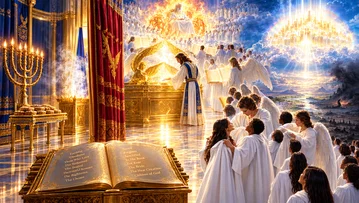
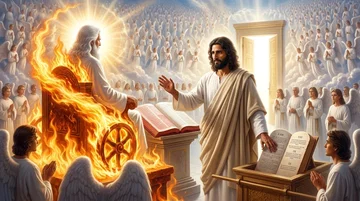
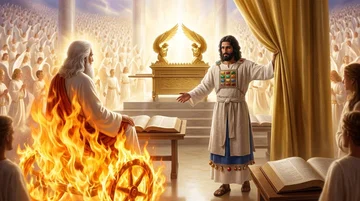
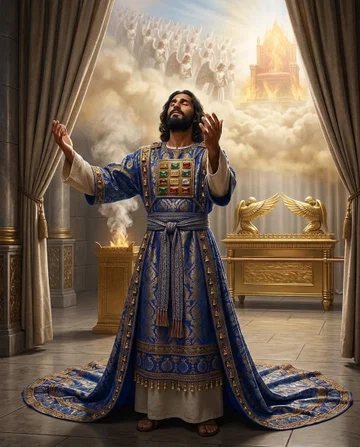
Cross-references 20 of 141
- Hebrews 8:1-2
Now of the things which we have spoken this is the sum: We have such an high priest, who is set on the right hand of the throne of the Majesty in the heavens;
Christ ministers as High Priest in the true heavenly sanctuary.
- Hebrews 9:11-12
But Christ being come an high priest of good things to come, by a greater and more perfect tabernacle, not made with hands, that is to say, not of this building;
Christ entered the greater heavenly sanctuary once by his own blood, obtaining eternal redemption.
- Hebrews 7:25
Wherefore he is able also to save them to the uttermost that come unto God by him, seeing he ever liveth to make intercession for them.
both describe Jesus living in heaven to intercede for believers
- Hebrews 8:5
Who serve unto the example and shadow of heavenly things, as Moses was admonished of God when he was about to make the tabernacle: for, See, saith he, that thou make all things according to the pattern shewed to thee in the mount.
Earthly priestly service is a pattern and shadow of heavenly things.
- Leviticus 16:29-30
And this shall be a statute for ever unto you: that in the seventh month, on the tenth day of the month, ye shall afflict your souls, and do no work at all, whether it be one of your own country, or a stranger that sojourneth among you:
The yearly earthly atonement foreshadows Christ’s heavenly priestly work.
- Revelation 11:19
And the temple of God was opened in heaven, and there was seen in his temple the ark of his testament: and there were lightnings, and voices, and thunderings, and an earthquake, and great hail.
The heavenly temple opens, revealing the ark of God’s testament.
- Hebrews 9:8-11
The Holy Ghost this signifying, that the way into the holiest of all was not yet made manifest, while as the first tabernacle was yet standing:
The earthly sanctuary was a figure pointing to Christ’s greater heavenly ministry.
- Exodus 25:40
And look that thou make them after their pattern, which was shewed thee in the mount.
Moses is told to make the earthly sanctuary according to the heavenly pattern.
- Hebrews 10:1
For the law having a shadow of good things to come, and not the very image of the things, can never with those sacrifices which they offered year by year continually make the comers thereunto perfect.
The earthly service is a shadow pointing to what is to come.
- Exodus 25:8-9
And let them make me a sanctuary; that I may dwell among them.
The earthly sanctuary was made according to the pattern shown to Moses.
- Hebrews 10:19-21
Having therefore, brethren, boldness to enter into the holiest by the blood of Jesus,
Christ’s work opens the way for believers to enter God’s presence with confidence.
- 1 John 2:1
My little children, these things write I unto you, that ye sin not. And if any man sin, we have an advocate with the Father, Jesus Christ the righteous:
Christ is the righteous Advocate with the Father, representing us.
- Hebrews 9:1-5
Then verily the first covenant had also ordinances of divine service, and a worldly sanctuary.
The earthly sanctuary and its furnishings are patterns of Christ’s true heavenly sanctuary.
- Leviticus 16:15-19
Then shall he kill the goat of the sin offering, that is for the people, and bring his blood within the vail, and do with that blood as he did with the blood of the bullock, and sprinkle it upon the mercy seat, and before the mercy seat:
The earthly Day of Atonement cleansing supplies the pattern for Christ’s heavenly ministry.
- Romans 8:34
Who is he that condemneth? It is Christ that died, yea rather, that is risen again, who is even at the right hand of God, who also maketh intercession for us.
Christ is at God’s right hand and intercedes for us.
- Hebrews 10:12
But this man, after he had offered one sacrifice for sins for ever, sat down on the right hand of God;
After offering one sacrifice for sins, Christ sat at God’s right hand.
- Revelation 8:3-4
And another angel came and stood at the altar, having a golden censer; and there was given unto him much incense, that he should offer it with the prayers of all saints upon the golden altar which was before the throne.
Incense and the saints’ prayers rise before God at the heavenly altar.
- Hebrews 9:9-11
Which was a figure for the time then present, in which were offered both gifts and sacrifices, that could not make him that did the service perfect, as pertaining to the conscience;
The earthly sanctuary and its services are figures pointing to Christ’s greater heavenly ministry.
- Hebrews 4:14
Seeing then that we have a great high priest, that is passed into the heavens, Jesus the Son of God, let us hold fast our profession.
Christ has passed into heaven as our great High Priest, representing believers before God.
- Hebrews 6:19-20
Which hope we have as an anchor of the soul, both sure and stedfast, and which entereth into that within the veil;
Christ enters within the veil as our forerunner and High Priest.
Commentary part 1 of 2
Each commentary is drawn from primary sources: the writings of Ellen G. White and Adventist pioneers and periodicals. Each commentary is separate. Its own words are not a quotation; follow the references to read the source passages.
Ellen G. White
89 sources
Christ did not enter the man-made holy places that were only figures and copies of the true, but entered heaven itself, the true sanctuary pitched by the Lord, to appear in the presence of God for humanity.GC88 420.2–3RH Nov 8, 1915Ms 101, 1897, par. 17–20 Having offered himself once by his own blood to put away sin and obtain eternal redemption, unlike earthly high priests who entered repeatedly with another's blood, he ended the typical sacrifices as a way of access while his atoning mediation remains essential.Ms 101, 1897, par. 17–20LS 110.3–112.112MR 392.1–3 As great High Priest, Advocate, Mediator and Intercessor he lives to plead his blood and suffering before the Father, claim pardon for the repentant, and present his people's prayers and faith purified by his merits and mingled with his righteousness.GC 420.2–421.1WLF 18.3–4Ms 94, 1899, par. 38–40GC 482.4PP 357.3–4 His ministry has two divisions corresponding to the earthly service, ministering first in the holy place and then, at the end of the 2300 days in 1844 on the antitypical Day of Atonement, entering the most holy place to cleanse the sanctuary by his blood and begin the investigative judgment of the dead and the living.LS 110.3–112.14SP 265.2–266.3ST May 17, 1883 Because this closing work is solemn with eternal results, believers are to follow him there by faith, afflict their souls, confess and put away sin, and cooperate with his cleansing work until sins are blotted out and his intercession is finished.4SP 265.2–266.3PP 357.5ST May 17, 1883GC88 430.2–311MR 83.4
True Sanctuary in Heaven
Christ did not enter holy places made with hands, which are only figures, copies, shadows and patterns of the true, but entered heaven itself, the true sanctuary pitched by the Lord and not by man, to appear in the presence of God for humanity.GC88 420.2–3RH Nov 8, 1915Ms 101, 1897, par. 17–20GC 420.2–421.1GC88 412.4–413.2 His entry after ascension began His heavenly high-priestly ministry, represented by the priests' daily year-round service in the first apartment of the earthly sanctuary.GC88 420.2–3LS 110.3–112.1GC 420.2–421.1 There He ministers as great High Priest at God's right hand, pleading His blood for sinners and presenting penitent believers' prayers to the Father with the fragrance of His own righteousness.GC88 420.2–3GC 420.2–421.1WLF 18.3–4 Unlike earthly high priests who entered repeatedly with another's blood, He offered Himself once to put away sin, and His completed sacrifice and continuing work make Him the people's Advocate, Minister and Forerunner before God.Ms 101, 1897, par. 17–20LS 110.3–112.1GC 413.3–414.2 These stages of ministry, unlike the yearly repeated services of the earthly sanctuary, are each accomplished once for all, and His entry into the most holy place on the day of cleansing did not mean He would then leave heaven to bless His waiting people.LS 110.3–112.1
The sanctuary of the first covenant on earth was built by Moses after the pattern shown in the mount, with earthly priests performing service in it as an example and shadow of heavenly things.RH Nov 8, 1915GC88 412.4–413.24SP 260.1–261.2 Its holy places, tabernacle and services were patterns that taught truths about the heavenly sanctuary and Christ's work of redemption there, and after offering His life as a sacrifice He ministers there as great High Priest on behalf of sinners.GC 413.3–414.24SP 260.1–261.2PP 343.2 The earthly sanctuary was a copy of the heavenly original established by the Lord, and its beauty faintly reflected the glory of God's heavenly dwelling where Christ appears before God on our behalf.GC88 412.4–413.2PP 343.2GC88 413.3–415.1
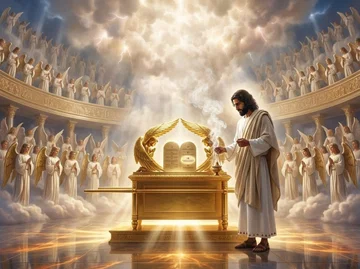
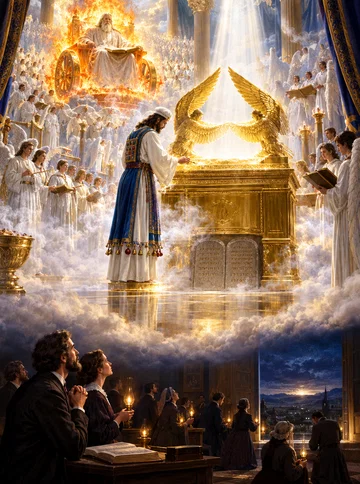
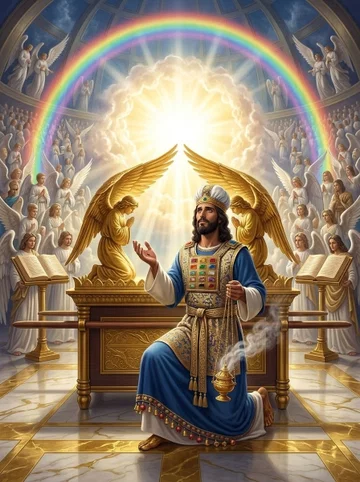
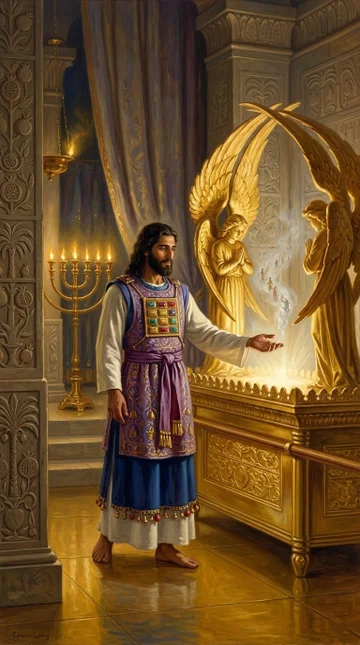
The heavenly temple has a Holy Place and a Most Holy Place, and in the Most Holy Place with the ark and mercy-seat Jesus stands beside the ark before God's law.WLF 18.3–4SG1 162.15MR 94.1–2 The two earthly apartments represent these two apartments of the heavenly sanctuary, which is the original, not a human-made structure.GC 414.3–415.1EW 213.1 At the close of the prophetic periods in 1844, ending His ministration in the holy place, He passed through the second veil from the Holy Place into the Most Holy Place of the heavenly sanctuary, clothed in priestly garments.SG1 162.1EW 213.15MR 94.1–2 There He presents the saints' prayers to the Father with incense and makes His final intercession, including for righteous living people and righteous dead people who sinned in ignorance because they had not received light about God's commandments.WLF 18.3–4SG1 162.1 This opened heavenly ministry is the setting in which God's commandments, especially the holy Sabbath, shine out and test His people, and by faith the waiting believers saw the open door and Jesus before the ark in the most holy place.LS 124.1–25MR 94.1–2
The heavenly sanctuary of the new covenant is where Christ ministers as great High Priest at God's right hand, where God is present.RH Nov 8, 19152MR 186.2–3 The heavenly temple is the great original center of the work for humanity's redemption, and the sanctuary's visible glory — including the shekinah — reflects God's presence, of which the earthly was only a dim reflection.4SP 313.1PP 349.3 This work concerns every person and reveals the plan's course through the close of time and its triumphant outcome in the contest between righteousness and sin.4SP 313.1 The celestial temple and the heavenly choir around God's throne are realities that spiritual sight can discern through study of God's Word, meditation, and prayer, and their worship turns hearts toward thanksgiving to Christ, who takes away the sin of the world. He gave Himself for believers and now stands in the presence of God as their High Priest, their Head, and through Him and with Him believers as His beloved household may enter the true tabernacle not made with hands, this hallowed temple, truths to keep continually in mind and study.2MR 186.2–3Lt 98, 1902, par. 3–6
Once-for-All Sacrifice Completed
Christ entered heaven itself, not an earthly sanctuary made with hands that merely pictured the true, to appear in God's presence on behalf of humanity.Ms 101, 1897, par. 17–20LS 110.3–112.112MR 392.1–3RH Jun 12, 1900 His entry followed His once-for-all offering of Himself by His own blood to put away sin and obtain eternal redemption, unlike earthly high priests who entered repeatedly with another's blood.Ms 101, 1897, par. 17–2012MR 392.1–3RH Jun 12, 1900 Through His suffering and death He opened the way to God, and His completed sacrifice with His continuing work as High Priest makes Him the people's Advocate who lives to intercede for those who come to God through Him.Ms 101, 1897, par. 17–2012MR 392.1–3RH Jun 12, 1900 He observed the law binding upon the Jews to the hour of His death on the cross, and then by giving His own life made the one great offering that all former offerings of the blood of beasts had foreshadowed.RH Jun 12, 1900ST Apr 8, 1875 At His death type met antitype, so the sacrificial offerings of the Jewish law became valueless and their value was terminated, and the daily and yearly typical atonement and animal sacrifices ended as a way of access.ST Apr 8, 1875SG1 169.1
He entered the heavenly holy place at His ascension by His own blood to minister there for His people, and ministered there until 1844, when He entered the most holy place to make a special atonement and cleanse the heavenly sanctuary by virtue of His own blood.LS 110.3–112.1SG1 169.1 These stages of ministry, unlike the yearly repeated services of the earthly sanctuary, are each accomplished once for all.LS 110.3–112.1 His entry into the most holy place on the day of cleansing did not mean that He would then leave heaven and bless His waiting people.LS 110.3–112.1 Through the Holy Spirit at Pentecost the disciples understood that Jesus was in the heavenly sanctuary and received the benefits of His atonement, while those who rejected this truth remained dependent on earthly sacrifices and did not benefit from Christ's mediation in the heavenly Holy Place.SG1 169.1 Atoning mediation through Him remains essential because of constant sin.Ms 101, 1897, par. 17–20
Immediately after His resurrection Jesus ascended to heaven to appear before the throne of God for His people, bearing the marks of shame and cruelty upon His brow, His hands and feet.ST Aug 22, 1878 He went to know that His sacrifice had been accepted by the Father and to receive assurance from God Himself that His atonement for the sins of His people was full and ample, that through His blood they might gain eternal life.ST Aug 22, 1878 Until the Father signified that His offering was accepted He refused to receive homage and honor, refusing the homage of Mary and also refusing the coronet of glory, the royal robe, and the adoration of the angels.ST Aug 22, 1878
In glorified humanity and priestly character He took the blood of His own atonement into the holiest of all, sprinkled it upon the mercy-seat and upon His own garments, and blessed the people.Lt 90, 1898, par. 30 His humanity was hidden on earth as a man of sorrows under God's plan, but at His descent from heaven that same humanity appears robed in glory, triumphant and exalted.Lt 90, 1898, par. 30 Having offered Himself as a sacrifice, He will appear the second time to declare that there is to be no more sacrifice for sin.Lt 90, 1898, par. 30 Still possessing His human nature, He stands in God's presence as humanity's representative, substitute, surety, and living intercessor, with power on humanity's behalf to carry forward the work of redemption.9T 286.1ST Nov 17, 1898 His resurrection and ascension assure God's people of victory over death and the grave and pledge that heaven is open to those whose characters are cleansed by the Lamb's blood, whom God will bring to behold and share His glory as they reflect Christ's image.9T 286.1
Mediation Before God
Christ appears in heaven itself in God's presence for his people as great High Priest, Jesus the Son of God, Advocate in the courts of heaven, Mediator, Intercessor, Representative, Forerunner, Head, and Lamb slain in the act of pouring out blood, who entered once by virtue of his own blood after offering himself to put away sin and obtain eternal redemption, opened the way to God, and now lives to intercede for all who come to God through him and is absolutely for his people.Ms 94, 1899, par. 38–40GC 482.4RH Jun 12, 1900AA 230.2SG4 8.3 In the judgment he acts as their advocate, pleading for those whose cases are examined, and through his continuing intercession he saves those who come to God through him.GC 482.4GC88 482.2–3 The earthly priest directing prayer toward the unseen mercy-seat represents God's people directing their prayers to Christ as Mediator before the mercy-seat in the heavenly sanctuary, whom they cannot see with natural sight but by faith see there and confidently claim the benefits of his mediation.SG4 8.3
After his ascension he began his work as High Priest appearing before God on behalf of penitent believers, and his ministry has two divisions each associated with a distinct place and time, the first corresponding to the daily service in which as the earthly priest sprinkled the sacrifice's blood in the holy place for the sinner so Christ pleads his blood for believers.PP 357.3–4 He pleads his blood, suffering and death before the Father, presenting his wounded hands and feet as evidence of the price paid to redeem them, and the memorial of his sufferings and death upon the cross as penalty due the transgressor is efficacious as perpetual propitiation in God's presence for all who believe.COS 191.3–192.1EW 41.1–2Lt 76, 1898, par. 30–31 When the sinner condemned by the broken law grasps the sacrifice by repentant faith with humble heart, Christ presents the oblation for every offense and shortcoming to give pardon, claims pardon and all covenant graces as reward of his sacrifice, and his blood cleanses from all sin those who accept him as personal Saviour.Lt 76, 1898, par. 30–31Ms 50, 1900, par. 15 For his sake the prayers of the penitent who come acknowledging him are accepted as yea and amen, their sins are blotted out and holy oil bestowed, and he saves to the uttermost all who come in faith while mercy and probation continue and while there is opportunity to change.Lt 76, 1898, par. 30–31Ms 128, 1897, par. 7–9 His presence and continuing sympathy give disciples confidence about the future as they await his return with the holy angels, while God's messengers carry saving truth so people may receive the seal of the living God.COS 191.3–192.1EW 41.1–2ST2 46.3
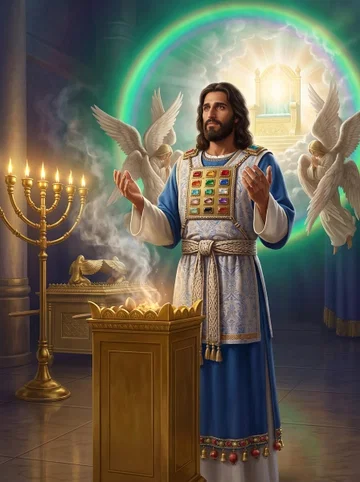
His heavenly ministry is the reality represented by the earthly sanctuary service begun at his ascension: he pleads his blood for sinners and presents penitent believers' prayers, repentance and faith to the Father purified by his merits and with the fragrance of his own righteousness and mingled with incense.GC88 420.2–3GC 420.2–421.1RH Nov 8, 191511MR 54.1–210MR 157.2–3 In the Most Holy Place beside the ark he presents the saints' prayers with incense, accepts their repentance, answers their prayers, and directs prayer toward the unseen mercy-seat.WLF 18.3–46RED 99.1ST Nov 22, 1883 Pardon is recorded, sins forgiven and blotted out, and at the end of the 2300 days light comes from the Father through the Son to the praying company.LS 124.1–2Lt 76, 1898, par. 30–31 His high-priestly work then enters the Most Holy Place to make atonement for sins and cleanse the sanctuary, completing the plan of redemption through the final atonement.11MR 54.1–210MR 157.2–3
His wounded hands recall his humiliation, suffering and anguish and plead for the pardon purchased by his blood, and those wounds secure his church the gifts and best gifts of God's power.6RED 99.1ST Nov 22, 1883 Through that Saviour strength comes to meet increased need, to receive special grace to overcome peculiar faults and a hard heart, to steadfastly resist temptation and evil promptings, to honor the Redeemer instead of doing the works of Satan, to sacrifice every idol and put away every darling sin, and to have the heart of stone taken away and a heart of flesh given.ST Nov 30, 1882 His sympathy for suffering humanity is unchanged, his ministry gives confidence that he hears prayer, and he will return with the heavenly host to take obedient children to the home he prepares, which is cause for joyful expectation.3SP 257.2–3 When believers yield to temptation they are to confess humbly and trust that Christ presents his wounded hands before the Father and makes atonement for those who confess.Ms 8, 1888, par. 28
His death began the work for humanity and his heavenly intercession completes it, and this intercession is as essential to salvation as his death on the cross.GC 489.14SP 313.2GC88 489.1 By faith believers enter within the veil where he has gone before them, there the light of the cross reveals redemption and the mysteries of redemption more clearly, and through his mediation their sincere desires brought in faith may be presented to God at the Father's throne.GC 489.14SP 313.2GC88 489.1 His sacrifice meets the full demands of God's broken law and he has opened the way to the Father's throne.GC 489.1
Having completed the sacrificial offering of himself when he suffered without the gate and made perfect atonement, he entered heaven itself once for all to work as great High Priest, Advocate and Intercessor, and because he performs his work in the holy place by his own virtue as sole Sin-bearer and Sin-offering, no propitiatory sacrifices are to be offered without.Ms 128, 1897, par. 7–9 Altars, masses for souls in purgatory, incense offered by men, traditions, inventions to earn salvation, human virtue, human intercession and intercession of saints are fallacies of no avail, Christ needs no man's virtue or intercession, and prayer and confession are to be offered only to him who ever lives to make intercession.Ms 128, 1897, par. 7–9 The daily and yearly typical atonement is ended and the holy places made with hands which were only figures and typical shadows are now without virtue, but atoning mediation through him remains essential because of constant sin.Ms 50, 1900, par. 15 His ministry exalts and honors God's law, so those who love God must not alter his commandments for convenience but obey them including keeping the Sabbath holy, while like Israelites in the outer court God's people stand with hearts bowed in contrition pleading pardon, waiting and looking for the blessed hope of the glorious appearing of Jesus.Ms 26, 1886, par. 18–19Ms 128, 1897, par. 7–9
Final Atonement Since 1844
Christ's heavenly ministry has two divisions of place and time answering to the earthly service, first in the holy place as in the daily service and then in the most holy place as on the Day of Atonement when work in the first ceased.LS 110.3–112.14SP 265.2–266.3PP 357.3–411MR 54.1–210MR 157.2–3 For eighteen centuries He pleaded His blood in the first apartment, presenting prayers, repentance and faith purified by His merits, and then entered the Most Holy to make atonement and cleanse the sanctuary, completing redemption through the final atonement.4SP 265.2–266.311MR 54.1–210MR 157.2–3Ms 69, 1912, par. 46–47RH Nov 8, 1915 The earthly types are made clear by this work, and unlike the yearly repeated earthly services each stage is accomplished once for all.LS 110.3–112.1Ms 69, 1912, par. 46–47 His entrance into the holy of holies began the closing work, not the end of intercession.LS 110.3–112.14SP 265.2–266.3
At the close of the prophetic periods, at the end of the 2300 prophetic days or years in 1844 on the antitypical Day of Atonement, He in priestly garments passed through the second veil from the holy place into the most holy place of the heavenly sanctuary to cleanse it by His own blood and make special and final atonement.LS 110.3–112.14SP 265.2–266.3GC 479.1–3ST May 9, 1878SG1 148.1 There He began the investigative judgment which takes place before His return, first with the cases of the righteous dead passing in review before God and then with judgment to be pronounced upon the living.4SP 265.2–266.3ST May 17, 1883GC 479.1–3 Each person has a case pending in the court of heaven and is individually to be judged according to deeds done in the body, with a final irrevocable decision upon every case.ST May 17, 1883GC 479.1–3 The cleansing of the sanctuary in Daniel 8:14 points to this closing work that finishes the atonement and prepares a people to abide the day of His coming, not to purification of the earth before it becomes the saints' home.ST May 9, 1878SG1 148.1
By His blood sins are recorded in the heavenly sanctuary, and its cleansing examines the records to determine who through repentance and faith receives the benefits of His atonement.4SP 265.2–266.3RH Nov 8, 1915 His blood releases the repentant sinner from the law's condemnation and secures pardon and acceptance, but it does not immediately erase the record, which remains in the sanctuary until the final atonement.4SP 265.2–266.3PP 357.5RH Nov 8, 1915 Just as the sin-offering blood in the earthly sanctuary removed sin from the penitent while the sin remained there until the Day of Atonement, so the record remains until then.4SP 265.2–266.3PP 357.5 In the final work the sins of the truly penitent are blotted from heaven's records and the sanctuary is cleansed from the record of sin.4SP 265.2–266.3PP 357.6PP 357.5
This explains the 1844 disappointment, for the mistake was not in calculating the prophetic time but in misunderstanding what the sanctuary was and how it would be cleansed.SG1 148.1EW 212.1Ms 6, 1876, par. 5–6 The sanctuary to be cleansed was in heaven, not the earth to be purified by fire at His return to destroy the wicked, and God's promise had not failed.SG1 148.1EW 212.1Ms 6, 1876, par. 5–6 At that time He had closed the holy place of the heavenly sanctuary and entered the most holy place to cleanse it from the people's sins by virtue of His own blood on the antitypical Day of Atonement.SG1 148.1EW 212.1Ms 6, 1876, par. 5–6 Those who continued to trust that God had led them followed Him by faith to recognize the church's closing work and prepare to proclaim the third angel's warning.EW 206.2–3EW 212.2GC88 432.1
In the most holy He makes atonement for His people and for Israel and receives the kingdom from His Father, afterward to return to earth and take His waiting people to live with Him forever.EW 206.2–3EW 212.2SG1 149.2 His entry there did not mean He would then leave heaven to bless them, nor was the expected event His coming to earth in 1844.LS 110.3–112.1EW 206.2–3 As Bridegroom receiving the kingdom this event settles the shut-door message, and His mediatorial work will be completed when He comes again in kingly power and great glory to establish His kingdom on earth.EW 206.2–3AA 228.3SG1 149.2 Standing before the ark containing God's law He makes final intercession for righteous living people and righteous dead who sinned in ignorance without light about God's commandments.EW 212.2SG1 162.1
This ministration belongs with heaven's last-day message given by the angels of Revelation 14, truth sought out point by point by prayerful study and testified to by miracle-working power.EW 218.1RH Dec 28, 1905Ms 4, 1883, par. 51–53 It is a way-mark that made God's commandment-keeping people what they are, a fundamental principle based on unquestionable authority to be preserved and held firmly with the grip of faith against every phase of heresy brought to becloud minds regarding the teaching of the Word.RH Dec 28, 1905Ms 4, 1883, par. 51–53 The first and second messages and the midnight cry prepare people to enter with Jesus by faith, and the third angel's message points to the most holy, shows the way there, anchors against Satan's delusions, and directs minds to the heavenly sanctuary.EW 218.1EW 221.1Ms 4, 1883, par. 51–53 Those who reject these messages do not understand His ministry there and cannot benefit from His intercession, and prayers directed to the sanctuary apartment He has left are useless.EW 218.1EW 221.1
Call to Follow Faithfully
The present moment is the antitypical day of atonement, a solemn time with eternal results in which every person has a case pending in the court of heaven to be judged individually according to deeds done in the body.ST May 17, 1883GC88 430.2–3Lt 55, 1886, par. 9–10 Since 1844 Christ has been in the most holy place of the heavenly sanctuary carrying forward the investigative judgment, with the cases of the righteous dead passing in review before God and a final irrevocable decision to be pronounced upon the living when that work is completed.ST May 17, 1883GC88 430.2–3Ms 168, 1898, par. 19–20 As in the type the people had to afflict their souls and confess sins that they might be atoned for and blotted out, so now sins must by confession and repentance go beforehand to judgment, with daily humbling before God, confession of individual sins, seeking of pardon for transgressions, deep heart-searching, and cooperation with Christ in preparing souls to reflect the divine image.ST May 17, 1883GC88 430.2–3Lt 55, 1886, par. 9–10Ms 168, 1898, par. 19–20 That purification is in harmony with the cleansing of the sanctuary in heaven, for Christ and angels work in human hearts and the church in heaven is united with the church on earth in spiritual conflict, and by faith believers enter the sanctuary above in sympathy with that work.11MR 83.4Ms 168, 1898, par. 19–2015MR 24.1Ms 15, 1886, par. 6 Their part is to cleanse the sanctuary of the soul by putting away everything offensive to God, including envy, jealousy, enmity, hatred and self-love, and loathing the sins that caused such suffering, or they will be weighed in the balances of the sanctuary and pronounced wanting.Ms 94, 1899, par. 38–40Ms 168, 1898, par. 19–20Ms 15, 1886, par. 6
Believers are to enter the sanctuary above with Him by faith and follow Him there, setting thoughts and sympathies in harmony with His work of making atonement and cleansing the sanctuary from their sins.11MR 83.4Ms 168, 1898, par. 19–20Ms 15, 1886, par. 6Ms 8, 1888, par. 28 His work in heaven sends light from the cross and the heavenly sanctuary that makes the plan of redemption clearer and reveals the significance of the ceremonial law and its types pointing to the coming Saviour.PP 367.3–410MR 228.1–3 When the law shows the sinner the depth of sin he must be pointed to the sacrifice as a Lamb slain in the very act of pouring out blood in his behalf, and be taught repentance toward God and faith toward the Lord Jesus Christ.4T 395.2Ms 8, 1888, par. 28 So the minister's work on earth must be in harmony with Christ's work in heaven for us, and in the great day of atonement Christ works through His ministers to arouse intense interest in present truth.4T 395.210MR 228.1–3 When believers yield to temptation they are to confess humbly and trust that Christ presents His wounded hands before the Father and makes atonement for those who confess, cleansing their lives from defilement.Ms 15, 1886, par. 6Ms 8, 1888, par. 28
Because Christ is absolutely and completely for His people before God, those who profess truth are called to be absolutely and completely for Him in this world.Ms 94, 1899, par. 38–40Lt 6, 1898, par. 12 They are to rise up in His spirit and mind, separate with firm purpose of heart from all worldly influences, break every worldly link, lay aside every weight, wear the armor of righteousness, work together with Jesus Christ, and make the kingdom of heaven and the glory of God their best and whole interest so the work will go forward.Ms 94, 1899, par. 38–40Lt 6, 1898, par. 12 While He presents His atoning sacrifice in their behalf before God they must not be idle but must work in His vineyard with earnest personal faith, earnest work, and faithful use of every God-given ability.Lt 6, 1898, par. 12ST Feb 24, 1898 That working includes keeping the commandments as Old and New Testaments require of all who would enter into life, since idleness and disobedience are sin and none of His promises reward disobedience.Ms 94, 1899, par. 38–40ST Feb 24, 1898 They are bound together in God in Christian brotherhood, loving one another as He loved them, showing compassion, pouring out the soul in repentance and contrition, offering self as a free acceptable sacrifice, confessing rather than covering sins to find mercy and grace to help in every time of need, and receiving a new heart with transgressions removed as far as east is from west.Ms 94, 1899, par. 38–40Lt 6, 1898, par. 12
His triumph opened heaven to humanity and revealed God's presence to human sight, so that fallen people can be restored to connection with God through faith in the Redeemer, tested and clothed in Christ's righteousness and exalted to His throne.SC 118.19T 105.1Lt 98, 1902, par. 3–6 His divine power becomes the heritage of every believer and makes salvation effective for the human race, for His intercession with His own blood as Intercessor and Advocate avails before God's throne.SC 118.1Lt 76, 1898, par. 30–319T 105.1 The memorial of His sufferings and death upon the cross as penalty due the transgressor is a perpetual efficacious propitiation in the presence of God for all who believe, cleansing from all sin those who accept Him as personal Saviour.Lt 76, 1898, par. 30–319T 105.1 For His sake the prayers of the penitent who come acknowledging Him as Saviour are accepted as yea and amen, their sins are blotted out, and the holy oil is bestowed upon them.Lt 76, 1898, par. 30–31Lt 98, 1902, par. 3–6 Through Him and with Him believers may enter the true tabernacle not made with hands as His beloved household with Him as Head, and spiritual sight through study of the Word, meditation and prayer discerns the realities of the celestial temple and heavenly choir around the throne, turning hearts toward thanksgiving to Him who takes away sin.SC 118.1Lt 98, 1902, par. 3–6
As Priest He pleads His blood, suffering and death before the Father for the remnant who are not yet sealed, and that appeal holds back the release of the four winds until God's servants receive the seal of the living God in their foreheads.EW 41.1–2ST2 46.3SLGB 1.3 God's messengers at the same time carry the saving truth so people may receive that seal.EW 41.1–26RED 100.2ST2 46.3 His work in the sanctuary will be finished, with sins to be confessed over the scapegoat and borne away.19MR 131.3Lt 164, 1909, par. 9–10 Then through the time of trouble people must live in the sight of the Lord without a High Priest, so those who would be protected must now receive the seal and reflect the image of Jesus fully.SLGB 1.3Lt 164, 1909, par. 9–10 They are to wait with joyful expectation for Him who prepares homes and will come again with power and great glory in the clouds with angels to receive the obedient and loyal to Himself, while the gospel to be preached joins together Christ in human form as man of sorrows, Christ in humiliation crucified, Christ resurrected, Christ as Advocate in heaven, and Christ to come again.EW 41.1–26RED 100.2Lt 164, 1909, par. 9–10
Sources
Pioneers and periodicals
266 sources
Christ did not enter the earthly holy places made with human hands but entered heaven itself, the true sanctuary, now to appear in the presence of God for humanity as High Priest, Mediator, Advocate and representative with His own blood.RH Aug 10, 1876RH Jan 23, 1855RH Jul 18, 1854RH Nov 25, 1909
The earthly holy places are figures, patterns, shadows and copies of the true, proving the heavenly sanctuary is real and contains two apartments corresponding to the two apartments of the earthly tabernacle shown to Moses.LDT 179.2ST May 13, 1886RH Sep 21, 1905RH Nov 25, 1909ST Oct 22, 1874
Unlike the repeated yearly entrance of the earthly high priest with the blood of calves and goats, Christ entered once for all by His own sacrifice on the cross, which avails for sins from Adam onward and needs no repetition.RH Nov 25, 1909RH Nov 25, 1909RH Feb 3, 1853ST Jul 1, 1880
The heavenly things themselves must therefore be purified, not from physical impurity or by fire, but from the guilt of confessed sins borne into the sanctuary through His ministry, cleansed by His better blood ministered in behalf of man.RH Aug 10, 1876RH Mar 11, 1858RH Feb 3, 1853RH Sep 1, 1863
That cleansing is His concluding priestly work in the most holy place before He comes as King, begun at the end of the 2300 days in 1844 when He changed ministration from the holy place to the holiest, blotting out sins in the investigative judgment and preparing worshipers for the second advent.RH Aug 10, 1876RH Feb 3, 1853RH Apr 5, 1870ST May 20, 1875
Wording and Grammar
The words holy places render the Greek word for holies in its plural form, the accusative plural hagia, and to render it in the singular as holy place obscures the meaning.RH Jan 23, 1855RH Oct 5, 1916 Hebrews is the only book in the New Testament that uses the word sanctuary, and here the Greek hagia meaning holy places or sanctuary refers to the celestial sanctuary where Christ as High Priest entered heaven itself to appear in the presence of God for us, not the holy places made with hands which are figures of the true.RH Oct 5, 1916 His work in that heavenly sanctuary includes what was performed in both apartments of the earthly tabernacle, which is why the singular holy place should give way to the plural holy places or sanctuary.RH Oct 5, 1916
The phrase a holy place or the holy places can mean the heavenly sanctuary as a whole, not only its most holy place, and the same Greek term is also used for the sanctuary in Hebrews 8:2 and for holy place in Hebrews 10:19.RH Nov 25, 1909RH Apr 15, 1873RH Nov 25, 1909 The true tabernacle in heaven contains two apartments corresponding to the two apartments of the earthly sanctuary, and Christ entered heaven itself at His ascension to begin His priestly work and to serve as representative and High Priest from whom believers receive spiritual benefit and draw near with confidence by His blood.RH Nov 25, 1909RH Nov 25, 1909 The word rendered the true is itself plural in the original and refers to the holy places in the plural, so the earthly holy places are plural figures of the true heavenly holy places.RH Feb 3, 1853ST May 16, 1878ST Dec 5, 1892 Christ's ministry takes place in the two apartments represented by the earthly sanctuary, beginning in the first apartment after His ascension and later to be completed in the second following the pattern of the earthly priests, since He does not minister in both apartments at once.ST Dec 5, 1892
The plural wording holy places, found also in Hebrews 9:8 and 9:12 and 10:19, proves that the heavenly sanctuary has two holy places or apartments corresponding to the two apartments of the earthly sanctuary, and that Christ ministers in both.RH Jan 4, 1870ST May 16, 1878RH Feb 3, 1853ST Aug 26, 1913 The earthly sanctuary's two holy places made by human hands were figures, images and examples of the corresponding holy places in heaven, and the earthly tabernacle and its vessels as patterns of things in the heavens prove that the greater and more perfect tabernacle in heaven itself contains two holy places just as the earthly figure, example and pattern does.STRH Jan 4, 1870ST May 16, 1878RH Feb 3, 1853 The plural is taken to indicate more than one holy place in heaven and to support two kinds of service corresponding to the two apartments and services of the earthly sanctuary, whose service in both apartments belonged to the high priest either performed by him or carried out under his oversight. The true sanctuary is in heaven where Christ entered heaven itself to appear before God for us, and the earthly priests served in a sanctuary patterned after heavenly things.STST Aug 26, 1913
Beside this, those who held the caution taught that the plural does not by itself prove two places in heaven or that Christ began the work represented by both holy places at the same time.RH Aug 28, 1853ST Feb 4, 1886RH Apr 15, 1873RH Aug 28, 1853 Greek may use the plural where English uses the singular for the sanctuary as a whole, so holy places can designate the heavenly sanctuary as a whole corresponding to the two earthly holy places rather than necessarily naming only its most holy apartment.RH Apr 15, 1873RH Aug 28, 1853RH Aug 28, 1853 The verse by itself identifies heaven as the place of His priestly ministry in support of a real heavenly sanctuary corresponding to the earthly sanctuary, but it does not by itself specify whether that heavenly sanctuary has two holy places or say that ministry in both began at ascension.RH Aug 28, 1853ST Feb 4, 1886RH Aug 28, 1853 This reading rests on the context identifying the antitype with the two earthly holy places and with the greater and more perfect tabernacle, with the plural form supporting but not solely establishing it.RH Aug 28, 1853
Earthly Sanctuary Pattern
The holy places made by human hands are figures, patterns, shadows, copies, images and examples of the true, and the sanctuaries of the two covenants stand in type and antitype relation as worldly pattern to heavenly reality.LDT 179.2ST May 13, 1886RH Sep 21, 1905ST Jul 1, 1880ST Oct 21, 1880 Christ did not enter the earthly copy but entered heaven itself to appear in the presence of God for humanity.LDT 179.2ST May 13, 1886 The earthly figure was a sanctuary where priests performed service to God by offering blood for themselves and for the errors of the people.RH Sep 21, 1905
The tabernacle of witness was built many times over according to the pattern God showed Moses in the mount, and that pattern was a representation of the heavenly sanctuary itself, so the true sanctuary includes the original.RH Jan 6, 1853RH Aug 11, 1863RH Apr 6, 1869 The tabernacle built by Moses and the temple built by Solomon were built by divine instruction according to the pattern of the sanctuary in heaven, and their holy places made with hands are figures of the true holy places and a pattern of things in the heavens.ST Nov 23, 1904ST Dec 3, 1874 Solomon's temple was constructed as such a copy of heavenly things, and Zerubbabel's temple continued Solomon's pattern, with Herod's temple and the temple services continuing until destruction in A.D. 70.RH Jan 6, 1853RH Jan 6, 1853 The priestly service in the worldly sanctuary was a shadow and type of Christ's service as High Priest in the heavenly temple, given as an object-lesson to make plain the plan of redemption and teach His priesthood.ST Nov 23, 1904
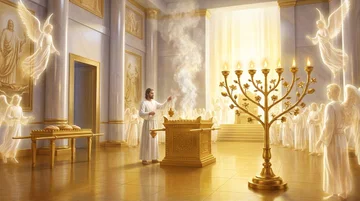
The earthly sanctuary as a whole with its two apartments and furnishings was carefully made to teach the heavenly sanctuary.RH Sep 21, 1905ST Oct 8, 1885 Its first apartment contained the golden candlestick with seven branches, the table for the showbread, and the altar of incense, and its second apartment contained the ark of the covenant, a chest overlaid with gold holding the two tables of stone on which were engraved the ten commandments as the standard of righteousness.RH Sep 21, 1905ST May 27, 1880 That earthly building was an oblong ten cubits in width and thirty in length, containing the golden candlestick, the altar of incense, and the table of shewbread, so its true antitype must have corresponding form and furniture.ST May 27, 1880 The heavenly temple contains the ark of God's testament, and the earthly ark and mercy-seat represent God's throne with the cherubim around it.ST Oct 8, 1885 The heavenly sanctuary also has a veil corresponding to the veil between the two earthly apartments.ST Nov 11, 1897
The earthly holy places are not figures of two dispensations.RH Jul 7, 1853RH Jul 7, 1853RH Feb 18, 1858 The sanctuary Moses built was a figure of the true sanctuary in heaven, not a figure of the earth or the land of Palestine.RH Jun 9, 1853 Heaven and earth do not represent those apartments, and the earth is not the holy place with heaven as the most holy place and the sky as a veil.RH Jan 13, 1859RH Feb 18, 1858 The earth cannot be that sanctuary or part of it, because it in no way resembles that building and has nothing answering to its candlestick, altar, and table, because sanctuary means a holy, sacred dwelling place for the Most High which the earth is not, and because the word sanctuary occurs 144 times in the Bible and is never once applied to the earth.ST May 27, 1880
The earthly tabernacle and its vessels, the patterns of things in the heavens, were necessarily purified with the blood of calves and goats, because without shedding of blood there is no remission.ST Jul 1, 1880RH Oct 30, 1855 The earthly sanctuary was cleansed with the blood of animal offerings.ST Oct 21, 1880
At Christ's death type met antitype, the temple veil was torn, typical sacrifices ceased and became valueless, the Aaronic priesthood ended, and the center of worship was transferred from the earthly sanctuary to the heavenly courts.ST Sep 20, 1899RH Sep 11, 1856RH Jul 4, 1854ST Apr 6, 1915 Christ is the reality to which the old covenant's types and shadows pointed, His offering is the only effective offering and was made once for all, and the ceremonial law was abolished at the cross.ST Oct 1, 1896RH Jul 4, 1854ST Apr 6, 1915 The sacrifices in the typical system pointed to His death, and they cannot represent repeated deaths of Christ after the 2300 days.RH Feb 21, 1856 Renewing animal sacrifices, including those prescribed in Ezekiel's temple vision, would make His offering of none effect, return from reality to shadow, and deny His once-for-all offering and priesthood, so they are no longer acceptable to God.RH Sep 11, 1856ST Oct 1, 1896
Heavenly Sanctuary Reality
Heaven itself contains the true and real sanctuary, the greater and more perfect tabernacle which the Lord pitched and not man and not made with hands.ST Oct 8, 1885ST Aug 15, 1878RH Feb 3, 1853RH Jan 9, 1855ST Dec 3, 1874 It is the real dwelling-place of God where He dwells as a personal being, established by the Lord rather than by man, and Christ has entered it as High Priest to appear before God on behalf of humanity.ST Oct 8, 1885ST Aug 15, 1878ST Apr 17, 1901RH Jan 13, 1859 The earthly holy places made by human hands were only patterns of the real holy places in heaven, and the earthly tabernacle with its furnishings was patterned after heavenly realities, so that the ark and mercy-seat represent God's throne with the cherubim around it and its temple contains the ark of God's testament.ST Oct 8, 1885ST Apr 17, 1901RH Feb 3, 1853RH Jan 13, 1859RH Jul 26, 1870 That heavenly sanctuary is Christ's dwelling above where He carries out His work for the salvation of His people, pointing forward to the heavenly dwelling that will be shared by those who had His indwelling during their earthly lives, and believers have there a real, enduring substance, not an immaterial nothing.ST Oct 8, 1885ST Apr 17, 1901RH Dec 10, 1861 Its cleansing is therefore a biblical doctrine, not a teaching opposed to Scripture.ST Dec 1, 1881RH Feb 21, 1856
The sanctuary of the new and better covenant and of the Christian dispensation is in heaven itself where God dwells, not the earth or any part of the earth or any earthly site or the Gospel church.ST Aug 15, 1878RH Apr 5, 1864RH Jan 9, 1855ST Dec 3, 1874RH Oct 30, 1855 The earthly sanctuary of the first covenant, the tabernacle built by Moses about 1500 years before Christ with its mortal priesthood and sacrifices of goats and calves and carnal ordinances, was only a temporary type, figure, pattern, shadow and example of the true, and at the time of reformation it gave place not to the earth but to this heavenly sanctuary.ST Aug 15, 1878RH Jan 9, 1855ST Dec 3, 1874RH Oct 2, 1856RH Oct 30, 1855 While the first tabernacle stood the way into the holy places of the heavenly temple was not opened, but with the introduction of the new covenant that way was opened, and Christ after His ascension became great High Priest and by His own blood entered heaven itself, the real sanctuary of God, with a more excellent ministry and better mediation, now to appear in the presence of God for fallen man and minister in mercy for him.ST Aug 15, 1878RH Jan 9, 1855ST Dec 3, 1874RH Oct 2, 1856 The new covenant has a heavenly sanctuary and a priestly ministry replacing the earthly sanctuary and its services when the old covenant ended, and its service had two yearly divisions, the daily ministration and a brief closing work in the most holy place called the cleansing of the sanctuary.RH Apr 5, 1864ST Dec 3, 1874RH Oct 2, 1856 That cleansing of the heavenly sanctuary, brought to view at the termination of the 2300 days in the autumn of 1844, must likewise be performed by Christ while yet a priest before He takes His kingdom and appears in glory, a cleansing not from physical impurities but from the presence of sins imparted to it through His blood ministered in behalf of sinners, and also purifying worshipers and preparing them for the second advent.ST Aug 15, 1878RH Apr 5, 1864RH Jan 9, 1855ST Dec 3, 1874RH Oct 30, 1855
The earthly holy places were figures of the true heavenly sanctuary, just as the priests' service and sanctuary cleansing were patterns of heavenly things, and the pattern, shadows and examples show that the heavenly sanctuary has a real counterpart to the earthly one.RH Jul 7, 1853RH May 27, 1852RH Jan 13, 1859ST Dec 1, 1881RH Feb 21, 1856 They are not figures of two dispensations, and Christ's appearing in God's presence does not by itself prove that He entered only the most holy place, because God's glory was manifested in both apartments of the tabernacle and temple and the divine presence also met people at the tabernacle's entrance during daily service.RH Jul 7, 1853RH Jan 13, 1859 At the close of the typical dispensation the true tabernacle of God in heaven and the more excellent ministry of Christ as great High Priest took the place of the earthly pattern and shadow.ST Dec 1, 1881RH Feb 21, 1856RH Sep 2, 1851 John's seeing its temple, ark, throne, lamps and altar corroborates its existence.ST Oct 8, 1885RH Jan 13, 1859RH Jul 26, 1870
That heavenly tabernacle is God's sanctuary and habitation and is the subject of prophecy as the Sanctuary of the Bible, the true tabernacle which the Lord pitched and not man.ST Dec 1, 1881RH Feb 21, 1856RH Sep 18, 1900ST Sep 16, 1886RH Jul 26, 1870 It is the sanctuary connected with the 2300 days, whose cleansing at the end of that period is a solemn work in which all inhabitants of earth have a personal interest, the same cleansing foretold in Daniel 8:14, meaning the removing of sin and iniquity by blood and not the removing of physical uncleanness.ST Dec 1, 1881RH Feb 21, 1856RH Sep 2, 1851RH Sep 18, 1900ST Sep 16, 1886 The earthly sanctuary made with hands and pitched by man was only a figure of the true sanctuary in heaven itself, made without hands and pitched by the Lord, where Christ ministers as High Priest of the Melchisedec priesthood with His own blood instead of the blood of beasts offered by the Levitical priesthood.RH Sep 18, 1900ST Sep 16, 1886RH Jul 26, 1870 His service in the heavenly sanctuary of the gospel replaces the yearly round of earthly service with a once-for-all service, and its last work is the great day of everlasting atonement to take away forever all sins borne by the High Priest at the confession of believers, called the cleansing of the heavenly sanctuary, which is the last work forever in behalf of any people and brings the very last days of the work of the gospel, when the gospel, the mystery of God, is finished.RH Sep 2, 1851RH Sep 18, 1900ST Sep 16, 1886 It is sacred reality associated with the Judge and angels, not an immaterial nothing or merely imagined symbols.ST Dec 1, 1881RH Feb 21, 1856RH Dec 10, 1861
The earthly structure represented the heavenly sanctuary in its leading and essential features, and the two apartments and their furnishings were carefully made according to the pattern shown to Moses so people could learn about the heavenly sanctuary and its furnishings.ST Aug 26, 1913ST Dec 10, 1894ST Jun 19, 1907RH Jan 16, 1900ST Oct 24, 1900 It was not a perfect image of it, because earthly things cannot fully represent heavenly things.ST Jun 19, 1907RH Jan 16, 1900ST Oct 24, 1900 Studying the sanctuary's pattern helps explain God's way of salvation and Christ's work for humanity, for the earthly sanctuary and its services were given in connection with the Levitical priesthood to instruct Israel concerning the true heavenly sanctuary and its services, where Christ ministers as priest after the order of Melchisedec.ST Jun 19, 1907RH Jan 16, 1900ST Oct 24, 1900 The earthly temple and its services were types and object-lessons pointing beyond themselves to the true sanctuary in heaven, and their ceremonies could not make worshipers complete but directed them to Christ, who has entered heaven as priest and advocate and appears before God on their behalf, from which pardon, peace, blessing, love and sympathy flow.RH Aug 27, 1857RH Jan 16, 1900ST Oct 24, 1900 Israel perverted it from its teaching purpose, made it final, and expected salvation by its service, though it was never the final service and never the way of salvation.RH Jan 16, 1900ST Oct 24, 1900 Christ serves as minister of the new covenant in heaven's true sanctuary, not in an earthly sanctuary made by human hands, and His service is more glorious than the old-covenant ministry because He offers a better sacrifice for sin and appears before God on our behalf.ST Aug 26, 1913ST Jun 19, 1907RH Aug 27, 1857
Two Holy Places
The true tabernacle in heaven contains two apartments corresponding to the two apartments of the earthly sanctuary made after the pattern shown to Moses, an outer holy place and a holy of holies.RH Nov 25, 1909ST Oct 22, 1874RH Jan 4, 1870ST May 16, 1878RH Feb 3, 1853 The entire earthly building with its two holy places, not the most holy place alone, is the pattern of the true tabernacle, and the plural wording of holy places made with hands as figures of the true supports that correspondence.ST Oct 22, 1874RH Jan 4, 1870ST May 16, 1878RH Feb 3, 1853RH Jul 7, 1853 The earthly sanctuary was a pattern of the heavenly one, and its two apartments and services show the order of ministry in heaven.RH Nov 25, 1909ST Oct 22, 1874RH Jan 4, 1870ST May 16, 1878RH Jul 7, 1853
The heavenly sanctuary also has a veil corresponding to the veil between the two earthly apartments, and its temple contains the ark of God's testament.RH Sep 21, 1905ST Oct 8, 1885RH Apr 5, 1870ST Nov 11, 1897RH Nov 22, 1864 Its first apartment is identified in heaven by the throne, the seven lamps, and the golden altar of incense, and its second by the ark, even as the earthly first apartment contained the golden candlestick with seven branches, the table for the showbread, and the altar of incense, and its second apartment contained the ark of the covenant, a chest overlaid with gold holding the two tables of stone on which were engraved the ten commandments, the standard of righteousness.RH Sep 21, 1905ST Oct 8, 1885RH Apr 5, 1870ST Nov 20, 1879RH Nov 22, 1864 The earthly tabernacle and its furnishings were patterned after heavenly realities, so the ark and mercy-seat represent God's throne, with the cherubim around it, and the ark before which ministry is done contains God's commandments.RH Sep 21, 1905ST Oct 8, 1885RH Apr 5, 1870 At the end of the 2300 days in 1844 ministry entered its second apartment to minister before the ark and cleanse the sanctuary, standing at the mercy seat to offer blood both for the sanctuary's cleansing and for pardon of sin, carrying out the closing work of intercession before God's throne.RH Apr 5, 1870RH Nov 22, 1864
Both the holy and most holy places represented the heavenly sanctuary, and the terms most holy place and heaven itself are not interchangeable.RH Jul 7, 1853RH Mar 17, 1853RH Jul 5, 1870RH Sep 24, 1914RH Mar 17, 1853 God's glory was manifested in both apartments of the tabernacle and temple, and the divine presence also met people at the tabernacle's entrance during daily service, so appearing in God's presence does not by itself prove entrance only into the most holy place.RH Jul 7, 1853RH Mar 17, 1853 The sanctuary's holy place and most holy place were distinct apartments with services performed at different times and under different circumstances, and the New Testament exposition recognizes those distinctions, with the most-holy-place service associated with the ancient service on the tenth day of the seventh month.RH Jul 7, 1853RH Mar 17, 1853RH Mar 17, 1853 The earthly holy places are not figures of two dispensations, and the distinction between apartments does not require service in the holy place during this age and then in a sanctuary built with hands in a future age.RH Jul 7, 1853RH Mar 17, 1853 The apartment containing the ark was entered only once a year by the high priest to cleanse the sanctuary, picturing final work as High Priest in heaven, cleansing the sanctuary and blotting out the sins of the people.RH Sep 24, 1914
The earthly service in both apartments belonged to the high priest, either performed by him or carried out under his oversight.RH Jul 5, 1870 The offerings' bodies were not carried into either earthly room, while their blood was brought into both, with blood entering the most holy place on the Day of Atonement.RH Jul 5, 1870 Ministry in heaven therefore cannot be reduced to the most holy place alone.RH Jul 7, 1853RH Mar 17, 1853RH Jul 5, 1870
Work in heaven corresponds to the work carried out in both earthly apartments, not only the yearly service in the holiest, and completes the corresponding round of ministration in the true tabernacle.RH Dec 8, 1915ST Mar 14, 1906ST Oct 22, 1874ST Aug 15, 1878ST May 7, 1912 Ministration in the heavenly temple follows the order indicated by the service in the two apartments of the earthly sanctuary and can be traced in those two phases in the New Testament, following first the daily service and then the Day of Atonement order.RH Dec 8, 1915ST Mar 14, 1906ST Oct 22, 1874ST Aug 15, 1878ST Nov 20, 1879 Work at ascension corresponds to the daily priestly service, while the heavenly sanctuary's cleansing at the close of ministry corresponds to the earthly Day of Atonement, which with its cleansing was an object lesson pointing to the heavenly sanctuary and its cleansing.RH Dec 8, 1915ST Mar 14, 1906ST Aug 15, 1878ST May 7, 1912ST Nov 20, 1879 Priestly entrance was once for all, as was death, and ministry began with the purpose of carrying out the work prefigured by the sanctuary service, the earthly priest entering the holy place repeatedly and the most holy place yearly while the one entrance looked forward to completion including the closing of the Day of Atonement and the final putting away of sin.RH Dec 8, 1915ST Mar 14, 1906 While the first tabernacle stood the way into the holy places of the heavenly temple was not opened, but with the introduction of the new covenant that way was opened.ST Aug 15, 1878
Sources