Luke 12:24
Consider the ravens: for they neither sow nor reap; which neither have storehouse nor barn; and God feedeth them: how much more are ye better than the fowls?
Translations
Consider the ravens: for they neither sow nor reap; which neither have storehouse nor barn; and God feeds them: how much more are you better than the fowls?
King James Version, KJV Cambridge Paragraph Bible
Consider the ravens: for they neither sow nor reap; which neither have storehouse nor barn; and God feedeth them: how much more are ye better than the fowls?
Consider the ravens: for they neither sow nor reap: which neither have store-house, nor barn; and God feedeth them: How much more are ye better than the fowls?
Revised Version, American Standard Version
Consider the ravens, that they sow not, neither reap; which have no store-chamber nor barn; and God feedeth them: of how much more value are ye than the birds!
'Consider the ravens, that they sow not, nor reap, to which there is no barn nor storehouse, and God doth nourish them; how much better are ye than the fowls?
Consider the ravens, that they sow not nor reap; which have neither storehouse nor granary; and God feeds them. How much better are ye than the birds?
Consider well the ravens—That they sow nor, neither do they reap, which have neither chamber nor barn,—and, God, feedeth, them! By how much do, ye, excel, the birds?
Berean Standard Bible, Majority Standard Bible
Consider the ravens: They do not sow or reap, they have no storehouse or barn; yet God feeds them. How much more valuable you are than the birds!
Consider the ravens: they don’ t sow, they don’ t reap, they have no warehouse or barn, and God feeds them. How much more valuable are you than birds!
Give thought to the ravens; they do not put seeds into the earth, or get together grain; they have no store-houses or buildings; and God gives them their food: of how much greater value are you than the birds!
Consider the rauens: for they neither sowe nor reape: which neither haue storehouse nor barne, and yet God feedeth them: how much more are yee better then foules?
Douay-Rheims (Challoner revision)
Consider the ravens, for they sow not, neither do they reap, neither have they storehouse nor barn, and God feedeth them. How much are you more valuable than they?
Pictures
Cross-references 20 of 24
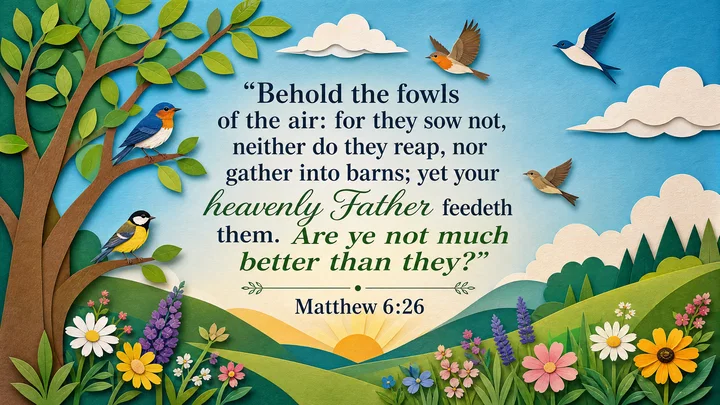
- Matthew 6:26
Behold the fowls of the air: for they sow not, neither do they reap, nor gather into barns; yet your heavenly Father feedeth them. Are ye not much better than they?
God feeds the birds and values people more.
- Matthew 10:29-31
Are not two sparrows sold for a farthing? and one of them shall not fall on the ground without your Father.
God notices sparrows and values people more highly.
- Psalms 147:9
He giveth to the beast his food, and to the young ravens which cry.
Both texts say God provides food for the ravens.
- Luke 12:6-7
Are not five sparrows sold for two farthings, and not one of them is forgotten before God?
God remembers sparrows and values people more.
- Psalms 37:3
Trust in the LORD, and do good; so shalt thou dwell in the land, and verily thou shalt be fed.
Trusting God is set against fear about livelihood and linked with being fed.
- Luke 12:31
But rather seek ye the kingdom of God; and all these things shall be added unto you.
Seeking God’s kingdom is joined to trusting God to provide.
- Matthew 6:30
Wherefore, if God so clothe the grass of the field, which to day is, and to morrow is cast into the oven, shall he not much more clothe you, O ye of little faith?
God clothes the lilies and will much more care for people.
- Matthew 6:32
( For after all these things do the Gentiles seek:) for your heavenly Father knoweth that ye have need of all these things.
God’s care for needs answers anxiety about provision.
- 1 Peter 5:7
Casting all your care upon him; for he careth for you.
Both urge casting care on God because he cares for his people.
- Job 38:41
Who provideth for the raven his food? when his young ones cry unto God, they wander for lack of meat.
Both describe God providing food for ravens.
- Matthew 6:34
Take therefore no thought for the morrow: for the morrow shall take thought for the things of itself. Sufficient unto the day is the evil thereof.
Both teach against worrying about tomorrow and trusting God to meet each day’s needs.
- Luke 12:7
But even the very hairs of your head are all numbered. Fear not therefore: ye are of more value than many sparrows.
God numbers people’s hairs and will not forget them.
- Psalms 104:28
That thou givest them they gather: thou openest thine hand, they are filled with good.
Both describe creatures receiving the food God provides.
- Luke 12:30
For all these things do the nations of the world seek after: and your Father knoweth that ye have need of these things.
The Father knows and provides for daily needs, unlike the nations’ anxious seeking.
- Matthew 6:19-20
Lay not up for yourselves treasures upon earth, where moth and rust doth corrupt, and where thieves break through and steal:
Heavenly treasure contrasts with earthly provision and possessions.
- 1 Timothy 6:17
Charge them that are rich in this world, that they be not highminded, nor trust in uncertain riches, but in the living God, who giveth us richly all things to enjoy;
Both contrast trust in God with reliance on uncertain riches.
- Matthew 10:30
But the very hairs of your head are all numbered.
Numbered hairs show God’s care extends even to the smallest detail.
- Luke 12:33-34
Sell that ye have, and give alms; provide yourselves bags which wax not old, a treasure in the heavens that faileth not, where no thief approacheth, neither moth corrupteth.
The chapter applies trust in God through giving alms and placing treasure in heaven.
- Matthew 6:8
Be not ye therefore like unto them: for your Father knoweth what things ye have need of, before ye ask him.
God knows what his people need.
- Psalms 145:16
Thou openest thine hand, and satisfiest the desire of every living thing.
God satisfies the needs of every living thing.
Commentary
Each commentary is drawn from primary sources: the writings of Ellen G. White and Adventist pioneers and periodicals. Each commentary is separate. Its own words are not a quotation; follow the references to read the source passages.
Ellen G. White
28 sources
God feeds the ravens even though they neither sow nor reap and have neither storehouse nor barn to gather food into.Ms 83, 1909, par. 4–7Ms 73, 1893, par. 4–8Ms 65, 1902, par. 2–5 People are of far greater value and consequence to Him, made and formed in His image with higher powers, so how much more will He care for and provide for them.Ms 83, 1909, par. 4–7Ms 73, 1893, par. 4–8Ms 65, 1902, par. 2–5 They are not to be consumed by anxiety over food and clothing and other daily needs, for anxious worry is unbelief and distrust while trust rests in the Father's care.Ms 83, 1909, par. 4–7Ms 73, 1893, par. 4–8Ms 65, 1902, par. 2–5 Jesus pointed to the birds singing without care to make this truth plain and simple, binding the lesson to nature so that seeing birds would repeat it to memory, lift daily toil toward the spiritual and unseen, and give courage to the afflicted and hope to the desponding to cast their cares on their sympathizing friend.Ms 108, 1905, par. 8–10RH May 30, 1871Lt 45, 1877, par. 43MR 333.2–3Lt 223, 1905, par. 8–10
Ravens Fed, People Valued
God feeds the ravens, though they neither sow nor reap and have neither storehouse nor barn in which to gather food into store.Ms 83, 1909, par. 4–7Ms 73, 1893, par. 4–8Ms 65, 1902, par. 2–515MR 98.2–3Lt 20, 1897, par. 5–7 Their lack of sowing, reaping, and storing does not leave them unfed, for their provision comes from Him.Ms 83, 1909, par. 4–7Ms 73, 1893, par. 4–8Ms 65, 1902, par. 2–54SP 445.2–446.1
The ravens must still gather their food and face danger, yet it is God who sustains living creatures and feeds the young ravens that cry.ED 117.2–3ED 99.1 Their life and provision therefore depend on His power, not their own.ED 117.2–3ED 99.1
People are of greater value and consequence to God than birds, and how much more will He care for and provide for them.Ms 83, 1909, par. 4–7Ms 73, 1893, par. 4–8Ms 65, 1902, par. 2–515MR 98.2–3ED 117.2–3 They are made in His image, formed in His image with higher powers, and therefore can trust His care.15MR 98.2–3DA 313.2–3Ms 108, 1905, par. 8–10 As His sons and daughters they are much better than the fowls, cared and provided for by Him.Ms 83, 1909, par. 4–7Ms 73, 1893, par. 4–8Ms 65, 1902, par. 2–5Lt 20, 1897, par. 5–74SP 445.2–446.1
People depend on God for life itself, since every breath, heartbeat, pulse, nerve, and muscle is sustained by His power.Ms 73, 1893, par. 4–815MR 98.2–3 Since they cannot add to their stature by worrying, worry cannot sustain them.Ms 73, 1893, par. 4–8
God watches over even the smallest creatures and cares for the flowers, so His children are never absent from His mind.DA 313.2–3Ms 108, 1905, par. 8–10 His care for people includes every detail of their lives, and He longs for them to reflect His character.DA 313.2–3 The ravens' faithful fulfillment of their created role reproves human unbelief and forgetfulness of dependence on God.Ms 35, 1899, par. 6–8
Christ Teaching Through Nature
Jesus taught in the open air, in groves and by the seaside and around lakes and mountains, where He could look upon the landscape and take familiar objects from humble daily life to make important truth plain and simple, and this choice of place and illustration was part of His care to make His teaching interesting to His hearers.RH May 30, 1871Lt 45, 1877, par. 2–3 The birds and other natural scenes around those lakes, groves, and mountains were meant to remind hearers of what He taught and to repeat those lessons to them.RH May 30, 1871Lt 45, 1877, par. 2–3 He pointed to birds singing without anxious care and to other created things to illustrate God's care in feeding His creatures, thereby associating the works of God in nature with the words of life.RH May 30, 18713MR 333.2–3 The birds of the air, well known from daily life, served Him as illustrations of immortal truth, and through them He directed minds through nature up to nature's God.RH May 30, 18713MR 333.2–3
He bound sacred lessons to natural objects so that the lessons would stay fresh in memory.RH May 30, 18713MR 333.2–3 Seeing birds and other created things after His ascension would hallow those truths in memory, repeat the lessons, remind of the spiritual and unseen, and light the way to heaven.RH May 30, 18713MR 333.2–3Lt 223, 1905, par. 8–10Lt 45, 1877, par. 2–3 Ordinary created things like the birds can thus remind people of God's care, while the lilies joined with them teach simplicity and trust in God.RH May 30, 1871Lt 223, 1905, par. 8–10 These lessons lift daily life beyond mere toil by directing the mind to spiritual and unseen things.Ms 108, 1905, par. 8–10Lt 223, 1905, par. 8–10 Christ's lessons from nature also rebuke ingratitude, lack of faith, and departures from God's plan, calling people of higher powers to trust Him rather than live in distrust and unbelief and to cast their cares on Christ who alone can help them bear life's burdens rightly.Ms 108, 1905, par. 8–10Lt 223, 1905, par. 8–10
God's feeding of the ravens and His care for birds and flowers show His love and care, and His provision for the ravens is evidence that He will care for people who are of greater consequence and value, as those formed and made in His image.CTBH 70.1–2FE 159.2–3CH 171.1CH 173.1 Attention to the beauty of creation belongs to this teaching, for the birds and flowers in nature can teach people about God's love and help them recognize His love and trust His care.FE 159.2–3CH 171.1CH 173.1 This use of nature is to be carried into the teaching of children, that they may notice God's care and love in the natural world.CTBH 70.1–2FE 159.2–3
Trust Without Anxious Worry
Consider the ravens because God feeds them though they neither sow nor reap and have neither storehouse nor barn, and people are of far greater value to Him and made in His image with higher powers, so they are to trust His care to provide for their needs rather than be consumed by anxiety over earthly necessities, food, clothing and other daily needs.Ms 83, 1909, par. 4–7Ms 73, 1893, par. 4–8Ms 65, 1902, par. 2–5Ms 35, 1899, par. 6–8Ms 21, 1889, par. 93–94 There is no time for anxious thoughts, and concern for food and daily needs is not to become an absorbing burden.Ms 83, 1909, par. 8Ms 21, 1889, par. 93–94 Anxious worry reflects unbelief, distrust and forgetfulness of dependence on God, while trust rests in the Father's care, and the ravens' faithful fulfillment of their created role reproves human unbelief.Ms 83, 1909, par. 4–7Ms 108, 1905, par. 8–10Ms 35, 1899, par. 6–8 People depend on God for life itself, since every breath, heartbeat, pulse, nerve and muscle is sustained by His power, and since they cannot add to their stature by worrying they should not be anxious but trust.Ms 73, 1893, par. 4–8
Those who serve God need not fear that hardship or taking a stand for truth will leave them and their families without what they need.Ms 83, 1909, par. 4–7 Faithful Sabbath-keepers fearing that obeying God may leave them unable to provide even bread for their children are assured that God sees them and will make a way for them to keep His commandments.HSFM 163.2–3 Even when God's people suffer deprivation and lack food during the judgments on the earth, they will not be abandoned to perish, but angels will provide them with food and water.4SP 445.2–446.1 God will not forget His people in danger, and even amid a storm at sea when a ship is threatened His care may be shown through heavenly angels guarding those under His protection.LSEGW 230.24T 288.3–289.1
The assurance of God's greater care and love for people made in His image gives courage to the afflicted and hope to the desponding.Lt 45, 1877, par. 4 Jesus is their sympathizing friend to whom they can bring all troubles and griefs and on whom they may cast their cares, for He alone can help them bear life's burdens rightly.Ms 108, 1905, par. 8–10Lt 45, 1877, par. 4 Christ's lessons from nature rebuke ingratitude, lack of faith and departures from God's plan and teach trust rather than distrust and unbelief.Ms 108, 1905, par. 8–10 Trust in God's care calls for living and working simply.Ms 83, 1909, par. 8 God will also give wisdom, skill, talent and ingenuity to meet human needs, including making wholesome food for the poor.Lt 27, 1902, par. 17–19
The chapter calls believers to trust God and use their resources faithfully, and its teachings apply to those spending the Lord's money on unnecessary things rather than supporting His work.Lt 147, 1899, par. 2 Those blessed with great light are to show earnest religious interest and put their whole heart into Christ's service instead of striving in a tame, listless way.Ms 185, 1898, par. 7–10 This is through daily prayer and watchfulness and earnest seeking of the Lord, so as not only to claim to believe the truth but to live and practice it with supreme love to God and to those for whom Christ died.Ms 185, 1898, par. 7–10
Those cared and provided for as God's sons and daughters, who are much more than the fowls, can move out by faith in His cause, accepting only help freely given and making sacrifice for its necessities without ostentation or display.Lt 20, 1897, par. 5–7 They are to build not a cathedral but a plain, neat, tasteful, thoroughly well-built tabernacle in harmony with faith and dedicated to God free from debt, refusing to spend the Lord's money in needless adornment and refusing the great loss of interest on debt.Lt 20, 1897, par. 5–7 They are to live as pilgrims and strangers whose citizenship is above, devoting the house to educating and training children and youth as well as elder members not to live to please themselves and not to court praise.Lt 20, 1897, par. 5–7 They are to guard their hearts with perpetual vigilance and jealousy lest they be estranged from God, to hunger and thirst after righteousness, to hide self in Jesus, to walk the way the great Teacher plainly defined, and to gain inward spiritual perception of the truth that never exalts self but leads the heart to realize sanctification of the Spirit in self-abasement and lowliness.Lt 20, 1897, par. 5–7
Sources
Pioneers and periodicals
61 sources
God feeds the ravens though they do not plant or harvest and keep no storehouse or barn, and people are far better and of far greater value to him than birds.ST Feb 16, 1882ST Jul 2, 1894ST Aug 9, 1899 The verse calls his disciples not to be anxious about life and food and clothing, because the Father knows their need and they are to seek his kingdom first with the promise that all these things will be added.ST Jul 2, 1894ST Aug 9, 1899RH Aug 1, 1854 That trust does not excuse idleness, for birds must gather what he provides and people must work with their own abilities, do their ordinary duties, and provide for themselves and their families without letting care consume them.RH Nov 10, 1859ST Apr 22, 1903ST Apr 8, 1886RH Apr 28, 1868 Fear about livelihood or loss is no excuse for disobedience, for he will feed and support those who put obedience first, even in keeping the seventh day, and those who sell and give alms lay up unfailing treasure in heaven.RH Nov 10, 1859ST Jul 18, 1878RH Apr 4, 1865ST Sep 30, 1880 His care may be claimed in prayer and in every trouble, for he is near to hear his children's cry and to help in poverty and sickness and danger, so want can be left in his hands without despair.RH Jul 1, 1902RH Nov 11, 1858RH Jun 2, 1903RH Jan 14, 1909ST Feb 25, 1875
Words and Setting
God feeds ravens though they do not sow or reap and keep no food in storehouse or barn, and people are of greater value to God than birds.ST Feb 16, 1882ST Jul 2, 1894ST Aug 9, 1899RH Aug 1, 1854 Disciples are of much more value than the birds, so life is more than food and the body more than clothing, and they should not be anxious about what they shall eat but trust their Father to feed them.ST Jul 2, 1894ST Aug 9, 1899RH Aug 1, 1854 The example teaches trust in God for food and freedom from anxious care about support, illustrating God's care for His children and showing why anxious effort cannot replace trust in His providence.ST Jul 2, 1894ST Aug 9, 1899ST Oct 21, 1886 It supports the instruction not to be anxious about food and clothing, but to seek God's kingdom and trust Him to provide.RH Aug 1, 1854
The raven is taken as a type of all birds to be considered, just as the lily is taken as a type of all flowers.ST Apr 16, 1896 The command to consider belongs to God's revealing of Himself in all nature, not alone in His word or His church or in miracles of power or grace.ST Apr 16, 1896 Birds still present in the Holy Land bear living witness to the truth of the statement that the fowls of the air that neither sow nor reap nor gather into barns are fed by the Heavenly Father.RH Aug 29, 1871 The same teaching is applied to the sparrow, for even a small seemingly worthless bird is cared for by the Lord, so one who feels forgotten can trust that God watches over and cares for them, and Jesus uses such a natural object to give force and beauty to a great truth.ST May 22, 1884RH Jan 9, 1872 It is applied also to robins and other feathered songsters sharing His bounty, whom God feeds and cares for while guarding people day by day even more, so they can be trustful and free from anxious care.RH Mar 26, 1901
The verse belongs to Christ's practical sermon in which faith is set against fear.ST Jan 22, 1880ST Jan 22, 1880ST Oct 3, 1878 It was addressed to His disciples in the presence of a multitude, holding up in widest contrast the confidence of willing faith and the fear of unbelief, where confidence in God through faith is contrasted with fear rooted in unbelief.ST Jan 22, 1880ST Jan 22, 1880ST Oct 3, 1878 It belongs to His instruction in Luke 12:22-37 to His disciples as the little flock waiting for their Lord to return from the wedding, and it binds everyone who claims that place now. Its command to sell what they have and give alms means every disciple must have works agreeing with faith, for dead faith will not stand in the judgment and receive acquittal with well done, good and faithful servants. With Matthew 24 and 25, Mark 13, and Luke 21 it gives exhortation to watch in connection with the signs of the second advent and applies to a certain period just prior to that event.RH Oct 15, 1872
Jesus taught in the open air, in groves and by the seaside, where He could see the landscape and use familiar objects from humble life to make important truth plain and simple.RH May 30, 1871 He pointed to birds singing without care to illustrate God's care and feeding of His creatures and how much more He values people, associating the works of God in nature with the words of life.RH May 30, 1871ST Sep 1, 1898 He directed minds through nature up to nature's God and bound sacred lessons to natural objects so the lessons would stay fresh in memory.RH May 30, 1871 Seeing birds and other created things after His ascension would make the truths hallowed in memory and light the way to heaven, and this use of nature was part of making His teachings interesting and caring for His hearers.RH May 30, 1871 Nature thus teaches through the example of ravens which He feeds that God provides for and cares for His children.ST Sep 1, 1898
God's Care for Creatures
God feeds and cares for creatures that make no provision for themselves, and his special care rests on those who faithfully do their daily duties.RH Nov 8, 1870ST Dec 4, 1879RH May 27, 1902 His care reaches every creature so that none is forgotten, giving each bird its daily portion with nothing laid up for the future.ST Dec 24, 1902RH Feb 8, 1906 He knows when one falls to the ground, regards the cry of the raven and gives food to ravens and all the fowls of heaven though they neither sow nor reap and have no storehouse nor barn.RH May 27, 1902RH Nov 3, 1863RH Feb 8, 1906 This constant watching and keeping of many small weak birds all over the world shows thoughtful providence, tender mercy, power and character revealed in nature, proves he has his creatures on his heart and concerns himself about them, and assures that he is near and will help and care even when human help is far away.ST Dec 4, 1879ST Nov 22, 1883RH Nov 3, 1863 The same care was seen when unexpected grain sown by enemies lay hidden in the mountains until it sustained 400 Waldenses through the winter.ST Nov 22, 1883
By a greater-to-lesser argument, the One who cares for birds for a day cares far more for people he made for eternity.ST Aug 18, 1887 People are of greater worth to him than birds and are much better than birds, so he will much more feed them.RH Nov 8, 1870ST Dec 24, 1902ST Aug 18, 1887 He cares much more for people and much more still for his children, who are of much more value and were redeemed by no less a price than the blood of his Son.RH Nov 3, 1863
The provision is still gathered, for birds must gather the food he makes available though they do not sow, reap or store it.ST Apr 22, 1903ST Dec 24, 1902ST Aug 26, 1897 Active effort is part of the law of life for creatures, and even when food is scanty diligent gathering makes it sweet and always enough, because life is more than food.ST Dec 24, 1902RH Feb 8, 1906 The birds' continual provision is reason to trust the Father in every kind of weather and circumstance, to receive what he gives and gather it with gratitude, and to use one's own abilities to work with God rather than be idle.ST Apr 22, 1903ST Aug 26, 1897
Trust Instead of Anxiety
Luke 12:24 calls disciples not to be anxious about life and what supports it, about food and drink and clothing, because life is more than food and the body more than clothing and the Father knows their need.ST Jul 2, 1894ST Aug 9, 1899RH Aug 1, 1854ST Sep 17, 1896 God feeds the ravens though they neither sow nor reap and have neither storehouse nor barn, and disciples are of much more value than the birds, so they are to trust him to feed them and be free from anxious care about support.ST Jul 2, 1894ST Aug 9, 1899RH Aug 1, 1854ST Dec 24, 1894 Faith trusts God for the needs of this life as well as for the life to come, seeks the kingdom of God first with the promise that all these things shall be added, and shows itself in a life of faith and good deeds with hope of the immortal kingdom rather than anxious dependence on earthly riches.RH Aug 1, 1854ST Dec 24, 1894ST Sep 17, 1896 This trust is to be put ahead of ordinary work and possessions, especially by those waiting for Christ's second coming, who are to remain ready for his return, and it supports selling possessions, giving alms, and laying up treasure in heaven.RH Aug 1, 1854ST Dec 24, 1894
Trust is tested when supplies seem to run out, for whoever trusts God for eternal life, which matters more than physical life, can trust him for food and clothing, which matter less.ST Jul 2, 1894 The verse warns against making earthly provision and possessions the chief concern of life, anxiously accumulating goods for self-gratification while neglecting to be rich toward God and to seek his kingdom first.ST Dec 24, 1894RH Nov 29, 1853RH Apr 28, 1868 Such worry comes from little faith despite strong assurances of faithfulness and love and care, and it stands in contrast to quiet dependence of the trusting soul that brings rest of mind and peace in the soul.RH Nov 5, 1872 It rebukes the selfish, meteor-like character that creates many artificial necessities for itself and is miserable in proportion to its anxiety over fancied wants, glowing and rushing wildly for a moment only to burst and end in the deepest darkness of disappointment instead of taking a lasting place among the shining worlds that go out from God.RH Nov 5, 1872 The warning is against letting care for this life consume time and purpose, not a rule about the quality or quantity of food.RH Apr 28, 1868
Just as God provides bodily food, he provides daily spiritual food in the holy Scriptures, which nourish the renewed life and point to heavenly bread.ST Aug 26, 1897 The ravens are a lesson against borrowing trouble from future evils, for they may suffer hunger today but do not worry about tomorrow's hunger, and God's care for them is the reason people need not anxiously think about tomorrow.RH Mar 24, 1903 His people can trust him to sustain them amid the third angel's message and should not grasp after the world.RH Dec 9, 1852
Work Alongside Trust
God feeds ravens that neither plant nor harvest nor store, and because people are much better than birds he provides for human need, yet that provision gives no warrant for idleness or for living off the giving of others.RH Nov 10, 1859ST Apr 22, 1903 Birds are fed without human means of sowing and reaping and storing, but they must still gather the food he makes available, and so people have reason not to fear for their needs while using their own abilities to work with God rather than standing idle.RH Nov 10, 1859ST Apr 22, 1903 Trust in the Father who knows and supplies the needs of his children for food and clothing removes anxiety while calling for doing one's best without worry.ST Apr 22, 1903ST Apr 8, 1886
The selling taught in the same chapter means raising means for vigorous and extensive spread of Bible truth, to be obeyed with sanctified good sense.RH Nov 10, 1859 The poor man must not rashly sell his little home and bring himself into want while hundreds hold more property than they need, while those with surplus should sell a portion to free themselves from burden and worldly care, and all should bear a part even if only a very small gift.RH Nov 10, 1859
The verse teaches trust in God's care, not neglect of ordinary duties, for it does not forbid cultivating the soil, sowing and planting, or giving reasonable thought to providing for oneself, one's family, and the poor.RH Apr 28, 1868 It lays down no rule about the quality or quantity of food, but warns against making food, clothing, and wealth the chief concern of life, anxiously accumulating goods for self-gratification while neglecting to be rich toward God and seek his kingdom first.RH Apr 28, 1868 It warns against letting care for this life consume time and purpose, allowing neither laziness nor faith without corresponding effort.RH Apr 28, 1868
Obedience and Generosity
Fear about supporting a family, protecting livelihood, losing business income, or having business interfered with by keeping the seventh day is no excuse for disobedience, because the God who provides for ravens that do not sow, reap, gather, or store will provide food and support for people who put obedience to him first, since people are of greater worth and more valuable to him than birds.ST Jul 18, 1878RH Apr 4, 1865ST Sep 30, 1880RH Sep 17, 1857RH Feb 7, 1916 Trust in that care is to take the place of putting worldly security ahead of obedience and letting anxiety about family provision keep from following him.ST Jul 18, 1878RH Feb 7, 1916
In its setting the verse supports selling possessions, giving alms, and laying up treasure in heaven rather than making earthly provision and possessions the center of life.RH Nov 10, 1859ST Dec 24, 1894 The command to sell binds everyone who claims the place of the little flock waiting for their Lord to return from the wedding, requiring works agreeing with faith, for dead faith will not stand in the judgment and receive acquittal with well done, good and faithful servants. That selling means raising means for vigorous and extensive spread of Bible truth, to be obeyed with sanctified good sense: those with surplus and more property than they need should sell a portion to free themselves from burden and worldly care, the poor man must not rashly sell his little home and bring himself into want, yet all should bear a part even if only a very small gift.RH Nov 10, 1859 What is given to the cause of God from a pure motive to glorify him — means, reputation, health and even life, houses, lands, earthly friends and everything this world calls dear — is not lost but saved, transferred from mortal life to the immortal shore, put beyond the reach of the fiery element of this world as treasure in heaven, to be exchanged for immortal health in the kingdom of glory.RH Jun 17, 1873 Those who freely and promptly bring all the tithes and give of their means to finish the work, advance the cause, and help the needy prove his care for his faithful, sacrificing children, and may trust him to provide and pour out a blessing beyond receiving.RH Dec 20, 1870
Because God feeds ravens that do no sowing or reaping and keep no stored food, and people are much better than birds so that God will feed them, anxious provision for the future through life insurance is forbidden, and care of widows and fatherless and daily need is to be left to God.RH Jan 7, 1902 The passage applies these directions especially to those waiting for Christ's second coming: they must put trust in God ahead of ordinary work and possessions, not be anxious about food and clothing but seek God's kingdom and trust him to provide, remain ready for his return, and not live like the nations whose concern is for earthly things.RH Aug 1, 1854RH Nov 12, 1857 They are to step out upon the truth with the whole soul knowing it will bear them, to be like men who wait for the coming of their Lord and no longer deny faith by works, and to lean upon the mighty arm of God for strength because he will never let those who trust in him fall.
God will feed and clothe his people in times of famine or poverty brought on by persecution for righteousness' sake.RH Dec 5, 1854 Ministers, like others, should be left in God's hands rather than relying on state support.ST Nov 15, 1905 Unexpected grain that sustained 400 Waldenses through the winter illustrates this care in providing for his people as he feeds the birds, for provisions sown by their enemies remained hidden in the mountains until needed.ST Nov 22, 1883 Those who give generously in trust may rely on him to provide for their needs, and people whom God feeds should in turn give the poor the Living Bread.RH May 28, 1872ST Sep 10, 1896
Prayer and Present Comfort
God's feeding of the ravens, which neither sow nor reap nor keep provisions in storehouse or barn, shows that he has his creatures on his heart and that people are worth far more to him than birds, so their needs can be left in his care, cast upon him and brought to him in prayer with assurance that he will hear, receive prayer and supply all needs.RH Nov 11, 1858RH Jan 14, 1909ST Feb 25, 1875RH May 27, 1902ST Mar 4, 1886 He hears his children's cries, stays near them, and helps, guards, leads and guides them.RH Jan 14, 1909ST Mar 4, 1886RH Mar 31, 1910 People may appeal to that care when they pray despite their errors, wanderings and unbelief, and the feeding of the ravens stands linked with seeking God and finding him.RH Nov 11, 1858ST Feb 25, 1875
The verse assures God's children that he is near and will help even when human help is far away, in poverty and want, sickness, hardship, scant harvest and storm, low wages and hard times, family need, fear, affliction, danger, and great and small troubles.RH Jul 1, 1902RH Jun 2, 1903ST May 22, 1884RH Jul 16, 1857ST Jan 7, 1889 Even one who feels small, seemingly worthless and forgotten like the sparrow can trust that the Lord watches over and cares for them, since he feeds the birds and gives each its portion.RH Jul 1, 1902ST May 22, 1884 A sick father in family need may trust that God will not let them go without, and timely relief often comes through the generosity of others such as children who give from what they have, and through unexpected help.RH Jul 1, 1902ST Jan 7, 1889 So they need not despair when they cannot understand his purposes, need not be afraid or lose their way, but can meet hardship patiently without worry about obtaining a living even while seeking to obey him, wait patiently in quiet confidence for his salvation at hand, learn obedience to his will, and even share cup and plate and divide supplies with one who has nothing.RH Jul 1, 1902ST Jan 7, 1889RH May 27, 1902
It cheers those toiling honestly under heavy burdens, while looking on nature, hearing birds sing and seeing flowers bloom, to be of good courage. They are not to murmur and complain if sickness comes, not to seek anxiously what to eat or drink like the nations of the world, and not to live in careful suspense or doubtful mind in little faith. The Father knows the need for food and drink and clothing, as seen also with the lilies God clothes without their toil beyond Solomon in glory and with the grass God clothes today though tomorrow it is cast into the oven, and with seeking the kingdom of God first comes the promise that all these things shall be added. They can trust him to provide their needs even more than he provides for birds that have no storehouse, and rejoice and praise him through uncertain days without waiting until the future is known.
In contrast, the poor man whose wife has died of hunger has received no such provision as the raven God feeds, yet he turns to God and trusts that there is a welcome for him beyond this life.RH Mar 11, 1875 His care is his love, heard in every note swelling a bird's throat and seen in blossoms and leaves.ST Dec 7, 1915 The blue sky is a canopy of blessing, the roof of the Father's house, where clouds only veil unchangeable light and night only unveils new worlds of light, so that fold after fold of the universe only unfolds more blessing and shows deeper and deeper the love at the heart of all, giving inexpressible joy.ST Dec 7, 1915
Sources