Matthew 6:30
Wherefore, if God so clothe the grass of the field, which to day is, and to morrow is cast into the oven, shall he not much more clothe you, O ye of little faith?
Translations
Why, if God so clothe the grass of the field, which to day is, and to morrow is cast into the oven, shall he not much more clothe you, O you of little faith?
King James Version, KJV Cambridge Paragraph Bible
Wherefore, if God so clothe the grass of the field, which to day is, and to morrow is cast into the oven, shall he not much more clothe you, O ye of little faith?
Wherefore, if God so clotheth the grass of the field, which to-day is, and to-morrow is cast into the oven, will he not much more clothe you, O ye of little faith?
But if God doth so clothe the grass of the field, which today is, and tomorrow is cast into the oven, shall he not much more clothe you, O ye of little faith?
But if God doth so clothe the grass of the field, which to-day is, and to-morrow is cast into the oven, shall he not much more clothe you, O ye of little faith?
'And if the herb of the field, that to-day is, and to-morrow is cast to the furnace, God doth so clothe — not much more you, O ye of little faith?
But if God so clothe the herbage of the field, which is to-day, and to-morrow is cast into [ the] oven, will he not much rather you, O [ye] of little faith?
Now, if the grass of the field—which to-day, is, and, to-morrow, into an oven, is cast—God thus adorneth, not much rather, you, little of faith?
Berean Standard Bible, Majority Standard Bible
If that is how God clothes the grass of the field, which is here today and tomorrow is thrown into the furnace, will He not much more clothe you, O you of little faith?
But if God so clothes the grass of the field, which today exists and tomorrow is thrown into the oven, won’ t he much more clothe you, you of little faith?
But if God gives such clothing to the grass of the field, which is here today and tomorrow is put into the oven, will he not much more give you clothing, O you of little faith?
Wherefore if God so clothe the grasse of the fielde which is to day, and to morowe is cast into the ouen, shall he not doe much more vnto you, O ye of litle faith?
Douay-Rheims (Challoner revision)
And if the grass of the field, which is today, and tomorrow is cast into the oven, God doth so clothe: how much more you, O ye of little faith?
Pictures


Cross-references 20 of 39
- Matthew 6:26
Behold the fowls of the air: for they sow not, neither do they reap, nor gather into barns; yet your heavenly Father feedeth them. Are ye not much better than they?
God feeds the birds, showing his care for people and reason to trust his provision.
- Luke 12:27-28
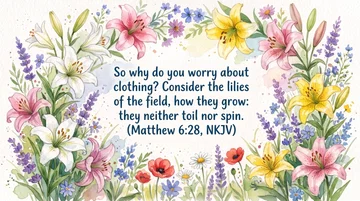
Consider the lilies how they grow: they toil not, they spin not; and yet I say unto you, that Solomon in all his glory was not arrayed like one of these.
God clothes the grass and uses the lilies to teach trust in his care.
- Matthew 10:29-31
Are not two sparrows sold for a farthing? and one of them shall not fall on the ground without your Father.
God’s care for sparrows and knowledge of each person’s hairs affirm his concern for people.
- 1 Peter 5:7
Casting all your care upon him; for he careth for you.
Both affirm God’s care and urge trust amid life’s needs.
- Luke 12:6-7
Are not five sparrows sold for two farthings, and not one of them is forgotten before God?
God’s care for sparrows and knowledge of people echo the appeal to his care.
- Matthew 6:25
Therefore I say unto you, Take no thought for your life, what ye shall eat, or what ye shall drink; nor yet for your body, what ye shall put on. Is not the life more than meat, and the body than raiment?
God’s promise of clothing addresses worry about life’s needs.
- Luke 12:24
Consider the ravens: for they neither sow nor reap; which neither have storehouse nor barn; and God feedeth them: how much more are ye better than the fowls?
God feeds the ravens, much more providing for people.
- Matthew 6:34
Take therefore no thought for the morrow: for the morrow shall take thought for the things of itself. Sufficient unto the day is the evil thereof.
God’s provision frees people to meet today’s duties without anxiety about tomorrow.
- Matthew 6:19-21
Lay not up for yourselves treasures upon earth, where moth and rust doth corrupt, and where thieves break through and steal:
Contrasts earthly hoarding with heavenly treasure before teaching trust in God.
- Romans 8:32
He that spared not his own Son, but delivered him up for us all, how shall he not with him also freely give us all things?
God’s gift of his Son assures confidence that he will provide what is needed.
- 1 Kings 17:4-6
And it shall be, that thou shalt drink of the brook; and I have commanded the ravens to feed thee there.
God sustains Elijah during famine by providing food through ravens.
- Psalms 147:9
He giveth to the beast his food, and to the young ravens which cry.
Both texts show God’s care in providing for his creatures.
- Matthew 10:30-31
But the very hairs of your head are all numbered.
God’s care and knowledge of people assure them of their greater worth.
- Luke 12:32
Fear not, little flock; for it is your Father’s good pleasure to give you the kingdom.
God’s care grounds fearless trust in the Father’s good pleasure to give the kingdom.
- Psalms 145:16
Thou openest thine hand, and satisfiest the desire of every living thing.
Both show God faithfully supplying needs and satisfying every living thing.
- Matthew 5:45
That ye may be the children of your Father which is in heaven: for he maketh his sun to rise on the evil and on the good, and sendeth rain on the just and on the unjust.
Sunshine and rain show God’s care for all people.
- Philippians 4:6-7
Be careful for nothing; but in every thing by prayer and supplication with thanksgiving let your requests be made known unto God.
Prayer and trust in God answer anxious care and bring his peace.
- Luke 12:28
If then God so clothe the grass, which is to day in the field, and to morrow is cast into the oven; how much more will he clothe you, O ye of little faith?
Both teach God’s care through the image of grass clothed today and cast into the oven tomorrow.
- 1 Timothy 6:8
And having food and raiment let us be therewith content.
Both connect trusting God for food and clothing with contentment.
- 1 Kings 17:14-16
For thus saith the LORD God of Israel, The barrel of meal shall not waste, neither shall the cruse of oil fail, until the day that the LORD sendeth rain upon the earth.
God sustains the widow’s food supply amid scarcity.
Commentary part 1 of 2
Each commentary is drawn from primary sources: the writings of Ellen G. White and Adventist pioneers and periodicals. Each commentary is separate. Its own words are not a quotation; follow the references to read the source passages.
Ellen G. White
116 sources
God clothes plant life that is brief and delicate, quickly withering and cut down and perishing within a day before it is burned for fuel.SC 123.22T 496.2Lt 175, 1896, par. 19–23 He taught this to call His hearers away from anxious thought about what to eat and drink and wear, since life is more than food and the body more than clothing, the Father knows these needs, and those who seek first His kingdom and righteousness will have all these things added.Ms 139, 1897, par. 3–5Lt 70, 1893, par. 29–33Lt 391, 1907, par. 13–16 If He so clothes the grass He will much more clothe and provide for His people, because they are formed in His image, gifted with higher powers, and of far greater value than birds and flowers.Lt 79, 1900, par. 23–26ST Jan 19, 1915Ms 43a, 1894, par. 36–38Ms 20, 1894, par. 24–2613MR 242.1–243.1 Worry and distrust about necessities are therefore rebuked as little faith, while trusting the caring Father, doing what can be done and leaving the rest to Him, brings rest from undue anxiety.SC 123.22T 496.2Lt 175, 1896, par. 19–23Ms 20, 1894, par. 24–26Ms 177, 1905, par. 12 The clothing He gives also points inward and upward to the meekness and righteousness of Christ and beauty of character, which unfolds in a yielded life as His life unfolds in a lily by rain and sunshine, without artificial striving or display.2T 496.218MR 3.1–3Lt 84, 1900, par. 12–14Ms 116, 1898, par. 10–11
Words and Immediate Context
The grass of the field that exists today and tomorrow is thrown into the oven is plant life that is brief, delicate and short-lived, quickly withering, cut down and perishing in a day.SC 123.22T 496.2Lt 175, 1896, par. 19–23Lt 43, 1896, par. 3Ms 94, 1899, par. 25–26 After its short life it is burned as fuel.2T 496.2Lt 175, 1896, par. 19–23Lt 43, 1896, par. 3Ms 94, 1899, par. 25–26MH 289.2–4 Its beauty while it lasts is delicate, varied and perishable.SC 123.22T 496.2Lt 43, 1896, par. 3
The saying was spoken by Christ in the Sermon on the Mount, given especially to His disciples while the gathered multitude also heard.Ms 151, 1898, par. 45–48DA 298.2–3FE 309.1 It belongs to His teaching about the holy law and the holy standard of character.Lt 7, 1886, par. 34Ms 26, 1899, par. 29–30 That teaching shows the law must be present in the heart and not merely observed outwardly, for the state of the heart regulates the life and character.Lt 7, 1886, par. 34Ms 26, 1899, par. 29–30 It is the pure gospel of the Mount concerning laying up treasure in heaven where moth and rust do not corrupt and thieves do not steal, because where treasure is the heart will be also, and concerning refusing service to mammon.Ms 139, 1897, par. 3–5Lt 70, 1893, par. 29–33Ms 151, 1898, par. 45–48 It opposed self-righteous doctrine and corrected a stern, compassionless picture of God.FE 309.1
Its immediate argument is that life is more than food and the body more than clothing.Ms 139, 1897, par. 3–5ST Mar 10, 1909 The heavenly Father knows His children need food, drink and clothing, for the God who gave life knows the need of food to sustain it and the God who created the body knows the need of clothing, and He who bestowed the greater gift will bestow what is needed to make it complete.Ms 139, 1897, par. 3–5Lt 70, 1893, par. 29–33Lt 391, 1907, par. 13–16Lt 53, 1898, par. 27–28ST Mar 10, 1909 They are therefore to take no anxious thought saying what they shall eat or drink or wear.Ms 139, 1897, par. 3–5Lt 70, 1893, par. 29–33Lt 391, 1907, par. 13–16RH Jul 3, 1900Lt 84, 1900, par. 12–14 Instead with singleness of eye they are to refuse laying up corruptible treasure on earth, refuse to serve mammon, and seek first the kingdom of God and His righteousness, trusting all these things shall be added unto them.Ms 139, 1897, par. 3–5Lt 70, 1893, par. 29–33RH Jul 3, 1900Lt 53, 1898, par. 27–28Lt 84, 1900, par. 12–14
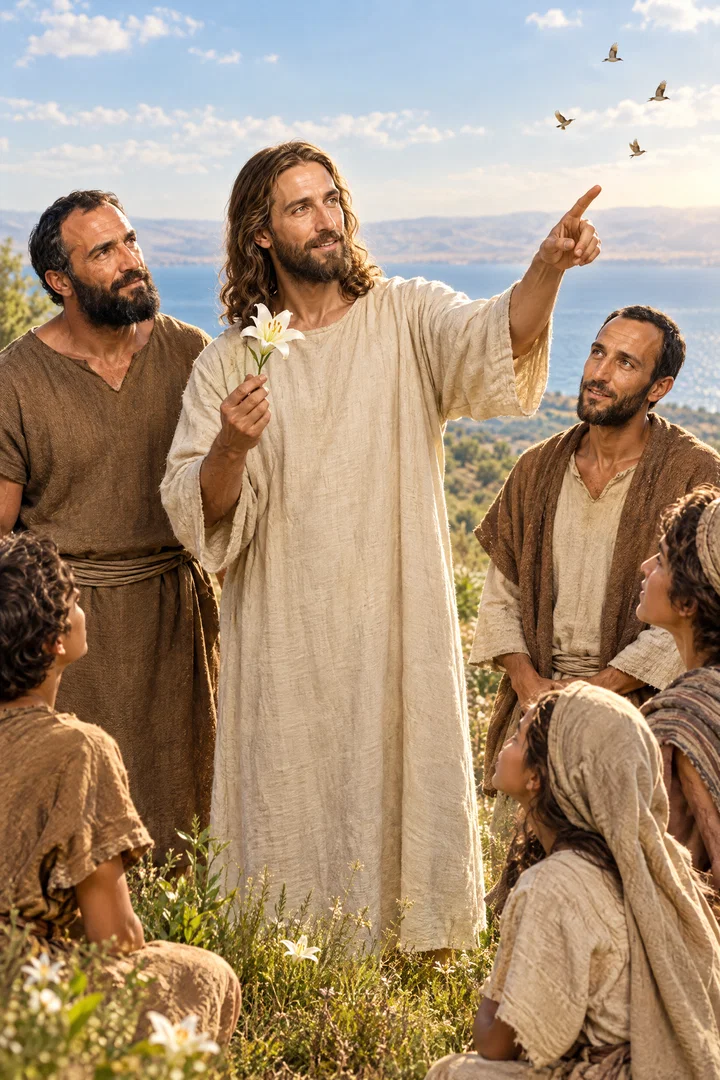
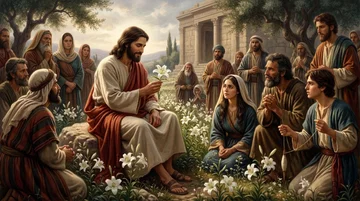
He illustrated it by pointing to the hillsides and fields bright with flowers in the dewy freshness of the morning, calling hearers to consider how the lilies grow.Lt 53, 1898, par. 27–28ST Mar 10, 1909 He placed lilies, and also roses and pinks, in the hands of children and youth.CT 178.3–179.1Lt 53, 1898, par. 27–28RH Jul 9, 1901 His own youthful face was aglow with His Father's light as He taught.Lt 53, 1898, par. 27–28 The flowers grow in natural simplicity and loveliness beyond Solomon in all his glory and beyond the robes of kings, without toil or spinning.CT 178.3–179.1Lt 53, 1898, par. 27–28RH Jul 9, 1901ST Mar 10, 1909
God's Greater Care for People
If God clothes even the grass of the field though it is short-lived, He will much more clothe His people and supply clothing and other needed blessings, for His care for people is greater than His care for grass and flowers.ST Jan 19, 1915Ms 43a, 1894, par. 36–38Ms 20, 1894, par. 24–26Lt 4a, 1902, par. 12Ms 44, 1894, par. 14–16 The verse assures worried and sorrowful people that they can trust the heavenly Father who knows what they need, rather than worrying with little faith, and it calls them to rely on Him for suitable, comfortable, neat and warm clothing without extravagance.ST Jan 19, 1915Ms 43a, 1894, par. 36–38Ms 44, 1894, par. 14–16 They can trust His care without first seeing how everything will turn out, because He is their caring Father, and this trust holds even in days of peril and trial.Ms 20, 1894, par. 24–26Lt 4a, 1902, par. 12Ms 177, 1905, par. 12 The lily and grass show that God's care rather than human effort is the source of what He provides, and the lesson drawn from the beauty of nature warns against little faith.Lt 4a, 1902, par. 12Ms 44, 1894, par. 14–16
The reason lies in the place human beings hold in creation, for they are formed in God's image and likeness, gifted with higher and nobler powers than lower creation, of greater consequence and value than birds and flowers, His purchased heritage and His children.Lt 79, 1900, par. 23–2613MR 242.1–243.1Ms 25, 1890, par. 12ST Oct 10, 1900DA 313.2–3 Blessing and care are proportionate to the place each thing holds in creation, so His estimate of and love for beings made in His image is immeasurably greater than His care for flowers that wither in a day.Lt 79, 1900, par. 23–2613MR 242.1–243.1Ms 25, 1890, par. 12 The beauty He gives short-lived plants, outshining Solomon in all his glory, is meant to enlarge views of His goodness and to prove how much more He will clothe and care for people.Lt 79, 1900, par. 23–26ST Oct 10, 1900FE 159.2–3
He keeps every human being continually in His mind and present before Him, knowing the whole history and even the number of the hairs on the head, so that people are not forgotten.Lt 79, 1900, par. 23–2613MR 242.1–243.1Ms 25, 1890, par. 12ST Oct 10, 1900DA 313.2–3 He watches each person in every circumstance and notices every tear and smile, and trusting this care frees from undue anxiety and brings rest of soul.CE 54.4–55.1DA 313.2–3SC 85.4–86.1 The hand that upholds the world upholds and strengthens His weakest child, and the great Master Artist who gives the lily its delicate tints cares for the little sparrow so that not one falls without His notice.Lt 79, 1900, par. 23–26ST Oct 10, 1900 With a page in the volume of providence recording the events of each life history, His wonderful love and care reach even to the smallest details of life and assure those who choose His service that He will provide the blessings they need for this life.Lt 79, 1900, par. 23–26DA 313.2–3
Even though men and women have sinned grievously they are not forsaken or forgotten, and His care extends even to the weakest and most sinful.Lt 79, 1900, par. 23–26ST Oct 10, 1900 He who rules in heaven will not pass by those formed in His own image and purchased with His own blood, nor ignore their suffering cries.Ms 90, 1894, par. 11MH 341.1ST Oct 20, 1914 He has not lost sight of the first cause or the last effect of evils such as drunkenness, but marks all the wickedness that keeps up misery and crime and charges it to those whose influence opens the door of temptation to another soul, requiring an account from those who lay a snare, rob and degrade, live in luxury by that degradation, and help speed others to ruin.Ms 90, 1894, par. 11MH 341.1ST Oct 20, 1914
He is constantly working to make this provision good, just as He constantly works to answer the prayer for daily bread, with an invisible power constantly at work as man's servant to feed and clothe him.COL 81.1ST Mar 10, 1909HL 291.2–293.1 The same power that set the starry worlds on high gives life to every blade and blossom, so that every wayside blossom owes its being to one pulse of life from God's great heart thrilling through all created things, and no human touch can impart life to even one flower or blade though human skill may copy graceful forms and delicate hues.ST Mar 10, 1909HL 291.2–293.1HL 19.3 Through soil, air, dew, rain and sunshine He sustains vegetation, and many agencies are employed to make seed that seems thrown away into a living plant, supplying in due proportion all that is required to perfect the harvest.COL 81.1HL 19.33SP 48.1 The God who gave life knows the need of food to sustain it and the God who created the body knows the need of raiment, so He who bestowed the greater gift will bestow what is needed to make it complete, the green grass and flowers testifying to His tender fatherly care and desire to make His children happy, with nothing too small for His attention and His care for eternal interests greater still.ST Mar 10, 1909HL 291.2–293.18T 325.43SP 48.1
Trust Over Anxious Unbelief
Anxious thought, perplexity, doubt, distrust and worry about what to eat, what to drink, what to wear and how necessities will be met are rebuked by the words O ye of little faith as signs of a faithless heart.SC 123.22T 496.2Lt 175, 1896, par. 19–23Lt 43, 1896, par. 3ST Jul 2, 1894 The grass of the field is delicate and short-lived, quickly withering and then used as fuel, yet the divine artist clothes it with varied colors and beauty, which proves that people made in His image can trust Him to provide clothing and inward adornment in the meekness and righteousness of Christ.SC 123.22T 496.2Lt 175, 1896, par. 19–23Lt 43, 1896, par. 3ST Jul 2, 1894 Worry over necessities instead of trusting the heavenly Father who knows what is needed is little faith, and the question calls for reliance on His tender, personal care rather than laying up treasure on earth.2T 496.2Lt 175, 1896, par. 19–23Lt 43, 1896, par. 3ST Jul 2, 1894Ms 73, 1894, par. 1–3
Trust means waiting upon the caring heavenly Father, serving faithfully, doing what can be done and leaving what cannot be done to Him, without first seeing how everything will turn out.Ms 20, 1894, par. 24–26Ms 166, 1897, par. 2–3CE 54.4–55.1SC 85.4–86.1COL 51.2 Such trust frees from undue anxiety and brings rest of soul, for He sustains all creation, watches each person in every circumstance, and notices every tear and smile.Ms 20, 1894, par. 24–26Ms 177, 1905, par. 12CE 54.4–55.1SC 85.4–86.1 It extends from everyday food and clothing to the redemption of the soul and to days of peril and trial, when the poor in toil and deprivation and fear of want and the rich in fear of loss and anxious cares are to cast the burden of life's cares upon Christ for help and comfort.Ms 177, 1905, par. 12Ms 166, 1897, par. 2–3COL 51.2 Forgetting this lesson leaves the burden uncarried by Christ, so that cares that should drive to the Saviour for help and comfort instead separate from Him, while having faith rather than sight means fighting the good fight of faith, trusting continually with thanksgiving and praise, talking faith, working in faith, looking to Jesus to grow in grace and knowledge, laying hold of God's hand in confidence and following without fretting while He strengthens and blesses those who put trust in Him.Ms 166, 1897, par. 2–3COL 51.2
Distrust is ingratitude and unbelief that dishonors God, robs Him of the honor due His holy name, and casts reflection upon Him.Ms 166, 1897, par. 2–3STB 353.1–3Ms 108, 1905, par. 8–10MWISDAP 10.1–3 Though gifted with higher and nobler powers than lower creation, man has disobeyed his Creator, departed from His plan, lowered himself to acts that dishonor his Maker, and that unbelief leads to evil works, wrong principles, greed, selfishness, worldliness and sharp practices.Ms 108, 1905, par. 11–15STB 354.1–2STB 353.1–3Ms 108, 1905, par. 8–10MWISDAP 10.1–3 This appears when professed disciples give first consideration to houses, lands, property and business interests and seek after all these things as the Gentiles seek.Ms 108, 1905, par. 11–15STB 354.1–2MWISDAP 10.4–11.2 God has made His will clearly known and gives evidence after evidence of His desire that none perish but that all by believing and obeying His word shall have eternal life, calling human beings to reveal the pure, unselfish love and unquestioning faith Christ manifested in clothing His divinity with humanity to become one with humanity, to live pure, holy lives to become one with Him and thus one with God, to become partakers of the divine nature and escape corruption through lust, and to cast all heavy burdens and cares upon Him because without His help they cannot be carried aright.STB 353.1–3Ms 108, 1905, par. 8–10MWISDAP 10.1–3
Such a self-serving course brings God's rebuke and stern judgments openly displayed, as upon the institutions and believers in Battle Creek, where the two largest institutions fell for unrighteousness.Ms 108, 1905, par. 11–15STB 354.1–2 Those who continue to act as the Gentiles act will be punished as the Gentiles with greater severity because of greater light unless there is thorough conversion and repentance, and determined obstinacy and defiance after correction brings continued divine displeasure.Ms 108, 1905, par. 11–15STB 354.1–2
The promise holds in concrete trials of loyalty and sacrifice, for doubting God's care to provide is little faith even when obedience costs work and wages.Ms 141a, 1897, par. 1–9Lt 54, 1897, par. 3–54T 253.3–254.1 When a person keeps the seventh day and loses employment rather than break the fourth commandment, fear about how the family will live and meet debt and want is unbelief in the care of the heavenly Father, strengthened by Satan, and God rebukes that fear as little faith while honoring loyalty by opening a better way and supplying the need for the honor of His name, as when Brother Sharp after losing his job for keeping the Sabbath found work with an employer who valued his honesty and allowed him to keep the Sabbath.Ms 141a, 1897, par. 1–9Lt 54, 1897, par. 3–5 The same assurance belongs to those pressed by poverty, to those who give up possessions and use entrusted substance to advance God's work even in famine as He cared for Elijah, to those called to advance when the time has fully come instead of holding back from worry about money and material provision, and to those sent out as workers without money in hand, for their bread and water will be sure and clinging to earthly treasure for fear of coming to want shows little faith that can cost heavenly treasure and everlasting life.4T 253.3–254.1RH Nov 26, 1857SG2 243.1–245.1Lt 21, 1900, par. 4–6
Christ's Teaching Through Nature
Jesus as Creator spoke of what His own hands had made, giving nature a new meaning as revelation of divine truth, illustrating the unknown by the known and sacred truth by familiar earthly things.CT 178.3–179.1Ms 8, 1873, par. 9–10Ms 16, 1897, par. 3–5 He drew His illustrations from facts of life and experience familiar to His hearers, from birds and flowers and the grass of the field and the lily, to reach the heart and the inner temple of the soul, so that seeing these things afterward would recall the teaching.RH May 30, 1871DA 253.6–254.11MR 21.4–22.2 The fresh and beautiful lily binds the common duties of life with the most precious treasures of divine truth and represents the regenerating power of grace in a figure all can comprehend, making truth and life part of daily appointments.16MR 98.5–99.1 Placing the flower in the hands of children and youth, He taught from its simple beauty, which surpasses Solomon's glory without toil, the ground for assurance of God's provision, showing God's care to clothe people much more than He clothes the short-lived grass.CT 178.3–179.1
His language was adapted to the opening intellect of child-life, bringing hearers into contact with nature so they may listen to the voice that speaks in all created things.Lt 223, 1905, par. 8–103MR 343.2–3 He reached minds by the pathway of familiar associations, hallowed recollections, tender sympathies, life experience and household ties, identifying Himself with the interests of His hearers and arousing their minds while breaking up their accustomed train of thought as little as possible.16MR 98.5–99.11MR 21.4–22.2 While weaving a new and transforming economy of truth into their experience in plain, direct simplicity with authority and vital force, He made every point clear and distinct, meeting people where they are to carry them to a higher plane of thought and life.16MR 98.5–99.11MR 21.4–22.2 As hearts become tender and minds receptive He helps them interpret the spiritual teaching of the scenes their eyes rest upon, preparing hearts to receive rays of light from the Light of the world, for all true knowledge is divine and, acted upon, leads heavenward.Lt 223, 1905, par. 8–103MR 343.2–316MR 98.5–99.1
All nature is a lesson book and teacher to everyone who will learn, and the things of nature can bring spiritual truth home to the heart and direct the mind toward God.Lt 223, 1905, par. 8–103MR 343.2–34T 579.2–580.2 The daily task instead of a mere round of toil is brightened and uplifted by constant reminders of the spiritual and unseen, for common duties are invested with solemn dignity, bound with divine truth and shown related to eternal interests.Lt 223, 1905, par. 8–103MR 343.2–316MR 98.5–99.1 Jesus linked lessons of truth with things in nature so they could be recalled amid the busy cares of daily life, and birds and flowers and grass and leaves helped His hearers remember sacred lessons when they later saw them.RH May 30, 1871DA 253.6–254.1CE 54.2 The lily so used teaches simplicity and trust in God's care, and the flowers of the field teach trust and faith that if God so clothes the grass He will much more clothe His people.Lt 223, 1905, par. 8–103MR 343.2–34T 579.2–580.2
The beauty with which God clothes flowers and grass is evidence of His love and a lesson in trusting Him rather than giving way to little faith, revealing His workmanship, wisdom, power and tender fatherly care.Ms 8a, 1894, par. 22Ms 8, 1894 [Copy 1], par. 28–29Ms 8b, 1894 [Copy 2], par. 29 Though the grass lasts only briefly and is soon withered and burned as fuel, He clothes it with beauty beyond the robes of kings, and the beauty and colors of flowers and the green earth express His love and assure that His care for people is greater still.Ms 20, 1894, par. 20–22CTBH 70.1–2 He loves what is beautiful and good, and has given natural things for enjoyment to turn the mind from artificial display to the natural, calling people to recognize dependence on Him rather than give themselves to worldly display and possessions.Ms 20, 1894, par. 20–22CTBH 70.1–2 Graceful forms and delicate hues may be copied by human skill, yet no human touch can impart life to even one flower or blade, for every wayside blossom owes its being to one pulse of life from God's great heart, and its beauty and life come from His power.
The lesson directs from passing beauty to its Creator, for what God clothes with beauty today may be burned tomorrow, and nature points beyond itself to God's power and goodness and gives reason to trust His care.Ms 154, 1903, par. 16–1815MR 99.1–100.1Lt 230, 1903, par. 7–9 Though marred by sin, the natural world still recalls the Eden home where Adam and Eve lived and points to the time when that home will be restored and the earth filled with praise to the Lord, its glories a mere shadow of Paradise and a voice speaking of unseen eternal treasures.Lt 213, 1902, par. 9–105MR 20.1 Reading aright this lesson from the book of nature that God has opened requires greater natural simplicity and far more spirituality, grasping through faith the eternal that God has set before the soul in earthly forms until the depths of the soul are reached, awakening not only reverence but love to God.5MR 20.1 God's care for the grass does not mean that He personally dwells in grass, flowers or trees, and this teaching opposed the self-righteous scribes' and Pharisees' doctrines and corrected their picture of God as stern and without compassion, mercy or love, supporting confidence in His fatherly love.Ms 154, 1903, par. 16–18FE 309.1Lt 230, 1903, par. 7–9
Spiritual Clothing and Character
Clothing in the verse points beyond fabric to inward and heavenly adornment, to the meekness and righteousness of Christ that make a person precious in God's sight and fit for immortality.2T 496.2Lt 43, 1896, par. 4 The God who clothes blossoms with beauty desires still more to clothe the soul with the beauty of Christlike character and holiness.Ms 137, 1908, par. 11–15ST Mar 10, 1909 He clothes His people with Christ's righteousness, and the heavenly adorning, even the robe of Christ's righteousness, must be put on by every human being who would enter the pearly gates of the New Jerusalem, with all needed things added to those who seek first the kingdom of God and His righteousness.Lt 84, 1900, par. 12–14Lt 43, 1896, par. 4 This is the greater beauty with which God desires to clothe the soul, the character of Christ, and those who display it reveal His image and give Him thanksgiving and praise.Ms 137, 1908, par. 11–15 To share Christ's throne requires that character, for trust in Jesus rather than doubt of His love prepares for that place.2T 496.2Lt 43, 1896, par. 4
As God's life unfolds in a lily through His word and the gifts of rain and sunshine, so His life can unfold in a person who yields to grace.ST Mar 10, 1909 The same word that creates flowers produces the graces of the Spirit, coming freely as sunshine and rain upon the yielding soul.ST Mar 10, 1909 In spiritual life as in nature all growth depends upon the Lord, and each person is to grow up under God's own supervision to his own individual measure.18MR 3.1–3Ms 116, 1898, par. 10–11 No one grows by taking thought to add to stature, nor by patterning after another mind or character, for God gives each an individual work and forms each character according to His own design rather than making all alike.18MR 3.1–3Ms 116, 1898, par. 10–11
Because God so clothes what today is and tomorrow is cast into the oven, artificial display is not needed and outward striving for adornment is unnecessary and useless, since human effort cannot compare with a simple flower of the field.Lt 84, 1900, par. 12–14RH Jul 9, 1901 Outward adornment does not give character its worth, and trust in the Maker supports clothing that is modest, simple, becoming, durable, healthful and suited to practical use rather than chosen for display.Ms 46, 1902, par. 17–19RH Jan 6, 19169MR 120.2 He who puts tint and color on grass and lilies can provide suitable, comfortable, neat and warm clothing without extravagance, gained by exploring the field and cultivating plants rather than by extra ribbons, ruffles, jewelry and expensive dress.Ms 43a, 1894, par. 36–38RH Jul 9, 19014MR 268.1–2 The beauty of flowers and birds turns the mind from the artificial to the natural things God has given for enjoyment, teaching to distinguish the genuine from the artificial and to value natural simplicity above artificial display, with parents using each leaf and flower to show children God's wonderful power, love and painting hand.RH Jul 9, 1901CTBH 70.1–2
Time spent pursuing worldly styles takes away from the work God gives and from seeking the Spirit's grace and a meek and quiet spirit.Ms 46, 1902, par. 17–19 Excessive eating, drinking and dressing become sins that waste entrusted time, money and strength and damage the body so it cannot be presented as a living sacrifice, and concern for food and clothing must not become greater than God's call.ST Sep 2, 1875 Jewelry and expensive dress do not give true influence or a welcome that endures, while living simply and working in simplicity, dressing modestly and becomingly, gains a welcome wherever one goes.9MR 120.2Ms 83, 1909, par. 8 True power with God comes from devotion to Christ's service, from the ornament of a meek and quiet spirit, with kindness and forethought for others precious in the sight of heaven and to be gained now without delay where they have been neglected.9MR 120.2Ms 83, 1909, par. 8
Practical Life Applications
The verse calls those set on becoming rich to be content and to yield the will to the control of the Holy Spirit, refusing service to mammon and refusing to lay up corruptible treasure on earth, but laying up treasure in heaven where flood cannot wash it away, fire cannot consume it, moth and rust do not corrupt and thieves do not steal, which is the only saving bank that never fails.Lt 70, 1893, par. 29–33Ms 73, 1894, par. 1–3STB 828.2–829.1AFUP 13.3Ms 15, 1912, par. 15–17 It rebukes striving for place and position, reaching for honor and recognition, and elbowing a fellow worker to make room for personal plans, directing ambition instead to honor Christ at every step and making the greatest desire to work in just the place God has assigned where He can look with approval.STB 828.2–829.1AFUP 13.3Ms 15, 1912, par. 15–17 It calls for freely putting entrusted means into God's treasury as His almoners to sustain His cause, putting away strife, hasty temper, cruel speech and unkind thought as manifestations of unconverted self.Lt 70, 1893, par. 29–33Ms 15, 1912, par. 15–17 Anxiety about necessities is little faith that fears want and hoards earthly treasure, while the heavenly Father who knows all needs, feeds birds that do not sow or reap, and arrays lilies beyond Solomon, adds all needed things to those who seek first the kingdom of God and His righteousness with the heart fixed on heavenly things rather than earthly concerns.Lt 70, 1893, par. 29–33Ms 73, 1894, par. 1–3RH Mar 29, 1870
Domestic duties and care of children must not be made an excuse for neglecting study of the Word and taking up God-given responsibilities, for life is more than food and the body more than clothing.Ms 139, 1897, par. 3–5 Every gift including clothing is to be recognized as coming from God, and gratitude for His goodness filling the heart brings a heavenly atmosphere to surround the soul.STB 823.2–3Ms 15, 1912, par. 1–2 Lives are to be ordered by its truth through more diligent study of the Scriptures as the truth of the living God, the foundation of faith and the assurance on which hope of eternal life in the kingdom of heaven is built, lessons not yet fully learned.Ms 139, 1897, par. 3–5STB 823.2–3Ms 15, 1912, par. 1–2
The grass, though it lives only a short time, has an appointed errand from God and does it by clothing the fields with beauty through silent yet ceaseless obedient action, like the moving ocean, wind-stirred leaves, sun, moon and stars, together with the practical lifework of Christ.STB 30.3–31.1Lt 103, 1900, par. 920MR 342.44MR 187.3–189.4 This belongs to the law of obedient action in which every created thing fulfills its mission in harmony, and it teaches that man, with mind and body made in God's likeness and similitude, must likewise be active to fill his appointed place, for idleness is sin.STB 30.3–31.1Lt 103, 1900, par. 920MR 342.44MR 187.3–189.4 The verse does not teach the extreme that Christians should give no thought to temporal welfare and should refrain from work, which Paul's teaching and example rebuke, and its provision is applied to sustaining diligent workers through the earth's yield.AA 348.1Ms 8b, 1894 [Copy 2], par. 26–27
This lesson should be loved and learned and taught to little children, with parents using each leaf and flower to turn minds from the artificial to the natural, teaching from them God's wonderful power, love, work, and painting hand.Lt 4, 1903, par. 12RH Jul 9, 1901CE 172.2–3 God made every spire and tint as an expression of love to form beautiful characters, giving beauty to enjoy and wanting their best and holiest affections rather than devotion to artificial display, since outward display and striving for artificial adornment are unnecessary and useless and human effort cannot compare with a simple flower.RH Jul 9, 1901CE 172.2–3 Children can learn God's care and great love and certainty to clothe them from lilies opening buds on the lake, growing through weeds, refusing what would taint beauty and gathering only what develops the blossom, and parents can help them appreciate creation as an expression of God's love especially on the Sabbath.Ms 21, 1897, par. 24–25Ms 31, 1901, par. 25–28RH Jul 9, 1901 Applied to parents, the teaching about laying up treasure in heaven where moth and rust do not corrupt and thieves do not steal, because where treasure is the heart will be also, enlightens them not to scold and fret at children or punish harshly in anger, but to act as teachers in God's place doing His mind and will, to bring up children in strict temperance, to prepare needed clothing beforehand so work is not left for the Sabbath, and to nurture them with gentle repeated care as plants flourish rather than force.Ms 151, 1898, par. 45–48Ms 21, 1897, par. 24–25Ms 31, 1901, par. 25–28
Sick people surrounded by His wonderful works should be pointed from nature to nature's God, for the God whose hand made lofty trees, grass, buds and flowers cares for birds and flowers and will much more care for human beings formed in His image, and every bud and flower is an expression of His love.MH 265.3–266.1CH 171.17T 85.4 Lovely flowers are precious messengers of God's love to His afflicted family, and gathering them while living amid attractive country surroundings restores health and happiness by reviving drooping spirits and recruiting waning strength.MH 264.2–3STB 108.5–109.1 Looking from nature to the Provider diverts attention from self, aches and pains, directs thoughts to God, uplifts minds from things seen to things unseen, and brings blessing and healing so sorrow, melancholy and depression leave and angels draw near.MH 265.3–266.1STB 108.5–109.1 Placed in warm sunshine and pure air among flowers, trees, birds and their songs, away from the city in sanitariums with grounds of grass and fruit trees and leafy shade, the sick can live out-of-doors, rest in shade, work a little among flowers, gather flowers and fruit, listen to birds praising God, and recover soundness of body and mind without drugs through good treatment, wholesome diet, fresh air, sunshine and exercise, while physicians and helpers uplift God and diseased minds grow healthier.STB 108.5–109.1Ms 86, 1902, par. 4–6STB 128.1–129.11MR 246.3–247.3
Little faith is rebuked for lost time when God's provision for health is not promptly provided, specifically in delaying to establish sanitariums in favored places near Los Angeles and elsewhere outside the city where the sick could have been helped out-of-doors, because God ordained medical missionary work as a means of saving souls and calls churches to engage in it.Lt 218, 1908, par. 30–35STB 128.1–129.11MR 246.3–247.3 Workers for Christ who are children of the same family with one heavenly Father should answer His care for lilies by striving for unity, not putting on garments of heaviness with doubts and lack of confidence in brethren, not hurting the soul by gathering thistles and thorns, but gathering roses and lilies and pinks and expressing their fragrance in words and acts.STB 472.1
Sources