Luke 14:13
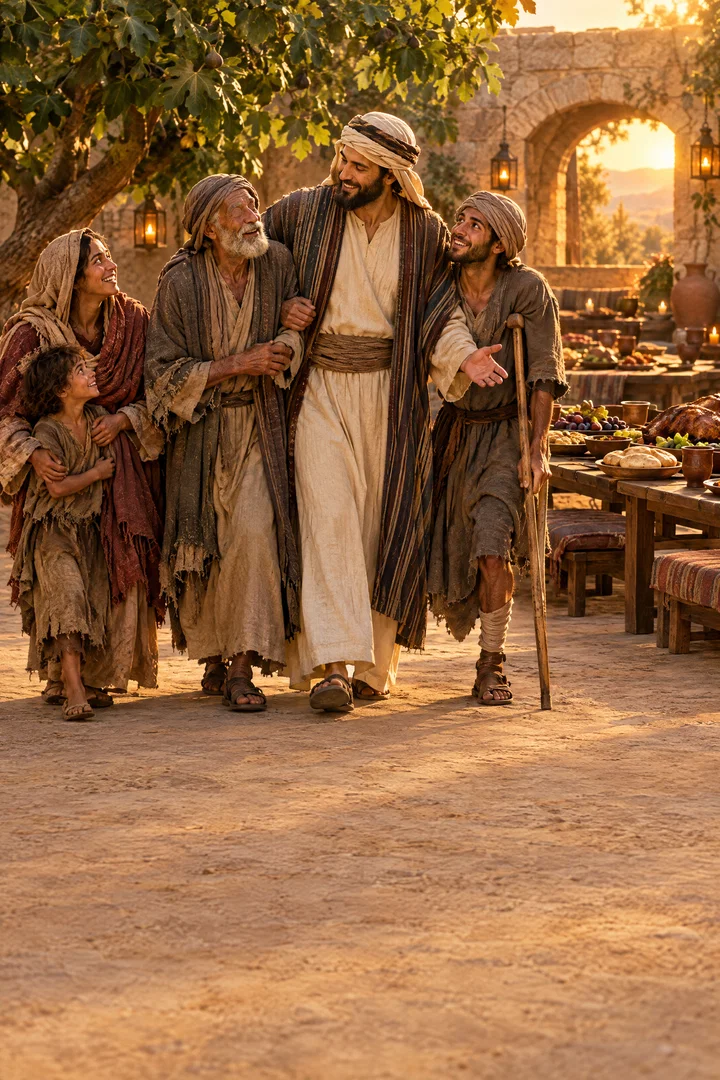
But when thou makest a feast, call the poor, the maimed, the lame, the blind:
Translations
But when you make a feast, call the poor, the maimed, the lame, the blind:
King James Version, KJV Cambridge Paragraph Bible, Webster Bible
But when thou makest a feast, call the poor, the maimed, the lame, the blind:
Revised Version, American Standard Version
But when thou makest a feast, bid the poor, the maimed, the lame, the blind:
but when thou mayest make a feast, be calling poor, maimed, lame, blind,
But when thou makest a feast, call poor, crippled, lame, blind:
But, whensoever, an entertainment, thou mayest be making, invite the destitute, the tried, the lame, the blind;
Berean Standard Bible, Majority Standard Bible
But when you host a banquet, invite the poor, the crippled, the lame, and the blind,
But when you make a feast, ask the poor, the maimed, the lame, or the blind;
But when you give a feast, send for the poor and the blind and those who are broken in body:
But when thou makest a feast, call ye poore, the maimed, the lame, and the blind,
Douay-Rheims (Challoner revision)
But when thou makest a feast, call the poor, the maimed, the lame, and the blind;
Pictures
Cross-references
- Matthew 25:40
And the King shall answer and say unto them, Verily I say unto you, Inasmuch as ye have done it unto one of the least of these my brethren, ye have done it unto me.
Welcoming the poor is counted as service to Christ.
- Luke 14:21
So that servant came, and shewed his lord these things. Then the master of the house being angry said to his servant, Go out quickly into the streets and lanes of the city, and bring in hither the poor, and the maimed, and the halt, and the blind.
The supper invitation repeats the call to invite the poor and disabled.
- Isaiah 58:7
Is it not to deal thy bread to the hungry, and that thou bring the poor that are cast out to thy house? when thou seest the naked, that thou cover him; and that thou hide not thyself from thine own flesh?
Both call for welcoming the poor and sharing food and shelter with them.
- Matthew 22:1-14
And Jesus answered and spake unto them again by parables, and said,
parable alluding to same supper
- Matthew 25:45
Then shall he answer them, saying, Verily I say unto you, Inasmuch as ye did it not to one of the least of these, ye did it not to me.
Serving people in need is counted as serving Christ.
- James 2:2-9
For if there come unto your assembly a man with a gold ring, in goodly apparel, and there come in also a poor man in vile raiment;
Both texts reject favoring the rich while neglecting the poor.
- Deuteronomy 15:7-11
If there be among you a poor man of one of thy brethren within any of thy gates in thy land which the LORD thy God giveth thee, thou shalt not harden thine heart, nor shut thine hand from thy poor brother:
Commands God’s people to open their hands to the poor and needy.
- James 1:27
Pure religion and undefiled before God and the Father is this, To visit the fatherless and widows in their affliction, and to keep himself unspotted from the world.
Care for the needy is described as pure religion and a test of character.
- Luke 6:34
And if ye lend to them of whom ye hope to receive, what thank have ye? for sinners also lend to sinners, to receive as much again.
Lending with an expectation of equal return contrasts with this precept.
- Deuteronomy 14:29
And the Levite, (because he hath no part nor inheritance with thee,) and the stranger, and the fatherless, and the widow, which are within thy gates, shall come, and shall eat and be satisfied; that the LORD thy God may bless thee in all the work of thine hand which thou doest.
Israel’s feasts included the stranger, fatherless, and widow.
- Proverbs 19:17
He that hath pity upon the poor lendeth unto the LORD; and that which he hath given will he pay him again.
Listed as a teaching to give to the poor.
- Isaiah 58:10
And if thou draw out thy soul to the hungry, and satisfy the afflicted soul; then shall thy light rise in obscurity, and thy darkness be as the noonday:
Both command care for the poor and afflicted.
- Job 29:11-16
When the ear heard me, then it blessed me; and when the eye saw me, it gave witness to me:
cited together as hospitality enjoined by example
- Psalms 41:1
Blessed is he that considereth the poor: the LORD will deliver him in time of trouble.
Listed alongside the call to give to the poor.
- Ephesians 4:28
Let him that stole steal no more: but rather let him labour, working with his hands the thing which is good, that he may have to give to him that needeth.
Both command giving to those in need.
Commentary
Each commentary is drawn from primary sources: the writings of Ellen G. White and Adventist pioneers and periodicals. Each commentary is separate. Its own words are not a quotation; follow the references to read the source passages.
Ellen G. White
22 sources
When a feast is made the poor, the maimed, the lame and the blind are to be called, rather than friends, brethren, kinsmen or rich neighbors who will invite again and repay the favor.MH 353.1–354.2Lt 54a, 1898, par. 2–4Lt 54, 1898, par. 7 It requires unselfish ministry to those who cannot repay, in contrast to the self-seeking practice of the world of giving only where return, gain or recognition is expected, with Christ's own life as the model.6T 305.1–2GW 512.1–2ST May 14, 1896COL 220.1–2ST May 14, 1896 Such kindness brings blessing precisely because the guests cannot recompense, and the host will be recompensed at the resurrection of the just when each person's deeds are made manifest.MH 353.1–354.26T 305.1–2GW 512.1–2 What is possessed beyond the actual necessities of life is held in trust from God, and the surplus is to be shared to feed the hungry, clothe the naked and relieve suffering rather than kept for self while others cry for bread.ST May 14, 1896COL 370.1 A feast kept by this rule is not turned into self-indulgent feasting and gluttony with luxuries for self and family, but is kept with genuine thanksgiving to God and remembrance of Christ by caring for people in need.21MR 222.4–223.1Ms 8, 1880, par. 4–6Ms 58, 1895, par. 4–6Ms 35, 1889, par. 9–1016MR 320.2
Meaning and Context
When a feast is made the call is to go to the poor, the maimed, the lame, and the blind, rather than to friends, brethren, kinsmen, or rich neighbors who will invite again and make recompense.MH 353.1–354.2Lt 54a, 1898, par. 2–4Lt 54, 1898, par. 7Ms 58, 1895, par. 4–6Ms 19, 1899, par. 20–23 Inviting those who cannot repay brings blessing, with recompense at the resurrection of the just.Lt 54a, 1898, par. 2–4Lt 54, 1898, par. 7Ms 58, 1895, par. 4–6Ms 19, 1899, par. 20–23Ms 103, 1900, par. 1–4 Welcoming such guests does not require costly food or display, for a warm welcome and a place at the table are themselves meaningful gifts.MH 353.1–354.2
What is possessed beyond the actual necessities of life is held in trust from God, and the surplus entrusted is to be used to bless humanity and relieve suffering.ST May 14, 1896COL 370.116MR 320.2 That means feeding the hungry, clothing the naked, caring for the widow and the fatherless, and ministering to the distressed and downtrodden, because abundance of luxuries was never meant to be kept for self while others cry for bread and widespread misery exists.ST May 14, 1896COL 370.1 Such sharing makes the kindness free of expectation of return, since the needy cannot repay.ST May 14, 1896
The command belongs to Luke 14:2-14, which gives warning of the danger imperiling souls in striving for the highest place.Ms 58, 1895, par. 1–3 The teaching in Luke 14:8-11 was spoken as a parable yet describes scenes actually witnessed in life, closing with the lesson that whoever exalts himself shall be abased and whoever humbles himself shall be exalted.Ms 58, 1895, par. 1–3 That lesson is to be practiced by choosing humbling instead of self-exalting, so as to be honored with lifting up instead of lifting up self.Ms 58, 1895, par. 1–3 The command stands together with the teaching on taking the lowest room in humility and with the parable of the great supper and the excuses of those first bidden.Lt 54a, 1898, par. 2–4
It leads directly to the parable of the supper, where giving the invitation is the work for all to do.Ms 19, 1899, par. 20–23 The class first invited refuses to come and will never be invited again and will not taste of the supper, while the second invitation gathers the poor and needy, the poor and the maimed and the halt and the blind, from streets and lanes and highways and hedges to fill the house.Ms 19, 1899, par. 20–23 So the great feast is abundantly supplied with guests, but none of those who refused will taste of it.Ms 19, 1899, par. 20–23
The instruction recalls Israel's duty to include the stranger, the fatherless, and the widow at the sacred feasts.COL 220.1–2 Those gatherings taught care for the bereaved and poor throughout the year, and taught that God's spiritual blessings given to Israel were to be shared with the world.COL 220.1–2 In the same way the verse belongs to the lesson that God's invitation to the blessings of His kingdom, pictured by a great feast and pointing to eternal life, was not reserved for the Jews but was to be extended to people they despised and shunned.COL 219.1
Unselfish Service Rewarded
The verse calls for unselfish ministry to those who cannot repay, in direct contrast to the self-seeking practice of the world which gives only where return favor, gain, or recognition is expected, and it holds up Christ's own life as the model for such service.6T 305.1–2GW 512.1–2 Because the poor, the maimed, the lame, and the blind cannot return the favor, welcoming them is free of expectation of return and is true hospitality.ST May 14, 1896COL 220.1–2ST May 14, 1896 That giving to those who cannot repay counters selfishness and the misuse of entrusted gifts, rather than reserving invitations for friends and wealthy relatives who can repay.ST May 14, 1896COL 220.1–2ST May 14, 1896
Such kindness brings blessing precisely because the guests cannot recompense, and the host will be recompensed at the resurrection of the just.MH 353.1–354.26T 305.1–2ST May 14, 1896Lt 54a, 1898, par. 2–4Lt 54, 1898, par. 7 At that time each person's deeds and the results of every life will be made manifest, and everyone will reap what he has sown.6T 305.1–2GW 512.1–2 Welcoming such guests need not involve costly food or display, for a warm welcome and a place at the table are themselves meaningful gifts.MH 353.1–354.2
Such service promises no reward of worldly gain, recognition, or earthly wealth, but being noted in heaven its recompense cannot fail.6T 305.1–2GW 512.1–2ST May 17, 1910 It directs people to store up treasure in heaven rather than seek their reward in earthly wealth.6T 305.1–2GW 512.1–2ST May 14, 1896 This promise is a stimulus and encouragement to every worker for God when work in this life seems almost fruitless, when earnest and persevering efforts to do good show no visible results and the effort seems lost.ST May 17, 1910
The duty to help people in need is an enduring command, not a new principle replacing the Old Testament instruction given through Moses, and no service to the needy, afflicted, or sorrowing will lose its reward.ST May 14, 1896 First attention should be given to those who are most needy, acting a part in the present life in order to share the blessedness of the future, while privileges of service lightly regarded and an invitation slighted will be sent to those despised as of little value.STMW11 15.1–2 Shunning humble and unfortunate people because helping them is unpleasant or seems beneath one's station is selfishness, not refinement.SA 37.1–2
Holiday Hospitality Practiced
Luke 14:13 gives the rule for keeping Thanksgiving Day, and few Thanksgivings are kept by it.21MR 222.4–223.1Ms 8, 1880, par. 4–6 When making a feast it must not be turned into self-indulgent feasting and gluttony by loading the table with luxuries for self and family.21MR 222.4–223.1Ms 8, 1880, par. 4–6 Keeping the day by the verse requires genuine thanksgiving to God with a thank offering in gratitude for rain, sun, crops and harvest, without gorging, murmuring, unpleasant feeling, or unholy thought.21MR 222.4–223.1 It requires inviting the poor and afflicted and people with disabilities who cannot repay, rather than reserving the feast for family and friends and guests who will invite again in return, with recompense promised at the resurrection of the just.21MR 222.4–223.1Ms 8, 1880, par. 4–6Ms 35, 1889, par. 9–10 It calls for caring for people in need and gratitude for Jesus rather than merely a sumptuous meal.Ms 8, 1880, par. 4–6Ms 35, 1889, par. 9–10
The verse is fulfilled in the Christmas celebration by not spending money in gratification of appetite through hurtful indulgences and stimulants which weaken the brain and physical powers.Ms 58, 1895, par. 4–6 It is fulfilled by not giving gifts only to human agents while Jesus is forgotten and left out of calculation.Ms 58, 1895, par. 4–6 Christmas kept by the verse remembers Christ who died to save the human family and God as the great Giver of all mercies and blessings, instead of selfishness and self-indulgence dishonoring God in earthly, selfish lines.Ms 58, 1895, par. 4–6 What is possessed is held in trust from God, and Christ's followers are to associate with others to share the benefits God has given in order to advance His work and serve others.Ms 58, 1895, par. 4–616MR 320.2 Christ's representatives are to include the poor, the lame, and the blind in their hospitality and care, for the duty to help people in need is an enduring command and not a new principle replacing the instruction given through Moses, and giving to those who cannot repay counters selfishness and the misuse of God's gifts, so that no service to the needy, afflicted, or sorrowing will lose its reward.ST May 14, 189616MR 320.2
Sources
Pioneers and periodicals
78 sources
When a dinner or supper is made, the guests to be called are the poor, the crippled, the lame and the blind, instead of friends, family and rich neighbors who can invite again and make return.RH Jul 11, 1912ST Jul 8, 1875ST Mar 2, 1882 The need of the guest, not worldly honor, wealth or position, is the true call to hospitality, requiring personally welcoming and making happy the poor, forsaken, orphaned and homeless rather than keeping them at a distance.RH Jul 29, 1915ST Aug 23, 1899ST Jan 13, 1914 Blessing follows precisely because such guests cannot repay, after the example of inviting the poor, blind and lame to the banquet of heaven.ST Mar 14, 1911 The recompense is given at the resurrection of the just, not at death and not before, so waiting for that day disproves reward at death and the claim that the dead have already gone to heaven.RH Dec 4, 1855ST Aug 21, 1884 Welcoming the poor and disabled honors Jesus and is the privilege of entertaining Him, for kindness to the least of His brethren is counted as done to Him.ST Dec 19, 1916ST Dec 19, 1916ST Dec 19, 1916
Setting and Wording
The setting is Jesus dining with a Pharisee, in the account of Luke 14:1-14, standing together with the teaching of Luke 13:31-35 about being humbled and exalted.ST Jul 23, 1894ST Dec 19, 1900 It is instruction about invitations to a feast, given with the healing of the man with dropsy and with the rule that everyone who exalts himself will be humbled and he who humbles himself will be exalted.ST Jul 23, 1894ST Dec 19, 1900ST Jul 23, 1894 Those to be invited are people who have nothing with which to repay, so that the host will be blessed and will be repaid at the resurrection of the just.ST Jul 23, 1894 Luke 14 shows that lawful means agreeable to law and conformable to the Sabbath law.RH May 19, 1851 Jesus gives there no new Sabbath law and does not relax the fourth commandment, but exposes the hypocrisy of the false charge of Sabbath-breaking and declares well-doing lawful, that is healing the sick, relieving dumb beasts in distress, and eating when hungry.RH May 19, 1851
The word for feast means reception and is used only by Luke.ST Jul 23, 1894 Calling those who cannot repay means giving up the empty applause of fellow men now in order to wait until the coming of the Lord and the resurrection, when God bestows eternal riches.ST Jul 23, 1894 What God bestows then He calls a reward in respect to the love that prompted the service, though all service is owed to Him and all received is gift.ST Jul 23, 1894 The words were spoken by Jesus at a notable supper in giving counsel to His host.ST Apr 21, 1909ST Oct 27, 1909 That host stands as a representative of God's servants.ST Apr 21, 1909ST Oct 27, 1909
The verse enjoins hospitality by precept, directing that when making a feast the poor, the maimed, the lame and the blind be called.ST Jan 4, 1905 That hospitality was the first lesson taught by Jesus after entering upon His ministry, shown in His hospitable invitation for the disciples to come with Him.ST Jan 4, 1905 As part of the parable of the great supper in Luke 14:1-24, together with the last part of Luke 14, it lays down the conditions of salvation strongly and clearly.ST Apr 7, 1909
Command to Invite Needy
When a dinner or supper is made, the call is to go to the poor, the maimed, the lame and the blind, and to those who cannot repay or help themselves, instead of to friends and brethren and kinsmen and rich neighbors who can invite again and make recompense.RH Jul 11, 1912ST May 14, 1896ST Jul 8, 1875ST Mar 2, 1882 Blessing rests on this very inability to recompense, and inviting friends to a church festival with expectation that they bring recompense violates the command and goes beyond the repaying invitation forbidden.RH Jul 11, 1912 A feast is to be shared with people in need from entrusted wealth, with kindness free from expectation of return.ST May 14, 1896ST Jul 8, 1875ST Mar 2, 1882
A feast means more than food, including whatever else has been given with which to make a feast. Musical skill and company and time are to be shared with poor folk who lack those things, rather than kept for rich neighbors of cultivated taste. Even one who never gives a great dinner or supper is bound by the command.
The command means just what it says when a feast such as a Christmas dinner is made, calling the poor and the lame and others in need instead of only special friends.ST Dec 19, 1916ST Dec 19, 1916 It does not forbid entertaining one's own friends at other times.ST Dec 19, 1916ST Dec 19, 1916 Its call is to share joy with those who have little of the sunshine of life and little happiness or comfort to vary the monotony of a cheerless existence.ST Dec 19, 1916ST Dec 19, 1916
Need, not worldly honor or wealth or position, is the true call to hospitality, reflecting the Father's house where no such distinctions are made.RH Jul 29, 1915ST Aug 23, 1899 The lowly and humble are to be drawn close and brought to the table instead of only friends and favored guests.RH Jul 29, 1915ST Aug 23, 1899ST Jan 13, 1914 This requires being sociable with the poor, the forsaken, orphans and those who have no homes and scarcely enough to eat, by inviting them in, entertaining them and endeavoring to make them happy, rather than keeping them at a distance or limiting concern to donations to institutions.RH Jul 29, 1915ST Aug 23, 1899ST Jan 13, 1914 Greater blessing comes from entertaining such needy guests than from inviting those who have abundance to provide for themselves, and hospitality freely given enriches the home through the gratitude, helpfulness, faith and good cheer the guests bring in return.RH Jul 29, 1915ST Jan 13, 1914
The rule is pure, disinterested benevolence expressing a meek and lowly spirit, opposing caste in religion and social preference based on wealth or status.ST Jun 28, 1877RH Jul 29, 1858RH Aug 9, 1864RH Jul 14, 1868 It stands in contrast to mutual-aid arrangements that assist only paying members, refusing to limit generosity to those who can repay or give reciprocal benefit.RH Jul 29, 1858RH Aug 9, 1864 It condemns favoring the rich with costly banquets while demanding usury from poor brethren.ST Jun 28, 1877RH Jul 14, 1868ST Sep 16, 1889
The worth of giving is in the giving and not in the gift, so help belongs to those who cannot repay.ST Nov 11, 1886 The less return can be expected the more complete the gift, and the more complete the gift the better for the giver because less self is in it.ST Nov 11, 1886 The duty to meet a just need stands while the need stands, whether from need or from due respect, and willingness to give must not be changed by likelihood of thanks.ST Nov 11, 1886 Ingratitude or dullness in the receiver does not remove the duty, for the receiver answers for his attitude and the giver for his, and the debt owed in giving is owed to God.ST Nov 11, 1886 Burdens are to be borne because they are burdens and not for return, which alone fulfills the law of Christ, for God does not measure His gifts by human gratitude and as received from Him so men ought to give.ST Nov 11, 1886
Blessing at Resurrection
Generosity is to be shown to the poor and disabled rather than only to friends, relatives and rich neighbors who can repay, and those who give without expecting repayment will be blessed precisely because the guests cannot repay.ST Mar 14, 1911ST Aug 25, 1881 The feast should include those who cannot help themselves or repay the invitation, and caring for them with practical provision for food, clothing and shelter rather than spending on display brings blessing with reward at the resurrection of the just.ST Mar 14, 1911ST Aug 25, 1881ST Oct 11, 1905 Jesus' invitation of the poor, blind and lame to the banquet of heaven is the supreme example of this generosity.
The recompense comes at the resurrection of the just, not at death and not before, so the saints receive no reward when they die but Christ directs their hope to the future resurrection.RH Dec 4, 1855ST Aug 21, 1884ST Feb 24, 1881ST Sep 15, 1881 If an immortal soul went to heaven at death, payment for a few meals would come long before the resurrection, so the required wait disproves reward at death and the popular funeral claim that the dead have already gone to heaven and that death is the gate to endless joy.RH Feb 5, 1861 The righteous receive their reward then, not before.ST Feb 24, 1881RH Feb 5, 1861
That resurrection when the reward is given is at the coming of Christ when He brings His reward to give every man according to his work, so the second coming and the resurrection of the just are simultaneous and inseparable.ST Aug 7, 1884ST Oct 4, 1905ST Oct 27, 1909 Therefore the righteous receive no reward until Jesus comes, and the reward of the saints is not obtained or entered upon at death but is reserved until the resurrection.ST Aug 7, 1884ST Apr 30, 1894 This proves death is not the second coming of Christ, because the second coming is the blessed hope and glorious consummation, and with no future advent there is no resurrection and no deliverance.ST Apr 30, 1894 That reward and completed salvation come only when Jesus fulfills His promise to come again.ST Jul 23, 1912
The recompense is the final reward of everlasting life and immortality, entrance into the endless kingdom of glory and the promised inheritance given to trusting children at Christ's coming, so the resurrection is necessary and not superfluous.ST Apr 21, 1909ST Oct 27, 1909 That resurrection brings the third and crowning phase of salvation, salvation from temptation and the possibility of sinning and from mortality and the possibility of dying, and therefore from sorrow, sickness and pain.ST Jul 23, 1912 The phrase resurrection of the just points to a distinct resurrection specifically for the just, implying also a resurrection of the unjust.RH Jun 13, 1854ST Jul 7, 1887RH Oct 17, 1854 The unjust have no part in it and no share in its reward, supporting that righteous and wicked do not share one simultaneous resurrection.RH Jun 13, 1854ST Jul 7, 1887RH Oct 17, 1854
Unselfish service done without earthly return is noted in heaven and its recompense cannot fail, directing people to store up treasure in heaven rather than seek reward in earthly wealth.ST May 17, 1910ST May 14, 1896 For every worker for God this is stimulus and encouragement when work in this life seems almost fruitless, when earnest and persevering efforts to do good show no visible results and the effort seems lost.ST May 17, 1910 The recompense will come at the resurrection of the just in seeing guests saved with everlasting salvation in the kingdom of glory.RH Mar 10, 1874
Prophecy and Coming Kingdom
The feast and its recompense at the resurrection of the just is eating bread in the kingdom of God at the marriage supper of the Lamb, a future glorious feast to which those called are blessed to be admitted.RH Dec 23, 1862 The promise joined to inviting the poor, the maimed, the lame, and the blind rather than friends, relatives, and rich neighbors prompted expectation of a happy gathering of Israel in the Messiah's kingdom.ST Mar 26, 1896
The supper unfolds in successive calls, with the first call being the preaching of the hour of God's judgment and the immediate coming of the Lord, which tested the church and could have healed her of unscriptural hope, false views, oppression, pride, and conformity to the world.RH Mar 6, 1855 Those who in heart rejected that first call will never appear as guests at that table, because their rejection proved their heart was with the world and not with their Lord, and because heaven's last means to heal Babylon failed she was given up to her own heart's desire.RH Mar 6, 1855 The second call was to be made quickly to the wounded in the streets and lanes of the city.LDT 192.4–193.2 The third call is compared with the preaching of the Third Angel's Message, which gathered a church and brought it into the Laodicean period, with the Laodicean address applying when the church has become lukewarm and the king's coming to see the guests following the third call.RH Mar 26, 1857
The whole idea of the passage is invitation, not compulsion, and gives no justification for compulsory Sunday observance or any law compelling sinners to recognize God's commandments.ST Aug 19, 1897 The later command to compel them to come in means to urge people by setting the invitation before them so forcibly in Christ's way that they listen to His servants even as they listened to Him.ST Aug 19, 1897 There is no Sunday law in the Bible except for work that may be done on that day, for God has a Sabbath He has commanded but compels no one to observe it, and His servants persuade and beseech.ST Aug 19, 1897 Men can compel outward recognition of human laws but never of God's laws, which are recognized by God only when kept from love for God, and human force cannot compel love.ST Aug 19, 1897
When it becomes known who is finally rejected is not available until after the investigative judgment, which closes just before Christ's literal second coming.ST Apr 20, 1915 Calling the maimed, lame, halt, and blind is bringing people into the work of inviting others to the marriage supper of the Lamb, a work calling for self-denial and taking up the cross.RH Mar 18, 1909
Christlike Unselfish Service
The verse is a key and daily practical test of Christian character, asking whether the soul goes out after others and whether a person is eager to do work that brings no present reward.RH Jan 6, 1874 It asks whether one will sacrifice means, ease and comfort to make others happy, and whether one knows the afflicted and needy in the neighborhood and is often found ministering to their wants.RH Jan 6, 1874 Being too hurried in getting a living, in the sense of keeping what one has and adding to it, proves failure of the test.RH Jan 6, 1874 Such selfishness is a spurious counterfeit that will not stand in the judgment, because it lacks the spirit that led Christ to die on earth and meekly to endure reviling and suffering without retaliation, committing Himself to Him who judges righteously, while having that spirit gives freedom in God, a life of usefulness, successful labor for others, and blessing on the effort.RH Jan 6, 1874
True missionary work is pure, disinterested benevolence that lays aside personal interests and selfishness to do good to others without looking for reward in this life.RH Mar 10, 1874 Its aim is that others may be brought to a knowledge of the truth as it is in Jesus, with recompense in seeing them saved with everlasting salvation in the kingdom of glory.RH Mar 10, 1874 The poor are left as a continual legacy and constant test of character for the rich, showing whether they will take an interest in suffering humanity or give themselves to the service of gold.ST Sep 17, 1912 The excuse that neglects them by calling them shiftless and lazy and worthless is forbidden, and wealthy men and women must take the same interest in the poor that they take in gold, not by handing out money indiscriminately, which often does more harm than good, but by personal interest that develops them through training and opens a way for them to succeed.ST Sep 17, 1912
The duty to help people in need is an enduring command and not a new principle replacing the instruction given through Moses.ST May 14, 1896 Giving to those who cannot repay counters selfishness and the misuse of God's gifts, and no service to the needy, afflicted or sorrowing will lose its reward.ST May 14, 1896ST Dec 21, 1915 Such giving and serving is to be done for Christ's sake toward people who have nothing to offer in return.ST Dec 21, 1915 Welcoming the poor and disabled to a feast is the privilege of entertaining Jesus Himself, for He counts kindness done to the least of His brethren as done to Him.ST Dec 19, 1916ST Dec 19, 1916ST Dec 19, 1916 The invitation is an act of love that gives joy and fellowship rather than requesting help or judging clothing or circumstances, and it honors Jesus.ST Dec 19, 1916ST Dec 19, 1916
The needy and afflicted bear His image, so caring for them, including prisoners, orphans, widows, the sick and the rejected, shows love and fellowship with Him, while neglecting them is inconsistent with belonging to Christ and having life in Him.RH Oct 9, 1856RH Jul 30, 1901 In ministering even to the most degraded, one finds Christ, since He gave His life for all regardless of race, speech or circumstances, and salvation is within their reach.RH Jul 30, 1901 The same words echo the welcome sinners find in Christ, for those burdened by sin and in need of salvation are invited to come to Him as they are without first trying to make themselves acceptable.RH Jan 27, 1916 That invitation is applied to the spiritually needy, who are welcomed without cost and receive healing and new sight from Him.RH Nov 6, 1860
The maimed, halt and blind are also applied to the church as a body, which God will find not maimed, halt and blind but perfectly joined together.RH May 8, 1856 Failing to invite the poor and disabled when holding a feast is given as an example of sin.ST Dec 11, 1901
Everyday Hospitality Applied
The verse is a practical text for a child to memorize before Christmas and to apply in choosing company for a Christmas feast.ST Dec 19, 1916 When making a dinner or feast at Christmas, which includes giving gifts, the call is to bid and remember the poor, the maimed, the lame, and the blind rather than giving only to friends, brethren, kinsmen, and rich neighbors who can invite again and repay.ST Dec 24, 1902ST Dec 24, 1896 Thankful response to the gift of Christ requires large-hearted giving to all needy ones who cannot repay, a debt owed to all that includes home and foreign missionary work.ST Dec 24, 1902 Gifts should go to people in need rather than to those who are not needy, and feasting and giving to those who do not need them is to be replaced by calling and giving to the poor and needy as Christ gave.ST Dec 24, 1896 At Christmas this means cutting loose from gormandizing, loose merrymaking, and needless gift-giving carried down from the idolatrous Roman Saturnalia, remembering the poor and needy, and letting Christ rule in the heart on that day and on all other days.
The same rule applies to Thanksgiving, where gratitude should move care for those in need and not end in a selfish feast.ST Nov 25, 1903 When a feast is given, those invited should be the poor or disabled rather than only friends, relatives, or wealthy neighbors who can repay, for giving to those who cannot return the favor is generous care that brings blessing and recompense in the resurrection of the just.ST Nov 25, 1903 Sharing a feast with people who are poor or have disabilities is exemplified by serving a Thanksgiving dinner to the poor and friendless.ST Dec 15, 1898 Inviting the poor, lame, and blind to share a meal at Thanksgiving, joined with prayer and praise and remembrance of God's mercies, fulfills the counsel.RH Jan 7, 1873
When a feast is made in the house of the Lord, the poor, the maimed, the lame, and the blind must be called instead of rich lords and ladies, with food freely given.LDT 159.1–2 Costly delicacies such as oysters, coffee and tea, ice-cream and sweetmeats sold by ticket have no place there, and costly social occasions centered on selling food and amusements are inconsistent with God's word.LDT 159.1–2GSAM 152.2 Inviting friends to a church festival and expecting them to bring a recompense violates the command and goes beyond the repaying invitation forbidden, since obedience brings blessing precisely because such guests cannot recompense. To make Belshazzar-like Babylonian feasts for the rich while opposing the second advent of Christ is eating and drinking with the drunken, the mark of the evil servant in the last times when Christ comes.LDT 159.1–2
Welcoming and helping people in need in mission work applies the teaching, as seen in the Helping Hand and Medical Mission and in support given to the Swiss mission in its work of sharing the gospel.ST Mar 31, 1898 A feast should include the poor and the maimed, lame, or blind, and their welcome shows the importance of serving them.RH Jul 30, 1901ST Mar 31, 1898 The feast is also sharing gospel literature, so that after providing extensively for people who can see, provision must also be made for blind people.RH Dec 1, 1910
A feast is sharing what one has, such as musical skill and company and time, with poor and plain people rather than keeping it for rich neighbors with cultivated taste. This calls for gathering the whole household, farmers and old grandmothers and boys and servants, to sing hymns together while patiently bearing untrained and discordant voices. Such giving brings a real happy time to those whose lives are bare and whose happy hours are few. A genuine gospel feast welcomes the poor and offers food they will appreciate, including delicacies that people accustomed to such things may take for granted.ST Oct 13, 1881
The verse lists inviting the poor and those with disabilities to a feast without expecting a return gift, showing the importance of serving and helping those in need.RH Nov 19, 1908RH Jul 30, 1901 Its lesson directs kindness and gifts toward those often neglected rather than chiefly toward the fortunate, which encourages and comforts those in hardship and follows Christ's example.RH Jul 30, 1901RH Jul 1, 1873 Christ's ministry of charity and mercy sought the poor, the ignorant, the lame, and the blind among the poor and humble rather than in splendid settings.RH Mar 27, 1856 Christian charity goes outward to all rather than centering on members or excluding those judged unfit to contribute, and its care for the poor, the halt, the lame, and the blind displays tender benevolence.ST Dec 7, 1882 Prayers for the poor ring hollow when the church rejects them as burdens rather than receiving them with compassion.ST Jul 4, 1899
Sources