Luke 14:21
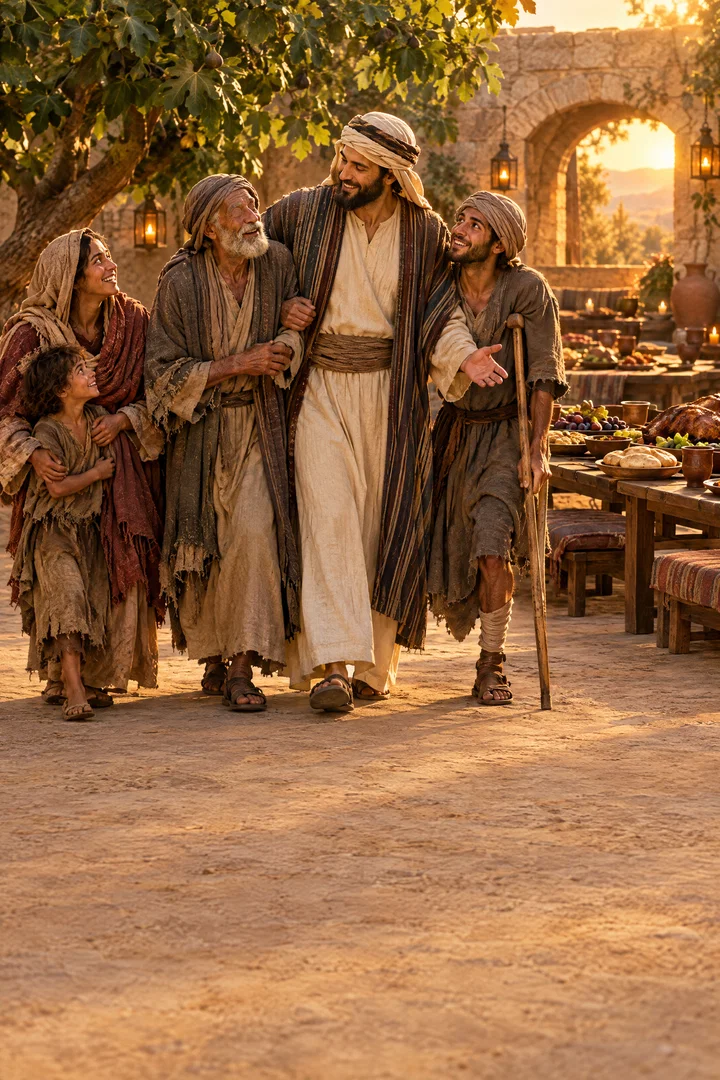
So that servant came, and shewed his lord these things. Then the master of the house being angry said to his servant, Go out quickly into the streets and lanes of the city, and bring in hither the poor, and the maimed, and the halt, and the blind.
Translations
So that servant came, and showed his lord these things. Then the master of the house being angry said to his servant, Go out quickly into the streets and lanes of the city, and bring in here the poor, and the maimed, and the halt, and the blind.
King James Version, KJV Cambridge Paragraph Bible
So that servant came, and shewed his lord these things. Then the master of the house being angry said to his servant, Go out quickly into the streets and lanes of the city, and bring in hither the poor, and the maimed, and the halt, and the blind.
So that servant came, and showed his lord these things. Then the master of the house being angry, said to his servant, Go out quickly into the streets and lanes of the city, and bring in hither the poor, and the maimed, and the halt, and the blind.
Revised Version, American Standard Version
And the servant came, and told his lord these things. Then the master of the house being angry said to his servant, Go out quickly into the streets and lanes of the city, and bring in hither the poor and maimed and blind and lame.
'And that servant having come, told to his lord these things, then the master of the house, having been angry, said to his servant, Go forth quickly to the broad places and lanes of the city, and the poor, and maimed, and lame, and blind, bring in hither.
And the bondman came up and brought back word of these things to his lord. Then the master of the house, in anger, said to his bondman, Go out quickly into the streets and lanes of the city, and bring here the poor and crippled and lame and blind.
And, going near, the servant reported unto his lord these things. Then, provoked to anger, the master of the house said unto his servant—Go out quickly, into the broadways and streets of the city,—and, the destitute, and tried, and blind, and lame, bring thou in here.
The servant returned and reported all this to his master. Then the owner of the house became angry and said to his servant, ‘ Go out quickly into the streets and alleys of the city, and bring in the poor, the crippled, the blind, and the lame.’
That servant returned and reported all this to his master. Then the owner of the house became angry and said to his servant, ‘ Go out quickly into the streets and alleys of the city, and bring in the poor, the crippled, the lame, and the blind.’
“ That servant came, and told his lord these things. Then the master of the house, being angry, said to his servant, ‘ Go out quickly into the streets and lanes of the city, and bring in the poor, maimed, blind, and lame.’
And the servant came back and gave his master an account of these things. Then the master of the house was angry and said to the servant, Go out quickly into the streets of the town and get the poor, the blind, and those who are broken in body.
So that seruaunt returned, and shewed his master these thinges. Then was the good man of the house angrie, and said to his seruant, Goe out quickely into the streetes and lanes of the citie, and bring in hither the poore, and the maimed, and the halt, and the blinde.
Douay-Rheims (Challoner revision)
And the servant returning, told these things to his lord. Then the master of the house, being angry, said to his servant: Go out quickly into the streets and lanes of the city, and bring in hither the poor, and the feeble, and the blind, and the lame.
Pictures
Cross-references 20 of 21
- Matthew 22:9-10
Go ye therefore into the highways, and as many as ye shall find, bid to the marriage.
Both parables send servants to gather guests after the first invitation is refused.
- Revelation 19:9
And he saith unto me, Write, Blessed are they which are called unto the marriage supper of the Lamb. And he saith unto me, These are the true sayings of God.
The parable’s supper is identified with the marriage supper of the Lamb.
- Luke 14:17
And sent his servant at supper time to say to them that were bidden, Come; for all things are now ready.
The supper invitation is announced before the invited guests refuse it.
- Isaiah 55:1
Ho, every one that thirsteth, come ye to the waters, and he that hath no money; come ye, buy, and eat; yea, come, buy wine and milk without money and without price.
Both offer a free invitation to come and receive.
- Matthew 22:3-4
And sent forth his servants to call them that were bidden to the wedding: and they would not come.
Both parables depict God’s prepared feast and the invitation that is refused.
- Revelation 22:17
And the Spirit and the bride say, Come. And let him that heareth say, Come. And let him that is athirst come. And whosoever will, let him take the water of life freely.
The Spirit and the bride invite whoever will to come and receive life freely.
- Luke 14:13-14
But when thou makest a feast, call the poor, the maimed, the lame, the blind:
Jesus commands inviting the poor and disabled, who cannot repay, with recompense at the resurrection.
- Matthew 22:11-13
And when the king came in to see the guests, he saw there a man which had not on a wedding garment:
The king inspects the feast’s guests and holds an unprepared guest accountable.
- Matthew 25:40
And the King shall answer and say unto them, Verily I say unto you, Inasmuch as ye have done it unto one of the least of these my brethren, ye have done it unto me.
Serving the least is counted as service to Christ.
- Isaiah 58:7
Is it not to deal thy bread to the hungry, and that thou bring the poor that are cast out to thy house? when thou seest the naked, that thou cover him; and that thou hide not thyself from thine own flesh?
Sharing bread with the hungry and welcoming the poor echoes the call to bring them in.
- James 2:5
Hearken, my beloved brethren, Hath not God chosen the poor of this world rich in faith, and heirs of the kingdom which he hath promised to them that love him?
The poor invited to the feast are described as heirs of the kingdom.
- Deuteronomy 14:29
And the Levite, (because he hath no part nor inheritance with thee,) and the stranger, and the fatherless, and the widow, which are within thy gates, shall come, and shall eat and be satisfied; that the LORD thy God may bless thee in all the work of thine hand which thou doest.
Both texts welcome people in need to share in a meal.
- Luke 14:16
Then said he unto him, A certain man made a great supper, and bade many:
identifies the supper as the same supper
- Matthew 8:11-12
And I say unto you, That many shall come from the east and west, and shall sit down with Abraham, and Isaac, and Jacob, in the kingdom of heaven.
Both describe outsiders welcomed to the kingdom feast while others are excluded.
- Mark 2:17
When Jesus heard it, he saith unto them, They that are whole have no need of the physician, but they that are sick: I came not to call the righteous, but sinners to repentance.
Christ calls sinners to repentance.
- Matthew 22:7
But when the king heard thereof, he was wroth: and he sent forth his armies, and destroyed those murderers, and burned up their city.
contrasts heavier punishment for king's rejecters
- Matthew 20:6-16
And about the eleventh hour he went out, and found others standing idle, and saith unto them, Why stand ye here all the day idle?
Latecomers are welcomed and receive the promised reward.
- Luke 4:18
The Spirit of the Lord is upon me, because he hath anointed me to preach the gospel to the poor; he hath sent me to heal the brokenhearted, to preach deliverance to the captives, and recovering of sight to the blind, to set at liberty them that are bruised,
Christ’s mission includes preaching the gospel to the poor.
- Job 29:15
I was eyes to the blind, and feet was I to the lame.
Job describes being eyes to the blind, as the passage applies the call.
- John 6:51
I am the living bread which came down from heaven: if any man eat of this bread, he shall live for ever: and the bread that I will give is my flesh, which I will give for the life of the world.
Christ is the bread offered at the gospel feast and the source of eternal life.
Commentary part 1 of 2
Each commentary is drawn from primary sources: the writings of Ellen G. White and Adventist pioneers and periodicals. Each commentary is separate. Its own words are not a quotation; follow the references to read the source passages.
Ellen G. White
95 sources
After those first bidden refused with one consent to see ground bought, to prove five yoke of oxen, and because of marriage, the servant reported it and the master of the house being angry ordered him to go out quickly into the streets and lanes of the city and bring in the poor and the maimed and the halt and the blind.Ms 149, 1898, par. 1–2Lt 54a, 1898, par. 2–4Ms 103, 1900, par. 1–4Ms 18, 1897, par. 1–4Ms 12, 1895, par. 22–24 The master of the house is God, the supper is the gospel feast of grace through His Son prepared at infinite cost, and the servant is His delegated messengers.Lt 96, 1898, par. 10–123T 383.1–3Ms 59, 1895, par. 60–62 The first invited are the Jewish priests and elders who professed to wait for the Messiah yet knew Him not, and those brought in their place are the despised publicans and sinners, hungry and without houses and lands, who would appreciate the bounty with gratitude and love.ST May 4, 1915COL 219.1Ms 81, 1899, par. 14ST May 4, 1915Ms 19, 1899, par. 10–13 Go out quickly means the second giving of the invitation is urgent because all things are now ready and time is short, the last call to the marriage supper to be carried without boundary of class or territory to high and low, rich and poor, by outdoor preaching, house-to-house work, and medical missionary service for body and soul.Ms 19, 1899, par. 20–23Lt 132, 1901, par. 4–6Ms 81, 1899, par. 14OEWP 36.1–37.1Ms 1, 1901, par. 17 The compelling is not force but the power of the Holy Spirit drawing souls to Christ, and each person must come humbly now and put on the wedding garment of Christ's righteousness, for those who slight the invitation for farms, merchandise, and home interests will not taste of His supper.Ms 6, 1897, par. 1–4Lt 96, 1898, par. 10–12Ms 12, 1895, par. 22–245MR 41.2–42.1Ms 11, 1894, par. 16–17
Parable Story and Setting
After those first bidden refused the supper, the servant came and showed his lord these things, and the master of the house being angry commanded him to go out quickly into the streets and lanes of the city and bring in hither the poor, and the maimed, and the halt, and the blind.Ms 149, 1898, par. 1–2Lt 54a, 1898, par. 2–4Ms 103, 1900, par. 1–4Lt 96, 1898, par. 10–12Ms 19, 1899, par. 20–23 The invitation was thereby extended to people in need who cannot repay their host, to those often shut out or overlooked, while not one of those who refused the first invitation will taste of the supper.Ms 149, 1898, par. 1–2Ms 103, 1900, par. 1–4Ms 11b, 1894, par. 16–18Ms 19, 1899, par. 20–23 Serving people in need in this way fulfills the Lord's instruction, it is work for all churches in every locality to do, and though long neglected it remains to be fulfilled.Ms 18, 1897, par. 1–4Ms 19, 1899, par. 20–23 The invitation pressed upon others is the provisions of grace provided through the only begotten Son, and it speaks with special force to everyone who has had the light of truth.Lt 96, 1898, par. 10–12
The servant's report was that those bidden answered with one consent when told all things are now ready, asking with three requests to be excused.Lt 54a, 1898, par. 2–4Ms 12, 1895, par. 22–24Lt 132, 1901, par. 4–6 One asked to go see a piece of ground bought, one to go prove five yoke of oxen bought, and one claimed inability to come because of having married a wife.Lt 54a, 1898, par. 2–4Lt 132, 1901, par. 4–6RH Aug 25, 1874 These excuses of merchandise, oxen, and marriage represent farms, cattle, merchandise, and home interests, worldly interests counted of greater value than eternal riches and used to disobey the claims of truth.Ms 12, 1895, par. 22–24RH Aug 25, 1874ST Apr 22, 1875 The very blessings given to prove whether they will render unto God the things that are God's are grasped as reasons they cannot obey, closing the heart to the messenger who says come while opening it to business cares.RH Aug 25, 1874ST Apr 22, 1875
The parable was spoken by Christ when He was a guest at a feast, using a temporal feast to illustrate the spiritual blessings of the gospel and the wonderful condescension of God in earnestly inviting all to come.Ms 81, 1899, par. 14ST May 4, 1915Ms 19, 1899, par. 10–13RH Oct 2, 1900 The sacred feast was a type of the blessings of eternal life, and the Jews pictured the future feast as one where they would sit with Abraham, Isaac, and Jacob while the Gentiles remained outside longing to enter.ST May 4, 1915 The first invited are the priests and elders, who made great professions of piety and acted as if they waited with anxious expectancy for the call to the supper and would go in immediately.ST Feb 10, 1898 They proclaimed everywhere the coming of the King of the Jews to conquer enemies and set up His kingdom, yet applied to His first advent the prophecies relating to His second coming, and when He came they knew Him not.ST Feb 10, 1898 They claimed to obey the law of God which is holy and just and good, but by exacting requirements made it impossible for anyone to keep, while themselves constantly disobeying it and rendering only a false obedience.ST Feb 10, 1898
Go out quickly means the call is urgent because all things are now ready and must be given without delay.Lt 132, 1901, par. 4–6OEWP 36.1–37.1ACSMHFP 4.5–7 It is to be given promptly in the cities, in streets and public places, and beyond the cities into highways and hedges and all classes, with a much more extensive work in great and wicked centers and in neglected cities and places that have not yet heard.Lt 132, 1901, par. 4–6Ms 1, 1901, par. 17Lt 75, 1898, par. 19–2010MR 18.2 It calls for working with vigilance because time is short, studying the life and teachings of Christ so every passing event furnishes a text, being instant in season and out of season, and following His example of preaching where the little group listening swells into a great company.Lt 75, 1898, par. 19–20ACSMHFP 4.5–7
Meaning of Feast Symbols
The master of the house is God, the great supper is the gospel feast and the provisions of grace He has provided through His only begotten Son, a bountiful table and banquet of truth prepared at great and infinite cost offering pardon and peace, justification by faith, access to the Father, the comfort of the Holy Spirit, and eternal life, and the servant is His delegated messengers giving the message of mercy.Lt 96, 1898, par. 10–123T 383.1–3Ms 59, 1895, par. 60–62Ms 59, 1895, par. 63–65Lt 89, 1898, par. 12–13 When those first bidden refuse with excuses, the invitation to partake of those provisions is pressed upon others, and it speaks with special force to everyone who has had the light of truth.Lt 96, 1898, par. 10–12Ms 59, 1895, par. 63–65 The Lord's table is provided to meet every person's need and all are invited to come without distinction, with accepting bringing the blessings of God's love and pardon and honoring the Giver while refusing or remaining indifferent shows contempt for God and can keep others away by influence, since spiritual needs are met only by coming to Jesus and receiving the Bread of Life.Ms 6, 1897, par. 1–4Lt 89, 1898, par. 12–13Ms 184, 1898, par. 50–51 Those who ought to give this testing message but hide their talents and make no use of their powers to draw souls are unfaithful, slothful servants who will be called to account, while faithful voices feel their responsibility and work with every means to compel people to come in.Lt 89, 1898, par. 12–13
The poor and the maimed and the halt and the blind gathered from the city's streets are those the Jews despised and shunned, excluded from the blessings of God's kingdom and regarded as unclean, meaning publicans and sinners.COL 219.1COL 229.4–231.1COL 225.2–226.1Lt 20, 1893, par. 10–12 They are a class not full and not in possession of houses and lands, hungry and lacking worldly wealth and the possessions that occupied the first guests, who would appreciate the bounty provided.ST May 4, 19152T 39.1–40.1COL 225.2–226.1 Because they are hungry they appreciate the master's bounty and respond with gratitude, love, and devotion, while those who slight the gracious invitation for worldly interests lose the offered blessing.ST May 4, 19152T 39.1–40.1 However wretched may be the people men spurn and turn aside from, they are not too low for the notice and love of God, for Christ longs for care-worn, weary, oppressed human beings to come to Him for light and joy and peace found nowhere else, the veriest sinners being objects of His deep pity and love, and He sends His Holy Spirit to yearn over them with tenderness to draw them to Himself.COL 225.2–226.1
The streets and lanes of the city are the first field after rejection, and the same plan of working sets the gospel call to the Gentiles where the message is first to be given in the highways, meaning men who have an active part in the world's work and teachers and leaders of the people, while the byways and hedges and country places are the further outreach into lonely places.COL 229.4–231.1COL 232.4–234.1Lt 233, 1905, par. 11–14 When the great and gifted refuse the truth, messengers are commanded to go quickly into the streets and lanes of the city and into the byways and hedges of the country to bring in the poor and lowly of the earth, not thinking only of men of influence and large capacity but seeking families and individuals in courts of great cities and lonely country places.COL 232.4–234.1 These include strangers without church relations who feel forgotten by God, those sunken in sin and pressed with suffering, want, unbelief, despondency, and disease of body and soul, who spend money for that which is not bread and are tempted by Satan with ruinous pleasures, yet in these suffering ones are those Christ came to save.COL 232.4–234.1 His servants are to follow His example by comforting the suffering and healing the sick and then placing before them the great truths of His kingdom, relieving bodily suffering to open ways to minister to the soul and pointing to the uplifted Saviour, telling the poor, desponding, straying, and morally weak, the stranger and outcast, even those sunken to the depths of sin, that they need not despair, that God has joy to restore to them the joy of His salvation, delights to take hopeless material through whom Satan has worked and make them subjects of His grace, rejoices to deliver them from wrath, and has healing and cleansing for every soul with a place waiting at the Lord's table, with medical missionary work opening the way for truth to enter large cities as the invitation reaches people who have not yet heard and is sent widely through highways and byways.COL 232.4–234.1Lt 233, 1905, par. 11–14
To share the supper guests must put on the wedding garment, which is the robe of Christ's righteousness, spotless as the pure white lily, the richest gift that can be bestowed on mortal man.Lt 96, 1898, par. 10–12Ms 143, 1898, par. 21Ms 109, 1901, par. 9 Only those who receive Christ and yield themselves to God are fit for the feast, giving full service with humanity united to divinity, and the banquet is a lifelong invitation reaching into eternity.Ms 6, 1897, par. 1–4 Those who accept the privileges of the gospel supper must strip off miserable inherited and cultivated traits of character that dishonor God, and must count the cost lest like a man building a tower without counting the cost they lay a foundation but fail.Lt 96, 1898, par. 10–12 Those who come humbly are welcomed without price and clothed in Christ's righteousness represented by the white garment, having first received Christ's blessings themselves and then sharing them, and all who would have admittance must heed the invitation now and make themselves ready by being clothed with the robe of righteousness for when the Bridegroom comes to enter in to the marriage supper.Ms 143, 1898, par. 21Ms 8, 1874, par. 9–10 Men of the world must not be passed by but must be urged and taken hold of and brought in to the banquet Christ has prepared, telling them Christ has provided the wedding garment and urging them to give whole attention to securing it, since heaven will be appreciated as repose from din and confusion and Christ longs to bestow peace, happiness, and joy, while those first bidden who keep excusing themselves and feasting on worldly pleasures, doing the work for heaven by halves and holding self-righteousness instead of the garment, will be shut out and none shall taste of His supper with loss realized too late when the door is shut.Ms 8, 1874, par. 9–10Lt 7, 1869, par. 6–7Ms 109, 1901, par. 9
First Refusal Then Replacement
The invitation to the supper was first given to the Jewish people, the highly favored people called to stand as teachers and leaders among men to impart the truth they had received.Ms 81, 1899, par. 14COL 229.4–231.1 They had the prophetic scrolls foretelling Christ's advent and the symbolic service foreshadowing His mission, and had priests and people heeded the call they would have united with His messengers in carrying the gospel invitation to the world.COL 229.4–231.1 The first invited were the priests and elders who made great professions of piety and claimed to wait eagerly and with anxious expectancy for the promised Messiah, proclaiming everywhere the coming of the King of the Jews to conquer their enemies and set up His kingdom, yet they applied to His first advent the prophecies relating to His second coming, and when He came they knew Him not.ST Feb 10, 1898 They claimed obedience to the law of God which is holy and just and good, while by exacting requirements they made it impossible for anyone to keep, themselves constantly disobeying it and rendering only a false obedience.ST Feb 10, 1898 When priests, people, and Jewish rulers refused the call, it was sent to the poor, the maimed, the halt, and the blind, meaning publicans and sinners received the invitation.COL 229.4–231.1COL 307.2–308.1 That rejection by the Jewish rulers is rejected again by religious teachers whose refusal is unwillingness to make a candid investigation of the Scriptures and closing the eyes against evidence, leaving them blind to their peril, with each further step in opposition easier until they show hatred for the principles of Christ's character just as the Jews did.Ms 23, 1900, par. 15 Many were convicted and considered accepting the call to accept Christ and be reconciled to God, but feared provoking the scribes, Pharisees, and Sadducees.Ms 197, 1898, par. 12–13
The refusal came from preoccupation and indifference, with those first invited refusing because of worldly concerns and preferring earthly goods and worldly advantages to the heavenly feast provided for all and open to everyone willing to receive it.5MR 41.2–42.1COL 221.1–222.2Ms 143, 1898, par. 4 Putting property before service for Christ places a minor matter above what is far more important, as seen in trivial excuses about merchandise, oxen, and marriage.Ms 12, 1895, par. 22–2419MR 245.4–246.1 The excuses show putting property, merchandise, oxen, farms, and worldly advantages before service, with self-sufficiency and refusal to receive Christ's call, living for self, rejecting the water of life and the binding claims of God's commandments, fearing neighbors' ridicule, and pursuing selfish interests.5MR 41.2–42.119MR 245.4–246.1Ms 9, 1898, par. 39–41 When those first invited refuse the master's supper for earthly interests, the invitation is extended to another class, and the poor and afflicted accept benefits that the first guests rejected.2T 40.2
After the invited guests refused, the servant reported their excuses and the master, angry at the refusal and because his invitation was despised, sent him out quickly into the streets and lanes of the city to bring in the poor, the maimed, the lame, the halt, and the blind.Ms 149, 1898, par. 1–2Lt 96, 1898, par. 10–12Ms 19, 1899, par. 20–23 The invitation to partake of the provisions of grace provided through His only begotten Son is thus pressed upon others when the first invited reject it, reaching those who were not among the first invited and people from every class who would accept it, including the poor and afflicted and those with disabilities, that His house may be filled.Lt 96, 1898, par. 10–12Ms 81, 1898, par. 33Ms 12, 1895, par. 22–24Lt 19a, 1895, par. 1–2 Those who had first been invited were excluded from the feast, losing their place at the supper and the spiritual and temporal blessings prepared by God.Ms 149, 1898, par. 1–2Ms 81, 1898, par. 33 Not one of those who refused the first invitation will taste of the supper, for those who made light of the message will not share in it, and the exclusion of those who slighted the householder's invitation is final.Ms 19, 1899, par. 20–23Lt 19a, 1895, par. 1–2COL 307.2–308.1 Refusing the gift purchased by Christ's life to avoid neighbors' ridicule or to pursue selfish interests means forfeiting its blessings, remaining without life-giving spiritual food, and those who refuse will not share in Christ's glory.Ms 9, 1898, par. 39–412T 40.2 Those who chose the world and the deceiver place themselves where there is no compelling of the Holy Spirit, though those who open the heart to Jesus Christ have the Spirit take possession and give power to overcome, bringing truth to remembrance and bowing the soul in allegiance at the sight of Christ and the cross.Ms 12, 1895, par. 22–24
When the first invited refused to come, this second giving of the invitation sent the next call to the poorer class who are not exalted by ambitious projects and may come if they will accept, and to people in lowly circumstances, in humble circumstances and in gross darkness, with the feast still having room for guests.Ms 29, 1898, par. 5–7Ms 81, 1899, par. 14Ms 18, 1899, par. 14 God's people are called to bring others into the gospel feast, including those in need of rescue from sin and destructive lives, carrying the invitation beyond those already reached and into the cities through personal labor without needless display, not only for great and gifted men but for all classes, so that God's house may be full.Ms 18, 1899, par. 14STMW10 4.2–5.1Ms 42, 1905, par. 3–5 Giving that invitation is work for all to do, and the great feast prepared will be abundantly provided with guests.Ms 19, 1899, par. 20–23 Those who come will be a mixed company, some true believers and others without the robe of Christ's righteousness who accept the invitation and appear to take their stand as believers yet have never put on Christ.Ms 18, 1899, par. 14 Servants cannot refuse admittance to any who come, for the work of separation is given to no human being, though they are charged to carry out the Bible rule in regard to disorderly members.Ms 18, 1899, par. 14
Final Call Before End
This is the second giving of the invitation to the gospel supper, coming after the class first invited refused to come, and it is the next call sent to the poorer class who are not exalted by ambitious projects and may come if they will accept it.Ms 19, 1899, par. 20–23Ms 81, 1899, par. 14 It is the last call to the gospel feast, the last invitation to the marriage supper of the Lamb, which is the message of Christ's soon coming that this people are called to give to the world.8T 72.26T 412.28T 71.2GW 64.3 Thousands of places that have not heard it are yet to hear it, many who have not given the message are yet to proclaim it, and young men in particular are called to sound it.6T 412.2GW 64.3 The great feast is prepared and will be abundantly provided with guests, but not one of those who refused the first invitation will taste of the supper.Ms 19, 1899, par. 20–23
Giving that invitation is work for all to do, and it is the command of Jesus that must be met by active work in going out to save those who will believe and uniting them in reaching the low, outcast class of sinners.Ms 19, 1899, par. 20–238T 72.2 That call was the work long neglected by the church in Battle Creek, which medical missionary workers are now giving.8T 71.2 Indifference to this command, standing afar off, criticizing the workers, and drawing away from them is wrong, and the fact that the gospel net draws both good and bad, and that even in the church there are those who have no connection with God, gives no reason to ignore or oppose the effort to save the outcasts.8T 72.2
The urgent call to bring people in illustrates the work of the last message, and going out into the streets and lanes and highways and byways is how the third angel's message is to be carried to all parts of the world and how the last message is to be brought to the world.LS 366.11MR 226.3–4Lt 164, 1899, par. 18 When people do not come to the gospel feast, the messengers must go to them where they are, carrying the invitation beyond the original hearers through house-to-house work into the streets, lanes, highways, and byways and extending the ministry to people in their circumstances.1MR 226.3–4Lt 164, 1899, par. 18 The master urgently sending his servant to bring in the poor and disabled is the call to carry the light of truth into the highways and byways so that salvation may be revealed.FE 532.1 The invitation to the banquet prepared at infinite cost must be taken to all, and sanitariums are one of the appointed means to bring truth to those who do not know it, especially those enslaved by intemperate habits destroying soul and body, so that under the influence of Bible truth they learn a better way of living and are won to Christ while angels impress their hearts.1MR 226.3–4
The parable teaches a lesson extending to the close of probation, and its meaning is misapplied when it is used to support theories contrary to that lesson.15MR 14.3–5Lt 11, 1890, par. 7 The heavenly feast has no second bidding: those who receive the warning and offer of pardon and salvation but reject them will have no later opportunity to accept the call.15MR 222.3
The command means urgent, widespread evangelism now because eternal interests are at stake, time is short, the highways and byways are yet unworked, and the signs of Christ's coming are fast fulfilling.Lt 169, 1903, par. 3–5Ms 4, 1899, par. 52–53Lt 169a, 1903, par. 3–5 God's people are to proclaim it unitedly, with the essential and testing truths that test character in the last days, following Christ as leader and example, and those who bear God's seal work to do good and help others, forgetting self.Ms 44, 1905, par. 12–13Ms 4, 1899, par. 52–53 It is the call to rally under Christ's bloodstained banner, unfurl the standard of truth before a world perishing in error, give the Bible to the people, multiply camp meetings in different localities, warn the cities, and send the warning far and near into regions beyond.Ms 4, 1899, par. 52–53 The Lord calls for young men to labor as canvassers and evangelists, doing house-to-house work in places that have not yet heard the truth to give the last note of warning to perishing souls, and those who go forth under His direction will be wonderfully blessed.Lt 169, 1903, par. 3–5Lt 169a, 1903, par. 3–5 Obeying this command and giving means to start and free the work brings an ingathering of souls, the establishment of churches, extended labors, and increasing financial strength that supplies not only the local work but other fields.Ms 4, 1899, par. 52–53 Camp-meeting work must follow Christ's manner rather than human devising, with church members drawn out to labor outward, taking the light from under the bushel so it reaches the many who need it, branching out into new territory and working intelligently for people in the byways in fields nigh as well as afar off so the warning of the world is accomplished, with angels directing the opening of those fields and openings for labor coming to those who go.Lt 320, 1908, par. 3 The lesson is to make urgent, increased efforts to bring people to the truth, investing resources where the need is felt rather than holding them back for the future.Lt 96, 1911, par. 4
Invitation to Every Class
There are to be no boundary lines of territory, society, or class in the work of the gospel supper, and the message is to go outside halls and meetinghouses to everyone without distinction.Lt 182, 1909, par. 8–9Ms 6, 1897, par. 1–46T 294.1–2 High and low, rich and poor, old and young, sinners of all degrees are to be invited, including those in humble circumstances and in spiritual darkness, the stranger, the outcast, the morally weak, strangers without church relations, and those in suffering, want, unbelief, despondency, and disease of body and soul.Lt 182, 1909, par. 8–9Ms 6, 1897, par. 1–4RH May 8, 1900Lt 19a, 1895, par. 1–2COL 232.4–234.1 The call reaches to people nearby who have been neglected and to those in every locality, to the hardest fields including Africa and regions beyond, and to all in the highways and byways who have not yet received its truth.Lt 182, 1909, par. 8–96T 294.1–2RH Jan 4, 1912 Following the example of many outdoor meetings with discourses to crowds as large as five thousand, going out quickly into the streets and lanes of the city to bring in all that will enter requires earnest invitations and outdoor sermons and more camp meetings held in cities and in country places.Lt 182, 1909, par. 8–9Ms 6, 1897, par. 1–4 Only those who receive Christ and yield themselves to God are fit for the feast, wearing His righteousness, yet the banquet is a lifelong invitation reaching into eternity, and the humblest who receive the truth are accepted to serve through patient, loving service.Ms 6, 1897, par. 1–4RH May 8, 1900
The compassionate Redeemer commands the call to His supper to rich and poor alike, and the highways as well as the byways must be worked.GW 350.1Lt 141, 1901, par. 14–15Lt 89, 1905, par. 6 Worldly moneyed men, wealthy and honorable men entrusted with the Lord's goods, and people of higher social standing and large capacity must not be passed by as hopeless but must be sought out with earnest, persevering, determined effort, taken hold of, urged and compelled to come in.GW 350.1Lt 141, 1901, par. 14–15Ms 109, 1901, par. 9Lt 21, 1899, par. 2 They are to be told Christ has prepared His supper and every preparation to seat them at His bountiful repast and serve them Himself, has provided the wedding garment which is the robe of His righteousness spotless as the pure white lily, the richest gift to mortal man, and is longing to bestow on them peace and happiness and joy as repose from din and confusion.GW 350.1Lt 141, 1901, par. 14–15Ms 109, 1901, par. 9 Many souls will come to the knowledge of the truth if earnest effort is put forth to save them, and will be crowned as overcomers.Lt 141, 1901, par. 14–15Lt 21, 1899, par. 2
However wretched may be the people men spurn and turn aside from, they are not too low or too wretched for the notice and love of God.COL 225.2–226.1COL 232.4–234.16T 279.4–280.2 Christ longs for the care-worn, weary, and oppressed to come to Him for light and joy and peace found nowhere else, the veriest sinners are objects of His deep, earnest pity and love, and He sends His Holy Spirit to yearn over them with tenderness to draw them to Himself.COL 225.2–226.1COL 232.4–234.1 He calls the degraded and fallen, the needy and outcast, those sunken in sin and destructive habits and to the depths of sin, those held by Satan in slavery of appetite, those whose abilities were hidden by misfortune, and those fallen into drunkenness, telling them through His servants that they need not despair.Ms 76, 1901, par. 2–321MR 442.2–3COL 232.4–234.16T 279.4–280.2 His servants are to seek families and individuals in the courts of great cities and lonely country places, comfort the suffering and heal the sick and then place before them the great truths of His kingdom, relieving bodily suffering to open ways to minister to the soul and pointing to the uplifted Saviour.8T 72.2COL 232.4–234.1 God has joy to restore to them the joy of His salvation, delights to take hopeless material through whom Satan has worked and make them subjects of His grace, rejoices to deliver them from wrath, and has healing and cleansing for every soul with a place waiting at the Lord's table.COL 225.2–226.1COL 232.4–234.1 Bringing in the lame and the halt and the blind therefore calls for rescuing work for the hopelessly degraded in the slums of large cities and for those in slavery of appetite through temperance presented at camp meetings by devoted workers free from fanaticism, where angels convict and convert, a work not to be neglected yet not to be done only in the slums nor so swayed toward the degraded that fields ripe for harvest are neglected.Ms 76, 1901, par. 2–321MR 442.2–38T 72.2
Applied to definite fields, the urgent order to go out quickly belongs to New York City, turning the invitation to the neglected afflicted classes when the first-invited will not come, yet leaving room for wealthy men with the Lord's money to be moved to open doors and prepare the way in the large cities.Lt 132, 1901, par. 4–6 Applied to a great and wicked center such as San Francisco, it calls for the city to be thoroughly worked with a much more extensive work, and more broadly for sending workers into cities, towns, country places, neglected places, and unworked highways and byways while there is still time.STE 147.1–149.1Ms 1, 1901, par. 17 Applied to the Southern field, people freed from political slavery but still burdened by ignorance and sin are to be sought and invited, white people and colored people no matter how degraded and dark their condition, by faithful and unselfish work raising memorials for God all through the field in churches, sanitariums, and schools, lest degradation and darkness testify against appointed agencies and leave the churches guilty.7T 222.1Lt 193, 1901, par. 6 Applied to America, the last call to bring people in was the work offered to the Battle Creek church and believers throughout the land to reach souls ready to perish.Lt 51, 1898, par. 4–6
Ways to Bring Them In
Following the example of many outdoor gatherings where discourses were given to crowds as large as five thousand, the command to go out quickly into the streets and lanes of the city to bring in the poor and the maimed and the halt and the blind orders earnest invitations and outdoor sermons, with more camp meetings to be held in cities and in country places.Lt 182, 1909, par. 8–9ACSMHFP 4.5–7 The gospel message is to go outside halls and meetinghouses with no boundary lines, carried through personal labor without needless display.Lt 182, 1909, par. 8–9Ms 42, 1905, par. 3–5 When people do not come to the feast, messengers must go to them where they are through house-to-house work and into the streets, lanes, highways, and byways, extending ministry to people in their circumstances and bringing them the last message to the world.Lt 164, 1899, par. 18Lt 75, 1898, par. 19–20 The call to the supper is one of the Lord's means for warning the world and one of the most effective methods for reaching all classes, high and low, rich and poor, sinners of all degrees, old and young, with a variety of Bible subjects and exercises, through delegated servants giving the message of mercy while the Lord impresses hearts so that those who stayed away from church for twelve, fourteen, and even sixteen years are convicted and converted, church members are deeply stirred as Scriptures are explained, and social meetings have something appropriate for every case.Lt 164, 1899, par. 18Ms 7, 1900, par. 1 Working with vigilance because time is short means studying the life and teachings so every passing event furnishes a text for an impressive lesson, preaching in highways and byways where the little group listening swells into a great company, being instant in season and out of season, making opportunities for presenting truth, and working together in many lines of evangelistic work.Lt 75, 1898, par. 19–20ACSMHFP 4.5–7 Canvassing is urgent evangelistic warning where salvation is life and death, and well-organized effort must not be confined to churches who know the truth or favored localities but branch into new territory nigh and afar off, laying plans according to the Word and moving forward with persevering active effort.Lt 75, 1898, par. 19–20Ms 7, 1900, par. 1
Serving people in need and carrying truth to them fulfills the direction to bring the poor, maimed, disabled, and blind into the house.HL 271.1Ms 18, 1897, par. 1–4 Churches in every locality are responsible for this medical missionary work, those doing it are carrying out work that would have been done by the Lord Himself, and the commission has been neglected and remains to be fulfilled.HL 271.1Ms 18, 1897, par. 1–4 The command to bring hither the lame, the halt, and the blind calls for work for the hopelessly degraded in the slums of large cities and for rescuing those held in slavery of appetite, with temperance presented at camp meetings by devoted workers where angels pass through the congregation convicting and converting souls.Ms 76, 1901, par. 2–321MR 442.2–3 Sanitariums are appointed means to bring truth to those who do not know it, especially those enslaved by intemperate habits destroying soul and body, so that under Bible truth they learn a better way of living and are won, while angels impress the hearts of unbelievers brought under its influence, and this going out is how the third angel's message is carried to all parts of the world.1MR 226.3–48T 160.1–161.1 First supplying food, shelter, and sound principles of healing opens the way to present Christ crucified.Ms 76, 1901, par. 2–31MR 226.3–4 This labor for the degraded and fallen, the needy and outcast, the poor and afflicted, is to be given with hearts filled with interest and solicitude, yet not made the principal and all-important line but only one part of the work, as the hand is to the body, to be combined with instructing the churches, teaching God's people how to help the needy, and standing firm for the old landmarks of truth and the warning message with no confederacy with the world.21MR 442.2–38T 160.1–161.1 It is to be carried forward by workers free from fanaticism, not done only in the slums nor swayed so heavily toward the hopelessly degraded that fields ripe for harvest are neglected, yet it is not to be neglected.Ms 76, 1901, par. 2–321MR 442.2–3
When those first invited refuse with trivial excuses about merchandise, oxen, and marriage, the master is angry and declares that none who refused shall taste of the supper, then sends the servant out quickly into streets and lanes and into highways and hedges to bring others in, including the poor and afflicted, that the house may be filled.Ms 12, 1895, par. 22–245MR 41.2–42.1 The command to compel them to come in does not mean forcing the intellect, using force, or shackling them.Ms 12, 1895, par. 22–245MR 41.2–42.1Ms 11, 1894, par. 16–17 It means the compelling power of the Holy Spirit working with the human agent, letting the light of truth shine so plainly that people are drawn to follow Jesus.Ms 12, 1895, par. 22–245MR 41.2–42.1Ms 11, 1894, par. 16–17 Those who open the heart have the Spirit take possession and give power to overcome, bringing truth to remembrance and bowing the soul in allegiance at the sight of Christ and the cross, while those who choose the world place themselves where there is no compelling.Ms 12, 1895, par. 22–245MR 41.2–42.1
Giving that invitation is work for all to do, taking the gospel to those who have not heard repeated efforts to teach it, reaching people in humble circumstances and in spiritual darkness, with churches and families sharing the message of mercy with them and churches in every locality responsible for welcoming and reaching those in need of salvation.Ms 6, 1897, par. 1–4Ms 18, 1897, par. 1–4RH May 8, 1900 The humblest people who receive the truth are accepted to serve through patient, loving service, including humble Christian workers who go out to invite people to receive the gospel.RH May 8, 1900PMMEP 19.2 Women share by personal visits and practical care, and men and women are to be trained to help wherever they are, using opportunities, abilities, talents, and means for new fields rather than spending on what can be done without.Ms 6, 1897, par. 1–4Lt 5, 1897, par. 7–10 Indifference to the command, standing afar off, criticizing workers, hiding talents, and obstructing the work is wrong and unfaithful, and the fact that the gospel net draws both good and bad, and that even in the church there are those with no connection to God, gives no reason to ignore or oppose the effort to save outcasts.8T 72.2Lt 5, 1897, par. 7–10 Only those who receive Christ and yield themselves to God are fit for the feast, wearing Christ's righteousness, yet the banquet is a lifelong invitation reaching into eternity and is to go to everyone without distinction.Ms 6, 1897, par. 1–48T 72.2
Personal Acceptance and Warning
The invitation must be answered now, not put off for earthly interests, for preoccupation and indifference keep men away when God calls.Ms 9, 1898, par. 39–41COL 221.1–222.2Ms 143, 1898, par. 4 It is a gracious call to a heavenly feast provided for all and open to everyone willing to receive it, a gift purchased by Christ's life and held out to all blessed with the privilege of hearing mercy.Ms 9, 1898, par. 39–41Ms 59, 1895, par. 60–62Ms 143, 1898, par. 4 The Lord's table is spread to meet every person's need, and all who come humbly are welcomed without price, first receiving Christ's blessings themselves and then sharing them, clothed in His righteousness as in a white garment.Ms 143, 1898, par. 21Ms 184, 1898, par. 50–51 Accepting brings God's love and pardon and honors the Giver, for spiritual needs are met only by coming to Jesus and receiving the Bread of Life.Ms 143, 1898, par. 21Ms 184, 1898, par. 50–51 Refusing in order to avoid neighbors' ridicule or to pursue selfish interests and worldly advantages forfeits its blessings, and remaining indifferent or refusing shows contempt for God, leaves the soul without life-giving food, and by influence can keep others away.Ms 9, 1898, par. 39–41Ms 184, 1898, par. 50–51
Those who accept must put on the righteousness of Christ, the wedding garment, stripping off miserable inherited and cultivated traits of character that dishonor God.Lt 96, 1898, par. 10–12Ms 75, 1895, par. 4 The call presses with special force upon everyone who has had the light of truth, coming to others when those first bidden reject it with excuses, and it is offered even to people the haughty despised and avoided as unclean.Lt 96, 1898, par. 10–12Ms 75, 1895, par. 4 Those who accepted were willing to turn from absorbing worldly interests and prepare for the feast, lest like a man building a tower without counting the cost they lay a foundation but fail.Lt 96, 1898, par. 10–12Ms 75, 1895, par. 4 Accepting calls for the whole person — heart, intellect, and strength — in a life joined to Christ, drawing its life from Him and showing that union through Christlike character and good works.Ms 75, 1895, par. 4
Each person bears individual responsibility to accept the invitation provided at infinite cost and to walk in the light, even when a spouse refuses the truth or makes acceptance difficult.Ms 59, 1895, par. 63–65 Marriage does not excuse anyone from coming to Christ, nor is one spouse permitted to bear responsibility for the other's soul.Ms 59, 1895, par. 63–65 Refusing the invitation to please family carries eternal consequences.Ms 59, 1895, par. 63–65
Jesus tests those brought to the knowledge of the truth by the supper He has prepared at great cost to Himself, watching what characters they develop and whether their own selfish interests will be counted of greater value than eternal riches.RH Aug 25, 1874ST Apr 22, 1875 The kindness and love of a long-forbearing God spreads a bountiful table offering pardon and peace to finite, fallen men, with Jesus Himself inviting all to come and make peace with God, yet the gracious invitation is often met with contempt, absolute rejection, frivolous and trifling excuses, jesting, and closed ears through attractive allurements.Lt 89, 1898, par. 12–13Lt 7, 1869, par. 6–7 Those invited turn to farms, cattle, home interests, and slight inducements they think will serve them better, letting worldly possessions and business cares outweigh every divine attraction, so their excuses are disobedience.RH Aug 25, 1874ST Apr 22, 1875 The very blessings God gave them to prove them, to see if they will render unto God the things that are God's, they grasp and use as an excuse that they cannot obey the claims of truth, closing the door of the heart to the heavenly messenger who says come for all things are now ready and opening it to the world's burden.RH Aug 25, 1874 They do the work for heaven by halves, easing conscience with resolves for future diligence, fostering self-justification in a wrong course, and holding self-righteousness instead of the wedding garment which is the righteousness of Christ.Lt 7, 1869, par. 6–7 Those who ought to give this testing message but hide their talents and make no use of their powers to draw souls are unfaithful, slothful servants who will be called to account, while faithful voices feel their responsibility and work with every means to compel men to come in.Lt 89, 1898, par. 12–13 The marriage supper is a heavenly entertainment prepared for the special benefit of those invited, requiring the powers of the mind and thorough preparation for everlasting life, and in the great judgment thorough preparation alone avails.Lt 7, 1869, par. 6–7 By rejecting, men remain unready and without fruit, their loss realized too late when the door is shut against those seeking admittance, and the slothful who fail to bear fruit are condemned out of their own mouth, while all who remain unready keep others away in the same unreadiness till the door is shut.Lt 7, 1869, par. 6–7
The message of the supper makes a deep impression upon minds and calls for a work to be done in human hearts and a reformation to take place in human characters that will give a close connection with God.2MR 259.3–260.4Ms 54, 1895, par. 1–7
Sources