Translations
American King James Version, King James Version
And hearing the multitude pass by, he asked what it meant.
and hearing the multitude pass by, he asked what it meant.
And hearing the multitude passing by, he asked what it meant.
Revised Version, American Standard Version
and hearing a multitude going by, he inquired what this meant.
and having heard a multitude going by, he was inquiring what this may be,
And when he heard the crowd passing, he inquired what this might be.
And. hearkening unto a multitude moving along, he enquired, what this, might be.
Berean Standard Bible, Majority Standard Bible
When he heard the crowd going by, he asked what was happening.
Hearing a multitude going by, he asked what this meant.
And hearing the sound of a great number of people going by, he said, What is this?
And when he heard the people passe by, he asked what it meant.
Douay-Rheims (Challoner revision)
And when he heard the multitude passing by, he asked what this meant.
Pictures
Cross-references
- Mark 10:46-52
And they came to Jericho: and as he went out of Jericho with his disciples and a great number of people, blind Bartimæus, the son of Timæus, sat by the highway side begging.
Both recount Bartimaeus calling to Jesus near Jericho and receiving his sight.
- Matthew 20:29-34
And as they departed from Jericho, a great multitude followed him.
Both recount blind beggars calling to Jesus near Jericho and receiving sight.
Commentary
Each commentary is drawn from primary sources: the writings of Ellen G. White and Adventist pioneers and periodicals. Each commentary is separate. Its own words are not a quotation; follow the references to read the source passages.
Ellen G. White
2 sources
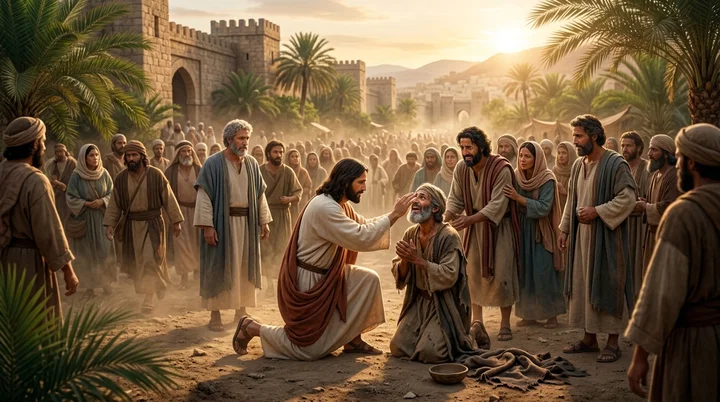
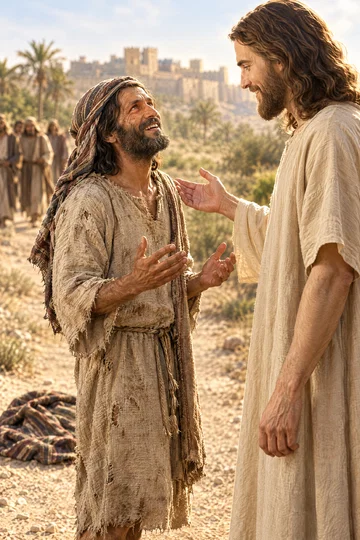
The verse pictures blind Bartimaeus sitting by the way as Jesus passes by amid a crowd, hearing the multitude moving past and asking what it means.SG2 202.1–219MR 18.2 His question is not idle curiosity but the moment of discovery that opens the healing story.SG2 202.1–219MR 18.2
Learning the cause of the stir leads him to cry out to Jesus as Son of David for mercy.SG2 202.1–2 That passing of Jesus is an opportunity to be seized, to seek Him earnestly for mercy, and those who do so may receive clearer sight and a gift more valuable than riches.19MR 18.2
That cry for mercy is the prayer of faith that brings a sick person in the arms of faith to Jesus the great Physician.SG2 202.1–2 Those who pray it are comforted and feel God's healing power, and therefore lay aside all medicine and rely alone upon the arm of the great Physician.SG2 202.1–2 Though not yet satisfied they hold faith for entire restoration, having seen God's salvation yet expecting to see and feel more, even to full strength to sound the last notes of warning to the world, with peace like a river, triumph in God, and unspeakable gratitude for tokens of God's love.SG2 202.1–2
Sources
Pioneers and periodicals
12 sources
The verse pictures a blind beggar sitting by the roadside who hears a crowd passing by and asks what is happening.ST Sep 3, 1894ST Sep 13, 1899ST Nov 21, 1900 When he learns that Jesus of Nazareth is passing, he cries out earnestly for mercy and for sight even as the crowd tries to silence him, and through that encounter his sight is restored.ST Sep 3, 1894ST Sep 13, 1899ST Jan 3, 1911 His asking marks the beginning of that meeting, for Jesus stopped to give time and attention to a blind man in need.ST Sep 3, 1894RH Feb 2, 1905 His earnest way of pleading stands against prayer that lacks effort and urgency, picturing a soul under sin's cruel blindness begging Jesus the Son of David and Healer of the blind not to pass by but to touch sightless eyes with grace, give sight that looks into the Lord's face, call nearer where sight is love, and lead into following Him.ST Jul 29, 1897RH Jul 21, 1863
Narrative Setting and Sequence
The blind beggar was sitting beside the road when he heard a crowd passing by and asked what was happening and what the commotion meant.ST Sep 3, 1894ST Sep 13, 1899ST Nov 21, 1900ST Aug 30, 1905RH Feb 2, 1905 When he learned that Jesus of Nazareth was passing by, he called out to Him for mercy.ST Sep 3, 1894ST Sep 13, 1899ST Aug 30, 1905 His earnest call for mercy was a plea for sight, made even though the crowd tried to silence him, and through this encounter with Jesus he received sight.ST Sep 3, 1894ST Jan 3, 1911ST Aug 30, 1905
The account is that of blind Bartimaeus at Jericho, the one beggar whom Luke mentions.ST Mar 18, 1889ST Jan 3, 1911ST Jul 29, 1897 He was likely the more conspicuous because of his persistence, and may have spoken for himself and his companion.ST Mar 18, 1889 The scene took place as Jesus was leaving Jericho with His disciples and a great multitude on His final journey to Jerusalem.ST Nov 21, 1900 The healing is placed on the route between the two Jerichos, before the events in the newer Roman-built city of Jericho.ST Nov 21, 1900
His first appeal came as Jesus was entering Jericho, and after an interval that Luke leaves unrecorded he appealed again as Jesus was leaving the city.ST Mar 18, 1889 It is as if, having first tried to gain attention at the entrance, he waited at the opposite gate and appealed again, consistent with his energetic persistence.ST Mar 18, 1889 In Luke's order the healing of the blind man comes after Christ's foretelling of His death and before the call of Zacchaeus.ST Apr 21, 1909 It stands within the section from Luke 18:24 through Luke 21 that also includes the parable of the pounds, the riding into Jerusalem, the weeping over the city, the parable of the husbandman, the questions of the Pharisees and Sadducees, and the discourse on the destruction of Jerusalem and the second coming.ST Apr 21, 1909
Earnest Appeal and Application
The hearing of the passing crowd and the asking what was happening marks the beginning of the blind beggar's encounter with Jesus, for on learning that Jesus of Nazareth was passing by he called on Jesus for mercy and through Him received sight.ST Sep 3, 1894 As Jesus passed by the man called to Him, and Jesus stopped to bless him, showing that Jesus gave time and attention to a blind person in need.RH Feb 2, 1905 The episode stands as an example of appealing to Jesus, whose earnest way of asking contrasts with prayer that lacks effort and urgency.RH Jul 21, 1863
Spiritually the hearing and asking is the plea of a soul under sin's cruel blindness to Jesus the Son of David and Healer of the blind not to pass by but to lay His healing touch of grace upon sightless eyes to set free.ST Jul 29, 1897 It is a cry for sight that looks into the Lord's face, for a call nearer to Himself where sight is love, and for a leading into following Him.ST Jul 29, 1897 The account of the blind beggar who came to Jesus in this way offers a comparison for a poor blind man who heard the gospel and gave from his poverty, with the hope that he too would receive sight and follow Jesus.
Sources