Mark 10:46
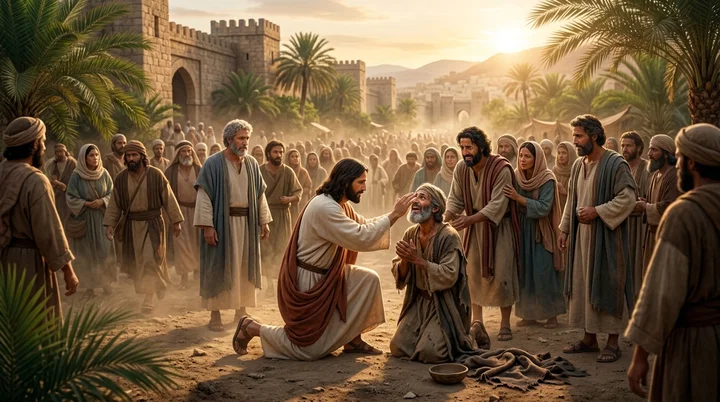
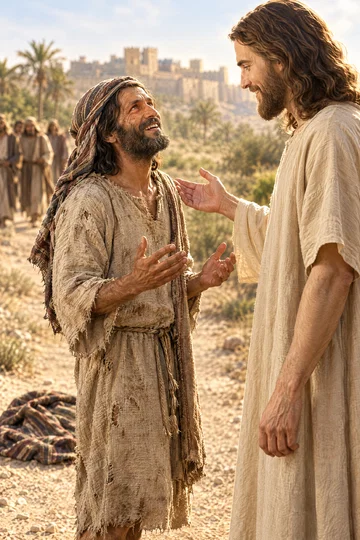
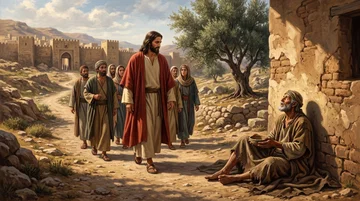
And they came to Jericho: and as he went out of Jericho with his disciples and a great number of people, blind Bartimæus, the son of Timæus, sat by the highway side begging.
Translations
And they came to Jericho: and as he went out of Jericho with his disciples and a great number of people, blind Bartimaeus, the son of Timaeus, sat by the highway side begging.
And they came to Jericho: and as he went out of Jericho with his disciples and a great number of people, blind Bartimæus, the son of Timæus, sat by the highway side begging.
And they came to Jericho: and as he went out of Jericho with his disciples and a great number of people, blind Bartimeus, the son of Timeus, sat by the highway side begging.
And they came to Jericho: and as he went out of Jericho with his disciples, and a great number of people, blind Bartimeus, the son of Timeus, sat by the highway-side begging.
And they come to Jericho: and as he went out from Jericho, with his disciples and a great multitude, the son of Timaeus, Bartimaeus, a blind beggar, was sitting by the way side.
And they come to Jericho: and as he went out from Jericho, with his disciples and a great multitude, the son of Timæus, Bartimæus, a blind beggar, was sitting by the way side.
And they come to Jericho, and as he is going forth from Jericho, with his disciples and a great multitude, a son of Timaeus — Bartimaeus the blind — was sitting beside the way begging,
And they come to Jericho, and as he was going out from Jericho, and his disciples and a large crowd, the son of Timaeus, Bartimaeus, the blind [ man], sat by the wayside begging.
And they come into Jericho. And, as he was journeying forth from Jericho, and his disciples, and a considerable multitude, the son of Timaeus, blind Bar-Timaeus, a beggar, was sitting beside the road.
Next, they came to Jericho. And as Jesus and His disciples were leaving Jericho with a large crowd, a blind beggar named Bartimaeus, the son of Timaeus, was sitting beside the road.
Next, they came to Jericho. And as Jesus and His disciples were leaving Jericho with a large crowd, a blind man named Bartimaeus, the son of Timaeus, was sitting beside the road begging.
They came to Jericho. As he went out from Jericho with his disciples and a great multitude, the son of Timaeus, Bartimaeus, a blind beggar, was sitting by the road.
And they came to Jericho: and when he was going out of Jericho, with his disciples and a great number of people, the son of Timaeus, Bartimaeus, a blind man, was seated by the wayside, with his hand out for money.
Then they came to Iericho: and as he went out of Iericho with his disciples, and a great multitude, Bartimeus the sonne of Timeus, a blinde man, sate by the wayes side, begging.
Douay-Rheims (Challoner revision)
And they came to Jericho: and as he went out of Jericho, with his disciples, and a very great multitude, Bartimeus the blind man, the son of Timeus, sat by the way side begging.
Pictures
Cross-references
- Luke 18:35-43
And it came to pass, that as he was come nigh unto Jericho, a certain blind man sat by the way side begging:
Parallel account of the blind beggar healed near Jericho.
- Matthew 20:29-34
And as they departed from Jericho, a great multitude followed him.
Both accounts describe Jesus healing blind beggars as he leaves Jericho.
- Luke 19:1-10
And Jesus entered and passed through Jericho.
Both show Christ giving personal attention to a seeker in Jericho.
- Matthew 9:27-31
And when Jesus departed thence, two blind men followed him, crying, and saying, Thou Son of David, have mercy on us.
Another account of Jesus healing blind men.
- Mark 8:22-26
And he cometh to Bethsaida; and they bring a blind man unto him, and besought him to touch him.
Another account of Jesus restoring a blind man's sight.
- Matthew 20:30-34
And, behold, two blind men sitting by the way side, when they heard that Jesus passed by, cried out, saying, Have mercy on us, O Lord, thou Son of David.
Jesus heals blind men who call to him for mercy.
- Mark 10:51
And Jesus answered and said unto him, What wilt thou that I should do unto thee? The blind man said unto him, Lord, that I might receive my sight.
golden text of the Bartimaeus healing
- Isaiah 35:5
Then the eyes of the blind shall be opened, and the ears of the deaf shall be unstopped.
Foretells the eyes of the blind being opened.
- Luke 18:37
And they told him, that Jesus of Nazareth passeth by.
Both describe Jesus of Nazareth passing by as blind Bartimæus is present.
- John 9
And as Jesus passed by, he saw a man which was blind from his birth.
Another account of Jesus healing a man born blind.
Commentary
Each commentary is drawn from primary sources: the writings of Ellen G. White and Adventist pioneers and periodicals. Each commentary is separate. Its own words are not a quotation; follow the references to read the source passages.
Ellen G. White
6 sources
The setting is Jericho as Jesus goes out of the city with His disciples and a great number of people, while blind Bartimaeus, the son of Timaeus, sits by the highway side begging.SG2 202.1–219MR 18.2 His moment comes because Jesus is passing by, and that passing gives him the opportunity to call to Him for mercy.19MR 18.2 Earnest seeking of Jesus in such a moment can bring clearer spiritual sight and gifts more valuable than material riches.19MR 18.2
Bartimaeus crying to Jesus as He passed, calling on Him as Son of David for mercy, is the pattern for seeking physical healing in faith.RH Jan 10, 1856SG2 202.1–2 Jesus is to be sought as the great Physician for healing, and the sick are to be carried to Him in the arms of faith with that same persistent cry for mercy.RH Jan 10, 1856SG2 202.1–2 That seeking lays aside all other medicine and relies alone on His arm.SG2 202.1–2 Such faith is answered with comfort and felt healing power, yet it is not satisfied with partial relief but presses for entire restoration and expects to see and feel more of the salvation of God.RH Jan 10, 1856SG2 202.1–2 It believes the one restored will yet live to sound God's last warning to the world, and it brings peace like a river, triumph in God, unspeakable gratitude for tokens of His love, and renewed dedication to Him.SG2 202.1–2
The blind beggar by the highway also pictures the sinner hardened in sin, unbelief and transgression, blind to the higher interests of the soul and to the blessed attractions of a heavenly life in the city of God, without hope and without God.Lt 1d, 1890, par. 17Lt 1d, 1890, par. 16 He has labored for that which is not bread, sacrificed peace and honor and the companionship of the children of God, even his own children, to walk without obstruction in his own way.Lt 1d, 1890, par. 16 He has striven to content himself in secret sinful pleasure and base gratification irrespective of God and heaven.Lt 1d, 1890, par. 16 While Jesus of Nazareth is passing by, He offers such a one what is most needed, which is of infinite gain even if it cost the toil and suffering of a whole lifetime.Lt 1d, 1890, par. 17Lt 1d, 1890, par. 16
Such a sin-hardened soul, separated from God and bound by his own wicked course and standing on the very borders of the eternal world, may still fall upon the Rock Christ Jesus and be broken before it is utterly too late.Lt 1d, 1890, par. 17Lt 1d, 1890, par. 18 He must throw himself at the feet of Jesus even at the eleventh hour without waiting, reasoning or delay, crying with a broken repentant heart for mercy while others bid him hold his peace.Lt 1d, 1890, par. 17Lt 1d, 1890, par. 18 He must break the bands of Satan, risk everything, get away from the place of wickedness, refuse Satan's suggestions and every voice telling him to keep silent, confess sins to God and to those wronged, and make thorough work of repentance to grasp the crown of life.Lt 1d, 1890, par. 18 For Jesus of Nazareth is passing by to pardon sin and rescue out of the snare of the devil those who come to Him without delay.Lt 1d, 1890, par. 17Lt 1d, 1890, par. 18 If he so comes, God will not leave him to perish, but God alone will touch his heart with new tenderness and lead him to feel the obligations to God that he has so long perverted.Lt 1d, 1890, par. 17
Sources
Pioneers and periodicals
35 sources
As Jesus went out of Jericho with his disciples and a great crowd, blind Bartimaeus the son of Timaeus sat by the highway side begging.RH Nov 17, 1859ST Nov 21, 1900ST Jul 29, 1897 Mark names only Bartimaeus though two blind beggars were present because he was the more conspicuous through persistency and acted as spokesman for himself and his companion, and the healing took place on the road between the old city and the Roman town so that Jesus was leaving the one while approaching the other.ST Mar 18, 1889ST Nov 21, 1900ST Mar 8, 1905ST Nov 21, 1900 Those who held the other understanding taught that he first called at the entrance and then waited and pleaded again at the other gate, with the healing at leaving.ST Mar 18, 1889 Jesus did not treat his cry as an unwelcome disturbance but stopped amid demanding work, heard him despite the crowd's rebukes to silence him, touched his eyes and gave him sight through his faith.RH Dec 6, 1906ST Mar 18, 1889ST Jun 14, 1905RH Dec 26, 1907RH Dec 2, 1862 His blindness pictures humanity poor, blinded by sin and unable to supply what it lacks, his casting aside his garment and crying for mercy shows sinners to cast aside sin and plead earnestly for spiritual sight, and having received sight he followed Jesus from darkness to light as his followers must turn aside to seek out fellow sinners.RH Nov 17, 1859RH Dec 6, 1906ST Jul 29, 1897RH Dec 26, 1907
Scene at Jericho
As he went out of Jericho with his disciples and a great number of people, blind Bartimaeus, the son of Timaeus, sat by the highway side begging.RH Nov 17, 1859ST Nov 21, 1900RH Feb 4, 1873ST Nov 9, 1915ST Dec 11, 1879 He sat beside the road near the city as Jesus passed by with his disciples and a crowd.ST Jul 29, 1897RH Aug 29, 1871ST Nov 25, 1880
Mark names only Bartimaeus though two blind beggars were present at Jericho.ST Mar 18, 1889ST Aug 30, 1905 He is singled out because he was the more conspicuous of the two through persistency and because he acted as spokesman for himself and his companion.ST Mar 18, 1889 Mark does the same at Gadara, naming only one demoniac where two were present.ST Mar 18, 1889 This is one of two healings of blind men at Jericho and is counted among seven instances specially noted as Jesus healing a blind person.ST Mar 8, 1905
The difference from Luke, who places the event as Jesus approached Jericho, is reconciled by there being two Jerichos, an old city and a Roman town, with the healing taking place on the road between them.ST Nov 21, 1900ST Nov 21, 1900 Jesus was thus leaving the old city while approaching the Roman town, so Mark describes him leaving the old city while Luke describes him approaching the Roman town.ST Nov 21, 1900ST Nov 21, 1900 Another understanding is that Bartimaeus first called to Jesus at the entrance to the city and then waited at the other gate and pleaded again, with Luke mentioning the plea at entering and the healing at leaving.ST Mar 18, 1889 Whether the plea began as Jesus entered or as he left does not change the important fact that Jesus healed him.ST Mar 18, 1889
The verse belongs in the first ten chapters of Mark presenting Jesus as a powerful and loving King who shows compassion to the suffering and relieves the burdened without self-seeking.RH Oct 30, 1860 It places the encounter on his final journey to Jerusalem by the city gate, his last opportunity for Bartimaeus, though he did not know it was his last opportunity.ST Nov 25, 1880 Blind people still sat by the wayside begging, and their pitiable cries moved Jesus to compassion.RH Aug 29, 1871
Christ's Compassionate Healing
Blind Bartimaeus sat as a poor and friendless beggar beside the road at Jericho as Jesus went out with his disciples and a great crowd.ST Mar 18, 1889RH Feb 4, 1873 His blindness left him dependent on others and weary of a life of darkness and neglect.RH Feb 4, 1873 Yet he was convinced that Jesus could restore his sight and waited expecting help when Jesus passed by.ST Mar 18, 1889RH Feb 4, 1873
His healing shows Christ's mission to the poor and to people of every station by the wayside.ST Jun 14, 1905ST Jul 9, 1894 The blind man crying by the roadside received personal attention from the Son of God, who sought him out with a personal and direct call.RH Dec 26, 1907 Jesus did not treat the man's need as an unwelcome disturbance or turn him away, but had time to stop and bless him amid demanding work.RH Dec 2, 1862RH Feb 2, 1905ST Nov 9, 1915 He heard him, touched his eyes, and opened them to give him sight.ST Mar 18, 1889ST Aug 30, 1905RH Dec 2, 1862ST Nov 9, 1915
Bartimaeus cried for mercy despite the crowd's efforts and rebukes to silence him.RH Nov 17, 1859ST Mar 18, 1889 He refused to be silenced and continued to cry out, repeating his plea with determination not to let the opportunity pass.ST Mar 18, 1889ST Sep 5, 1911 His cry for the definite, deeply felt need of recovering his sight illustrates direct, earnest, persistent prayer that clearly asks for what is needed.ST Mar 18, 1889RH Oct 23, 1860 His appeal shows sinners to come expecting help, and his coming in answer to Christ's call shows them to cast aside whatever hinders them.RH Nov 17, 1859RH Feb 4, 1873
He received his sight through faith in Jesus, for Jesus said his faith had made him whole.RH Dec 6, 1906 His appeal is the pattern for seeking Christ as the great Physician in faith for healing and complete restoration.RH Jan 10, 1856 His healing is the pledge of blessings received by faith in God's Word: as surely as he received sight, believers may now have by faith cleansing from sin, power in Christ, righteousness, the Spirit, salvation, and eternal life, though heaven and immortality await Christ's appearing.ST May 6, 1897
After receiving sight he followed Jesus.RH Dec 6, 1906ST Mar 18, 1889ST Jul 29, 1897RH Feb 4, 1873 He was brought from blindness to sight, a happier life than begging beside the road. From a beggar living in darkness he was changed into a child of light, trusting in the fame of Christ's power and love.ST Aug 30, 1905 Restored sight meant seeing the Lord and following him.ST Jul 29, 1897
He stands among people in distress, suffering, helpless, needy and disconsolate whose burdens were lifted when Christ came.RH Feb 25, 1875ST Mar 4, 1880ST Jun 7, 1877 His distress is one example of human sorrow that was relieved when Christ came as the Consolation and Burden-Bearer.RH Feb 25, 1875ST Mar 4, 1880ST Jun 7, 1877 His encounter belongs among Jesus' works of mercy, showing compassion and interest in helping people who cry loudly for help and triumph over human weakness.RH Dec 2, 1873
Spiritual Sight and Discipleship
The sitting beggar by the roadside pictures the condition of those blinded by sin and misled by the world, who have eyes for physical sight yet cannot see spiritual truth.ST Jul 29, 1897ST Oct 17, 1878 It pictures humanity itself as poor and blind and unable to supply what it lacks, but finding in Jesus rest and sight and life and righteousness, changed from a beggar living in darkness into a child of light.ST Aug 30, 1905 His pleading with Jesus, the Son of David, for mercy and healing shows that those who come to him in faith receive spiritual sight and forgiveness, and restored sight means seeing the Lord and following him.ST Jul 29, 1897 That same power that gave Bartimaeus his sight gives spiritual eyesight and wisdom from above to hearts that are blind and hard and stony and dead in sin and cry out to God for awakening and full and complete conversion of soul and a deep and permanent work of the Spirit that makes doing right easy and natural.
That spiritual blindness is failing to see the way and other people's pain and the harm caused by careless words, and the appeal for sight is a plea for mercy and for light to find the right way.ST May 13, 1889 Selfishness can make a person spiritually blind, and restoring that sight requires an even greater miracle of divine grace than the miraculous restoring of physical sight.ST The blind beggar beside the road is the image of blindness in religious matters, and of sight impaired by theological training.ST Dec 11, 1879RH Jun 23, 1874
His crying for mercy despite efforts to silence him, and his coming when called expecting help, show sinners to come to Jesus for mercy whatever their need or guilt, and to cast aside whatever hinders them.RH Nov 17, 1859 The casting aside of his garment is the casting aside of self-righteousness and sin that hinder a person from coming to Jesus. His appeal is the example of seeking Christ's help in faith as the great Physician for healing and complete restoration, applied to asking for awakening and full conversion and spiritual eyesight and wisdom.RH Jan 10, 1856 He is the model for pleading with Jesus for mercy and sight applied to spiritual blindness, asking Christ to help the speaker see his way and follow him.ST Jun 20, 1906 Those blinded by torture and anguish and too weak for prayer may come as beggars at Christ's feet pleading for dear sight for the soul, to see his pierced heart whence poured life's last red drop on Calvary's hill and the cruel thorns that crowned his forehead, that the sight may touch a diviner chord crying out braver than the will, whether suffering is removed or pressed deeper still.ST Mar 20, 1893
Jesus seeking out the crying man by the roadside with a personal and direct appeal sets the pattern to be copied by turning aside from little earthly affairs to seek out fellow sinners and hand them the message prepared for them, speaking directly and tenderly as balm and solace to the aching heart.RH Dec 26, 1907 His stopping on the road to attend to the blind man and opening his eyes shows care for blind people and stands against treating their need as an unwelcome disturbance or turning them away.RH Dec 2, 1862 The lesson is to notice blind people who call for help and to have time to stop and bless them and assist them, going among people of every station including those in need by the wayside and doing what can be done for them.RH Feb 2, 1905ST Jul 9, 1894 So his story is the model and hope for the poor blind man in Ning Shang, that he too will receive sight and follow Jesus.
Sources