Luke 18:40
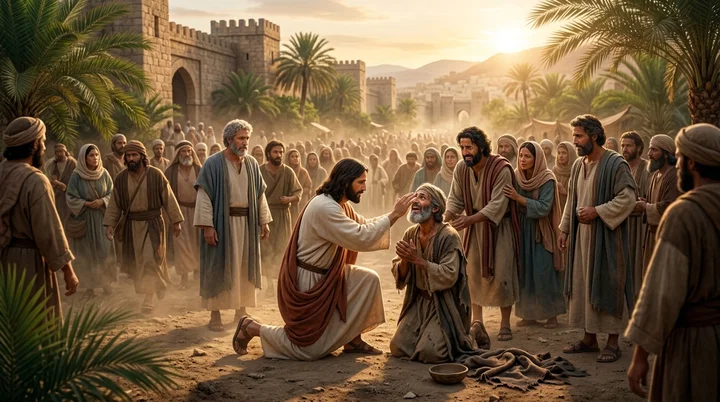
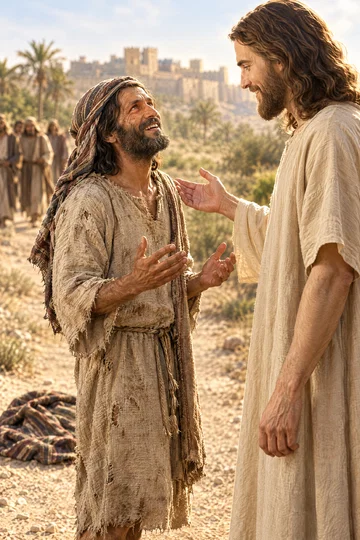
And Jesus stood, and commanded him to be brought unto him: and when he was come near, he asked him,
Translations
And Jesus stood, and commanded him to be brought to him: and when he was come near, he asked him,
King James Version, KJV Cambridge Paragraph Bible, Revised Version, American Standard Version
And Jesus stood, and commanded him to be brought unto him: and when he was come near, he asked him,
And Jesus stood and commanded him to be brought to him: and when he had come near, he asked him,
And Jesus having stood, commanded him to be brought unto him, and he having come nigh, he questioned him,
And Jesus stood still, and commanded him to be led to him. And when he drew nigh he asked him [saying],
And, standing still, Jesus commanded him to be led unto him; and, when he had drawn near, he questioned him—
Jesus stopped and directed that the man be brought to Him. When he had been brought near, Jesus asked him,
Jesus stopped and directed that the man be brought to Him. When he had come near, Jesus asked him,
Standing still, Jesus commanded him to be brought to him. When he had come near, he asked him,
And Jesus, stopping, gave orders that he was to come to him, and when he came near, he said to him,
And Iesus stoode stil, and commanded him to be brought vnto him. And when he was come neere, he asked him,
Douay-Rheims (Challoner revision)
And Jesus standing, commanded him to be brought unto him. And when he was come near, he asked him,
Pictures
Cross-references
- Matthew 20:32
And Jesus stood still, and called them, and said, What will ye that I shall do unto you?
Jesus stops and calls the blind men to him.
- Mark 10:49-52
And Jesus stood still, and commanded him to be called. And they call the blind man, saying unto him, Be of good comfort, rise; he calleth thee.
Jesus calls the blind man to him and restores his sight.
- Matthew 9:27-31
And when Jesus departed thence, two blind men followed him, crying, and saying, Thou Son of David, have mercy on us.
Both texts recount Jesus healing blind men.
- Mark 8:22-26
And he cometh to Bethsaida; and they bring a blind man unto him, and besought him to touch him.
Another recorded instance of Jesus healing a blind man.
- Matthew 12:22
Then was brought unto him one possessed with a devil, blind, and dumb: and he healed him, insomuch that the blind and dumb both spake and saw.
Both texts recount Jesus healing a blind man.
Commentary
Each commentary is drawn from primary sources: the writings of Ellen G. White and Adventist pioneers and periodicals. Each commentary is separate. Its own words are not a quotation; follow the references to read the source passages.
Ellen G. White
3 sources
Jesus stood still and stopped on His way, commanded that the blind man be brought to Him, and when the man had come near He spoke personally with him.SG2 202.1–219MR 18.2 In that standing He is the great Physician standing to receive the sufferer, receiving those who are brought to Him in the arms of faith.SG2 202.1–2 He is Jesus of Nazareth passing by with a blessing in His hand, a blessing that must not be allowed to pass unreceived.Ms 128, 1901, par. 31
To call upon Him as Son of David for mercy is to find comfort and to feel healing power go through the soul and body.SG2 202.1–2 His stopping for the blind man makes every such moment an occasion to cry to Jesus for mercy and to receive clearer spiritual sight through God's grace.19MR 18.2 The answer He gives calls for laying aside all earthly medicine and relying alone upon the arm of God.SG2 202.1–2
Faith thus awakened is not satisfied with partial relief but claims entire restoration, expecting to see and to feel still more of the salvation of God.SG2 202.1–2 The result is peace flowing like a river, triumph in God, unspeakable gratitude for tokens of divine love, renewed dedication to God, and restored strength to sound the last notes of warning to the world.SG2 202.1–2 For His commandment-keeping people that blessing is received by coming down from all self-exaltation, walking humbly before Him, seeking Him with all heart and soul and strength and mind, searching the heart, setting in order what ought to have been set in order, and preparing the King's highway, all to glorify His name.Ms 128, 1901, par. 31
Sources
Pioneers and periodicals
17 sources
Jesus stopped and stood still at Jericho and commanded the blind beggar to be brought near to him, giving him personal attention and speaking with him before healing him.ST Nov 21, 1900ST Sep 13, 1899ST Mar 8, 1905RH Jul 2, 1861 He readily receives and heeds the urgent, persistent cry of one suffering and helpless, answering with tender compassion that restores sight and brings light and life.ST Sep 3, 1894ST Jan 3, 1911ST Jul 29, 1897ST Aug 30, 1905 It is not fine or eloquent prayer but crying, persevering prayer that will not be silenced that attracts his notice and makes him stand still to hear and answer.RH Jul 21, 1863 The helpless can call on God and by intelligent, growing faith receive sight, for blindness pictures blindness to sin and its healing pictures the sinner asking for mercy and receiving the divine touch that opens his eyes to see Christ and follow him.ST Sep 3, 1894RH Dec 16, 1909ST Jul 29, 1897RH Jul 2, 1861ST Jul 7, 1898 Because Jesus made time to stop for the man who called as he passed by, those who need help should not be passed by but stopped for with compassion.RH Feb 2, 1905
Setting and Action
Jesus stopped and stood still and commanded that the blind beggar be brought to him.ST Nov 21, 1900ST Sep 13, 1899ST Apr 24, 1901 In answering the man's persistent plea he gave him personal attention and had him brought near so he could speak with him.ST Sep 13, 1899RH Jul 2, 1861ST Apr 24, 1901 He spoke with him before healing him, attentive to one who called for his help.RH Jul 2, 1861ST Apr 24, 1901
The verse belongs to the account of the healing of a blind man at Jericho, one of two healings of blind men at Jericho specially recorded in the Gospels.ST Mar 8, 1905 It stands within the section from Luke 18:24 through Luke 21.ST Apr 21, 1909 Luke, like Mark, mentions one beggar, Bartimeus, while Matthew mentions two, and Bartimeus may have been the more conspicuous because of his persistence and may have spoken for both himself and his companion.ST Mar 18, 1889 The encounter belongs to Jesus' journey through Jericho and can be read as the man first calling to Jesus as he entered the city and receiving healing after Jesus came out, with Luke noting the earlier appeal and the later healing without recounting the interval.ST Mar 18, 1889
As Jesus called him, the people who had rebuked him told him to take heart and come, and he came to Jesus.ST Nov 21, 1900 Bartimeus received his sight and followed Jesus. He is an example of a blind person who receives sight and follows him.
Mercy Faith and Application
Jesus readily receives the blind beggar and has him brought near so that he can answer his request, and in stopping to heed his urgent, persistent cry he shows mercy and care for one who is suffering and helpless.ST Sep 3, 1894ST Jan 3, 1911 He answers the plea with tender compassion, restoring sight and bringing light and life to the soul, drawing the man close to himself as healer.ST Jul 29, 1897ST Aug 30, 1905 In opening the eyes of a blind beggar he acts as a missionary to the poor.ST Jun 14, 1905
It is not fine or eloquent prayer but crying, persevering prayer that attracts his notice and makes him stand still to hear and answer, prayer pressed by distress to push through, struggle, wrestle and agonize to be heard and helped. The beggar would not be silenced when rebuked but cried so much the more, because he must be heard and helped now or never, since his only Saviour from his malady was passing by and might never pass again, with all hope hung on that one moment and on Jesus only. His stopping creates a moment of breathless suspense, with the beggar full of hopes, fears and deep anxiety, Jesus full of compassion toward him, and every onlooker watching between and upon them both. Such earnest appeals are examples of prayer that differs from mere repeated or lengthy words, and believers should ask whether their own prayers stop Jesus in his way and cause him to stand still, and should seek a baptism of such crying prayer upon the churches.RH Jul 21, 1863
The helpless can call upon God and receive sight through faith, and this simple record gives reason for a large increase of faith.ST Sep 3, 1894RH Dec 16, 1909 It means that those seeking righteousness will have divine help, that they will ask and God will hear, that God will care for them and deliver them in peril even if they do not at once feel what they expect, for his praying, believing people are under his special care while heavenly intelligences look with interest on the work.RH Dec 16, 1909 The verse therefore calls for constant exercise of intelligent faith, a faith that grows continually and grasps the promises of God so that the promises will be fulfilled.RH Dec 16, 1909
The miracle illustrates how spiritual sight and riches are received by coming to Jesus and trusting his promise, with blindness as an image of blindness to sin and healing leading to seeing Christ and following him.ST Sep 3, 1894ST Jul 29, 1897 It shows how a sinner who asks Jesus for mercy may by faith receive the divine touch that opens his eyes, and that a person can receive Christ's help without understanding how it is given.RH Jul 2, 1861ST Jul 7, 1898 Because Jesus stopped for the man who called as he passed by and made time to receive and bless him, people should not pass by those who need help but should stop and show them compassion.RH Feb 2, 1905
Sources