Matthew 20:32
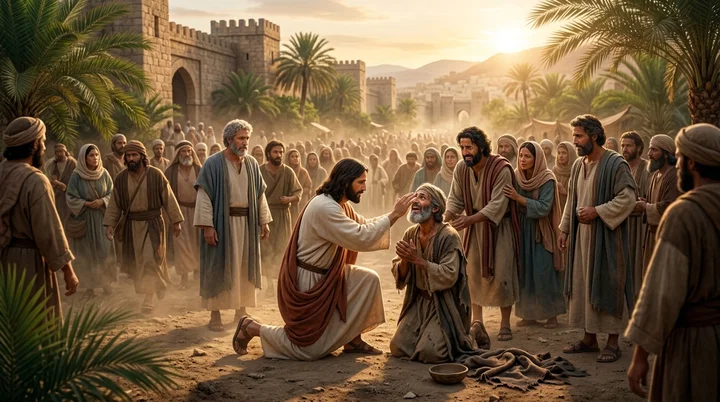
And Jesus stood still, and called them, and said, What will ye that I shall do unto you?
Translations
And Jesus stood still, and called them, and said, What will you that I shall do to you?
King James Version, KJV Cambridge Paragraph Bible
And Jesus stood still, and called them, and said, What will ye that I shall do unto you?
And Jesus stood still, and called them, and said, What will ye that I shall do to you?
Revised Version, American Standard Version
And Jesus stood still, and called them, and said, What will ye that I should do unto you?
And having stood, Jesus called them, and said, 'What will ye [that] I may do to you?'
And Jesus, having stopped, called them and said, What will ye that I shall do to you?
And, standing still, Jesus called them, and said—What desire ye I should do for you?
Berean Standard Bible, Majority Standard Bible
Jesus stopped and called them. “ What do you want Me to do for you?” He asked.
Jesus stood still and called them, and asked, “ What do you want me to do for you?”
And Jesus, stopping, sent for them, and said, What would you have me do to you?
Then Iesus stoode still, and called them, and said, What will ye that I should do to you?
Douay-Rheims (Challoner revision)
And Jesus stood, and called them, and said: What will ye that I do to you?
Pictures
Cross-references
- Luke 18:40-42
And Jesus stood, and commanded him to be brought unto him: and when he was come near, he asked him,
Jesus brings the blind man near, asks what he wants, and restores his sight.
- Mark 10:51
And Jesus answered and said unto him, What wilt thou that I should do unto thee? The blind man said unto him, Lord, that I might receive my sight.
Jesus asks Bartimaeus what he wants before restoring his sight.
- Matthew 9:27-30
And when Jesus departed thence, two blind men followed him, crying, and saying, Thou Son of David, have mercy on us.
Jesus restores sight to blind men who appeal to him for mercy.
- Isaiah 35:5
Then the eyes of the blind shall be opened, and the ears of the deaf shall be unstopped.
Foretells the eyes of the blind being opened.
Commentary
Each commentary is drawn from primary sources: the writings of Ellen G. White and Adventist pioneers and periodicals. Each commentary is separate. Its own words are not a quotation; follow the references to read the source passages.
Ellen G. White
1 source
In this encounter Jesus stands as the great Physician who meets the cry for mercy with words of comfort and with healing power.SG2 202.1–2 The sick are carried to Him in the arms of faith, crying to Him as Son of David for mercy just as blind Bartimaeus did.SG2 202.1–2 Faith that cries in this way puts aside all medicine and leans wholly upon His arm alone.SG2 202.1–2 That faith senses His healing power at work, is comforted by it, and keeps pressing on for complete restoration while looking to see and feel still more of God's salvation.SG2 202.1–2
Sources
Pioneers and periodicals
18 sources
As he was leaving Jericho for Jerusalem with a great multitude following, Jesus stopped when two blind beggars by the way persistently cried to him for mercy and called them to him to state what they wanted him to do for them.ST Aug 29, 1911ST Sep 13, 1899ST Nov 21, 1900ST Mar 18, 1889ST Aug 29, 1911 Though the crowd disregarded them, he attentively heard their cry and, when they asked for sight, gave them sight and healing according to their faith.ST Aug 30, 1905ST Jan 3, 1911ST Nov 20, 1901RH Sep 1, 1904ST Aug 29, 1911 Although he knew their need, his question teaches that those who seek mercy from God should lay their particular needs before him in prayer, and he hears even the heart's cry amid a crowd and gives relief as is best.ST Aug 29, 1911ST Aug 29, 1911 Their blindness and poverty picture the condition of all people, who whatever their wealth or appearance cannot truly see, and their healing pictures bringing the soul from darkness to sight, rest, life, and righteousness in Christ.ST Aug 30, 1905ST Jul 29, 1897ST Nov 20, 1901ST Nov 20, 1901 His willingness to stand still and help is the pattern for responding with compassion and making time for people in need.RH Feb 2, 1905
Setting and Encounter
Jesus' question to the two blind men belongs to the moment when he was leaving Jericho on his way to Jerusalem with a great multitude following him, yet outwardly following him was not the same as being his disciple.ST Aug 29, 1911 Those he addressed were two blind beggars near Jericho, with Bartimeus the more conspicuous who spoke for himself and his companion when they called out to him for mercy.ST Mar 18, 1889ST Nov 20, 1901 Their poverty and need stand in contrast to the small, grudging alms given by the wealthy, and their need is a plea made in God's name.ST Nov 20, 1901
Affliction had brought them to seek him, and they persistently called to him for mercy to gain his attention as he was leaving Jericho.ST Aug 29, 1911ST Mar 18, 1889 He stood still and called them to him and asked what they wanted him to do for them.ST Sep 13, 1899ST Nov 21, 1900ST Aug 30, 1905RH Jan 25, 1906 In doing so he gave them the opportunity to state their need for healing before they asked him to open their eyes and receive their sight.ST Sep 13, 1899ST Nov 21, 1900ST Nov 20, 1901
Compassion and Healing Power
Jesus heard the blind men's cries even amid the press of the multitude, stood still, and called them to Himself to speak with them directly.ST Aug 29, 1911RH Jul 2, 1861RH Jan 25, 1906 His stopping to ask what they wanted stands in contrast to the indifference of the crowd around Him and reveals His attentive care for those who suffer.ST Jan 3, 1911RH Jan 25, 1906 He answered their appeal for mercy personally, though they could not explain by what means He would heal them.RH Jul 2, 1861 He was willing to listen to their request for healing and give them opportunity to lay it before Him.RH Jan 25, 1906
His tender halt and question show that He attends to all who cry out to Him.ST Aug 30, 1905ST Nov 20, 1901 In the same act He meets the deep need of everyone who comes to Him.ST Aug 30, 1905 When they asked that their eyes might be opened, He healed them and gave them sight.ST Aug 30, 1905ST Nov 20, 1901ST Mar 18, 1889 That gift of sight displays His power to give sight and healing, bestowed according to their faith.ST Aug 30, 1905ST Nov 20, 1901RH Sep 1, 1904
The opening of their eyes pictures more than bodily cure, for it represents the bringing of a soul out of darkness into the light of life and love.ST Nov 20, 1901
Prayer and Spiritual Lessons
Although he knew what the blind men needed, he invited them to tell him their specific request.ST Aug 29, 1911 People may ask God generally for mercy and should also lay their particular needs before him in prayer, for he knows their needs yet invites them to express them and gives relief and blessing as is best.ST Aug 29, 1911 Prayer does not require outward quiet or privacy, for even in a crowd and without speaking aloud he hears and attends to the heart's cry.ST Aug 29, 1911 His answer establishes that Christian experience, including overcoming obstacles and gaining victories, is according to the measure of faith.RH Sep 1, 1904
Their blindness and poverty picture the spiritual condition of all people, who whatever their earthly wealth, reputation, or appearance lack what they need and cannot see truly.ST Aug 30, 1905ST Nov 20, 1901 The healing applies to freedom from sin's blindness, with those who ask to be led nearer to him receiving sight.ST Aug 30, 1905ST Jul 29, 1897 In Christ are found rest, sight, life, health, and righteousness, and he clothes the needy soul in righteousness rather than its own inadequate righteousness.ST Aug 30, 1905ST Nov 20, 1901
His willingness to stop and help is an example for Christians to make time for people in need and respond to their appeals with compassion.RH Feb 2, 1905
Sources