Luke 5:39
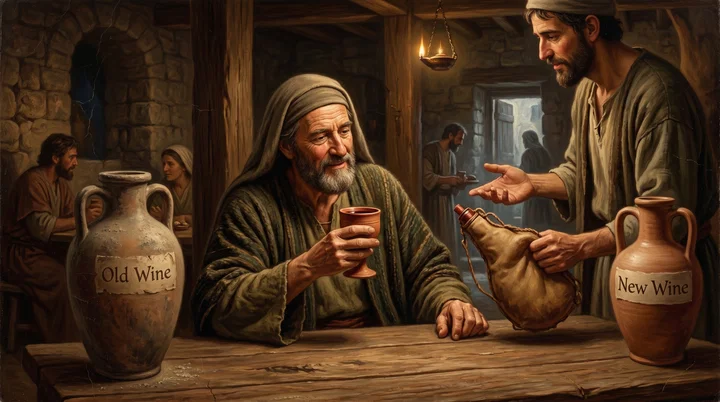
No man also having drunk old wine straightway desireth new: for he saith, The old is better.
Translations
No man also having drunk old wine straightway desires new: for he says, The old is better.
King James Version, KJV Cambridge Paragraph Bible
No man also having drunk old wine straightway desireth new: for he saith, The old is better.
No man also having drank old wine, immediately desireth new: for he saith, The old is better.
And no man having drunk old wine desireth new: for he saith, The old is good.
And no man having drunk old wine desireth new; for he saith, The old is good.
and no one having drunk old [wine], doth immediately wish new, for he saith, The old is better.'
And no one having drunk old wine [straightway] wishes for new, for he says, The old is better.
[No one, having drunk old, desireth new; for he saith, The old, is, mellow.]
And no one after drinking old wine wants new, for he says, ‘ The old is better.’”
And no one after drinking old wine immediately wants new, for he says, ‘ The old is better.’”
No man having drunk old wine immediately desires new, for he says, ‘ The old is better.’”
And no man, having had old wine, has any desire for new, for he says, The old is better.
Also no man that drinketh olde wine, straightway desireth newe: for he sayth, The olde is more profitable.
Douay-Rheims (Challoner revision)
And no man drinking old, hath presently a mind to new: for he saith, The old is better.
Pictures
Cross-references
- Matthew 9:9-17
And as Jesus passed forth from thence, he saw a man, named Matthew, sitting at the receipt of custom: and he saith unto him, Follow me. And he arose, and followed him.
Listed as a parallel passage for the chapter.
- Mark 2:14-22
And as he passed by, he saw Levi the son of Alphæus sitting at the receipt of custom, and said unto him, Follow me. And he arose and followed him.
Listed as a parallel passage for the chapter.
Commentary
Each commentary is drawn from primary sources: the writings of Ellen G. White and Adventist pioneers and periodicals. Each commentary is separate. Its own words are not a quotation; follow the references to read the source passages.
Ellen G. White
2 sources
The saying belongs to a parable teaching that Christ's teachings cannot be attached to the old religious maxims and customs as a mere addition.Ms 72, 1895, par. 11 It states the principle that people accustomed to old teaching and practice do not immediately desire new truth because they judge the old to be better.DA 279.1–3 False teaching and cherished traditions dull both the desire for truth and the ability to recognize it.DA 279.1–3
The scribes and Pharisees illustrated this by clinging to lifeless forms and rejecting Christ's teaching, even though that teaching displayed in fresh beauty the truth already given through the patriarchs and prophets.DA 279.1–3 To receive Christ's teaching, people must abandon human commandments taught as doctrine and the traditions and customs that leave no room for living truth.Ms 72, 1895, par. 11DA 279.1–3 His religion instead requires an entirely renewed character, wholehearted obedience, self-denial and self-sacrifice under a higher and holier standard.Ms 72, 1895, par. 11
Sources
Pioneers and periodicals
11 sources
No one used to old wine wants new wine right away, but calls the old better because he is satisfied with what he already has.ST Mar 11, 1913ST Mar 5, 1894ST Apr 15, 1880 This does not mean the old is truly better, only that those accustomed to it prefer it.ST Mar 11, 1913 The new wine is Christ's teaching, which must be put into people made new by His power, while the old wine and old skins are the Jewish system of types, ceremonies and self-righteousness and hearts hardened by tradition, so Christ could not carry on His work through the established leaders who clung to Moses, kept fasting and mourning as if the bridegroom had not come, and refused to be made new.ST Mar 11, 1913ST Apr 15, 1880RH Jul 4, 1871ST Mar 5, 1894ST Mar 5, 1894 The same spirit appears whenever people settled in established religious teaching want nothing beyond what they already know, and so reject present truth and turn against those who bring further light, as was done to the prophets, to Christ, and to later reformers.ST Mar 11, 1913
Parable Meaning and Context
The saying pictures drinkers accustomed to old wine as satisfied with what they already have and unwilling to desire anything new, calling the old better and even good.ST Mar 11, 1913ST Mar 5, 1894ST Apr 15, 1880RH Jul 4, 1871 In its setting the new wine is the teaching of Jesus, which belongs in people made new by his power, while the old wine and the old wineskins are the traditional system of the Jews and hearts shaped by tradition.ST Mar 11, 1913 The declaration that the old is better is not a judgment that the old is actually better than the new, nor that the old is good; it only describes the preference of those accustomed to the old for what is familiar.ST Mar 11, 1913 This explains why the established Jewish leaders resisted the new teaching and work of Jesus.ST Mar 5, 1894
The old wine is the system of types and ceremonies of the Pharisees, to which they clung as disciples of Moses while rejecting Christ.ST Apr 15, 1880RH Jul 4, 1871 They continued to fast and mourn as though the bridegroom had not come.ST Apr 15, 1880RH Jul 4, 1871
The new wine of the gospel could not be put into the old vessels of Jewish self-righteousness.ST Mar 5, 1894 Priests and Levites could have joined the work of Christ only by being made new, which they refused, so the established leaders of the Jews could not be used in his work.ST Mar 5, 1894ST Mar 5, 1894
Old wine is understood as having acquired body and firmness, in contrast to new wine that ferments and frets, and this illustrates the growth of the Christian in strength as grace matures. Like drinkers accustomed to old wine, people rooted in established religious teaching may resist advanced truth because they prefer what they already know and judge it better than the new.
Doctrinal and Practical Applications
The old wine pictures attachment to an established religious tradition, in which those accustomed to what they have are satisfied and desire nothing new, and the same resistance appears whenever people turn away God's truth for their time because they want nothing beyond what they already know.ST Mar 11, 1913 The saying is not a judgment that the old is actually better than the new, but a description of the drinkers' preference for what is familiar.ST Mar 11, 1913 Those rooted in established teaching may therefore resist advanced truth because, like drinkers of old wine, they prefer what they know and judge it better than the new. Bringers of new light may in consequence be rejected, expelled from religious communities, and denounced or persecuted, as was done to Elijah, to the other prophets, to Jesus, and to later reformers. Honoring reformers after their deaths does not itself mean accepting the principles of faithfulness to God and following the light.
The preference for the old even after tasting the new is also applied in the opposite direction, to commend the Christian faith grounded in Christ over a religion that rejects its foundations.RH Oct 14, 1909 In that application the old is better because the new removes a personal God, salvation by grace, regeneration by the Spirit, and Christ's atoning work.RH Oct 14, 1909 Those who have tasted the religion taught by Jesus Christ regard it as better than the alternatives and remain committed to it.ST Nov 22, 1910 Applied to the Advent movement, the preference for the old over the new means that the original platform and message must be preserved intact rather than replaced by a new philosophy.RH Aug 3, 1905
Applied to law and custom, the declaration that the old is better sets God's existing law against later customs, so that the seventh-day Sabbath command remains binding because it has not been abrogated.ST Jan 29, 1885 The gradual adoption of a contrary custom does not make disobedience right.ST Jan 29, 1885 Applied to worship, the preference of those accustomed to the old for what is familiar commends traditional church worship, especially congregational singing with simple, heartfelt participation, as better than fashionable music and modern refinements.RH Sep 30, 1873
Sources