Luke 7:17
And this rumour of him went forth throughout all Judæa, and throughout all the region round about.
Translations
And this rumor of him went forth throughout all Judaea, and throughout all the region round about.
And this rumour of him went forth throughout all Judæa, and throughout all the region round about.
And this rumour of him went forth throughout all Judea, and throughout all the region round about.
And this rumor of him went forth throughout all Judea, and throughout all the neighboring region.
And this report went forth concerning him in the whole of Judaea, and all the region round about.
And this report went forth concerning him in the whole of Judæa, and all the region round about.
And the account of this went forth in all Judea about him, and in all the region around.
And this report went out in all Judaea concerning him, and in all the surrounding country.
And this report went forth throughout the whole of Judaea, and all the surrounding country.
Berean Standard Bible, Majority Standard Bible
And the news about Jesus spread throughout Judea and all the surrounding region.
This report went out concerning him in the whole of Judea and in all the surrounding region.
And this story about him went through all Judaea and the places round about.
And this rumour of him went foorth throughout all Iudea, and throughout all the region round about.
Douay-Rheims (Challoner revision)
And this rumour of him went forth throughout all Judea, and throughout all the country round about.
Pictures
Cross-references
- Luke 7:7-10
Wherefore neither thought I myself worthy to come unto thee: but say in a word, and my servant shall be healed.
Jesus heals the servant by his word, demonstrating the faith proclaimed in the report.
- 2 Kings 4:32-37
And when Elisha was come into the house, behold, the child was dead, and laid upon his bed.
Elisha raises a dead child, paralleling Jesus’ raising of the widow’s son at Nain.
- Matthew 8:5-13
And when Jesus was entered into Capernaum, there came unto him a centurion, beseeching him,
Parallel account of the centurion’s encounter with Jesus and his servant’s healing.
- Matthew 8:16
When the even was come, they brought unto him many that were possessed with devils: and he cast out the spirits with his word, and healed all that were sick:
Jesus’ healings demonstrate his power over disease.
Commentary
Each commentary is drawn from primary sources: the writings of Ellen G. White and Adventist pioneers and periodicals. Each commentary is separate. Its own words are not a quotation; follow the references to read the source passages.
Ellen G. White
7 sources
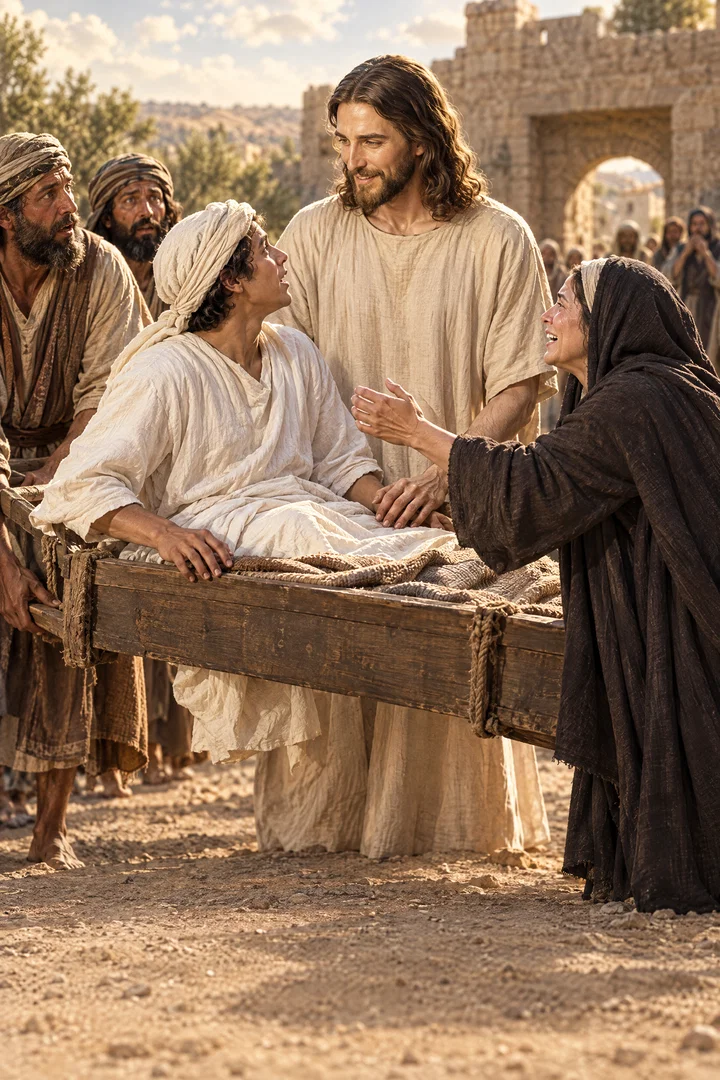
This rumour went forth as the close of the raising of the widow of Nain's only son, whom Jesus restored to life and gave back to his mother.DA 318.3–5DA 318.1–2DA 512.2COS 86.2–87.2 At Nain the people glorified God over the miracle, declaring that a great prophet had risen among them and that God had visited His people.DA 318.3–5DA 318.1–2 They returned home praising Him with joy for what had been done.COS 86.2–87.2
The report of the miracle and of that response went forth throughout all Judea and the surrounding region, carrying what had happened at Nain far beyond the town itself.DA 318.3–5DA 318.1–2 It was part of the widespread reports about Jesus that were spreading everywhere.DA 315.2–316.1 The event shows that Jesus is touched by a mother's sorrow and gives comfort and help in grief and need.DA 512.2 It demonstrates Christ's power over death and points to His return, when His voice will call the dead in Christ from their tombs to immortal life to be with Him forever.COS 86.2–87.2
The verse also belongs to the Luke 7:1-17 account of the centurion who sought Jesus to heal his servant, which parallels Matthew 8:5-13.DA 315DA 315.1 The widespread reports about Jesus that the centurion heard inspired his faith that Jesus could heal his servant, though he had not seen Him.DA 315.2–316.1 In that centurion story Christ marvels at the centurion's faith in contrast to the unbelief of His own nation, which required signs and wonders.DA 315.1
Sources
Pioneers and periodicals
31 sources
The report went out after Jesus raised the widow of Nain's only son to life when at His word the dead young man sat up and spoke.ST May 24, 1905ST Jun 2, 1881 It spread openly throughout all Judea and the surrounding region, showing His work was public and not done in a corner.ST Feb 3, 1904ST Sep 20, 1910 Fear took hold on all, and the people glorified God, saying a great prophet had risen among them and God had visited His people.ST May 24, 1905ST Jun 2, 1881ST Mar 26, 1894 The report was of His life-giving word, showing He has power over death as the great Conqueror, the same power seen in the healing of the centurion's servant and the raising of Jairus's daughter.ST Mar 26, 1894ST Sep 13, 1899ST May 24, 1905 That raising was literal, yet not to immortality, an extraordinary exception before the appointed resurrection that does not mean all the dead should be raised in the same way now.RH Jun 22, 1916ST Aug 12, 1889ST Jan 28, 1889 Together with Lazarus and Jairus's daughter it helps settle the question of man's condition after death, for why bring the son back to earthly life if the dead were already in heaven or suffering punishment, and that same power can quicken a heart dead in sin to life.ST Oct 30, 1907ST May 24, 1905ST Oct 7, 1913RH Jan 23, 1913
Rumour and Its Setting
This rumour went forth after Jesus raised the only son of the widow of Nain to life.ST May 24, 1905ST Jun 2, 1881ST Mar 26, 1894ST Sep 13, 1899 At His word the dead young man sat up and spoke after Jesus touched the bier and said, Young man, arise, while the funeral bearers stood still in amazement.ST Mar 26, 1894 The report was of His lifegiving word, the same word that healed the centurion's servant from a distance.ST Mar 26, 1894ST Oct 30, 1907ST Sep 13, 1899
It went forth openly throughout all Judea and all the region round about.ST Feb 3, 1904ST Sep 20, 1910ST Sep 20, 1910 From the upland country around Nain it spread to reach Judea in the south and distant Perea.ST Jun 2, 1881 His ministry was public and not done in a corner, so that increasing numbers sought Him.ST Sep 27, 1910
The spread was accompanied by fear taking hold on all and by the people glorifying God.ST Mar 26, 1894ST Feb 3, 1904 They said a great prophet had risen among them and God had visited His people.ST May 24, 1905ST Jun 2, 1881ST Mar 26, 1894ST Feb 3, 1904 That acclaim was likely stirred by memories of Elijah and Elisha, whose ministries and raisings of sons belonged to the nearby area.ST Jun 2, 1881 It is understood as praise of Him as the promised Messiah.ST Sep 20, 1910ST Sep 20, 1910
The report reached John's disciples and they told John what Jesus had done. It belongs to the larger account that includes the healing of the centurion's servant and the lesson drawn from John the Baptist.ST Mar 26, 1894ST Mar 24, 1909 It is presented as an argument that Jesus will not forget or leave His messenger to perish in prison but will come to open the prison doors.ST Sep 27, 1910
The publicity also intensified opposition and division.ST Sep 20, 1910ST Sep 20, 1910ST Sep 20, 1910 While many wondered, rejoiced and gave thanks, men in authority hardened their hearts.ST Sep 20, 1910 The crowds and attention helped intensify the Pharisees' opposition. The Pharisees contended for the resurrection from the dead while Annas the Sadducean high priest denied the dead rise.ST Sep 20, 1910ST Sep 20, 1910 He questioned whether the youth had truly been dead, charged he had only been sleeping or in league with Jesus and the attending physician, called Jesus a wizard whose enchantments chained Israel's senses, and claimed the whole circumstance from beginning to end was prearranged to make good His claim to Messiahship and would bode no good to authority.ST Sep 20, 1910ST Sep 20, 1910ST Sep 20, 1910 So the miracle was made of none effect before part of the people.ST Sep 20, 1910
The young man, elsewhere named as young Reuben, had been sick unto death with a fever and died with no breath left in him in the morning.ST Sep 20, 1910ST Sep 20, 1910ST Nov 29, 1910 He was being carried on a bier before a great concourse when Jesus, the son of Joseph the carpenter of Nazareth, gave him life again.ST Sep 20, 1910ST Sep 20, 1910 His mother testifies he was dead but now lives, and the youth himself remembers nothing except being sick unto death and now seeing the crowd, the bier and Jesus, whom he asks if He is the Messiah.ST Sep 20, 1910 The deed was known even in Bethany.ST Nov 29, 1910
Power and Its Teaching
The report that went forth was of His lifegiving word, the same word that healed the centurion's servant from a distance and made the dead young man sit up and speak when the bier was touched and the command Young man, arise was given.ST Mar 26, 1894ST Sep 13, 1899ST May 24, 1905 It showed Jesus has power over death as the great Conqueror, a power that awakened faith and strengthened faith in Him.ST Mar 26, 1894ST Sep 13, 1899ST May 24, 1905 It belongs with the lame walking, the dumb shouting, and the leper cleansed until his body became like the flesh of a little child, and with the raising of Jairus's twelve-year-old daughter after she had died.ST Sep 27, 1910ST Nov 29, 1910ST Nov 22, 1910 Its publicity served as assurance to Jairus that the same power could heal his daughter, and with the healing of Mary, the cleansing of Simon the leper, and the deed known even in Bethany, it gave ground to believe that whatsoever Christ asks of God will be given Him even with Lazarus dead.ST Nov 29, 1910ST Nov 22, 1910
The going forth of the report shows the goodness and mercy of God in Christ's miracles and teaching, standing in mighty contrast to Israel's low condition in the time of the judges, and giving material for meditation and spiritual growth.ST Mar 24, 1909RH Jun 13, 1871 His labor was a labor of love in doing good, wiping tears from sorrow and bringing consolation to distress, commanding death itself to give the boy back and lighting a smile on the pale sad face of his bereft mother by restoring him to her gaze.RH Jun 13, 1871RH Sep 4, 1855 The gate of Nain stands among the scenes that reveal His character and continue to draw people to Him, and His entering Nain to restore the widow's son to life shows that His coming brings life, not death.RH Sep 4, 1855ST May 10, 1910
The raising at Nain was one of three persons Christ raised from the dead during His earthly ministry, the second of the three, while the funeral bearers stood still in amazement.RH Jan 6, 1916RH Nov 25, 1902 It took place before He raised Lazarus and thus proves Lazarus was not the first man He raised.RH Jan 6, 1916ST Mar 24, 1909RH Nov 25, 1902 That resurrection was a literal example of the dead hearing the Son of God's voice and living, yet it was not to immortality, though the power of death was broken by it just as truly as by a resurrection to eternal life.ST Aug 12, 1889RH Oct 19, 1869 Because it happened before Christ's own resurrection, His being called the first to rise from the dead cannot mean first in point of time, for He was not the first person restored to life after natural death.ST Aug 12, 1889RH Feb 25, 1873 It was one of the exceptions to the general rule that the dead live again only through a resurrection at Christ's coming, an extraordinary act that does not mean all who have died since should be raised in the same way before the appointed time.RH Jun 22, 1916ST Jan 28, 1889
Together with Lazarus and the daughter of Jairus, these resuscitations in the presence of many onlookers provide means at hand for solving the great problem of man's condition after death.ST Oct 7, 1913RH Jan 23, 1913 The son's restoration to life on earth raises the question why Christ would bring him back if the dead were already enjoying heaven or suffering punishment, and it fits the scriptural teaching about the state of the dead.ST Oct 7, 1913RH Jan 23, 1913 That same power that called the dead back to life can quicken a heart dead in sin and overcome sin to bring life, and the account is used to comfort a bereaved family with the promise that Jesus has power over death and the dead will be raised.ST Oct 30, 1907ST May 24, 1905 That resurrection took place by virtue of the Son of God's sacrifice, which had not yet been accomplished at that time but was already established in the purpose of God, while unbelief treats the miracle as one of the New Testament miracles it calls incredible.ST Oct 12, 1876
Sources