Luke 7:16
And there came a fear on all: and they glorified God, saying, That a great prophet is risen up among us; and, That God hath visited his people.
Translations
And there came a fear on all: and they glorified God, saying, That a great prophet is risen up among us; and, That God has visited his people.
King James Version, KJV Cambridge Paragraph Bible
And there came a fear on all: and they glorified God, saying, That a great prophet is risen up among us; and, That God hath visited his people.
And there came a fear on all: and they glorified God, saying, That a great prophet hath risen among us; and, That God hath visited his people.
Revised Version, American Standard Version
And fear took hold on all: and they glorified God, saying, A great prophet is arisen among us: and, God hath visited his people.
and fear took hold of all, and they were glorifying God, saying — 'A great prophet hath risen among us,' and — 'God did look upon His people.'
And fear seized on all, and they glorified God, saying, A great prophet has been raised up amongst us; and God has visited his people.
And fear seized them, all, and they began to glorify God, saying—A great prophet, hath been raised up amongst us! and—God hath visited his people!
Berean Standard Bible, Majority Standard Bible
A sense of awe swept over all of them, and they glorified God. “ A great prophet has appeared among us!” they said. “ God has visited His people!”
Fear took hold of all, and they glorified God, saying, “ A great prophet has arisen among us!” and, “ God has visited his people!”
And fear came on all, and they gave praise to God, saying, A great prophet is among us: and, God has given thought to his people.
Then there came a feare on them all, and they glorified God, saying, A great Prophet is risen among vs, and God hath visited his people.
Douay-Rheims (Challoner revision)
And there came a fear on them all: and they glorified God, saying: A great prophet is risen up among us: and, God hath visited his people.
Pictures
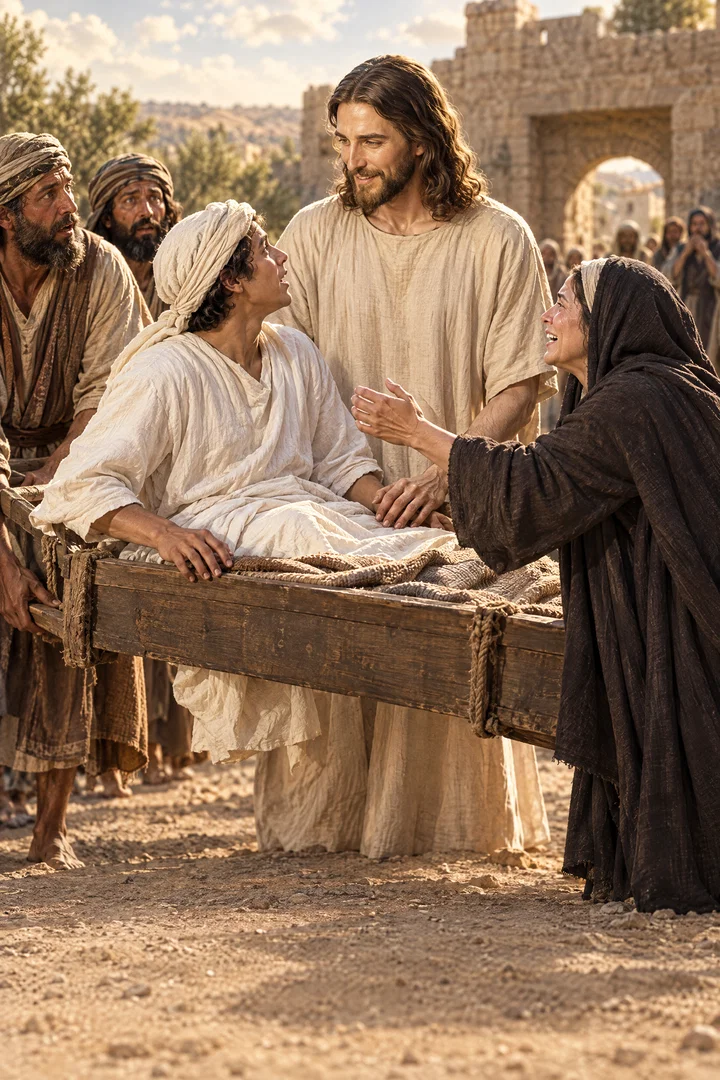
Cross-references
- 1 Kings 17:17-24
And it came to pass after these things, that the son of the woman, the mistress of the house, fell sick; and his sickness was so sore, that there was no breath left in him.
Elijah raised a widow’s son, recalled at Nain.
- 2 Kings 4:32-37
And when Elisha was come into the house, behold, the child was dead, and laid upon his bed.
listed as parallel raising by same power
- Luke 8:54-55
And he put them all out, and took her by the hand, and called, saying, Maid, arise.
Jesus raises Jairus’s daughter, as he had raised the widow’s son.
- John 11:43-44
And when he thus had spoken, he cried with a loud voice, Lazarus, come forth.
Both are raisings by Jesus, with Nain earlier.
- Luke 7:22
Then Jesus answering said unto them, Go your way, and tell John what things ye have seen and heard; how that the blind see, the lame walk, the lepers are cleansed, the deaf hear, the dead are raised, to the poor the gospel is preached.
Lists Jesus’ healings and raising the dead together.
- Matthew 15:30-31
And great multitudes came unto him, having with them those that were lame, blind, dumb, maimed, and many others, and cast them down at Jesus’ feet; and he healed them:
Both describe God-given power shown through healing and followed by glorifying God.
Commentary
Each commentary is drawn from primary sources: the writings of Ellen G. White and Adventist pioneers and periodicals. Each commentary is separate. Its own words are not a quotation; follow the references to read the source passages.
Ellen G. White
4 sources
The verse describes the response after Jesus raised the widow of Nain's only son to life.DA 318.3–5DA 318.1–2DA 512.2COS 86.2–87.2 The crowd that witnessed it responded with reverent fear, as if standing in God's presence, and glorified and praised God.DA 318.3–5DA 318.1–2COS 86.2–87.2 They recognized Jesus as a great prophet risen up among them and understood the miracle as God visiting His people.DA 318.3–5DA 318.1–2COS 86.2–87.2 News of Him then spread through Judea and the surrounding region.DA 318.1–2
The return of the son to his mother revealed Jesus' compassion for a mother's sorrow, showing that He is touched by mothers' grief.DA 512.2 Christ's raising of the dead in His earthly ministry points to His return, when His voice will call the dead in Christ from their tombs to immortal life.COS 86.2–87.2 He gives comfort and help in every grief and need.DA 512.2
Sources
Pioneers and periodicals
45 sources
At Nain Jesus stopped a funeral procession for a widowed mother's only son, spoke to the dead man on the bier and gave him back alive to his mother.RH Jan 6, 1916ST Mar 24, 1909ST Sep 20, 1910 The witnesses were filled with fear and awe and glorified God, declaring that a great prophet had risen among them and that God had visited His people.ST Jun 2, 1881ST May 24, 1905 Their cry recalled Elijah and Elisha who had also restored widows' sons, while many wondered if this worker from Nazareth was the promised Messiah come to deliver Israel.ST Jun 2, 1881ST Sep 20, 1910ST Jun 2, 1881 The work showed His authority over death and His pity that meets real human sorrow, not display, proving His divine mission and tender character.ST Sep 13, 1899ST May 24, 1905ST Jun 8, 1882RH Sep 4, 1855 The raising was a restoration to earthly life, not to immortality, foreshadowing the day when all in the graves will hear His voice and come forth to life or to judgment.RH Jun 18, 1908RH Jun 22, 1916RH Oct 19, 1869
Miracle Setting at Nain
Luke 7:16 belongs to the raising of the widow's son at Nain, when Jesus met the mourners carrying the dead man to his grave, compassionately stopped the funeral procession, touched the bier, spoke His life-giving word to the dead man, and restored him to his mother.ST Oct 30, 1907RH Jan 6, 1916ST Sep 20, 1910RH Jun 18, 1908 His word reached the dead man and raised him up, showing that Christ's word can bring life to the dead and quicken a heart dead in sin.ST Oct 30, 1907 The visitation at Nain bids those He touched to follow Him onward from Nain toward Judah and Bethany and toward the awakening of Lazarus who sleeps and the final day of visitation when the sleeping captives burst forth, sorrow is put away, and heads are lifted up.RH Jun 18, 1908
The dead man was the only son of his widowed mother dwelling in Nain, carried on his bier before a great concourse of people.ST Mar 24, 1909ST Sep 20, 1910ST Sep 27, 1910ST Sep 20, 1910 He had been sick unto death of a fever and was left in the morning with no breath in him, when Jesus of Nazareth gave him life again.ST Sep 20, 1910ST Sep 20, 1910 Jesus awakened him from the sleep of death by His call, one of His marvelous miracles standing with making the lame walk, making the dumb shout, and cleansing the leper until his flesh became like a little child's.ST Sep 27, 1910
The account stands among the notable miracles Jesus performed soon after the Sermon on the Mount.ST Sep 16, 1886 It is Luke's account of raising the widow of Nain's son, recorded by Luke but not by the other Gospel writers.ST Sep 20, 1905 It came with the healing of the centurion's servant, the teaching connected with John the Baptist, and the anointing of Jesus.ST Mar 24, 1909 It happened before Jesus raised Lazarus the brother of Martha and Mary, so Lazarus was not the first person Jesus raised from the dead, and it had happened before Jairus sought help for his daughter, who apparently had not yet heard of it.ST Mar 24, 1909ST Feb 6, 1896
Fear Praise and Prophet
The raising at Nain filled all who saw it with fear and awe, and moved them to glorify and praise God with wonder, joy and gratitude.ST Jun 2, 1881ST May 24, 1905ST Mar 26, 1894 They declared that a great prophet had risen up among them, and that God had visited and helped His people.ST May 24, 1905ST Mar 26, 1894ST Sep 13, 1899 Their fear was reverent awe before divine power, and their praise recognized in the miracle God's present care for them.ST May 24, 1905ST Mar 26, 1894ST Sep 13, 1899
The cry of a great prophet recalled Elijah and Elisha, who had also raised the dead and raised widows' sons.ST Jun 2, 1881ST Jun 2, 1881 The village of Shunem lay nearby, where Elisha had raised a woman's son, and the plain of Jezreel associated with Elijah's life was in sight, which helps explain why the people thought at once of the great prophets. In Jesus they saw prophetic greatness renewed and God's care returning to His people.ST Jun 2, 1881ST Jun 2, 1881
They also praised Him as the promised Messiah come to deliver Israel.ST Sep 20, 1910 Wondering hearts asked whether this Son of Joseph the carpenter of Nazareth was the Messiah who would reign gloriously and break Roman rule.ST Sep 20, 1910
Their words acknowledged that Jesus came from God.ST Jan 30, 1896 That recognition made them accountable to follow His teaching, so that those who finally reject Him will stand as witnesses that their judgment is just.ST Jan 30, 1896 His works at Nain stand as evidence against the claim that He was no prophet.ST Jan 30, 1896ST Nov 29, 1910
The same visitation belongs with the loving devotion of the sinful woman at the Pharisee's table, who wept at Jesus' feet, washed them with tears, wiped them with her hair, kissed them and anointed them.RH Dec 3, 1867 Her act showed a forgiven sinner's great love and tender appreciation when He was met with haughty neglect.RH Dec 3, 1867
Christ Power and Compassion
The raising at Nain displayed Christ's authority and power over death, an enemy He has overcome, and His power to raise the dead remains part of His victory over sin and death and strengthens faith in His work.ST Sep 13, 1899ST May 24, 1905ST Jan 26, 1915 His word reached the dead man and gave him life, rising at His command, which illustrates how that same word can quicken a heart dead in sin.ST Oct 30, 1907 This was a literal accomplishment of His word that the dead would hear the voice of the Son of God and live, proving the Father has given the Son to have life in Himself and therefore power to bestow life on those who hear His voice.RH Oct 19, 1869 It stands with the raising of the ruler's daughter, Lazarus, and the saints raised after Christ's resurrection as a foreshadowing of the greater manifestation when all in the graves will hear His voice and come forth to the resurrection of life or the resurrection of judgment.RH Oct 19, 1869
The raising was done by virtue of the sacrifice of the Son of God, which had not yet been accomplished at that time but was already established in the purpose of God.ST Oct 12, 1876 The work was a labor of love going about doing good, wiping tears from sorrow and pouring comfort into distress, and at Nain He lit a smile on the pale sad face of a widow bereft of her only son by commanding the power of death and giving the boy's features to his mother's gaze once more.RH Jun 13, 1871 His miracles met real human needs and relieved suffering through pity and compassion rather than with display to draw attention to Himself.ST Jun 8, 1882 That compassion reveals His humanity while the miracles attested His divinity, leading the people to recognize that God had visited His people, and He remains just as tender and compassionate, present with people and concerned for them now.ST Jun 8, 1882RH Sep 4, 1855
The event manifested God-given power to make glad the hearts of the afflicted and to confirm His mission and the benevolence of His character.ST Feb 1, 1899RH Sep 4, 1855 It proves His rejection, betrayal, mocking, condemnation, and execution did not happen because He failed to show divine power.ST Feb 1, 1899 The two miracles in Luke 7:2-16 show Christ's mission to earth in practical action in healing the sick and raising the dead, moving the people to glorify God and declare Him a great prophet risen among them.ST Mar 12, 1896 That work was only begun then, because He did not heal all the sick or raise all the dead.ST Mar 12, 1896 Those mighty works are an earnest of a completer work to come, when He will heal all and raise all in final salvation, and until then they help faith.ST Mar 12, 1896
Resurrection Doctrine Foreshadowed
The raising at Nain was not to immortality but a restoration to earthly life through Christ's power, an exception to the general pattern of the dead awaiting resurrection.ST Aug 12, 1889ST Jan 28, 1889 It does not mean that all who have died since should be raised to life in the same way before the resurrection, the appointed time.RH Jun 22, 1916 The power of death was broken by it just as veritably as though it had been to eternal life.ST Aug 12, 1889
It took place long before Christ's own resurrection, and before Jesus raised Lazarus the brother of Martha and Mary, so Lazarus was not the first person Jesus raised from the dead.ST Mar 24, 1909ST Aug 12, 1889 Its occurrence before Christ's resurrection proves that Christ being called the first to rise from the dead does not mean first in point of time.ST Aug 12, 1889 It points to a raising from natural death that shows He was not the first person ever restored to life, in contrast to rising from among the dead.ST Aug 12, 1889RH Feb 25, 1873
The verse means the dead do not go at death either to heaven or to the place of torment.RH Jan 23, 1913 For if the son had gone to the reward of the righteous, Christ would have called him back from reward to earthly life.RH Jan 23, 1913 If he had gone to punishment with the wicked, Christ would have separated him from punishment to give him another probation here.RH Jan 23, 1913 Restoring him would have required taking from him all knowledge of his enjoyment or suffering after death.RH Jan 23, 1913
It stands with the raising of the ruler's daughter, Lazarus, and the saints raised after Christ's resurrection as a foreshadowing of the greater manifestation of divine power when all in the graves will hear His voice and come forth to the resurrection of life or the resurrection of judgment.RH Oct 19, 1869 It was a literal accomplishment of Christ's word that the dead would hear the voice of the Son of God and live, proving the Father has given the Son to have life in Himself and therefore power to bestow life on those who hear His voice.RH Oct 19, 1869 The visitation at Nain bids those He touched to follow Him onward from Nain toward Judah and Bethany, leaving Nain behind yet carrying its lesson, toward the awakening of Lazarus who sleeps and toward the final day of visitation when the sleeping captives burst through the gates of the hadean night, sorrow is put away, and heads are lifted up.RH Jun 18, 1908
It is one of several resuscitations by Christ, together with Lazarus and the daughter of Jairus, that supply means to settle the question of man's condition after death.ST Oct 7, 1913 It belongs to a history of raisings continued by holy men in the early church for at least two hundred years after Christ's ascension, in an age of philosophic inquiry, literature and investigation never surpassed.ST Oct 7, 1913 The raising of Jairus's daughter is described as like this miracle, and the raising of the dead man at Nain led the people to awe and to glorify God, recognizing Jesus as a great prophet and as evidence that God had visited His people.ST Nov 22, 1910
The event displays the mighty miraculous power of God in Jesus Christ and stands as part of the infallible Bible. Denying it as myth, allegory, fancy, crude, or childish is soul-destroying error that leads to denying every essential saving truth of the Word. Jesus coming to Nain shows He comes not as a messenger of death but to give life; His coming brings life, not death.ST May 10, 1910
Witness Against Unbelief
The raising at Nain belonged to Christ's open public work, not to anything done in secret, at a time when growing numbers were seeking Him, and it stands as one of the three instances in which He raised the dead.ST May 8, 1907 It stands together with making the lame walk, making the dumb shout, and cleansing the leper until his flesh became like the flesh of a little child, as eyewitness proof of healing power.ST Sep 27, 1910 The widow of Nain herself is counted among those who knew the truth as an eyewitness to the miracle.ST Jan 19, 1882 That public display of power gave Jairus reassurance that the same power could heal his daughter.ST Feb 6, 1896
The response was divided, with many glorifying God and asking whether this Son of Joseph the carpenter of Nazareth was the Messiah, while those holding the Pharisees' faith under Rabbi Ben-Israel contended for the resurrection from the dead.ST Sep 20, 1910ST Sep 20, 1910 Those who denied contended that the dead rise not at all, that the young man had only been sleeping, that even Moses himself gave no life to dead men, and that Moses in the law says not that the dead shall live.ST Sep 20, 1910ST Sep 20, 1910
Jewish leaders met the miracle with unbelief and hostility even while the people glorified God, with Annas the high priest, Rabbi Shaphan, and Tubal prominent among them.ST Sep 20, 1910ST Sep 20, 1910 They declared Jesus a pretender teaching blasphemy, a vain fellow and impostor even in Nazareth, born of fornication and shaming Israel.ST Sep 20, 1910 They called Him a wizard whose enchantments chained the senses, claimed He had been known from childhood as a begetter of strife and sedition, and feared His coming to Nain as a threat to those in authority.ST Sep 20, 1910 They charged that the entire circumstance from beginning to ending was prearranged and contrived by Him and His friends, with the young man, others, and the physician Gideon in league with Him to make good His claim to Messiahship.ST Sep 20, 1910ST Sep 20, 1910 Yet Gideon testified that he had himself attended the sickness and death, and still the sign was made of none effect before many through unbelief.ST Sep 20, 1910ST Sep 20, 1910
The miracle was dismissed as only apparent and arranged to mislead the common people and draw them from their lawful instructors and leaders, with denial that the young man had truly been dead.ST Sep 20, 1910
Comfort and Present Visitation
The raising at Nain is fitting to speak at a funeral, for it turns grief toward Christ's power over death and toward the promised resurrection. When the widow's son was restored, awe fell on all who saw it, and they glorified God, confessing that a great prophet had risen among them and that God had visited His people.RH Oct 27, 1910 Those same words of awe and praise become words of comfort to mourners.RH Oct 27, 1910 As His word reached the dead man and raised him up, so His word still has power to bring life and to quicken a heart that is dead in sin.ST Oct 30, 1907
God's visiting of His people calls for a response in the present, and the call is to seek a share in the refreshing that comes with such a visitation.RH May 4, 1911 Reports of spiritual victories, of blessings received, and of growing interest in evangelistic work are signs that God is visiting His people now.RH Aug 27, 1914 When such a work is recognized, the right response is the same as at Nain, to receive it with awe and to glorify God for raising up His instrument and visiting His people.RH May 4, 1911RH Aug 27, 1914
The fear that came on all and their glorifying of God display the goodness and mercy of God.ST Mar 24, 1909 That goodness stands in mighty contrast to the low condition of Israel in the time of the judges.ST Mar 24, 1909 The account of the young man of Nain, the only son of his mother, stands together with the healing of the centurion's servant, the teaching connected with John the Baptist, and the anointing of Jesus.ST Mar 24, 1909 It is an interesting, touching, uplifting, and pathetic account, giving material for meditation and spiritual growth every day.ST Mar 24, 1909
Sources