Matthew 8:5
And when Jesus was entered into Capernaum, there came unto him a centurion, beseeching him,
Translations
And when Jesus was entered into Capernaum, there came to him a centurion, beseeching him,
King James Version, KJV Cambridge Paragraph Bible
And when Jesus was entered into Capernaum, there came unto him a centurion, beseeching him,
And when Jesus had entered into Capernaum, there came to him a centurion, beseeching him,
Revised Version, American Standard Version
And when he was entered into Capernaum, there came unto him a centurion, beseeching him,
And Jesus having entered into Capernaum, there came to him a centurion calling upon him,
And when he had entered into Capernaum, a centurion came to him, beseeching him,
And, when he entered into Capernaum, there came near unto him a centurion, beseeching him,
Berean Standard Bible, Majority Standard Bible
When Jesus had entered Capernaum, a centurion came and pleaded with Him,
When he came into Capernaum, a centurion came to him, asking him for help,
And when Jesus was come into Capernaum, a certain captain came to him with a request,
When Iesus was entred into Capernaum, there came vnto him a Centurion, beseeching him,
Douay-Rheims (Challoner revision)
And when he had entered into Capharnaum, there came to him a centurion, beseeching him,
Pictures
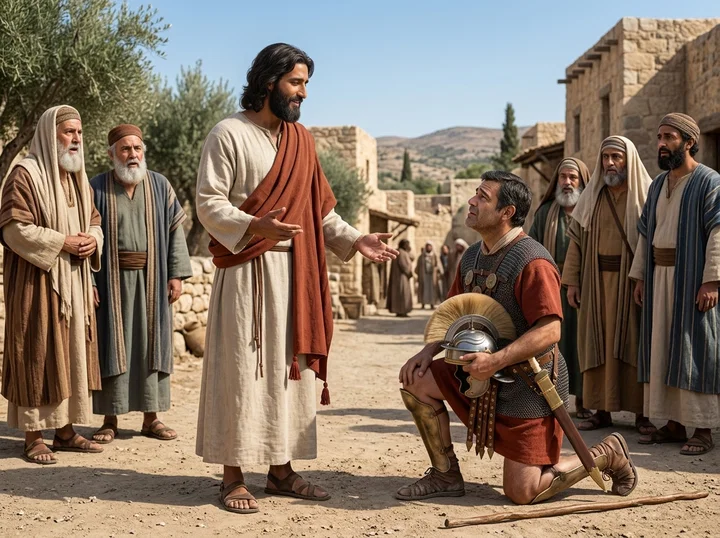



Cross-references
- Luke 7:1-10
Now when he had ended all his sayings in the audience of the people, he entered into Capernaum.
Luke recounts the centurion’s appeal and Jesus’ healing of his servant.
- John 4:46-53
So Jesus came again into Cana of Galilee, where he made the water wine. And there was a certain nobleman, whose son was sick at Capernaum.
Jesus heals a Capernaum official’s son from a distance, and the father trusts his word.
- Matthew 8:11-12
And I say unto you, That many shall come from the east and west, and shall sit down with Abraham, and Isaac, and Jacob, in the kingdom of heaven.
Jesus connects the centurion’s faith with Gentiles welcomed into the kingdom and unbelieving heirs cast out.
- Matthew 8:13
And Jesus said unto the centurion, Go thy way; and as thou hast believed, so be it done unto thee. And his servant was healed in the selfsame hour.
Jesus heals the centurion’s servant in response to his belief.
- Luke 7:6
Then Jesus went with them. And when he was now not far from the house, the centurion sent friends to him, saying unto him, Lord, trouble not thyself: for I am not worthy that thou shouldest enter under my roof:
centurion calls himself unworthy of visit
- Matthew 8:10
When Jesus heard it, he marvelled, and said to them that followed, Verily I say unto you, I have not found so great faith, no, not in Israel.
commends centurion's faith above Israel
- Mark 2:1-12
And again he entered into Capernaum after some days; and it was noised that he was in the house.
Jesus heals a paralytic at Capernaum.
- Luke 4:30-39
But he passing through the midst of them went his way,
Both describe Jesus’ ministry and miracles in Capernaum.
- Psalms 107:20
He sent his word, and healed them, and delivered them from their destructions.
God sends his word to heal, reflected in Jesus’ healing at a distance.
- Mark 1:21-31
And they went into Capernaum; and straightway on the sabbath day he entered into the synagogue, and taught.
Both texts recount Jesus’ ministry and miracles in Capernaum.
Commentary
Each commentary is drawn from primary sources: the writings of Ellen G. White and Adventist pioneers and periodicals. Each commentary is separate. Its own words are not a quotation; follow the references to read the source passages.
Ellen G. White
23 sources
When Jesus entered Capernaum a Roman centurion came to Him pleading for his slave who lay stricken with palsy and near death, whom he loved and greatly desired to see recovered.Ms 62, 1904, par. 17DA 315.2–316.1STST Aug 8, 1916 Though he had never seen Jesus, he believed reports of His teaching and healing, had broken through hatred between conqueror and conquered to honor God and build the Jews a synagogue, yet judged himself unworthy to come himself or receive Jesus under his roof and so first sent Jewish elders and then a message before coming in person.DA 315.2–316.1STST Aug 8, 1916 He asked with humble unselfish confidence, never doubting Jesus could heal by a spoken word alone, reasoning that as his soldiers obeyed him as Rome's representative so all created things and disease obey Christ as representative of the infinite God, and his servant was healed as he believed with a faith greater than Jesus had found in Israel.Lt 114, 1895, par. 7–10DA 315.1STST Aug 8, 1916ST May 4, 1876 Making his great need and helplessness his plea rather than his own goodness, he teaches that sinners may come to Christ with nothing to recommend them, renouncing self-dependence and self-righteousness to rely wholly on the Saviour's mercy.12MR 289.1–2ST Aug 8, 1916STST May 22, 1901 His coming was Christ's direct ministry beyond acknowledged Israel, proving His grace is not circumscribed to race or nation but freely dispenses salvation to Gentiles as fellow-heirs with the Jews, foreshadowing the time when whole Gentile communities would gladly receive the gospel while unbelieving Israel would be excluded.ST May 4, 18768RED 14.1–2SLP 51.1ST Jun 12, 1879DA 402.2
Capernaum Plea Described
When Jesus entered Capernaum a Roman centurion came to Him pleading for help, and in that healing work the ministry of the Word is joined with medical missionary work.Ms 62, 1904, par. 17 The one for whom he pleaded was his slave, stricken with palsy and near death, and though Roman slaves were bought and sold and often treated with abuse and cruelty, the centurion was tenderly attached to him, loved him, and greatly desired his recovery.DA 315.2–316.1STST Aug 8, 1916 He had never seen Jesus, but the reports he heard of His teaching met the need of his soul and inspired faith that Jesus could heal the servant.DA 315.2–316.1STST Aug 8, 1916
He was convinced that the religion of the Jews was superior to his own despite their formalism, and he had broken through the national prejudice and hatred between conquerors and conquered, showing respect for the worship of God and kindness to the Jews as His worshipers, even building them a synagogue.DA 315.2–316.1ST Feeling unworthy to come to Jesus himself or to receive Him under his roof, he first appealed through a delegation of Jewish elders, then sent a message while Jesus was on the way, then came in person to complete the plea.DA 315.2–316.1STST Aug 8, 1916 The elders urged Jesus to help him because he loved the nation and had built the synagogue.DA 315.2–316.1
Faith, Humility, Healing
The plea at Capernaum was unselfish concern for a suffering servant joined to a humble approach and full confidence in Jesus' authority and spoken word, a faith that drew Christ's praise though the pleader was not of Israel.Lt 114, 1895, par. 7–10 He never questioned whether Jesus could heal and never required Him to come in person, but trusted that a word or a command alone would suffice.DA 315.1STST Aug 8, 1916 He reasoned that as he himself represented Rome's supreme power to his soldiers, so Christ represented the power of the infinite God, whom all created things and even disease obey.STST Aug 8, 1916 His faith was greater than any Jesus had found in Israel, and the servant was healed exactly as he believed, Jesus answering his faith.ST Aug 8, 1916ST May 4, 1876
That faith stands set against doubt, for Israel's unbelief would lead to rejecting great light, to condemnation, and to exclusion from the kingdom, while people from the east and west would share the kingdom with Abraham, Isaac, and Jacob.ST May 4, 1876 Judging himself unworthy, he rested his plea not on his own goodness but on the Saviour's mercy, making his great need itself his argument.ST Aug 8, 1916ST This teaches that sinners may come to Christ with nothing to recommend them, that their very helplessness makes His saving power necessary, and that they must renounce self-dependence and rely wholly on His mercy.ST Aug 8, 1916ST
The verse therefore means that Jesus receives and bears with those whose lives show the deformity of sin, with tenderness and care and sympathy and love, despite their wickedness and failure to honor God.12MR 289.1–2 It teaches humility rather than self-confidence and self-righteousness, and it requires bearing with the erring and sinful as Jesus bears with all.12MR 289.1–2 The centurion's compassionate concern for one under his care, met by a Saviour who receives without prejudice or partiality, shows that same tenderness in action.12MR 289.1–2ST May 22, 1901
Salvation Beyond Israel
The coming of the centurion to Jesus at Capernaum was his conversion and an instance of Christ's direct work and ministry outside the acknowledged people of Israel.8RED 14.1–2SLP 51.1ST Jun 12, 1879 In receiving him Christ recognized those outside Israel as children of God, proving that His grace and love are not circumscribed to race or nation but are dispensed freely to others besides Israel.ST Jun 12, 1879DA 402.2 By rewarding the faith of this Gentile who had shown kindness to Israel, He sought during His life to lead the Jews out of their exclusiveness and showed He did not share Jewish intolerance and exclusiveness.8RED 14.1–2SLP 51.1ST Apr 23, 1885DA 402.2 The act unfolded the mystery hid for ages that the Gentiles should be fellow-heirs with the Jews and partakers of His promise in Christ by the gospel.DA 402.2 It was lesson upon lesson to disciples slow to learn this truth who thought He dispensed the gifts of His grace too freely, and it stands with preaching the gospel to the inhabitants of Sychar, who had some knowledge of God, as prior evidence of impartial mercy before bringing the disciples into contact with a heathen regarded as having no reason to expect favor.DA 402.2
It pointed to and foreshadowed the coming time for active and continued preaching among the Gentiles when whole communities would receive the gospel gladly and glorify God.8RED 14.1–23SP 356.2–3ST Jun 12, 1879 His faith and Jesus' response show that people among the Gentiles, though often regarded as unworthy of salvation, hunger for truth and are welcomed into God's salvation.AA 19.2–20.1 People from other nations came seeking healing or help for loved ones, and their longing for what they lacked, their reception of His teaching, and His words of hope and healing show He acted for humanity at large with no territorial or social barriers, setting an example of service for the whole world.AA 19.2–20.1Ms 50, 1897, par. 2 The gospel is thus for all peoples, with no territorial or social barriers separating them from God's promise in Christ.AA 19.2–20.1
The encounter also shows Jesus deliberately finding ways to reach the rich and people of wealth and rank as well as the poor and outcast.MH 24.2ST Jun 9, 1914Ms 3, 1899, par. 12 He received people of different ranks and backgrounds who would hear His word, and the coming of the Roman ruler illustrates His seeking acquaintance, becoming familiar with interests and occupations, accepting invitations and sharing social fellowship, to gain access to the heart and reveal imperishable riches.MH 24.2ST Jun 9, 1914Ms 3, 1899, par. 12
Sources
Pioneers and periodicals
50 sources
Just after the Sermon on the Mount, Jesus in Capernaum where he made his home was earnestly besought by a Roman centurion commanding about a hundred soldiers for his slave lying at home sick with palsy and near death.ST May 31, 1905ST Jun 2, 1881RH Dec 6, 1906ST Sep 21, 1915ST Apr 11, 1900 Though a heathen Gentile soldier, he loved the Jews, acknowledged the God of Israel and had built their synagogue, and he was tenderly attached to his slave and felt unworthy to approach Jesus or receive him under his roof.STST Jun 2, 1881ST Mar 6, 1907ST Jun 2, 1898 His great faith was confidence that Jesus need only speak a word without coming or touching, reasoning that as his own soldiers and servants obeyed him under Rome's power, so disease obeyed Christ sent with the infinite God's power.ST May 31, 1905ST Jan 23, 1893ST Oct 30, 1907ST Apr 23, 1896ST May 31, 1905 Jesus marveled that he had not found so great faith in Israel, and as he believed so it was done, the servant healed in that hour from a distance by Christ's word.ST May 31, 1905RH Dec 6, 1906ST Jan 23, 1893ST Oct 30, 1907ST Jan 23, 1893 He stands for Gentiles from east and west who would enter the kingdom while unbelieving Israel would be shut out, and for all sinners to come in humility without goodness of their own, trusting God's word as sure and life-giving.ST Aug 8, 1916ST May 4, 1876RH Dec 6, 1906ST Jul 17, 1884ST Jul 17, 1884
Place and Occasion
Jesus entered Capernaum, his own city where he lived as a citizen paying dues and taxes and made his earthly home on the northwestern shore of the Sea of Galilee, just after he finished the Sermon on the Mount and came down from the mountain with disciples and multitudes following.ST May 31, 1905ST Jun 2, 1881ST Apr 11, 1900ST Jan 30, 1896ST Jul 17, 1884 The appeal recorded here took place there shortly after that teaching, when a Roman officer came to him seeking healing for his servant.ST May 31, 1905ST Apr 11, 1900ST Sep 16, 1886 The parallel account identifies the request as help for a gravely ill servant, whom Jesus healed.ST Apr 11, 1900
Capernaum had a mixed Jewish and Gentile population under Roman military rule, with relatively close relations between them.ST Jun 2, 1898ST Apr 11, 1900 A small garrison was kept there by Herod Antipas on the edge of his territory, and the centurion commanded that garrison.ST Jun 2, 1881 A centurion was a Roman officer commanding about a hundred soldiers, and this officer was likely attached to the town's Roman garrison.ST Jan 23, 1893ST Jan 23, 1893RH Jan 28, 1873ST Apr 11, 1900
The one besought for was the centurion's slave, lying at home in the house sick of the palsy and grievously tormented.STRH Dec 6, 1906ST Sep 21, 1915 He lay sinking with paralysis and near death.ST Jun 2, 1881ST Apr 11, 1900ST Jul 17, 1884 The appeal was for this sick servant.
The healing of the servant is identified as one of the principal events in the chapter and as notable miracles performed soon after the Sermon on the Mount.ST Sep 12, 1911ST Sep 16, 1886 It is counted as one of three healings immediately after the Sermon on the Mount.RH Dec 9, 1852 It is also counted as one of four ways Jesus helped men in sickness and as part of his continuing miracles.ST Jan 30, 1896 It belongs to his Galilean work of teaching, healing and casting out evil spirits, and to his work on earth as foretold by prophecy, revealing his deeds of kindness and his healing power.ST Jan 30, 1896RH Sep 3, 1908
Centurion and Servant
The man who came was a heathen Roman Gentile soldier, a centurion commanding about a hundred men.ST Jun 2, 1881ST Mar 6, 1907ST Jun 2, 1898ST Jul 17, 1884 Though a heathen, he had been drawn toward Judaism by its contrast with idolatry, had rejected Rome's gods, had acknowledged the God of Israel, and had come to love and favor the Jewish people.STST Aug 8, 1916ST Jun 2, 1881ST Jul 17, 1884 He respected God's worship and the service of God, admired the worship of one God and the moral life of the people, and showed generous sympathy and kindness to the Jews as His worshipers by building at his own cost the town synagogue at Capernaum, which Romans who despised the Jews would not commonly do.STST Jun 2, 1881ST Mar 6, 1907ST Jun 2, 1898ST Jul 17, 1884
The one for whom he pleaded was his slave, bought and sold under Roman law and commonly treated as mere chattel and property rather than as a person, often with abuse and cruelty.STST Jun 2, 1881 To this slave the centurion was tenderly attached with a tenderness that did him honor, greatly desiring and longing for his recovery, and showing a kind, solicitous character and compassionate concern and service for one under his care.STST Aug 8, 1916ST May 22, 1901ST Jun 2, 1881ST Jun 13, 1900 His tenderness moved him to seek help, believing Jesus could heal him even when the servant lay sinking and fast approaching death.STST Aug 8, 1916ST Jul 17, 1884ST Jun 13, 1900
He had never seen Jesus, but the reports he heard inspired and won faith in him.STST Aug 8, 1916ST Jul 17, 1884ST Jun 13, 1900 Despite the formalism of the Jews and despite national prejudice and hatred between conqueror and conquered, he was convinced their religion was superior to his own.STST Jul 17, 1884 He found in the reported teaching of Christ what met the need of his soul.STST Aug 8, 1916ST Jul 17, 1884
He came to Jesus at Capernaum and earnestly besought Him, pleading with a prayer of faith and with a won heart.ST May 31, 1905ST Jun 2, 1881RH Dec 6, 1906RH Oct 7, 1915ST Jun 13, 1900 He felt unworthy to approach Jesus and unworthy to receive Him under his roof, and therefore first appealed through others.STST Aug 8, 1916ST Aug 8, 1916ST May 31, 1905ST Jul 17, 1884 Jesus received him without prejudice or partiality, at once complied, said He would come and heal the servant, and set out toward the quarters, which brought the centurion joy.STST May 22, 1901ST Jun 2, 1881RH Dec 6, 1906RH Oct 7, 1915 In this heathen soldier Jesus saw and loved what was good despite different faith and background.ST May 22, 1901RH Jun 2, 1904RH Jul 22, 1902 His example shows that Christ's love reaches people across differences and faults by looking beyond what is bad rather than magnifying it.RH Jun 2, 1904RH Jul 22, 1902
Telling of the Appeal
Matthew's statement that the centurion himself came beseeching Jesus stands alongside Luke's statement that he sent others, with no contradiction between them.ST Jun 2, 1881ST Sep 15, 1887ST Mar 6, 1907ST Apr 23, 1896ST Mar 26, 1894 Matthew condenses the exchange and follows the common way of speaking that credits a man with what is done by his authority, since agents represent him and what they do or say counts as his own act.ST Jun 2, 1881ST Sep 15, 1887ST Mar 6, 1907ST Apr 23, 1896 Luke supplies the fuller detail that the approach was made through messengers because the centurion did not consider himself worthy to approach Jesus or to receive him at home, and Luke's silence about the personal meeting does not contradict Matthew when the accounts are joined to include all the details.ST Sep 15, 1887ST Mar 26, 1894 The centurion's own illustration from commanding soldiers to go and come shows this principle of representation, and his confidence that Jesus could heal through spiritual agents shows the healing remained Christ's own work even when he was not physically present.ST Apr 23, 1896
As an Eastern mark of special respect when a request is made, he first sent a deputation of the elders of the Jews, the foremost men and governing magistrates of the synagogue, who pleaded that he loved the Jewish people and had built their synagogue.ST Jun 2, 1881ST Mar 6, 1907 It was unusual for Jewish officials to come as representatives of a heathen, yet their tenderness for his slave's sinking paralysis moved them to carry his begging to Jesus, and Jesus at once complied and set out with them toward the centurion's quarters.ST Jun 2, 1881 Feeling unworthy to approach Jesus, he first appealed through the Jewish elders, then sent a message while Jesus was on the way, then came in person to complete the plea that Christ need only speak the word.STST Aug 8, 1916
Jesus' offer to come and heal uses a word for medical attendance, while the centurion's answer uses a stronger word for healing, trusting that Jesus need only speak for the servant to recover.ST Jan 23, 1893ST Jan 23, 1893 Jesus used the offer to come to test the centurion's faith, and then declared he had not found such great faith in Israel.ST Jan 23, 1893ST Jan 23, 1893 The sufferer is also described as his child, for when Jesus was about to come to his house the centurion sent word that Jesus need only speak and the child would live, at which Jesus marveled.ST Oct 22, 1885
Faith in Christ's Authority
The centurion's faith was superior and great, not merely belief that healing was possible but confidence that speaking a word alone would be enough, with no need to enter the house, to be physically present, to touch, or to be seen.ST May 31, 1905ST Oct 30, 1907ST Jan 23, 1893ST Oct 22, 1896ST May 31, 1905 When the offer to come was made, the word used meant medical attendance, while the answer used a stronger word for actual healing, trusting that speech alone would bring recovery.ST Jan 23, 1893ST Jan 23, 1893 That confidence in authority apart from bodily presence is what was commended as great faith.ST Jan 23, 1893ST Jan 23, 1893ST Oct 22, 1896
He reasoned from his own position as a man under authority who says to soldiers to go and to come and to servants to do things, and they obey.STST Sep 21, 1915ST May 31, 1905 As he himself represented Rome's supreme power to those under him, so Christ, sent by God, represented the power of the infinite God, whom all created things and disease obey.STST Aug 8, 1916ST May 31, 1905 Therefore Christ could act at a distance through spiritual agents and invisible messengers, and the healing would still remain Christ's own work even without physical presence.ST Apr 23, 1896ST May 31, 1905ST Jul 17, 1884
The offer to come was used to test that faith.RH Dec 6, 1906ST Jan 23, 1893 Jesus marveled at the answer and declared He had not found so great faith, no, not in Israel.RH Dec 6, 1906ST Jan 23, 1893ST Sep 21, 1915ST Mar 6, 1907 This stood in contrast to those in Israel who thought they needed to see Christ or have Him touch the sick.STST May 31, 1905
As he believed, so it was done to him, for the servant was healed in that selfsame hour from a distance by Jesus speaking.ST Aug 8, 1916RH Dec 6, 1906ST Oct 30, 1907ST Jan 23, 1893ST Sep 21, 1915 This showed that power reaches as far away as near.ST May 31, 1905ST Oct 8, 1902 The sudden cure came from the same power that works through slower recoveries.ST Oct 8, 1902RH Feb 8, 1906
The healing power remained in Christ's word, not in the messenger who carried it, and the word's potency came from God.ST Oct 30, 1907ST May 31, 1905 That spoken word alone carries spirit and life and power to heal at a distance, with substance more sure than anything else.ST Oct 30, 1907ST Sep 21, 1915ST Sep 21, 1915 Christ still ministers in heaven and sends His word to heal, since God has both the ability and the willingness to accomplish what He promises.ST Oct 30, 1907ST May 31, 1905
Gospel Beyond Israel
The centurion who came to Jesus at Capernaum is an example of a pious Gentile among those who sought God and prayed before him.ST Jun 21, 1883 Christ ministered to him directly and brought the gospel to a Roman by healing his servant, recognizing those outside Israel as children of God.ST Jun 12, 1879ST May 1, 1907 His conversion was an instance of leading the Jews beyond their exclusiveness, showing work beyond the acknowledged people of God.ST Apr 23, 1885ST Jun 12, 1879 It foreshadowed the later active preaching of the gospel among Gentile communities, which received it gladly and glorified God.ST Jun 12, 1879
He represented the Gentiles who would come from east and west to share the kingdom with Abraham, Isaac, and Jacob.ST May 4, 1876ST Jul 17, 1884 By contrast, Israel's unbelief in rejecting great light would bring condemnation and exclusion from the kingdom.ST May 4, 1876 His faith, greater than any found in Israel, stands as the pattern of those outsiders entering in while unbelief shuts others out.ST May 4, 1876ST Jul 17, 1884
The encounter also illustrates that Jesus sought access to people of wealth and rank, including Roman rulers, by becoming familiar with their lives so He could reach their hearts and reveal imperishable riches.ST Jun 9, 1914 The same centurion from Capernaum whose servant Jesus healed later witnesses Jesus command the storm and recognizes His power over wind and sea.ST Nov 22, 1910
Call to Trust
The coming to Jesus at Capernaum to beseech Him for a servant lying at home sick of the palsy and grievously tormented is recorded for admonition as an illustration of like, real, perfect faith showing heaven's response to faith.RH Dec 6, 1906ST Sep 21, 1915ST Sep 12, 1911 When tested by the offer to come and heal him, the answer in humility was unworthiness to receive Him under the roof and confidence that speaking the word only would heal, reasoned from authority as a man under authority whose soldiers go and come and whose servants do what is told at his command.RH Dec 6, 1906ST Sep 21, 1915 Jesus marveled and declared He had not found so great faith, no, not in Israel, and sent him away with the rule that as believed so it should be done, and the servant was healed in that hour.RH Dec 6, 1906ST Sep 21, 1915 That full assurance that the thing spoken will be fulfilled is the joy of believing what God says and seeing it worked out in life, the pattern for tempted, tempest-tossed souls to hunt out God's words from the Bible, anchor to them as a nail in a sure place, and stand upon them knowing they never deceive.ST Sep 21, 1915ST Sep 21, 1915 Christ's spoken word alone carries spirit and life and substance more sure than anything else, with power to heal at a distance, speaking forgiveness of sins and healing to bodies, for heaven and earth may pass away but the word of God abides forever.ST Sep 21, 1915ST Sep 21, 1915
The answered prayer of a kind centurion coming with faith and a won heart for a slave fast approaching death belongs to the Galilean work of teaching and healing the ill and making evil spirits flee, revealing God with us and the great Physician of the soul who makes whole.RH Aug 12, 1875ST Jun 13, 1900 It proves unchanging power and love, that there is still power in Christ to heal today and to bring relief from grief, pain and disease, able by His word to drive the devil away from one who believes.RH Aug 12, 1875ST Jun 13, 1900 The sudden cure by speaking from a distance shows power reaching far away as well as near, remaining a personal expression of the Father's love for His children, as the source and Lord of all healing working through the same power as in slower recoveries.ST Oct 8, 1902RH Feb 8, 1906 That life-giving word carries the creative power of God, which also brings forgiveness, cleansing, a new heart, and joy when received in faith.ST Oct 30, 1907
True humility does not keep a person from asking in faith but leads to reliance on divine grace and appropriate intercession, seeking help despite feeling unworthy to approach.ST Aug 8, 1916ST Jul 17, 1884 The plea rested not on personal goodness but on great need and the Saviour's mercy, teaching that sinners may come without anything to recommend them because helplessness makes saving power necessary, renouncing self-dependence and appealing through the advocacy of the Son of God.ST Aug 8, 1916STST Jul 17, 1884 As one who received those coming beseeching Him, He is held out to urge rich and poor, masters and servants, old and young, white man and black, sinners of every class even with guilty conscience and wicked heart and without money, to come for mercy and help.RH Nov 17, 1859
The account of the miracle showing the foretold work on earth in deeds of kindness and healing power is profitable study for morning exercises in church-schools, to be dwelt upon with Elijah's and Elisha's deeds and with illustrations from nature.RH Sep 3, 1908 Superior faith was not merely belief that healing was possible, but confidence in healing without being physically present, as a commander carries out orders through soldiers, so One sent by God acts through spiritual agents and invisible messengers.ST May 31, 1905ST Mar 6, 1907 The healing power remained in Christ's word, not in the messenger, its potency coming from God, and Christ still ministers in heaven and sends His word to heal, with any agency having power only through the indwelling Word.ST May 31, 1905ST Mar 6, 1907 While personally present even close friends struggled to grasp the omnipresence of His Spirit and the work of angels sent by the Spirit, where those in Israel thought seeing Him or His touch was needed, but after He went away the Comforter could come, and others outside the visible church would also grasp God's power and wisdom.ST Mar 6, 1907
Sources