Luke 8:4
And when much people were gathered together, and were come to him out of every city, he spake by a parable:
Translations
And when much people were gathered together, and were come to him out of every city, he spoke by a parable:
King James Version, KJV Cambridge Paragraph Bible
And when much people were gathered together, and were come to him out of every city, he spake by a parable:
And when many people were collected, and had come to him out of every city, he spoke by a parable:
Revised Version, American Standard Version
And when a great multitude came together, and they of every city resorted unto him, he spake by a parable:
And a great multitude having gathered, and those who from city and city were coming unto him, he spake by a simile:
And a great crowd coming together, and those who were coming to him out of each city, he spoke by parable:
And, seeing that a great multitude were coming together, and they who from every city were journeying forth unto him, he spake through means of a parable:—
Berean Standard Bible, Majority Standard Bible
While a large crowd was gathering and people were coming to Jesus from town after town, He told them this parable:
When a great multitude came together and people from every city were coming to him, he spoke by a parable:
And when a great number of people came together, and men from every town went out to him, he gave them teaching in the form of a story:
Nowe when much people were gathered together, and were come vnto him out of all cities, he spake by a parable.
Douay-Rheims (Challoner revision)
And when a very great multitude was gathered together, and hastened out of the cities unto him, he spoke by a similitude.
Pictures
Cross-references
- Matthew 13:1-9
The same day went Jesus out of the house, and sat by the sea side.
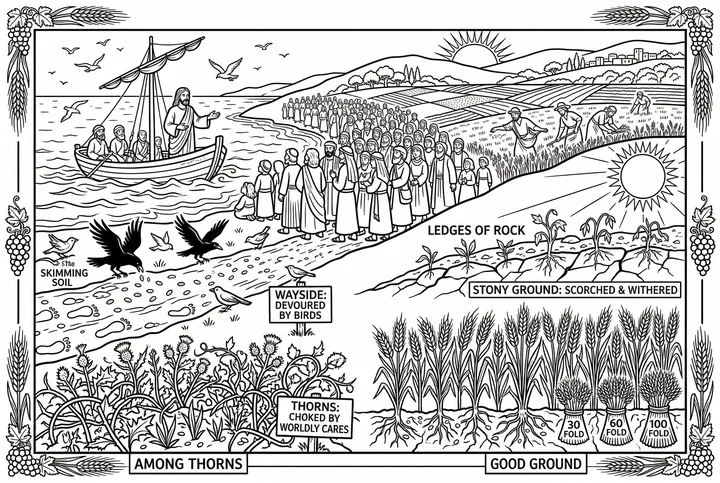
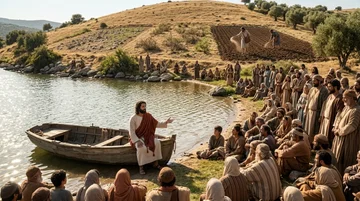
Jesus teaches the gathered crowd the parable of the sower.
- Mark 4:1
And he began again to teach by the sea side: and there was gathered unto him a great multitude, so that he entered into a ship, and sat in the sea; and the whole multitude was by the sea on the land.
Jesus teaches the gathered crowd by the sea before telling the sower parable.
- Matthew 13:3-23
And he spake many things unto them in parables, saying, Behold, a sower went forth to sow;
Parallel account of the crowd and the sower parable, including its explanation.
- Matthew 13:3-9
And he spake many things unto them in parables, saying, Behold, a sower went forth to sow;
Matthew gives the parallel telling of the parable of the sower.
- Matthew 13:2
And great multitudes were gathered together unto him, so that he went into a ship, and sat; and the whole multitude stood on the shore.
parallel account of same crowd gathering
- Mark 4:14-15
The sower soweth the word.
Satan takes the word from some who hear it.
- Luke 8:11
Now the parable is this: The seed is the word of God.
Identifies the seed in Jesus’ parable as the word of God.
- Matthew 13:10-13
And the disciples came, and said unto him, Why speakest thou unto them in parables?
Explains why Jesus taught the crowds in parables.
- Luke 8:12-15
Those by the way side are they that hear; then cometh the devil, and taketh away the word out of their hearts, lest they should believe and be saved.
The explanation shows how different hearers receive the word and whether it bears fruit.
Commentary
Each commentary is drawn from primary sources: the writings of Ellen G. White and Adventist pioneers and periodicals. Each commentary is separate. Its own words are not a quotation; follow the references to read the source passages.
Ellen G. White
6 sources
A large, eager multitude gathered together to Jesus, coming to Him out of every city.ST Jun 30, 1881COL 33.2–34.1COL 33COL 30.12SP 234.1–2 The gathering took place beside the sea, by the Sea of Galilee, where an eager company had come to hear Him.ST Jun 30, 1881COL 33.2–34.1COL 30.1 As the people pressed around Him, He taught them from a boat just off the shore.COL 33.2–34.1
There He taught the crowd by speaking a parable.ST Jun 30, 1881COL 33.2–34.1COL 33COL 30.12SP 234.1–2 The parable thus introduced is that of the sower scattering seed.COL 33.1COL 33.2–34.1COL 332SP 234.1–2 The same account of the sower scattering seed is also told in Matthew 13 and Mark 4.COL 33
He used the surrounding scene to make the teaching clear and to fix the lesson in the hearers' minds.ST Jun 30, 18812SP 234.1–2 The visible details that helped fix the lesson were the seed, the varied ground, the rocks, and the weeds.2SP 234.1–2 The parable illustrates the things of the kingdom of heaven and the work of the great Husbandman for His people, portraying the spreading of the gospel.COL 33.12SP 234.1–2
Like a sower in the field, He came to scatter the heavenly grain of truth, and His parable teaching itself was the seed by which the most precious truths of grace were sown.COL 33.1 From the natural seed cast into the soil He leads minds to the gospel seed, whose sowing brings man back to loyalty to God.COL 33.1 He who gave the parable of the tiny seed is the Sovereign of heaven, and the same laws that govern earthly seed-sowing govern the sowing of the seeds of truth.COL 33.1 Because of its simplicity, the parable has not been valued as it should be.COL 33.1 Its hearers respond differently: some quickly lose its impression and return to sin and indifference amid worldly cares and temptations, while others begin a holier life and live by its teaching.2SP 234.1–2
Sources
Pioneers and periodicals
10 sources
The verse describes a great crowd gathered to Jesus from many cities, out of every city, whom he taught by a parable, namely the parable of the sower.ST Jun 30, 1881ST Nov 26, 1894RH May 11, 1869ST Nov 13, 1901 The gathering and teaching took place beside the sea, the Sea of Galilee also called the Sea of Gennesaret, near Capernaum.ST Nov 26, 1894ST May 17, 1899 Jesus taught from a boat to the people on the shore, using the surrounding scene to make his teaching clear.ST Jun 30, 1881ST May 17, 1899 The setting is paralleled in Matthew 13:2, where Jesus likewise teaches the crowd from a boat.ST May 17, 1899
The use of a parable here marks a move from simple declarations to parables as a way of pressing home truths about God's kingdom.ST Nov 26, 1894 In the parable the seed is God's word or proclaimed truth, and the hearers are like four kinds of soil whose differing responses determine whether the word bears fruit.RH May 11, 1869ST Nov 13, 1901RH Jul 10, 1860ST Jun 16, 1887 Only the good ground represents those who become truly converted, continue in that state, and bear fruit.RH May 11, 1869 Those are the ones with an honest and good heart who keep the word and patiently bear abundant fruit, and who thus overcome and inherit everlasting life.ST Nov 13, 1901 The rest remain fruitless despite hearing the word and often professing faith.RH May 11, 1869
Some lose the word as the enemy takes it from the conscience so that it becomes unfruitful.ST Nov 13, 1901ST Jun 16, 1887 Some fall away under temptation.ST Nov 13, 1901 Some grow weary in doing good and are choked or overcome by life's cares, riches, and pleasures, while others bear abundant fruit.ST Nov 13, 1901RH Jul 10, 1860 The possibilities for the seed that falls on good ground encourage faith.ST Feb 6, 1896 The parable therefore calls for preaching that makes the word effective for salvation by reaching hearers personally and exposing sin and the person guilty of it.ST Jun 16, 1887
The parable is fulfilled when a large church displays its different soils together. About half its members are lukewarm, neither cold nor hot and not realizing their condition. The living truth-loving members are aroused and encouraged and strengthened to press on for life, eternal life at the coming of the Lord. They need the Lord to continue to stir and purge them so they may bear much fruit that God may be glorified. The seed-sowing image also applies to carrying God's message and love to people in need without knowing what harvest the work will bring, since God owns both the seed and the field and brings the harvest in his own time.
The verse belongs to a chapter that gives an explicit account of a person raised from the dead before the resurrection of Christ, the ruler's daughter, proving Christ was neither the only one nor the first raised from the dead.ST Mar 30, 1876
Sources