Translations
American King James Version, King James Version, KJV Cambridge Paragraph Bible
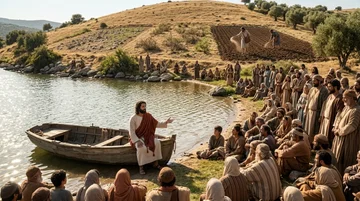
The same day went Jesus out of the house, and sat by the sea side.
The same day Jesus went out of the house, and sat by the sea side.
Revised Version, American Standard Version
On that day went Jesus out of the house, and sat by the sea side.
And in that day Jesus, having gone forth from the house, was sitting by the sea,
And that [same] day Jesus went out from the house and sat down by the sea.
On that day, Jesus, going out of the house, was sitting near the sea:
Berean Standard Bible, Majority Standard Bible
That same day Jesus went out of the house and sat by the sea.
On that day Jesus went out of the house and sat by the seaside.
On that day Jesus went out of the house and was seated by the seaside.
The same day went Iesus out of the house, and sate by the sea side.
Douay-Rheims (Challoner revision)
The same day Jesus going out of the house, sat by the sea side.
Pictures
Cross-references
- Mark 4:1-20
And he began again to teach by the sea side: and there was gathered unto him a great multitude, so that he entered into a ship, and sat in the sea; and the whole multitude was by the sea on the land.
A parallel account of Jesus teaching by the sea and the parable of the sower.
- Luke 8:4-15
And when much people were gathered together, and were come to him out of every city, he spake by a parable:
Luke gives the parallel account of the parable and its explanation.
- Matthew 13:18-23
Hear ye therefore the parable of the sower.
Jesus explains the parable introduced at the seaside.
- Mark 4:35-41
And the same day, when the even was come, he saith unto them, Let us pass over unto the other side.
The passage identifies Mark’s account of the storm that followed Jesus’ teaching.
- Matthew 13:36-43
Then Jesus sent the multitude away, and went into the house: and his disciples came unto him, saying, Declare unto us the parable of the tares of the field.
Jesus explains the wheat-and-tares parable after leaving the seaside.
- Matthew 8:23-27
And when he was entered into a ship, his disciples followed him.
The passage points to Matthew’s parallel account of the crossing and storm.
Commentary
Each commentary is drawn from primary sources: the writings of Ellen G. White and Adventist pioneers and periodicals. Each commentary is separate. Its own words are not a quotation; follow the references to read the source passages.
Ellen G. White
14 sources
On the same day He left the house, Jesus went out and sat by the lakeshore of the Sea of Galilee to teach the gathered crowd the parable of the sower.ST Jun 30, 1881COL 33.2–34.1COL 30.1 As the people pressed too closely around Him, He stepped into Peter's fisherman's boat just offshore and sat there teaching those on shore in full view and hearing.ST Jun 30, 1881COL 33.2–34.1DA 230 In that parable Christ scatters the seed of heavenly truth to bring people back to loyalty to God, with the sowing of truth governed by the laws of sowing natural seed.Ms 116, 1909, par. 1COL 33.1 The words then given were greatly needed by the hearers and are still greatly needed, so all need to read them as for life and take them to heart.Ms 116, 1909, par. 1Lt 317, 1905, par. 7–9 His manner of work there exemplifies instruction essential to true, higher education, calling believers to study His lessons, bring them into ministry, and work with Him in practice.Lt 28, 1909, par. 11–12CH 164.1
Setting by the Sea
On the same day He left the house, Jesus went out and sat by the seaside, the lakeshore of the Sea of Galilee, setting the scene for teaching the gathered crowd the parable of the sower.ST Jun 30, 1881COL 33.2–34.1COL 30.1DA 2304RED 78.1–2 After spending the night in prayer, He came to the shore early in the morning where His disciples were fishing and met them there.ST Jun 30, 1881ST May 3, 18774RED 77.1–2 As the crowd gathered around Him in the open air by the sea, He was ready to teach the people.ST Jun 30, 1881ST May 3, 18774RED 77.1–2
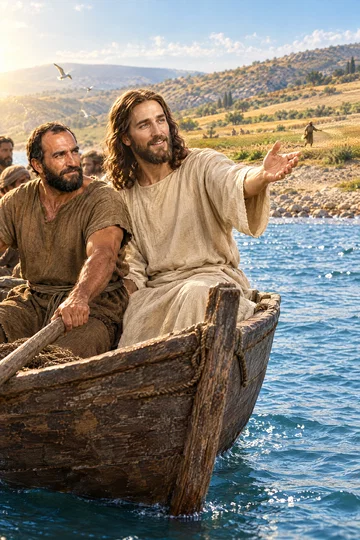
As the crowd grew, including sick people seeking healing, and pressed too closely around Him, He stepped into Peter's fisherman's boat just offshore and sat there.ST Jun 30, 1881COL 33.2–34.12SP 260.2–261.14RED 78.1–2ST May 3, 1877 From there He taught the people on shore in full view and hearing without interruption, finishing a long day of teaching.DA 2302SP 260.2–261.14RED 78.1–2ST May 3, 18774RED 77.1–2 In the open air He preached salvation and the words of life to ordinary listeners with patience and kindness toward the tempted, sorrowful, and disheartened.4RED 78.1–24RED 77.1–2 He used the lake, sea, mountains, fields, hills, birds, and other surroundings to illustrate His lessons and make them memorable, a method He also used with His disciples in other natural settings.ST Jun 30, 1881DA 2304RED 78.1–2CH 164.1
Teaching and Its Call
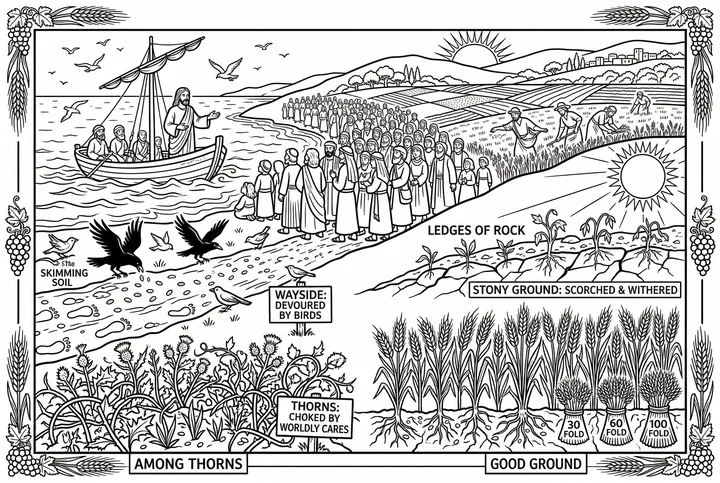
The same day He left the house sets the scene for the telling of the parable of the sower to the gathered crowd.COL 33COL 33.1COL 33.2–34.1COL 30.1 The picture is of a robed sower standing on a sloping cultivated hillside scattering seed across rows of furrows with a wooded ridge behind.COL 33 The crowd had gathered on the shore of the Sea of Galilee to hear Him, including sick people seeking healing, and when they pressed too closely He got into a boat and taught the people on shore.COL 33.2–34.1
The parable teaches that Christ scatters the seed of heavenly truth.COL 33.1 The parable itself is seed through which precious truths of grace are sown, and the gospel seed brings people back to loyalty to God.COL 33.1 The laws that govern the sowing of natural seed also govern the sowing of truth, including that some seed fell upon good ground and brought forth fruit.Ms 116, 1909, par. 1COL 33.1
The words then given were greatly needed by the hearers and are still greatly needed.Ms 116, 1909, par. 1 Everyone needs to be in a position to understand these precious words of Jesus Christ.Ms 116, 1909, par. 1 They must be read as for life and taken to heart.Lt 317, 1905, par. 7–9
His teaching and manner of work exemplify instruction essential to true, higher education.Lt 28, 1909, par. 11–12 He began by teaching the people who gathered to hear Him, then continued His lessons in a retired place.Lt 28, 1909, par. 11–12 His teaching astonished many because it was new and unfamiliar.Lt 28, 1909, par. 11–12 His disciples faithfully recorded these lessons so that they would continue to instruct believers, who should study them and bring them into ministry.Lt 28, 1909, par. 11–12 What was learned beside the lake was to be put into practice by working with Him, as He also taught in other natural settings using the things around them to illustrate His lessons.CH 164.1
The chapter opened by the verse is a warning to take heed to oneself, to let no human sophistries or mocking burlesque of sacred things blind the mind.Lt 317, 1905, par. 7–9 It calls for prayerful self-examination over who shall stand acquitted without spot or stain of character before the judgment seat of Christ.Lt 317, 1905, par. 7–9 In it is contemplated the future destiny of those for whom He gave His life, showing that those who are saved must form characters without fault in the sight of a pure and holy God.Lt 317, 1905, par. 7–9 Each is to do the work given him, wearing Christ's yoke and learning His meekness and lowliness, with angels ministering to them and Christ daily teaching them the meaning of the divine beatitudes.Lt 317, 1905, par. 7–9 At the great day of judgment every man will be judged according to deeds done in this life.Lt 317, 1905, par. 7–9
Sources
Pioneers and periodicals
37 sources
On the same day as the events just before, Jesus left the house and sat by the shore of the Sea of Galilee near Capernaum.ST Jun 30, 1881ST Oct 2, 1901ST Sep 16, 1886 When the crowd pressed close He sat in a fishing boat just off shore while the people stood on the shore to hear Him, and the sea and fields around Him supplied pictures for what He taught.ST Jun 30, 1881ST May 3, 1877ST Oct 2, 1901 The sitting by the sea opens a chapter of parables centered on the sower and the wheat and the tares, applying to the Christian dispensation after the gospel went to the Gentiles.RH Aug 20, 1872ST Nov 26, 1894ST Sep 12, 1911ST Jun 8, 1904ST May 2, 1878 The sower shows the same good seed bears fruit only according to the ground where it falls, so hearing must be joined with doing and rooted receiving to endure opposition.RH May 11, 1869RH Jun 13, 1854RH May 4, 1869ST Jan 23, 1896 The wheat and the tares show righteous and wicked remain together until the harvest at the end of the world and Christ's second advent, when the righteous are gathered to shine in the Father's kingdom and the wicked are burned.RH Jun 13, 1854ST Jul 24, 1884RH Oct 29, 1908
Seaside Setting and Occasion
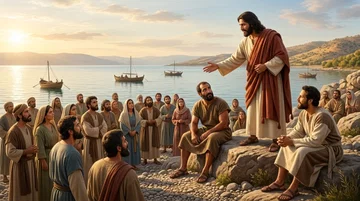
On the same day as the events just before it Jesus went out of the house and sat by the seaside.ST Jun 30, 1881ST Oct 2, 1901ST Sep 16, 1886RH Sep 23, 1862ST Jun 13, 1900 That seaside was by the Sea of Galilee near Capernaum, also called the lakeside and the shore of Gennesareth.ST Jun 30, 1881ST Nov 26, 1894ST May 25, 1904 There He began teaching the truths of the kingdom through parables, with the parable of the sower first and the parable of the wheat and the tares following.ST Oct 2, 1901ST Sep 16, 1886RH Sep 23, 1862ST Nov 26, 1894 The gathered crowd stood on the shore to see and hear Him while He taught.ST Oct 2, 1901RH Aug 10, 1876ST Apr 3, 1907
After spending the night in prayer He had come to the shore early in the morning to find His disciples fishing.ST Jun 30, 1881ST May 3, 1877 When the crowds gathered and pressed in too closely He sat in a fishing boat just off shore.ST Jun 30, 1881ST May 3, 1877ST Oct 2, 1901 He sat in a ship while the audience stood on the shore, speaking from a fishing boat so the people gathered on shore could see Him.RH Aug 10, 1876ST Apr 3, 1907ST May 25, 1904 In that boat by the shore of Gennesareth He told the parable of the sower and the seed.ST Apr 3, 1907ST May 25, 1904
After teaching the crowds there for many hours, including the parables of the chapter, He proposed that the disciples cross to the other side.ST Jul 19, 1905 His ministry there took place during a brief period of peace in Palestine that allowed quiet gatherings and teaching from fishermen's boats on the shore of the Sea of Galilee.ST Jan 13, 1914 The sea, mountains, fields, hills, and other sights around Him provided illustrations for His teaching.ST Jun 30, 1881 The setting was open air by the sea, where hills and nature accompanied His parables and ordinary settings and events by the sea carried heavenly truths.ST Jun 30, 1881ST May 3, 1877ST May 25, 1904
The verse begins a chapter devoted to parables and teachings.ST Sep 12, 1911ST May 2, 1878 Its principal examples are the parable of the sower and the parable of the wheat and the tares.ST Sep 12, 1911 It preserves one of His two popular discourses, the other having been delivered on a mountain.ST Jun 8, 1904
Parables Taught and Applied
The sitting by the sea opens the parable of the sower, which shows how hearers of God's word respond and whether they bear fruit.RH May 11, 1869RH Jun 13, 1854ST Feb 6, 1896 The same good seed produces different results only from the conditions where it falls, not from any difference in the seed itself.RH May 11, 1869 Seed on the wayside does not spring up, while seed among rocks and thorns withers and bears no fruit, and only seed on good ground bears fruit, a prospect that encourages faith by what is possible on good ground.ST Feb 6, 1896
Hearing must be joined with doing, for hearing alone does not make a true follower of Christ.RH May 4, 1869ST Jan 23, 1896 Those who receive truth without deep roots fall away when opposition comes, as when Sabbath observers abandon observance under church pressure and fear of losing mill jobs, like seed that withers for lack of depth.RH May 4, 1869ST Jan 23, 1896 The parable of the sower gives no promise that the response to the preached word will change while it is preached.RH Jun 13, 1854ST Mar 6, 1901 Nor does it teach that wickedness will steadily decrease or that the world will become righteous before the end.RH Jun 13, 1854ST Mar 6, 1901
The parables of this chapter — the sower, the wheat and tares, the mustard seed, the leaven, and the fishing net — apply to the Christian dispensation, the continuing work of God's plan to save people after the gospel went to the Gentiles.RH Aug 20, 1872ST Nov 26, 1894 The kingdom of grace has passed through patriarchal, Jewish, and Christian stages, and its transfer from the Jews did not complete its work, which continues under new husbandmen.RH Aug 20, 1872 Its truths about the kingdom of heaven were taught by the Sea of Galilee near Capernaum and by the lakeside to multitudes, including the poor and outcast as well as the wealthy and influential, answering whether such people can belong to God's kingdom.ST Feb 23, 1915ST Nov 26, 1894ST Nov 14, 1906
The parable of the wheat and the tares teaches that righteous and wicked, both of which have existed since the fall, remain together in the world until the harvest.RH Jun 13, 1854ST Jul 24, 1884ST Apr 14, 1887 That harvest is the end of the world and the end of the Christian age that began with John and ends at Christ's second advent.RH Jun 13, 1854RH Oct 29, 1908 Then Christ removes those who offend and do evil, takes the righteous to heaven to shine in the kingdom of their Father, and the wicked are burned, separating the two groups forever.RH Jun 13, 1854RH Oct 29, 1908 This mortal state will therefore witness no period of universal happiness and holiness when all shall know the Lord.RH Jun 13, 1854ST Apr 14, 1887
In this setting from a ship by the shore Jesus taught about sowing, the harvest, the end of the world, the burning of the tares, and the righteous shining, presenting His teaching on the second advent and its consequences.RH Jul 10, 1913ST Oct 9, 1879 At His coming angels gather the elect and bind His enemies for burning, and judgment on the wicked accompanies His return.RH Jul 10, 1913ST Oct 9, 1879 His rejection by many does not make His preaching or God's provision of salvation a failure.ST Oct 9, 1879 The parables show He did not expect to return in clouds with power and great glory in His disciples' lifetime, but at a future, indeterminate time seeming long deferred.RH Jul 10, 1913ST Mar 3, 1909
The seven parables of the chapter correspond chronologically to the letters to the seven churches in Revelation, especially the drag-net to Laodicea.ST Apr 19, 1910 The net represents worldwide evangelism while Laodicea represents a self-satisfied, worldly, lukewarm church, together describing the last state of the gospel work and the church.ST Apr 19, 1910 The sitting introduces the promise of the harvest that Jesus comes as a reaper with sickle in hand to gather the result of the great threefold message sent to save the world.ST Aug 22, 1911 The same message ripens everyone it reaches, as the same sun ripens wheat and tares and ripens grain and weeds, ripening those who accept and walk in it for the heavenly garner and ripening those who utterly reject it in wickedness into character unworthy of salvation.ST Aug 22, 1911
The going out from the house to the multitude shows preaching beyond temple or synagogue and outside any fixed time or place, illustrating that worship means doing God's will at all times and in all places.RH Aug 10, 1876RH Nov 19, 1908 As a missionary He went out to seek people in the great thoroughfares of travel, led multitudes to the seashore, and preached gracious tidings of goodness, mercy, and love for the salvation of the lost, healing the sick, comforting the desponding, bringing hope to the despairing, and preaching to the poor instead of building so grand a house that the poor were excluded.ST Apr 16, 1894RH Aug 10, 1876RH Nov 19, 1908 His teaching there was in words so simple a child could grasp them without a dictionary, not opening the mysteries of science nor preaching from a newspaper.ST Apr 16, 1894 He made the woods, fields, hills, and seaside His schoolroom, giving precious lessons while watching the farmer till and sow, showing that teachers should come into close touch with the Creator's handiwork, as in country church-schools.ST Apr 16, 1894RH Apr 2, 1908 His words to those present continue through the Holy Spirit to speak to faithful people in every age, bringing hope in trial, comfort in sorrow, light in darkness, and peace to hearts.ST May 3, 1899RH Apr 2, 1908
Sources