Translations
American King James Version, King James Version, KJV Cambridge Paragraph Bible, Webster Bible
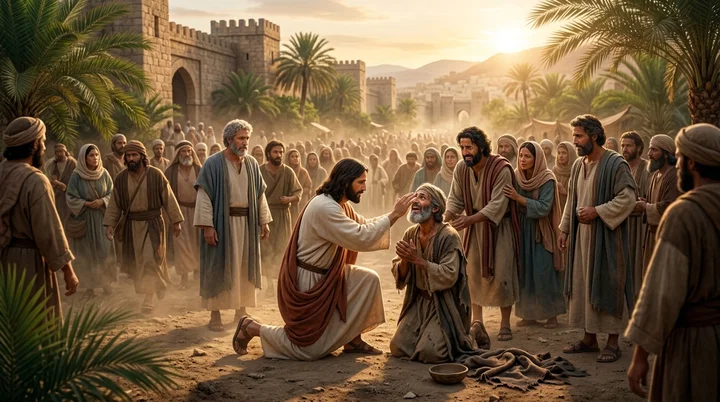
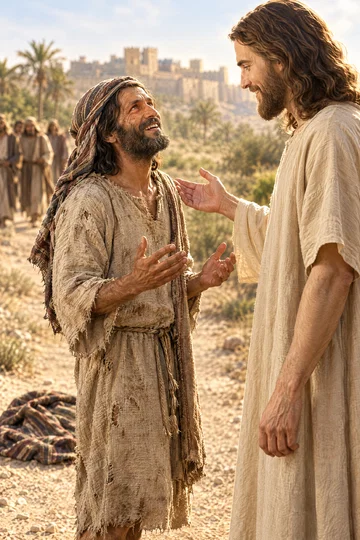
And he, casting away his garment, rose, and came to Jesus.
Revised Version, American Standard Version
And he, casting away his garment, sprang up, and came to Jesus.
and he, having cast away his garment, having risen, did come unto Jesus.
And, throwing away his garment, he started up and came to Jesus.
And, he, throwing off his mantle—springing to his feet, came unto Jesus.
Throwing off his cloak, Bartimaeus jumped up and came to Jesus.
Throwing off his cloak, Bartimaeus rose up and came to Jesus.
He, casting away his cloak, sprang up, and came to Jesus.
And he, putting off his coat, got up quickly, and came to Jesus.
So he threwe away his cloke, and rose, and came to Iesus.
Douay-Rheims (Challoner revision)
Who casting off his garment leaped up, and came to him.
Pictures
Cross-references
- Luke 18:35-43
And it came to pass, that as he was come nigh unto Jericho, a certain blind man sat by the way side begging:
Luke recounts the same healing of the blind beggar near Jericho.
- Matthew 20:29-34
And as they departed from Jericho, a great multitude followed him.
Parallel account of Jesus healing the blind beggars near Jericho.
Commentary
Each commentary is drawn from primary sources: the writings of Ellen G. White and Adventist pioneers and periodicals. Each commentary is separate. Its own words are not a quotation; follow the references to read the source passages.
Ellen G. White
5 sources
The verse pictures blind Bartimaeus crying to Jesus as the Son of David for mercy and coming to him to be healed, responding urgently as Jesus passes by by throwing aside his garment, rising, and coming.SG2 202.1–219MR 18.2 Jesus passing by offers mercy to one blind to the higher interests of the soul and to the blessed, glorious attractions of heavenly life in the city of God.Lt 1d, 1890, par. 16 That one has labored for that which is not bread and sacrificed peace and honor and the companionship of the children of God, even his own children, to walk without obstruction in his own way and to content himself in secrets of sinful pleasure and base gratifications irrespective of God and heaven, leaving himself with no hope and without God.Lt 1d, 1890, par. 16 Even then Jesus offers him that which he most needs, which is of infinite gain even if it cost the toil and suffering of a whole lifetime.Lt 1d, 1890, par. 16
Even one hardened in sin and transgression and unbelief, without hope and without God, can still come to Jesus even at the eleventh hour and will not be left to perish.Lt 1d, 1890, par. 17 A sin-hardened person bound by Satan and standing on the very borders of the eternal world must break with sin and come to Jesus without a moment's delay while Jesus of Nazareth is passing by.Lt 1d, 1890, par. 18 Casting away the garment means risking everything, breaking the bands woven by a wicked course, getting away from the place and course of wickedness, and refusing to let any person or the suggestions of Satan keep the voice of supplication silent through fear of having deeds reproved.Lt 1d, 1890, par. 18 Coming means falling on Christ the Rock and being broken before it is utterly too late, with a broken and repentant heart crying Jesus of Nazareth have mercy on me, not waiting for anything, not stopping to reason, but throwing himself at the feet of Jesus.Lt 1d, 1890, par. 17
Coming also means crying what shall I do to be saved, confessing sins to God and to those wronged, making thorough work for repentance, and seeking pardon from the sin-pardoning Saviour in order to be rescued out of the snare of the devil and grasp the crown of life.Lt 1d, 1890, par. 18 God then touches the heart with new tenderness and leads to a sense of long-perverted obligations to him.Lt 1d, 1890, par. 17 Through God's grace, the one who seeks Jesus earnestly for mercy receives clearer sight and a gift more valuable than earthly riches.19MR 18.2 The verse means the sick can be brought to Jesus the great Physician in the arms of faith with earnest crying for mercy, and those who come this way are comforted and feel the healing power of God.SG2 202.1–2 It calls for laying aside all medicine and relying alone on the great Physician, holding faith for entire restoration, seeing the salvation of God yet expecting to see and feel more, with peace like a river, triumph in God, unspeakable gratitude for tokens of his love, and dedicating oneself anew to God.SG2 202.1–2
Sources
Pioneers and periodicals
30 sources
Mark 10:50 belongs to the healing of blind Bartimaeus, the blind beggar by the roadside at Jericho who cried to Jesus for mercy and whose eyes Christ opened.RH Dec 6, 1906ST Jun 14, 1905RH Aug 29, 1871 When Jesus called him he rose at once with eager persistence, casting aside his outer cloak as a poor man's cumbersome covering so that nothing would hinder him from reaching Jesus quickly.RH Nov 17, 1859ST Jan 3, 1911RH Feb 4, 1873ST Nov 21, 1900 His readiness to leave it behind showed faith that Jesus would restore his sight so he could find it again, and his faith made him whole so that he received his sight and followed Jesus instead of remaining a beggar by the road.RH Dec 6, 1906ST Nov 21, 1900 Casting away the garment pictures coming to Jesus by casting off sin and every hindrance and pushing through difficulties to seek mercy and salvation before the opportunity passes.RH Nov 17, 1859RH Feb 4, 1873 His plea and coming picture the need to be freed from sin's blindness, for Jesus can give spiritual eyesight and light and life to every darkened, blinded soul who cries out for full conversion and looks to him.ST Jul 29, 1897ST Jun 20, 1906ST Aug 30, 1905
Bartimaeus Coming to Jesus
The verse belongs to the healing of blind Bartimaeus at Jericho.RH Dec 6, 1906ST Jun 14, 1905RH Aug 29, 1871RH Feb 25, 1875 He was a blind beggar sitting by the roadside and wayside who cried to Jesus for mercy and pity, and whose coming to Jesus when called is described here.RH Dec 6, 1906RH Aug 29, 1871RH Feb 25, 1875 His healing shows Christ as a missionary to the poor in opening the blind beggar's eyes.ST Jun 14, 1905
That healing at Jericho involved two blind men and is recorded also in Matthew 20 and Luke 18.ST Mar 8, 1905 It is one of seven specially recorded cases in which Jesus healed blind men — two at Capernaum, two at Jericho, one at Bethsaida, one more at Capernaum, and the man at Jerusalem.ST Mar 8, 1905 Unlike the Jerusalem man, the men at Jericho are not said to have been born blind.ST Mar 8, 1905 The rising and coming takes place after Jesus leaves Jericho, though he may first have called to him as he entered the city.ST Mar 18, 1889
The garment he cast away was an outer cloak and cumbersome outer garment.RH Feb 4, 1873ST Nov 21, 1900RH Feb 4, 1873 It was a poor person's covering which the law protected from being kept overnight as a pledge, and a particular kind worn by people in his condition.RH Feb 4, 1873ST Nov 21, 1900 When Jesus called him, he responded at once with eager, energetic, determined persistence that would not be hushed.ST Mar 18, 1889RH Feb 4, 1873ST Mar 18, 1889 He rose quickly, threw off his garment, and hastened and ran to Jesus.ST Mar 18, 1889ST Jan 3, 1911RH Feb 4, 1873ST Jan 3, 1911 He cast off his cloak so it would not hinder him and he could reach Jesus more easily and quickly.RH Nov 17, 1859ST Jan 3, 1911ST Jan 3, 1911
His unusual readiness to leave his cloak behind showed implicit faith that Jesus would restore his sight and he could find it again after being healed.ST Nov 21, 1900 His faith led him to come, Jesus said his faith had made him whole, and he received his sight and followed Jesus.RH Dec 6, 1906 He was brought from blindness to sight and followed Jesus instead of remaining a beggar by the road.RH Dec 6, 1906 Jesus stopped for the blind man who called loudly by the roadside, gave him personal attention in pity, and took time to bless and heal him amid his demanding work of bringing salvation to the world.RH Dec 26, 1907RH Feb 2, 1905ST Nov 9, 1915RH Aug 29, 1871RH Dec 2, 1873 Helping a blind person was not an unacceptable disturbance.RH Dec 2, 1862 Bartimaeus, the blind man at Jericho whom Jesus healed, was the uncle of Miriam, the maidservant of Claudia Procula, the wife of Pilate.ST Jan 17, 1911
Spiritual Sight and Invitation
Casting away the cloak so that it would not hinder him, rising and coming to Jesus when called, pictures coming to Jesus by casting off sin and pushing through difficulties to seek mercy and salvation even with a guilty conscience or wicked heart.RH Nov 17, 1859 It pictures casting aside self-righteousness and every sin that hinders in order to reach Jesus more easily and quickly, and receiving in return spiritual sight, gracious acceptance and forgiveness. His quickly throwing aside the cumbersome outer garment and going to Jesus is the model for putting away sin promptly and accepting his invitation before the opportunity for repentance passes.RH Feb 4, 1873
His plea for healing and his coming to Jesus picture the need to be freed from sin's blindness, to come nearer to Jesus and follow him.ST Jul 29, 1897 The healing of the blind beggars at Jericho who call to Jesus and receive sight pictures the change from spiritual darkness to light and the gift of life and righteousness found in Jesus.ST Aug 30, 1905 He can give spiritual eyesight and wisdom from above to those who are spiritually blind, hard-hearted, and as dead men in spiritual death, when they sigh, long, and cry out to him for a full and complete conversion of soul and a deep and permanent work of the Spirit. Every waste, desolate, darkened, blinded, chaotic soul who believes, looks to him, reaches up a helpless hand and asks his presence will have the mighty Creator-Redeemer by the same word that spoke matter into existence and turned confusion to order, chaos to cosmos, and wasteness to fruitfulness and beauty speak light and life and fruitfulness and order and beauty into him.ST Jul 7, 1898
Recognizing need for healing should lead to coming to Jesus with earnestness, and his unusual readiness to leave behind his cloak, a poor person's covering which the law protected from being kept overnight as a pledge, showed implicit faith that Jesus would restore his sight and he could find it again after being healed.ST Nov 21, 1900 Prayer is a definite, deeply felt request brought directly to Christ, as in the blind man's cry to Jesus for sight.RH Oct 23, 1860 A blind beggar could ask Jesus for mercy and receive healing without understanding how his eyes would be opened, and his experience of having been blind and now seeing shows that faith does not depend on being able to explain how help comes.RH Jul 2, 1861 His coming to Jesus and receiving sight through faith illustrates that faith in God's Word can make promised blessings real now, including cleansing from sin, power in Christ, righteousness, the Spirit, eternal life, salvation, and deliverance from darkness, even though immortality and heaven remain future.ST May 6, 1897
Coming to Christ means coming in weakness, fear, and helplessness as a beggar at his feet to plead for the soul's dear sight.ST Mar 20, 1893 It means seeing his pierced heart pouring out life's last red drop on Calvary's hill and seeing the cruel thorns crowning his forehead, which touches a diviner chord that cries out braver than the will, whether suffering is removed or pressed deeper still.ST Mar 20, 1893 When the Burden-Bearer comes the burden is lifted, for the blind beggar by the wayside had his burden lifted at his coming.RH Feb 25, 1875ST Mar 4, 1880 He stands among the sorrowing and needy who received consolation when Christ came, with distress and burden lifted by the Saviour.
His coming pictures Christ as a missionary to the poor in opening the blind beggar's eyes.ST Jun 14, 1905 It pictures Christ seeking sinners out and speaking to them personally and directly, even calling them by name, and because Christ left heaven to come into the world to save sinners, believers ought to turn aside from earthly affairs to bring fellow creatures the prepared message, speaking a direct and tender word as balm and solace to the aching heart.RH Dec 26, 1907 His stopping for the blind man who called to him and taking time to bless him teaches noticing and responding compassionately to those in need.RH Feb 2, 1905
Spiritual sight means seeing the hurt caused by careless words and finding the right way, with mercy and healing sought from Jesus.ST May 13, 1889 It means rising and coming to him in a plea for spiritual sight so as to see Christ's way and follow him.ST Jun 20, 1906 The healing of Bartimaeus, the blind man at Jericho who was the uncle of Miriam, the maidservant of Claudia Procula the wife of Pilate, is proof that Jesus is truly innocent and just and must not be condemned to death.ST Jan 17, 1911 The blind man coming to Jesus also serves as a comparison portraying theological training as having impaired a person's spiritual sight.RH Jun 23, 1874
Sources