Translations
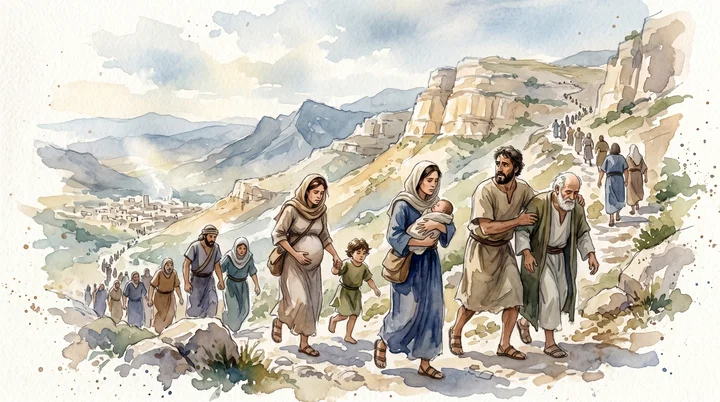
And pray you that your flight be not in the winter.
King James Version, KJV Cambridge Paragraph Bible, Webster Bible
And pray ye that your flight be not in the winter.
Revised Version, American Standard Version
And pray ye that it be not in the winter.
and pray ye that your flight may not be in winter,
And pray that it may not be in winter time;
But be praying, that it may not happen in winter.
Pray that this will not occur in the winter.
Pray that your flight will not occur in the winter.
Pray that your flight won’t be in the winter.
And say a prayer that it may not be in the winter.
Pray therefore that your flight be not in the winter.
Douay-Rheims (Challoner revision)
But pray ye, that these things happen not in winter.
Pictures
Cross-references
- Matthew 24:20
But pray ye that your flight be not in the winter, neither on the sabbath day:
Both warn that the flight should not occur in winter.
- Luke 21:20-22
And when ye shall see Jerusalem compassed with armies, then know that the desolation thereof is nigh.
Jerusalem’s encirclement signals flight and the days of vengeance.
- Matthew 24:3
And as he sat upon the mount of Olives, the disciples came unto him privately, saying, Tell us, when shall these things be? and what shall be the sign of thy coming, and of the end of the world?
Both texts belong to the same discourse answering the disciples’ questions.
- Mark 13:14
But when ye shall see the abomination of desolation, spoken of by Daniel the prophet, standing where it ought not, ( let him that readeth understand,) then let them that be in Judæa flee to the mountains:
gives the signal that requires the flight
Commentary
Each commentary is drawn from primary sources: the writings of Ellen G. White and Adventist pioneers and periodicals. Each commentary is separate. Its own words are not a quotation; follow the references to read the source passages.
Ellen G. White
2 sources
The verse belongs to a discourse about the destruction of Jerusalem and the coming of Jesus, with the two events described together.DA 627.1–3 That discourse is also directed to those living in the final scenes of earth's history.DA 627.1–3 It commands those in Judea to pray that their escape not happen in winter, when flight would be hardest.Ms 35, 1906, par. 15–23
The commanded prayer is part of an urgent flight to the mountains upon seeing the abomination of desolation standing where it should not be.Ms 35, 1906, par. 15–23 The flight must be so urgent that one does not go down into the house or turn back from the field for clothing.Ms 35, 1906, par. 15–23 Special woe rests on those who are pregnant and nursing infants in those days.Ms 35, 1906, par. 15–23 The flight occurs just before days of affliction unequaled from the beginning of creation and never to be repeated.Ms 35, 1906, par. 15–23
Sources
Pioneers and periodicals
47 sources
Pray that flight from coming danger does not fall in winter, when escape would be especially hard.ST Nov 15, 1899ST Jan 24, 1906ST Aug 4, 1914ST Jul 21, 1898RH Jan 7, 1862 It was given as warning that when Jerusalem would be surrounded by armies His people must flee to the mountains, and those who heeded were saved when the Romans encompassed Jerusalem before its destruction.ST Jan 24, 1906 It belongs to His prophecy on the Mount of Olives in answer to the questions about the destruction of the temple, the sign of His coming, and the end of the age.ST Aug 21, 1893RH Aug 20, 1901ST Aug 25, 1887 That prophecy is preserved in Matthew 24, Mark 13, and Luke 21, which must be studied together, with Matthew 24 as the fullest account.ST Jan 17, 1906ST Aug 14, 1893RH Jun 23, 1904 Its predictions reach from the destruction of Jerusalem to the second advent, being partly fulfilled when Titus captured the city, while that nearer event also pictured events of the distant future and the end of the age.STRH Feb 17, 1916RH Apr 12, 1915ST Sep 16, 1889ST Nov 27, 1879
Discourse Setting and Parallels
The verse belongs to Christ's prophecy given on the Mount of Olives while viewing Jerusalem, in answer to the disciples' questions about when the temple at Jerusalem would be destroyed, what would be the sign of His coming, and what would be the sign of the end of the age.ST Aug 21, 1893RH Aug 20, 1901ST Nov 21, 1911 That prophecy concerns Jerusalem's destruction, the persecution of His followers, and the signs of the nearness of the end of the world and His second coming.ST Aug 21, 1893RH Aug 20, 1901 It outlines the history of the Christian dispensation, indeed the whole dispensation, and its fulfillment includes the siege and overthrow of Jerusalem and the destruction of the temple.ST Aug 25, 1887ST Nov 21, 1911 It helps answer whether definite and distinct signs will show that His coming is near, signs widespread in the sun, the moon, the stars, the earth, and the nations, with distress, perplexity, roaring sea and waves, failing hearts, and shaken powers of heaven, heralding the Son of Man coming in a cloud with power and great glory as the greatest event ever witnessed by the universe.ST Aug 21, 1893
The discourse is preserved in three parallel accounts in Matthew 24, Mark 13, and Luke 21 that each supplement the others without contradiction.ST Jan 17, 1906ST Aug 14, 1893 No single account gives the whole answer, and all three must be studied together to grasp its full meaning and to understand His teaching about those events and the time of His return.ST Jan 17, 1906ST Jul 8, 1897 Matthew 24 is the fullest and most complete account, with Mark used for details it includes.ST Jan 17, 1906ST Aug 14, 1893 The verse is part of Jesus' answer and specific instructions to His disciples with reference to the destruction of Jerusalem and His second coming, one of Christ's words in His prophecy of future events standing in the sequence of prophecies in Matthew 24, Mark 13, and Luke 21.ST Jan 17, 1906ST Aug 14, 1893RH Jun 23, 1904
The verse is part of another account of Jesus' lesson about the signs of His coming, to be studied alongside Matthew 24 and Luke 21.ST Nov 28, 1895ST Jul 8, 1897 It stands in Christ's threefold teaching, given also in Matthew 24 and Luke 21, that the generation witnessing all the signs of His coming is the last generation.ST Nov 28, 1895 Mark 13 shows that when all these things are seen it is duty to know that He is near, even at the doors, that this generation shall not pass till all these things be fulfilled, and that heaven and earth shall pass away but His words shall not pass away.ST Nov 28, 1895
Meaning of Winter Prayer
The verse urges those who must flee to pray that their flight not take place in winter, when escape would be especially difficult.ST Nov 15, 1899ST Aug 4, 1914ST Jul 21, 1898RH Sep 9, 1915ST Mar 3, 1909 It belongs to Jesus' instruction to His disciples on the Mount of Olives concerning the signs of His coming and the end of the world, to His discourse about Jerusalem's destruction, the end of the age, and the signs of His coming, and to His teaching about the signs of the end.ST Aug 4, 1914ST Jul 21, 1898RH Sep 9, 1915ST Mar 3, 1909 Winters in Judea could be severe, so fleeing in that season would bring special hardship.ST Jan 24, 1906RH Jan 7, 1862 Jesus told His followers to pray that their flight from Jerusalem would not take place in winter in order to spare them the hardships of fleeing in that season, and the warning also touches the Sabbath, when flight would conflict with conscience and profane God's law.ST Jan 24, 1906
The verse belongs to Christ's warning that when Jerusalem would be surrounded by armies His people must flee to the mountains, urging them to pray that their flight not take place in winter. That warning marks a change in their duties when that danger arrives. Christ's warning about Jerusalem's coming destruction included concern for the time of flight, and the disciples heeded the warning, fled to the mountains, and were saved.ST Jan 24, 1906 The warning applied when the Roman army surrounded Jerusalem in A.D. 70, giving believers an opportunity to escape the city before its destruction.ST Jan 24, 1906
The discourse about Jerusalem's destruction and His coming at the end of the world presents events concerning Jerusalem as a type of the second coming, and speaks both of Jerusalem's destruction and of Christ's second coming, without giving a specific explanation of the warning about fleeing in winter.ST Oct 20, 1909ST Nov 27, 1879 The prophecy in these chapters is not always or necessarily fulfilled in the order in which it is given, and not all of it was fulfilled when Jerusalem fell.ST Nov 27, 1879
Jerusalem and Second Advent
Mark 13:18 belongs to Jesus' predictions covering the period from Jerusalem's destruction to the second advent, describing both Jerusalem's destruction and Christ's second coming.STST Sep 16, 1889ST Nov 27, 1879 The discourse places His second coming far in the future, with many notable events required to take place first, and the occurrence of those events does not mean that the end has arrived. Prophecy in these chapters is not always or necessarily fulfilled in the order in which it is given, but must be compared with other Scriptures to determine correct application.ST Sep 16, 1889ST Nov 27, 1879
The chapter was not all fulfilled when the Romans destroyed Jerusalem, and the coming of Christ described in it had not yet taken place.ST Sep 16, 1889ST Nov 27, 1879 The predictions were partly fulfilled in Jerusalem's destruction, when Titus captured Jerusalem.RH Feb 17, 1916RH Apr 12, 1915 That nearer event also depicted and pictured events belonging to the distant future and the end of the age.RH Feb 17, 1916RH Apr 12, 1915
The prophecy outlines the history of the Christian dispensation and the whole dispensation from the first advent to the second.RH Jan 21, 1873ST Aug 25, 1887ST Nov 21, 1911 Its fulfillment includes the siege and overthrow of Jerusalem and the destruction of the temple.RH Jan 21, 1873ST Aug 25, 1887 Some prophecies recorded in Mark 13 have already been made history, distinct from those in immediate connection with the coming of the Lord that remain unfulfilled.ST Jan 6, 1887 Yet the application is not limited to Jerusalem's destruction, and events concerning Jerusalem are presented as a type of the second coming.ST Oct 20, 1909
Prophetic Signs and Periods
Mark 13 belongs to Jesus' teaching about signs that precede His second coming and show that His coming is near, given shortly before He went back to heaven in answer to what should be the sign of His coming again and of the end of the world, foretelling signs before the great and terrible day of God and marking the last days of earth's sorrow and travail.ST Mar 3, 1914GSAM 67.2–68.1ST Nov 8, 1905ST Apr 15, 1903ST Dec 30, 1903 The discourse warns repeatedly against impostors and makes clear the end would not take place in that day, directing the mind forward through ages of war, famine, plague and earthquakes.ST Apr 15, 1903 It is recorded together with Matthew 24 and Luke 21, and Mark 13 shows that when all these things are seen it is duty to know that He is near, even at the doors, as surely as summer is near when trees put forth leaves.ST Apr 15, 1903
The signs are placed after the long tribulation and persecution of the papal power in the Dark Ages, identified as the 1,260 years beginning in 538 and ending in 1798, restrained by the Reformation before that period ended.ST Apr 24, 1879ST Apr 15, 1903 The predicted signs began with the darkening of the sun and moon at the time specified, fulfilled in the darkened sun and blood-like moon of May 19, 1780.ST Apr 24, 1879ST Apr 15, 1903ST Dec 30, 1903 The moon had the appearance of blood whenever it appeared through the overwhelming darkness the night following.ST Apr 15, 1903ST Dec 30, 1903
Those signs include the darkening of the sun and of the moon and the falling of the stars, coming at a particular time in those days after the tribulation.ST Apr 15, 1903 The falling of the stars is placed on November 13, 1833, and this proves He is near, even at the door. Those who date the same falling of the stars to November 30, 1833 hold it likewise proves nearness, and that the generation seeing all these things shall see the coming of Christ.ST Apr 15, 1903 The dark day of May 19, 1780 as a sign of Christ's coming is distinguished from the later, literal darkening of the stars and other heavenly bodies described in Joel 3, placed among events ushering in the day of God.ST Sep 3, 1912
The full message of Christ's second coming went forth from the end of the 2,300 days in 1844 in the last threefold message of Revelation 14:6-14 proclaiming the hour of His judgment is come. Mark 13 gives signs of Christ's coming and of the judgment together with Matthew 24, Luke 21 and Revelation 6, and in connection with the unsealed prophecies of Daniel and John their purpose is that God's people may know His coming is nigh, even at the doors.RH Dec 9, 1851 Only the present generation able to know this nearness could give the judgment-hour message, and this generation that bears that last message of mercy to the world and proclaims the Lord's coming with all the accompanying signs will witness His coming.RH Dec 9, 1851 Definite and distinct signs will show His coming is near, widespread in the sun, the moon, the stars, the earth and the nations, with distress, perplexity, roaring sea and waves, failing hearts and shaken powers of heaven, heralding the Son of Man coming in a cloud with power and great glory as the greatest event ever witnessed by the universe.ST Aug 21, 1893
Scriptural Proof and Certainty
Mark 13 gives literal prophecy in plain language rather than through symbols and figures, stated clearly so that people willing to understand can do so.ST Apr 9, 1896 Its application is not limited to Jerusalem's destruction. Its description of unparalleled affliction is not an exaggeration caused by Christ's feelings, but a truthful prophetic statement.
It contains prophecy spoken by the Lord about the future, and its fulfillment proves the divine stamp and authority of the Scripture canon.ST Sep 26, 1895 That fulfillment furnishes mighty evidence of the divine stamp upon the Scripture canon.ST May 1, 1907 It is one of Christ's prophetic sayings about the future of the world, included among the prophecies whose fulfillment is illustrated with historical comments.RH Aug 4, 1904
Mark 13 is one of the prophetic outlines concerning the end of the age and Christ's coming.ST Nov 28, 1900 It is one of the great lines of prophecy that begins at a distinct point in history and carries forward to the consummation of Christ's kingdom. Its place among converging lines of prophecy points toward the second coming.ST Nov 28, 1900 The prophecy of the end of the age and Christ's coming given in Matthew 24, Mark 13, and Luke 21 counts as one of twelve great lines of prophecy whose converging lines bring to the very focal center, the second coming of Christ.ST Dec 14, 1904 Mark 13 is presented as a prophetic timetable that marks the progress of the Christian era toward the coming of Christ.ST Oct 20, 1909
Watching for Final Generation
The prophecy reaches beyond the generation of the disciples to those living just before the second coming, giving literal signs and assuming that those near the end will also know the other prophecies pointing to the same culmination. It warns of future calamities and dangers culminating in the last generation, describing events that precede the end of the age and the coming in glory.ST Nov 1, 1910ST Apr 17, 1901
The lesson was spoken to the disciples at that time but written for the present generation that sees all these things.ST Feb 14, 1906 It was given so the disciples might know that Jerusalem would be destroyed and how it would happen, that Christ's coming was not in their day, that its definite time was not to be known, and that the Spirit could use this definite instruction through them for those who should come afterward.ST Feb 14, 1906 The greater part of the instruction, with its definite signs, fearful dangers, deceptions, admonitions, warnings, and assurances, is for the people who see these signs in the light of God's Word, of whom some at least shall not pass from among earth's living till Christ shall come again.ST Feb 14, 1906 When they see all these things they know He is nigh, even at the doors, for heaven and earth shall pass away but His words shall not pass away.ST Feb 14, 1906ST Nov 28, 1895 The generation witnessing all the signs of His coming is the last generation, and when all these things are seen it is duty to know that He is near, even at the doors, that this generation shall not pass till all these things be fulfilled.ST Nov 28, 1895
They are bidden to stand fast and endure unto the end against weariness of waiting, the peace-and-safety cry, deceptions, and the strength of a great numerical rich popular church with higher criticism and a converted world.ST Feb 14, 1906 The last days will bring persecution of those who do God's will, as the end of the Sunday-sabbath movement, and the discourse describes the last days as evil, showing the world will not be converted before the end.ST Dec 26, 1892ST Jul 1, 1908 The exhortations to watch are given in connection with the signs of the second advent and apply to a certain period just prior to that event.RH Oct 15, 1872 No man knows the day or hour of His coming in heaven when He leaves the sanctuary to go to the Father to receive His kingdom when His priestly work ceases, and those not ready for that event will not be ready for His personal coming in the clouds after the time of trouble.RH Sep 7, 1916
For this reason He commands all to watch.RH Sep 7, 1916 Only those prepared beforehand, whose sins have all been confessed and gone beforehand to judgment, will be ready to meet Him at His earthly coming with rejoicing in His salvation.RH Sep 7, 1916 Only the present generation, able to know this nearness from the signs of Christ's coming and of the judgment given together with Matthew 24, Luke 21, Revelation 6, and the unsealed prophecies of Daniel and John, could give the judgment-hour message that His coming is nigh, even at the doors.RH Dec 9, 1851 The discourse is a prophetic sketch of the leading events from the first advent down to the second whose great outlines reached completion in the present generation, so its expressions about definite time apply to the last generation.RH Feb 6, 1855RH Jan 21, 1873 They stand with force against setting a definite time for the second advent, creating a difficulty for the position that the prophetic periods terminate at the second coming.RH Jan 21, 1873
Sources