Mark 13:14
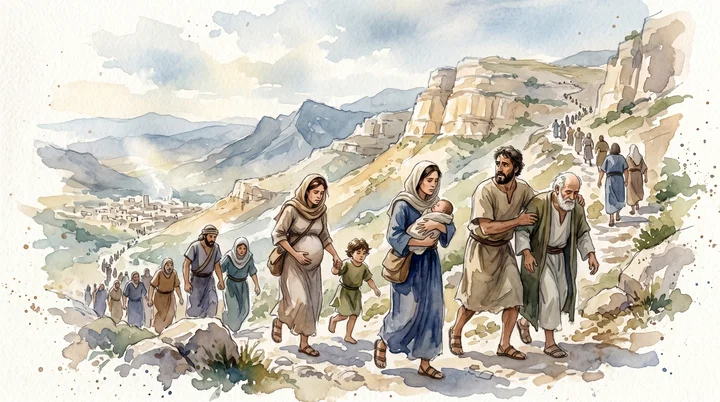
But when ye shall see the abomination of desolation, spoken of by Daniel the prophet, standing where it ought not, ( let him that readeth understand,) then let them that be in Judæa flee to the mountains:
Translations
But when you shall see the abomination of desolation, spoken of by Daniel the prophet, standing where it should not, (let him that reads understand,) then let them that be in Judaea flee to the mountains:
But when ye shall see the abomination of desolation, spoken of by Daniel the prophet, standing where it ought not, ( let him that readeth understand,) then let them that be in Judæa flee to the mountains:
But when ye shall see the abomination of desolation, spoken of by Daniel the prophet, standing where it ought not, (let him that readeth understand,) then let them that be in Judea flee to the mountains:
But when ye shall see the abomination of desolation, spoken of by Daniel the prophet, standing where it ought not, (let him that readeth understand) then let them that are in Judea flee to the mountains:
But when ye see the abomination of desolation standing where he ought not ( let him that readeth understand), then let them that are in Judaea flee unto the mountains:
But when ye see the abomination of desolation standing where he ought not ( let him that readeth understand), then let them that are in Judæa flee unto the mountains:
'And when ye may see the abomination of the desolation, that was spoken of by Daniel the prophet, standing where it ought not, (whoever is reading let him understand), then those in Judea, let them flee to the mountains;
But when ye shall see the abomination of desolation standing where it should not, ( he that reads let him consider [ it],) then let those in Judaea flee to the mountains;
But, when ye shall see the abomination of desolation, standing where it ought not, he that readeth, let him, think, then, they who are in Judaea, let them flee into the mountains;
So when you see the abomination of desolation standing where it should not be ( let the reader understand), then let those who are in Judea flee to the mountains.
So when you see the abomination of desolation, spoken of by Daniel the prophet, standing where it should not be ( let the reader understand), then let those who are in Judea flee to the mountains.
“ But when you see the abomination of desolation, spoken of by Daniel the prophet, standing where it ought not” ( let the reader understand), “ then let those who are in Judea flee to the mountains,
But when you see the unclean thing which makes destruction, in the place where it has no right to be (let this be clear to the reader), then let those who are in Judaea go quickly to the mountains:
Moreouer, when ye shall see the abomination of desolation (spoken of by Daniel the Prophet) set where it ought not, (let him that readeth, consider it) then let them that be in Iudea, flee into the mountaines,
Douay-Rheims (Challoner revision)
And when you shall see the abomination of desolation, standing where it ought not: he that readeth let him understand: then let them that are in Judea, flee unto the mountains:
Pictures
Cross-references 20 of 27
- Matthew 24
And Jesus went out, and departed from the temple: and his disciples came to him for to shew him the buildings of the temple.
Parallel account of Christ’s discourse.
- Luke 21:20-21
And when ye shall see Jerusalem compassed with armies, then know that the desolation thereof is nigh.
Jerusalem surrounded by armies signals its desolation and the time to flee.
- Daniel 9:27
And he shall confirm the covenant with many for one week: and in the midst of the week he shall cause the sacrifice and the oblation to cease, and for the overspreading of abominations he shall make it desolate, even until the consummation, and that determined shall be poured upon the desolate.
Daniel names the abomination associated with desolation.
- Matthew 24:3
And as he sat upon the mount of Olives, the disciples came unto him privately, saying, Tell us, when shall these things be? and what shall be the sign of thy coming, and of the end of the world?
The disciples’ question introduces the parallel prophecy.
- Daniel 7:25
And he shall speak great words against the most High, and shall wear out the saints of the most High, and think to change times and laws: and they shall be given into his hand until a time and times and the dividing of time.
Describes the persecuting power and its allotted time of oppression.
- Daniel 11:31
And arms shall stand on his part, and they shall pollute the sanctuary of strength, and shall take away the daily sacrifice, and they shall place the abomination that maketh desolate.
Daniel names the abomination of desolation and says it is placed after the daily sacrifice is taken away.
- Daniel 8:11-14
Yea, he magnified himself even to the prince of the host, and by him the daily sacrifice was taken away, and the place of his sanctuary was cast down.
It describes the desolating power removing the daily sacrifice and profaning the sanctuary.
- Daniel 12:11
And from the time that the daily sacrifice shall be taken away, and the abomination that maketh desolate set up, there shall be a thousand two hundred and ninety days.
Both texts name the abomination of desolation in Daniel’s prophecy.
- Luke 21:7
And they asked him, saying, Master, but when shall these things be? and what sign will there be when these things shall come to pass?
Luke records the disciples’ question about the sign of the approaching end.
- Daniel 2
And in the second year of the reign of Nebuchadnezzar Nebuchadnezzar dreamed dreams, wherewith his spirit was troubled, and his sleep brake from him.
Its prophetic outline reaches the kingdom’s consummation and converges on Christ’s coming.
- 2 Thessalonians 2:4
Who opposeth and exalteth himself above all that is called God, or that is worshipped; so that he as God sitteth in the temple of God, shewing himself that he is God.
The abomination stands in God’s temple, where it ought not.
- Matthew 24:2
And Jesus said unto them, See ye not all these things? verily I say unto you, There shall not be left here one stone upon another, that shall not be thrown down.
Jesus predicts the temple’s destruction, prompting the disciples’ questions answered in the discourse.
- Mark 13:30
Verily I say unto you, that this generation shall not pass, till all these things be done.
The generation statement continues the prediction about the timing of the coming.
- Daniel 12:8-9
And I heard, but I understood not: then said I, O my Lord, what shall be the end of these things?
Daniel’s prophecy connects with the Lord’s prophecy about the abomination of desolation.
- Matthew 24:20
But pray ye that your flight be not in the winter, neither on the sabbath day:
The Sabbath prayer concerns the disciples’ commanded flight.
- Daniel 7:8
I considered the horns, and, behold, there came up among them another little horn, before whom there were three of the first horns plucked up by the roots: and, behold, in this horn were eyes like the eyes of man, and a mouth speaking great things.
The little horn’s development is identified with the later Roman power.
- Matthew 24:21-22
For then shall be great tribulation, such as was not since the beginning of the world to this time, no, nor ever shall be.
Identifies the persecution period preceding the signs.
- Daniel 12:1
And at that time shall Michael stand up, the great prince which standeth for the children of thy people: and there shall be a time of trouble, such as never was since there was a nation even to that same time: and at that time thy people shall be delivered, every one that shall be found written in the book.
Names the unprecedented trouble associated with the closing events.
- Daniel 8:17-19
So he came near where I stood: and when he came, I was afraid, and fell upon my face: but he said unto me, Understand, O son of man: for at the time of the end shall be the vision.
The vision is linked to events at the appointed time of the end.
- Luke 19:43-44
For the days shall come upon thee, that thine enemies shall cast a trench about thee, and compass thee round, and keep thee in on every side,
Jesus foretells Jerusalem’s destruction after its people fail to recognize their time of visitation.
Commentary
Each commentary is drawn from primary sources: the writings of Ellen G. White and Adventist pioneers and periodicals. Each commentary is separate. Its own words are not a quotation; follow the references to read the source passages.
Ellen G. White
5 sources
Jesus gave this warning privately on the Mount of Olives opposite the temple to Peter and James and John and Andrew, when they asked when these things would be and what would be the sign when all these things would be fulfilled, concerning when the temple would fall and what would be the sign of His coming and of the end of the world.Ms 35, 1906, par. 15–23DA 627.1–3 The account of the destruction of Jerusalem is mingled in that answer with the account of His coming, in mercy because the disciples could not have endured the future if it had been opened plainly, so its meaning must be studied out.DA 627.1–3 What is spoken concerning Jerusalem reaches beyond that event to the final burning when the Lord rises to punish the world for iniquity.DA 627.1–3
That discourse connects with the coming destruction of sinful cities, when God will display His authority through earthquakes, fire, and floods, and human wealth, buildings, and devices will be powerless to prevent it.21MR 66.7–67.1 The discourse containing this verse was given not for the first disciples only but for those who live in the last scenes of this earth's history.DA 627.1–3 The abomination of desolation standing where it ought not corresponds to Satan's final device in the last closing work, impersonating Christ so that people believe their prayers for Christ's coming and deliverance have been answered.Ms 16, 1884, par. 11
What is before us comes suddenly and the time is short, so when certain things take place believers are not to go into the house to get anything out of it but are to make their way to the mountains as fast as they can go.Ms 119, 1909, par. 20–22 What exactly may break forth is not known, so readiness is required through daily humbling and imparting to others the light God gives.Ms 119, 1909, par. 20–22
Sources
Pioneers and periodicals
73 sources
When the Roman armies gathered around Jerusalem with their worshiped idolatrous standards standing on holy ground where they had no right to be, their presence showed desolation was near and those in Judea were to flee to the mountains at once without turning back for possessions.ST Jan 24, 1906RH Dec 3, 1867ST May 14, 1902ST Jan 7, 1903RH May 6, 1909 Watching Christians recognized the sign in the siege by Cestius Gallus and his sudden withdrawal, and fled with their families to Pella before Titus shut up the city to famine and destruction.RH Dec 3, 1867ST May 14, 1902 The same power in its papal form was afterward set up in the church, the gospel-era temple where God's law and Spirit should dwell, its supremacy established in A.D. 538 standing for 1,260 years of tribulation and persecution of the saints.ST Apr 14, 1909RH Dec 9, 1852RH Dec 9, 1852ST Jun 7, 1905 The destruction by Titus was only a partial fulfillment supplying images for distant events, for the discourse was not all fulfilled at Jerusalem but reaches from the overthrow of the city in A.D. 70 to the signs in sun, moon, and stars and on to the second coming and gathering of the elect.RH Dec 22, 1904ST Jan 6, 1887RH Feb 17, 1916RH Apr 12, 1915 By citing Daniel with authority and commanding the reader to understand, Jesus proved Daniel's divine origin and truthfulness and gave His people the key by which to recognize the sign and escape.STST Nov 21, 1911ST Apr 9, 1896ST Sep 4, 1901RH May 6, 1909
Setting and Wording
Mark 13 is parallel to Matthew 24 and Luke 21, reporting the same address of Jesus, and none of the three chapters is complete by itself.ST Jan 17, 1906ST Aug 4, 1914ST Jun 27, 1900 Each supplements the others without contradiction, and they must be studied together with other prophecies concerning the same period to grasp the full meaning of His teaching.ST Jan 17, 1906ST Aug 14, 1893 Matthew 24 is the most complete basis among them, while together they give plain evidence of Christ's nearness that the simple and unlearned can comprehend and heed.ST Aug 14, 1893
The verse belongs to Jesus' answer to the disciples' earnest inquiry about when the temple would be destroyed, what would be the sign of His coming, and what would mark the end of the age and the end of the world.ST Aug 4, 1914 It stands within specific instructions about the destruction of Jerusalem and the second coming, describing signs that precede His coming and make it possible to know when the end is approaching.ST Aug 14, 1893ST Jul 21, 1898 That teaching includes Jerusalem's destruction and events that must occur before the end, unfolding over time rather than showing that the second coming was due in the apostles' day.ST Jul 30, 1902 Its explanations of prophecy, prophetic symbols, and prophetic time are part of the Gospel itself, not subjects separate from it, and can form the basis of a Gospel warning.
The discourse is Christ's own foretold history of the world and prophetic outline of the history of the Christian dispensation from His time to the end and to the completion of His kingdom, covering the period from Jerusalem's destruction to the second advent.STRH Dec 31, 1903ST Aug 25, 1887 Its fulfillments are presented in consecutive historical order, running from the overthrow of Jerusalem in A.D. 70 through later political, social, and religious disturbances to the present, with every prophecy fulfilled except the final act.RH Dec 22, 1904RH Dec 24, 1903RH Dec 31, 1903 It places His coming far in the future and describes intervening events and conditions leading to the end before the end comes.ST The prophecy was spoken from the Mount of Olives while viewing Jerusalem.ST Aug 25, 1887ST Nov 21, 1911ST Dec 29, 1887 It includes the siege and overthrow of Jerusalem and the destruction of the temple, the long persecution His followers would face, and signs showing the nearness of the end of the world and His second coming.RH Aug 20, 1901ST Aug 25, 1887 Standing at the beginning of the history of the whole dispensation, it runs down to the time when sin and sinners are no more, God's entire universe is clean, and the great controversy is forever ended.ST Nov 21, 1911
Standing where it ought not means standing in God's holy temple or on holy ground where it has no place or right to exercise authority, including the holy ground around Jerusalem.ST Apr 14, 1909ST Jan 7, 1903 This refers both to pagan Rome and to papal Rome's usurpation.ST Apr 14, 1909 The invading army was the predicted Roman power whose presence on that ground showed that God had withdrawn His protection and given the city over to destruction and that desolation was near.ST Jan 7, 1903 Its standards bore images and ensigns that were worshiped as false gods, and since the ground beyond Jerusalem's walls was also considered holy, those standards standing within that territory meant the abomination was standing in the holy place.RH May 6, 1909 The verse marks the point where Jesus moves from describing events generally to specifying the sign leading to His coming, when the abomination of desolation appears and those in Judea are to flee to the mountains at once without delay.ST Nov 15, 1899
Abomination of Desolation
The abomination of desolation is the Roman power and its armies gathering around Jerusalem and destroying it, whose surrounding of the city was the sign that its desolation and judgment were near.ST Jan 24, 1906RH Dec 3, 1867ST May 14, 1902ST Nov 21, 1900 When Cestius Gallus besieged Jerusalem and then suddenly withdrew, God used that retreat to open a plain way of escape though believers were surrounded by hostile forces, and watching Christians with their families who trusted the warning fled from Judea and escaped before Titus besieged the city and brought famine and destruction.RH Dec 3, 1867ST May 14, 1902 The invading army standing on ground where it should not be was understood as standing on the holy ground around Jerusalem, and its presence there was the sign to flee to the mountains at once.RH Dec 3, 1867ST May 14, 1902ST Jan 7, 1903
The Roman army was that abomination because its standards bore images and ensigns that were worshiped as false gods, and since the ground beyond Jerusalem's walls was also considered holy, those standards standing within that territory meant the abomination was standing in the holy place.RH May 6, 1909 That destruction came upon the Jews by the Romans because they put man in God's place by choosing Caesar and because they rejected the Lord Jesus, rejected the Lord of the Sabbath by rejecting God's idea of the Sabbath of the Lord, persecuted Him and sought to kill Him, and at last killed Him in an effort to save the nation from the Romans, but that killing only caused the nation to be destroyed by the Romans.ST Jan 24, 1906ST Nov 21, 1900 The presence of the invading army on holy ground where it should not be showed that God had withdrawn His protection and given the city over to destruction.ST Jan 7, 1903
The abomination is also pagan Rome and papal Rome's usurpation standing in God's holy temple where it has no place or right to exercise authority.ST Apr 14, 1909 It is papal power set up in the church, the gospel-era holy place or temple of God where His law and Spirit should dwell, after paganism was restrained and taken away, with papal supremacy established in A.D. 538 standing there for 1,260 years during which the saints were subjected to persecution with torture, imprisonment, and death, and this period was the tribulation of those days whose violence was shortened for the elect's sake.ST Apr 14, 1909RH Dec 9, 1852RH Dec 9, 1852ST Jun 7, 1905 After paganism lost its power to suppress the Catholic faith in the Western Roman Empire, the papal abomination became triumphant over paganism, pagan practices continued in another form within Catholicism, and the papacy's later conflicts were with other Christian groups and with princes.ST Sep 16, 1880 In its later development as the little horn this same Roman power rejected God's Sabbath and substituted Sunday, enforcing that false Sabbath by law and punishing those who kept the Sabbath of the Lord.ST Nov 21, 1900
The daily sacrifice taken away before the abomination was set up is the pagan Roman governments and its sacrifices, which were first restrained and then removed, and afterward the abomination was placed or set up in the holy place.RH Dec 9, 1852 Those who hold this papal application deny that the abomination is the Roman armies or their idolatrous standards at the destruction of Jerusalem or the pagan Roman governments and sacrifices, and deny that the holy place is the temple at Jerusalem, which had been destroyed more than four hundred years before this power was set up, identifying it instead as the setting up and establishing of the jurisdiction of the papal governments in the church with the pope of Rome as supreme executive.RH Dec 9, 1852 A different position identifies the event with Antiochus Epiphanes' persecution of the Jews and desecration of the temple around 160 B.C., roughly two centuries before Jesus gave this instruction, and uses that identification to argue that Daniel 8 does not concern Christ's coming or God's everlasting kingdom.RH May 15, 1856
Flight to Mountains
When the sign appears, those in Judea are to flee to the mountains at once with urgency, without going back for belongings or stopping to gather possessions.ST Nov 15, 1899ST Nov 15, 1899ST Mar 5, 1896RH Feb 11, 1862 The following instructions stress acting without delay and praying that the flight will not be in winter or on a Sabbath.ST Nov 15, 1899ST Nov 15, 1899 The verse is the waymark concerning Jerusalem encompassed with armies, marking a change in labor for Christ's people from His own day to the end. Those who heed what was foretold act in harmony with His word at each successive step, while the nominal church and the world fulfill the outline without being in the condition of true disciples.
God used the siege by Cestius Gallus and his sudden and unexpected withdrawal to open a plain way of escape though believers were surrounded by hostile forces.RH Dec 3, 1867ST May 14, 1902RH Sep 3, 1857 Watching Christians with their families fled to Pella, at least sixty miles away, and escaped before Titus besieged the city and brought famine and destruction.RH Dec 3, 1867ST May 14, 1902RH Sep 3, 1857RH Feb 11, 1862 They heeded the warning and were not in the city when Jerusalem was destroyed under Titus, while the calamity that fell fulfilled the prophecies of Moses and Jesus.ST Jul 19, 1905 The abomination spread over the holy place in the desolation of Jerusalem, and Jesus' followers fled to Pella for safety.RH Jul 10, 1856 The warning also points to a point in the last-day tribulation when people will likewise need to flee to save their lives.ST Mar 5, 1896
The flight of God's people to the mountains marks the beginning of a tribulation that continued as Roman power persecuted the church with torture, imprisonment, and death, with A.D. 538 as the beginning of papal Rome's fully established unlimited power.ST Jun 7, 1905 The command to pray that flight not be in winter or on the Sabbath shows Jesus wished to spare them winter's hardships and avoid forcing them to profane the Sabbath.ST Nov 15, 1899ST Jan 24, 1906 That prayer would keep the early church mindful of the Sabbath during the years before Jerusalem's destruction, showing Christ's care that His people not be forced to violate the day of rest.ST Jan 24, 1906RH Feb 11, 1862
Prophetic Scope and Timing
The discourse does not apply entirely to Jerusalem and was not all fulfilled when the Romans destroyed it, for apart from what is immediately connected with the Lord's coming its prophecies have been fulfilled, yet it reaches to the second coming and the gathering of His people.ST Jan 6, 1887ST Mar 3, 1909ST Jul 30, 1902 The teaching about the signs of His coming and the end of the age includes Jerusalem's destruction and events that must occur before the end, with the signs unfolding over time rather than showing that Christ's second coming was due in the apostles' day.ST Mar 3, 1909ST Jul 30, 1902 Its timing is indeterminate and may appear long deferred, pointing to Christ's second coming as future and not as an event expected during Jesus' lifetime.ST Mar 3, 1909
The capture of the city by Titus under the Romans was a real but only partial fulfillment, for that nearer event supplied images for events belonging to the distant future and the end of the age.RH Feb 17, 1916RH Apr 12, 1915 Jerusalem's fall did not deliver God's people, punish God's enemies, or bring the predicted sign of the Son of man, so it did not fulfill the whole prophecy, though that nearer event also pictured events at the end of the age.RH Feb 17, 1916RH Apr 12, 1915 Prophecy is not always fulfilled in the order in which it is given, so the statements about Jerusalem and the second coming must be compared with other Scriptures to determine their proper application.ST Sep 16, 1889ST Nov 27, 1879 The parallel accounts concerning the temple's destruction and the second coming were not fulfilled entirely by Jerusalem's destruction, and Christ's second coming had not yet taken place.ST Sep 16, 1889ST Nov 27, 1879
Its fulfillments are presented in consecutive historical order from the overthrow of Jerusalem in A.D. 70 through later political, social, and religious disturbances to the present time, with every prophecy fulfilled except the final act.RH Dec 22, 1904RH Dec 24, 1903RH Dec 31, 1903RH Nov 5, 1903RH Dec 10, 1903 It is Christ's own foretold history of the world covering the time from Jerusalem's destruction to the second advent, whose outline of world history and the second advent has been fulfilled and illustrated.RH Dec 31, 1903RH Nov 5, 1903ST Feb 7, 1906 All but one of the heavenly signs have already occurred and the foretold conditions are manifest in the present, with the signs pointing to the approach of the end.ST Feb 7, 1906
After the long persecution of the papal power, the 1,260 years from 538 to 1798 already restrained by the Reformation, the predicted signs in sun, moon, and stars began.ST Apr 24, 1879ST Apr 15, 1903 Mark's account places those signs after the tribulation, with the sun and moon darkened just before that persecution ended and the stars falling a few years later.ST Apr 24, 1879 The sun was darkened at midday on May 19, 1780 and became black as sackcloth of hair, the full moon gave no light and appeared as blood, and the stars fell in the remarkable shower of November 13, 1833, also dated November 30, 1833.ST Apr 15, 1903ST Dec 30, 1903 The dark day of May 19, 1780 as a sign of Christ's coming is distinct from the later literal darkening of the heavenly bodies associated with the events ushering in the day of God.ST Sep 3, 1912
The generation that sees all these signs, with the going forth in fullness from 1844 at the end of the 2,300 days of the judgment-hour message that the hour of His judgment is come, is the last generation that bears the last message of mercy and will not pass away before Christ comes.GSAM 67.2–68.1ST Apr 15, 1903 When all these things are seen, including the dismembering of the Roman kingdom so nation is against nation and the long period of persecution, it is duty to know that He is near, even at the doors, for this generation shall not pass till all these things including the coming of Christ be fulfilled, though heaven and earth shall pass away His words shall not pass away.ST Apr 15, 1903ST Nov 28, 1895 The discourse sketches the leading events from the first advent to the second and forbids setting a definite time for the return.ST Dec 3, 1874RH Jan 21, 1873 Its expressions about definite time apply to the last generation, its force against setting the date of the Second Advent belongs chiefly to those who see these signs, and to the disciples it told that Jerusalem would be destroyed and how and that Christ's coming was not in their day.ST Dec 3, 1874ST Feb 14, 1906RH Jan 21, 1873
The fulfillment of these predictions provides evidence for the divine authority of Scripture and shows the divine stamp upon the canon.ST May 1, 1907ST Sep 26, 1895 The literal signs are to be seen not with the physical eye alone but in the light of prophecy as fixed to a particular time, and they confirm the other prophecies in Scripture about events leading to the same climax. Together with Matthew 24 and Luke 21 and Revelation 6 and the unsealed prophecies of Daniel and John they give plain evidence of Christ's nearness that the simple and unlearned can comprehend and heed, and only the present generation able to see those signs and understand those prophecies could know that His coming is nigh even at the doors and therefore could give the judgment-hour message that no earlier generation could give.ST Aug 14, 1893RH Dec 9, 1851 Those signs are to be proclaimed and preached as they come to pass to show Christ is near, and the generation that sees them fulfilled and being fulfilled will not pass before Christ comes.
Daniel and Understanding
Jesus cited Daniel's prophecy with authority in connection with the destruction of Jerusalem and future judgments upon the world, and urged the reader to understand it.STST Nov 21, 1911ST Sep 4, 1901 The reference treats Daniel as a prophet and upholds the prophetic character of his book, which foretells the world's future and gives an almost exact date for the expected Messiah's appearance.RH Jun 8, 1911 By commanding readers to understand Daniel, Jesus thereby proved Daniel's divine origin and absolute truthfulness.ST Sep 4, 1901 Understanding that prophecy gave the disciples the key to escaping the doomed city of Jerusalem, making it possible to recognize when to flee.RH May 6, 1909
The call for the reader to understand shows the discourse is a clear, literal prophecy that can be understood by those willing to understand it and is meant to be understood.ST Apr 9, 1896RH Apr 30, 1901 It remains a living prophecy worth repeating that does not grow old before its promises are fulfilled.RH Apr 30, 1901 Faster printing and wider access to Scripture give increased ability to study God's word and understand its prophecies.ST Jun 9, 1881
The call to understand is an admonition to recognize fulfillment when peace is promised while people are preparing for war, as with Micah's promise of peace spoken while preparations for war go forward.RH Sep 10, 1872
Warning and Promise
The prophecy gives God's people light about events and conditions in the Christian age, especially in the last days, with definite signs, fearful dangers, deceptions, admonitions, warnings, and assurances belonging to those who see these signs in the light of God's Word.ST Feb 14, 1906ST Oct 16, 1893 It was spoken to the disciples then but written chiefly for the present generation who see all these things and who will not all pass from the living till Christ comes again, telling that Jerusalem would be destroyed and how, that His coming was not in their day, and that its definite time was not to be known.ST Feb 14, 1906 Its exhortations to watch belong to a certain period just prior to the second advent.RH Oct 15, 1872 It bids them stand fast and endure unto the end against weariness of waiting, sleep without oil, the peace-and-safety cry, deceptions, and the pressure of a great numerical rich popular church with higher criticism and expectation of a converted world.ST Feb 14, 1906
It warns and counsels them so they can escape coming dangers and stand before the Son of Man.ST Oct 16, 1893 The last days it describes bring persecution against those who do God's will, expected at the end of the Sunday-sabbath movement.ST Dec 26, 1892 Only the present generation, able to see the signs given by Christ of His coming and of the judgment together with Matthew 24, Luke 21, and Revelation 6, and able to understand the unsealed prophecies of Daniel and John, could know that His coming is nigh, even at the doors.RH Dec 9, 1851 Therefore only this generation could give the judgment-hour message that no earlier generation could give.RH Dec 9, 1851
The chapter places Christ's coming in His kingdom, His descent to earth in glory with the heavenly hosts, and His gathering of His children and elect to Himself at His future return.RH Nov 1, 1870 One sign remains to be fulfilled before He appears in the clouds, so the gathering is not at each believer's death.RH Nov 1, 1870 When the Son of Man comes, His people must be living in the purity of the everlasting gospel.ST Jan 9, 1893 The last days it describes are evil, not a time when the world will be converted.ST Jul 1, 1908
It is one of the great lines converging on the second coming, presenting events leading to the giving of the everlasting gospel to the world and showing that the end of earthly rule is nearly over and the great day of God is about to come.ST Sep 14, 1882ST Dec 24, 1912ST Jul 21, 1898RH Sep 9, 1915 It belongs to Jesus' answer on the Mount of Olives about the sign of His coming and the end of the world, connecting its signs with the approach of the day of Christ's coming.ST Sep 14, 1882ST Jul 21, 1898 Its final events may occur at almost any time.ST Dec 24, 1912 The language of an abomination that desolates marks grave wickedness that makes holy ground desolate, as in slave trading at a Methodist camp meeting including the sale of an enslaved mother and her children and a man stopped from praying and handcuffed.
Sources