Mark 13:3
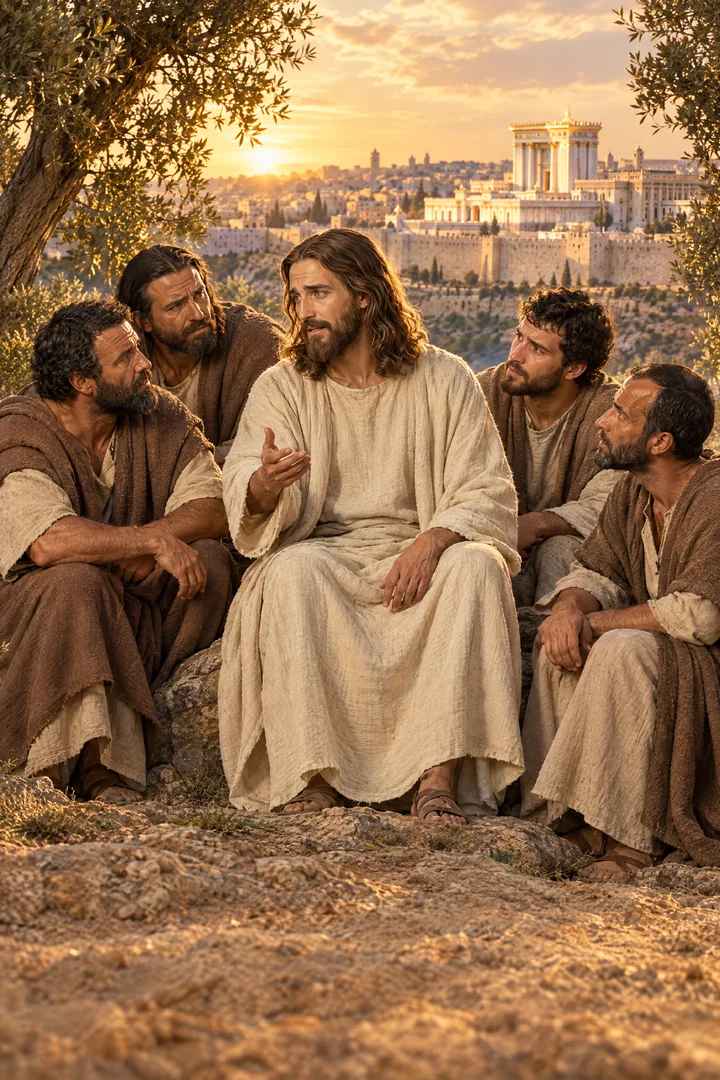
And as he sat upon the mount of Olives over against the temple, Peter and James and John and Andrew asked him privately,
Translations
American King James Version, Revised Version, American Standard Version
And as he sat on the mount of Olives over against the temple, Peter and James and John and Andrew asked him privately,
King James Version, KJV Cambridge Paragraph Bible
And as he sat upon the mount of Olives over against the temple, Peter and James and John and Andrew asked him privately,
And as he sat upon the mount of Olives, over against the temple, Peter, and James, and John, and Andrew, asked him privately,
And as he is sitting at the mount of the Olives, over-against the temple, Peter, and James, and John, and Andrew, were questioning him by himself,
And as he sat on the mount of Olives opposite the temple, Peter and James and John and Andrew asked him privately,
And, as he was sitting within the mount of Olives, over against the temple, Peter and James and John and Andrew were questioning him, privately—
Berean Standard Bible, Majority Standard Bible
While Jesus was sitting on the Mount of Olives opposite the temple, Peter, James, John, and Andrew asked Him privately,
As he sat on the Mount of Olives opposite the temple, Peter, James, John, and Andrew asked him privately,
And while he was seated on the Mountain of Olives opposite the Temple, Peter and James and John and Andrew said to him privately,
And as he sate on the mount of Oliues, ouer against the Temple, Peter, and Iames, and Iohn, and Andrew asked him secretly,
Douay-Rheims (Challoner revision)
And as he sat on the mount of Olivet over against the temple, Peter and James and John and Andrew asked him apart:
Pictures
Cross-references
- Matthew 24
And Jesus went out, and departed from the temple: and his disciples came to him for to shew him the buildings of the temple.
Parallel account of Christ’s Mount of Olives discourse.
- Luke 21:7
And they asked him, saying, Master, but when shall these things be? and what sign will there be when these things shall come to pass?
Luke records the disciples’ question about the signs of Jesus’ foretold events.
- Luke 21:29-36
And he spake to them a parable; Behold the fig tree, and all the trees;
A parallel account of Jesus’ end-time prophecy.
- Luke 21:37
And in the day time he was teaching in the temple; and at night he went out, and abode in the mount that is called the mount of Olives.
Connects Jesus’ teaching with his departure from the temple and presence on the Mount of Olives.
- Matthew 24:2
And Jesus said unto them, See ye not all these things? verily I say unto you, There shall not be left here one stone upon another, that shall not be thrown down.
temple prediction that prompted the inquiry
- Mark 13:24-27
But in those days, after that tribulation, the sun shall be darkened, and the moon shall not give her light,
Continues Jesus' answer to their question.
- Mark 13:14-23
But when ye shall see the abomination of desolation, spoken of by Daniel the prophet, standing where it ought not, ( let him that readeth understand,) then let them that be in Judæa flee to the mountains:
Continues Jesus’ answer to their question.
- Luke 21:6
As for these things which ye behold, the days will come, in the which there shall not be left one stone upon another, that shall not be thrown down.
Records Jesus’ prediction that the temple would be destroyed.
- Mark 13:30
Verily I say unto you, that this generation shall not pass, till all these things be done.
The declaration belongs to the prophecy about Christ’s coming.
- Mark 13:32-37
But of that day and that hour knoweth no man, no, not the angels which are in heaven, neither the Son, but the Father.
ends Jesus' answer to their question
Commentary
Each commentary is drawn from primary sources: the writings of Ellen G. White and Adventist pioneers and periodicals. Each commentary is separate. Its own words are not a quotation; follow the references to read the source passages.
Ellen G. White
5 sources
Jesus sat upon the Mount of Olives over against the temple.Ms 35, 1906, par. 15–23DA 627.1–321MR 66.7–67.1ST Aug 6, 1894 Peter and James and John and Andrew came to Him there alone and asked Him privately.Ms 35, 1906, par. 15–23DA 627.1–321MR 66.7–67.1Ms 78, 1897, par. 34 Their private approach followed His public foretelling in the hearing of the people that the magnificent, apparently indestructible temple would be thrown down with not one stone left upon another, a saying that followed His declaration that their house was left desolate and filled priests, rulers, and disciples with terror and foreboding.DA 627.1–3 They asked when the predicted destruction of the temple would happen and what would be the sign when all these things were about to be fulfilled.Ms 35, 1906, par. 15–23DA 627.1–321MR 66.7–67.1Ms 78, 1897, par. 34 Their question also concerned what would be the sign of His coming and of the end of the world.DA 627.1–3Ms 78, 1897, par. 34
Their question opens the prophetic discourse in which He answers and teaches them.Ms 35, 1906, par. 15–23DA 627.1–3ST Aug 6, 1894 In that teaching He uses parables to impress on them truths about His second coming.ST Aug 6, 1894 In His answer He does not separate the destruction of Jerusalem from the great day of His coming and the final judgment, but mingles and joins the two events.DA 627.1–3Ms 78, 1897, par. 34 He mingled the events in mercy because the disciples could not have endured a full sight of the future, leaving them to study out the meaning for themselves.DA 627.1–3
Thus His words about Jerusalem reach beyond the fall of the temple to the last scenes of earth's history, to the final burning when the Lord punishes the world for iniquity.DA 627.1–3Ms 78, 1897, par. 34 The whole discourse begun by their question was given not for the disciples only but for those who live in the last scenes of this earth's history.DA 627.1–3
Sources
Pioneers and periodicals
61 sources
As he sat on the Mount of Olives opposite the temple, facing and looking toward Jerusalem, Peter and James and John and Andrew asked him privately after he had left the temple and predicted its destruction and desolation.ST Nov 15, 1899ST Apr 22, 1889RH Nov 30, 1916 Astonished and grieved that the magnificent temple could be desolated, they asked when these things would happen and what would be the sign of his coming and of the end of the age, since its massive fall set in the mountain seemed to them to mean the end of the world.ST Nov 15, 1899RH Nov 30, 1916ST Mar 3, 1914ST Dec 20, 1910 Mark 13 is the same discourse recorded in Matthew 24 and Luke 21, joined also with Matthew 25 and Luke 17, and no single account gives every part, so they supplement one another without contradiction and must be studied together.ST Jan 17, 1906ST Aug 14, 1893ST Jul 8, 1897 It joins the nearer event of Jerusalem's destruction with the more distant second coming and end of the world, giving Christ's own outline history of the Christian dispensation from his time to the end of the conflict between good and evil.STRH Dec 22, 1904RH Dec 24, 1903GSAM 67.2–68.1ST Feb 7, 1906 He answered with not one sign but many signs in many places by which his coming could be known to be near, even at the doors, and charged his first disciples and those in every age to watch and live ready for his glorious return in the clouds to gather his elect.RH Sep 10, 1857GSAM 67.2–68.1RH Oct 15, 1872
Setting and Private Question
As he sat on the Mount of Olives opposite the temple, facing and looking toward Jerusalem and the temple, Jesus gave the discourse.ST Nov 15, 1899ST Apr 22, 1889RH Nov 30, 1916ST Apr 20, 1904 Peter and James and John and Andrew were with him there and asked him privately on the Mount.ST Nov 15, 1899ST Apr 22, 1889RH Nov 30, 1916ST Apr 20, 1904 The private conversation on the Mount opposite the temple is the setting for his prophecy of signs concerning the second advent.ST Apr 22, 1889RH Nov 30, 1916ST Dec 3, 1874
The question came after he predicted the temple's destruction and desolation, after he had left the temple for the day.ST Nov 15, 1899RH Nov 30, 1916ST Mar 3, 1914ST May 14, 1896 The disciples were astonished and grieved at the thought that the magnificent temple could be desolated, and Jesus answered that it would be destroyed with not one stone left upon another.ST Nov 15, 1899ST Apr 22, 1889ST Mar 3, 1914 They privately asked him to explain his words about the temple and the events connected with his coming and the end of the world.ST Nov 15, 1899RH Nov 30, 1916ST Mar 3, 1914 They asked when these things would happen and what would be the sign of his coming and of the end of the age or world.ST Nov 15, 1899ST Mar 3, 1914ST Aug 14, 1893 The inquiry contains three distinct questions: when Jerusalem would be destroyed, when the age would end, and what signs would mark Christ's coming.ST Aug 4, 1914ST Aug 14, 1893
The temple appeared so massive and firmly set in the mountain that its fall seemed to them to mean the end of the world.ST Dec 20, 1910 The verse records their earnest private inquiry about the future as the occasion for the teaching in the chapter.ST Jun 27, 1900 In asking when these things shall be and what shall be the sign of his coming and of the end of the age, they voiced the questions asked by generations.ST Jun 27, 1900
Parallel Gospel Accounts Together
Mark 13 is a parallel account of the same discourse recorded in Matthew 24 and Luke 21, joined also with Matthew 25 and Luke 17, concerning the destruction of Jerusalem and the second coming.ST Jan 17, 1906ST Aug 4, 1914ST Aug 14, 1893RH Feb 17, 1916 It is part of Jesus' instruction about His second coming and its signs, recording His answer to the disciples' questions about the temple's destruction, His coming, and the end of the age.ST Jan 17, 1906ST Aug 4, 1914ST Aug 14, 1893 The discourse answers three distinct questions of when Jerusalem would be destroyed, when the age would end, and what signs would mark Christ's coming and presence and the end of the age.ST Aug 4, 1914ST Aug 14, 1893 The capture of Jerusalem by Titus belongs to the discourse, but that destruction was real yet only partial, with the nearer event supplying the colors picturing the distant future belonging to the end of the age and Christ's literal return, since when Jerusalem fell God's people were not delivered, God's enemies were not punished, and the sign of the Son of man did not appear in heaven.RH Feb 17, 1916
No single account gives every part, and Mark's account contributes to the full meaning of Jesus' instruction alongside Matthew 24 and Luke 21.ST Jan 17, 1906ST Aug 14, 1893ST Jul 8, 1897 None of the three chapters is complete by itself, and each supplements the others without contradiction.ST Aug 14, 1893 The parallel accounts should be studied together because each supplies additional information, with Matthew 24 as the most complete.ST Aug 14, 1893ST Jul 8, 1897 The chapter refers both to the destruction of the temple and the overthrow of Jerusalem and to Christ's second coming, and these events were not all fulfilled at Jerusalem's destruction, for Christ's coming described there did not occur then and has not yet occurred.ST Sep 16, 1889ST Nov 27, 1879 The correct application of some statements in the chapter is learned by comparing them with other Scriptures, since prophecy is not always given or fulfilled in the order in which it is stated.ST Sep 16, 1889ST Nov 27, 1879
Prophetic Scope and Fulfillment
The discourse begun on the Mount of Olives is Christ's own outline history of the world and of the Christian dispensation from His time to the end, tracing leading events through to the everlasting gospel going to the world, the second coming, and the end of the conflict between good and evil when sin and sinners are no more and God's universe is clean.STRH Dec 22, 1904RH Dec 24, 1903RH Nov 5, 1903RH Jan 7, 1904 It joins the nearer event of Jerusalem's destruction with the more distant second coming and end of the world, covering the period from Jerusalem's destruction to the second advent with its heavenly signs and conditions evident before the end.STGSAM 67.2–68.1ST Feb 7, 1906RH Feb 17, 1916ST Jul 30, 1902 Through the great tribulation it gives definite signs by which nearness of His coming could be known.GSAM 67.2–68.1ST Feb 7, 1906
Its application is not limited to the destruction of Jerusalem in A.D. 70 but reaches through later ages to Christ's second coming in power and glory and the gathering of His people.ST Jul 30, 1902ST Aug 21, 1893 Every prophecy in the chapter is fulfilled in consecutive order from Christ's time to the present except those immediately connected with the coming of the Lord, while the final act remains future.RH Dec 22, 1904RH Dec 24, 1903RH Dec 31, 1903ST Jan 6, 1887RH Nov 5, 1903 All but one of the signs have already occurred, and the conditions foretold are evident in the present age.ST
The consecutive fulfillment runs from the overthrow of Jerusalem in A.D. 70 and Vesuvius and Pompeii in A.D. 79 through the Dark Ages and the Dark Day to Mount Pelee and St. Pierre and the latest political, social, and religious upheavals and disturbances among the nations.RH Dec 22, 1904ST Apr 20, 1904RH Dec 10, 1903 The Dark Day stands at the prophetic point assigned it, along with the falling away, the Sabbath change, and the 1,260 days of persecution, as part of the prophecy's historical fulfillment.ST Apr 20, 1904
Jerusalem's capture by Titus was a real but only partial and miniature fulfillment and a type of the end, the nearer event supplying the colors and imagery picturing a distant future belonging to the end of the age and Christ's literal return.RH Feb 17, 1916RH Apr 12, 1915ST Oct 20, 1909ST Apr 22, 1889 When Jerusalem fell God's people were not delivered, God's enemies were not punished, and the sign of the Son of man did not appear in heaven, which belong to the time when Christ comes again.RH Feb 17, 1916RH Apr 12, 1915 The temple portion has been fulfilled, while the portion about Jesus' coming and the end awaits fulfillment, and its terrors anticipate the greater terrors of the end.ST Apr 22, 1889 The signs of Jerusalem's destruction also serve as a type of the signs of the Second Coming, including the threefold message that began in 1844 seen in the light of prophecy.ST Oct 20, 1909
Though spoken to the disciples then, its signs, warnings, and assurances address generations beyond them and apply to the last generation living just before Christ's return, who would know other prophecies pointing to the same climax.ST Dec 3, 1874ST Feb 14, 1906RH Jan 21, 1873ST Apr 22, 1889 Its expressions about the definite time of the second coming apply to the last generation, and its warnings that the time is unknown apply to the waiting, watching time.ST Dec 3, 1874RH Jan 21, 1873 This gave greater force against setting a definite time for the second advent in 1844 and made it necessary for time-setters to explain away the difficulty.RH Jan 21, 1873 The chapter points to Christ's coming as a future event, not one expected during the disciples' lifetime, and Jesus' instructions to His first disciples also guide His disciples in every age to watch for the end.ST Mar 3, 1909ST Apr 22, 1889
Signs Before the End
In answer to the private question He gave definite and distinct signs by which His coming could be known to be near, even at the doors, not one sign but many signs in many places, in the sun and moon and stars and on earth, with distress among the nations, by which when these signs begin redemption may be recognized as drawing near.RH Sep 10, 1857GSAM 67.2–68.1ST Aug 21, 1893ST Nov 28, 1895 The signs He gave precede His coming so that when they are all seen His coming is near, including the gospel going to all nations as a witness, the darkening of the sun and moon and the falling of the stars, false christs and prophets, distress among nations, and the love of many believers growing cold, which have occurred or are occurring.RH Sep 10, 1857GSAM 67.2–68.1ST Jul 21, 1898 He placed His coming far in the future, after many notable events, warning that those events did not mean the end had arrived.ST Apr 15, 1903ST Mar 3, 1909 He carefully and repeatedly assured that these signs and the end would not take place in the disciples' day, and warned again and again to beware of impostors, directing minds forward through ages of war, famine, plague, earthquakes and tidal waves.ST Apr 15, 1903ST Mar 3, 1909
There shall be signs in the sun and in the moon and in the stars, whose time and nature He told.ST Apr 24, 1879ST Apr 15, 1903 The sun was darkened at midday and became black as sackcloth of hair on May 19, 1780, the full moon the following night gave no light and appeared as blood whenever seen through the darkness, and the stars fell from heaven in the remarkable shower of November 13, 1833, also reported as November 30, 1833.ST Apr 15, 1903ST Dec 30, 1903 The sun, moon and star signs John still gives after A.D. 90 as omens of the coming of the great day of God.ST Aug 21, 1893ST Nov 28, 1895 These heavenly signs occur after the long persecution of the Dark Ages, after the papal persecution had been restrained and the church's tribulation had ceased.ST Apr 24, 1879ST Apr 15, 1903 The long dark centuries of persecution began in 538 and ended in 1798, after which immediately the sun would be darkened.ST Apr 24, 1879ST Apr 15, 1903ST Nov 28, 1895
Other preceding signs are wars and rumors of wars with nation rising against nation and kingdom against kingdom, which could not be fulfilled before Jerusalem was destroyed while Rome ruled the world.ST Jul 21, 1898ST Jul 30, 1902ST Aug 21, 1893 With them are the gospel going to all nations as a witness, false christs and prophets, worldwide fear and distress among nations, and many believers growing cold.ST Jul 21, 1898ST Jul 30, 1902ST Apr 17, 1901 Among those events is spiritual decline in which as lawlessness abounds many lose love understood as loyalty, integrity and faithfulness in duty, becoming morally hardened and insensitive to sin.ST Jul 21, 1898ST Apr 17, 1901 The time of the end is fixed to 1798 at the close of the 1,260 days of persecution in the Dark Ages, when the fulfilling of the definite-time prophecies began, the last ending in 1844.ST Oct 20, 1909ST Nov 28, 1895 The signs of Jerusalem's destruction also serve as a type of signs of the Second Coming, and the generation that sees all the signs fulfilled in the light of prophecy, including the threefold message that began in 1844, will not pass before all is accomplished.ST Oct 20, 1909ST Nov 28, 1895
The dark day of May 19, 1780 as a sign of Christ's coming is distinct from the literal darkening of the stars in Joel 3:15, which occurs among the final events connected with the close of probation and the ushering in of the day of God.ST Sep 3, 1912 The generation that sees all these things fulfilled and bears the final message of mercy will not pass till all is fulfilled, including Christ's coming.ST Apr 15, 1903ST Jul 30, 1902ST Oct 20, 1909 This generation means the generation that sees these events reach their culmination and sees Christ's coming near, and will not pass away before all is fulfilled.ST Jul 30, 1902ST Nov 28, 1895 Heaven and earth will pass away but Christ's words will not pass away, and seeing all these things means knowing He is near even at the doors, which belongs to the present generation living just before Christ comes.ST Apr 15, 1903ST Nov 28, 1895
Watching and Living Ready
The discourse teaches what the second coming is and how near it is, opening on the Mount of Olives with Christ's wonderful prophetic teaching about His coming in His kingdom.ST Apr 16, 1894 It is His glorious return to earth in the clouds with the heavenly hosts to gather His people to Himself, the clear assurance of the Christian hope.RH Nov 1, 1870 This gathering comes after He finishes His work in the heavenly sanctuary, when the sleeping saints will be gathered home to the mansions, rather than at the death of each saint.RH Nov 1, 1870
It traces the history of God's people from Jesus' day to the end, marking successive waymarks that bring changes in their duties, trials, and dangers. It warns of those dangers and shows how to respond at each stage, by fleeing, enduring hatred, preaching the gospel, learning from the signs of Christ's nearness, and going out to meet the bridegroom. The warning about Jerusalem's destruction was not heeded by the Jews, but the disciples believed it and when Jerusalem was surrounded fled to the mountains and were saved.
Jesus' instructions to His first disciples also guide His disciples in every age to watch for the end, joining the nearer destruction of Jerusalem with the more distant second coming and end of the world.ST Apr 22, 1889 Jerusalem's destruction was a miniature fulfillment of the world's destruction, its terrors anticipating the greater terrors of the end; the temple portion has been fulfilled while the portion about His coming and the end awaits fulfillment.ST Apr 22, 1889 He used parables to impress truths about His second coming upon those with Him opposite the temple.ST Aug 6, 1894 The exhortations to watch in connection with the signs apply to the certain period just prior to that event, the waiting, watching time without definite time since the disappointment in 1844.RH Oct 15, 1872
The discourse in Matthew 24, Mark 13, and Luke 21 is a prophetic sketch of leading events from the first advent down to the second, so its expressions about definite time apply to the last generation.RH Jan 21, 1873 This gave those texts greater force against setting a definite time for the second advent in 1844 and made it necessary for time-setters to explain away the difficulty.RH Jan 21, 1873 It is literal prophecy stated in plain language that can be understood by those willing to understand it.ST Apr 9, 1896 The fulfillment of its predictions proves the divine stamp upon the Scripture canon.ST Sep 26, 1895
Christ's full answer to when these things will be and what will be the sign of His presence and the end of the age shows His followers have the right to inquire about how and when the age will end and He will come.ST Aug 14, 1893 None of the three accounts is complete by itself; each supplements the others without contradiction, with Matthew 24 the most complete.ST Aug 14, 1893 The chapter is one of a dozen great lines of symbolic and literal prophecy marking the highways of time and converging almost to the focal center of the second coming.ST Nov 28, 1900ST Dec 14, 1904 Joined with Matthew 24 and Luke 21 as one highway, and with Daniel 2, 7, 8 and 9, 10 and 11, and Revelation, its converging testimony brings to the second coming and shows the end of earthly rule nearly over and Christ's coming near.ST Dec 14, 1904
It is a prophetic history whose fulfillment shows the world is in the closing years of this age and Christ's second coming is the next great event, presenting a great timetable of events marking the Christian era's progress toward His coming.ST Sep 10, 1894ST Oct 20, 1909 It presents His literal prophecy of His return, foretelling signs before it and distinctly marking the last days of earth's sorrow and travail, tracing events culminating in the everlasting gospel going to the world.ST Dec 24, 1912ST Nov 8, 1905 It also includes final events that may occur at almost any time.ST Dec 24, 1912
It is part of the great prophecy with Matthew 24 and 25 and Luke 17 and 21 revealing leading events in the world and church during the Christian dispensation and specially marking the condition of things in the last days.ST Oct 16, 1893 Those last days are evil like the times of Noah and Lot, confirming the world will not be converted before the end.ST Jul 1, 1908 Among the events before the end and His coming in glory is spiritual decline, as abounding lawlessness makes many lose love as loyalty, integrity, and faithfulness in duty, becoming morally hardened and insensitive to sin.ST Apr 17, 1901 Jesus must therefore find His people keeping the everlasting gospel in its purity when He comes, and the prophecy gives God's people light on their pathway to the dawn of eternal day so the day of the Lord does not come upon them as a thief.ST Oct 16, 1893ST Jan 9, 1893
Its fulfillment, together with the other prophetic outlines, was evidence that the end-time warning and proclamation of Christ's soon return had come.RH Feb 6, 1855 Those signs of His coming and the judgment, together with Daniel's and John's unsealed prophecies, enable the generation that sees them to know His coming is near and to proclaim that the hour of judgment has come.RH Dec 9, 1851 This identifies the proclamation with the Advent movement and the end-time warning.RH Feb 6, 1855RH Dec 9, 1851 The chapter's setting for this teaching about the destruction of Jerusalem and the end of the world is Jesus with His disciples on the Mount of Olives.ST Mar 3, 1909
Sources