Matthew 24:2
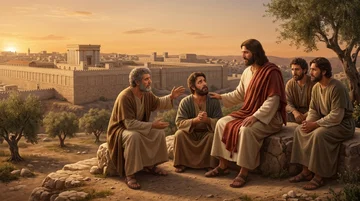
And Jesus said unto them, See ye not all these things? verily I say unto you, There shall not be left here one stone upon another, that shall not be thrown down.
Translations
And Jesus said to them, See you not all these things? truly I say to you, There shall not be left here one stone on another, that shall not be thrown down.
King James Version, KJV Cambridge Paragraph Bible
And Jesus said unto them, See ye not all these things? verily I say unto you, There shall not be left here one stone upon another, that shall not be thrown down.
And Jesus said to them, See ye not all these things? verily I say to you, There shall not be left here one stone upon another, that shall not be thrown down.
Revised Version, American Standard Version
But he answered and said unto them, See ye not all these things? verily I say unto you, There shall not be left here one stone upon another, that shall not be thrown down.
and Jesus said to them, 'Do ye not see all these? verily I say to you, There may not be left here a stone upon a stone, that shall not be thrown down.'
And he answering said to them, Do ye not see all these things? Verily I say to you, Not a stone shall be left here upon a stone which shall not be thrown down.
But, he, answering, said unto them—Are ye not beholding all these things? Verily, I say unto you—in no wise, shall there be left here, stone upon stone, which shall not be thrown down.
“ Do you see all these things?” He replied. “ Truly I tell you, not one stone here will be left on another; every one will be thrown down.”
“ Do you see all these things?” Jesus replied. “ Truly I tell you, not one stone here will be left on another; every one will be thrown down.”
But he answered them, “ You see all of these things, don’ t you? Most certainly I tell you, there will not be left here one stone on another, that will not be thrown down.”
But he, answering, said to them, See you not all these things? truly I say to you that here there will not be one stone resting on another, which will not be pulled down.
And Iesus sayd vnto them, See ye not all these things? Verely I say vnto you, there shall not be here left a stone vpon a stone, that shall not be cast downe.
Douay-Rheims (Challoner revision)
And he answering, said to them: Do you see all these things? Amen I say to you there shall not be left here a stone upon a stone that shall not be destroyed.
Pictures
Cross-references 20 of 39
- Mark 13:2
And Jesus answering said unto him, Seest thou these great buildings? there shall not be left one stone upon another, that shall not be thrown down.
Jesus predicts that the temple buildings will be thrown down.
- Luke 21:6
As for these things which ye behold, the days will come, in the which there shall not be left one stone upon another, that shall not be thrown down.
Jesus predicts that the temple will be demolished, with no stone left upon another.
- Matthew 23:38
Behold, your house is left unto you desolate.
Jesus declares Jerusalem’s house desolate before predicting the temple’s destruction.
- Luke 21:20
And when ye shall see Jerusalem compassed with armies, then know that the desolation thereof is nigh.
Jerusalem surrounded by armies signals its coming desolation.
- Luke 19:44
And shall lay thee even with the ground, and thy children within thee; and they shall not leave in thee one stone upon another; because thou knewest not the time of thy visitation.
Jesus foretells Jerusalem’s destruction because it did not recognize its time of visitation.
- Matthew 24:32-33
Now learn a parable of the fig tree; When his branch is yet tender, and putteth forth leaves, ye know that summer is nigh:
The signs show watchers that Christ’s coming is near.
- Daniel 9:26
And after threescore and two weeks shall Messiah be cut off, but not for himself: and the people of the prince that shall come shall destroy the city and the sanctuary; and the end thereof shall be with a flood, and unto the end of the war desolations are determined.
Foretells the destruction of Jerusalem and its sanctuary.
- Matthew 24:15
When ye therefore shall see the abomination of desolation, spoken of by Daniel the prophet, stand in the holy place, ( whoso readeth, let him understand:)
The sign of desolation answers the question about Jerusalem’s destruction.
- Mark 13:1
And as he went out of the temple, one of his disciples saith unto him, Master, see what manner of stones and what buildings are here!
The disciples point out the temple buildings before Jesus predicts their destruction.
- Matthew 24:34
Verily I say unto you, This generation shall not pass, till all these things be fulfilled.
The generation seeing the signs will remain until all is accomplished.
- Micah 3:12
Therefore shall Zion for your sake be plowed as a field, and Jerusalem shall become heaps, and the mountain of the house as the high places of the forest.
Foretells Jerusalem’s ruin and Zion being plowed as a field.
- Matthew 26:61
And said, This fellow said, I am able to destroy the temple of God, and to build it in three days.
Both use the same Greek word for destroying the temple.
- Matthew 23:36
Verily I say unto you, All these things shall come upon this generation.
Christ’s judgment on that generation includes Jerusalem’s destruction.
- Luke 13:35
Behold, your house is left unto you desolate: and verily I say unto you, Ye shall not see me, until the time come when ye shall say, Blessed is he that cometh in the name of the Lord.
Jesus declares Jerusalem’s house desolate, paralleling the announced destruction.
- Mark 13:24-27
But in those days, after that tribulation, the sun shall be darkened, and the moon shall not give her light,
Parallel account of the signs and the Son of man coming in glory.
- Daniel 9:27
And he shall confirm the covenant with many for one week: and in the midst of the week he shall cause the sacrifice and the oblation to cease, and for the overspreading of abominations he shall make it desolate, even until the consummation, and that determined shall be poured upon the desolate.
Daniel’s prophecy connects the abomination of desolation with Jerusalem’s destruction.
- Jeremiah 25:18
To wit, Jerusalem, and the cities of Judah, and the kings thereof, and the princes thereof, to make them a desolation, an astonishment, an hissing, and a curse; as it is this day;
Jerusalem is named among the places made desolate under judgment.
- Mark 14:58
We heard him say, I will destroy this temple that is made with hands, and within three days I will build another made without hands.
The temple-destruction saying is twisted into a treason charge.
- Deuteronomy 28:52-57
And he shall besiege thee in all thy gates, until thy high and fenced walls come down, wherein thou trustedst, throughout all thy land: and he shall besiege thee in all thy gates throughout all thy land, which the LORD thy God hath given thee.
The siege brings Jerusalem’s destruction and the calamities foretold in the covenant curses.
- Leviticus 26:31-33
And I will make your cities waste, and bring your sanctuaries unto desolation, and I will not smell the savour of your sweet odours.
Foretells the city’s desolation and devastation.
Commentary part 1 of 2
Each commentary is drawn from primary sources: the writings of Ellen G. White and Adventist pioneers and periodicals. Each commentary is separate. Its own words are not a quotation; follow the references to read the source passages.
Ellen G. White
51 sources
Jesus foretold the complete overthrow of the Jerusalem temple, so that not one stone would be left upon another but all would be thrown down into ruins.4SP 25.1–2DA 627.1–3ST May 9, 1878 The prediction was startling because the temple seemed permanent, built of massive stones and magnificent buildings enlarged and adorned over more than forty years with great wealth, labor and skill.4SP 25.1–2DA 627.1–3Lt 18a, 1906, par. 8–15 It was fulfilled to the letter forty years later when the Romans burned and razed the temple and city despite efforts to save it, and more than a million perished in the siege.4SP 33.3–36.1GC 32.3–33.2GC88 33.1–35.1ST Dec 19, 1900 Its meaning is twofold, foreshadowing both Jerusalem's destruction and the terrors of the last great day in the final judgment of the world by fire.DA 627.1–3Ms 77, 1899, par. 4–5Ms 87, 1897, par. 1–3 With the temple overthrown its animal sacrifices would serve no more, because Christ the Lamb of God offered Himself for sin and fulfilled what they foreshadowed, calling all to watch and be ready for His coming in power and great glory.ST Apr 21, 1898ST May 9, 1878Ms 170, 1897, par. 14–163SP 71.1
Temple Setting and Prediction
The prediction is that the Jerusalem temple would be completely overthrown, so that not one stone would be left upon another but all would be thrown down into ruins.4SP 25.1–2DA 627.1–3ST May 9, 1878Lt 18a, 1906, par. 8–15GC 393.2–394.1 It was striking because the temple seemed permanent, its stones massive and finely built and its buildings magnificent and beautiful, giving every appearance of strength.DA 627.1–3Lt 18a, 1906, par. 8–1521MR 79.9–80.33SP 69.3–70.1ST Dec 19, 1900 It had been enlarged and adorned over more than forty years with great wealth, labor and architectural skill, Herod the Great lavishing upon it Roman wealth and Jewish treasure while even the emperor enriched it.4SP 25.1–2GC88 25.1–2 That work included enormous blocks of white marble, some brought from Rome, lavishly set in place to make the splendor dazzling.4SP 25.1–2GC88 25.1–2ST Dec 19, 1900
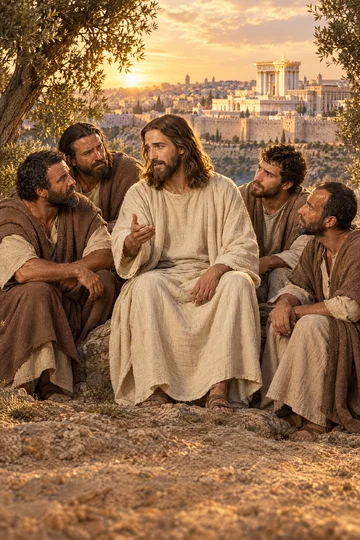
Jesus spoke the words after leaving the temple for the last time following His denunciation of the Jewish rulers.GC 23.1 He sat with His disciples on the Mount of Olives looking across at Jerusalem and the temple in its dazzling splendor.GC 23.1 The discourse of Matthew 24 and 25, to which the words belong, was given shortly before He entered Gethsemane, after a day of work and amid the Pharisees' efforts to trap Him, and it included predictions and warnings.ST Nov 20, 1884
The words were given as a solemn and startling answer when the disciples called attention to the temple, admiring its strength, beauty and durable materials.GC88 25.1–23SP 69.3–70.1 They were amazed and filled with awe and wonder at the answer.Lt 18a, 1906, par. 8–15GC88 25.1–2 They could not see how it could be fulfilled and believed the beautiful structure must stand forever, so they desired to understand its meaning more fully.Lt 18a, 1906, par. 8–1521MR 79.9–80.3GC88 25.1–2 They therefore asked when these things would be and what would be the sign of His coming and of the end of the world.Ms 87, 1897, par. 1–3GC 25.2–3
John lived long enough to witness the fulfillment, seeing the Jewish temple in ruins with no stone left upon another.6RED 51.13SP 233.1ST Oct 3, 18786RED 71.1
Fulfilled in Jerusalem's Fall
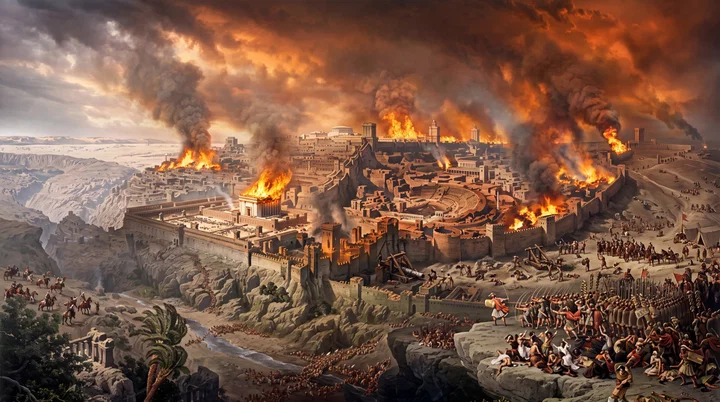
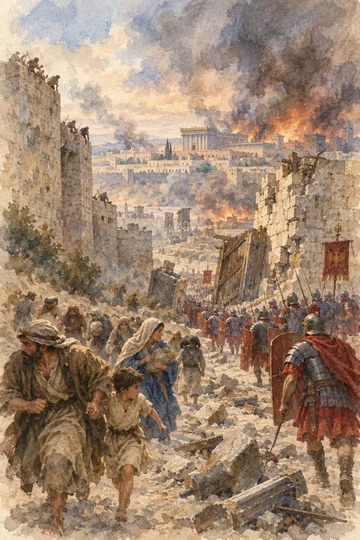
The declaration was carried out when the Romans burned the temple and razed both temple and city, demolishing it stone by stone despite the determined efforts of Titus to save the sacred place.4SP 33.3–36.1GC 32.3–33.2GC88 33.1–35.1 What the soldiers did in tearing it down fulfilled the word of One greater than Titus.GC88 33.1–35.1 The prediction was fulfilled to the letter forty years later, when Jerusalem was destroyed and more than a million people perished in the siege.ST Dec 19, 1900
In that fulfillment the city was seen besieged by the Roman army, its people suffering starvation and terrible violence, and its very site plowed as a field.ST Feb 15, 1899 Crucifixion, which had fallen into disuse in Judea soon after Christ's death because the scenes at His death, the malignity of the priests, the rage of the people, the convulsions of nature and the supernatural darkness had struck terror to the Romans, was revived with the Jews themselves as victims.DA 840.5 Multitudes perished by crucifixion, crosses were planted upon Calvary as thickly as forest trees, and there came upon them the same doom they had pronounced upon Christ.DA 840.5
The ruin came as God's retributive judgment after years of labor to bring the nation to repentance.AC1 51.23SP 319.2 Jerusalem rejected its visitation and the world's Redeemer, repeatedly rejected God's light and finally refused to honor His Son, so that God's protection was withdrawn.ST Feb 15, 1899RH Oct 8, 1901 Its rebellion against God and hostility toward Rome brought the calamity upon it, for it refused the chance of safety through submission to the invading armies and was left without heaven's protection through disobedience.2SP 393.2–395.1RH Nov 13, 1900 That judgment vindicated God's honor and magnified His law.AC1 51.23SP 319.2 Beyond the burning of the temple was seen the nation scattered, its people driven among foreign lands without a secure home, and their descendants facing persecution and rejection.RH Nov 13, 1900
Type of Final Judgment
The prediction of complete overthrow, that not one massive, finely built stone of the temple would remain upon another despite its apparent strength but all would be reduced to ruins, carries a twofold meaning, foreshadowing the destruction of Jerusalem and also prefiguring the terrors of the last great day.DA 627.1–3GC 25.2–3ST Feb 20, 1901 It reaches beyond Jerusalem to the final judgment of the world and its more terrible destruction by fire, when the Lord rises to punish the inhabitants of the earth for their iniquity.DA 627.1–3Ms 77, 1899, par. 4–5ST Feb 20, 1901 Hearing the foretelling of Jerusalem's destruction led the disciples to ask when these things would be and what would be the sign of His coming and of the end of the world, and His answer interweaves the destruction of Jerusalem with the still greater final destruction of the world.Ms 77, 1899, par. 4–5Ms 87, 1897, par. 1–3 In that interwoven answer the destruction of Jerusalem is used as a type of the world's final destruction by fire, and the warning given to the disciples about what they would meet at the hands of their fellow men is also a warning for later believers.Ms 77, 1899, par. 4–5Ms 87, 1897, par. 1–3
Jerusalem represents the world, and the overthrow of the temple is connected with the world's more terrible destruction.ST Feb 20, 1901Ms 78, 1897, par. 30 Both judgments follow the refusal to acknowledge the truth God has given, with Jerusalem's ruin following its people's rejection of Christ and the withdrawal of God's protection.RH Oct 8, 1901ST Feb 20, 1901Ms 78, 1897, par. 30 Christ's prediction of Jerusalem's destruction as the result of its rebellion also points to the destruction of the world at the end of its history, when people will continue to refuse God's mercy.RH Oct 8, 1901Lt 98, 1900, par. 31–33
He blended the two events because the disciples could not bear or fully understand a complete account of what lay ahead.Ms 87, 1897, par. 1–3Ms 78, 1897, par. 54–57 They mistakenly connected the temple's destruction with Christ's return, expecting Him then to overthrow the Jews' enemies and establish a temporal kingdom at Jerusalem.GC 25.2–3Ms 78, 1897, par. 54–57 Before that retribution would come upon the apostate nation, which would further reveal its hostility to Christ through its treatment of His followers.Ms 87, 1897, par. 1–3Ms 78, 1897, par. 54–57
That destruction of Jerusalem was not the second advent, though Universalists used it to claim that Christ had already come.LS 56.1–57.3LS 75.1–77.4 The verse belongs to Christ's outline of important events in the history of the world and the church from His first advent to His second, including Jerusalem's destruction.GC88 bC.1GC 393.2–394.1GC88 393.1–394.1 That great prophecy in Matthew 24 gives the history of the present dispensation through to the complete restitution of all things, with the closing scenes of this world's history as its most thrilling and momentous part.GC88 bC.1GC 393.2–394.1 The Olivet discourse about Jerusalem's fate and the scenes of His second advent also foretells that His followers will face humiliation, reproach and suffering from the time He is taken from them until His return in power and glory.GC88 393.1–394.14SP 39.1
The chapter also foretells events preceding the coming of the Son of man.Ms 77, 1899, par. 4–54SP 39.1 It outlines what is to come upon the world, including the perils of the last days, and its warnings show that judgment is coming upon wicked cities and that people facing destruction in sin must be warned.Ms 77, 1899, par. 4–510MR 220.1–2 Foreseeing Jerusalem's downfall and destruction, Christ looked beyond the immediate moment across ages and centuries.10MR 220.1–2Ms 37, 1894, par. 4–5
End of Sacrificial System
The razing of the Jerusalem temple so that not one stone remained upon another meant the temple and its animal sacrifices would no longer serve their former purpose.ST May 9, 18783SP 71.1 Christ the Lamb of God offered Himself for sin and for the sins of the world, fulfilling what those sacrifices had foreshadowed.ST May 9, 18783SP 71.1 Their symbols met their fulfillment in Him, and after that self-offering animal sacrifices could no longer atone for sin.ST May 9, 18783SP 71.1
The prediction is a lesson in the purification of religion by making outward forms and ceremonies of no effect.FE 398.1–399.1Ms 9, 1896, par. 5–8 The temple system was to be abolished by Christ's true offering of Himself as the living sacrifice.Ms 9, 1896, par. 5–8 Christ announced Himself greater than the temple, the One in whom all Jewish ceremony and typical service finds its fulfillment.FE 398.1–399.1Ms 9, 1896, par. 5–8 He stands forth in the place of the temple, with all the offices of the church centering in Himself alone.FE 398.1–399.1Ms 9, 1896, par. 5–8
The disciples did not yet understand this reason for the calamity at the time.ST May 9, 18783SP 71.1 They understood Jesus' words later after the events had taken place.ST May 9, 18783SP 71.1 As judgment for rejecting Christ, the city and temple would be destroyed, for the rejected stone would fall upon His rejecters, breaking and scattering their glory like dust.ST Apr 18, 1878
Warning and Readiness Today
The prediction belongs to the sure word of prophecy that is the foundation of faith, to be carefully studied and brought to the attention of all, both believers and unbelievers, and explained by ministers and teachers to those under instruction.Ms 62, 1903, par. 9–12GW 148.1–2 Its fulfillment is taking place in the present time with unmistakable evidence that Christ's coming is at hand, so matters of lesser and minor consequence are to be left out in order to present its essential truths.Ms 62, 1903, par. 9–12GW 148.1–2 It is to be studied together with the prophecies of Daniel and Revelation and in connection with Jesus as the Lamb of God who takes away the sin of the world, because its truths decide the eternal destiny of souls and call the church to arouse.Ms 62, 1903, par. 9–12GW 148.1–2
It stands as part of the description in Matthew 24 and 25 of Christ's second coming to this world, when the sign of the Son of man appears in heaven and all the tribes of the earth mourn and see Him coming in the clouds with power and great glory, sending His angels with a trumpet to gather His elect from the four winds.ST Apr 21, 1898 The day and hour is known to the Father only, and the coming will be as the days of Noah when people were eating and drinking and marrying until the flood came and took them away, so all must watch and be ready because the Son of man comes in an hour not expected.ST Apr 21, 1898 The faithful and wise servant who gives meat in due season and is found so doing will be made ruler over all goods, while the evil servant who says his lord delays his coming and smites fellow servants and eats and drinks with the drunken will come to sudden judgment and be cut asunder and given a portion with the hypocrites with weeping and gnashing of teeth, portraying the condition of the church at His coming and calling true believers to earnest zeal.ST Apr 21, 1898 The same warning calls for discernment and faithfulness to God rather than adopting worldly policies or joining worldly confederacies, with constant watchfulness for coming events.ST Apr 21, 1898Ms 170, 1897, par. 14–16
The overthrow foretold shows that God looks upon impenitent cities and sends messages of reproof and warning by His messengers, and when the messengers are despised and the messages rejected and patience will not turn hearts to Him, He sends judgments which no human power can stand against.Lt 18a, 1906, par. 8–1521MR 79.9–80.3 The disciples were amazed and could not see how the throwing down could be fulfilled, because the massive stones of the grand, beautiful temple made it seem that the structure must stand forever.Lt 18a, 1906, par. 8–1521MR 79.9–80.3 That unbelief is the same confidence the inhabitants of San Francisco had that their grand, towering structures could not be destroyed, yet judgment fell upon that city as upon Jerusalem.Lt 18a, 1906, par. 8–15 No human structure can withstand God's judgments when warnings are persistently rejected and repentance refused, and lofty buildings will be cast down because of sin in the closing days of earth's history.Lt 18a, 1906, par. 8–1521MR 79.9–80.3Lt 132, 1908, par. 5 Matthew 24 outlines what is to come upon the world, including the perils of the last days, showing that judgment is coming upon wicked cities and that people facing destruction in sin must be warned.10MR 220.1–2Lt 132, 1908, par. 5
Stately earthly architecture and worldly riches trusted as the chief good will crumble into dust and lie in ruins, so heaping them up is a poor investment ending in eternal loss.Lt 90, 1902, par. 5–9 Its lesson in the perils of the last days now present is urgent warning of those perishing in sin and liberal use of money as a treasure lent by God to advance the last message of mercy and sustain gospel work.Lt 90, 1902, par. 5–9 Self-denial and sacrifice of earthly riches secures eternal riches and entrance through much tribulation into the kingdom of heaven.Lt 90, 1902, par. 5–9
The rejection of the Son of God decided that nation's destiny, fulfilled to the letter forty years later when Jerusalem was destroyed and more than a million people perished in the siege.ST Dec 19, 1900 That fulfillment warns that rejecting God's holy memorial, the Sabbath, may likewise decide the fate of professed Christians.ST Dec 19, 1900
The destruction described includes a still greater destruction, the destruction of the world, which is near at hand when the history of this earth is to be swallowed up in an endless eternity.Ms 89, 1903, par. 3 In view of this, members of the church of God should not spend their time in dissension and strife, criticizing and condemning one another.Ms 89, 1903, par. 3 No human being is given the work of sitting in judgment and passing sentence upon brethren, for that work Christ alone can do.Ms 89, 1903, par. 3
Sources
Pioneers and periodicals
245 sources
Jesus foretold the complete demolition of the Jerusalem temple buildings, so that not one stone would be left standing upon another.ST Jul 24, 1884ST Jan 14, 1875ST He spoke the words as He departed from the temple for the last time for the Mount of Olives at the close of His public ministry, after the disciples showed Him its massive stones and stately grandeur.RH Apr 15, 1909ST Nov 15, 1899ST Nov 3, 1898 The prediction was literally and exactly fulfilled about forty years later, when Titus and the Roman army captured the city in A.D. 70, burned and demolished the temple, leveled the city and scattered the nation.RH Apr 15, 1909ST May 8, 1907ST Mar 30, 1915 Its destruction ended the Jewish dispensation and the purpose of the earthly temple and its sacrifices, because Christ the true sacrifice had been offered on the cross, the veil was rent, and He had entered the heavenly temple to minister as great high priest.ST May 9, 1878RH Jan 20, 1853 It came as judgment because Jerusalem rejected and crucified Christ, and though distinct from His coming and the end of the age, it stands as a type and miniature of the greater final destruction associated with Christ's personal, visible second coming, with warning to recognize the signs and flee to escape.ST Nov 21, 1900ST Mar 30, 1888ST Jan 6, 1887ST Apr 22, 1889ST May 14, 1902
Words and Historical Setting
The saying foretells the utter demolition of the Jerusalem temple buildings, so that not one stone would be left standing upon another, not even two stones remaining in place.ST Jul 24, 1884ST Jan 14, 1875STRH Apr 15, 1909 It belongs to the discourse about Jerusalem's destruction, the end of the world, and the signs of the second coming, and it concerns the temple's destruction as distinct from the coming and the end of the age addressed separately in the chapter.ST Jul 24, 1884ST Jan 14, 1875 The disciples' attention to the temple prompted the prediction, and Jesus assured them it would occur while explaining when its desolation would be imminent rather than giving an exact date.ST Jul 24, 1884ST Jan 14, 1875 The sign that Jerusalem was surrounded by armies would warn that desolation was near and give time to escape before the ruin.ST Jul 24, 1884 The massive stones seemed almost impossible to overthrow, but the prophecy was literally fulfilled when Roman forces devastated temple and city, with searches for hidden treasure contributing to the walls' destruction and the foundations plowed up.RH Apr 15, 1909ST May 8, 1907
The word rendered thrown down denotes literal demolition of a building, that no stone of the temple would remain upon another.RH Jul 16, 1857 It can also mean to destroy or put an end to something, and more fully to destroy, demolish, dissolve, overthrow, annul, abrogate, or render void and null.RH Jul 16, 1857RH Apr 13, 1869RH Sep 29, 1874ST Aug 13, 1874 The same Greek word is used for destroying the law in Matthew 5:17, where Christ's statement that He did not come to destroy the law means He did not abolish or bring it to an end.RH Apr 13, 1869RH Sep 29, 1874ST Aug 13, 1874
The words were spoken near the close of the earthly ministry as He departed from the temple for the last time and went to sit upon the Mount of Olives over against the temple overlooking the city.ST Nov 15, 1899ST Nov 3, 1898RH Jan 8, 1901ST Mar 3, 1914 This was at the close of public ministry in A.D. 31, two days before the Passover when He was betrayed and crucified, after saying the house was left desolate.ST Nov 15, 1899RH Jan 8, 1901 It followed a day of work amid efforts to trap Him and came shortly before Gethsemane.RH Apr 15, 1909 The disciples, who expected Him to sit on David's throne in Jerusalem and failed to understand the desolation, came to Him as He departed to show Him the temple buildings, though feeling restrained from asking further.RH Jan 8, 1901 He pronounced judgment against the nation and temple that would fall upon that generation, warned His disciples so they could escape the destruction of city and nation, and began the sermon on the signs of the times recorded in Matthew 24.RH Apr 15, 1909ST Nov 3, 1898
The temple meant massive structure with stones forty feet long, eight feet wide and ten feet thick cemented in Solomon's days, with massive marble walls, foundations set in the mountain's rocks, and towers.RH Jan 8, 1901 It possessed magnificence, strength, beauty, wealth, stately grandeur and apparent solidity, with impressive stones and buildings pointed out by the disciples as they left the temple.ST Jan 14, 1875ST Mar 13, 1893ST Nov 15, 1899 The disciples found the prediction hard to believe because such foundation stones seemed impossible to overthrow, and they were startled, astonished and surprised by the word that so imposing a structure would be completely overthrown and left desolate.ST Mar 13, 1893RH Aug 24, 1914RH Jan 8, 1901ST Mar 3, 1914 They associated its destruction with the end of the world.RH Aug 24, 1914
The phrase these things in the disciples' question points to that destruction of the temple and Jerusalem, an event also foretold by Moses and the prophets.ST Aug 21, 1893ST Feb 3, 1881 Startled by the prediction, they asked privately on the Mount when this destruction would happen.ST Oct 19, 1915ST Mar 3, 1914 That question about when was distinct from what would mark His coming and the end of the world or age, though they mistakenly thought city and temple could not fall apart from His second coming and the end.ST Mar 30, 1915ST Oct 19, 1915ST Mar 3, 1914 Jesus told what would happen but not exactly when.
The discourse was spoken to His disciples, not as an address to the Jews as a people.RH Mar 17, 1859 Matthew's account is the fullest, but Mark 13 and Luke 21 preserve other parts of the same instruction and should be studied together because each supplies additional information needed for its full meaning.ST Jan 17, 1906ST Jul 8, 1897
Fulfillment in Jerusalem's Fall
The prediction was literally and exactly fulfilled about forty years later, within less than forty years and soon after His death.RH Apr 15, 1909RH Jun 30, 1904RH Nov 28, 1907ST May 4, 1882 Jerusalem fell in A.D. 70 when Titus and the Roman army under the Roman conqueror Vespasian captured the city, burned and demolished the temple, removed its foundations, leveled and obliterated the city, enslaved many, took prisoners, scattered the nation, and devastated temple and city.RH Apr 15, 1909ST Mar 30, 1915RH Jun 30, 1904RH Dec 24, 1903 The massive stones had seemed almost impossible to overthrow, yet Roman forces threw down the buildings completely so that no stone of the temple was left standing upon another.RH Apr 15, 1909ST May 8, 1907ST Mar 30, 1915RH Jun 30, 1904RH Dec 24, 1903 Those who believed and obeyed His warning were saved by fleeing to the mountains, while the generation that rejected Him met the downfall and the end of the Jewish nation.RH Jun 30, 1904RH Mar 11, 1909
The siege lasted five months, in which eleven hundred thousand Jews perished and ninety-seven thousand were taken prisoners.ST May 4, 1882 The destruction occurred on the same month and day as the Babylonians' destruction of Solomon's temple about 650 years earlier, and soon after Christ's death the temple that still stood intact with its sacrifices being offered was destroyed so that not one stone remained upon another.RH Nov 28, 1907ST May 4, 1882 Roman searches for hidden treasure contributed to destroying the walls, and the foundations were plowed up by Tarentius Rufus leaving only bare rock.RH Apr 15, 1909ST May 4, 1882RH Feb 21, 1871 Towers, walls and temple were brought down like a field of stones amid signs and portents with the temple burned to ashes, echoing Micah's prophecy that Jerusalem would become heaps and Zion be plowed like a field, and Helena's later search for the cross came about 250 years after that destruction.ST Feb 15, 1899ST Dec 20, 1910ST May 4, 1882
The temple lay in ruins and was burned with no stone left upon another despite Titus's determination and effort to save it as an honor to himself and despite his order to spare it.RH May 30, 1912ST Sep 20, 1910RH Jun 17, 1915ST May 4, 1882ST Apr 11, 1878 A Roman soldier climbed on his comrades' shoulders and thrust a burning brand into a window, and the temple burned despite frantic efforts of the Jews joined by Titus to stop the flames.ST May 4, 1882ST Apr 11, 1878RH Feb 21, 1871 Titus carried away the golden candlestick, the table of showbread, and the volume of the law wrapped in golden tissue, and the city was leveled.ST May 4, 1882 Jerusalem's overthrow was caused by an insurrection in one province of the Roman Empire, distinct from the later signs in the chapter.ST Sep 16, 1889 Its fulfillment was recorded by Josephus, while John lived to witness Jesus' words fulfilled when the temple lay in ruins.ST Oct 3, 1878RH Jul 16, 1908
When the apostate emperor Julian permitted the Jews to rebuild the temple to disprove Jesus' words, with wealthy women carrying rubbish among the builders, the joint effort was disrupted and abandoned.ST May 8, 1907ST Jan 18, 1899ST Oct 21, 1897RH Dec 19, 1865 Subterranean explosions interrupted the work, an earthquake scattered stones from the old foundations and shook nearby buildings, and balls of fire bursting from the ruins with supernatural manifestations drove away the builders.ST Aug 31, 1915ST Oct 21, 1897ST Feb 11, 1913 Julian's death ended their hopes, showing Christ's word stronger than the emperor's power, and human effort and imperial power could not prevent what Jesus spoke.ST May 8, 1907ST Oct 21, 1897ST Feb 11, 1913RH Dec 19, 1865 Present efforts by the Zionist movement seeking the German emperor's help with the sultan to gain permission to settle in Palestine and rebuild will likewise fail, for the destruction is fixed by unbreakable prophecy and the temple is left unrebuilt.ST Jan 18, 1899
The temple's mighty walls have fallen and vanished so it is only a memory, with Jerusalem's former joy and music hushed and its people scattered in exile. This destruction followed the people's rejection of Jesus as Messiah and was accompanied by their being driven into slavery under the Romans and scattered among the nations.RH Mar 11, 1909 The moldering ruins in complete overthrow stand as proof of God's present judicial action in which wrong done in one generation is reproduced in the sufferings of the next, teaching that righteousness lifts a nation while sin brings shame and ruin.RH Apr 25, 1871
Meaning for Israel and Sanctuary
The destruction meant the temple and its animal sacrifices would no longer serve their former purpose, because Christ the Lamb of God would offer Himself for sin and fulfill what those sacrifices foreshadowed.ST May 9, 1878RH Sep 18, 1856 The typical service found its fulfillment when the true sacrifice was offered on the cross, rending the veil and consecrating the new and living way, and when the risen Saviour ascended to the Father's right hand and entered the heavenly temple of which the old sanctuary was a copy and shadow, as great High Priest to plead His sacrifice and minister mediation.ST May 9, 1878ST Feb 4, 1897RH Sep 18, 1856 From that time the earthly temple was no longer God's dwelling after Jesus left it, its Mosaic worship and Levitical priesthood and sanctuary service ended, and it was superseded by the sanctuary of the new covenant, with Christ Himself raised after three days becoming the true temple and center of worship.RH Jan 20, 1853RH Sep 2, 1852ST Feb 4, 1897 Its services had in Heaven's purpose come to an end and no longer had virtue, for God had already departed after Christ's death when the veil was torn and its services became an empty form, a reason the disciples did not yet understand but did later.ST May 9, 1878RH Sep 2, 1852ST Feb 4, 1897RH Sep 18, 1856
The prediction made the desolation concrete and signaled the end of the Jewish nation and dispensation and the complete destruction of Jerusalem's Jewish religious, civil and political order.RH Apr 15, 1909RH Jun 30, 1904RH Sep 3, 1872 It ended God's long favor that had preserved Israel with its records, usages and institutions, proved the certainty of His word, and showed the withdrawal of holiness and of God's favor, protection and prosperity.RH Apr 15, 1909ST Sep 20, 1910 The destruction came as judgment because Jerusalem rejected what was good, rejected and crucified Christ, decided against the message of Jesus and the apostles, chose its own way in crimes and apostasy, rejected its visitation and the Redeemer, and persisted in transgression as the fruit of their own way.ST Feb 15, 1899RH Oct 8, 1901ST Jan 6, 1887RH Jun 17, 1915 That rejection and killing took away the Jewish nation's place and nation, and was bound up with false ideas about the Sabbath and rejection of the Lord of the Sabbath.ST Nov 21, 1900
The people trusted in the building's outward wealth and materials rather than in Him the true glory of the temple, and by rejecting Him they rejected the true glory, so the house was left desolate and God's presence departed.RH Oct 8, 1901ST May 14, 1902 The rejected stone fell upon His rejecters breaking their glory like dust, and the remnant was destroyed with scattering and prolonged suffering without Heaven's protection, with starvation, terrible violence, rebellion against God and hostility toward Rome, and descendants facing persecution and rejection without a secure home.ST Feb 15, 1899RH Oct 8, 1901RH Jun 17, 1915 He grieved deeply over what the city might have become.ST Feb 15, 1899 That destruction did not end the Jewish age or open the Christian dispensation, for the peculiarities of the Jewish age were taken out of the way at the cross and the gospel dispensation was fully opened at Pentecost and the turning to the Gentiles, while the end in Matthew 24 is the utmost limit of the gospel dispensation when the gospel of the kingdom has been preached worldwide for a witness and Christ comes.ST Nov 20, 1879
Jesus foretold utter demolition after His people rejected His counsel and message, knowing national ruin could be the only result when the temple was their pride and trust.RH Nov 20, 1900 Though true, the prediction was perverted by false witness in His condemnation proceedings into the false charge of high treason that He Himself would destroy the temple.RH Nov 20, 1900 The temple's costly stones, grandeur, strength, beauty, years and wealth invested in it did not make it the kingdom of God, which is spiritual in people's hearts, and were not what mattered to Him.RH Jun 18, 1914ST Nov 28, 1900 His grief was that through unbelief and selfishness the people had shut God's presence out and desecrated the temple, showing that a religious institution without people filled with God's Spirit is only an impressive structure, not a living witness. Its fate pronounced even before it was completed warns against trusting visible human achievements or material progress instead of heeding prophecy and against preserving empty rites and meaningless ceremonies whose outward forms cannot prevent ruin when Christ departs.ST Nov 28, 1900RH Jun 5, 1900
The temple's ruin does not mean the church will cease to exist, for the church as the company of triumphant believers will endure before God's throne even when earth and heaven pass away. This stands in contrast to the outer earthly place of service which was soon pulled down versus service to the living God in the house not made with hands.RH Jan 30, 1866
Relation to the Second Coming
The prediction of no stone left upon another concerns the complete demolition of Jerusalem's temple despite its apparent magnificence and strength, and it is distinct from the second coming and the end of the age which are addressed separately in the same discourse.ST Jan 14, 1875RH May 2, 1854RH Dec 20, 1870 The disciples' question about these things is a question about that destruction, answered in Matthew 24:15-21, while their questions about the coming and the end belong to a different event separated by a long interval of ages and marked by different signs though presented together.ST Jul 29, 1913RH May 2, 1854ST Mar 30, 1888 That overthrow was caused by an insurrection in one province of the Roman Empire and does not by itself fulfill the final events of the prophecy.ST Sep 16, 1889 The disciples admired the temple and supposed it would stand until the judgment, and they may have joined its fall with the coming and the end in their minds, but that supposed view is conjectural and does not establish that the events must occur at the same time.RH Dec 20, 1870ST Nov 27, 1879
The chapter as a whole is not limited to Jerusalem's destruction but also concerns the future personal advent, the end of the world or age, and the signs of the second coming, covering the period from Jerusalem's destruction to the second advent.ST Aug 22, 1911ST Matthew's account is the fullest, but Mark 13 and Luke 21 preserve other parts of the same instruction and all three are needed for its full meaning.ST Jan 17, 1906 Prophecy is not always fulfilled in the order in which it is given, so statements about Jerusalem's fall and Christ's return need not describe events occurring at the same time, and their correct application is learned by comparing Scripture with Scripture, since the temple's destruction does not exhaust the prophecy.ST Sep 16, 1889
The first part of the sermon, including the destruction of the temple spoken as Jesus sat on the Mount of Olives over against the temple in answer about when it would be destroyed and what would be the sign of His coming and the end, was completely fulfilled in history, and that complete fulfillment shows the latter part concerning the end of the world will in its time be just as promptly and literally fulfilled.ST Nov 3, 1898 The fall under Titus was real but only partial, furnishing imagery for the distant future at the end of the age without fulfilling the whole prophecy, while the predictions also pictured events beyond the city's fall to the Second Advent and the last generation.RH Feb 20, 1866RH Feb 17, 1916ST Feb 3, 1881 The discourse does not apply entirely to Jerusalem's destruction and does not expect the coming during the disciples' lifetime, and the generation that sees all the signs fulfilled in the light of prophecy, including the threefold message begun in 1844, will not pass away.ST Aug 14, 1879ST Oct 20, 1909ST Mar 3, 1909
The destruction of Jerusalem and the temple serves as a type, symbol, near fulfillment, miniature and imagery of the greater and more dreadful final destruction associated with the second coming at the end of the age.ST Mar 30, 1888ST Apr 22, 1889 Jerusalem represents the world, the temple prophecy was fulfilled while the coming and the end await fulfillment, and the prediction foreshadowed the terrors of the last great day with a secondary fulfillment when a later generation rejects the message of the second advent as that generation rejected the first advent.ST Mar 30, 1888ST Jun 3, 1897 The tribulation of that time does not exhaust the prophecy but symbolizes greater events leading to the end, and the temple's destruction is also a sign by which the times of the coming and the end may be recognized, just as the fall of ancient Babylon is a sign.ST Apr 22, 1889ST Nov 14, 1900 The world at the second advent will be much like Jerusalem when its ruin was warned of, making its destruction a warning alongside the final warning message and call to prepare.ST Jun 3, 1897
The declaration that the temple with its magnificence and stately grandeur would be completely destroyed was spoken as Jesus was leaving the temple, passing out after the disciples pointed out the buildings, before the discourse on the Mount of Olives on the last day of His public ministry.ST May 14, 1896 That declaration prompted the question about when these things would be and the sign of His coming and of the end, opening a prophecy that applies alike to the destruction of Jerusalem and to the second coming, with twofold application covering Jerusalem's destruction, the end of the world, and signs of His return to reward His children.ST May 14, 1896ST Apr 16, 1894ST Jul 15, 1908RH Jul 2, 1901
Treating the words as fulfilled at Jerusalem's destruction and thereby explaining away the coming in glory is rejected as exhausting the chapter's meaning, for the Lord's coming in Matthew 24 does not refer to Jerusalem's destruction.RH Apr 4, 1854ST Dec 18, 1879 The second coming is not the destruction of Jerusalem, which was not the second advent, not the inheriting of the kingdom, and not the gathering of all nations for judgment.ST Dec 11, 1879 That gathering of the saints described with 2 Thessalonians 2 did not occur at Jerusalem's destruction, when followers fled and were scattered, and the destruction stands as one event that must come before the second coming, after which the great tribulation, false christs and prophets, and signs in sun, moon and stars with worldwide trouble must appear before the Son of Man is seen coming in a cloud with power and great glory.ST Nov 27, 1879ST Jul 30, 1902
The claim that Christ came a second time at Jerusalem's destruction in A.D. 70 is rejected because it would make two second comings, one associated with the transfiguration during the first advent and another forty years later.RH Jun 18, 1861 Many religious teachers wrongly identified the second coming in the chapter with Jerusalem's destruction and also taught that Christ comes whenever a person dies, treating the Second Advent as already past or as a private event at death rather than the future coming of Christ.RH Mar 6, 1855 One view described holds that the chapter relates wholly to events connected with Jerusalem's destruction.ST Feb 27, 1879
The discourse is held by others to belong to a coming of the Son of man that was about to take place immediately in the first century, with warnings to the apostles, disciples and Christians of that age to hold themselves ready because He would come in an hour they thought not, so that the whole chapter was applicable only to that time.RH Oct 22, 1872 Early Christians almost universally so understood it and believed Christ would then appear, their mistake lying only in the manner of appearing by expecting a bodily coming from heaven, like the Jews' mistake over the first advent.RH Oct 22, 1872 That error is held to be repeated by those teaching a bodily return and final conflagration as at hand, including Edward Irving, William Miller and the Second Adventists whose predictions proved untrue, while the true epiphany is continually before us.RH Oct 22, 1872
The verse has direct reference to the end of time and the final closing scenes of this world's history, not to the destruction of Jerusalem alone.RH Jul 21, 1874 It records words on the earth's destiny and coming changes associated with the day of God, which Peter had heard and which prepared him to declare that the heavens and earth would be dissolved by fire.ST
Sources