Mark 2:3
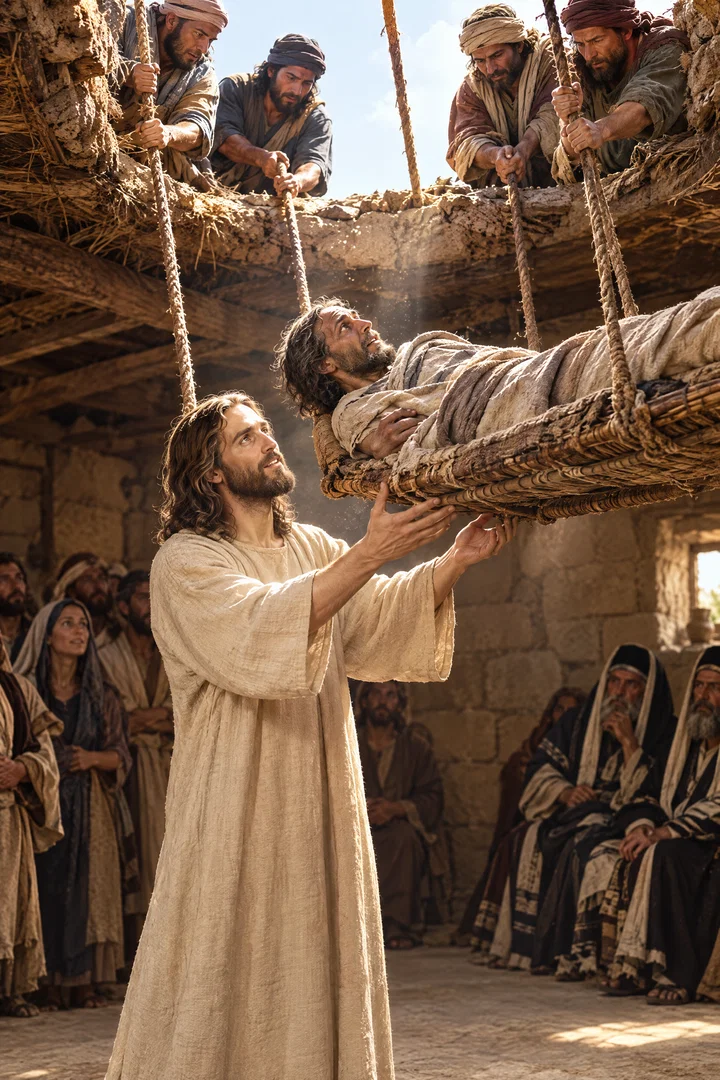
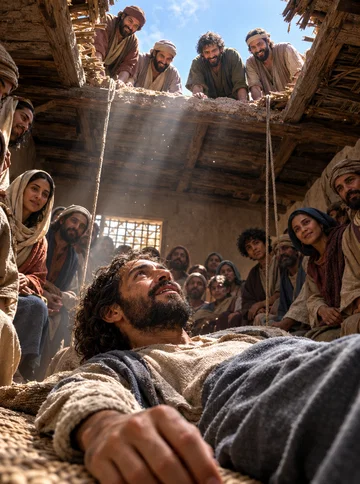
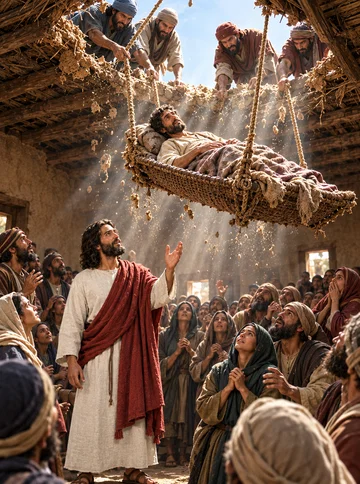
And they come unto him, bringing one sick of the palsy, which was borne of four.
Translations
And they come to him, bringing one sick of the palsy, which was borne of four.
King James Version, KJV Cambridge Paragraph Bible
And they come unto him, bringing one sick of the palsy, which was borne of four.
And they come to him, bringing one sick with the palsy, who was borne by four.
Revised Version, American Standard Version
And they come, bringing unto him a man sick of the palsy, borne of four.
And they come unto him, bringing a paralytic, borne by four,
And there come to him [ men] bringing a paralytic, borne by four;
and they come, bearing unto him a paralytic, upborne by four,—
Berean Standard Bible, Majority Standard Bible
Then a paralytic was brought to Him, carried by four men.
Four people came, carrying a paralytic to him.
And four men came to him with one on a bed who had no power of moving.
And there came vnto him, that brought one sicke of the palsie, borne of foure men.
Douay-Rheims (Challoner revision)
And they came to him, bringing one sick of the palsy, who was carried by four.
Pictures
Cross-references
- Luke 5:18-24
And, behold, men brought in a bed a man which was taken with a palsy: and they sought means to bring him in, and to lay him before him.
Men bring the paralytic to Jesus, who forgives his sins and heals him.
- Matthew 9:2
And, behold, they brought to him a man sick of the palsy, lying on a bed: and Jesus seeing their faith said unto the sick of the palsy; Son, be of good cheer; thy sins be forgiven thee.
Jesus heals the paralytic brought to him and forgives his sins.
- Mark 2:10-11
But that ye may know that the Son of man hath power on earth to forgive sins, (he saith to the sick of the palsy,)
Jesus heals the man to demonstrate his authority to forgive sins.
- Luke 5:17
And it came to pass on a certain day, as he was teaching, that there were Pharisees and doctors of the law sitting by, which were come out of every town of Galilee, and Judæa, and Jerusalem: and the power of the Lord was present to heal them.
Places Jesus’ teaching and healing among the gathered crowd as the paralyzed man is brought to him.
- Mark 2:12
And immediately he arose, took up the bed, and went forth before them all; insomuch that they were all amazed, and glorified God, saying, We never saw it on this fashion.
The healed man rises, takes up his bed, and leaves before the crowd.
- Luke 5:19
And when they could not find by what way they might bring him in because of the multitude, they went upon the housetop, and let him down through the tiling with his couch into the midst before Jesus.
They lower the paralytic through the roof to bring him before Jesus.
- Mark 2:10
But that ye may know that the Son of man hath power on earth to forgive sins, (he saith to the sick of the palsy,)
Christ has power on earth to forgive sins.
- Luke 5:24
But that ye may know that the Son of man hath power upon earth to forgive sins, (he said unto the sick of the palsy,) I say unto thee, Arise, and take up thy couch, and go into thine house.
The healing demonstrates Jesus’ power to forgive sins.
- Matthew 8:5-13
And when Jesus was entered into Capernaum, there came unto him a centurion, beseeching him,
Both recount Jesus healing a paralytic through another’s faith.
- Mark 2:7
Why doth this man thus speak blasphemies? who can forgive sins but God only?
murmurers questioned forgiving sins
Commentary
Each commentary is drawn from primary sources: the writings of Ellen G. White and Adventist pioneers and periodicals. Each commentary is separate. Its own words are not a quotation; follow the references to read the source passages.
Ellen G. White
32 sources
At Capernaum four friends and relatives bore a local man utterly helpless with incurable palsy on his bed to Jesus as He taught in Peter's house before disciples, hostile scribes and a dense crowding multitude.ST Jan 21, 1889Lt 30, 1911, par. 11–13DA 262DA 262.4–264.22SP 292.1 They undertook it cheerfully at his own urgent pleading because they had heard His gracious teaching and seen that He turned none away, even cleansing lepers and freeing captives from Satan's power.ST Jan 21, 18892SP 292.1ST Apr 5, 1877 His wasting, deathward affliction was the penalty of a life of dissipation in transgression of God's law, and the Pharisees and doctors had coldly pronounced him incurable and abandoned to God's wrath as evidence of divine displeasure.ST Jan 21, 1889ST Mar 24, 1881STDA 267.1–4 When hope revived at hearing of Jesus' miracles of mercy, he longed above physical restoration for relief from guilt and assurance of peace with Heaven, content to live or die if pardoned according to God's will.ST Jan 21, 1889STDA 267.1–4 Christ first lifted the heavier burden of sin by forgiveness to give hope and joy to the mind, then quickened the body so the man rose in youthful vigor and carried home his couch, manifesting His power on earth to forgive sins and His pattern of ministering to diseased mind as well as body.Lt 30, 1911, par. 11–133RED 69.2–33T 168.2–3DA 267.1–4RH May 21, 1914
Carried to Jesus at Capernaum
The bringing of the paralytic took place at Capernaum when Jesus was a guest in Peter's house teaching, while men, women and children were flocking from every direction to hear Him and others were gathered about Him beside the lake.DA 262.4–264.22SP 292.1ST Oct 16, 1879 Inside the crowded house the disciples sat near Jesus to hear the truths they were to proclaim by word and pen over all lands and through all ages, while haughty Pharisees, doctors and scribes gathered near with wicked purpose to confuse Him and accuse Him as an impostor.ST Oct 16, 18792SP 294.1 Outside and about the house pressed a dense promiscuous multitude of all grades of society and many nationalities, drawn by desire to hear, by wonder, by curiosity and by love of excitement.ST Oct 16, 1879 With the lame, the blind and those dying of various maladies gathered about Him for healing, Jesus laid His hands upon the sick, so that the scene itself later strengthened a distant leper's faith that even one shut out as unclean could be healed.DA 262.4–264.2
The sufferer was a man of the vicinity reduced to utter helplessness by incurable palsy, unable to walk or to come to Jesus on his own.ST Mar 24, 18812SP 292.1ST Oct 16, 1879 His arms were useless and lifeless, his flesh wasted and shrunken and leaden-hued, and in his dying state his body was beginning to decay toward death.ST Jan 21, 1889ST Oct 16, 1879 He was borne slowly on his bed, couch or litter by four friends and relatives who carried him as one utterly dependent on others.ST Jan 21, 1889Lt 30, 1911, par. 11–13DA 262ST Mar 24, 1881
Those four began to hope he might be relieved if he could be brought under Jesus' notice because they had heard His gracious teaching, had witnessed His wonderful miracles, and had seen that He turned none away, with even loathsome lepers finding access to His presence and being cleansed and healed.ST Jan 21, 18892SP 292.1ST Apr 5, 1877ST Oct 16, 1879 They encouraged him by telling of His miraculous power to cure every malady and every disease, of His words of mercy to the despairing, and of His freeing of captives held by Satan's power by a word of sublime authority.ST Jan 21, 18892SP 292.2ST Oct 16, 1879 They assured him that Jesus had healed others in every respect as sinful and helpless as himself.ST Jan 21, 1889ST Oct 16, 1879
Though racked with bodily pain the sick man kept full strength of intellect, and feeling there was no time to lose he himself in urgent crying proposed and besought his friends to carry him on his bed to Jesus.ST Jan 21, 1889ST Oct 16, 1879 His friends were anxious to help and cheerfully undertook his proposal after other plans to reach Jesus proved unworkable.ST Jan 21, 1889ST Oct 16, 1879 They pressed with their burden toward the house until their passage was completely blocked by the dense crowd in and about it, and they had to stop before coming within hearing of His voice.ST Oct 16, 18792SP 294.1 Unwilling to endure the disappointment of help so near yet unreachable, they persisted and bore him to the rear of the house to break through the roof and let him down into His immediate presence, opening the roof and lowering him when the crowd blocked their way.ST Mar 24, 1881ST Oct 16, 18793T 168.2–3ST Jan 21, 1889
Sin, Rejection, and Revived Hope
His palsy had followed a life of sin, for dissipation and love of the pleasures of sin in transgression of God's law had been its main cause, and his bodily suffering was the penalty of his wrongdoing.ST Jan 21, 1889ST Mar 24, 18813RED 67.2–68.1DA 267.1–4ST Oct 16, 1879 Remorse embittered his suffering, and the burden of guilt left him fearing that Jesus, the pure Physician, would not tolerate him in His presence or receive him.ST Jan 21, 1889ST Mar 24, 18813RED 67.2–68.1DA 267.1–4MH 73.2–3 He felt he had brought the disease upon himself, so that hope fell even as it rose, and he dreaded rejection by One so holy.ST Jan 21, 1889STDA 267.1–4
He had already sought the Pharisees and doctors for sympathy and relief of mind and body, but they had looked coldly upon him, pronounced him incurable, and abandoned him to the wrath of God.ST Jan 21, 1889DA 267.1–4ST Oct 16, 1879 They added to his woe by telling him he suffered God's righteous retribution and was cast off for his sins, torturing him with the teaching that God had cast him off because of his sins.ST Jan 21, 1889ST Mar 24, 1881ST Oct 16, 18796T 234.3 They held themselves aloof from the sick and needy and taught that sickness and distress are always evidence of divine displeasure and of God's anger toward the transgressor, though themselves often more corrupt in heart and life than the sufferers they condemned.DA 267.1–4ST Oct 16, 1879 In their arrogance they had given him over to death and the wrath of God.DA 267.1–43RED 74.3
He had sunk into despair with help from no quarter, with no prospect of aid and no hope of recovery.STDA 267.1–4MH 73.2–3ST Oct 16, 18792SP 293.2 Then hope revived in him and in his friends when they heard of Jesus' miracles of mercy and wonderful works.ST Jan 21, 1889STDA 267.1–4ST Oct 16, 18792SP 293.2 He longed to see Jesus and place himself in His hands, desiring relief from the burden of sin and assurance of forgiveness and peace with Heaven more than physical restoration.ST Jan 21, 1889STDA 267.1–4MH 73.2–3ST Oct 16, 1879 If pardoned and given relief of mind, he would be content to live or die according to God's righteous will.ST Jan 21, 1889STDA 267.1–4ST Oct 16, 18792SP 293.2
Forgiveness, Healing, and Ministry Pattern
The carrying of the palsied man on his bed into Christ's presence belongs to a work that meets both physical and spiritual need in those who seek His help.Lt 30, 1911, par. 11–133RED 69.2–3MH 73.2–3 Christ saw and perfectly understood his condition, knowing he had a sickness of the soul far more aggravating than bodily suffering and that the greatest burden borne for months was on account of sins.3T 168.2–3RH May 21, 1914HRP 12.1–14.1 His deepest distress was therefore the burden of guilt, and his greatest desire was relief from sin with assurance of forgiveness and peace with Heaven, even more than physical restoration.3T 168.2–3MH 73.2–3HRP 12.1–14.1 Forgiveness came first to lift the burden of sin and give hope, peace and joy to the mind, and then His power reached and quickened the suffering body to life and health so the man could rise, walk and glorify God.3T 168.2–3RH May 21, 1914HRP 12.1–14.1
The healing was complete, and he rose with the strength and energy of youth.ST Apr 5, 18772SP 300.3ST Mar 24, 1881 Arms that had been lifeless and useless now quickly obeyed his will, flesh that had been wasted, shrunken and leaden-hued became fresh and ruddy, and he stood in the full vigor of manhood with firm, free step, with hope, purity and peace replacing the marks of sin and suffering.DA 271.2ST Oct 16, 18792SP 296.2 He received the words of Jesus with simple faith as new life in silent joy, then passed through the crowd blessing God and returned home carrying with ease as if light the same couch that had carried him.DA 271.2ST Oct 16, 1879ST Apr 5, 18772SP 300.32SP 296.2
His return brought tears of joy and glad thanksgiving to his family, and left him and his household with undoubting faith and loyalty, ready to lay down their lives for Jesus.DA 271.2ST Oct 16, 1879ST Apr 5, 18772SP 300.3 God was glorified through His Son as the restorer of hope to the hopeless and strength to the stricken.DA 271.2ST Oct 16, 1879ST Apr 5, 18772SP 300.3 The people fell back, gazed with awe-struck faces and whispered of strange things, as if Heaven had opened before them.DA 271.22SP 296.2 From afar a leper caught a few words from Christ's lips and saw the paralytic restored to health praising God for deliverance, and the sight strengthened faith in his heart that Jesus could and would heal even one shut out as unclean.DA 262.4–264.2 The scribes and Pharisees who had given the sufferer over to death were dumb with amazement and overwhelmed with defeat, yet hardened in hatred and unbelief against clear and convincing evidence.2SP 300.1
The miracle was performed to manifest Christ's power on earth to forgive sins, and to show His love and power to heal the guilty and afflicted, pointing to His message of salvation.DA 267.1–4ST Mar 24, 18812SP 300.1 The account therefore binds together preaching the truth and healing the sick, for his first need was peace of mind through forgiveness which filled his heart with peace and joy, followed by bodily healing.RH May 21, 1914HRP 12.1–14.16T 234.3 It stands for instruction that physicians and workers for souls must minister to the diseased mind as well as the body, joining faith in God's healing power with the use of outdoor life, exercise, good food and the best treatments in health work.RH May 21, 19146T 234.3
Sources
Pioneers and periodicals
50 sources
Four men carry a helpless paralytic on a light portable bed to Jesus as he teaches in a crowded house at Capernaum, his earthly home.ST May 13, 1897ST Feb 3, 1904ST Apr 12, 1899RH Sep 20, 1906 His wasting incurable affliction is the penalty of a sinful life, leaving his soul burdened by guilt even more than his body is burdened by disease, so that he longs even more for pardon and peace with God than for bodily healing.ST Jan 21, 1889STST Jul 12, 1905ST Oct 15, 1894 Hope revives when he and his friends hear that Jesus receives and heals even the most sinful and helpless, so at his own request they cheerfully bear him to Jesus and, blocked by the crowd, persist in faith by breaking up the roof to lower him into his immediate presence.ST Jan 21, 1889ST Mar 24, 1881STST Jun 21, 1905ST Apr 12, 1899 Seeing their faith, Jesus first lifts the burden of sin by forgiving him to give hope and peace to the mind, then quickens his body to health, for the same divine creative power that forgives sin also heals disease.RH May 21, 1914ST Apr 12, 1899RH Sep 20, 1906ST Jun 21, 1905 He rises completely restored with youthful strength and carries with ease the couch that had carried him, revealing Christ's divine authority on earth to forgive sins and his compassionate love to save from both moral sin and physical disease.ST Oct 16, 1879ST Apr 5, 1877RH Oct 30, 1860ST Dec 2, 1889ST Mar 16, 1904
Scene and Wording
The bringing takes place in Capernaum on the Sea of Galilee, which Jesus made His earthly home, while He is a guest at Peter's house teaching and speaking the Word in a house crowded with listeners so that there is no room even about the door.ST Oct 16, 1879ST May 13, 1897ST Apr 12, 1899ST Jan 16, 1896 Men, women, and children flock from every direction to hear Him, and the sick man brought there is from the vicinity.ST Oct 16, 1879 The coming with the sick man leads into Jesus' demonstration of His power to forgive sins.ST May 13, 1897
The sick man is borne by four men on a bed, litter, or couch that is light and portable, since bedding in the houses of the region could be rolled up and put away during the day.ST Feb 3, 1904ST Apr 12, 1899RH Aug 1, 1865 The four are described as friends, relatives, and bearers, eager because they remember or have heard that Jesus healed many sick people during an earlier visit to the city.ST Oct 16, 1879ST Apr 12, 1899ST Feb 3, 1904 One is described as a young man brought forward while Jesus was speaking in the crowded house.ST Apr 12, 1899 The word palsy is to be understood broadly for disabling conditions such as paralysis, catalepsy, and severe cramps.ST Mar 10, 1890
Because the crowd blocks the ordinary way and the door and their passage is completely blocked, the bearers carry him to the roof, to the rear of the house to find another way, uncover and break up the roof, and let down the bed before Jesus, so that at Capernaum he is lowered through the roof into His immediate presence.ST Apr 12, 1899ST Jul 12, 1905ST Jun 21, 1905ST May 13, 1897ST May 13, 1897 Their faith in finding another way through the roof does not accept defeat.ST Jun 21, 1905ST Mar 10, 1890 The account of the bringing is joined to care for the body with forgiveness of sins, for the same power that forgives also heals.RH Sep 20, 1906
Inside and about the house sit the disciples near Jesus to hear words they are to proclaim, and Pharisees and doctors of the law from every town of Galilee and Judea and Jerusalem and scribes sitting by, with haughty purpose to confuse Him and accuse Him as an impostor, while outside is a promiscuous multitude of men, women, and children of all grades of society and many nationalities drawn by desire to hear, wonder, curiosity, and love of excitement, and the power of the Lord is present to heal.ST Oct 16, 1879ST Jan 16, 1896 The verse belongs to Mark's graphic account of Jesus healing the paralytic, one of the miracles Mark recounts in rapid succession.ST May 13, 1897ST Oct 4, 1910
Sickness and Guilt
The man borne of four was utterly helpless with incurable palsy, unable to come to Jesus on his own and carried on his bed, litter, or couch because he could not walk.ST Jan 21, 1889ST Mar 24, 1881ST Mar 24, 1881ST Feb 3, 1904ST Mar 16, 1904 He was reduced to a dying condition in which dissolution was doing its work upon his body, with wasted flesh beginning to decay, lifeless arms and shrunken leaden-hued flesh.ST Jan 21, 1889ST Oct 16, 1879RH May 21, 1914 Though racked with bodily pain he preserved full strength of intellect and cried to come into Jesus' presence at once if mortality could be arrested.ST Jan 21, 1889ST Oct 16, 1879
Dissipation and love of the pleasures of sin in transgression of the law of God, including excesses in living, had been the main cause of his affliction as the penalty of his crime, and his bodily suffering was the effect of sin.ST Jan 21, 1889ST Mar 24, 1881STST Jun 30, 1914ST May 13, 1897 Remorse deepened his suffering, and his soul was in agony and burdened by sin even more than his body was burdened by disease.ST Jun 30, 1914ST Jul 12, 1905ST May 13, 1897 He had a sickness of soul far more aggravating than bodily suffering, with the greatest burden he had borne for months on account of sins.RH May 21, 1914ST Mar 16, 1904ST Oct 15, 1894
He had sought the Pharisees and doctors for sympathy and relief of mind and body, but they had looked coldly on him, pronounced him incurable, and left him in despair with help from no quarter.ST Jan 21, 1889ST Mar 24, 1881ST Oct 16, 1879 They held themselves aloof from the sick and needy and added to his woe by telling him he suffered God's righteous retribution and punishment, holding that sickness and distress are always evidence of God's anger toward the transgressor.ST Mar 24, 1881ST Oct 16, 1879 They themselves were often more corrupt in heart and life than the sufferers they condemned.ST Oct 16, 1879
He longed for healing but even more for forgiveness, relief of mind, and peace with God, feeling that pardon of sin would give relief and that he would be content to live or die according to Jesus' righteous will.ST Jan 21, 1889STST Jun 30, 1914ST Oct 16, 1879ST Oct 15, 1894 His bodily suffering drew compassion, but his sin-sickness was the deeper concern, for his soul was burdened even more than his body.ST Jul 12, 1905ST Mar 16, 1904ST May 13, 1897
Hope and Bringing
Hope revived in the paralytic and in his friends and relatives because they had heard Jesus' gracious teaching and witnessed his miracles of mercy.ST Jan 21, 1889ST Apr 5, 1877ST Oct 16, 1879ST Oct 16, 1879 They had seen that he turned none away and that even loathsome lepers found access to his presence and were healed, so they believed the helpless man might be relieved if brought under his notice.ST Jan 21, 1889ST Apr 5, 1877ST Oct 16, 1879ST Oct 16, 1879 They remembered or had heard that he had healed many sick people during an earlier visit to the city.ST Feb 3, 1904 He had lost all hope of recovery, but hearing of Jesus' healing gave him hope again, and above all he longed for forgiveness and peace with God, trusting he could then be content to live or die according to God's righteous will.ST Jan 21, 1889STST Oct 16, 1879
His friends encouraged him by telling of Jesus' miraculous power to cure every malady, his words of mercy to the despairing, and his freeing of captives bound by the power of Satan by a word of sublime authority.ST Jan 21, 1889ST Oct 16, 1879 They assured him Jesus had healed others in every respect as sinful and helpless as himself.ST Jan 21, 1889ST Oct 16, 1879ST Apr 5, 1877 As he listened hope revived and he longed to see Jesus and place himself in his hands.ST Jan 21, 1889ST Oct 16, 1879ST Apr 5, 1877 Yet he feared rejection by the pure Physician, feared he would not be tolerated or welcomed or allowed into his presence.ST Jan 21, 1889ST Oct 16, 1879ST Apr 5, 1877
Feeling there was no time to lose and crying to come into Jesus' presence at once if mortality could be arrested, the sick man himself at his own request proposed that his friends carry him on his bed to Jesus.ST Jan 21, 1889ST Oct 16, 1879 Though racked with bodily pain he preserved full strength of intellect when he made the proposal.ST Jan 21, 1889ST Oct 16, 1879 They cheerfully undertook to do it and willingly carried him to seek help for both his physical suffering and his burden of guilt.ST Jan 21, 1889ST Mar 24, 1881ST Apr 5, 1877 They pressed with their burden toward the dense crowd in and about the house where Jesus was teaching until their passage was completely blocked and they had to stop before coming within hearing of his voice.ST Jan 21, 1889ST Oct 16, 1879
When the crowd blocked the ordinary way in, the man and his attendants persisted with zealous faith that did not accept defeat.ST Jun 21, 1905ST Apr 12, 1899ST Mar 10, 1890 They went onto the roof and to the rear of the house to find another way, and carried him in through the roof and lowered him on his bed before Jesus.ST Jan 21, 1889ST Apr 5, 1877ST Jun 21, 1905ST Mar 10, 1890ST May 13, 1897 Their persistent effort to bring him into Jesus' presence showed their faith and his faith in Jesus as his only help.ST Jan 21, 1889ST Apr 5, 1877ST Apr 12, 1899ST May 13, 1897 Because he could not come on his own, their help brought him into Jesus' presence.ST Mar 24, 1881
Forgiveness and Healing
Lowered before him, the sick man meets eyes that see the faith of the bearers as well as his own, and the first words spoken to him are son, thy sins are forgiven, followed by the command to arise and walk.ST Apr 12, 1899ST Jun 21, 1905ST May 13, 1897 He takes that word in belief, and the pardon is real, not merely pronounced.RH Jan 7, 1915 Choosing to obey, he finds that the very word commanding him supplies the power, so that he rises and goes out carrying the couch that had carried him.ST Jan 18, 1899
The order matters, for the body brought to Christ is met first in the soul, the burden of sin lifted to give hope and peace and joy to the mind, and then the suffering body reached and quickened to life and health.RH May 21, 1914 Those weighed down by sin and its effects need that mental relief and cleansing of the soul before bodily strength is restored. The same divine power is at work in both, the power that forgives and comforts the soul also healing the body.RH Sep 20, 1906RH Nov 30, 1916 The word that heals disease is equally powerful to forgive sin, as the word that cleanses the leper, who is a type of sin. Bodily healing and forgiveness call for the same divine, creative power, which alone can save from sin, so that healing stands as a pledge that God can forgive sins, and forgiving and cleansing a soul is as truly a miracle as healing the body.ST Dec 17, 1894RH Oct 30, 1913
The cure is complete, with the strength and energy of youth, and he returns home in the full vigor of manhood, carrying with ease the couch that had carried him.ST Oct 16, 1879ST Mar 24, 1881 He walks with a firm, free step, with quick obedient arms and fresh ruddy flesh, hope on his face and peace and purity in place of gloom.ST Oct 16, 1879 His home is filled with tears of joy and glad thanksgiving, his family rejoices, and God is glorified through His Son who restores hope to the hopeless and strength to the stricken.ST Oct 16, 1879ST Apr 5, 1877 He and his household are left in perfect faith and fealty.ST Oct 16, 1879
In forgiving by his own word, healing by divine power, and knowing the unspoken thoughts of the scribes, he manifests divinity in action.ST Dec 2, 1889 He heals before the watching crowd precisely so they may see that the Son of man has authority on earth to forgive sins, and his departure in health confirms that power.RH Jan 7, 1915RH Jan 7, 1915 Yet even here his person and mission are doubted, as doubt will appear again at the grave of Lazarus.ST May 15, 1907 The whole work breathes sympathy and care for the diseased and the burdened, relieving them and helping those who have none to help, bringing hope to the most needy whom others would pass by as hopeless.RH Oct 30, 1860RH Feb 9, 1905 Bodily suffering draws his compassion, but the deeper concern is sin-sickness, and his healing aims to draw men and women to himself that they may have faith and be forgiven.ST Mar 16, 1904 So is shown his love and power to heal the guilty and afflicted, to change the heart and make the person new, and to save from physical disease as well as moral sin, pointing to his message of salvation.ST Mar 24, 1881ST The account stands with the healings of disease to be read with his healing of the centurion's servant in Luke 7:1-10 and Matthew 8:5-13, showing his power to heal in response to faith and his pity toward sufferers.ST Apr 11, 1900
Doctrine and Application
The bringing of the paralytic carried by four belongs to the example of ministering to the sick and healing on the Sabbath.ST Such care shows Sabbath observance was never meant to withhold what is necessary for life and comfort.ST Healing of the sick with forgiveness of sins expresses the special blessing found in the Sabbath, though this verse itself does not state that this healing took place on the Sabbath.ST Jul 16, 1894
Healing the sick gave those seeking grounds to accuse him cause for offense.ST Apr 9, 1894 Yet such healing did not make him a transgressor of God's law.RH Nov 1, 1853 If he had sinned he could not have been the sinless sacrifice for humanity.RH Nov 1, 1853
The bringing of the paralytic for healing is among the works done on earth that those who believe are to continue and exceed because he went to the Father.RH Aug 7, 1913 That does not necessarily mean more paralytics healed in body.RH Aug 7, 1913 It surely means more miracles of grace upon the hearts of men, women, and children, since there is no greater work than transformation of the unregenerated heart.RH Aug 7, 1913
The memory of the sick being brought because he could not come on his own recalls the feeble young man who had to be carried to the water for baptism.RH Jul 5, 1870 The account of the paralytic's healing shows the Great Physician's love and compassion in physical and moral healing.RH Feb 9, 1905 The world, sick both physically and morally, needs the lessons of that healing.RH Feb 9, 1905
Sources