Translations
American King James Version, King James Version
And Simon he surnamed Peter;
KJV Cambridge Paragraph Bible, Revised Version, American Standard Version
and Simon he surnamed Peter;
And Simon he surnamed Peter.
And he put on Simon the name Peter;
And he gave to Simon the surname of Peter;
and he appointed the twelve (and imposed a name on Simon—) Peter,
These are the twelve He appointed: Simon ( whom He named Peter),
Simon ( whom He named Peter),
Simon ( to whom he gave the name Peter);
To Simon he gave the second name of Peter;
And the first was Simon, and hee named Simon, Peter,
Douay-Rheims (Challoner revision)
And to Simon he gave the name Peter:
Pictures
Cross-references
- Luke 6:13-16
And when it was day, he called unto him his disciples: and of them he chose twelve, whom also he named apostles;
Parallel account of Jesus choosing the twelve and naming Simon Peter first.
- Matthew 10:2
Now the names of the twelve apostles are these; The first, Simon, who is called Peter, and Andrew his brother; James the son of Zebedee, and John his brother;
Both texts name Simon as Peter among the apostles.
- Luke 6:14-16
Simon, ( whom he also named Peter,) and Andrew his brother, James and John, Philip and Bartholomew,
gives the ordered personal names in parallel
- Acts 1:15
And in those days Peter stood up in the midst of the disciples, and said, (the number of names together were about an hundred and twenty,)
Peter stands among the disciples as the apostles appoint a replacement for Judas.
- 1 Peter 5:13
The church that is at Babylon, elected together with you, saluteth you; and so doth Marcus my son.
Cited as a basis for the claim that Mark learned Gospel facts from Peter.
Commentary
Each commentary is drawn from primary sources: the writings of Ellen G. White and Adventist pioneers and periodicals. Each commentary is separate. Its own words are not a quotation; follow the references to read the source passages.
Ellen G. White
5 sources
This naming is one part of the first step in organizing the church that after Christ's departure was to be His representative on earth, by calling and setting apart the twelve to the apostolate for sacred responsibility in the gospel work.DA 290.2–291.2DA 290.1ST Apr 19, 1877 In this choice He brought together disciples of diverse character to work together, giving a place among the twelve to those who joined Him while multitudes were following.DA 716.4Lt 49, 1876, par. 13–15 Those set apart were to stay with Him, learn from His teaching and work, witness His deeds, and afterward continue the work and help lay the foundation of the Christian church, trusted to do the work of an evangelist and endowed with power to heal the sick and to cast out devils.ST Apr 19, 1877DA 716.4
Judas illustrates who was admitted, for he was moved by Christ's words spoken in the synagogue, by the seaside, and upon the mount.DA 716.4 He was moved also by seeing the sick, the lame, and the blind flock to Jesus from towns and cities, the dying laid at His feet, and His mighty works in healing the sick, casting out devils, and raising the dead.DA 716.4 He felt in himself the evidence of Christ's power, recognized His teaching as superior to all he had heard, loved the great Teacher, desired to be with Him, desired to be changed in character and life, and hoped to experience this through connecting himself with Jesus.DA 716.4 Though admitted, he did not surrender himself fully to Christ, did not give up worldly ambition or love of money, did not come under the divine moulding, felt he could retain his own judgment and opinions, and cultivated a disposition to criticize and accuse.DA 716.4
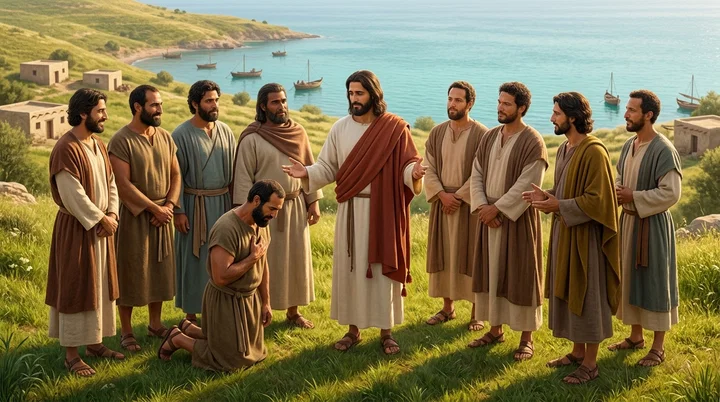
The naming took place with no costly sanctuary, under the sheltering trees on a mountainside a little distance from the Sea of Galilee, in the retreat Jesus loved where the sermon on the mount was also given, and the beauty of mountain and vale and sea was forever linked with the sacred experiences of that day.DA 290.2–291.2DA 290.1 Jesus withdrew from the confusion of the city to the quiet of the fields and hills as more in harmony with the lessons of self-abnegation He desired to teach.DA 290.2–291.2 The fields and hills were His favorite resorts and much of His teaching was given under the open sky rather than in the temple or the synagogues.DA 290.1 No synagogue could have received the throngs that followed Him, but He chose the fields and groves not for this reason only, because He loved the scenes of nature and to Him each quiet retreat was a sacred temple.DA 290.1 This account gives no further explanation of Simon's surname Peter.ST Apr 19, 1877
Sources
Pioneers and periodicals
12 sources
Mark 3:16 names Simon as the disciple whom Jesus surnamed Peter, meaning a stone, the same as Cephas, in the list of the twelve he chose and ordained.RH Oct 30, 1860ST May 3, 1899 The choosing of the twelve was the first step in organizing the New Testament church to stand as Christ's representative on earth after his departure, to keep the faith pure and united and to carry the witness to the world.RH Aug 17, 1916RH Apr 15, 1909 Out of the larger company of disciples he set twelve apart, named them apostles and ordained them to the ministry of the word and to general oversight of the whole gospel church, as the twelve patriarchs stood for Israel.ST Apr 19, 1877RH Aug 17, 1916RH Apr 15, 1909 Christ himself chooses his workers, even humble men like fishermen, to stay with him, learn from his teaching and deeds, and then continue his work and lay the foundation of the Christian church, so that a yielded life bears fruit to God's glory.ST Apr 19, 1877ST Dec 17, 1894RH Sep 25, 1913ST Dec 23, 1897ST
Naming and Context
The verse names Simon as the one Jesus surnamed Peter in the listing of the disciples He ordained and chose as the twelve.RH Oct 30, 1860ST May 3, 1899RH Sep 18, 1900RH Sep 25, 1913 Peter corresponds to Cephas and means a stone. The verse does not say the name was first given on that occasion, for Jesus may have given it earlier when He said Simon would be called Cephas, and that earlier naming may have been prophetic, and no further explanation of the surname is given here.ST Apr 19, 1877
The twelve were ordained early in the morning after Jesus had spent the whole night in prayer, and their personal names are to be repeated in their order.ST May 3, 1899ST Dec 23, 1897 Mark tells the choosing of the twelve with graphic force, moving rapidly from event to event and piling miracle upon miracle in much less space than the longer synoptists.ST Oct 4, 1910 His Gospel was written primarily for Gentiles, omitting Jewish law and genealogy and explaining Hebrew words, and it portrays Jesus as a perfect King and model of character.RH Oct 30, 1860ST Oct 4, 1910
Organizing Church Leadership
The choosing of the twelve was the first step in organizing the New Testament church to be Christ's representative on earth after His departure, to maintain purity and unity in the faith and to carry the witness to the world against efforts to introduce error and division.RH Aug 17, 1916RH Apr 15, 1909 Out of the larger number of disciples He chose twelve, named them apostles, set them apart for sacred responsibility, and ordained them to the ministry and apostleship.ST Apr 19, 1877RH Aug 17, 1916RH Apr 15, 1909 As the twelve patriarchs stand as representatives of Israel, so the twelve apostles were to stand as representatives of the whole gospel church, not of a local congregation only.RH Aug 17, 1916RH Apr 15, 1909 Their office was general for the whole church, given to the ministry of the word and preaching and to general oversight unifying the work of the churches as the gospel spread, with others later called to the same office and work as the work enlarged.RH Aug 17, 1916RH Apr 15, 1909
They were to stay with Jesus, learn from His teaching and work, witness His deeds, and later continue the work and help lay the foundation of the Christian church.ST Apr 19, 1877 Christ Himself chooses His workers and trains them to become leaders, and when a person yields to His choosing He ordains that person and works through him so that life brings forth fruit to God's glory.ST Dec 17, 1894RH Sep 25, 1913
In choosing the twelve to spread His teachings and be His companions, Jesus chose humble men from humble occupations, including fishermen.ST Dec 23, 1897ST The gulf between His wisdom and their humble station was bridged by love.ST Peter stands first among the twelve and is impulsive yet true.RH Sep 18, 1900 Peter as a rash man, alongside Judas as a betrayer, shows that even a group of twelve may include flawed members.RH May 12, 1863
Sources