Mark 4:13
And he said unto them, Know ye not this parable? and how then will ye know all parables?
Translations
And he said to them, Know you not this parable? and how then will you know all parables?
And he said unto them, Know ye not this parable? and how then will ye know all parables?
And he said unto them, Know ye not this parable? and how then will you know all parables?
And he said to them, Know ye not this parable? and how then will ye know all parables?
Revised Version, American Standard Version
And he saith unto them, Know ye not this parable? and how shall ye know all the parables?
And he saith to them, 'Have ye not known this simile? and how shall ye know all the similes?
And he says to them, Do ye not know this parable? and how will ye be acquainted with all the parables?
And he saith unto them—Know ye not this parable? How then will ye get to know all the parables?
Berean Standard Bible, Majority Standard Bible
Then Jesus said to them, “ Do you not understand this parable? Then how will you understand any of the parables?
He said to them, “Don’ t you understand this parable? How will you understand all of the parables?
And he said to them, If you are not clear about this story, how will you be clear about the others?
Againe he said vnto them, Perceiue ye not this parable? howe then should ye vnderstand all other parables?
Douay-Rheims (Challoner revision)
And he saith to them: Are you ignorant of this parable? and how shall you know all parables?
Pictures
Cross-references
- Luke 8:4-15
And when much people were gathered together, and were come to him out of every city, he spake by a parable:
Explains the parable of the sower and how different hearers receive the word.
- Matthew 13:10-17
And the disciples came, and said unto him, Why speakest thou unto them in parables?
Jesus explains why he teaches in parables and why some hearers understand while others do not.
- Matthew 13:18-23
Hear ye therefore the parable of the sower.
Explains the parable of the sower and the different responses to the word.
- Matthew 13:3-9
And he spake many things unto them in parables, saying, Behold, a sower went forth to sow;
The parable’s seed and soils illustrate different responses to the word.
- Luke 8:9-10
And his disciples asked him, saying, What might this parable be?
The disciples ask about the parable, and Jesus explains the purpose of parables.
- Isaiah 6:9-10
And he said, Go, and tell this people, Hear ye indeed, but understand not; and see ye indeed, but perceive not.
Both describe hearing and seeing without understanding or perceiving.
- Mark 4:3-9
Hearken; Behold, there went out a sower to sow:
The soil’s condition determines whether the seed can take root.
- Luke 8:5-8
A sower went out to sow his seed: and as he sowed, some fell by the way side; and it was trodden down, and the fowls of the air devoured it.
A parallel account of the parable identified as the key.
- Matthew 13:18
Hear ye therefore the parable of the sower.
Jesus proceeds to explain the parable of the sower.
- Matthew 13:34
All these things spake Jesus unto the multitude in parables; and without a parable spake he not unto them:
Jesus used parables to teach
Commentary
Each commentary is drawn from primary sources: the writings of Ellen G. White and Adventist pioneers and periodicals. Each commentary is separate. Its own words are not a quotation; follow the references to read the source passages.
Ellen G. White
26 sources
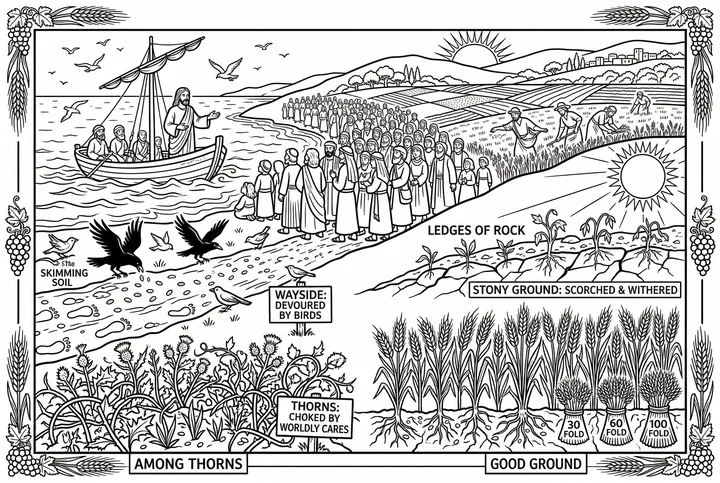
Jesus spoke this rebuke to His disciples after He had taught the crowd from a boat the parable of the sower, which plainly set forth the work He had come to do.COL 33.2–34.14RED 82.1–22SP 236.3–237.2 The sower is the key to all His parables, so that if this plain lesson drawn from seed cast into soil is not grasped the greater truths He taught in this way cannot be understood.ST Jun 30, 18812SP 235.1–24RED 80.3 The seed is the word of God, and though sower and seed are the same, the harvest depends wholly on the condition of the hearer's heart.COL 56.1–2COL 57.1–2 Some are hardened by neglected duty, some receive eagerly but have no root and fall before trial and sacrifice, and others let love of the world and its cares choke the word so that hearing does not become a fruitful life.2SP 241.1–24RED 86.2–3TCBMP 140.1–142.1 Understanding is given to those who are willing to see and hear and obey, while those who shut their eyes and resist remain in darkness by their own choice, yet no heart need remain hard or shallow or choked, for the soil can be broken up by repentance and cleansed by earnest effort in Christ's strength.ST Jun 30, 1881COL 56.1–2ST May 3, 18774RED 82.1–22SP 236.3–237.2
Setting and Purpose as Key
Jesus spoke this question in the course of His public teaching of the parable of the sower, given from a boat on the Sea of Galilee to the multitude gathered on the shore.COL 33.2–34.1 The parable of the sower is the key and necessary starting point for understanding all His other parables, so that if this plain parable is not grasped the greater truths taught in parables will not be understood.ST Jun 30, 18812SP 235.1–24RED 80.3COL 33ST May 3, 1877 Jesus expected the disciples to understand it and to use its meaning as the key to the rest, linking this parable of the seed and the different kinds of hearers to all that would follow.COL 33ST May 3, 1877COL 56.1–2
He taught through familiar scenes from nature and earthly seed-sowing, making lessons plain through objects so that the mind is led from natural seed cast into soil to gospel truth and remembers it.ST Jun 30, 1881COL 33.1 Lessons for children are to be made plain in the same way, leading their minds from nature to God and sowing seeds of truth.6T 205.1 His illustrations were meant to awaken thought and prompt inquiry, and hearers who wanted fuller understanding could ask Him and receive an explanation, as the disciples did.2SP 235.1–24RED 80.3ST May 3, 1877ST May 3, 18772SP 234.1–2
Understanding depends on willingness to see and hear, for the Pharisees deliberately shut their eyes and ears and left their hearts unreachable, while the disciples received His teaching.ST Jun 30, 1881ST May 3, 1877 He reproved the disciples for failing to understand the sower, which plainly illustrated the very teaching He had come to give, so that if they could not grasp this clear lesson they would not be able to understand greater truths He would teach in parables.4RED 82.1–22SP 236.3–237.2 Those who follow closely, obey, open their minds to instruction, and are ready to believe will receive deeper knowledge of God's kingdom, while those who reject truth and neglect their opportunities to understand remain in darkness by their own choice.4RED 82.1–22SP 236.3–237.2
The sower parable in this setting also addressed doubts about why many people, including the learned and wealthy, did not accept Jesus as Messiah.2SP 235.1–2
What the Sower Reveals
The parable gives a brief, clear picture of the different kinds of people taught and the tendencies of the human heart, explaining why the ministry had limited immediate results.2SP 241.1–2ST May 3, 18774RED 86.2–3 The seed is the word of God, and although the sower and seed are the same, the different results depend on the condition of the hearer's heart.COL 56.1–2COL 57.1–2 Some hearers are hardened by neglected moral duty and corrupt influences, some receive truth eagerly but lack deep roots so that trials, sacrifice, or correction make them fall away, and others accept truth while love of the world, dishonest gain, anxiety, and worldly cares choke it.TCBMP 140.1–142.1 These responses show that hearing and professing truth do not necessarily produce a changed, fruitful life.TCBMP 140.1–142.1
Through earthly seed-sowing the parable explains the sowing of gospel truth and God's work for His people, leading the mind from natural seed cast into soil to truth that brings people back to loyalty to God.COL 33.1 People are left free to accept or reject Christ without compulsion, and are called to join their own efforts with divine power to overcome sin.2SP 241.1–24RED 86.2–3 Hearers need not remain hard, shallow, or thorn-choked, for by resisting the Spirit they become inattentive to God's word and responsible for the conditions that keep it from taking root and growing.COL 56.1–2 Yet the heart as soil must and can be prepared, with repentance breaking up the soil and earnest, diligent effort in Christ's strength uprooting evil tendencies that would choke the good seed.COL 56.1–2ED 111.1–2
The beaten path pictures hearts hardened to truth, yet Christlike personal care and ministry can soften hard hearts so the seed takes root.COL 57.1–2GW 185.1 Teaching believers to live by Christ's life and character, deny self, trust Him, serve others, and win souls helps keep the word from being choked and uproots worldly influences.COL 57.1–2 The seed's planting and growth also illustrate Christ's death and the truth of the resurrection, with natural and spiritual processes corresponding as the plant grows.ED 111.1–2
Sowing Seed in Practice
Truth sown in the mind is as seed that may lie dormant for a time until grace awakens it to life, and then it bears fruit for God's glory.TBC1872 111.1 Its effect may not be seen at once, but it can later spring up and bear fruit and help save many, with the instruction passed on to future generations.ST May 2, 1878 Lessons for children are to be made plain through objects, leading their minds from nature to God as seeds of truth are sown, and the full good produced by such teaching may not be seen until the great day of God.6T 205.1 Hearing the truth can leave an impression that takes root in the heart and leads to conversion, even when a person hears only one discourse and later encounters the truth elsewhere.Lt 202, 1897, par. 6
In early life good seed must be sown in the good soil of the mind and heart so that it bears fruit unto eternal life.4T 499.2 The soil of children's hearts must be carefully prepared, and the Sower's good seed needs prepared soil in the heart to grow, for the parable of the sower is the key to understanding all parables.CTBH 67.3 Parents should not send little ones away to school too early nor trust the molding of the infant mind to other hands, but should themselves be the best teachers until children are eight or ten years old.CTBH 67.3 Their schoolroom should be the open air amid flowers and birds and their textbook the treasures of nature, with parents opening God's great book of nature before them as fast as their minds can comprehend it, so the lessons will not soon be forgotten.CTBH 67.3 Great pains to cultivate children's minds and form correct habits prepares the heart for the Sower, and if half the time and labor now wasted in following the fashions of the world were given to this cultivation a marked change would appear in families.CTBH 67.3
The parable governs gospel preaching: the seed sown is the theory of the truth with its evidences, and it springs up and bears fruit to the glory of God when Christ as Saviour of the world with His redeeming love and cross is presented together with that theory.4T 393.3 Discourses that are wholly argumentative leave the seed without power to bring souls to Christ's side, and because any hearing may be the hearer's last with the opportunity then lost forever, Christ must be exalted in every presentation of truth.4T 393.3 Teaching is seed planted in the heart, so books that mix Scripture with fanciful interpretations can grow into infidelity.CT 186.3–187.2
Sources
Pioneers and periodicals
37 sources
Jesus pressed His disciples for failing to grasp the parable of the sower, asking how they would then grasp all His other parables.ST Sep 16, 1886 Understanding that parable is the starting point and key that opens the meaning of all His parables and teachings.ST Jun 30, 1881ST Jan 28, 1889RH Nov 30, 1916 In it the seed is the word of God, the gospel and the truth, sowing it is preaching and spreading that truth, and its fruit is obedient believers, churches and souls won.RH Dec 21, 1905ST Mar 18, 1889 The four soils are four classes of hearers, where three fail to bring forth mature fruit because the heart is unprepared, while only the good soil wisely receives the word in a prepared and honest heart and bears fruit with patience, so the failure lies with the hearers.ST May 3, 1877RH May 11, 1869RH May 11, 1869 He taught in familiar scenes from nature to make spiritual truth clearer, more engaging and memorable, yet His parables disclose truth only to those willing to see and hear while hiding it from those who shut their eyes and ears.ST Jun 30, 1881ST May 3, 1877ST Jan 28, 1889
Question and Narrative Setting
Jesus expressed surprise that the disciples did not grasp the parable of the sower, pressing them with the challenge of how they would then comprehend his other parables.ST Sep 16, 1886 In Mark's account this question belongs to his telling of Jesus' parables concerning the kingdom, which are given briefly and vividly rather than as long discourses.ST Oct 4, 1910
The parables were given as illustrations meant to awaken thought and prompt inquiry that would lead to clearer understanding.ST May 3, 1877ST May 3, 1877ST Jan 28, 1889 Those who desired a fuller explanation could ask him for it, as the disciples did, and receive it.ST May 3, 1877ST Jan 28, 1889 He expected the disciples to understand the sower and to use its meaning as the key to his other teachings, since that parable lays bare the different responses of the human heart and thereby explains the limited immediate results of his ministry.ST May 3, 1877 Grasping this one parable was thus necessary for grasping the others, and understanding itself depended on receptiveness, for while the disciples asked and were taught, the Pharisees willfully shut their eyes and ears to the meaning and left their hearts unreachable.ST May 3, 1877ST Jan 28, 1889
Key to Understanding Parables
Understanding the parable of the sower is the necessary starting point and key for understanding all of Jesus' other parables and teachings.ST Jun 30, 1881ST May 3, 1877ST Jan 28, 1889RH Nov 30, 1916 If this parable is not grasped the others will not be understood, and its meaning is to be used as the key to the rest.ST Jun 30, 1881ST May 3, 1877ST Jan 28, 1889 Jesus was surprised that the disciples did not understand it, and pressed them with how they would then understand the other parables.ST Jun 30, 1881ST Sep 16, 1886 He treated it as a comparison requiring explanation and as the model for understanding parables.RH Nov 30, 1916RH Mar 31, 1868
The parable uses familiar scenes from nature to teach truth in a way listeners can remember, and was meant to prompt inquiry leading to clearer understanding.ST Jun 30, 1881ST May 3, 1877 Understanding also depends on being willing to see and hear, since the Pharisees deliberately shut themselves off while the disciples received Jesus' teaching.ST Jun 30, 1881 The sower parable reveals the different responses of the human heart and in this way explains the limited immediate results of Jesus' ministry.ST May 3, 1877
Parables illustrate subjects through comparison and, like prophetic figures, must be explained by the subject and by Scripture.RH Mar 31, 1868RH Feb 18, 1873 They must be explained by considering the subject and the Bible, as figures are explained.RH Mar 31, 1868RH Feb 18, 1873 Each distinct and important detail in the figure corresponds to a fact.RH Dec 12, 1854 Applied to the parable of the rich man and Lazarus, the rich man and his five brothers represent the Jewish people, including the ten tribes understood as lost, while the poor man represents the Gentiles deprived of the truth.RH Dec 12, 1854 Their deaths represent the change of condition brought by a change of dispensations, in which the Jews lost much while the Gentiles gained much.RH Dec 12, 1854
How Parables Reveal Truth
Mark 4:13 makes the parable of the sower the measure for all parables, for if that parable is not grasped the others will not be understood.ST Jun 30, 1881ST Jan 28, 1889 That parable and the others work through familiar scenes from nature and familiar illustrations that make spiritual truth clearer, more engaging, and easier to remember.ST Jun 30, 1881ST Jan 28, 1889 Their illustrations were meant to awaken thought and to prompt inquiry that leads to clearer understanding.ST May 3, 1877ST May 3, 1877ST Jan 28, 1889 Those who wanted fuller explanation could ask as the disciples did and receive it, and the different responses of the human heart shown in the sower explain the limited immediate results of Jesus' ministry.ST May 3, 1877ST May 3, 1877ST Jan 28, 1889
Parables at once disclose truth to those ready to receive it and conceal it from others, so understanding turns on willingness to see and hear.ST Jun 30, 1881ST May 3, 1877ST Jan 28, 1889 The disciples received the teaching because they were open, while the Pharisees deliberately shut their eyes and ears and shut themselves off, leaving their hearts unreachable.ST Jun 30, 1881ST May 3, 1877 What is pointed to in the sower is that God's words are living seeds of truth and spiritual power planted in the human mind and heart.ST Apr 11, 1900 Faith supplies the conditions for them to grow, and to receive them merely as words leaves them without power and without growth, with the fault lying not in the seed.ST Apr 11, 1900
Meaning of Seed and Soils
In this parable the seed is the word of God, the gospel, and the truth, and sowing it is preaching and spreading the truth wherever hearts may receive it.RH Dec 21, 1905ST Mar 18, 1889RH Feb 10, 1910ST Aug 12, 1880RH Nov 11, 1909 Its fruit is people obeying the truth, in believers raised up, churches formed, and souls won unto eternal life.RH Dec 21, 1905RH Feb 10, 1910ST Aug 12, 1880 The gospel sown in children's minds can take root and produce an abundant and lasting harvest leading to their salvation.ST Mar 18, 1889 Thousands of isolated believers quietly sowing that seed of truth by daily life prepare the way for definite efforts by ministers.RH Nov 11, 1909
The parable distinguishes four classes of hearers, three of whom fail to bear mature fruit because the soil is unprepared, while the good soil represents those who wisely receive the word in a prepared and honest heart and bear fruit patiently.RH May 11, 1869RH May 11, 1869 The failure lies with the hearers, who risk eternal interests on ground as unsuitable as a path, a rock, or a thorn patch is for growing seed.RH May 11, 1869 The different outcomes explain the limited immediate results of the ministry, since some become weary and are overcome by life's cares and pleasures while others bear abundant fruit.ST May 3, 1877RH Jul 10, 1860
The same seed produces different results because hearts receive it differently.RH Aug 6, 1861 Some do not understand and lose the word when the enemy takes it from the conscience, like seed that never roots.ST Jun 16, 1887 Some receive it joyfully but give it up under trouble, persecution, or temptation, like seed on stony ground, and some are crowded out by worldly cares, riches, pleasures, desires, and passions.RH Aug 6, 1861 The truth must be the ruling, rooted principle of the heart rather than a secondary concern, for otherwise trial and persecution expose shallow commitment and the person may abandon the truth, whereas a life ordered around the truth shows it has taken root.RH Aug 6, 1861 The word preached is meant to bring the hearer's own sin to light and lead to salvation.ST Jun 16, 1887
The heart is soil where every ill weed will naturally take root and spread: worldly care as thorns, worldly vanity as thistles, with unprofitable weeds and roots of bitterness taking possession.RH Jul 10, 1856 As a husbandman watches his land, the Christian must search and examine the heart and cast them all out.RH Jul 10, 1856 Sympathy must remain tender and imagination free so the heart stays open to God's influence, otherwise that influence is scattered without effect.RH Oct 22, 1914 When this work is rightly done the soil is ready for the good seed to spring up and prosper under divine grace like corn by rain and sunshine from heaven above.RH Jul 10, 1856 Even lives that seem small and insignificant are worth offering to God as such soil, for He asks for them so He can bring much good from what is given.ST Aug 5, 1913
Seeds also picture the effects of words, thoughts, and actions, which may bear good fruit or bring death and sorrow long after they are sown.RH Jul 7, 1874 This life is the time for sowing and the future brings a harvest according to deeds.RH Sep 17, 1857 Those who sow evil cannot expect good, and those who do not sow cannot expect a harvest, so no one has grounds to complain about reaping what was sown.RH Sep 17, 1857 Those who hear and keep the word with honest hearts bear fruit patiently and themselves become sowers of the good seed.
Sowing and Bearing Fruit
Truth sown as seed makes the manner of Bible teaching decisive, for helpful questions, remarks, and illustrations prepare the soil for it to take root, while scolding, needless repetition, or excessive explanation bury good teaching and keep it from growing.ST Oct 19, 1882 The gospel sown in children's minds as blessed lessons can take root and yield an abundant harvest, and impressions so made may last and lead to their salvation, yet distractions can divert those lessons before they settle and bear fruit.ST Jun 18, 1885ST Mar 18, 1889
Teaching sown in minds may show no effect at once and still remain to bear fruit later for God's glory and help save many, since what hearers receive can be passed on to future generations.ST May 2, 1878 What was once spoken can stay with a hearer and ripen afterward into a changed life.RH Dec 10, 1867 The lesson therefore is to persevere in sowing the truth whenever there is opportunity, praying and hoping for God's blessing so that some seed will grow and produce an abundant harvest of souls won unto eternal life.RH Feb 10, 1910ST Aug 12, 1880 Even those slow to understand can still comprehend the plan of salvation and bring forth fruit.RH Dec 24, 1908
Song about Jesus can soften hardened hearts so that the preached message takes root and leads to everlasting life.RH Oct 23, 1913 Thousands of isolated believers quietly sowing the seed of truth by their daily lives prepare the way for definite efforts by ministers.RH Nov 11, 1909 Teaching from the Book of Life is seed meant to fall as on good ground into fertile soil, to take deep root in readers' hearts, and in due time to produce fruit and spring up unto eternal life.RH Feb 10, 1910RH Oct 7, 1915ST Jun 27, 1911
Where hearts are receptive soil the Word received bears fruit in believers and churches, as among the German Russian wheat-growing colonies in the province of Entre Rios.ST Those who hear and keep the Word with honest hearts bear fruit patiently and themselves become sowers of the good seed. The word preached is meant to bring the hearer's own sin to light and lead to salvation, though it may be taken from the conscience by the enemy and become unfruitful.ST Jun 16, 1887
Sources