Mark 7:5
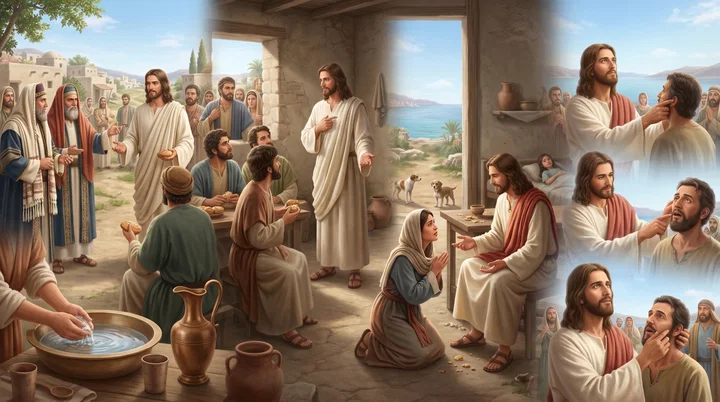
Then the Pharisees and scribes asked him, Why walk not thy disciples according to the tradition of the elders, but eat bread with unwashen hands?
Translations
Then the Pharisees and scribes asked him, Why walk not your disciples according to the tradition of the elders, but eat bread with unwashed hands?
King James Version, KJV Cambridge Paragraph Bible
Then the Pharisees and scribes asked him, Why walk not thy disciples according to the tradition of the elders, but eat bread with unwashen hands?
Then the Pharisees and scribes asked him, Why walk not thy disciples according to the tradition of the elders, but eat bread with unwashed hands?
Revised Version, American Standard Version
And the Pharisees and the scribes ask him, Why walk not thy disciples according to the tradition of the elders, but eat their bread with defiled hands?
Then question him do the Pharisees and the scribes, 'Wherefore do thy disciples not walk according to the tradition of the elders, but with unwashed hands do eat the bread?'
then the Pharisees and the scribes ask him, Why do thy disciples not walk according to what has been delivered by the ancients, but eat the bread with defiled hands?
and so the Pharisees and the Scribes, question, him—For what cause do thy disciples not walk according to the tradition of the elders, but, with defiled hands, eat bread?
So the Pharisees and scribes questioned Jesus: “ Why do Your disciples not walk according to the tradition of the elders? Instead, they eat with defiled hands.”
So the Pharisees and scribes questioned Jesus: “ Why do Your disciples not walk according to the tradition of the elders? Instead, they eat with unwashed hands.”
The Pharisees and the scribes asked him, “ Why don’ t your disciples walk according to the tradition of the elders, but eat their bread with unwashed hands?”
And the Pharisees and the scribes put the question to him, Why do your disciples not keep the rules of the fathers, but take their bread with unwashed hands?
Then asked him the Pharises and Scribes, Why walke not thy disciples according to the tradition of the Elders, but eate meate with vnwashen hands?
Douay-Rheims (Challoner revision)
And the Pharisees and scribes asked him: Why do not thy disciples walk according to the tradition of the ancients, but they eat bread with common hands?
Pictures
Cross-references
- Matthew 15:1-9
Then came to Jesus scribes and Pharisees, which were of Jerusalem, saying,
The passage cites this parallel account of traditions set against God’s commandments.
- Isaiah 29:13
Wherefore the Lord said, Forasmuch as this people draw near me with their mouth, and with their lips do honour me, but have removed their heart far from me, and their fear toward me is taught by the precept of men:
Jesus applies Isaiah’s words about lip service and human teachings to the Pharisees’ challenge.
- Matthew 15:11
Not that which goeth into the mouth defileth a man; but that which cometh out of the mouth, this defileth a man.
Jesus answers the complaint by teaching that what comes from within, not food, defiles.
- Matthew 15:3
But he answered and said unto them, Why do ye also transgress the commandment of God by your tradition?
Jesus likewise rebukes traditions that transgress God’s command.
- Matthew 15:18-20
But those things which proceed out of the mouth come forth from the heart; and they defile the man.
Defilement comes from evil thoughts and actions arising from the heart.
- Matthew 15:6
And honour not his father or his mother, he shall be free. Thus have ye made the commandment of God of none effect by your tradition.
Tradition makes God’s command of no effect.
- Colossians 2:20-22
Wherefore if ye be dead with Christ from the rudiments of the world, why, as though living in the world, are ye subject to ordinances,
Both reject human rules governing what people may eat or touch.
- Mark 7:9-13
And he said unto them, Full well ye reject the commandment of God, that ye may keep your own tradition.
The Corban example exposes the questioners’ appeal to tradition.
- Mark 7:1
Then came together unto him the Pharisees, and certain of the scribes, which came from Jerusalem.
sets deputation that asked the question
- Mark 7:15
There is nothing from without a man, that entering into him can defile him: but the things which come out of him, those are they that defile the man.
Jesus answers the handwashing charge by explaining what truly defiles a person.
- Exodus 20:1-17
And God spake all these words, saying,
The passage contrasts the elders’ rules with the commandments given at Sinai.
- Mark 7:21-23
For from within, out of the heart of men, proceed evil thoughts, adulteries, fornications, murders,
Lists evils from within that defile.
- Romans 14:17
For the kingdom of God is not meat and drink; but righteousness, and peace, and joy in the Holy Ghost.
God’s kingdom is not a matter of food and drink.
- Matthew 23:23
Woe unto you, scribes and Pharisees, hypocrites! for ye pay tithe of mint and anise and cummin, and have omitted the weightier matters of the law, judgment, mercy, and faith: these ought ye to have done, and not to leave the other undone.
Both contrast strict attention to religious details with weightier matters like mercy and judgment.
- Isaiah 42:21
The LORD is well pleased for his righteousness’ sake; he will magnify the law, and make it honourable.
Foretells that Christ will magnify the law.
Commentary
Each commentary is drawn from primary sources: the writings of Ellen G. White and Adventist pioneers and periodicals. Each commentary is separate. Its own words are not a quotation; follow the references to read the source passages.
Ellen G. White
8 sources
The question was a public challenge put by a deputation of Pharisees and scribes from Jerusalem who had come to watch Jesus after He stayed away from the Passover where they had expected Him and had laid a trap for Him.DA 395.3–396.2Ms 65, 1897, par. 1–4 They were sent for the express purpose of watching Him to find something with which to accuse Him, yet they did not attack Him directly but accused Him through His disciples before the multitude.DA 395.3–396.2Ms 65, 1897, par. 1–4 The charge was that the disciples did not walk according to the tradition of the elders but ate bread with unwashen hands, and it was made hoping to provoke controversy and to draw words from Christ of which they could make capital against Him.DA 395.3–396.2Ms 65, 1897, par. 1–4
The tradition of the elders means numberless rabbinical rules of ceremonial purification before eating, including washing of hands, cups, pots, brazen vessels and tables.DA 395.3–396.2Ms 65, 1897, par. 1–4 It was a mass of oral traditions wholly human and conceived by narrow minds, professedly made to guard the law given from Sinai.DA 395.3–396.2Ms 65, 1897, par. 1–4Ms 176, 1898, par. 16–17 That human tradition was exalted above God's commandments and treated as more sacred and more essential than the precepts of Jehovah, being given preference when the two collided.DA 395.3–396.2Ms 53, 1901, par. 7–9DA 395.1–2Ms 176, 1898, par. 16–1721MR 4.1–2 By supplementing God's commandments with human inventions taught as doctrine, the leaders displaced God's requirements, blurred the difference between sacred and common, and turned lifeless formalism into the counsel that must be followed.Ms 53, 1901, par. 7–9Ms 176, 1898, par. 16–17ST Apr 9, 1912Ms 25, 1897, par. 25
Keeping these washings had become an endless round and a long struggle against ceremonial defilement that a lifetime was scarcely enough to learn.DA 395.3–396.2 The minute particulars about exactly what ceremonies were to be observed were senseless, unreasonable forms and trifling distinctions that God never commanded or required.DA 395.3–396.2DA 395.1–2Ms 176, 1898, par. 16–1721MR 4.1–2 Yet neglect of them was counted a heinous sin to be punished in this world and the next, and destroying the transgressor was counted a virtue, while occupation with them turned attention away from the great principles of God's law.DA 395.3–396.2 Christ and His disciples did not observe these washings, and the spies made that neglect the ground of accusation that the disciples did not walk according to tradition but ate bread with unwashen hands.DA 395.3–396.2Ms 65, 1897, par. 1–4 Jesus answered with authority and divine power, exposing the questioners as hypocrites who laid aside the commandment of God to hold the traditions of men.Ms 65, 1897, par. 1–4Ms 53, 1901, par. 7–9
The questioners, the controlling religious leaders including Sadducees, Pharisees and Essenes, represent those not converted and not sanctified through the truth, with perverse ideas and self interwoven in all they do, without oneness with Christ and without active Christian fellowship.Ms 176, 1898, par. 16–17 They cherished jealousy against all they supposed did not keep the letter of the law and dealt most unfairly with Christ.Ms 176, 1898, par. 16–17Ms 25, 1897, par. 25 Their hostility over difference of opinion on these forms contributed to their killing the world's Redeemer.Ms 176, 1898, par. 16–1721MR 4.1–2 To hold and follow this tradition is to leave Christ who has the words of eternal life and to take sides with His opposers against Him.Ms 25, 1897, par. 25
Sources
Pioneers and periodicals
42 sources
The Pharisees and scribes challenged Jesus because his disciples ate bread without following the elders' tradition of washing hands before eating.ST Sep 8, 1881ST Jun 21, 1899RH May 19, 1851 That washing had grown into strict human rules against possible ritual impurity, going beyond the spirit of the Mosaic purification requirements, and was treated as a binding mark of piety though it was a human ceremony rather than a command from God.ST Sep 8, 1881ST Sep 8, 1881ST Sep 8, 1881 The dispute was about ceremonial defilement and whether that washing made food clean, not about the distinction between clean and unclean animals, and eating without that traditional washing did not defile a person.ST Feb 10, 1898ST Apr 30, 1896 Defilement comes from evil things that proceed from within the heart, not from what outwardly enters the mouth, for outward acts cannot make a person righteous or cleanse the heart.ST Jun 21, 1899ST Jun 8, 1915RH Aug 7, 1866 Holding to the tradition of men is laying aside the commandment of God and making it of no effect, fulfilling Isaiah's prophecy of honoring God with the lips while the heart is far from him and worshiping in vain through human doctrines.RH Oct 21, 1851RH Feb 23, 1869RH Jul 13, 1905 That rebuke is proved in the Corban device that made void the Fifth Commandment, Honor thy father and thy mother, showing that no commandment of the Decalogue may be altered even for a plausible pious reason, and therefore the Fourth Commandment concerning the seventh-day Sabbath may not be set aside for the human tradition of Sunday observance.ST Mar 28, 1906ST Apr 15, 1875ST Aug 23, 1883RH Jun 13, 1854
Setting of Challenge
The question records the Pharisees and scribes confronting Jesus because his disciples ate bread without following the elders' tradition of washing hands before eating.ST Sep 8, 1881ST Jun 21, 1899RH May 19, 1851ST Dec 10, 1896ST Apr 15, 1875 The challenge appeals to that elders' tradition as the standard for conduct, faulting the disciples for eating with unwashed hands.ST Jun 21, 1899RH May 19, 1851ST Dec 10, 1896ST Apr 15, 1875ST May 16, 1911 The washing at issue had grown into strict rules requiring precautions against possible ritual impurity, going beyond the spirit of the Mosaic purification requirements.ST Sep 8, 1881 They treated this washing as a binding tradition and mark of piety, though it was a human ceremony rather than a command from God.ST Sep 8, 1881ST Sep 8, 1881 They washed their hands every time they came into the house for fear of having accidentally touched something unclean outside, and had others perform many duties for them so they would not become ceremonially unclean.ST Sep 8, 1881
Eating with unwashed hands in this setting is not a lesson in neglecting bodily cleanliness but opposition to Jewish extremists.RH Apr 23, 1867 The Jews treated it as a violation of their ceremonial law, reflecting rules added by the rabbis rather than a command in the fourth commandment.RH Dec 10, 1857 Jesus rejected those added restrictions while keeping the Sabbath in the spirit and limits of God's command.RH Dec 10, 1857 The scene is one of those in the first ten chapters of Mark that presents Jesus as a model of perfection, with his authority and kingship joined with humility, justice, love, and benevolence.RH Oct 30, 1860
The verse belongs to a period when the Jewish church was degenerating into empty forms and divisions, exalting the elders' traditions above God's word as part of its apostasy.ST Jan 30, 1896 At the coming of Christ it had lost the spirit of its religion.RH Mar 31, 1863 Their zeal for ceremonies and minor points was kept with strict outward exactness, as in washing hands before eating, tithing garden herbs, fasting twice in the week, and making long prayers to be seen and heard of men.RH Mar 31, 1863 That zeal masked neglect of the weightier matters of the law, mercy and judgment, along with love of the world, killing the prophets, and rejecting the Spirit of God, leaving only outward beauty like whited sepulchres full within of dead bones and uncleanness.RH Mar 31, 1863
The scribes and Pharisees made human traditions the center of religion.ST Jun 7, 1899 Their teaching was speculative, without point, definiteness, personal conviction, or power, because bigotry and prejudice shut out vital truth.ST Jun 7, 1899 They occupied themselves with outward forms such as dress, set orthodox phrases, and washings of hands and pots as the all-absorbing themes of worship and daily temple service.ST Jun 7, 1899 This produced a religion of display with ostentatious fastings and prayers on street corners and holding the people to synagogue services only by slavish chains of superstitious requirements.ST Jun 7, 1899 The Pharisees outwardly observed the requirements of the Decalogue and were honorable and moral men, not wicked men, and in outward life better than many professing Christians.RH Oct 10, 1871
Ritual Washing Dispute
The question is about ritual washing and whether that washing made food clean, not about the distinction between clean and unclean animals, and it gives no permission to eat pork, which stands classed among the unclean animals. The concern was ceremonial defilement, not whether the food itself was proper to eat, and eating without that traditional washing did not defile a person.ST Feb 10, 1898ST Apr 30, 1896 The Pharisees did not condemn the disciples for eating foods forbidden by the law, and Jesus did not condemn the Pharisees for strictness or laxness about foods, for Mark 7:15 has no reference to foods whatever.ST Apr 30, 1896
The elders' rule about handwashing was a foolish human law impossible to carry out under all circumstances without suffering.ST Apr 30, 1896 By it the Pharisees judged Christ and His disciples for not following the elders' handwashing tradition, and by the same traditions they judged His Sabbath-keeping, relying on human interpretations and additions to the law rather than simply on God's law.RH Jan 2, 1900
Heart Versus Outward Formalism
Eating with unwashed hands does not defile a person, for defilement comes not from what accidentally adheres outwardly and is placed in the mouth but from the evil things that proceed from within the heart.ST Jun 21, 1899RH Aug 7, 1866ST Apr 30, 1896 Outward acts cannot make a person righteous or cleanse the heart, for it is the will, desires, motives, lusts, and passions that make a deed acceptable or evil in God's sight.ST Jun 8, 1915ST Apr 30, 1896 The dispute concerned human ordinances about such defilement, not clean and unclean meats.ST Jun 8, 1915ST Apr 30, 1896
The question belongs to Jesus' rebuke of religious formalism, in which ceremonial practices including ritual handwashing and abstaining from certain foods were treated as grounds for righteousness before God.ST Apr 9, 1912ST Aug 13, 1912 His lesson directs attention away from external washing to the heart as the fountain of all good or evil, about which they cared far less than about outward things.ST Apr 9, 1912RH Aug 7, 1866 The heart must first be right before God.ST Aug 13, 1912
While holding strictly to outward cleanness they washed their hands every time they came into the house for fear of having accidentally touched something unclean outside, and had others perform many duties for them so they would not become ceremonially unclean.ST Sep 8, 1881 At the same time they taught and practiced things that could come only from a heart defiled with sin, and were self-satisfied so long as their sin stayed hidden.ST Sep 8, 1881 For this reason they are blind leaders of the blind, stumbling over the very defilement they were anxious to avoid, with those depending on them for instruction necessarily in the same condition.ST Sep 8, 1881
Holding the tradition of men is laying aside the commandment of God, rejecting the commandment of God in order to keep human tradition, and making the commandment of God of no effect.RH Oct 21, 1851 Walking according to the traditions of men is walking away from the commandments of God, and making void God's commandments to keep human traditions is displeasing to God.RH Feb 23, 1869
Jesus answers by applying Isaiah's prophecy about honoring God with the lips while the heart is far from him and worshiping in vain through human doctrines.RH Jul 13, 1905 Observing the traditions of men produces hypocrisy.
Reliance on human traditions instead of God's law showed they had turned their backs upon the true God and forgotten His law, teaching the traditions of men instead.ST May 16, 1911 They had stopped their ears and hardened their hearts so they would not hear the law of the Lord, and were blind to the demands of God's spiritual law even while claiming to defend it.ST May 16, 1911
Tradition Against God's Commandment
The question put to Jesus is about a human tradition, not a commandment of God, for the elders' rule about washing before eating is set against God's written command.ST Jun 21, 1899RH May 19, 1851ST Jun 30, 1914RH May 19, 1851 Human religious traditions must not be added to God's word nor obeyed in place of His commandments, and every religious duty must be tested by Scripture rather than accepted on the authority of tradition.RH May 19, 1851ST Jun 30, 1914RH May 19, 1851 Tradition that makes God's commandment void is not a valid rule of faith and practice, and Jesus answered the appeal to custom by exposing its conflict with the written command and calling people back to Scripture and the truth given from the beginning.RH May 19, 1851ST Jun 30, 1914RH May 19, 1851 Such traditions lead people to set aside God's commandments, while eating with unwashed hands does not defile a person because defilement comes from the evil things that proceed from within the heart.ST Jun 21, 1899
The deeper issue is that the leaders rejected God's commandment in order to preserve their own traditions, thereby making God's word ineffective.ST Dec 10, 1896 Religious customs and creeds can in this way displace the plain teaching of Scripture and distort the spirit of religion.ST Dec 10, 1896 The elders' tradition was exalted above God's written word, above the prophets, and above the Ten Commandments.ST Dec 10, 1896ST Feb 6, 1907 The passage therefore draws the line between those who keep God's commandments and those who reject them in order to keep their own traditions.RH Jul 8, 1852 Jesus taught the people to remove the traditions that had been added to God's law and to understand the requirements of the law in their original purity.
The severe rebuke takes up infringement of the fifth commandment, Honor thy father and thy mother, by the Corban device. Hypocrisy taught that a man might withhold from needy parents the support he owed them, cast it into the treasury of the Lord, say It is corban, and let them beg or die, yet be free. This proves that no commandment of the Decalogue may be altered with impunity even for a plausible pious reason, and therefore the fourth commandment concerning the seventh-day Sabbath may not be altered either. The same dispute shows how human tradition can obscure or make void God's law, for the Sabbath had been buried under rabbinical superstition and the fifth commandment had been made ineffective in at least one respect or particular.ST Oct 7, 1897ST Sep 29, 1909 Although the Pharisees claimed authority as the teachers and custodians who brought the Scriptures, they made the Scriptures and law of God void through tradition, proving that a long line of priestly succession and possession of the Scriptures is no evidence of title to the church of God.ST Sep 29, 1909
Sabbath, Sunday, and Applications
Worship becomes empty when God's commandment is set aside in order to hold to human tradition, and the challenge over the elders' tradition applies directly to replacing God's appointed Sabbath with another day.ST Mar 28, 1906 The first-day Sabbath is a human institution sustained by human tradition and general practice, lacking any biblical command.ST Apr 15, 1875ST Aug 23, 1883ST Aug 5, 1875 Treating Sunday as the Sabbath is a human tradition contrary to God's Sabbath commandment and without divine authority, standing against Scripture despite appeal to the elders' tradition.ST Apr 15, 1875ST Aug 23, 1883RH Jul 13, 1905ST Aug 5, 1875RH Jul 20, 1876
Upholding observance of the first day as a religious festival in order to set aside the Sabbath commandment is the same condemned course of making the commandments of God of no effect, and it is wicked.RH Jun 13, 1854 Human tradition gives no excuse for changing God's commandment, including the commandment about the Sabbath.RH Sep 17, 1872 Their traditions burdened religious practice and made void God's commandments, obscuring faithful obedience including proper Sabbath observance.ST Jun 11, 1894 Jesus rejected those added restrictions while keeping the Sabbath in the spirit and limits of God's command, for the accusation about eating reflected rules added by the rabbis and not a command in the fourth commandment.RH Dec 10, 1857 The scribes' and Pharisees' religious traditions concerning Sabbath observance could be imposed in minute detail.ST Mar 18, 1897
Those traditions were human laws in direct contravention of the law of God, which Jesus ignored for that reason, proving that God's law takes precedence over man's law.ST Nov 27, 1901 Ignoring a human law in deference to God's commandment is obedience, not anarchy, and his example authorizes those who keep the Lord's Sabbath and refuse human Sunday laws commanding disregard of God's plain commandment.ST Nov 27, 1901 A civil government has no authority to enforce religious observances or traditions on anyone, whether they observe a particular day or no day.ST Mar 18, 1897 Walking according to men's traditions also applies to Lent and Easter traditions being followed by Protestants as folly whose effect must be pondered, for walking according to the traditions of men is walking away from the commandments of God. The same principle of hypocrisy is seen when people borrow the garb of piety during Lent and make a pretense of fasting, honoring God with the lips while the heart is far from him.
The tradition of the elders is human religious teaching handed down apart from Scripture.RH Feb 25, 1873 The teaching that all the dead will be raised at the same time is one such tradition, standing as an obstacle to understanding the resurrection and judgment, but examination in the light of the divine word shows it is not taught in the Bible and it must be discarded.RH Feb 25, 1873 Jesus' followers faced opposition for not observing human religious traditions, and that rejection connects with the unpopularity of Adventist beliefs and contrasts with being welcomed when useful to others.ST Jul 14, 1898
Sources