Mark 7:6
He answered and said unto them, Well hath Esaias prophesied of you hypocrites, as it is written, This people honoureth me with their lips, but their heart is far from me.
Translations
He answered and said to them, Well has Isaiah prophesied of you hypocrites, as it is written, This people honors me with their lips, but their heart is far from me.
King James Version, KJV Cambridge Paragraph Bible
He answered and said unto them, Well hath Esaias prophesied of you hypocrites, as it is written, This people honoureth me with their lips, but their heart is far from me.
He answered and said to them, Well hath Isaiah prophesied concerning you hypocrites, as it is written, This people honoreth me with their lips, but their heart is far from me.
And he said unto them, Well did Isaiah prophesy of you hypocrites, as it is written, This people honoureth me with their lips, But their heart is far from me.
And he said unto them, Well did Isaiah prophesy of you hypocrites, as it is written,
This people honoreth me with their lips,
But their heart is far from me.and he answering said to them — 'Well did Isaiah prophesy concerning you, hypocrites, as it hath been written, This people with the lips doth honour Me, and their heart is far from Me;
But he answering said to them, Well did Esaias prophesy concerning you hypocrites, as it is written, This people honour me with their lips, but their heart is far away from me.
But, he, said unto them—Well, prophesied Isaiah concerning you, ye hypocrites, as it is written—This people, with the lips do honour me, while, their heart, far off, holdeth from me,—
Berean Standard Bible, Majority Standard Bible
Jesus answered them, “ Isaiah prophesied correctly about you hypocrites, as it is written:
‘ These people honor Me with their lips,
but their hearts are far from Me.He answered them, “ Well did Isaiah prophesy of you hypocrites, as it is written,
‘ This people honors me with their lips,
but their heart is far from me.And he said, Well did Isaiah say of you, you false ones: These people give me honour with their lips, but their heart is far from me.
Then hee answered and sayd vnto them, Surely Esay hath prophecied well of you, hypocrites, as it is written, This people honoureth mee with lippes, but their heart is farre away from me.
Douay-Rheims (Challoner revision)
But he answering, said to them: Well did Isaias prophesy of you hypocrites, as it is written: This people honoureth me with their lips, but their heart is far from me.
Pictures
Cross-references
- Isaiah 29:13
Wherefore the Lord said, Forasmuch as this people draw near me with their mouth, and with their lips do honour me, but have removed their heart far from me, and their fear toward me is taught by the precept of men:
Jesus applies Isaiah’s prophecy about outward honor and hearts far from God.
- Matthew 15:7-9
Ye hypocrites, well did Esaias prophesy of you, saying,
Jesus applies Isaiah’s words about lip-service and human traditions to the Pharisees.
- Matthew 7:21
Not every one that saith unto me, Lord, Lord, shall enter into the kingdom of heaven; but he that doeth the will of my Father which is in heaven.
Entering the kingdom requires doing the Father’s will, not merely professing faith.
- Exodus 20:12
Honour thy father and thy mother: that thy days may be long upon the land which the LORD thy God giveth thee.
Corban tradition set aside the commandment to honor parents.
- Isaiah 6:9-10
And he said, Go, and tell this people, Hear ye indeed, but understand not; and see ye indeed, but perceive not.
The prophecy describes people whose hearts and ears are closed to God.
- Matthew 15:18-20
But those things which proceed out of the mouth come forth from the heart; and they defile the man.
These verses explain that evil comes from the heart and defiles a person.
- Matthew 15:11
Not that which goeth into the mouth defileth a man; but that which cometh out of the mouth, this defileth a man.
Christ’s parallel teaching in the same dispute.
- Matthew 15:2
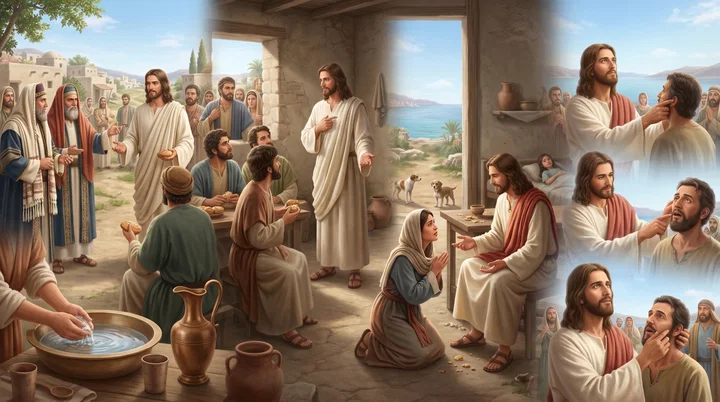
Why do thy disciples transgress the tradition of the elders? for they wash not their hands when they eat bread.
The accusation about unwashed hands prompts Jesus’ rebuke of their hypocrisy.
- Matthew 23:27
Woe unto you, scribes and Pharisees, hypocrites! for ye are like unto whited sepulchres, which indeed appear beautiful outward, but are within full of dead men’s bones, and of all uncleanness.
Christ condemns the Pharisees’ hypocrisy, contrasting outward appearance with inward uncleanness.
- Matthew 15:6
And honour not his father or his mother, he shall be free. Thus have ye made the commandment of God of none effect by your tradition.
Makes God’s commandment ineffective through human practice.
- Matthew 23:23
Woe unto you, scribes and Pharisees, hypocrites! for ye pay tithe of mint and anise and cummin, and have omitted the weightier matters of the law, judgment, mercy, and faith: these ought ye to have done, and not to leave the other undone.
Scrupulous tithing accompanies hypocrisy and neglect of weightier matters.
- Matthew 6:5
And when thou prayest, thou shalt not be as the hypocrites are: for they love to pray standing in the synagogues and in the corners of the streets, that they may be seen of men. Verily I say unto you, They have their reward.
Both texts rebuke hypocrites who make outward displays of devotion.
- Mark 7:11-12
But ye say, If a man shall say to his father or mother, It is Corban, that is to say, a gift, by whatsoever thou mightest be profited by me; he shall be free.
Gives the Corban example behind the rebuke.
- Luke 6:46
And why call ye me, Lord, Lord, and do not the things which I say?
Calling Jesus Lord is linked with doing what he commands.
- Luke 18:11-12
The Pharisee stood and prayed thus with himself, God, I thank thee, that I am not as other men are, extortioners, unjust, adulterers, or even as this publican.
The Pharisee boasts of outward religious obedience as evidence of his righteousness.
- Mark 12:38-40
And he said unto them in his doctrine, Beware of the scribes, which love to go in long clothing, and love salutations in the marketplaces,
Their showy piety and exploitation expose hypocrisy.
Commentary
Each commentary is drawn from primary sources: the writings of Ellen G. White and Adventist pioneers and periodicals. Each commentary is separate. Its own words are not a quotation; follow the references to read the source passages.
Ellen G. White
9 sources
Jesus spoke the words to a deputation of Pharisees and scribes from Jerusalem who confronted Him before the multitude to criticize His disciples for eating without ceremonial handwashing, after He had stayed away from the Passover where a trap had been laid for Him.DA 395.3–396.2Ms 65, 1897, par. 1–4DA 395.1–2 They had been sent expressly to watch Him and find ground for accusation, hoping to provoke controversy by asking why His disciples did not walk according to the tradition of the elders about washing hands, cups, pots, brazen vessels and tables, but ate bread with unwashed hands.Ms 65, 1897, par. 1–4DA 395.1–2 In answer He called them hypocrites and declared Isaiah's prophecy fulfilled in them.DA 395.3–396.2Ms 65, 1897, par. 1–4Ms 53, 1901, par. 7–9
To honor God with the lips while the heart is far from Him is hypocrisy, with outward sanctity serving only as a cloak for iniquity and outward religious form being empty without true devotion of heart.DA 395.3–396.2Ms 65, 1897, par. 1–4ST Feb 27, 189621MR 4.1–2ST Apr 9, 1912 Their hypocrisy was proved by treating numberless rabbinical rules about purification, professedly made to guard the law, as more sacred and essential than the law itself.DA 395.3–396.2 They supplemented God's commandments with a mass of wholly human oral traditions conceived by narrow minds.Ms 176, 1898, par. 16–17 The Sadducees, Pharisees and Essenes in Christ's day held controlling influence over Jewish religious belief and represent those not converted and sanctified through truth, with perverse ideas, self interwoven in all they did, not one with Christ, without active Christian fellowship, and cherishing jealousy toward any supposed not to keep the letter of the law.Ms 176, 1898, par. 16–17
When human precepts collided with the commandments given from Sinai they laid aside God's commandment to hold the traditions of men, preferring their own inventions.DA 395.3–396.2Ms 65, 1897, par. 1–4ST Feb 27, 1896 They wove human maxims into God's laws, taught human commandments as religious doctrine, occupied the people with trifling distinctions God had not required, confused them about the laws of His government, turned attention away from its great principles, and made His law and word of no effect.DA 395.3–396.2Ms 53, 1901, par. 7–9Ms 176, 1898, par. 16–17ST Feb 27, 1896ST Apr 9, 1912 A specific proof was their setting aside of the fifth commandment to honor father and mother through the Corban rule that freed a man from helping his parents.Ms 65, 1897, par. 1–4
Their self-centered, unconverted religion led them to oppose and kill the world's Redeemer over difference of opinion about senseless, unreasonable forms and minute particulars of handwashing ceremonies before eating for which they had no command from God.Ms 176, 1898, par. 16–1721MR 4.1–2 His untainted purity in life, words and works was a bitter reproof to their self-righteous uncleanness.ST Feb 27, 1896 He charged them with ignorance of the Scriptures and the power of God, condemned their pride, ambition, injustice, fraud and robbery of the poor, and exposed their evil motives to open shame.ST Feb 27, 1896 They rejected Him because He would not use divine power to free them from Rome and give temporal triumph as Israel had been delivered from Egypt but instead condemned their evil works.ST Feb 27, 1896
The same lip-honor with a far heart is seen in those who set aside the seventh-day Sabbath of the fourth commandment and uphold the man-made first-day sabbath.Ms 65, 1897, par. 7–9 They place men's commandments on a level with divine requirements and exalt a spurious sabbath above the Sabbath God blessed, sanctified, and commanded to be remembered and kept holy.Ms 65, 1897, par. 7–9 Obedience to such man-made requirements makes their worship null and void, though God bears with their ignorance until light comes to them.Ms 65, 1897, par. 7–9
Sources
Pioneers and periodicals
47 sources
Christ spoke it to the Pharisees and scribes when they charged His disciples with breaking the tradition of the elders by eating without ceremonial handwashing, a human extension of purification rules beyond the law of Moses.ST Sep 8, 1881ST Feb 10, 1898 It declares that to honor God with the lips in spoken profession while the heart is far from Him is hypocrisy, and such outward worship is empty and vain, for the heart must first be made right with God.ST Mar 28, 1906ST Jun 21, 1899RH Dec 16, 1858ST Aug 13, 1912ST Jun 8, 1915 It condemns rejecting God's commandment to preserve human tradition, thereby making His word and commandment void and ineffective when the commandments of men are taught in place of His.ST Dec 10, 1896RH May 19, 1851ST Jan 9, 1893ST Feb 6, 1907RH Jan 2, 1900 So by tradition men openly set aside the fifth commandment by withholding support from parents under a pious vow, and buried the Sabbath under rabbinical requirements while replacing what God commanded with what He never sanctified.ST Oct 7, 1897RH Oct 31, 1854RH Oct 10, 1854 The same charge falls on calling Sunday observance a divine command and making void the fourth commandment to keep human tradition, and on all cold formalism where outward practice continues without heartfelt devotion.RH Jul 13, 1905RH Oct 10, 1854ST Aug 5, 1875RH Feb 5, 1857RH Mar 2, 1905
Setting and Wording
Jesus spoke these words in the dispute over his disciples eating without ceremonial handwashing.ST Sep 8, 1881ST Feb 10, 1898RH Jan 2, 1900 The Pharisees had made washing before eating a strict requirement by extending purification rules beyond the law of Moses.ST Sep 8, 1881ST Feb 10, 1898 The defilement in question was ceremonial, not whether the food itself was proper to eat, and their forms did not make food unclean.ST Feb 10, 1898 They judged Christ and his disciples by the tradition of the elders rather than by God's law, thereby setting themselves up as judges of others by human interpretation of religious practice.ST Sep 8, 1881ST Feb 10, 1898RH Jan 2, 1900
He addressed the rebuke to Pharisees and scribes when they asked why his disciples did not walk according to the tradition of the elders. Isaiah's prophecy was applied directly to them as those who claimed to honor God while their hearts were far from him. This was his first denunciation of the Pharisees as hypocrites, and their hatred grew until they sought his death.ST Jul 14, 1898ST Jun 21, 1899 They could not accuse him of disloyalty to God's law, for he upheld it as the standard that exposed their human inventions and condemned their actions.ST Jun 21, 1899 His faithfulness and that of his followers made them unpopular because it conflicted with what people wanted from them.ST Jul 14, 1898ST Jun 21, 1899
To honor God with lips or spoken profession while the heart is far from him is hypocrisy.ST Mar 28, 1906ST Jun 21, 1899RH Dec 16, 1858RH May 19, 1851ST Apr 15, 1875 Such outward honor is empty, and worship so offered is vain, especially when human tradition is taught and followed in place of God's commandments.ST Mar 28, 1906ST Jun 21, 1899RH May 19, 1851ST Jan 9, 1893ST Apr 15, 1875 Outward religious observance cannot make worship sincere when the heart is distant from God.ST Mar 28, 1906ST Jun 21, 1899ST Jan 9, 1893 To use the charge against Sabbath-keepers who seek to obey God's commandments is contradictory, since the condemnation falls on those who reject God's commandment in favor of human tradition.ST Mar 28, 1906RH Dec 16, 1858RH May 19, 1851 Obedience to human religious rules cannot replace the word of God.ST Mar 28, 1906RH May 19, 1851ST Apr 15, 1875
The heart must first be right before God, for outward acts such as washing hands cannot make a person righteous or clean in heart.ST Aug 13, 1912ST Jun 8, 1915ST Jun 7, 1899 Treating outward observances as the way to become righteous while the heart remains far from God stands condemned, and traditions about defilement made God's word ineffective.ST Aug 13, 1912ST Jun 8, 1915 Centering religion on outward forms and human traditions such as ritual washing, while neglecting vital truth, gives no spiritual life or power.ST Aug 13, 1912ST Jun 8, 1915ST Jun 7, 1899 Religious words, rituals, and offerings do not amount to true devotion when the heart is withheld and deepest loyalty belongs elsewhere.RH Oct 14, 1858RH May 15, 1855RH Jun 4, 1867 Profession of love and worship with the lips can mask a heart estranged from God and secretly opposed to him, since slavish fear can produce outward worship without true love or trust.RH Oct 14, 1858RH May 15, 1855RH Jun 4, 1867 God wants the whole heart, so knowingly continuing in an evil habit while keeping religious ceremonies is disobedience rather than Christian obedience, and half-hearted obedience is not enough.RH Oct 14, 1858RH May 15, 1855RH Jun 4, 1867
Tradition Voids Commandment
The rebuke condemns rejecting God's commandment in order to preserve human tradition, thereby making God's word and commandment void and without effect.ST Dec 10, 1896RH May 19, 1851ST Apr 15, 1875ST Aug 23, 1883RH Oct 21, 1851 Worship becomes vain when human commandments are taught in place of God's, and such substitution is sinful, wicked and displeasing to God, marking a decline into empty forms.RH May 19, 1851ST Jan 9, 1893ST Apr 15, 1875ST Aug 23, 1883RH Oct 21, 1851 Zeal for a religious creed cannot make that worship faithful when obedience to human religious rules is put in place of God's word.ST Dec 10, 1896RH May 19, 1851ST Jan 9, 1893
The teachers had turned their backs on the true God, forgotten His law, and taught the traditions of men in its place.ST Feb 27, 1896ST May 16, 1911 They stopped their ears and hardened their hearts so they would not hear the law of the Lord, honoring Him with lips while hearts remained far away.ST Feb 27, 1896 They wove human traditions and maxims of men into the laws of God, confusing people about the laws of His government and laying aside His commandment to hold tradition.ST Feb 27, 1896ST May 16, 1911
Blind to the demands of God's spiritual law and ignorant of the Scriptures and the power of God, they called Christ a sinner and a commandment-breaker for an act of mercy in healing on the Sabbath.ST Feb 27, 1896ST May 16, 1911 At the very same time they were planning to take His life, thus calling good evil and evil good and denouncing the goodness of God as the work of the wicked one.ST May 16, 1911 His untainted purity in life, words and works was a bitter reproof to their self-righteous uncleanness, exposing pride, ambition, injustice, fraud and robbery of the poor to open shame.ST Feb 27, 1896 They rejected Him because He condemned their evil works instead of using divine power to free them from Rome and give temporal triumph as Israel had been delivered from Egypt.ST Feb 27, 1896
By tradition they openly violated the fifth commandment by teaching that goods formally devoted to sacred purposes exempted a man from supporting his parent.ST Oct 7, 1897RH Oct 10, 1854 Using a seemingly pious reason to evade honoring parents shows that religious motives cannot excuse setting aside God's command.RH Oct 10, 1854 Such teaching destroys morality at its source.RH Oct 10, 1854
They buried the Sabbath under rabbinical superstition and burdened it with traditions, and made the fifth commandment of no effect in at least one particular.ST Oct 7, 1897ST Sep 29, 1909RH May 12, 1863 Replacing the Sabbath commanded by God with a day He has not sanctified or commanded people to keep is an example of making God's command void in order to keep human tradition.ST Oct 7, 1897RH Oct 31, 1854 Typical Israel's failure over the Sabbath command illustrates the choice of human traditions over the Sabbath appointed by God.ST Oct 7, 1897RH May 12, 1863
Possessing, preserving and bringing the Scriptures and law of God to others, even as its teachers and transmitters, gives no title to the church of God when tradition is used to make them void.ST Sep 29, 1909 The Pharisees exalted human traditions above God's written word, including the prophets and the Ten Commandments.ST Feb 6, 1907RH Jan 2, 1900ST Nov 27, 1901 Their traditions were human laws in direct contravention of God's law, and this rejection of Scripture fostered unbelief and helped lead them to reject Christ.ST Feb 6, 1907ST Nov 27, 1901 They judged Christ and His disciples over handwashing before eating by the tradition of the elders rather than by God's law, thereby setting themselves up as judges of others.RH Jan 2, 1900ST Nov 27, 1901
Outward claims of love and obedience and spoken professions do not amount to true piety when the heart is far away.ST Dec 10, 1896ST Nov 20, 1884 Zeal for religious profession does not make worship faithful when God's law is set aside by human traditions and the Son is rejected.ST Dec 10, 1896ST Nov 20, 1884
Isaiah Prophecy Fulfilled
Isaiah spoke well when he described these hypocrites, and Jesus applied that prophecy to the people of his own day who claimed to honor God while their hearts were far from him.RH Feb 14, 1871RH Jul 13, 1905RH May 29, 1900RH Jul 8, 1902 The charge exposed religious teachers as hypocrites who honored God outwardly with their words while withholding the heart, surrounding God's law with traditions instead of keeping it in its original purity.RH Jul 13, 1905RH May 29, 1900 Their worship was vain because they set aside God's commandment and held human traditions in its place, teaching for doctrines the commandments of men and grounding worship on human teaching rather than God's authority.RH Jul 13, 1905RH May 29, 1900RH Jul 8, 1902 The rebuke came in answer to their challenge over the disciples not walking according to human tradition, showing that lip honor without heart nearness is hypocrisy.RH Jul 13, 1905
The verse stands as a Scripture example of prophesying, to be compared with Isaiah 29:13-21 and read alongside Jude 14-19 and 2 Peter 3:2-12.RH Feb 14, 1871 The Jews' mistake about Christ's first advent arose in the same way, through human traditions and willful ignorance of plain Scripture.ST Mar 20, 1901
It exposes formalism as the same spirit that destroyed Jerusalem in Daniel's time, that led to rejecting the Messiah and to Jerusalem's destruction by the Romans.RH Jul 8, 1902 Even while scrupulously paying tithe of mint and anise and cummin, the leaders moved to put Jesus to death to stop men believing on him and to save their place and nation.RH Jul 8, 1902 That act instead gave all men basis to believe on him, and they lost their place and nation.RH Jul 8, 1902
Scripture Authority Tested
The verse exposes honoring God with words while the heart is far from Him as hypocrisy, and in its setting Jesus applies Isaiah's prophecy to those who use human tradition to set aside God's commandment.RH May 19, 1851RH May 19, 1851RH Sep 17, 1872 It stands as a warning that obedience to human religious rules cannot replace the word of God, and that tradition must not be followed in place of God's word.RH May 19, 1851RH May 19, 1851 It belongs to Christ's challenge to teachers who put human tradition above God's written Word, calling them back to Scripture.ST Jun 30, 1914 In that exchange He exposes traditions handed down by religious elders, including religious customs and rituals, that lead people away from God's commandment and are used to alter it.ST Jun 30, 1914RH May 19, 1851RH Sep 17, 1872
The passage draws a dividing line between those who keep God's commandments and those who reject them in order to keep human tradition.RH Jul 8, 1852 The traditions of the Jewish elders at issue were human laws in direct contravention of the law of God, and Jesus disregarded them because obedience to God takes precedence over obedience to men.ST Nov 27, 1901 Refusing a human requirement that disregards God's plain commandment is therefore faithfulness to God, not anarchy.ST Nov 27, 1901
Warnings for Worship Today
Observing human traditions produces hypocrisy, for to walk according to the traditions of men is to walk away from the commandments of God. Honoring God with the mouth while the heart remains far from Him is the sure result of such observance, as when piety is borrowed for a season and fasting is made a pretense. This applies to Protestants carried away with Lent and Easter traditions.
The same charge falls on calling Sunday observance a divine command when it rests on human authority rather than God's authority, for worship built on human teachings is exposed as hypocrisy.RH Jul 13, 1905 The change of the Sabbath rests on human tradition rather than biblical command, and letting tradition replace God's commands is warned against.ST Aug 5, 1875 Exalting tradition above the Ten Commandments while offering outward worship in disobedience from the heart drew a fearful rebuke, as when goods formally devoted to sacred purposes were taught to exempt a man from supporting his parent and thus destroyed morality at its source.RH Oct 10, 1854 That rebuke applies with greater force to Protestants who, with a less venerable tradition and against greater light, make void the fourth commandment to keep their own traditions.RH Oct 10, 1854
To turn this verse against Sabbath-keepers who seek to obey God's commandments exposes a contradiction.RH Dec 16, 1858RH Dec 16, 1858 The verse condemns rejecting God's commandment in order to keep human tradition, so condemning those who obey God's commandments while accusing them of rejecting God's commandment reverses its meaning.RH Dec 16, 1858RH Dec 16, 1858 Believers who have become cold and formal are warned that outward religious practice without heartfelt devotion leaves them unprepared for God's work and coming events.RH Feb 5, 1857 Honoring God with words and public prayers is empty when the heart is far from Him, and claiming progress in the Christian life while continuing in sin without conscience shows that outward profession is not knowing God.RH Feb 5, 1857RH Mar 2, 1905
A spoken Amen should express wholehearted desire for what is good, not merely outward or intellectual assent, since honoring God with the lips is not enough when the heart is not sincerely involved.ST Aug 24, 1888 Repeatedly invoking God's name in everyday speech without heartfelt reverence is outward devotion without inward meaning, empty spoken honor with the heart far away.ST Aug 24, 1888RH Oct 15, 1908 Knowingly continuing in an evil habit while keeping religious ceremonies is disobedience rather than Christian obedience, for God wants the whole heart and half-hearted obedience is not enough.RH Jun 4, 1867 Lifeless formalism and teaching human commandments instead of God's truth are not genuine faith, since outward religious form is empty when the heart is not truly devoted to God.ST Apr 9, 1912RH Jun 4, 1867
Lip honor with the heart far from God is a worship God cannot hear and answer, leaving the worshiper in sins.RH Oct 10, 1871 Yet joined with outward keeping of the requirements of the decalogue and faithful tithing of all possessed, it can make a man outwardly honorable and moral rather than wicked.RH Oct 10, 1871 Such a man may even be better than many professing members today whose minds in worship are occupied by other things and controlled by evil.RH Oct 10, 1871
Sources