Matthew 2:3
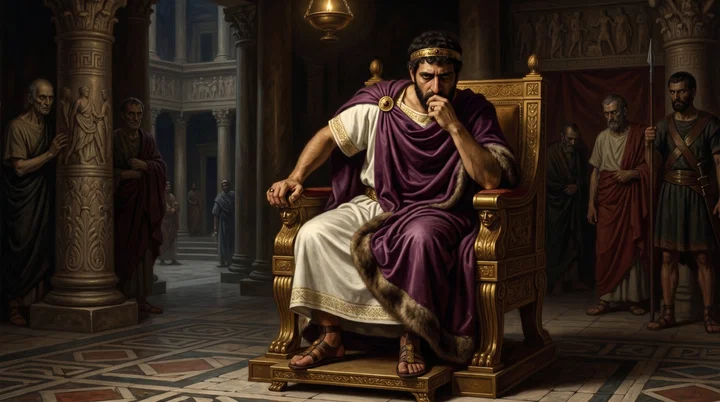
When Herod the king had heard these things, he was troubled, and all Jerusalem with him.
Translations
American King James Version, King James Version, KJV Cambridge Paragraph Bible, Webster Bible
When Herod the king had heard these things, he was troubled, and all Jerusalem with him.
Revised Version, American Standard Version
And when Herod the king heard it, he was troubled, and all Jerusalem with him.
And Herod the king having heard, was stirred, and all Jerusalem with him,
But Herod the king having heard [ of it], was troubled, and all Jerusalem with him;
But, when King Herod heard, he was troubled, and all Jerusalem with him;
When King Herod heard this, he was disturbed, and all Jerusalem with him.
When Herod the king heard this, he was disturbed, and all Jerusalem with him.
When King Herod heard it, he was troubled, and all Jerusalem with him.
And when it came to the ears of Herod the king, he was troubled, and all Jerusalem with him.
When King Herod heard this, he was troubled, and all Hierusalem with him.
Douay-Rheims (Challoner revision)
And king Herod hearing this, was troubled, and all Jerusalem with him.
Pictures
Cross-references
- Micah 5:2
But thou, Beth-lehem Ephratah, though thou be little among the thousands of Judah, yet out of thee shall he come forth unto me that is to be ruler in Israel; whose goings forth have been from of old, from everlasting.
It foretells the Messiah’s birthplace as Bethlehem.
- Matthew 2:11
And when they were come into the house, they saw the young child with Mary his mother, and fell down, and worshipped him: and when they had opened their treasures, they presented unto him gifts; gold, and frankincense, and myrrh.
The Magi find Jesus, worship him, and present gifts.
- Matthew 2:16
Then Herod, when he saw that he was mocked of the wise men, was exceeding wroth, and sent forth, and slew all the children that were in Bethlehem, and in all the coasts thereof, from two years old and under, according to the time which he had diligently enquired of the wise men.
Herod’s alarm develops into his attempt to kill the child.
- Matthew 2:13-14
And when they were departed, behold, the angel of the Lord appeareth to Joseph in a dream, saying, Arise, and take the young child and his mother, and flee into Egypt, and be thou there until I bring thee word: for Herod will seek the young child to destroy him.
Herod’s hostility prompts Joseph to flee with Jesus and Mary to Egypt.
- Matthew 2:9
When they had heard the king, they departed; and, lo, the star, which they saw in the east, went before them, till it came and stood over where the young child was.
The star leads the wise men to the place where Jesus was.
- Matthew 2:7-8
Then Herod, when he had privily called the wise men, enquired of them diligently what time the star appeared.
Herod secretly questions the Magi and sends them to find the Child, pretending he will worship him.
- Numbers 24:17
I shall see him, but not now: I shall behold him, but not nigh: there shall come a Star out of Jacob, and a Sceptre shall rise out of Israel, and shall smite the corners of Moab, and destroy all the children of Sheth.
Balaam’s prophecy of a star out of Jacob is linked to the sign seen by the Magi.
- Matthew 2:12
And being warned of God in a dream that they should not return to Herod, they departed into their own country another way.
The Magi obeyed God’s warning and did not return to Herod.
- Matthew 2:19-23
But when Herod was dead, behold, an angel of the Lord appeareth in a dream to Joseph in Egypt,
After Herod dies, the family returns and settles in Nazareth.
- Jeremiah 31:15
Thus saith the LORD; A voice was heard in Ramah, lamentation, and bitter weeping; Rahel weeping for her children refused to be comforted for her children, because they were not.
The prophecy depicts lamentation caused by Herod’s massacre of children in Bethlehem.
- Exodus 1:22
And Pharaoh charged all his people, saying, Every son that is born ye shall cast into the river, and every daughter ye shall save alive.
Pharaoh’s order to kill Israelite boys parallels Herod’s decree.
- Luke 1:32-33
He shall be great, and shall be called the Son of the Highest: and the Lord God shall give unto him the throne of his father David:
The passage contrasts Christ’s true reign with Herod’s political fears.
Commentary
Each commentary is drawn from primary sources: the writings of Ellen G. White and Adventist pioneers and periodicals. Each commentary is separate. Its own words are not a quotation; follow the references to read the source passages.
Ellen G. White
23 sources
The arrival of the wise men searching for the newborn King of the Jews made the whole nation aware of His coming and stirred excitement and public interest throughout Jerusalem.LC1 17.1–2RH Dec 24, 18721RED 17.1–2 Herod was troubled because envy and fear made him see the child as a rival with a higher claim to the throne, and as a man of alien descent hated by the people and dependent on Rome he feared losing his rule to a Jewish king.LC1 17.1–2RH Dec 24, 1872DA 61.3–62.1 He hid his alarm behind courtesy while plotting to kill Christ, and Jerusalem shared his trouble with surprise and fear but without joyful recognition, turning from shock to indifference because the people were absorbed in their own ambitions.LC1 17.1–2RH Dec 24, 1872ST Dec 5, 1916DA 61.1 The priests and rabbis had already heard the shepherds' report yet pride and envy kept them from investigating, and when the wise men's questions forced them to consider the prophecies they still refused to go to Bethlehem, and that refusal began a rejection that hardened into hatred.DA 64.3RH Dec 24, 1872ST Dec 5, 1916DA 62.4–5 God instead revealed the truth to Gentile shepherds and Eastern magi who heeded the light they had, leading students of the heavens by a star wrought by angels and by the prophecies of Scripture to worship the child in His humble birth at Bethlehem, while God watched over Jesus amid the opposition and directed His refuge in Egypt.3MR 362.1Lt 150, 1899, par. 7Lt 91, 1887, par. 13ST Dec 5, 1916DA 621.1–622.2
Herod and Jerusalem Troubled
The strangers from the East came asking where the newborn King of the Jews could be found, and their arrival made the whole nation aware that he had come and fixed attention on what was taking place.LC1 17.1–2RH Dec 24, 18721RED 17.1–2ST Jun 16, 1887DA 61.3–62.1 Their search stirred excitement and public interest throughout Jerusalem, moving the city with shock at the news.LC1 17.1–2RH Dec 24, 18721RED 17.1–2DA 61.3–62.1ST Dec 5, 1916
Herod was troubled because envy and fear made him regard the infant as a possible rival who threatened his rule.LC1 17.1–2RH Dec 24, 1872DA 61.3–62.1ST Dec 5, 1916 He saw in the child one with a higher claim to the throne, one born to rule, and feared the people might rally to him.LC1 17.1–2DA 61.3–62.1ST Dec 5, 1916 That fear was sharpened by his own position, for he was of alien descent, hated by the people, and dependent on Rome's favor for security.LC1 17.1–2RH Dec 24, 1872DA 61.3–62.1 He was opposed to the prospect of a Jewish king ruling over a temporal kingdom, and his mistaken expectation of what such a Messiah would be helped fuel the crisis.RH Dec 24, 1872RH Dec 24, 1872
He hid his distress behind apparent courtesy while he was already planning against Jesus.LC1 17.1–2RH Dec 24, 1872 His alarm did not stop at uneasiness but led him to seek to kill and destroy Christ.LC1 17.1–2Ms 147, 1906, par. 14–15RH Dec 24, 1872RH Dec 24, 1872
All Jerusalem was troubled with him, yet the news met with no joyful recognition.Ms 147, 1906, par. 14–15ST Dec 5, 1916DA 61.1DA 621.1–622.2 The questions of the visitors brought surprise and fear, mixed with contempt.ST Dec 5, 1916DA 61.1 The first shock gave way to indifference, for the Jews as a whole were so absorbed in their own ambitions that they did not recognize his coming.RH Dec 24, 1872DA 621.1–622.2
Leaders Reject, Gentiles Receive
The priests and rabbis had already heard the shepherds' report of the angels' announcement, but pride and envy led them to dismiss those reports and refuse to investigate them.ST Dec 5, 1916DA 62.4–5 When the wise men's inquiries about the newborn Messiah stirred Jerusalem, that public attention brought those same leaders to consider the prophecies concerning the Messiah and the birth that had just taken place.DA 64.3 Yet they refused to go to Bethlehem themselves, and they led the people to treat interest in Jesus as fanatical excitement and fanaticism.ST Dec 5, 1916DA 62.4–5 Their mistaken expectation of a forceful political Messiah who would rule a temporal kingdom helped fuel the crisis.RH Dec 24, 1872
That refusal was the beginning of their rejection of Christ, which hardened into hatred.ST Dec 5, 1916DA 62.4–5 While God was opening the way for the Gentiles, the Jewish leaders were shutting themselves out and closing the way to themselves.ST Dec 5, 1916DA 62.4–5 So it was the shepherds and the Eastern magi who had heeded the light they received to whom God revealed the truth.GC88 316.1 Magi from a foreign land came to worship him while Jerusalem, absorbed in its own ambitions, did not recognize his coming and missed him.DA 621.1–622.2
The verse belongs to the account of God leading wise men from the East, who were not Jews, by a star and by signs in the heavens suited to people who studied the heavens.3MR 362.1Ms 60, 1886, par. 65MR 353.1–354.1 That star was the work of angels and moved before them as they set out.3MR 362.1 The star in the East guided them to find Jesus, to the manger where he lay and to the child in Bethlehem.Lt 91, 1887, par. 13DA 770.4Ms 60, 1886, par. 6 Their study of Scripture and its prophecies had led them to recognize the time of Christ's coming.Ms 60, 1886, par. 6
They came to worship him in his humble birth, which was part of the plan of redemption as he entered human life to meet its temptations and needs.Lt 150, 1899, par. 7 They understood his exalted character, true position, and the honor due the Son of God more definitely than his own later disciples who received his instruction and beheld his mighty miracles.4RED 111.1 They bent in homage before him while he was but a babe cradled in a manger and presented him with precious gifts of gold, frankincense, and myrrh, proving that no sacrifice is too costly to offer him.4RED 111.1Ms 60, 1886, par. 6Ms 58, 1895, par. 4–6 Their arrival and search made the nation aware of his coming and focused attention on what was taking place, and amid the opposition their news stirred, God watched over Jesus.ST Jun 16, 1887 He directed Joseph to take him to Egypt for refuge, where the family found safety and where the gifts from the wise men helped sustain them.ST Jun 16, 1887
Sources
Pioneers and periodicals
93 sources
When the wise men came to Jerusalem asking for the newborn King of the Jews whom they had come to worship after seeing his star, Herod the king was troubled, and all Jerusalem with him.ST Jul 2, 1894ST Dec 3, 1896ST May 25, 1915
Herod was troubled because in envy and fear he saw the child as a rival threatening his throne, and that alarm soon led to his decree and violence against the children.RH Dec 24, 1872ST Jul 2, 1894ST Feb 2, 1915
He hid his intent behind courtesy, calling the visitors secretly and sending them to Bethlehem to bring word of the child's whereabouts while pretending he wanted to find him to worship him.RH Dec 24, 1872ST Jun 16, 1887ST Dec 2, 1880
Jerusalem, where above all cities the birth should have produced joy and eager welcome, was instead thrown into excitement, fear and wrath rather than welcome.ST Dec 5, 1916ST Dec 2, 1880RH May 30, 1865
The priests could name Bethlehem from prophecy and so enabled the wise men to find the infant, yet they did not recognize or believe he was the promised Messiah, and through Herod pagan Rome stood ready to devour Jesus as soon as He was born.ST Dec 13, 1883ST May 20, 1897ST Jan 24, 1906ST Dec 22, 1881RH Dec 2, 1909
Setting and Sequence
When Herod the king heard the wise men from the east asking where the newborn King of the Jews was because they had seen his star and had come to worship him, he was troubled, and all Jerusalem was troubled with him, for the report announced a rival king.ST Jul 2, 1894ST Dec 3, 1896ST May 25, 1915 The widespread expectation of the Messiah together with their arrival and search for the infant Messiah stirred the city, producing excitement rather than welcome, for the visitors expected the Jews to know his coming was near.ST May 25, 1915ST Dec 2, 1880ST Mar 15, 1910 Their announcement that they had come seeking and worshiping Jesus as King of the Jews caused great excitement, and Herod was deeply troubled but concealed his distress and received them with apparent courtesy.ST Jun 16, 1887
The consultation belongs to their arrival in Jerusalem to seek the Messiah, and it took place there with the king and the chief priests.ST Jun 16, 1887 They reasoned that the Jews could not be unaware of his coming and made inquiries near Jerusalem after the star stopped guiding them, so the star was not visible while they were consulting with the king.ST Jun 16, 1887 Men guided by the star thus came to Jerusalem and there inquired for Christ, then went from there to Bethlehem where they found Jesus, worshiped him and gave him gifts.ST Sep 17, 1894GSAM 60.1 They had come to Jerusalem seeking the newborn King before continuing to Bethlehem where they found and worshiped him, then returned to their own country another way because of the warning God gave.ST Sep 17, 1894GSAM 60.1
The Magi arrived several weeks after the birth and found him in a house, and they did not see him until he was more than a month old.ST Dec 20, 1910ST May 15, 1907 Their visit came after he was forty days old and presented according to the law, when Joseph and Mary had gone back to Bethlehem and the visitors found them there, and the gifts came sometime in the month following his birth.RH Jun 16, 1874ST Dec 20, 1910ST Dec 20, 1910 Matthew gives their story rather than the shepherds' visit because his account was suited to readers especially interested in the Magi.ST May 15, 1907 The visit comes before Joseph takes Jesus and his mother to Egypt.ST Dec 20, 1910
After the wise men found Jesus and his family in Bethlehem, Joseph fled with them to Egypt at God's warning and remained there until Herod died.ST Jun 5, 1879RH Dec 22, 1868RH Jun 16, 1874 Herod's trouble at their news led to that warned flight, and afterward fear of staying in Bethlehem turned Joseph aside to his old home in Nazareth, which is the return to Nazareth Luke records.RH Dec 22, 1868RH Jun 16, 1874 Luke passes over all these events between the presentation and the return to Nazareth.ST Jun 5, 1879RH Jun 16, 1874 Herod's hostility also led to the massacre of children at Bethlehem.
The Herod troubled here is Herod the Great, distinguished from the later rulers in the Herodian family, a cruel ruler and a Roman-appointed king ruling Judea.ST Oct 6, 1914 He was a subject-king of Rome and a governor holding office under its jurisdiction when Rome ruled over all the earth, instigated by the devil to slaughter the children in hope of killing Jesus.ST Mar 5, 1912RH Mar 31, 1874 His rule and the later removal of Judea's kingly power by pagan Rome illustrate the loss of that form of government at Christ's first advent. He died a few days before Passover in the latter part of March in 4 B.C., so Jesus was born sometime before then.ST Oct 6, 1914
Herod's Fear of Rival
Herod was troubled when he heard the wise men ask where the newborn King of the Jews was, because the report announced a rival king threatening his throne.RH Dec 24, 1872ST Jul 2, 1894ST Feb 2, 1915 His alarm arose from envy and fear that the child would threaten his power, and being troubled by the predicted power of the child he regarded as a rival, he sought to have him killed as Satan's agent.RH Dec 24, 1872ST Feb 2, 1915ST Oct 2, 1893 His fear soon led to his decree against the children and to search and violence against them, even to the slaughter of Bethlehem's children to destroy his one rival.ST Feb 2, 1915ST Nov 15, 1910 The infant whom he sought to kill is the same Jesus of Nazareth who later healed the sick and was recognized as the Messiah.
He concealed his distress and alarm behind apparent courtesy while planning against Jesus, receiving the visitors with outward courtesy though deeply troubled.RH Dec 24, 1872ST Jun 16, 1887ST Dec 2, 1880 He secretly planned to kill the child while pretending he wanted to find him to worship him, his expressed desire to worship being a wicked ruse as his subsequent course proved.RH Dec 24, 1872ST Jul 10, 1901ST Jul 30, 1912 He secretly called the eastern visitors to his presence rather than publicly, lest he appear in the eyes of the people to pay heed to strangers, demanded of the learned men where the prophets said Christ would be born, and when they answered Bethlehem of Judea he sent the Magi to seek the young King there.ST Mar 1, 1910ST Jul 30, 1912 He charged them to bring him word of His exact whereabouts when the Child was found so he might join them in worship.ST Mar 1, 1910ST Jul 30, 1912
He was base and ambitious, and cruel, vindictive, licentious and beastly, so jealous that though an old man he feared a babe.ST Jul 30, 1912ST Aug 6, 1912 His disposition was such that he would slay a multitude of children to make sure of destroying his one Rival.ST Aug 6, 1912 He saw the child as a possible rival with a higher claim to the kingdom, since he was born to rule, and feared that the people might support him and threaten his throne.ST Dec 5, 1916ST Aug 6, 1912 He understood Christ's kingship as a temporal rule that would threaten his own power and opposed the prospect of a Jewish king ruling over a temporal kingdom, while the religious leaders also presented Christ as a temporal prince destined to rule over every kingdom and nation.ST Dec 5, 1916RH Dec 24, 1872ST Jun 16, 1887
He was unprepared for the birth of the King of the Jews, knowing it meant a soon change of rule and authority in Jerusalem even while the King was yet a child, that his days were numbered, and that he would have to relinquish his reign and submit to a new governor in Judea.RH May 30, 1865 This would cut short his days of sinful pleasures and overturn his worldly schemes and hopes.RH May 30, 1865 As the agent of the dragon Rome, his trouble was Rome's trouble, for Rome was not ready to give up Judea as a Roman province nor to be dethroned at its capital and deposed of its possessions throughout the world, because Rome understood the prophecies that His dominion would be not only on the throne of David in Mount Zion but from sea to sea and unto the ends of the earth, so the dragon stood ready to devour the child as soon as it was born, and nothing so alarmed the Roman world as proof from the Scriptures and the history of Christ that there was indeed another King, one Jesus.RH May 30, 1865 All Jerusalem with him means the Jewish nation and church were also unready, for by rebellion and sin their government was broken and subjected to Rome, yet they had not repented but had concluded to submit to Caesar, and they knew if their King was born He would rebuke and destroy sinners out of Zion, bring sooner or later a collision between the restored kingdom of Israel and Rome, and come near in swift judgment against sorcerers, adulterers, false swearers, and those that oppress the hireling, widow, fatherless, and stranger, and being far from prepared for that fiery ordeal they were seized with consternation when the wise men brought knowledge of His predicted star.RH May 30, 1865
God providentially led the wise men to the king even though Herod did not know who Jesus was, and Herod's position and the privilege of hearing the news gave him opportunity, light and a choice to learn of Jesus and receive him.ST Dec 23, 1897 His alarm arose because he thought his throne was in danger.ST Dec 23, 1897 His anxiety was then expressed publicly when he and the people of Jerusalem were troubled at the inquiry about the newborn King.ST Dec 11, 1893 His fearful hostility would brook no rival and he was thought to be plotting the child's death, which made the child's protection necessary, though Jehovah would preserve His Anointed.ST Dec 11, 1893ST Mar 8, 1910
Jerusalem and Leaders Unprepared
The report that the newborn King had been sought in Jerusalem stirred the city to excitement rather than welcome, and Herod and all Jerusalem were troubled and made angry by the news that the star had appeared showing the Messiah had been born.ST Dec 2, 1880RH May 30, 1865ST Dec 25, 1901 That trouble was wrong, for every Jew should have been glad, expectant and eagerly waiting to welcome the King, and above all cities Jerusalem should have met the birth of the King of Israel with joy and gladness instead of surprise, fear, contempt, consternation and wrath.ST Dec 5, 1916RH May 30, 1865ST Dec 25, 1901 The Jews had professedly been looking and hoping for their long-predicted King, yet his birth produced consternation where it should have produced joy.RH May 30, 1865
No one in Jerusalem wanted Christ any more than in Bethlehem, for the wise men brought glad tidings that he was born King of the Jews and the city was troubled instead of receiving him with joy.RH Aug 17, 1876 The excitement in Jerusalem reflected shock at the wise men's search, while the people and leaders otherwise showed indifference, suspicion and envy and were uninterested and not joyful about his advent.RH Dec 24, 1872ST Jun 16, 1887ST Jun 16, 1887 This indifference and lack of joy proves the Jews would not have given him a glorious reception even if they had known he was the Messiah, and Herod hunted his life as if he were a terrible murderer so that his parents had to flee with him into a foreign land.RH Aug 17, 1876
The Jewish leaders could identify Bethlehem from prophecy about the Messiah's birth, and their instruction enabled the wise men to find the infant Saviour in Bethlehem where the chief priests had said he was to be born.ST May 20, 1897ST Jan 24, 1906RH Dec 2, 1909 Yet they did not recognize or believe the child born there was the promised Messiah, and they had no light to give until Herod asked where the child was to be born and did not believe Jesus was that child.ST May 20, 1897
The Jewish people were absorbed in their own ambitious plans and did not know of his coming, because they were not studying the prophecies of the momentous events about to take place and did not know the time of the Messiah's advent and were unprepared to receive him.ST Mar 26, 1912ST Jul 1, 1897ST Apr 12, 1905 Therefore the communication that should have been given to priests and rulers was given instead to humble shepherds, who were guided to the birthplace of Christ and worshiped him, while the magi from the East also came with gifts, frankincense and myrrh.ST Mar 26, 1912ST Jul 1, 1897 The star and the heavenly hosts recognized Christ, while the priests and rulers were blind and later rejected evidence of his divinity.ST Jul 25, 1878
The priests expected the Messiah to take David's throne by force, free the Jews, restore their privileges, and rule as a temporal prince over every kingdom and nation.ST Jun 16, 1887ST Jun 16, 1887 Herod understood Christ's kingship in the same temporal sense as a threat to his own power and was determined to thwart and destroy him as soon as he could find him, while the leaders' mistaken expectation of a forceful political Messiah helped fuel the crisis.RH Dec 24, 1872ST Jun 16, 1887ST Jun 16, 1887 With only scant knowledge of the Hebrew Scriptures the wise men were ready to follow the star, while the Jewish people, captivated by Grecian and Roman philosophy, let a groundless desire for a national hero to deliver them from Rome's political supremacy eclipse the true spiritual significance of his humiliation and death.ST May 19, 1909 They failed to discriminate between the prophecies pertaining to his first advent in lowliness, suffering and death and those pointing to his second coming as a deliverer from earthly oppression.ST May 19, 1909
News of Jesus' birth and the prophecies about him had reached Jerusalem, so the people had opportunity to learn and verify where he would be born, and the contrast between the wise men who recognized and worshiped Christ and the Jewish people who had received greater spiritual light exposes the failure of those expected to be ready.ST Dec 3, 1896ST Jul 2, 1894 Pride and self-sufficiency led the leaders to reject Christ because he came in a lowly manner and not through the people or circumstances they preferred, and rejecting God's truth meant rejecting Christ.ST Jul 2, 1894 Those given much light are accountable to live by it, otherwise their light becomes darkness and the work of heralding Christ may be entrusted to others.ST Dec 3, 1896
The news of the Messiah's advent troubled the Jews and made his coming an unwelcome truth to them, for truth is not determined by the majority but was received by a few wise men, shepherds and common people while the majority of the religious community was mistaken and opposed him.ST Mar 19, 1885RH Jun 8, 1869 The priests and rabbis had already heard the shepherds' report but pride and envy led them to dismiss it, and when the wise men came the leaders refused to go to Bethlehem and led the people to treat interest in Jesus as fanatical excitement.ST Dec 5, 1916 Their refusal began their rejection of Christ and hardened into hatred, while God was opening the way for the Gentiles and the Jewish leaders were closing the way to themselves.ST Dec 5, 1916 The sacrifices and typical services, the prophecies of the introductory and progressive work and closing scenes of the first advent, and the definite time of the seventy weeks marking the close of the Jewish dispensation and the anointing of the Most Holy by Christ's atoning sacrifice for iniquity and everlasting righteousness, gave the first house of Israel every facility to know the time of their visitation.RH Nov 3, 1874 They should have searched the sure word and hailed the babe of Bethlehem with joy with Simeon and Anna and the wise men in the East and become partakers and heralds of the blessing, but instead they looked to Abraham as their father, rejected the light, clung to types and shadows, sank in culpable neglect, darkness and criminal unbelief, and at last clamored for the blood of the Son of God, so Christ became to them a stumbling stone and rock of offense and their house was left desolate.RH Nov 3, 1874
Wise Men and Providence
The magi who troubled Herod by their inquiry were a learned and influential priestly class versed in philosophy and astronomy, with Daniel once placed at their head, and some among them were worshipers of the true God.ST Sep 11, 1901 Though they were non-Jews regarded by the Jews as heathen, they shared the Gentile expectation of the promised Deliverer and responded to God's drawing in seeking Him.RH May 10, 1915ST May 8, 1907 They followed the light they had more faithfully than the Jews followed their greater light.ST May 8, 1907
They belonged to the very few then living in vital union with God, Spirit-filled and Spirit-guided in studying the many Messianic predictions until they saw the time fulfilled and the Redeemer at the door.ST Jul 30, 1912 With Simeon, Anna and many others they therefore recognized and hailed Him as the Seed of the woman, the Desire of Ages, the Son of the living God.ST Jul 30, 1912 Belief in God's word enabled them to recognize the Saviour where others saw only an ordinary man, for only a few saw the sign and knew who Christ was.ST Mar 24, 1914 The shining star that guided them to Jesus and His mother in Bethlehem was a glorious company of angels.ST May 8, 1907 The first coming was very extensively known beforehand over the known world through the dispersion of the Jews among the nations even beyond the Roman Empire, while the star pointed out the precise time and showed the way.RH May 5, 1863
God is no respecter of persons and reveals Himself regardless of station, revealing His truth to earth's great men if equally humble and teachable as readily as He revealed the blessed evangel to the meek and lowly shepherds of Bethlehem by angels.ST Jul 30, 1912 Crowned sages and humble shepherds knelt before the child as their common King, showing social rank a temporary distinction and equal worth of every class before Christ.RH Dec 11, 1856RH May 28, 1861 The wise men recognized His exalted position and the honor due Him, bringing precious gifts and bowing in homage while He was still a baby in a manger, with frankincense and myrrh among their offerings.ST Oct 9, 1879ST Mar 26, 1912ST Jul 1, 1897 The wise men from the East at the beginning and the Greeks from the West at the close alike represent the nations, tribes and peoples awakening to their need of a power out of and above finite power and coming to see Jesus.ST Mar 26, 1912ST Jul 1, 1897
Their arrival and search made the nation aware of His coming, focused attention on the important events taking place, and stirred opposition.ST Jun 16, 1887 The threat against Jesus belonged to Satan's effort to destroy the promised Deliverer, like Pharaoh's earlier decree against the Hebrew boys, but God watched over Jesus and preserved Him to fulfill His purpose.ST Jun 16, 1887ST Mar 30, 1904 He directed Joseph to take Him to Egypt for refuge, where the gifts from the wise men helped sustain the family.ST Jun 16, 1887 The danger surrounding the infant did not disturb the peace of the manger, for Jesus was safe from Herod, and those who trust in Him are safe from sin and every assault.RH Jan 6, 1903
Prophecy Fulfilled in History
The account belongs to the birth narrative that identifies Jesus with the Jewish people as born in Bethlehem of David's line, and setting it aside would require rejecting other Scriptures affirming his descent from David according to the flesh.ST Sep 29, 1909ST Jan 2, 1879 It fulfills Micah's prophecy that Christ would be born in Bethlehem.ST Jan 2, 1879 It points to Bethlehem as the place where heaven met earth, greater than princely Tyre, Sidon, Rome, Babylon, hundred-gated Thebes, and Athens with its wisdom and art, because the rod from Jesse's stem sprang from there and Jacob's star first shone there.RH Dec 19, 1865 It belongs to the account of Jesus' birth at Bethlehem where a mysterious star guided wise men from the East to the infant Jesus.RH Jul 20, 1905 It belongs to the account of the visit of the wise men to the Christ-child, who was born in Bethlehem and laid in a manger because he had no other bed.ST Mar 16, 1904
Jeremiah's prophecy concerned the killing of the little children in Bethlehem, who were the first martyrs for Jesus, and though they were cut off in death they will come again through the resurrection.ST Feb 11, 1886 The hostility aroused led to the massacre of children at Bethlehem and the flight of Jesus and his parents into Egypt. News of the newborn King of the Jews troubled Herod and stirred alarm in Jerusalem, and Herod's fear led to the search for the child and the violence against children described in the surrounding account.ST That violence came after Herod was deceived by the wise men, followed by the reappearance of the angel to Joseph and the resulting flight into Egypt.ST Jul 16, 1885
Jesus appeared when there was a general and widespread expectation of the Messiah, and the troubling of Herod and all Jerusalem at news of the newborn king of the Jews is part of the account supporting that claim.RH Nov 18, 1862 As the time drew near for God to accomplish his promise, many in Israel who had faith in God were impressed by his Spirit and the light of his word that the coming of the Messiah was very near.RH Aug 17, 1876 The alarm arose amid a widespread expectation in the East that an extraordinary ruler would arise in Judah and establish a kingdom over the world, and Herod feared the loss of his throne, a fear that led to the murder of Bethlehem's children.RH Feb 11, 1915
The facts of the Saviour's birth were already recorded in New Testament books existing about A.D. 176 and were quoted by an enemy of Christianity from those writings themselves.ST Jul 16, 1885 The facts noticed then include the star seen at his birth, the adoration paid to the newborn Saviour by the Magi at Bethlehem, Herod's murder of the infants after being deceived by the wise men, and the reappearance of the angel to Joseph with the resulting flight into Egypt.ST Jul 16, 1885 The correspondence shows the books then referenced are the identical books now possessed.ST Jul 16, 1885
A literal star led the wise men to the infant Saviour at his first advent.ST Feb 10, 1898RH Aug 18, 1874 That guiding light heard by Herod in the wise men's report of the light that guided them from the East to Jerusalem was not Halley's Comet and was not any comet or fixed star, for the Biblical account is contrary to a comet or star acting as the guide, while a meteor would have some ground. The star led the seers to the manger, and the star and the heavenly hosts recognized Christ, while the priests and rulers later rejected evidence of his divinity.ST Jul 25, 1878 The wise men followed a remarkable star to Bethlehem where they honored the newborn Christ, in contrast with the Pharisees' blindness to the prophecies' fulfillment.ST Feb 10, 1898 That literal heavenly guidance was given in connection with Christ's coming, just as the sun, moon, and stars did not shine for three days when God's judgments fell on Egypt and just as the sun was darkened and the earth was robed in gloom while Christ hung on the cross, and it shows how proper it is for literal signs in the sun, moon, and stars to appear before the second coming of Christ and the day of wrath.RH Aug 18, 1874
Dragon as Pagan Rome
Pagan Rome stood ready to devour Jesus as soon as He was born, acting through Herod as its representative and governor holding his office under the jurisdiction of Rome when Rome ruled over all the earth.ST Dec 13, 1883ST Dec 22, 1881RH Mar 31, 1874 When Herod heard the news about the newborn Christ he was troubled, and Jerusalem was troubled with him, and that troubling belongs to a Roman ruler seeking Christ's life soon after His birth.ST Dec 13, 1883RH Jun 22, 1916RH Mar 31, 1874 This is the dragon standing before the woman, the church, to devour her child as soon as He was born, with pagan Rome acting through Herod to threaten Christ at His birth in opposition to Christ and His church.RH Mar 31, 1874 This identifies the great red dragon with seven heads and ten horns in Revelation 12 as Rome, and since Rome in the time of Christ was pagan before the church obtained supremacy, it is pagan Rome and not the Catholic church.ST Dec 22, 1881 It likewise proves the man-child is Jesus Christ, who was delivered out of Herod's hand and afterward was caught up unto God and to His throne and is soon to rule all nations with a rod of iron.ST Dec 22, 1881RH Mar 31, 1874
Troubled by the predicted power of the child he regarded as a rival king, Herod sought to have Him killed.ST Oct 2, 1893ST Mar 5, 1912 Though a subject-king of Rome, he was instigated by the devil and acted as Satan's agent in the slaughter of the children in hope of killing Jesus.ST Oct 2, 1893ST Mar 5, 1912 His stated wish to worship the Child concealed a secret intent to kill, for although the visitors believed him he intended destruction.ST Oct 2, 1893ST Jan 18, 1899 He was determined to thwart and destroy Christ as soon as he could find Him.ST Mar 5, 1912ST Jun 16, 1887ST Jan 18, 1899
Herod the Great was a Roman-appointed king ruling Judea when Christ was born, and his rule with the later removal of Judea's kingly power by pagan Rome illustrates the loss of that form of government at Christ's first advent. He is named among those who set themselves against the truth, and like them he died while the word of God stands.ST Jul 15, 1908
Warning and Application
The birth of the King of Israel produced consternation and wrath in Jerusalem, the very city where above all others it should have produced joy and gladness, even though the Jews had professedly been looking and hoping for their long-predicted King.RH May 30, 1865 That same alarmed and hostile reaction to good news is repeated when unmistakable evidence is given to the church and world that the King of kings and Lord of lords is about to appear to organize and set up His kingdom to rule over all the earth in equity and righteousness and peace forever, though His coming and kingdom is professedly the desire of all nations and of the church.RH May 30, 1865
The announcement that troubled Herod and all Jerusalem led to the order to kill the children in Bethlehem.RH Jan 8, 1857 The birth and holy life of Jesus thus stirred opposition, and faithful devotion to God and obedience to His commandments likewise provoke hostility against God's people.RH Jan 8, 1857 The remnant's faithful response to Jesus' counsel to the Laodicean church is connected with the opposition that will lead to a decree against the saints.RH Jan 8, 1857 The disappointment of those who came seeking Christ at His birth is like the disappointment of those who expected Christ to come in 1844.ST Jan 16, 1893
The troubling news of Jesus' birth as the Messiah was a sign that the Jews could have recognized as evidence of His identity.RH Mar 17, 1859 Herod was troubled because he feared the newborn King of the Jews threatened his rule, and Jerusalem shared the alarm, while the birth prophecies and signs also awakened hope in those waiting for the Messiah.RH Mar 17, 1859RH Dec 1, 1859 The account of the Magi gives no support for the later doctrine of Mary's immaculate conception.RH Feb 28, 1871 The wise men were not astrologers, for God did not reveal Christ's birth through pagan star-worship or an idolatrous philosophy of the stars.
Eastern magi who had long watched for the glorious star of prophecy beheld its earliest beams with joy and followed its mild radiance till they found the full-orbed Sun of righteousness, the perfect embodiment of God's boundless love combining all the fullness of the Deity with weak and frail humanity. There shepherds startled from watching their flocks and led by angels singing glory to God on high and on earth peace, good will to men met the sages led by the star and poured their treasures at the Saviour's feet in the cold dark stable made aglow with heavenly light.ST Dec 15, 1909 He accepted for lost Adam's race an earthly destiny of toil and weariness and pain to open a way to everlasting life. The wisest princes of the earth came from afar bringing gold and incense with only a gleaming star for guide, and that strange birth of the Babe at Bethlehem brought heaven down to earth and blessed the spot trod by Emmanuel, the Christ of God.ST Jun 30, 1909 It was a night when voices of the sky hymned peace on earth to shepherds, when a clear shining light shed heaven's glory around palms and streams and on the shepherd's head, and when a star led to Him whose love brought down man's free ransom, a night of hope, joy, and faith whose voices, light, and star still speak and guide.ST Dec 15, 1909
Sources