Matthew 20:4
And said unto them; Go ye also into the vineyard, and whatsoever is right I will give you. And they went their way.
Translations
And said to them; Go you also into the vineyard, and whatever is right I will give you. And they went their way.
And said unto them; Go ye also into the vineyard, and whatsoever is right I will give you. And they went their way.
and said unto them; Go ye also into the vineyard, and whatsoever is right I will give you. And they went their way.
And said to them, Go ye also into the vineyard; and whatever is right, I will give you. And they departed.
Revised Version, American Standard Version
and to them he said, Go ye also into the vineyard, and whatsoever is right I will give you. And they went their way.
and to these he said, Go ye — also ye — to the vineyard, and whatever may be righteous I will give you;
and to them he said, Go also ye into the vineyard, and whatsoever may be just I will give you. And they went their way.
and, to them, he said—ye also, go your way into the vineyard, and, whatsoever may be right, I will give you;
Berean Standard Bible, Majority Standard Bible
‘ You also go into my vineyard,’ he said, ‘ and I will pay you whatever is right.’
He said to them, ‘ You also go into the vineyard, and whatever is right I will give you.’ So they went their way.
And he said to them, Go into the vine-garden with the others, and whatever is right I will give you. And they went to work.
And sayd vnto them, Goe ye also into my vineyard, and whatsoeuer is right, I will giue you: and they went their way.
Douay-Rheims (Challoner revision)
And he said to them: Go you also into my vineyard, and I will give you what shall be just.
Pictures
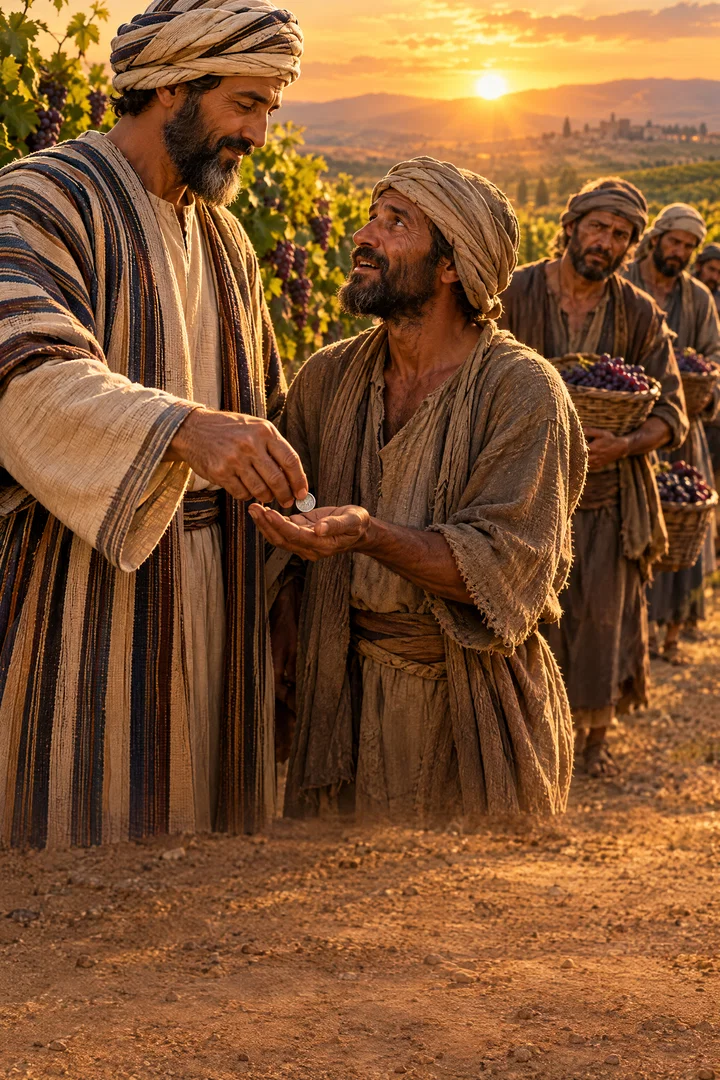

Cross-references
- Matthew 20:8-16
So when even was come, the lord of the vineyard saith unto his steward, Call the labourers, and give them their hire, beginning from the last unto the first.
The vineyard workers receive their promised reward, and the master defends his generous fairness.
- Matthew 9:37-38
Then saith he unto his disciples, The harvest truly is plenteous, but the labourers are few;
Both describe the plentiful harvest and the need for workers.
- Matthew 21:28
But what think ye? A certain man had two sons; and he came to the first, and said, Son, go work to day in my vineyard.
Both call people to go and work in the vineyard.
- Matthew 19:27-30
Then answered Peter and said unto him, Behold, we have forsaken all, and followed thee; what shall we have therefore?
The parable continues Jesus’ answer to Peter’s question about the reward for following him.
- Matthew 20:16
So the last shall be first, and the first last: for many be called, but few chosen.
The vineyard workers’ motives accompany the reversal of first and last.
- Matthew 20:15
Is it not lawful for me to do what I will with mine own? Is thine eye evil, because I am good?
The owner asserts his right to do as he wills with his own.
- Matthew 19:30
But many that are first shall be last; and the last shall be first.
parable illustrates that saying
- Revelation 22:12
And, behold, I come quickly; and my reward is with me, to give every man according as his work shall be.
Christ gives each person a reward according to their work.
- Matthew 20:8
So when even was come, the lord of the vineyard saith unto his steward, Call the labourers, and give them their hire, beginning from the last unto the first.
The parable places the day’s end at evening.
- Matthew 20:13
But he answered one of them, and said, Friend, I do thee no wrong: didst not thou agree with me for a penny?
The master defends the agreed penny.
- Matthew 16:27
For the Son of man shall come in the glory of his Father with his angels; and then he shall reward every man according to his works.
The righteous are repaid according to their works.
- Luke 10:7
And in the same house remain, eating and drinking such things as they give: for the labourer is worthy of his hire. Go not from house to house.
Says the laborer is worthy of his hire.
Commentary
Each commentary is drawn from primary sources: the writings of Ellen G. White and Adventist pioneers and periodicals. Each commentary is separate. Its own words are not a quotation; follow the references to read the source passages.
Ellen G. White
128 sources
In the parable of Matthew 20:1-16 the householder goes to the marketplace at the third hour, finds men idle because no one had hired them, promises to give them whatsoever is right without naming a fixed sum, and they go into the vineyard to work.Ms 87, 1899, par. 1–3Ms 23, 1908, par. 33–36RH Jul 31, 1900ST Aug 9, 1899 The vineyard is the Lord's work and kingdom and the world, and the householder's dealing pictures God's dealings with humanity by the principles of His kingdom and not by human standards.COL 396.3–397.1Ms 29, 1911, par. 664T 518.1–23T 121.1–2 The workers who are accepted trusted his goodness and fairness, asked no questions about wages and left payment to his judgment, and their reward is measured by grace as a gift and not as a debt earned by length, amount or visible results of labor.COL 390.1COL 396.3–397.1RH Jul 24, 1900ST Jul 13, 1915COL 401.2–402.1 Those hired first who bargained for fixed terms and then grumbled at the equal penny show the hireling spirit that treats long service as entitling to greater payment and preference, and finds itself last.RH Jul 24, 1900RH Jul 31, 1900COL 399.5–401.1ST Jul 13, 1915Ms 87, 1899, par. 10 No one is to remain idle, for Christ still calls every man, woman and youth into service until the last hour, so that even penitent late workers and eleventh-hour believers in the closing work receive the same eternal reward.RH Jul 24, 1900RH Mar 24, 19104T 518.1–2SBAWP 10.3–11.1Lt 123, 1897, par. 24–28
Parable Context and Symbols
The saying belongs to the parable of the workers hired for the vineyard in Matthew 20:1-16, which continues the answer given to the rich young man and to Peter's question about the reward of leaving all to follow Christ in Matthew 19:16-30, Mark 10:17-31, and Luke 18:18-30.COL 390ST Aug 9, 1899 The picture is rural field labor, a lone laborer with a long-handled hoe working the soil in a fenced field among trees and crops.COL 390
The householder went out again to the marketplace at about the third hour, where men customarily waited to be hired, and found workers standing idle without employment.ST Aug 9, 1899RH Jul 24, 1900 They were idle because no one had hired them, not because they had refused a morning call.Ms 87, 1899, par. 1–3RH Jul 31, 1900 He invited them into his vineyard with the promise to give them what was right, and they trusted his offer and went to work.Ms 87, 1899, par. 1–3RH Jul 24, 1900
The vineyard is a figure worth studying in the Saviour's parables, and it represents the world.FE 512.4Ms 99, 1907, par. 3 It also represents the Lord's work and service, His kingdom and cause and church, purchased by His blood and suffering and to be advanced with entrusted means and abilities.4T 518.1–23T 121.1–23T 159.2Lt 1, 1883, par. 60–63 To go into it is to consecrate mind and strength to God rather than to self and property, to study Scripture and grow in spiritual knowledge, to walk in the light from one degree to another, to warn sinners and win souls and point the unbelieving and desponding heavenward.3T 159.2
The householder's treatment of the workers represents God's dealings with the human family.COL 396.3–397.1Ms 29, 1911, par. 66RH Jul 24, 1900 Those dealings follow the laws and principles of His kingdom and not human standards or opinions, for His thoughts and ways are higher.RH Jul 24, 1900Ms 87, 1899, par. 8–9 In the parable the steward who carries out the settlement represents Christ.Ms 87, 1899, par. 10
The call into the vineyard could come at different times, even near the end of the working day.Ms 19, 1897, par. 38–41 Those hired at different times under this arrangement later received the same penny, including those called earlier and later than these.Ms 23, 1908, par. 33–36RH Jul 24, 1900 Those who had labored longer then objected to sharing the same wage.RH Jul 24, 1900
Invitation and Trusting Acceptance
The householder freely offers work in his vineyard and promises to give those he hires whatsoever is right, a fair and just reward, without naming a fixed amount.Ms 23, 1908, par. 33–36RH Jul 24, 1900Ms 29, 1911, par. 65Ms 29, 1911, par. 67 They accept the work on his word and go, trusting that he will deal fairly rather than insisting on a set wage.Ms 23, 1908, par. 33–36RH Jul 24, 1900Ms 29, 1911, par. 65 The invitation is a call to serve in the Lord's work, where laborers are to depend on God and cooperate with Him in love rather than set their own estimate on their service, seek self-exaltation, or work merely for wages and human praise.RH Jul 24, 1900Ms 29, 1911, par. 65RH Jul 31, 1900 Christ in this warns His servants not to bargain for a fixed wage as though He would deal unfairly, for He values the spirit in which work is done, and those who grumble over His dealings show a heart that needs changing.RH Jul 24, 1900Ms 29, 1911, par. 65 Their pay is afterward shown to be the same penny given to workers hired earlier and later, rewarded according to his generous purpose rather than the amount of work done.Ms 23, 1908, par. 33–36Ms 29, 1911, par. 67
The workers hired later trusted the householder's justice, goodness and fairness, asked no questions about wages, left payment to his judgment, and did not bargain for a fixed wage or preference.COL 396.3–397.1RH Jul 24, 1900ST Jul 13, 1915COL 397.2–398.1COL 396.1–2 Their trust was rewarded according to his generous purpose and not according to how much they had worked, and his treatment of them pictures God's dealing with people.COL 396.3–397.1ST Jul 13, 1915COL 396.1–2 He deals with people in ways that develop their moral and spiritual abilities, judging service not by the amount of labor or its visible results but by the spirit brought to the work.RH Jul 24, 1900COL 397.2–398.1 The last workers hired are placed first because they bring faith to their labor, and the workers hired earlier would also have remained first had they worked with loving trust.RH Jul 24, 1900 Their thankful, humble service shows the spirit God desires in His servants, who are to labor in confidence in His justice and not as hirelings seeking reward in proportion to their work.COL 397.2–398.1COL 396.1–2 So the poor sinner who enters Christ's service late, expecting little and grateful simply to be accepted, may receive far more than expected, rejoicing in the privilege and working from gratitude and not chiefly to gain a reward.RH Jul 24, 1900COL 397.2–398.1
They accepted the invitation and went their way into the vineyard to work.9T 73.3–74.1Ms 87, 1899, par. 1–3Ms 23, 1908, par. 33–36Ms 19, 1897, par. 38–41RH Jul 24, 1900 The owner returned to the marketplace at the third hour, where hiring customarily waited, and found workers idle because no one had hired them.Ms 87, 1899, par. 1–3ST Aug 9, 1899RH Jul 24, 1900 He called these additional workers from the marketplace with the promise to pay whatever is right, and they trusted his offer and went to work.Ms 87, 1899, par. 1–3ST Aug 9, 1899RH Jul 24, 1900 The vineyard workers represent the Master's servants, and the call could come at different times, even near the end of the working day.Ms 19, 1897, par. 38–41 The parable continues Jesus' answer to the disciples' dispute about who would be greatest and to Peter's question about what the disciples would receive for leaving everything to follow Him.ST Aug 9, 1899 Service to God is valued by the spirit of faith and love in which it is given, not by how long a person has labored, which applies even to sharing religious books, whose circulation should not be forbidden even when sold at a low price if the light thereby reaches those who might otherwise miss it.9T 73.3–74.1RH Aug 13, 1908
Christ still calls people into His vineyard, hiring them Himself and making them responsible to use all their abilities in the best service, with wages to be received later.RH Jul 24, 1900SBAWP 13.2RH Apr 13, 1905 His servants are to trust His fairness rather than bargain for a fixed reward.RH Jul 24, 1900 The call applies to believers who consecrate themselves to God and work with Christ, and their service brings them nearer to Him and helps them grow in spiritual strength and understanding.SBAWP 13.2 By contrast the first-called workers illustrate the hireling spirit, treating their labor as more valuable than that of later workers and serving for wages they expect to receive.RH Jul 24, 1900
Reward Measured by Grace
God's favor and the eternal reward of the righteous are not earned by human works, for the reward is a gift of free grace and not a debt owed for labor, so no worker can claim it as a right or begrudge another's share, and first and last share alike in the same eternal life.COL 390.1COL 401.2–402.1ST Jul 13, 1915 The parable corrects a grasping, mercenary spirit and warns those called first against becoming self-righteous, proud, jealous, and eager for human praise or superiority over others.COL 390.1ST Jul 13, 1915
Service is valued and rewarded not by how long one has labored, how much has been done, or what visible results appear, but by willing and faithful service offered in the spirit brought to the work.9T 73.3–74.1ST Jul 13, 1915RH Jul 24, 19009T 74.2Ms 87, 1899, par. 8–9 What pleases God is faith and love, humility and surrender of self, sincerity and faithfulness, with love for others rather than self-seeking, so that even a small duty done in that spirit is acceptable to Him.RH Jul 31, 1900ST Jul 13, 1915 Christ deals with people in ways that develop their moral and spiritual abilities, judging that spirit rather than any claim to large wages or recognition.RH Jul 31, 1900RH Jul 24, 1900Ms 87, 1899, par. 8–9 Purity of motive and desire to glorify God can therefore bring the same reward to one who accomplishes less.9T 73.3–74.19T 74.2
Those hired later trusted the householder's justice, goodness, fairness and generosity, asking no questions about wages, making no bargain for a fixed amount, and leaving payment to his judgment.COL 396.3–397.1ST Jul 13, 1915Ms 87, 1899, par. 11–12COL 397.2–398.1Ms 29, 1911, par. 67 They are rewarded according to his generous purpose rather than according to merit or the amount done.COL 396.3–397.1COL 397.2–398.1Ms 29, 1911, par. 67 This is the experience of the poor sinner who enters Christ's service late with penitent, humble, thankful faith and obedience, expecting little because service has been short and unworthy, glad simply to be accepted, yet receiving far more than earned or expected.RH Jul 24, 1900ST Jul 13, 1915Ms 87, 1899, par. 11–12COL 397.2–398.1 Such an undeserving one rejoices in the privilege and works from gratitude rather than chiefly to gain a reward.Ms 87, 1899, par. 11–12COL 397.2–398.1
The Lord does not judge as man judges by appearances, but looks upon motives, sincerity and fidelity.ST Aug 9, 1899 Humble, lowly workers imbued with His Spirit, serving in self-sacrifice and self-abasement, thinking little of what they do while longing to do more for their Redeemer, will stand first.ST Aug 9, 1899ST Jul 13, 1915 Their little things of love and tenderness, such as a kind word to the disheartened and a gift to relieve the distressed, are noticed by Him, who measures the humble, childlike spirit of love in which they were performed and makes the reward proportionate, regardless of status, ability, or length of service.ST Aug 9, 1899ST Jul 13, 1915
The laborer who accepts the call and works receives the promised penny, while the loiterer in the marketplace does not, for people must do their part and the fruit borne makes the character of the work visible before God, angels, and others.Ms 132, 1901, par. 17 Doing what is right brings its own reward, and even the humblest servant can serve by consistently living out the faith without laboring through constant argument about doctrine.Lt 31, 1879, par. 4
Warning Against Hireling Spirit
The first-hired workers show the hireling spirit, making fixed terms with God and claiming a set reward for a set amount of work instead of trusting the householder to give what is right. RH Jul 24, 1900COL 399.5–401.1Ms 87, 1899, par. 10Lt 93, 1899, par. 14Ms 142, 1903, par. 90 They serve for wages they expect to receive, measure their service against the pay they demand, and treat their own long labor, hardships and sacrifices as more valuable than the work of those hired later. RH Jul 24, 1900COL 399.5–401.1Ms 87, 1899, par. 10Lt 93, 1899, par. 14Ms 142, 1903, par. 90 With every true, self-sacrificing and faithful worker God sends His angels, but those who will not work without the wages they themselves stipulate are the first-called of the parable, who at the close of the day found themselves last and were made last. RH Jul 24, 1900Ms 87, 1899, par. 10Lt 93, 1899, par. 14Ms 142, 1903, par. 90 Entering the design of the divine Planner requires denying self, taking up the cross daily and following Christ, with the steward in the parable representing Christ. Ms 87, 1899, par. 10Lt 93, 1899, par. 14
Longer service does not entitle workers to greater payment, honor, preference or first place, and those called earlier must not grumble or assume that more hours earn more. ST Aug 9, 1899RH Jul 31, 1900ST Jul 13, 1915Ms 29, 1911, par. 65 They must not claim preference for being first in the field, take credit for advancement, seek flattery and human praise and first place, expect reward for everything done, set a high estimate on their own services, swell with pride and self-importance, or measure every hour's work with exactness to do as little as possible. ST Aug 9, 1899ST Jul 13, 1915SSP 13.1–2 God sees not as man sees, for man judges by appearances while the Lord judges motives, sincerity, fidelity and the spirit and principles governing the work, and grumbling over His dealings points to a heart that needs changing. ST Aug 9, 1899Ms 29, 1911, par. 65Ms 72, 1902, par. 34 Workers are to labor whole-heartedly to the utmost of their ability, comparing their efforts with the Saviour's work and accounting themselves unprofitable servants, aroused to grasp the fulness of Christ in order to do much for Him. ST Aug 9, 1899SSP 13.1–2
Workers must not cherish jealousy and suspicion toward others who share the reward, but welcome them, remembering that they too are saved by grace. ST Jul 13, 1915Ms 29, 1911, par. 66Ms 87, 1899, par. 15 The equal payment to those hired later shows the householder's liberality, yet selfishness kept the first workers from recognizing it and blinded them to it. ST Jul 13, 1915Ms 29, 1911, par. 66Ms 87, 1899, par. 15 A purified heart sees His generosity rather than finding cause to complain, and service pleases God when marked by love for others, humility, surrender of self, sincerity and faithfulness rather than self-seeking. ST Jul 13, 1915Ms 87, 1899, par. 15 Murmuring over how others are treated shows failure to recognize God's goodness and liberality. Ms 29, 1911, par. 66Ms 87, 1899, par. 15
Claiming greater reward because of long service reflects the belief that a certain amount of work earns a corresponding payment and earns salvation, treating service as earning heaven rather than receiving grace. ST Jul 13, 1915Ms 87, 1899, par. 10Ms 87, 1899, par. 16 Even those who endure hardship and trial become unchristlike and untrustworthy when they complain and claim entitlement to a large reward, and in God's estimation they are last. Ms 87, 1899, par. 10Ms 87, 1899, par. 16 The invitation continues from early morning until the last hour, but it does not excuse those who hear the truth, agree with it and then refuse to obey, or who turn down the first call to suit their own wishes in order to answer later. RH Jul 31, 1900COL 399.1 The later workers had not refused the morning call, since they had been unemployed and unhired and had not been present in the morning and had not rejected an earlier invitation, which warns against delaying response to the first call of mercy. RH Jul 31, 1900COL 399.1 Workers in every part of the vineyard must examine their hearts, stop exalting themselves and belittling others, serve in love and dependence on God, and not measure one another's work or reward, for purity of motive and an earnest desire to glorify God can bring the same reward to one who accomplishes less as to one who accomplishes more. Ms 87, 1899, par. 26–27Ms 72, 1902, par. 34
Late Workers and Last Days
The promise to give whatever is right is for the poor sinner who comes into service late, with penitent and humble faith, with gratitude simply to be accepted and with obedience, expecting little because the service has been short and unworthy yet receiving far more than earned.RH Jul 24, 1900RH Jul 24, 1900Ms 87, 1899, par. 11–12 Such workers do not bargain for a fixed wage or demand a set reward as hirelings do, but leave payment to the householder's judgment, trusting His goodness, justice and fairness and going to work on His word.RH Jul 24, 1900RH Jul 24, 1900Ms 87, 1899, par. 11–12 The last are put first because they bring faith and loving trust to their labor, and those hired earlier would also have stayed first if they had worked in the same spirit instead of bargaining as though dealing with one who would be unfair.RH Jul 24, 1900 The value lies in the spirit in which the work is done, in faith and gratitude rather than in a claim to large wages.RH Jul 24, 1900Ms 87, 1899, par. 11–12
Even at the eleventh hour workers may still answer the call and serve faithfully, and those who remain true to principle receive the reward for faithfulness.Lt 123, 1897, par. 24–28 People from every nation who gain light from Scripture may take the place of those who had greater privileges but turned away.Lt 123, 1897, par. 24–28 The dying thief shows what such late faith is, asking in faith, patience, contrition and earnestness, fully realizing that Jesus could save him, with hope mingled with anguish that without Him he would be lost, eternally lost, casting his helpless dying soul and body upon Him in consciousness of sinfulness and entire dependence on the mercy of a dying Saviour.Ms 52, 1897, par. 26–27 Those who come in faith at the eleventh hour receive as much as those who have labored many hours.Ms 52, 1897, par. 26–27
The eleventh-hour workers represent faithful laborers who enter when the work has become harder and people more hardened, filling places left vacant by deaths and apostasies, and they receive their penny.10MR 170.2–3 Those who accept the truth at the eleventh hour in the final crisis likewise receive the same reward as those who have labored through the day.Ms 18, 1888, par. 30 Many souls will yet come out of the world and out of the churches, even the Catholic church, whose zeal will far exceed that of those who have stood in rank and file to proclaim the truth heretofore.Ms 30, 1889, par. 73–79 They will see the battle coming over religious liberty and give the trumpet a certain sound, and when the crisis is upon them, when the season of calamity comes, they will come to the front, gird themselves with the whole armor of God, exalt His law, adhere to the faith of Jesus, and maintain the cause of religious liberty.Ms 30, 1889, par. 73–79
The call has special force near the close of earth's history, in the closing work of the third angel's message, which is the Lord's work of giving the last message of mercy to the lost.RH Mar 24, 191015MR 81.1 Probation is fast closing and the opportunity to give that message will soon be past forever, so the help of everyone is needed and there must be no idlers. Faithfulness in the vineyard includes not robbing God in tithes and offerings, which are needed to sustain His cause. God has useful work in both the home field and distant regions for humble people with varied talents, who can serve acceptably even without human ordination.RH Mar 24, 1910 The Lord's invitation to work continues from early morning until the last hour of the day, and Christ makes this call throughout the ages, urging those standing idle in the marketplace to enter active service for Him.RH Jul 31, 1900RH Mar 24, 191015MR 81.1
Universal Call to Service
No one is to remain idle in the Lord's vineyard, for there is work for everyone and work for all, and no idlers are allowed.4T 518.1–2SBAWP 10.3–11.1CH 583.25T 386.13T 64.1–2 Spiritual idleness and slothfulness are unfaithfulness bringing penalty, and those able to work should take up a share rather than assume their service is unnecessary.4T 518.1–2SBAWP 10.3–11.12T 114.2–4 Idlers will not find abundant entrance into Christ's kingdom, while everyone is required to work for time and eternity and to bring people from error to truth to prepare them for Christ's coming.4T 518.1–2SBAWP 10.3–11.13T 64.1–2 Each accountable person can find opportunities to do good work for the Master and help suffering people, serving wherever needed and to the fullest of ability in personal sacrifice rather than choosing work for enjoyment or gain.CH 583.25T 386.1
The call is not for ministers alone, for every individual church member is to have some part to act in the Master's vineyard as God's agent in communicating heaven's light to the world.Ms 42, 1890, par. 31–32Lt 12a, 1893, par. 32Lt 80, 1894, par. 30–33Lt 32, 1890, par. 7–9Ms 62, 1894, par. 3 Every son and daughter of God has responsibility to use entrusted powers to become more efficient in serving the Master, including men, women and youth each according to ability.Ms 42, 1890, par. 31–32Lt 12a, 1893, par. 32Ms 62, 1894, par. 3 Promising new believers must be shown to work earnestly for the salvation of others, and church members must stop standing idle and use entrusted talents in soul-winning under the Lord's direction and not in their own strength.AA 186.2–3Lt 80, 1894, par. 30–33 The opportunity is now, during God-given probation when character is formed after Christ's example, and no genuine Christian is left without work so that one need not crowd out another.Lt 32, 1890, par. 7–9Ms 62, 1894, par. 3 All are united as links in a golden chain binding hearts to one another and to God, each responsible for the health and spiritual strength and growth of the church through pure religion and prayer from sincere contrite hearts for grace to work the works of God, combining with every prepared agency in heaven to carry light to all parts of the world.Lt 32, 1890, par. 7–9
Ministers should give idle ones a share of the work, for people learn to use abilities by using them.OEWP 36.1–37.1Lt 47, 1895, par. 87–88Ms 10a, 1895, par. 99–100 When they make mistakes they should be corrected and set to work again rather than left idle.OEWP 36.1–37.1Lt 47, 1895, par. 87–88Ms 10a, 1895, par. 99–100
Workers should begin serving where they are rather than waiting for a regular process or formal assignment.RCOC 114.5Lt 109, 1901, par. 12 This includes self-sacrificing work outside regular lines and in so-called irregular lines, which wins souls and teaches by experience what it means to be laborers together with God.RCOC 114.5Lt 109, 1901, par. 12 God has workers throughout His vineyard whom He teaches, leads and guides in appointed places rather than bound under one human center of control, for the vineyard is everywhere and the call is for every church member now to take up the work right where they are.Lt 109, 1901, par. 12Lt 180, 1901, par. 5–6
The call means going where work is needed, leaving places where the message is already established to plant truth in towns, regions and fields that have not heard it.8T 215.4–216.411MR 45.3–46.18T 138.2–3 Workers are to spread rather than concentrate efforts and institutions in one place, for the vineyard is one great field with servants employed in different parts who must work without selfish or sectional aims to warn the careless and save the lost.8T 215.4–216.411MR 45.3–46.15T 417.2 Means must not be selfishly absorbed in one place or one line to build one mammoth institution, but with equity and just judgment many small sanitariums, treatment-rooms and hygienic restaurants are to be built in many places, every building erected with reference to the needs of other places, giving other parts of the vineyard a chance to have facilities where memorials are still unworked and destitute.YGBCOEP 39.3–40.2 Those truly converted care about the work in every place and not only their own branch or institution, and are ready to help wherever help is needed.8T 138.2–3
This includes earnest persevering labor for souls in new fields and places not yet receiving truth, with ministers not confining work to churches having much light and advantage.7T 255.2–3Ms 1a, 1859, par. 7–8 It includes entering cities to work with God to win souls and persisting until the work is thorough.ST Oct 31, 1911RH Apr 7, 1910 It includes neglected and destitute regions including the Southern field, foreign lands, home fields and distant regions, work among the colored people, and missionaries in their own communities, cities and towns.7T 255.2–3ST Oct 31, 1911RH Apr 7, 1910RH Sep 28, 1905CE 46.1 It is carried on by canvassers bringing the gospel where truth is unknown, by Bible readings and meetings awakening interest, and by those who feel the burden carrying the message with power through prayer, holy living and teaching to raise up Sabbathkeepers in new fields rather than spending most effort among believers who already understand.RH Jun 2, 1903Ms 1a, 1859, par. 7–8 Not everyone helping is called to give himself wholly to teaching or to travel extensively, for some are called only to assist.Ms 1a, 1859, par. 7–8
It includes vineyard work for the young, in homes where older members cultivate that part of the vineyard by helping and patiently teaching younger children the knowledge gained, in schools where students uniting with the Saviour grow in spirituality to become valuable soul-winners, and in gospel ministry for which young men are to prepare.HCSSP 18.17T 231.56T 411.2RH Jun 2, 1910 The church is called to take up Christ's spiritual work for the young, and neglect in educating youth makes one like an idler.HCSSP 18.16T 411.2 Workers must be prepared and given opportunities and support both at home and in foreign fields, and those humbly taking part in missionary work are workers in that vineyard.LSEGW 375.3–376.1RH Dec 10, 1914
Christ welcomes and calls people who seem unlikely, unqualified, unprepared or unready, seeing in them abilities suited to place and time.CH 26.17T 271.1GW 36.2–3 As they give their hearts, keep learning and begin humbly, His providence fits them for work within their capabilities and the Holy Spirit gives power to speak.CH 26.17T 271.1GW 36.2–3 They can serve according to the abilities He sees, through continued learning, providence and the Spirit becoming fitted for the work given them to do.7T 271.1
Going into the vineyard means devoted self-sacrificing labor in imitation of the Saviour's life of self-denial, sacrifice and faithful earnest work, laboring zealously for salvation and availing every opening to press in truth in unison with heavenly messengers moving on hearts.3T 202.1TCBMP 201.14T 75.4 It means laboring whole-heartedly to the utmost without setting high estimate on services, without swelling pride, without measuring hours with exactness or studying how little can be done, but comparing efforts with the Saviour's and accounting oneself unprofitable, aroused to grasp the fulness of Christ to do much for Him.SSP 13.1–2 Those who have received love and redemption must not excuse themselves from even unpleasant duties despite disappointment or rebuffs, and precious time is to be used in prayer, Bible study and labor rather than idleness.4T 75.4GW92 326.2 Laborers are to be prayerful, faithful, self-denying and restrained in appetite and passion, showing the power of truth so work bears fruit.GW 80.2
Answering the call requires denying self daily, taking up the cross and following Christ into the design of the divine Planner, with angels sent forth with every true self-sacrificing faithful worker.Lt 93, 1899, par. 14 It requires feeling a burden for souls and going out to labor rather than sitting at home calling the church to oneself, giving self wholly to God, going without the camp bearing reproach, keeping step with God's people and work, and placing oneself in the channel where God is working.Lt 93, 1899, par. 14Lt 58, 1890, par. 5–6 Remaining unoccupied breaks unity and is self-deception failing to gather experience, and it requires practicing self-denial with determination not to fail nor be discouraged, without expecting paid passage, large wages or being carried financially or spiritually, trusting the Master to give what is right while cooperating with God and fellow workers.Lt 58, 1890, par. 5–6Ms 173, 1898, par. 12–13 Those who will not work without wages they stipulate are the first-called who at close found themselves last.Lt 93, 1899, par. 14
Forms of the work include circulating publications even at low price if light thereby reaches those who might miss it, for service is measured by spirit not length of labor.RH Aug 13, 1908 It includes canvassing as gospel ministry bearing the burden of souls in gratitude rather than choosing other book work for flattering prospects.RH Jun 2, 1903 It includes publishing-office labor handling sacred things with sense of sacredness instead of common labor, sending earnest prayers in faith for fellow workers not fully in truth and feeling the worth of souls, for frivolity grieves angels and fruitless cumberers are called to consecrate affections and hopes to God.3T 191.2 It includes entering ministry to explain Scriptures and lecture upon prophecies with cultivated intellect and education, for God accepts those with good abilities who serve intelligently, ignorance not increasing humility, and even a few months' schooling in common branches and present truth greatly benefits those entering.3T 160.2FE 45.1–2 It includes seizing opportunities to share known truth and work earnestly for salvation, and developing capable missionaries for their own communities.GW92 47.3RH Jun 2, 1903
Those called are hired by God and responsible for using all abilities in best service to accomplish the great work, which God does nothing without man's cooperation.RH Apr 13, 1905Ms 51, 1900, par. 11 The church and its institutions are to send workers into the field and support them with sympathy and opportunities to develop so interest does not fade, allowing a God-appointed work to proceed.RH Jun 2, 1903Ms 46, 1903, par. 27 Gifts and offerings support those going out to bring people to God, and wages are a sacred transaction on fair principles with workers having voice and consent and needs openly stated.21MR 223.3–6Ms 46, 1903, par. 27 When responsible stewards neglect a destitute field workers may bring necessities directly to the people and plan their own way, and no human rule may prescribe one required kind of prior service, with those unable to support themselves helped to serve according to ability.Ms 46, 1903, par. 272MR 62.2
Abilities and means entrusted by God must be used to advance His work while available, bringing satisfaction now and reward hereafter, and when turned to selfish gain they are perverted and do great harm.TCBMP 164.2–165.23T 126.2–127.2TCBMP 156.1 This applied to W. C., who could have done much good had abilities been put to work for the Lord rather than selfish gain.TCBMP 164.2–165.2 It applied to the Lindsay children taking up their share rather than leaving burdens heavily on parents.TCBMP 77.2–3 It includes a mother's praying, training and counteracting godless influence for her children in an unbelieving home through poverty and harsh opposition as true vineyard work, not a hindrance to be left for other labor.Lt 28, 1890, par. 23–24 Refusing vineyard labor for selfish financial interest turns away from duty and opportunity given.Ms 122, 1899, par. 80–83
The claim to be called to labor must be given up when it leaves family support and self-support on the church.Lt 21, 1859, par. 3 Edson White was assured God had work and a place for him in the harvest field where life need not be sacrificed, supporting a change of field while continuing to serve.Lt 92, 1899, par. 6–8 New workers should receive help from the experienced, and workers in one part must not regard work as independent of the rest.Ms 19, 1911, par. 4 The heaviest obligation rests on whose means and opportunity are greatest, for today is trust and opportunity before the reckoning, and each vessel is accountable for interest on entrusted talents in proportion to capital, ability and opportunity, the smaller not expected to hold as much as the larger.Lt 8, 1890, par. 35
Answering the call brings workers nearer to Christ with growth in spiritual strength, understanding and spirituality to win souls, with wages received later.SBAWP 13.2 Daily persevering effort increases ability to serve effectively and bear fruit for glory though each can accomplish only little, for every member of the household has a task.4T 454.1 Young people consecrating themselves and using abilities may become persevering workers warning sinners and be welcomed to the joy of the Lord, and faithful service belongs to the way leading to eternal life rather than devotion to pleasure.MYP 206.2–207.1STSE 27.1–28.1 Slothful professors binding talents in a napkin must unearth them to enlighten others, for the work belongs to all disciples.Lt 1, 1883, par. 60–63 The invitation remains open to spread mercy, and consecrated service willingly and faithfully rendered, cultivating neglected areas and sharing the Word of life without seeking esteem, is accepted unto commendation and eternal reward as owed to Christ who purchased by blood and suffering.6T 304.2Lt 1, 1883, par. 60–63
Sources
Pioneers and periodicals
86 sources
The householder finds men idle in the marketplace waiting to be hired and sends them also into his vineyard, which is the world and the work of saving souls, with the promise to give them whatever is right, and they trust his goodness and go without bargaining for a fixed wage as the first laborers had done.ST Aug 9, 1899ST Apr 30, 1902RH May 27, 1862RH Nov 6, 1856ST Dec 2, 1886 What is right is left to his just and generous decision, so reward rests on grace rather than on length of service, amount of labor, or visible results, and those called late who were truly unhired before may share fully with lifelong workers.RH Jul 31, 1900RH Jul 24, 1900ST Jan 24, 1911ST Dec 2, 1886RH Apr 8, 1902 Service is measured by the love, faith, sincerity, humility, and self-sacrifice brought to the work, so devoted late workers may be placed first and even small duties done in love are honored.RH Jul 31, 1900ST Dec 2, 1886ST Dec 2, 1886ST Feb 26, 1880 Those who hold that Scripture teaches reward according to works teach that the parable cannot mean all receive equal reward regardless of labor in the world to come.RH Sep 4, 1866RH Sep 4, 1866RH Sep 4, 1866 The call is urgent and belongs especially to the last days, when the gospel is to be preached rapidly to a close and no one is to remain idle waiting for a great task, but each is to do the humble duty at hand until evening, trusting the Master even for daily bread and support.RH Aug 4, 1868ST Aug 12, 1875RH Dec 2, 1915RH May 16, 1907RH Oct 8, 1903
Day Hours and Sabbath
The hours named in the parable are the twelve divisions of the daylight period from sunrise to sunset, not fixed clock hours, and their length changes with the season.RH Dec 4, 1855RH Dec 4, 1855 Evening comes at sunset, and the parable therefore gives no basis for setting evening, when the day begins, at a fixed hour such as six o'clock.RH Dec 4, 1855RH Dec 4, 1855
The owner hires laborers during the day and promises to give them what is right.RH May 26, 1853 The workday runs from six in the morning to six in the evening, placing the third hour at nine in the morning, the sixth at noon, the ninth at three in the afternoon, and the eleventh at about five in the afternoon.RH May 26, 1853RH Apr 21, 1851RH Jun 2, 1851 Those hired at the eleventh hour work one hour before payment and dismissal at evening, at the termination of the twelfth hour, which identifies evening at six o'clock as the close of a twelve-hour day and the beginning of the next.RH May 26, 1853RH Apr 21, 1851RH Jun 2, 1851RH Aug 5, 1851 Evening so understood marks the close of the day and the start of the next, and supports beginning and ending the Sabbath at evening, at six in the evening.RH Apr 21, 1851RH Aug 5, 1851
Story and Its Setting
The householder goes out to the marketplace where workers wait to be hired, finds them without employment and idle, invites them to go also into the vineyard, promises to give them whatever is right, and they trust the promise and go to work without bargaining for a stated wage.ST Aug 9, 1899RH Jul 24, 1900RH Jul 24, 1900ST Jul 13, 1915ST Dec 2, 1886 The hiring custom was familiar, with laborers waiting in the marketplace to be employed, and the repeated words likewise and also show they went to labor on his farm.ST Aug 9, 1899ST Apr 30, 1902 Those hired at the third hour and at the later hours accept the arrangement and enter the vineyard, while the first laborers stand apart because they made a separate agreement for a fixed wage.RH Jul 24, 1900RH Jul 24, 1900ST Dec 2, 1886 Their reward rests not on questioning the amount but on the householder's generous purpose, and devoted service without thought of future reward may be honored above longer service done for reward.ST Jul 13, 1915ST Dec 2, 1886
The idle laborers show the condition of those who have no capital or independent means of work and cannot labor without permission.STST Their livelihood depends on another person's decision to provide work, so they must wait until someone hires them before they can work.STST They picture multitudes standing idle in the marketplaces while barns are filled with plenty, presses burst with new wine, warehouses groan with goods, and those same millions starve for lack of the goods they need.ST Nov 25, 1913
The parable answers Peter's anxious question about what those who have forsaken houses, family, lands and followed Christ will receive.ST Aug 9, 1899ST Dec 2, 1886 It follows the promise that followers will sit on twelve thrones judging the twelve tribes of Israel when the Son of man sits on the throne of his glory in the regeneration, and that everyone who has forsaken houses, family or lands for Christ's name will receive a hundredfold and inherit everlasting life, illustrating that many that are first shall be last and the last first.ST Dec 2, 1886 It teaches the difference between being called and being chosen, for the call to salvation is open to all and does not force anyone, some first called to sacrifice refuse while others called later make their calling and election sure by sacrificing and are among the chosen, and those who reject it exclude themselves.ST Feb 20, 1901RH Sep 4, 1866 The owner's dealings represent God's dealings with humanity, whose thoughts and ways are higher than human standards and opinions, so labor is valuable in his sight not because of time and strength but because of love and faith, and the reward is given by grace and not earned by works.RH Jul 24, 1900ST Mar 5, 1902ST Dec 2, 1886 The lesson is made accessible through an everyday experience, using the familiar hiring of workers for a vineyard to teach spiritual truth.ST May 4, 1876
The master's voice is full of love and sympathy and quiet authority, and unlike human justice that mocks and condemns the unemployed, he has a place for everyone willing to labor. He carefully searches out and hails every group gathered along the highway from early morning until the last hour, calling each idle person into the vineyard of the kingdom. The call is the same whenever it comes, to go and work and keep God's commandments, and it still holds even when the morning or noon of life is past, with payment sure at last to everyone who comes when bidden.ST Feb 26, 1880RH Nov 1, 1853 Not having worked earlier through no neglect is not counted against them, for patient willingness while waiting counts as service and is rewarded accordingly.ST Feb 26, 1880 He has supreme right to use what he has won to pay even for labor never done, and the wages offered are of far greater value than the labor of a short life or even the longest life, giving no ground to fear that justice will be shunned.ST Feb 26, 1880
Promise of What Is Right
What is right is left to the master's just and generous decision, and those hired are to go trusting his goodness and fairness rather than bargaining for a stated wage or setting their own estimate of service.RH Jul 24, 1900RH Jul 24, 1900RH Jul 24, 1900ST Jul 13, 1915ST Dec 2, 1886 The promise warns against serving as if he would deal unfairly, against claiming large wages or recognition, and against questioning the amount to be paid, since the reward rests not on how much is worked but on his generous purpose.RH Jul 31, 1900RH Jul 24, 1900RH Jul 24, 1900ST Jul 13, 1915 Those who expect little and are grateful simply to be accepted may receive far more than expected, and the last hired are placed first because they bring faith to their labor, while the earlier hired would also have remained first had they worked with loving trust.RH Jul 24, 1900RH Jul 24, 1900 The invitation stands open from early morning until the last hour, but it excuses only those who were unemployed and unhired and had not refused the morning call, not those who hear the truth, agree with it, and then refuse to obey or turn down the first call to suit their own wishes.RH Jul 31, 1900
Workers hired at different hours receive the same penny by grace and not by works, so length of service, amount of labor, and visible results do not measure the reward.RH Apr 8, 1902ST Feb 26, 1880ST Feb 26, 1880 What matters is entering the right way and continuing toward the right goal, responding willingly when bidden and waiting to be hired when no earlier hiring was at fault, with payment sure at last.ST Jan 24, 1911ST Feb 26, 1880ST Feb 26, 1880 The wages offered are of far greater value than the labor of a short life or even the longest life, for the Master has supreme right to use what he has won to pay even for labor never done, and nothing he has said or done gives ground to fear that justice will be shunned.ST Feb 26, 1880 So one who enters late may still share fully with lifelong laborers, whether a poor sinner, a humble short-service worker, or a heathen who sought God and lived by the light he had and then accepted and proclaimed the gospel when he heard it late in life, faithful to the opportunity received.RH Apr 8, 1902ST Feb 26, 1880ST Feb 26, 1880 Yet the promise does not make it wise for people in Christian lands to delay answering a call already heard, and genuine love for God is shown through service, with the love motivating service mattering more than how long a person serves.RH Apr 8, 1902ST Feb 26, 1880
Service is valued by the love, faith, sincerity, humility, gratitude, and self-sacrificing spirit brought to the work, not by time and strength required.RH Jul 31, 1900RH Jul 24, 1900RH Jul 24, 1900ST Dec 2, 1886ST Dec 2, 1886 Those who serve devotedly and without thought of future reward may be honored above those who have served longer for the sake of reward, and devoted late workers are placed first.RH Jul 24, 1900ST Dec 2, 1886 Humble, lowly workers imbued with the Spirit, longing to do more for their Redeemer and thinking little of what they do, will stand first when they serve in self-sacrifice and self-abasement.ST Aug 9, 1899 Small duties done in love and tenderness are honored and made proportionate in reward, such as a kind word to the disheartened and a gift to relieve the distressed, which the Lord notices, measuring the humble, childlike spirit of love in which they were performed.ST Aug 9, 1899
The parable as so taught cannot mean that all the righteous receive equal rewards regardless of how much they have labored, because Scripture plainly teaches reward according to works and deeds.RH Sep 4, 1866RH Sep 4, 1866 Workers who answer the call may be blessed, promoted, and prospered by the Lord in this life, while murmurers against the householder cannot use the parable to claim equal reward in the world to come, since persistent murmuring without sacrifice is incompatible with salvation.RH Sep 4, 1866RH Sep 4, 1866 The call is to active service rather than religion limited to beliefs, feelings, good intentions, or belief alone, with each person rewarded according to works and each faithful laborer receiving his allotted reward when the reckoning day comes.ST Mar 3, 1887
The first-called illustrate the hireling, envious, and self-righteous spirit that treats its own labor as more valuable, serves for wages expected, claims preference for being first in the field, takes credit for advancement, seeks flattery and first place, expects reward for everything done, and murmurs at generosity.ST Aug 9, 1899RH Jul 24, 1900RH Sep 4, 1866 Earlier experience and outward religious profession do not excuse refusing to sacrifice from love of possessions more than God, other people, and heavenly treasure, and longer service does not entitle anyone to greater payment or superiority over others.RH Jul 31, 1900ST Jul 13, 1915RH Sep 4, 1866 God sees not as man sees, for man judges by appearances while the Lord judges motives, sincerity, and fidelity, and the reward is of grace, not works, nor a basis for earning a place in heaven.ST Aug 9, 1899ST Jul 13, 1915 Those who serve must therefore meet the householder's generosity with faith rather than resentment, welcoming others without jealousy, suspicion, pride, eagerness for human praise, or grumbling.RH Jul 31, 1900ST Jul 13, 1915RH Sep 4, 1866
Late Call and Last Days
The invitation late in the day covers only those who had never been hired before, not those who heard the truth, agreed with it, and then refused to obey or turned aside the first call to suit their own wishes.RH Jul 31, 1900RH Apr 20, 1876RH Dec 14, 1905 The call comes when it is first heard, often in childhood or youth, and delaying obedience until later cannot claim the promise belonging to faithful people who first hear the gospel late in life, with less honor for the one who delays.ST Feb 26, 1880ST Feb 26, 1880 A heathen who seeks God and lives by the light he has, then accepts and proclaims the gospel when he hears it late in life, is faithful to the opportunity he received and may share fully the same reward as lifelong laborers.ST Feb 26, 1880 Equal wages for latecomers do not excuse delaying service, for the lesson applies to those truly not invited earlier and not to people who have repeatedly rejected mercy and grieved away the Spirit.RH Apr 20, 1876 Waiting until death or the close of probation to seek God is dangerous and cannot be treated as a sure path to salvation, and the right time to surrender and work is when the call comes.RH Apr 20, 1876RH Dec 14, 1905
The present is already the eleventh hour, and the eleventh-hour call belongs to the generation that witnesses the coming of the Lord.RH Oct 8, 1903RH Dec 14, 1905 When the work grows harder in the closing preaching of the pure gospel that prepares the way of the Lord, including the third angel's message, God brings in a variety of talents and provides openings and facilities.RH Oct 8, 1903 Those workers include sacrificing men and women, young and old, who fill the places made vacant by death and apostasy and by those not willing to do what would fit them for a place in the heavenly temple, and they prove faithful and receive their penny with the co-operation of heavenly intelligences, with converted minds and converted tongues as with lips touched with a live coal from the divine altar, while walking humbly with God and carrying His work onward and upward.RH Oct 8, 1903 Entering now means giving up earthly employment as attorneys, farmers, merchants and other business, selling properties, and consecrating oneself to the work of the Lord, as a sign of the times that the latter rain is falling and God's work will be rapidly completed in the earth.RH May 16, 1907 There is no excuse for saying there is nothing to do or no one has hired, because God calls everyone to go into active service or into preparation for service, especially young men and young women, even if fathers and mothers must give up an only child as Abraham did, since what belongs to God cannot be withheld.RH Dec 2, 1915
No idlers are allowed as probation fast closes, and God's Spirit calls all His people to work while there is still opportunity, including by circulating religious literature and by doing one's share in spreading the gospel and completing the quota for Christ's Object Lessons.RH Jan 28, 1902RH Jun 24, 1902 The chapter gives the chronology and duration of the waiting time before the Bridegroom's coming.RH Apr 21, 1868 When evening comes the Master will give what is just, which is the day when He shall come with His reward with Him, whether men are called at high noon or at the eleventh hour of life.ST Feb 4, 1886 The verse stands with the glorious first resurrection when the dead saints will live and reign with Christ.RH Oct 18, 1853 The penny represents the promised reward, given even to believers who have not borne the burden and heat of the day, and those who receive the three messages are encouraged to expect that reward.RH Jul 10, 1855
Those who enter God's vineyard late are still called to work earnestly and to give their means to the cause, and are to receive their penny along with those who have borne the burden and heat of the day.ST Jun 7, 1877ST Jun 7, 1877 The sixth and ninth hours mark those who come into the vineyard late, when the cause and work have grown large.ST Jan 4, 1883 They stand in contrast to the first laborers who entered when the cause was young and the work was small, and latecomers can hardly realize the cheerful courage, strength of purpose, and ardent zeal with which the early workers went forth from times of refreshing under timely counsel and admonition.ST Jan 4, 1883 The calling of later workers to labor with the promise of receiving what is right applies to those who joined the work of the cause at a later time, and the arrival of new laborers entering the gospel work near its close makes new and broader plans necessary.ST Jun 7, 1877RH May 27, 1858
Work for Every Believer
The vineyard is the world, and it is the kingdom of heaven and Christ's own work of saving souls, into which all who hear the command are to go and labor together with one another and with Christ, trusting his just reward.RH May 27, 1862RH Nov 6, 1856RH Aug 5, 1873 The invitation makes service in the Lord's work the leading business of his followers, calling them to be active rather than idle and to work with all their might.RH Nov 6, 1856 The householder has work enough for everyone who has a mind to work and reward enough for all at the close of labor, and his question why men stand all the day idle is itself his call to service.RH Aug 5, 1873 Only those who labor within the vineyard are promised their reward, and they are to labor together according to one rule in harmony with those who have borne the day's heat, unlike those who work independently outside it. The call reaches all without exception who are willing, old and young, able and feeble, ordained and unordained, to steady employment fitted to strength and ability, including home duties, cities, the neglected South, foreign fields, schools, sanitariums, publishing and circulation of religious books even at low price, canvassing, tent efforts, health work, and ordinary faithful labor around them.RH Aug 13, 1908RH May 27, 1862RH Aug 4, 1868RH May 21, 1914RH Aug 5, 1873
The call is urgent because the field is vast, the harvest great, laborers few, time short and night coming, and workers must go now and labor until evening, using whatever ability and opportunity they have.ST Sep 16, 1875ST Oct 31, 1911ST Jul 28, 1881 They must leave idleness and enter the harvest field before the day ends, to proclaim God's message, preach salvation, warn of judgment, gather souls and gleanings, and bring the perishing into the fold.ST Sep 16, 1875ST Oct 31, 1911 Faithful labor in this short time requires the Holy Spirit's strength and greater diligence, because the Master's coming will reveal whether workers have been faithful.ST Jul 28, 1881 Those who accept the work can look forward to a rich reward from God, even stars in crowns, eternal life, mansions, rest, and joy.ST Aug 28, 1898
No one should stand idle waiting for some great and important work, for assignment of particular tasks and arrangement of every detail, or until better qualified or a more convenient field appears, but should do whatever humble, lowly, small duty lies at hand with cheerful, active obedience.RH May 21, 1914RH Aug 5, 1873ST Jan 22, 1880 The call reaches even the humblest, and limited ability or means, weakness, youth, and affliction are no excuse for inaction, since the work requires strength that is supplied by seeking God's grace and wisdom.RH Aug 4, 1868ST Aug 12, 1875 Believers are hired in order to be saved in order to spread salvation, to be doers of the word and not hearers only, living as servants of Christ who give little time to self and to idle time and idle talk and much to Christ and his people, using talents, means, influence, sympathy, tracts, and practical help.ST Aug 12, 1875RH Jul 22, 1858 The results that flow from acts of obedience cannot be known and are not a person's business, and when self-advancement and self-dignity are left out and the honor of God and the well-being of men are sought with singleness of heart, even cheerful obedience to the humblest duties can be the most acceptable work in God's sight.ST Jan 22, 1880
Serving is not limited to visible labor or gathering sheaves, for those who support the harvest without bringing sheaves of their own are not idle or without value and will receive a reward at the reckoning.ST Nov 24, 1881ST Jan 19, 1882 Those who stand and wait also serve, and even when a person cannot work the master still loves that person and the promised reward rests with the master rather than on doing more or harder labor than others, to be given with the others in his own time.RH Apr 2, 1901ST Jan 19, 1882 As the day draws toward its end, a life of labor in the vineyard means using remaining time to work faithfully rather than dwelling on past failures, encouraging those newly brought into the work to do their best, and keeping on in faith and courage until work is done and promised rest comes.ST Feb 26, 1885ST Dec 4, 1893 Desire and profession are not enough without effort and doing, and the faithful laborer who patiently continues will receive the final commendation of well done.ST Apr 15, 1903
Trust for Just Support
The promise to give whatever is right calls workers to enter without a fixed wage or guaranteed financial support, trusting the Master to supply needs including simple food and clothing.RH Aug 17, 1911RH Dec 20, 1906RH Feb 6, 1908 Those who go in this trust go to neglected fields and to mission service wherever called, rather than holding back over questions of livelihood, and they labor faithfully through opposition without fainting until the due time to reap.RH Dec 20, 1906RH Feb 6, 1908RH Sep 29, 1863 The same trust belongs to the canvassing field, where willing and consecrated workers are needed and where the called worker is assured of support by keeping expenses within net profits as the wages received.RH Nov 28, 1907RH Oct 21, 1902 Gospel ministers serve Christ and not themselves with no set sum agreed beforehand, and therefore they avoid entanglement in secular affairs and especially speculation, living of the gospel through those who accept the salvation they proclaim as men worthy of their hire.RH Dec 31, 1903
What is right is a fair and good reward, neither great wealth nor large income, yet enough to buy bread and keep wife and children from hunger, cold, sleeplessness and want.ST Sep 5, 1895RH Jul 30, 1901 To hire as cheaply as possible and pay less than bread money breaks the promise, and the prayer and groan of the hungry cheerless family rises to Him on the throne.ST Sep 5, 1895 The Master is not hard or unjust but a tender and good Father who blesses even weakness according to strength, and when the reckoning day comes each faithful laborer receives his allotted reward.RH Apr 26, 1870 That reward is joy, eternal life, souls won, strength asked aright, mansions above, rest forever free from sin, entrance to eat of life's healing tree, and a star in the crown for every soul saved and gathered from the paths of death.
Sources