Matthew 20:16
So the last shall be first, and the first last: for many be called, but few chosen.
Translations
American King James Version, King James Version, KJV Cambridge Paragraph Bible
So the last shall be first, and the first last: for many be called, but few chosen.
So the last shall be first, and the first last: for many are called, but few chosen.
Revised Version, American Standard Version
So the last shall be first, and the first last.
So the last shall be first, and the first last, for many are called, and few chosen.'
Thus shall the last be first, and the first last; for many are called ones, but few chosen ones.
Thus, shall be—The last first, and the first last.
So the last will be first, and the first will be last.”
So the last will be first, and the first will be last. For many are called, but few are chosen.”
So the last will be first, and the first last. For many are called, but few are chosen.”
So the last will be first, and the first last.
So the last shalbe first, and the first last: for many are called, but fewe chosen.
Douay-Rheims (Challoner revision)
So shall the last be first, and the first last. For many are called, but few chosen.
Pictures
Cross-references 20 of 25
- Matthew 19:30
But many that are first shall be last; and the last shall be first.
It gives the same first-and-last reversal.
- Mark 10:31
But many that are first shall be last; and the last first.
Jesus says the last will be first and the first last.
- Matthew 20:7
They say unto him, Because no man hath hired us. He saith unto them, Go ye also into the vineyard; and whatsoever is right, that shall ye receive.
The later-hired workers trust the householder to give what is right.
- Matthew 20:12
Saying, These last have wrought but one hour, and thou hast made them equal unto us, which have borne the burden and heat of the day.
The first workers complain that later workers received equal pay.
- Luke 14:11
For whosoever exalteth himself shall be abased; and he that humbleth himself shall be exalted.
The self-exalting are brought low, while the humble are exalted.
- 2 Peter 1:10
Wherefore the rather, brethren, give diligence to make your calling and election sure: for if ye do these things, ye shall never fall:
Both speak of calling and election, with diligence urged to make them sure.
- Luke 13:30
And, behold, there are last which shall be first, and there are first which shall be last.
Both sayings describe the last becoming first and the first becoming last.
- Luke 14:16-23
Then said he unto him, A certain man made a great supper, and bade many:
The supper invitation and varied responses parallel the call to work in the vineyard.
- Matthew 22:14
For many are called, but few are chosen.
It repeats the saying that many are called but few are chosen.
- Matthew 20:8-10
So when even was come, the lord of the vineyard saith unto his steward, Call the labourers, and give them their hire, beginning from the last unto the first.
The last workers are paid first, yet all receive the same penny.
- Matthew 19:16-22
And, behold, one came and said unto him, Good Master, what good thing shall I do, that I may have eternal life?
The young man’s refusal to give up his possessions contrasts with the first workers’ reward.
- Matthew 23:12
And whosoever shall exalt himself shall be abased; and he that shall humble himself shall be exalted.
Self-exaltation leads to abasement, while humility leads to exaltation.
- Luke 18:18-30
And a certain ruler asked him, saying, Good Master, what shall I do to inherit eternal life?
The rich ruler’s encounter precedes the parable of the laborers.
- Mark 9:35
And he sat down, and called the twelve, and saith unto them, If any man desire to be first, the same shall be last of all, and servant of all.
Being first means becoming last and servant of all.
- Matthew 20:9-10
And when they came that were hired about the eleventh hour, they received every man a penny.
The last and first workers receive the same penny.
- Matthew 20:1
For the kingdom of heaven is like unto a man that is an householder, which went out early in the morning to hire labourers into his vineyard.
Introduces the vineyard-workers parable that concludes with this principle.
- Matthew 20:4
And said unto them; Go ye also into the vineyard, and whatsoever is right I will give you. And they went their way.
The late-hired workers trusted the householder’s promise of a fair reward.
- Psalms 118:22
The stone which the builders refused is become the head stone of the corner.
The rejected stone becomes the cornerstone, reversing its lowly status to the highest place.
- 1 Peter 2:9
But ye are a chosen generation, a royal priesthood, an holy nation, a peculiar people; that ye should shew forth the praises of him who hath called you out of darkness into his marvellous light:
God’s people are chosen and called to show forth his praises.
- Matthew 19:27-29
Then answered Peter and said unto him, Behold, we have forsaken all, and followed thee; what shall we have therefore?
Peter asks what disciples will receive for following Jesus, prompting the saying the parable illustrates.
Commentary part 1 of 2
Each commentary is drawn from primary sources: the writings of Ellen G. White and Adventist pioneers and periodicals. Each commentary is separate. Its own words are not a quotation; follow the references to read the source passages.
Ellen G. White
84 sources
The verse closes the parable in which laborers hired at the eleventh hour are paid first and receive the same penny as those hired early in the morning, who are paid last and receive no more than their agreed wage, so the last become first and the first become last.9T 73.3–74.1Ms 19, 1897, par. 38–41Ms 87, 1899, par. 1–3Ms 23, 1908, par. 33–36Ms 87, 1899, par. 4–5 It was given to correct the error that God's favor must be earned and reward gained by works, answering the disciples' dispute over greatness and what they would receive for following Christ.COL 390.1ST Aug 9, 1899 God's reward is not measured by length of service, amount of work, or human merit, but is given by His own just and generous grace, so the first and the last share the same eternal gift which cannot be bought yet may be received by the weakest through simple faith and love.9T 73.3–74.1ST Jul 13, 1915COL 396.3–397.1ST Jul 13, 1915COL 401.2–402.1 Those who serve long yet bargain for wages, trust in service, seek preference and murmur at generosity to others reveal a hireling, self-righteous spirit that makes them last, while humble workers who trust without bargaining, serve with love and gratitude, take the last place and count themselves least will be exalted and made first.ST Jul 13, 1915Ms 19, 1897, par. 38–41Ms 87, 1899, par. 4–5RH Jul 24, 1900RH Jul 24, 1900 Being called to serve does not by itself make one chosen, for the chosen are tested by spirit and have faith that works through love and purifies the soul, and even at the very late eleventh hour it is not too late to believe, be forgiven, and receive the full reward.ST Jul 13, 1915RH Jul 31, 19001MR 271.2–4Ms 48, 1891, par. 55
Parable Story and Occasion
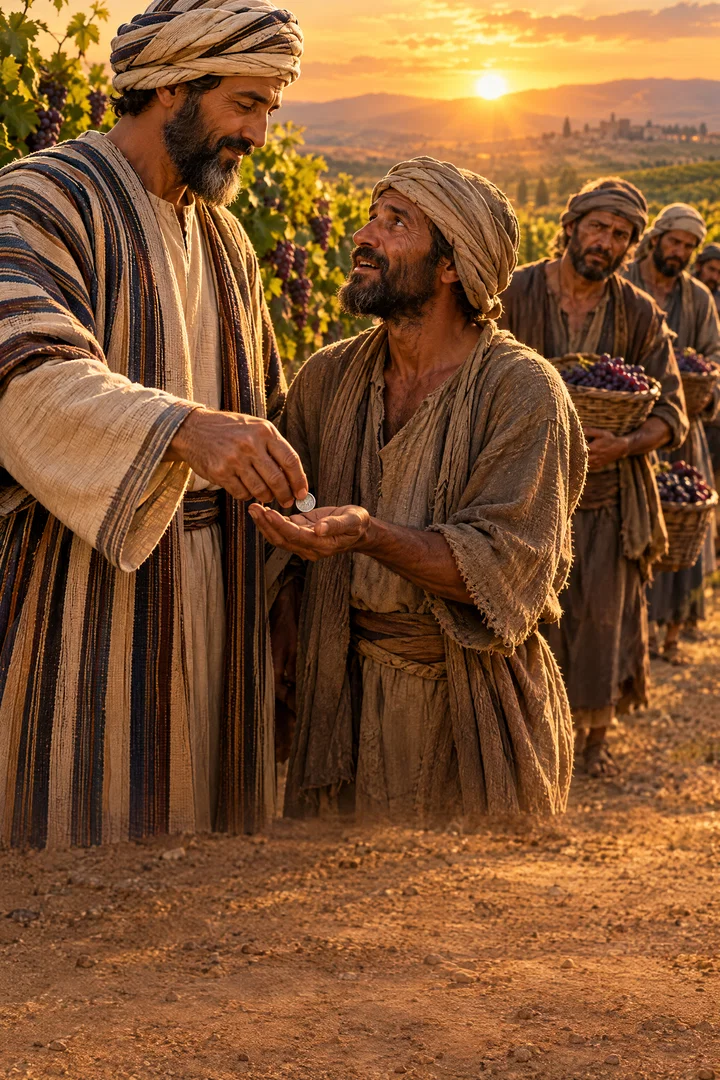
The saying closes the story of the kingdom of heaven likened to a householder who went out early in the morning to hire laborers into his vineyard for an agreed penny a day and went out again about the third and the sixth and the ninth and the eleventh hours with the promise to give what is right.Ms 87, 1899, par. 1–3Ms 87, 1899, par. 4–5 At evening he directed his steward to call the laborers and give them their hire, beginning from the last unto the first, and those hired about the eleventh hour received every man a penny.Ms 87, 1899, par. 1–3Ms 87, 1899, par. 4–5 Those hired first, seeing this, expected to receive more, but received likewise only their agreed penny, and they murmured that those who had wrought but one hour had been made equal to them who had borne the burden and heat of the day.Ms 87, 1899, par. 1–3Ms 87, 1899, par. 4–5 The householder answered that he did them no wrong since they had agreed with him for a penny, that it was lawful for him to do what he would with his own and to give to the last even as to the first, and that their eye should not be evil because he was good.Ms 87, 1899, par. 1–3Ms 87, 1899, par. 4–5
In the parable those hired last are called first in the evening to receive their hire and are paid the same sum as those hired first, while those hired first are paid last and receive no more than their agreed wage, so the last become first and the first become last.9T 73.3–74.1Ms 19, 1897, par. 38–41Ms 23, 1908, par. 33–36COL 399.2–4RH Jul 24, 1900 The reversal follows the complaint of the early workers, who had labored twelve hours through the burden and heat of the day and judged their service superior, against the equal payment of those who had worked only one hour in the cooler part of the day.Ms 19, 1897, par. 38–41Ms 87, 1899, par. 4–5COL 399.2–4RH Jul 24, 1900 The saying states this exchange of places and adds that many are called but few chosen, without further explaining who is called or chosen.9T 73.3–74.1Ms 23, 1908, par. 33–36COL 399.2–4ST Aug 9, 1899 The equal reward is given according to generous purpose and grace rather than in proportion to amount of work, length of service, or human merit, and it exposes the grasping, mercenary spirit of those who resent such generosity as unworthy of increased wages or the highest place.9T 73.3–74.1Ms 19, 1897, par. 38–41Ms 23, 1908, par. 33–36COL 396.3–397.1RH Jul 24, 1900
The parable was given to correct the error that God's favor must be earned and the reward of the righteous gained by works, an error taught by the rabbis and almost lost sight of by the Jews, from which even Christ's disciples were not wholly free.COL 390.1ST Aug 9, 1899 It answers the disciples' dispute over who should be greatest and Peter's question about what they would receive for leaving all to follow Jesus.ST Aug 9, 1899 It establishes as its closing principle that order of service does not determine precedence or reward.ST Aug 9, 1899
The vineyard figure in the Saviour's parables is worth studying, for the world is presented as God's vineyard and the owner represents God's dealings with the human family.RH Jul 24, 1900FE 512.4Ms 184, 1898, par. 6 The parable shows how God deals with His servants and the spirit in which they should work for Him.RH Jul 24, 1900COL 396.1–2 Christ's kingdom follows God's higher ways and thoughts and standards rather than human judgments and comparisons.RH Jul 24, 1900
The eleventh hour is very late, yet even then it is not too late to learn to believe, to have sins forgiven, and to have wrongs made right.RH Jul 31, 1900Ms 48, 1891, par. 55 Those called later had not been present when the householder first hired, and so had not refused that call.RH Jul 31, 1900 Those who learn faith at the eleventh hour learn the joy of their calling and praise with heart and soul and voice, beginning here the shout of praise that will go forth at last in glorious triumph when captivity is turned and mourning and tears are forever past, with every fiber of the root of bitterness put away as Christ kills it by His Holy Spirit in every heart so that it never buds nor blossoms again.Ms 48, 1891, par. 55
God's Generous Reward
God's gracious reward is not measured by length of service, amount of work, visible results, learning, position, ability or human merit, but is given according to His own just and generous purpose and grace.9T 73.3–74.1COL 396.3–397.1ST Jul 13, 1915COL 397.2–398.1ST Jul 13, 1915 In the vineyard the workers hired late receive the same pay as those hired early, while those hired first receive no more than their agreed wage, and being first or last in the kingdom is not decided by how much a person does.9T 73.3–74.1COL 396.3–397.1ST Jul 13, 1915RH Jul 24, 1900 The saying that many are called but few chosen closes the parable and warns against measuring worth or reward by length of service, while showing that gracious acceptance is cause for gratitude, not resentment.9T 73.3–74.1ST Jul 13, 1915 Service should be motivated by love for God and others, not by eagerness for compensation, and those who trust His justice and accept the opportunity to serve are rewarded by grace.COL 396.3–397.1COL 397.2–398.1
The eleventh-hour workers illustrate the humble sinner who knows his unworthiness, asks only to be accepted, trusts the employer's promise without bargaining over wages, and is grateful for the opportunity to serve.RH Jul 24, 1900ST Jul 13, 1915Ms 87, 1899, par. 11–12 They asked no questions about payment but worked with love, thankfulness, faith and joy, trusting the householder to do what is right.RH Jul 24, 1900RH Jul 24, 1900Ms 87, 1899, par. 11–12 The householder's generous payment surprised them beyond expectation and filled them with gratitude, illustrating Christ's gracious acceptance and compensation of the humble sinner who comes even at a late hour.RH Jul 24, 1900Ms 87, 1899, par. 11–12 Such penitent sinners who come to Him in humble faith and obey His commandments are placed first because they served in faith.RH Jul 24, 1900Ms 87, 1899, par. 11–12
God values the spirit, love, faithfulness, humility, self-forgetfulness and likeness of Christ brought to the work rather than a worker's own estimate of its worth, negotiated wage, wages and praise.ST Jul 13, 1915RH Jul 31, 1900Ms 87, 1899, par. 8–9 Even a small duty done sincerely in love and tenderness is more pleasing than great work marred by self-seeking, and the reward is proportionate to that humble spirit, not earned through prideful claims.ST Jul 13, 1915ST Aug 9, 1899 He judges motives rather than appearances, values even small acts of kindness done in love, and regards the love and faithfulness shown in the work.ST Jul 13, 1915ST Aug 9, 1899 Those who worked all day would have remained first if they too had served with love and trust, while those who compare their labor with others or serve for a promised reward with a hireling spirit may be last.RH Jul 24, 1900Ms 87, 1899, par. 8–9 Those united with Christ work for Him rather than to exalt themselves, and share the joy of working with God.RH Jul 31, 1900
The first and the last share the same eternal reward, which is received by grace and cannot be bought even by the greatest, while the weakest and most humble may receive it through simple faith and love.ST Jul 13, 1915COL 401.2–402.1ST Jul 13, 1915 It is given by grace rather than earned as a right by long service, great work, learning, position or ability, so no one is privileged above another and no one has cause to boast or begrudge another's reward.ST Jul 13, 1915COL 401.2–402.1ST Jul 13, 1915 Those first called should gladly welcome the last, since those who resent another's reward forget that they themselves are saved by grace.ST Jul 13, 1915COL 401.2–402.1 Those who serve briefly or humbly need not fear losing the reward if they faithfully follow Christ, for acceptable service comes through willingness and faithfulness, humility, love for others and self-forgetfulness.ST Jul 13, 1915ST Jul 13, 1915
The Lord Jesus, not other people, measures a worker's service and gives the reward due according to the spirit and principles governing the work.Ms 72, 1902, par. 34 An earnest desire to glorify God and purity of motive bring the same reward to a faithful worker who accomplishes little as to one who accomplishes more.Ms 72, 1902, par. 34 God's grace does not remove the need for human effort, for the vineyard reward belongs to those who faithfully do their appointed work and not to those who merely wait or loiter.Ms 132, 1901, par. 17 The fruit they bear reveals the character of their work.Ms 132, 1901, par. 17
Why First Become Last
Spiritual precedence is not secured by having served longer or endured more, nor by doing great work, learning, position, ability, or claiming greater honor and reward.ST Jul 13, 1915COL 399.5–401.1COL 397.2–398.1Ms 87, 1899, par. 16ST Jul 13, 1915 Long service and hardship do not entitle anyone to more and do not earn salvation, for the reward is given by grace according to God's own generous purpose and not by merit, amount of work, or visible results.RH Jul 31, 1900COL 397.2–398.1ST Jul 13, 1915Ms 87, 1899, par. 16ST Jul 13, 1915 Those who rely on their service and sacrifice, trust years of labor to earn more, seek preference, superiority and praise, and resent God's equal generosity to others show self-righteousness, distrust of God, jealousy, and little of Jesus.ST Jul 13, 1915COL 399.5–401.1RH Jul 31, 1900ST Jul 13, 1915Ms 87, 1899, par. 16 The first laborers stand for this error, as did the Jews who were called first but became proud of their service and resented the Gentiles receiving equal privileges, holding the mistaken belief that work earns salvation, and the warning guards Christ's first-called disciples against believing advancement or service earns a place in heaven.COL 399.5–401.1ST Jul 13, 1915Ms 87, 1899, par. 16 Being called to serve does not by itself mean being among the chosen, and those who serve with loving trust do not cling to rank, remaining first only if they serve without seeking self-advancement.ST Jul 13, 1915COL 399.5–401.1
Those who bargain for a stipulated wage and count their service as more valuable and superior serve with a hireling, grasping, mercenary spirit.ST Jul 13, 1915Ms 19, 1897, par. 38–41RH Jul 24, 1900RH Jul 31, 1900Ms 29, 1911, par. 65 In the evening those hired last are called first to receive their hire and are paid the same penny as those hired first, though the latter worked twelve hours bearing burden and heat of the day while the former worked only one hour in the cooler part, and the householder does no wrong because they agreed for a penny and it is lawful for him to do what he will with his own and give to the last even as to the first.Ms 19, 1897, par. 38–41Ms 87, 1899, par. 4–5 Those who then murmur, complain, grumble and find fault when others receive equal generosity reveal an evil eye against his goodness, an unpurified, unchristlike, untrustworthy heart that needs changing, and unworthiness of increased wages or the highest place.ST Jul 13, 1915Ms 19, 1897, par. 38–41Ms 87, 1899, par. 4–5RH Jul 31, 1900Ms 29, 1911, par. 65 Faithful service requires trusting his just and generous dealing rather than treating eternal life, time and abilities entrusted by Him as something earned by amount of work and selfishly claimed.RH Jul 31, 1900Ms 29, 1911, par. 65
Those who seek supremacy, exalt themselves, put themselves first, live to please themselves, strive to rule and have their own way, disparage associates and pull others down by dishonesty, fraud, envy and self-interest will be brought low and made last and least.6MR 54.1–213MR 99.3–100.1RH Jul 31, 1900Ms 87, 1899, par. 26–277T 200.1–2 Self-seeking pride puts human self in control, reflects Satan's character, prevents the Lord from working freely lest the proud claim the glory, and stands in the way of growth and connection with God.6MR 54.1–27T 200.1–2 Ambition that complains of being overlooked reveals unfitness for responsibility, while advancement must not be pursued by pulling others down, and people are accountable for the use of abilities and will reap what they sow.13MR 99.3–100.1Ms 87, 1899, par. 26–27 Those who humble themselves, take the last place, count themselves least, lean on God in weakness and walk humbly like children with self hidden with Christ will be exalted and made first.6MR 54.1–2RH Jul 31, 1900Ms 87, 1899, par. 26–277T 200.1–2Ms 116, 1898, par. 23 God uses all kinds of workers to carry His great work forward, both those given the gift to act as organizers and those who work in retirement feeling little and unknown with few to recognize their work and none to pity mistakes or praise victories, and in every age He has His workmen and at the needed time prepares a person of talent to come in, showing He Himself supervises His work and no one person can fill every place.Ms 87, 1899, par. 26–27Ms 116, 1898, par. 23
At the final judgment human rankings will be overturned, for many whom people place first will be placed last, while some whom people put in the lowest place will be made first.RH Jul 31, 1900Ms 87, 1899, par. 29Ms 113, 1899, par. 14–171MR 271.2–4 Christ judges each case by what people cannot see, weighing service and every secret motive, since even the most secret things are open to His sight and His judgment is not based on human estimation.RH Jul 31, 1900Ms 87, 1899, par. 29 Those who value their own service highly and selfishly take more than their share may be counted least, while faithful unselfish workers who receive little may receive the highest reward, and covetousness and selfishness can disqualify one called to work from being among the chosen.Ms 113, 1899, par. 14–171MR 271.2–4 The parable does not excuse hearing the truth and refusing to obey it, or refusing the first call because obedience would be inconvenient, for it is unsafe to trifle with the first call of mercy and God will not be trifled with.RH Jul 31, 1900 The workers called later had not been present when the householder first hired and so had not refused that call, and those who refuse and later repent do well to repent.RH Jul 31, 1900
Prophetic Latecomers Foretold
The saying applies to the Jews, who were first called but grew proud of their service and years of labor, trusted those years as a claim to greater honor and reward, and resented the Gentiles receiving equal privileges in the kingdom of God.COL 399.5–401.1Ms 87, 1899, par. 16 Their jealous, complaining spirit revealed the mistaken belief that work earns salvation and that long service and hardship entitle anyone to more, and it made them untrustworthy and unable to remain first except by serving with love and trust without seeking self-advancement.COL 399.5–401.1Ms 87, 1899, par. 16 Christ gave the warning to guard His disciples against self-righteousness and against the belief that human effort earns a place in heaven.COL 399.5–401.1
The dying thief is represented by the eleventh-hour laborers who receive as much reward as those who labored many hours.Ms 52, 1897, par. 26–27 At the last of Christ's work, at deepest midnight, the faith of a dying sinner laying hold upon a dying Saviour obtains full reward.Ms 52, 1897, par. 26–27 That faith asks in faith, patience, contrition and earnestness, fully realizing that Jesus can save, with hope mingled with anguish at being eternally lost if He does not, casting the helpless dying soul and body on Christ.Ms 52, 1897, par. 26–27
The parable of calling laborers at different hours applies with particular force near the close of earth's history, when Christ continues to call people to work in His vineyard.15MR 81.1 The eleventh-hour laborers who receive their penny are many souls still to come out of the ranks of the world and out of the churches, even the Catholic church.Ms 30, 1889, par. 73–79 When the crisis and season of calamity comes over the law of God and religious liberty, they will come to the front, see the battle coming, give the trumpet a certain sound, gird themselves with the whole armor of God, exalt the law, adhere to the faith of Jesus and maintain religious liberty.Ms 30, 1889, par. 73–79 Their zeal will far exceed that of those who stood in rank and file to proclaim the truth heretofore, yet they receive the same penny.Ms 30, 1889, par. 73–79
In the perils of the last day men and women will still be brought into the fold at the eleventh hour and paid as much as those who first entered.Ms 17, 1901, par. 21 If they are in earnest the Lord will accept them and work through them, and as they put on Christ their minds are enlarged by higher education.Ms 17, 1901, par. 21 They then give treasures of heavenly truth to others to be given to still others, so workers are raised up who help and educate others, extending the good work and blessing whole communities as each does his part with humble mind in all-round work, using all talents, improving capabilities to become wise unto salvation, and seeking and laboring for those in the churches and for fellow men.Ms 17, 1901, par. 21 Those who enter the work at the eleventh hour may through Christ's grace in presenting the truth be accounted first.Lt 36, 1895, par. 30–32 Those who enter then can remain faithful and receive their reward, while vacant places left through apostasy or failure to be fitted for service are filled by others God calls.10MR 170.2–3
People who receive the light and opportunities of the gospel but turn away from Christ may lose their place, while others with fewer opportunities respond faithfully and are brought in to take it.Lt 123, 1897, par. 24–28 The eleventh-hour laborers represent latecomers who consecrate their abilities and means to God's work, and they receive the reward because they are faithful to principle and duty.Lt 123, 1897, par. 24–28 Those who reject their privileges may have their crown taken, while newcomers occupy the places they leave vacant.Lt 123, 1897, par. 24–28
Many Called Few Chosen
Mere invitation to work does not itself place anyone among the chosen, for spiritual precedence is never secured by having served longer, endured more, or claimed a greater reward. ST Jul 13, 19151MR 271.2–4ST Aug 9, 1899 God tests what spirit people bring to the service, and the chosen are those whose faith works through love and purifies the soul while maintaining a living connection with Him. RH Jul 31, 1900ST Aug 9, 1899 Those who prize their own service, take the most for themselves, claim large wages for long service, yet complain, exalt themselves, remain self-sufficient, covetous and selfish, and neglect the needy, reveal distrust of God, jealousy toward others, and no living connection with Him, and they will become last and least in the judgment. ST Jul 13, 1915RH Jul 31, 19001MR 271.2–4ST Aug 9, 1899 The reversal therefore rests not chiefly on activity or zeal but on tenderness, graciousness, love and humility, with loving trust refusing to cling to rank and with acts of love toward Christ's needy people counted as acts done to Him. ST Jul 13, 1915ST Aug 9, 1899 Final reward reverses human estimates of rank and merit, so faithful, unselfish workers who receive little may be rewarded most highly while those who value their own service most may be counted least. 1MR 271.2–4
The later workers had not been present when the householder first hired, so they had not refused that call, and the parable does not excuse hearing the truth and refusing to obey it or refusing the first call because obedience would be inconvenient. RH Jul 31, 1900 It is unsafe to trifle with the first call of mercy, for God will not be trifled with, though those who refused and later repent do well to repent. RH Jul 31, 1900
Many young men are called to be earnest, persevering, successful laborers in warning sinners and winning souls, and God would accept their service if they consecrated themselves to Him unreservedly, exercised for God the powers of mind they use in serving themselves and acquiring property, and studied the Scriptures to become intelligent in the things of the kingdom. 3T 159.2 But few are chosen because few do that acceptable work, most remaining wise in worldly and temporal things and not intelligent in spiritual knowledge, so there are but few soul-winners when there should be many. 3T 159.2 Few respond when service does not advance their worldly interests, though God's gifts grow through use and those who have been faithful should not stand back when it is their turn to labor. 3T 159.2TCBMP 77.2–3 Those who turn their minds into a heavenly, divine channel, walk in the light going on from one degree of light and strength to another, turn sinners to Christ, and point the unbelieving and desponding to a bright track heavenward will when the warfare is ended be welcomed to the joy of their Lord. 3T 159.2
Those truly called to the work bear its burden and labor to spread the message in new fields, while not everyone who can assist is called to serve wholly or travel extensively as a chosen servant. Ms 1a, 1859, par. 7–8
Working in Vineyard Now
The verse calls every Christian and every church member to earnest, persevering, self-sacrificing labor in the Lord's vineyard for the salvation of others, following Christ's example of self-denial, sacrifice and faithful service.3T 202.1GW92 47.3MYP 206.2–207.1 There are to be no idlers and no fruitlessness, for every member of Christ's household has a task and all who profess Christ should work and persevere in seeking greater usefulness, since daily effort increases ability to labor effectively and bear fruit to God's glory.3T 191.24T 454.1SBAWP 10.3–11.1 All are to work together with Christ as fellow laborers with God, consecrating themselves to Him and centering hopes and affections in Him, treating the work as sacred service rather than common labor, and those who receive eternal life will have done their work well as faithful servants whom the King exalts and commends.MYP 206.2–207.13T 191.2RCOC 114.5 Such self-sacrificing labor outside regular lines can win souls.RCOC 114.5
That labor is to reach new fields through personal effort rather than concentrate on churches that already have much light and many advantages, laboring earnestly and perseveringly for souls.GW92 47.37T 255.2–3 The Master's call summons laborers to enter the cities and work with God to win souls, and those who have delayed must redeem the time and respond wholeheartedly, including work among foreigners promptly and perseveringly, service in the destitute Southern Field, and home work in helping and instructing younger children as valuable service not inferior to higher schooling.ST Oct 31, 1911RH Jun 2, 1910Ms 49, 1910, par. 4 The vineyard also includes writing missionary letters to friends and strangers, distributing tracts and papers to neighbors, and sending literature by mail to those willing to read.RH Dec 10, 1914 Men last hired from the marketplace are to be made first workers by being given parts of the vineyard, allowed to start even if they blunder, corrected and set to work again rather than hindered, learning ability by trading upon talents while walking in the light, without needing to journey to a central place to be educated, and they will do good work as missionaries in dark parts of the earth and in home missionary work in large cities, towns, highways and hedges, calling and bidding men to come because all things are now ready.OEWP 36.1–37.1
Christ sees qualifications in people whom others might overlook or doubt, including humble beginners and those who seem discouraging, and as they learn and receive the Holy Spirit's power He fits them for work suited to their abilities.CH 26.17T 271.1GW 36.2–3 God uses all kinds of workers to carry His great work forward, both those given the gift to act as organizers and those who work in retirement feeling little and unknown, with few to recognize their work and none to pity mistakes or praise victories, for no one person can fill every place.Ms 116, 1898, par. 23 In every age He has His workmen, and at the needed time preparation is made for a person of talent and gift to come in, which shows that He Himself supervises His work.Ms 116, 1898, par. 23 Those who in weakness lean upon God and walk in humility of mind as children, counting themselves least, will be put ahead.Ms 116, 1898, par. 23
Acceptable workers answer the call with humble, willing, devoted hearts, connected with God and praying before approaching others, without seeking self-exaltation, supremacy, personal control or praise, but presenting truth in simplicity.SBAWP 10.3–11.1RH Dec 10, 1914 Whole-hearted labor means working to the utmost of ability without setting the highest estimate on one's own services, refusing pride and self-importance and refusing to measure every hour's work with exactness, instead comparing efforts with the Saviour's work and accounting oneself an unprofitable servant, not studying how little may meet the lowest standard but grasping the fullness of Christ to do much for Him.SSP 13.1–2 It requires faith, energy, perseverance, decision, purity, self-denial, consecrated use of good abilities, quick perception and understanding of the word to do good and glorify God, cultivation and improvement of entrusted talents by education in proportion to means and opportunity, including the common branches, the truths of God's word for this time, and the prophecies, since even a few months' instruction greatly benefits workers.3T 160.2TCBMP 164.2–165.23T 126.2–127.2 A sanctified heart in that service imparts energy, efficiency and humility that commands respect and gives influence for good, while the same powers turned to selfish gain become selfish, penurious and overbearing and do great harm.TCBMP 164.2–165.23T 126.2–127.2 The work includes bringing people out of darkness and error and establishing them in truth in preparation for Christ's coming.SBAWP 10.3–11.1
Human claims to priority do not determine God's judgment: being an heir or a child does not entitle one to entrusted means, for God's claims come first and surplus wealth is to be put to work advancing His cause faithfully while alive rather than left by will, bringing satisfaction now and reward hereafter.3T 121.1–2TCBMP 156.1 God's cause must be fair and true, wages must not be cut without consent and understanding, and desire for higher wages spoils spirituality.YGBCOEP 39.3–40.2 His work and resources are not to be concentrated selfishly in one place or attached to one great center, institution or group of responsible men laying human contracts and unappointed burdens on others, but burdens are to be divided and planted in many places so other parts of the vineyard receive what they need and the light reaches farther.YGBCOEP 39.3–40.2Lt 180, 1901, par. 5–68T 138.2–3 Those truly converted care equally about God's work in every part of it and are ready to help wherever help is needed rather than seeking advantage for interests they oversee, and different places of service in one vineyard do not justify jealousy or feelings of superiority but call for disinterested labor for the cause and for salvation.8T 138.2–35T 417.2
Sources