Matthew 21:3
And if any man say ought unto you, ye shall say, The Lord hath need of them; and straightway he will send them.
Translations
And if any man say something to you, you shall say, The Lord has need of them; and straightway he will send them.
King James Version, KJV Cambridge Paragraph Bible
And if any man say ought unto you, ye shall say, The Lord hath need of them; and straightway he will send them.
And if any man shall say aught to you, ye shall say, The Lord hath need of them; and immediately he will send them.
Revised Version, American Standard Version
And if any one say aught unto you, ye shall say, The Lord hath need of them; and straightway he will send them.
and if any one may say anything to you, ye shall say, that the lord hath need of them, and immediately he will send them.'
And if any one say anything to you, ye shall say, The Lord has need of them, and straightway he will send them.
And, if anyone, unto you, say aught, ye shall say—Their Lord, hath, need,—and, straightway, he will send them.
Berean Standard Bible, Majority Standard Bible
If anyone questions you, tell him that the Lord needs them, and he will send them right away.”
If anyone says anything to you, you shall say, ‘ The Lord needs them,’ and immediately he will send them.”
And if anyone says anything to you, you will say, The Lord has need of them; and straight away he will send them.
And if any man say ought vnto you, say ye, that the Lord hath neede of them, and straightway he will let them goe.
Douay-Rheims (Challoner revision)
And if any man shall say anything to you, say ye, that the Lord hath need of them: and forthwith he will let them go.
Pictures
Cross-references
- Zechariah 9:9
Rejoice greatly, O daughter of Zion; shout, O daughter of Jerusalem: behold, thy King cometh unto thee: he is just, and having salvation; lowly, and riding upon an ass, and upon a colt the foal of an ass.
Foretells the King’s humble entry into Jerusalem riding on a colt.
- Mark 11:3-6
And if any man say unto you, Why do ye this? say ye that the Lord hath need of him; and straightway he will send him hither.
The disciples answer those questioning them, and the colt is released as Jesus directed.
- Luke 19:28-40
And when he had thus spoken, he went before, ascending up to Jerusalem.
Parallel account of Jesus’ entry into Jerusalem.
- John 12:12-16
On the next day much people that were come to the feast, when they heard that Jesus was coming to Jerusalem,
Parallel account of Jesus’ entry into Jerusalem and the crowd’s welcome.
- Matthew 21:9
And the multitudes that went before, and that followed, cried, saying, Hosanna to the Son of David: Blessed is he that cometh in the name of the Lord; Hosanna in the highest.
same entry, Hosanna cry
Commentary
Each commentary is drawn from primary sources: the writings of Ellen G. White and Adventist pioneers and periodicals. Each commentary is separate. Its own words are not a quotation; follow the references to read the source passages.
Ellen G. White
36 sources
Jesus sent two disciples to bring a donkey and its unridden colt for His ride into Jerusalem, telling them to answer any question by saying that the Lord had need of them, upon which the owner would send them at once without delay.DA 569.3–4Ms 128, 1899, par. 2–34RED 120.2COS 91.1–54RED 115.3 When they were asked why they were untying the colt they gave that answer and the animals were released to them, and they laid their garments on the colt for Jesus to sit upon.Ms 128, 1899, par. 2–3ST Jun 8, 18822SP 384.1–385.1Ms 128, 1899, par. 1 In this He fulfilled the prophecy of the promised lowly King riding as Israel's kings had ridden, and was welcomed as Messiah and King with garments spread in His path and cries of Hosanna to the Son of David.DA 569.1–2ST Jun 8, 1882DA 570.1–571.12SP 384.1–385.1 The entry was His deliberate public presentation as Redeemer to direct attention to His coming sacrifice as the antitypical Lamb at Passover, while it also pointed to Jerusalem's coming doom and foreshadowed His future coming in glory with angels and rejoicing saints.3SP 20.1ST Jun 8, 18823SP 9.1DA 571.2–4ST Jan 10, 1878 That the Lord has need means He still has need of people for His service and of what they have for His work, calling them to overcome self-pleasing, surrender themselves, release what is asked, and respond immediately.Lt 155, 1896, par. 21–23Lt 92a, 1897, par. 2–4CEv 103.2Lt 12, 1857, par. 8–10Lt 11, 1893, par. 1–3
Obtaining the Animals
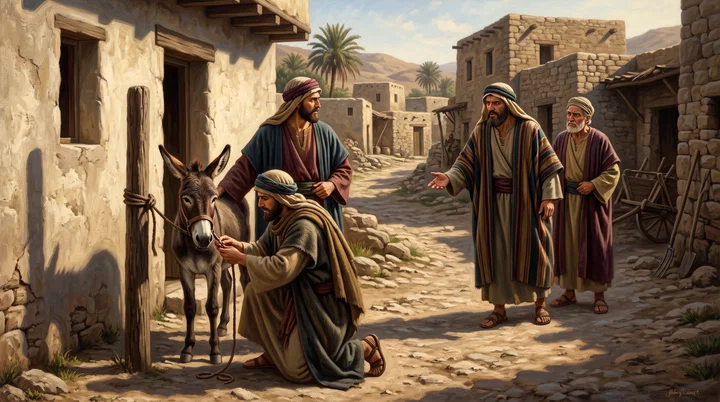
The verse belongs to the account of Christ's triumphal ride into Jerusalem, when Jesus sent two disciples to bring a donkey and colt, the foal of an ass, for His entry.COS 91.1–5ST Jul 22, 1886DA 546Lt 126, 1894, par. 6–7Ms 86, 1893, par. 24–25 The colt was to be used for His humble, prophetic entry as King as He approached Jerusalem.COS 91.1–5DA 546Lt 126, 1894, par. 6–7 If any man questioned them about taking the animals, they were to answer that the Lord had need of them, and the owner would then send them straightway, at once and without delay.DA 569.3–4Ms 128, 1899, par. 2–34RED 120.2COS 91.1–5DA 546 The entry thus unfolded according to the Lord's direction.4RED 120.2
The instruction was fulfilled exactly as given.Ms 128, 1899, par. 2–3Ms 128, 1899, par. 1 When people asked why the disciples were untying the colt, they gave the commanded answer and the animals were released to them.Ms 128, 1899, par. 2–3Ms 128, 1899, par. 1 The colt selected for His use had never been ridden.ST Jun 8, 18822SP 384.1–385.1 The disciples placed their garments on it and seated Jesus upon it, and the crowd's homage followed as He entered Jerusalem.ST Jun 8, 1882
The disciples were puzzled by the direction because Jesus had usually traveled on foot.4RED 115.32SP 383.2 His precise directions revealed His divinity.DA 569.3–4 Yet though all the cattle on a thousand hills were His, He depended on a stranger's kindness for the colt on which He entered Jerusalem, and this plea was readily granted.DA 569.3–4
King's Prophetic Entry
The entry fulfills the prophecy of the promised lowly King coming riding on a donkey.DA 569.1–2DA 570.1–571.1 He rode the colt as Israel's kings had ridden, and in doing so was identified as the promised heir to David's throne coming as Messiah and King.DA 569.1–2DA 570.1–571.1 The colt chosen for His use had never been ridden, and the disciples placed their garments upon it and seated Him upon it for the public entry.ST Jun 8, 18822SP 384.1–385.1
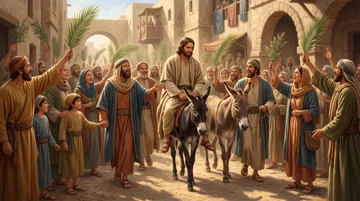
He was welcomed into Jerusalem as Messiah and King amid praise and rejoicing.DA 570.1–571.12SP 384.1–385.1COS 90 A joyful crowd surrounded Him and spread their garments in His path as He entered the city.ST Jun 8, 1882COS 90 People flocked from all the region around, crying Hosanna to the Son of David, until the slopes of the Mount of Olives echoed with the joyful shouts of the triumphant multitude.1T 57.3–58.13SP 250.3 When priests and elders wanted the multitude stilled, the answer was that if they held their peace even the stones would cry out, for prophecy must be fulfilled.1T 57.3–58.1
The disciples and followers honored Him as their King but wrongly expected a temporal kingdom.EW 206.44SP 253.2 They expected Him to be crowned king and to reign on David's throne, to take that throne and deliver Israel from its oppressors by overthrowing Roman rule and restoring the nation's independence.DA 570.1–571.11T 57.3–58.14SP 253.2 Within a few days those same disciples saw their beloved Master stretched upon the cruel cross above mocking Pharisees, with the darkness of death closing about them, and their high hopes were disappointed.EW 206.41T 57.3–58.1 That disappointment was greater than any later disappointment over unfulfilled hope, yet their hopes revived when He rose and appeared to them, showing Him true to His promises, with sweet consolation to His people and rich reward for the true and faithful.EW 206.41T 57.3–58.1
Sacrifice and Judgment
The entry was His deliberate public presentation as Redeemer, meant to turn attention toward His coming sacrifice for the sins of the world.ST Jun 8, 1882DA 571.2–4 At Passover He presented Himself as the antitypical Lamb, voluntarily setting Himself apart as an offering for the world.ST Jun 8, 1882DA 571.2–4 He did so while remaining in the humble way that characterized His life, accepting a humble human life rather than appearing with heavenly pomp.ST Jun 8, 1882DA 571.2–4 The public events surrounding the entry were to direct people to that sacrifice.ST Jun 8, 1882DA 571.2–4
Those public events came before His trial and death, with the slopes of the Mount of Olives echoing the joyful shouts of the triumphant crowd as He rode into the city.ST Jun 8, 18823SP 250.3 Afterward they would be considered alongside His trial and death, when searching the prophecies would show that He was the Messiah.ST Jun 8, 1882 That searching would reveal One who gave His life for the world rather than coming with outward display.ST Jun 8, 1882
The same triumphal entrance pointed to the doom of Jerusalem and to its coming destruction.3SP 20.1ST Jan 10, 1878 It came just before He cleansed the temple, and it sets the scene for the fig tree as a symbol of that destruction.Lt 82, 1907, par. 9ST Feb 15, 1899 The journey to Jerusalem for the entry is thus taught together with the riding into the city and with the barren, fruitless fig tree.Lt 82, 1907, par. 9Ms 5, 1882, par. 11 That tree warns that professed service to God without a life bearing fruit does not bring glory to Him.Lt 82, 1907, par. 9 The triumphal ride also foreshadowed His future coming in glory with angels and rejoicing saints.3SP 9.1
The Lord's Present Need
The Lord hath need means He has need of people for His service.Lt 155, 1896, par. 21–23CEv 103.2 He has need of people and He provides for what is needed for His work.CEv 103.2 That need calls people to overcome self-pleasing and to devote their lives to serving God and glorifying their Redeemer.Lt 155, 1896, par. 21–23 A sense that the Lord has need of a person may mean God is calling that person to a needed work, to seek God's will and consecrate self in order to know whether called to help at the Office, with assurance that if God calls, He will strengthen and sustain in the work.Lt 12, 1857, par. 8–10
The Lord's need is reason to release what is requested.Lt 92a, 1897, par. 2–4Lt 11, 1893, par. 1–3 Money previously invested for missionary work is to be called for and used to support the work of building a meetinghouse in Stanmore.Lt 92a, 1897, par. 2–4 The Lord has need of what is His, and of the person himself, while the person has need of the Lord, so surrender to Christ should be straightway rather than delayed.Lt 11, 1893, par. 1–3
The account of riding into Jerusalem calls hearers to let the word take hold upon souls.Lt 29, 1880, par. 22–237MR 32.2 Setting forth that entry exalts Jesus and lifts Him up, showing that salvation is not by law but by Jesus, and moves hearers to accept Him, be baptized, and unite with the church.Lt 27, 1880, par. 8 Taught together with the barren fig tree, the entry shows the Son of God came to our world to draw all men unto Him, coming not to send peace but a sword.Ms 5, 1882, par. 11 Everyone is urged to do their part well with faithfulness and to walk in the light of His glorious example without questioning the cost in labor and trial and suffering, with a work for each and all to maintain the truth in its purity and push the triumphs of His cross and extend His kingdom.Lt 29, 1880, par. 22–23Ms 5, 1882, par. 11 Faithfulness now matters so as to stand acquitted in the day of final accounts when the judgment shall sit and the books shall be opened and everyone's account is balanced, pressing the solemn question of who will be saved through the words spoken.Lt 29, 1880, par. 22–237MR 32.2
Sources
Pioneers and periodicals
49 sources
Jesus sent two disciples near the close of his ministry, only days before his suffering and death, to bring the animals for his ride into Jerusalem with the word that their master needed them, and they were allowed to take them at once.ST Sep 27, 1899ST Oct 5, 1904ST Sep 27, 1899ST Nov 8, 1883 The animal was a colt that no one had ever ridden, and by seating himself upon it in everyday attire he entered as a lowly King, the Prince of peace and burden-bearer for the people.ST Jun 8, 1882ST Jul 22, 1886ST Mar 27, 1901ST Mar 25, 1903 In this he fulfilled Zechariah 9:9, the prediction of the Messiah coming humble upon a donkey and a colt, down to its minute circumstances.RH Nov 18, 1862ST May 9, 1878RH Jun 24, 1858ST Nov 8, 1883 The disciples and crowd welcomed him expecting him to take David's throne and reign as a temporal king, yet within days he was crucified, and their bitter disappointment did not prove their faith false but was part of God's plan.ST Aug 13, 1902RH Mar 17, 1859RH Sep 18, 1855RH Jul 25, 1865ST Jul 27, 1882 His need of even that small humble animal shows he still has use for every reader, young and old, to serve him in carrying light and rescuing perishing souls.RH Apr 9, 1908STRH Oct 20, 1910ST
Setting of the Entry
Matthew 21:3 belongs to the account of Jesus' triumphal entry into Jerusalem near the close of his ministry, in the last week of his earthly life, only a few days before his suffering and crucifixion and death.ST Nov 8, 1883ST Feb 14, 1878ST Aug 13, 1902RH Mar 17, 1859 That entry was his triumphant ride into the city and included his visit to the temple.ST Feb 14, 1878 It fulfilled Zechariah's prophecy of the king coming humbly on a donkey, although the crowd's hope that he would immediately take David's throne and be proclaimed king was not fulfilled.RH Mar 17, 1859RH Apr 20, 1916 Instead he was crucified soon afterward and the disciples scattered, leaving them deeply disappointed.ST Aug 13, 1902RH Mar 17, 1859RH Apr 20, 1916
The remarkable entry took place the day after Jesus' last Sabbath before his crucifixion.ST Dec 16, 1886 It followed the raising of Lazarus, which drew many people to him in public demonstration.ST Dec 16, 1886
The entry was met with public rejoicing, as people spread garments and branches along the way and praised God for his mighty works. The disciples placed their garments on the colt and seated Jesus upon it, and the crowd's homage followed as he entered Jerusalem.ST Jun 8, 1882 The welcome rose in hallelujah cries and acclamation, with the Lord's need being met as the crowd received him.STST The fullest account of that scene amid the hallelujah cry and his weeping over the city is in Luke 19, and it is also recorded in Mark 11 and John 12.ST
The entry came thirty-three years after his birth as a rejoicing procession moving over Olivet toward Jerusalem.RH Nov 25, 1873 Jesus of Nazareth sat upon an ass, majestic in mien and benign in countenance, while the whole city was moved to ask who he was.RH Nov 25, 1873 He is the One foretold by prophets, worshiped by angels, and anointed by God, and his coming in this manner shows that what Zechariah foretold about him was intended to be understood literally.RH Nov 25, 1873
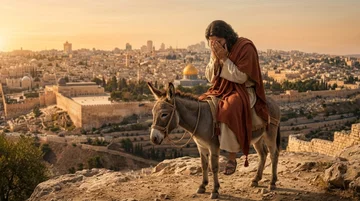
The triumphal entrance pointed to the city's coming doom.ST Jan 10, 1878 Amid the welcome Jesus wept over the city, and Jerusalem's rejection and coming destruction stand in contrast to that welcome.STST The entry came just before he cleansed the temple and sets the scene for the fig tree as a symbol of Jerusalem's coming destruction.ST Feb 15, 1899
Meaning of the Instruction
Jesus sent two disciples to fetch the animals for his ride, telling them that if anyone challenged them they were to answer that the Lord needed them, and the owner would send them at once.ST Sep 27, 1899ST Oct 5, 1904ST Sep 27, 1899ST Mar 27, 1901ST Apr 12, 1905 That instruction provided how he procured the beast for his entry into Jerusalem as King, making preparation for his ride into the city.ST Oct 5, 1904ST Mar 27, 1901ST Apr 12, 1905ST Jan 17, 1900 The disciples found the colt as directed, and when questioned those who challenged them let them go with it.ST Sep 27, 1899ST Sep 27, 1899
The animal chosen was a colt, the foal of an ass, which no one had ever ridden.ST Jun 8, 1882ST Jul 22, 1886 The disciples laid their garments upon it and seated Jesus on it, and the crowd's homage followed as he entered Jerusalem.ST Jun 8, 1882 By obtaining and riding that humble colt he entered as King, the lowly Prince of peace, fulfilling the prophecy of the coming King.ST Mar 27, 1901 He came in humility, clad in everyday attire instead of gorgeous robes, and never rode upon the people's shoulders, because he himself was the burden-bearer for the people.ST Mar 25, 1903
Prophecy Fulfilled
The entry into Jerusalem fulfilled Zechariah 9:9, the prediction of the Messiah's humble arrival as King coming lowly on a donkey and on a colt.RH Nov 18, 1862RH Jun 24, 1858ST Nov 8, 1883RH Mar 17, 1859ST Aug 1, 1916 The fulfillment extended even to the minute circumstances of obtaining the animals and bringing them for the ride.RH Nov 18, 1862RH Mar 17, 1859 It took place near the close of his ministry, only a few days before his crucifixion, and was recognized and proclaimed as one link in a chain of events.ST Nov 8, 1883RH Mar 17, 1859ST Aug 1, 1916 Although the crowd hoped he would then take David's throne and take possession of the kingdom, that expectation was not fulfilled, for he was crucified soon afterward and the disciples scattered.RH Mar 17, 1859RH Feb 16, 1869
The account illustrates how a prophecy stated as a command points to what will happen when its appointed time arrives.ST May 9, 1878 What Zechariah foretold was intended to be understood literally, as proved by his coming in this manner thirty-three years after his birth.RH Nov 25, 1873 Then a rejoicing procession moved over Olivet toward Jerusalem, with Jesus majestic in mien and benign in countenance seated on an ass, so that the whole city was moved to ask who he was.RH Nov 25, 1873 He is the One foretold by prophets, worshiped by angels, and anointed by God.RH Nov 25, 1873
It fulfilled the word spoken long before by the Spirit of prophecy, Shout, O daughter of Jerusalem, behold thy King cometh unto thee, with Jesus riding on a colt followed by a vast multitude.ST Feb 4, 1903 The shout there was a genuine shout of triumph put by God, praise for a great victory about to be achieved.ST Feb 4, 1903 It was true triumph even though he was not then made king but was crucified by his bitterest enemies, because his crucifixion was his real coronation and his triumph over the powers of darkness on Calvary's cross.ST Feb 4, 1903 The disciples did not understand this, and instead of shouting happily over the victory they were disappointed.ST Feb 4, 1903
The prophecy was fulfilled through the proclamation of the disciples and the people, and through the crowd's welcome, even though they misunderstood what was about to happen and expected him to take David's throne then.RH Jun 29, 1911RH Feb 16, 1869 The fulfillment in Matthew 21:1-12 of the prophecy that the stone which the builders rejected has become the head stone of the corner, and that this is the day which the Lord hath made, shows the change of the Sabbath from the seventh to the first day of the week by divine appointment.RH May 10, 1860 The day is the resurrection day, prophesied in connection with the resurrection.RH May 10, 1860 Those who held the other teaching held that the verse and the surrounding fulfillment account of the rejected stone becoming the cornerstone do not teach a change of the Sabbath and do not identify a resurrection day or seventh day.RH May 10, 1860
Disappointment and Expectation
The entry into Jerusalem on the colt led the disciples and the crowd to expect that Jesus would then be crowned king and take David's throne, take possession of the kingdom and reign as a temporal king.ST Aug 13, 1902RH Mar 17, 1859RH Jul 25, 1865ST Dec 3, 1874RH Apr 20, 1916 Their shouts of hosanna to the son of David showed they thought he was going to establish the kingdom at that time rather than soon die.RH Sep 18, 1855RH Jul 25, 1865ST Dec 3, 1874 Their enthusiasm was moved by sight rather than faith, and it was strengthened because he permitted their homage.ST Aug 13, 1902ST Mar 27, 1901 Instead of being proclaimed king he was crucified a few days later, and instead of being hailed as king in a royal palace he was laid as a lifeless form in Joseph's new sepulcher while the disciples scattered.RH Mar 17, 1859ST Jul 27, 1882RH Apr 20, 1916RH Jul 6, 1869ST Mar 24, 1887 Seeing their Master crucified so soon after they had escorted him in triumph brought them bitter disappointment, disappointment in tenfold degree because the only throne he then went to was the cross.ST Aug 13, 1902RH Jul 25, 1865ST Jul 27, 1882RH Jul 6, 1869ST Mar 24, 1887
That disappointment did not prove the belief false, for the first-advent believers were blessed in receiving the truths they had heard and their rejoicing was right, since if the people had been silent the stones would have cried out.RH Sep 18, 1855RH Jul 25, 1865ST Jul 27, 1882 Their disappointment in the timing was part of God's plan, just as second-advent expectation can be true while its believers experience disappointment.RH Sep 18, 1855RH Jul 25, 1865ST Jul 27, 1882 The mistaken views of the disciples at the entry did not justify rejecting the gospel they preached.RH Feb 14, 1871 Their loyalty during the entry illustrates how believers can remain loyal when later disappointment tests them, unlike those who did not love Christ and his appearing.RH Feb 26, 1867
The taking of the owner's ass at Jesus' instruction cannot rightly be used as a warrant for taking what belongs to another.RH Aug 17, 1869 To treat the disciples' obedience to their Master as permission for misconduct is the misuse of Mr. Self-will.RH Aug 17, 1869 The triumphal entry also warns that public welcome and friendship can quickly turn, so the world's approval is unsafe to rely on.ST Jul 30, 1894
Character and Mission of Christ
The entry into Jerusalem turned attention toward Jesus' final sacrifice, for it stood just before his death for the sins of the world.ST Jun 8, 1882 As the antitypical Passover Lamb he voluntarily set himself apart as an offering, accepting a humble human life rather than appearing with heavenly pomp in order to give his life for the world.ST Jun 8, 1882 The public events surrounding the entry were meant to direct people to that sacrifice, so that after his death they would be considered alongside his trial and death, and searching the prophecies would show that he was the Messiah.ST Jun 8, 1882
The triumphal entry displays self-denying love, in contrast to the force displayed by worldly kingdoms.ST Feb 6, 1901 In the same chapter the Father is seen planting a vineyard and letting it out to husbandmen who refused to make returns when called upon by authorized collectors.ST Nov 20, 1884 The Son then came to attend to that business, proving that Christ came as a special agent doing his Father's business.ST Nov 20, 1884
The account of the entry is to be connected with the final, glorious triumph when Christ enters his kingdom to reign.ST Apr 14, 1898 It stands at the close of the first advent of Christ, following the life and mission of John the Baptist. It covers Christ's life and mission, his miracles and teachings, and the nature and necessity of his life-work.
Call to Service
The statement that the Lord has need is a call addressed to the reader, whom the Saviour requires to help carry light to people in other lands and rescue souls who are perishing.RH Apr 9, 1908 In the same way it is a call to young people to serve God by making themselves available for His work, as seen in Robert Moffat's call to mission labor in Africa.RH Oct 20, 1910
Jesus instructed the disciples to answer anyone who questioned their taking the animals by declaring His need of them, with the assurance that the owner would send them at once.STST The animal thus obtained included the small, humble colt He would ride into Jerusalem, and His need of even that lowly creature shows that He has a use for boys as well, even for a young boy.STST So also His need supplies the request for the boy's lunch basket, when a humble gift placed in His hands was used to meet the multitude's need.RH May 29, 1900 Though small, it became more than enough under God's blessing.RH May 29, 1900
Sources