Matthew 24:17
Let him which is on the housetop not come down to take any thing out of his house:
Translations
American King James Version, King James Version
Let him which is on the housetop not come down to take any thing out of his house:
let him which is on the housetop not come down to take any thing out of his house:
Let him who is on the house-top not come down to take any thing out of his house:
Revised Version, American Standard Version
let him that is on the housetop not go down to take out the things that are in his house:
he on the house-top — let him not come down to take up any thing out of his house;
let not him that is on the house come down to take the things out of his house;
And, he that is on the house-top, let him not come down, to take away the things out of his house;
Berean Standard Bible, Majority Standard Bible
Let no one on the housetop come down to retrieve anything from his house.
Let him who is on the housetop not go down to take out the things that are in his house.
Let not him who is on the house-top go down to take anything out of his house:
Let him which is on the house top, not come downe to fetch any thing out of his house.
Douay-Rheims (Challoner revision)
And he that is on the housetop, let him not come down to take any thing out of his house:
Pictures
Cross-references
- Luke 21:20-21
And when ye shall see Jerusalem compassed with armies, then know that the desolation thereof is nigh.
Luke gives the parallel warning to flee when Jerusalem is surrounded by armies.
- Mark 13
And as he went out of the temple, one of his disciples saith unto him, Master, see what manner of stones and what buildings are here!
A parallel account of the same discourse.
- Daniel 9:27
And he shall confirm the covenant with many for one week: and in the midst of the week he shall cause the sacrifice and the oblation to cease, and for the overspreading of abominations he shall make it desolate, even until the consummation, and that determined shall be poured upon the desolate.
Daniel’s abomination is the sign that triggers the flight warning.
- Luke 21:21
Then let them which are in Judæa flee to the mountains; and let them which are in the midst of it depart out; and let not them that are in the countries enter thereinto.
A parallel account of the warning to flee when Jerusalem is surrounded.
- Luke 17:31
In that day, he which shall be upon the housetop, and his stuff in the house, let him not come down to take it away: and he that is in the field, let him likewise not return back.
Jesus gives a parallel warning not to go back for possessions.
- Genesis 19:17
And it came to pass, when they had brought them forth abroad, that he said, Escape for thy life; look not behind thee, neither stay thou in all the plain; escape to the mountain, lest thou be consumed.
Lot is urgently commanded to escape destruction without delay.
- Mark 13:34-37
For the Son of man is as a man taking a far journey, who left his house, and gave authority to his servants, and to every man his work, and commanded the porter to watch.
Urges readiness for the Master’s unexpected return.
- Luke 17:28-30
Likewise also as it was in the days of Lot; they did eat, they drank, they bought, they sold, they planted, they builded;
Christ’s revelation brings sudden destruction, as in Lot’s day.
- Luke 17:32
Remember Lot’s wife.
Lot’s wife warns against looking back when escape is urgent.
- Luke 17:33
Whosoever shall seek to save his life shall lose it; and whosoever shall lose his life shall preserve it.
true disciples would not save life selfishly
- Matthew 24:2-3
And Jesus said unto them, See ye not all these things? verily I say unto you, There shall not be left here one stone upon another, that shall not be thrown down.
The prophecy and the disciples’ question concern the temple’s overthrow.
- Luke 12:40
Be ye therefore ready also: for the Son of man cometh at an hour when ye think not.
Both texts urge readiness because the Son of man comes unexpectedly.
Commentary
Each commentary is drawn from primary sources: the writings of Ellen G. White and Adventist pioneers and periodicals. Each commentary is separate. Its own words are not a quotation; follow the references to read the source passages.
Ellen G. White
23 sources
Jesus gave this command in His answer about the sign of His coming and the end of the world, tracing events from His first advent to His second and reaching beyond Jerusalem's fall to the final judgment.DA 627.1–3GC 393.2–394.1GC88 393.1–394.1
Its plain meaning was that when the sign of danger appeared, the idolatrous Roman standards set up on holy ground outside the walls, anyone on a housetop had to flee at once without going down into the house for belongings, and forty years later the Christians who obeyed escaped Jerusalem's destruction.Ms 78, 1897, par. 464SP 25.3–26.2ST Feb 20, 1901GC88 26.1
Beyond that first fulfillment, Jerusalem's destruction typifies the world's final destruction by fire.DA 627.1–3Ms 77, 1899, par. 4–5
The command stands as part of the description of Christ's second coming in the clouds with power and great glory to gather the elect at an unknown hour, calling for watching and readiness as in the days of Noah.ST Apr 21, 1898STB 362.1–2AA 259.4–260.2
Because those predictions are being fulfilled and show His coming is at hand, believers must heed them, warn the world, stay in constant readiness through daily humbling, and be prepared for a future time of sudden flight when they must leave at once for the mountains without turning aside for possessions.Ms 62, 1903, par. 9–12Ms 189, 1907, par. 14Ms 142, 1906, par. 8–11Ms 119, 1909, par. 20–22
Setting and Original Meaning
Jesus spoke these words in answering His disciples' question about the sign of His coming and the end of the world, describing the destruction of Jerusalem as one of the important events.GC 393.2–394.1GC88 393.1–394.1 That answer traces the important events from His first advent to His second, including Jerusalem's destruction, persecution of the church, signs in the heavens, and His coming in glory.GC88 393.1–394.1 The discourse joins the destruction of Jerusalem and His coming together, and its prophecy reaches beyond the fall of Jerusalem to the final judgment.DA 627.1–3
It was given shortly before He entered Gethsemane, after a day of work and extended speaking while He was weary, as a discourse of prediction and warning that also included the parable of the talents.ST Nov 20, 1884 It covers both the fate of Jerusalem and the experience of His people from His departure until His return, foretelling that His followers would face humiliation, reproach, and persecution.4SP 39.1
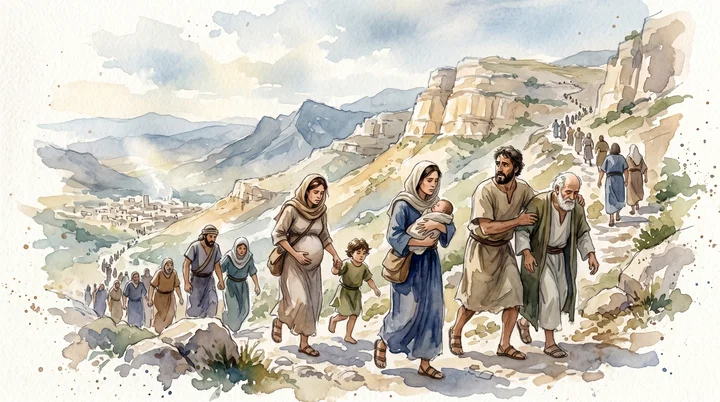
The command meant that when the sign of danger appeared, escape had to be immediate, with anyone on a housetop to flee at once without going down into the house or going back inside to retrieve belongings, even valued possessions.Ms 78, 1897, par. 464SP 25.3–26.2ST Feb 20, 1901Ms 77, 1899, par. 4–5GC88 26.1 Those who recognized the danger were to flee without delay and without losing time.Ms 78, 1897, par. 46Ms 77, 1899, par. 4–5 The signal to flee was the Roman idolatrous standards set up on holy ground outside the city walls.4SP 25.3–26.2GC88 26.1 Judgment would follow so quickly that delay or hesitation could mean being caught in the destruction.4SP 25.3–26.2GC88 26.1
The warning was fulfilled forty years later at the destruction of Jerusalem, and the Christians who obeyed it escaped the city's destruction.Ms 78, 1897, par. 46ST Feb 20, 1901
Prophecy and Present Urgency
Beyond its first fulfillment in the fall of Jerusalem, the destruction of that city foreshadows the final destruction of the world by fire, for the prophecy joins those two crises and reaches beyond Jerusalem to the final judgment.DA 627.1–3Ms 77, 1899, par. 4–5 The command not to go back indoors for belongings therefore teaches that those who recognize the danger must flee without delay.Ms 77, 1899, par. 4–5
The chapter sketches the history of the present dispensation down to the complete restitution of all things, dwelling especially on the thrilling and momentous closing scenes of this world's history.GC88 bC.1 It follows the church through warfare and sufferings to promised redemption and the final triumph of God's people, with the destruction of Satan and all his followers, the total and eternal extirpation of evil from the universe, and the renovation of the earth as the everlasting inheritance of the saints when the great controversy is concluded.GC88 bC.1 It is part of the description in Matthew 24 and 25 of Christ's second coming to this world, when the Son of man comes in the clouds of heaven with power and great glory and sends His angels with a great sound of a trumpet to gather His elect.ST Apr 21, 1898 That coming is at a day and hour no one knows, and will be as the days of Noah before the flood when they ate and drank and knew not until taken away.ST Apr 21, 1898 It calls for watching and readiness at an unthought hour, for faithful and wise service in giving meat in due season with blessing and rulership for the servant found so doing, and cutting asunder with weeping and gnashing of teeth for the evil servant who says his lord delays his coming, thus portraying the condition of the church at Christ's coming.ST Apr 21, 1898
The verse belongs to the prophetic waymarks and outline of what will come upon the world, showing that the foretold events will surely come to pass and bearing on the perils of the last days.Ms 165, 1902, par. 17–2010MR 220.1–2 Those predictions are being fulfilled in the present time and show that Christ's coming is at hand.Ms 62, 1903, par. 9–12 They are to be studied and brought to the attention of all, and to be presented by ministers and teachers instead of matters of lesser consequence, because their truths decide the eternal destiny of souls and call the church to arouse as unmistakable fulfillment is seen.Ms 62, 1903, par. 9–12 The verse is among the signs and instructions given to the disciples to help later believers prepare for the great conflict, warning people to respond urgently when the events preceding the Son of man's return unfold, with signs given so people will be ready and not indifferent for His coming.STB 362.1–2AA 259.4–260.2
The chapter warns of judgments upon Jerusalem and other impenitent cities and belongs to the perils of the last days now present.Lt 90, 1902, par. 5–921MR 79.9–80.3 It calls for careful heed to the warnings and for warning the world that the end is near.21MR 79.9–80.3 Because that time has come, those perishing in sin must be warned, and entrusted means must be invested in giving the world the last message of mercy rather than spent in self-gratification.Lt 90, 1902, par. 5–9 The fulfillment of this signs-of-the-times passage calls those who know the truth to wake from lethargy and take responsibility for their work.Ms 147, 1902, par. 1
The warning applies to a future time of crisis requiring flight, when people will be driven to the mountains, leaving at once rather than going back into houses to collect possessions.Ms 189, 1907, par. 14 It supports moving children out of crowded cities beforehand to places with room and land to cultivate.Ms 189, 1907, par. 14 That flight will be sudden and urgent when the judgments before the day of the Lord come with earthquakes in different places and wars and rumors of wars.Ms 142, 1906, par. 8–11 Wherever a person is, if on top of the house, he must not go down through the house to get luggage to carry out, but flee to the mountains as fast as possible with no chance to pack goods at all.Ms 142, 1906, par. 8–11 That time is right ahead, and therefore it does not pay to accumulate a great amount of property, because God's judgments are in the world.Ms 142, 1906, par. 8–11 His coming comes suddenly: when certain things take place believers must not turn aside for possessions in the house but flee to the mountains as fast as they can go, and since what may break forth is not known, the command requires constant readiness through daily humbling and imparting to others the light received.Ms 119, 1909, par. 20–22
Sources
Pioneers and periodicals
112 sources
The housetop instruction commands that when the signal to flee comes the one on the roof must not go back down into the house for anything, but must escape at once without delay for property, because life and safety are worth more than goods.RH Jun 30, 1904RH Feb 11, 1862RH May 10, 1915ST
It was spoken privately on the Mount of Olives in answer to when these things shall be and what shall be the sign of His coming and of the end of the world, covering both Jerusalem's overthrow and Christ's return.ST Dec 2, 1889ST Sep 9, 1886ST Mar 30, 1915ST Jan 7, 1889ST Nov 3, 1898
The sign was Jerusalem compassed with Roman armies, and when Cestius Gallus suddenly retreated the Christians recognized it and fled to the mountains and over Jordan to Pella, so that not one Christian perished while the city fell in A.D. 70.ST Feb 20, 1901RH Jun 30, 1904RH May 30, 1912ST
Joined to the command to pray the flight be not on the Sabbath, it shows Christ's sacred regard for the seventh-day Sabbath forty years after His death.ST Feb 7, 1911ST Sep 24, 1912ST Oct 22, 1896RH Mar 11, 1862ST Feb 16, 1882
Jerusalem's destruction is distinct from the end yet stands as a type of the final destruction, when God's people likewise must flee at once from doomed cities with no thought of preserving possessions, having given up earthly goods beforehand.ST Mar 30, 1888RH Apr 15, 1909ST Apr 15, 1903ST Oct 8, 1894RH Aug 13, 1872
Urgent Command Explained
When the predicted signal to flee appears, the one who is on the housetop is not to come down and is not to go back inside the house to take anything out of it, but is to escape at once as he is, for his life, without delay for property.RH Jun 30, 1904RH Feb 11, 1862ST Nov 20, 1879ST Dec 12, 1911 The instruction belongs to the warning about flight from Judea when the sign of desolation appears, and it makes escape immediate and unconditional.RH Jun 30, 1904RH Feb 11, 1862ST Nov 20, 1879ST Feb 16, 1882
With the next verse about the man in the field, it allows no return for possessions or clothing and sets personal safety and life above goods.RH May 10, 1915STRH Mar 3, 1853ST Aug 19, 1880RH Aug 13, 1872 The housetop flight was to be without carrying goods, and the field flight was to be without turning back for clothes, so that both together forbid going back for belongings.RH May 10, 1915STRH Mar 3, 1853ST Aug 19, 1880RH Aug 13, 1872
Eastern houses were reached by outside stairs leading to the roof, and the roof itself was built of rafters with sticks and brushwood covered by mortar or earth, so that breaking through it meant scraping away the earth and removing the sticks.ST Apr 12, 1899 The single Greek preposition ek in the verse expresses coming out of the house.ST May 17, 1883 The verse means just what it says and is to be taken literally as written for the common mind, not explained away by loose and fanciful spiritualizing that destroys the intensity of impression it was designed to produce and causes incalculable injury.RH Sep 3, 1872 No departure from literality is justified unless a literal reading is absolutely impracticable because it clashes with other portions of Scripture or with indubitable facts, and no such reason exists here.RH Sep 3, 1872
Its present-tense address to those then present is prophetic language for the future and does not prove the events were already occurring when spoken, for the chapter is prophecy.ST May 6, 1880ST Nov 18, 1889 As Isaiah 9 speaks of the Messiah's birth as already having taken place and Isaiah 53 speaks of His sufferings and death as already past more than half a millennium before He appeared on earth, so this discourse uses the present for the future in the common manner of the prophecies.ST Nov 18, 1889 To deny its future fulfillment because of that present-tense address would destroy its evidence just as it would destroy the evidence for the Messiahship of Jesus from Isaiah.ST Nov 18, 1889
Jerusalem Flight Fulfilled
The warning was given to Christians in Judea to escape the Roman armies that would destroy Jerusalem, fleeing to the mountains when destruction was near, and they fled to Pella.ST Jan 14, 1875ST Jul 24, 1884ST Feb 11, 1875ST Mar 4, 1903 When the sign of coming desolation appeared, the one on the housetop was to flee at once rather than go back inside to take belongings, without delay for property or return for possessions.ST Jul 24, 1884ST Feb 11, 1875ST Mar 4, 1903 Their flight would bring hardship, so the instructions were given to help them escape. The warning enabled them to escape, and those who saw the city surrounded by armies heeded it, fled to the mountains, and were saved from the siege under Titus.ST Jan 14, 1875
The sign to flee was the abomination of desolation standing in the holy place, which is Jerusalem compassed with armies.RH May 30, 1912RH May 6, 1909ST Sep 24, 1912 The Roman standards near the temple signaled the Christians to escape, and the Roman army encircling Jerusalem was the sign that its desolation was near, so delay to collect possessions could prevent escape.RH May 30, 1912RH May 6, 1909 That signal is further defined as the Roman army occupying the holy ground around Jerusalem and the priestly cities, the consecrated land extending two thousand cubits from the wall, with desolation so near that everyone who believed must act at once to save life with no time lost.ST Mar 10, 1914 To treat the coming of the Son of man as the Roman army's arrival would remove the warning's meaning and the people's opportunity to escape.
The opportunity to escape came when Cestius and his army suddenly retreated, opening the way for the disciples to escape when they recognized that the time to flee had come.RH May 30, 1912ST May 14, 1902 Christians recognized Cestius's sudden retreat as the opportunity, and the time to flee was when Jewish forces rushed out of the city after the retreating Romans, not years later when the next siege began.RH May 30, 1912RH May 6, 1909 After Cestius Gallus withdrew from Jerusalem the Christians escaped to Pella, leaving the city and Judea for safety even though circumstances appeared to favor the Jews.RH May 6, 1909ST Mar 30, 1915 It was fulfilled when the Roman army encompassed the city and then withdrew, and every Christian inside fled at that withdrawal in a brief interval before the city was later surrounded under Titus, escaping not only Jerusalem but the awful calamities that accompanied its siege and overthrow.ST May 14, 1902ST Nov 24, 1909
Those who heeded the God-given sign fled for their lives over the Jordan River, and not a single Christian perished in the downfall of Jerusalem.ST Mar 10, 1914RH May 6, 1909 Obedience kept the disciples secure during the horrors of famine, so that when Jerusalem ran with blood and eleven hundred thousand perished not one disciple suffered.ST Those who obeyed escaped the city's destruction and the general doom.ST Feb 20, 1901ST Oct 26, 1904 Their escape and deliverance came through trustful obedience, not their own foresight, and they did not trust the false promises and expectations that led the multitude to ruin.RH May 6, 1909ST Mar 30, 1915
The warning was fulfilled forty years later when Jerusalem was destroyed, completely fulfilled in the overthrow of Jerusalem by the Romans.ST Feb 20, 1901ST Mar 30, 1915 In its setting the Roman destruction is dated to A.D. 70, with the Roman army's encirclement giving followers an opportunity to escape without delay for earthly possessions.ST Feb 7, 1911ST Jan 24, 1906 That fulfillment included the siege, destruction of the temple, and was followed by a period of Roman persecution identified as the martyr age, with only the final act of the chapter remaining unfulfilled among prophecies stretching from A.D. 70 to present disturbances.ST Jul 4, 1878RH Jan 7, 1904 The surrounding verses describe the hardship of flight and famine, especially for pregnant and nursing women. Their expectation of a peaceful, happy time did not prevent the predicted tribulation, for when they thought it was far off destruction came suddenly with famine, sword and fire, and their scattering throughout the earth stands as a sign that God's word does not fail.RH Oct 18, 1870
Discourse Setting and Scope
The instruction stands in the great prophecy spoken on the Mount of Olives overlooking Jerusalem to the west where the temple and its courts and a large part of the city could be seen, sitting over against the temple.ST Mar 30, 1915ST Jan 7, 1889ST Nov 3, 1898 It was spoken privately to the disciples late in the afternoon of the third day of the crucifixion week, two days before the Passover feast at which He was betrayed and crucified, after He had left the temple saying their house was left desolate.ST Mar 30, 1915ST Nov 3, 1898RH Jan 8, 1901 This followed the disciples showing Him the temple buildings and His answer that not one stone would be left upon another, and it came after a day of work and extended speaking while weary, shortly before entering Gethsemane, completing His work on earth for the redemption of fallen humanity.ST Nov 20, 1884ST Mar 30, 1915RH Jan 8, 1901 It belongs to one continued discourse covering Matthew 24 and 25, including prediction, warning, and the parable of the talents, whose first part was completely fulfilled in history and whose latter part concerning the end of the world will be fulfilled just as promptly and literally.ST Nov 20, 1884ST Nov 3, 1898RH Jan 8, 1901ST May 13, 1880
It answers the disciples' questions when these things shall be and what shall be the sign of His coming and of the end of the world.RH May 2, 1854RH Mar 17, 1904ST Jan 17, 1906RH Jan 8, 1901 Its purpose is especially to give signs of His coming and the end of the world, teaching the church to recognize when that time is near, even at the doors, as when all these things are seen, though not the day or hour.ST Dec 2, 1889ST Sep 9, 1886ST Apr 7, 1881 It was not given to prove that His coming will be literal and personal, for no question about the nature of His coming was asked, but concerning a certain event and the time of its fulfillment.ST Sep 9, 1886ST Apr 7, 1881 Matthew gives the fullest account of this discourse, but the complete meaning of its instructions is found by considering the accounts in Mark 13 and Luke 21 as well.ST Jan 17, 1906
The chapter concerns both Jerusalem's destruction and Christ's second coming, addressing the temple's destruction, the church's later persecution during the 1260 years of papal power, and finally Christ's coming.RH May 2, 1854ST Jul 29, 1913ST Nov 27, 1879 Its statements do not all apply to the same event nor occur in the order they are given, and their correct application is learned by comparing Scripture with Scripture.ST Sep 16, 1889ST Jan 17, 1906ST Nov 27, 1879 It was not all fulfilled when the Romans destroyed Jerusalem, for Christ did not then come in the clouds of heaven with power and great glory, and His coming to claim His people remains future and has not yet occurred.ST Sep 16, 1889RH Apr 4, 1854
The Jerusalem portion was fulfilled in the generation that heard it, partly fulfilled when Titus captured Jerusalem, but that nearer event also pictured scenes belonging to the distant future and the end of the age.ST Apr 14, 1914RH Feb 17, 1916RH Apr 12, 1915 It has a double sense, concerning Jerusalem's destruction and also connected with the end of the world, so that future events will be fulfilled as minutely as past events.ST Apr 14, 1914ST Mar 30, 1888 Those events surrounding Jerusalem's destruction and tribulation also symbolize greater events leading to the end of the world, distinct from the end yet presented as a type of the final destruction at the second coming, like other prophecies concerning Jerusalem with traits of twofold application.ST Mar 30, 1888ST Apr 22, 1889RH Jul 2, 1901
One position holds the verse belongs to the second going-over of the prophecy in verses 15-28, and specifically to verses 15-20 which describe the siege of Jerusalem and the overthrow of the Jewish nation.RH Sep 3, 1872RH Sep 3, 1872 In that setting it is a literal warning for people in Judea to flee without delay when Jerusalem's destruction is near, with anyone on a housetop fleeing without going back inside to collect belongings.RH Sep 3, 1872ST Jan 5, 1882 The urgency makes the instruction unsuitable as a description of Christ's second advent, and it belongs to the warning about escape from the city with its hardship of flight and famine, not to the later great tribulation of papal persecution.RH Sep 3, 1872ST Jan 5, 1882
Those who held the opposite positions taught it has direct reference to the end of time and the final closing scenes of this world's history, not only to the destruction of Jerusalem.RH Jul 21, 1874 They placed it in Christ's prophecy of the great tribulation and the signs preceding His literal second coming, as part of the warning about the persecution of the saints, not a description of events at Jerusalem's destruction.ST Dec 11, 1879RH Jul 21, 1874
Another position held the coming of the Son of man in Matthew 24 was about to take place immediately, spoken to the apostles, disciples, and Christians of that age and only applicable to that time, telling them to hold themselves in readiness lest the coming take them unawares.RH Oct 22, 1872 In this view the early Christians for the first century almost universally believed Christ would then appear, mistaken only in the manner of that appearing by expecting a bodily coming from heaven, a mistake about a bodily personal return and final conflagration repeated ever since like the Jews' mistake about Christ's first advent and ending in disappointment.RH Oct 22, 1872 The same discourse prophetically describes the destruction of the Jewish nation and its political, civil, and religious order, the end of that dispensation, and the establishment of the Christian dispensation, while the claim that the abomination of desolation and the tribulation were still future is rejected as a fanatical teaching.RH Sep 3, 1872RH Jun 23, 1859
The verse is often placed without separate explanation of the housetop instruction within Jesus' prophetic outline of events surrounding the Roman capture of Jerusalem in A.D. 70 and the later history leading to the end of all things.ST Nov 27, 1879RH Feb 20, 1866 It belongs to the connected discourse in Matthew 24-25 which traces events involving the Christian church from the first advent to the second advent, including Jerusalem's destruction, the 1260 years of papal persecution, and the signs of Christ's return.RH May 2, 1854RH Jun 9, 1851 Its predictions were not all fulfilled at Jerusalem's destruction in A.D. 70, for the chapter also concerns events preceding Christ's coming, with its statements requiring comparison with other scriptures to determine their application.ST Dec 2, 1889ST Nov 27, 1879RH Feb 20, 1866
Signs Pointing to Return
Matthew 24 is a great literal prophecy of the personal, literal, visible, glorious return of the Saviour, as certain as His first coming, when the Son of man comes in the clouds of heaven with power and great glory and sends His angels with a great sound of a trumpet to gather His elect and reward His children.ST Apr 21, 1898ST Sep 9, 1886ST Apr 1, 1875ST Nov 20, 1879ST Oct 13, 1909 It reaches beyond the destruction of Jerusalem into the yet future, embracing also the resurrection and the future judgment, and it gives the particulars of the true manner of His coming so the elect will recognize the true Christ and not be deceived by false christs and false prophets doing great signs and wonders.ST Apr 1, 1875ST Nov 20, 1879ST Jun 8, 1904 Its portrayal of eating and drinking as in the days of Noah, of watching and being ready at an unthought hour, of the faithful and wise servant giving meat in due season with blessing and rulership and the evil servant cut asunder for saying his lord delays, shows the condition of the church at that coming.ST Apr 21, 1898
Its object was not to prove that the coming will be literal and personal, for no question about its nature was asked, and literalness is not made a point at all in it.ST Sep 9, 1886ST Apr 7, 1881ST Nov 20, 1879 The question it answers is what shall be the sign of His coming and of the end of the world, concerning a certain event and the time of its fulfillment, and the answer is direct: when all these things are seen, know that it is near, even at the doors.ST Sep 9, 1886ST Apr 7, 1881GSAM 117.1–3 The signs show His personal, visible return is near as surely as spring leaves show summer is approaching, as surely as the leafing of trees proves summer is near, and the definite statements about darkening of sun and moon and falling of stars may be spoken of with utmost positiveness because they have actually taken place in the exact manner foretold.ST Dec 21, 1882GSAM 117.1–3ST Sep 14, 1882ST Aug 7, 1884
The discourse outlines leading events from His time until His return, recorded so people could recognize the times and seasons and make preparation to meet Him in peace.ST Dec 24, 1896 It traces the centuries through wars, famines, pestilences, earthquakes, tidal waves, the gospel preached to all nations, and the church's later persecution during the 1260 years of papal power from 538 to 1798, shortened for the elect with persecutions ceasing about 1776.RH May 2, 1854RH Jun 9, 1851ST Dec 25, 1901ST Apr 15, 1903 Those events do not themselves mean the end has arrived, and the greater part of the prophecy applies to the last days immediately before Christ returns, to be understood alongside the other signs of that time and the same closing period described in Revelation 13, 14, 16, Matthew 13:38-39, and Joel 3:9-15.ST Dec 2, 1889 At that point of gathering, when spirits of devils work miracles to deceive and gather kings and people to the battle of the great day of God Almighty, Christ comes as a thief with blessing on the watcher, then deceptions are put forth, the world is deceived, the Son of man appears, the harvest is reaped, the battle is fought, and the enemies of God are overthrown.ST Dec 2, 1889
Immediately after the tribulation of those days the heavenly signs appear, with their time told and their nature declared.RH Feb 19, 1861ST Apr 15, 1903 The sun was turned into darkness and the moon into blood on the dark day and night of May 19, 1780, and the stars fell in the meteor shower of November 30, 1833, fulfilled minutely and magnificently and connected so closely with the coming of the Son of man in power and great glory as to leave no room for many years to intervene.RH Feb 19, 1861ST Dec 25, 1901ST Apr 15, 1903ST Aug 7, 1884 With them belong signs in the political world, unprecedented complications among nations bringing anger, distress and perplexity, famines and pestilences, earthquakes and tidal waves, amassing of wealth, labor troubles and coming conflict, whose exact fulfillment is shown by history and reaches to present-day conditions.RH Feb 19, 1861ST Apr 15, 1903 These are to be read carefully and prayerfully as proof that He is near, even at the door, as surely as summer is near when trees put forth leaves.ST Apr 15, 1903
The predictions cover the time from the destruction of Jerusalem in A.D. 70 to the second advent in consecutive order, illustrated as fulfilled in history down to present political, social and religious disturbances.RH Dec 22, 1904RH Dec 15, 1904RH Nov 5, 1903 All but one of the signs in the heavens to indicate the approach of the end are in the past, with conditions everywhere manifest today, proving that the generation now living is the last one before Christ shall come again and that the generation seeing these things shall not pass till all be fulfilled.STST Aug 10, 1904ST May 25, 1904ST Sep 14, 1882ST Apr 15, 1903 The events described as signs point toward the culminating event of earth's history and the restoration of the earth as the home of the faithful.RH Dec 15, 1904
Therefore when the signs of the Son of man's coming show it is near, people must act without delay, recognize the time, and be warned and prepared.ST May 27, 1880ST Apr 19, 1910ST Sep 6, 1883 The discourse was given to be understood and followed, calling for watching and readiness at an unknown day and hour, faithful and wise service, and patience in the time of delay before His coming without casting away confidence after doing the will of God.ST Apr 21, 1898ST Dec 24, 1896ST Apr 19, 1910RH May 15, 1913 The danger is that multiplied signs become common and fail to appeal to heart and life, that hearts become overcharged with surfeiting and drunkenness and cares of this life so the day comes unawares, and that some professing outward faith say in their hearts that the Lord delays, let hope grow dim, lose the power of truth, and eat and drink with the drunken.RH May 15, 1913 So fulfilled, the prophecy evidences the divine authority of Scripture and inspires confidence in the Word of God and new thoughts concerning the Saviour and His work.ST Apr 15, 1903
The warning and the escape it provides cannot be explained by treating the coming of the Son of man as the Roman army's arrival at Jerusalem, for that would remove the warning's meaning and the people's opportunity to escape. Not all the words were fulfilled at Jerusalem's destruction, for Christ did not then come in the clouds of heaven with power and great glory, and His coming to claim His people remains future.RH Apr 4, 1854ST Jul 30, 1902ST Mar 3, 1909 His coming was not to be 1800 years ago, for wars and nation rising against nation were not possible then under Roman rule and were not immediate signs but the beginning of sorrows, requiring the destruction of Jerusalem to come, the great tribulation to run its course, false christs and false prophets including Mormonism and Spiritualism to deceive many, definite signs in sun, moon and stars, worldwide trouble with men's hearts failing and powers of heaven shaken, and then the Son of man seen coming in a cloud with power and great glory.ST Jul 30, 1902 As God gave Noah the year of the flood so he would know when to build and warn, so the prophecies of Daniel and John with signs in heavens, on earth, in the church and in a wicked world warn of approaching doom and show Christ and the day of vengeance at hand, while the vision of His glory with Moses as type of the resurrected and Elijah as type of the translated was given to keep the disciples from discouragement over seeming long delay and Israel's refusal.ST Mar 3, 1909
Sabbath Truth Confirmed
The instruction to leave the housetop without going back inside to gather belongings shows how urgent the flight from Judea was to be when the warning sign appeared.ST Feb 7, 1911ST Sep 24, 1912ST Feb 16, 1882 That sign was the abomination of desolation standing in the holy place, which is Jerusalem compassed with armies, and those who saw it were to flee at once to the mountains without delay for goods.ST Feb 7, 1911ST Sep 24, 1912 This urgent flight was foretold nearly forty years before the Roman destruction of Jerusalem in A.D. 70, about forty years after Christ's death, and joined to the teaching to pray that the flight not be forced to occur on the Sabbath, it shows sacred regard for the seventh-day Sabbath in the Christian dispensation.ST Feb 7, 1911ST Sep 24, 1912ST Feb 16, 1882 The lesson was meant to impress the Sabbath's sacredness on the first Christian generation so that reverence for it would pass on to later generations.ST Feb 16, 1882 The early church at Jerusalem fled at this command when the Romans took the city, and the Christians known as Nazarenes associated with that church continued to keep the Sabbath.ST Oct 22, 1896
The sudden flight from Judea came when the Roman army's withdrawal signaled that escape from Jerusalem was possible.RH Mar 11, 1862 It occurred after the Feast of Tabernacles, in October, and not on the Sabbath.RH Mar 11, 1862 That timing was providential, answering the disciples' prayer for God's intervention and allowing them to flee without violating the Sabbath.RH Mar 11, 1862ST Feb 16, 1882 In this way the warning to leave immediately reflects care for the people and for the Sabbath.RH Mar 11, 1862
The command was given to Christ's disciples, who were still to keep the Sabbath at the destruction of Jerusalem.ST Oct 22, 1896RH Mar 3, 1853 It required those on the housetop to flee at once without coming down to take anything out of the house, joined to the command for those in the field not to turn back to take clothes.RH Mar 3, 1853 Since the flight was to be immediate and without carrying goods, trouble from the Jews over carrying things on the Sabbath does not apply.RH Mar 3, 1853
Final Crisis Foreshadowed
Jerusalem's destruction is distinct from the end of the world yet is presented as a type of the final destruction at the second coming.ST Mar 30, 1888RH Apr 15, 1909ST Apr 15, 1903 The warning to flee Jerusalem has a secondary fulfillment in events leading to the end of the world, fulfilled first in the generation that heard it and serving also as a type for the last generation when the gospel has been preached throughout the world.RH Apr 15, 1909ST Apr 15, 1903 That flight serves as a pattern for God's people fleeing doomed cities in the final destructions and calamities, with no thought of preserving earthly possessions, as Lot fled Sodom.ST Jan 24, 1906 The same language of urgent flight without return is used in Luke about the coming of Christ.ST Jan 24, 1906
As God's people fled when Jerusalem was surrounded by armies, so in the very last days they must flee at once and stay for nothing when the decree goes forth that all who will not worship the beast and his image shall be killed.STST Oct 8, 1894 He who is on the housetop must keep on without turning aside for possessions, valuing personal safety above property with the same haste required of those in Judea to flee to the mountains and those in the field not to return for clothes.STST Oct 8, 1894 Obedience kept the disciples secure during famine and horror when Jerusalem ran with blood and eleven hundred thousand perished without one disciple suffering, proving that way best.ST That command foreshadows a cruel law pronouncing the death penalty on the loyal of Revelation 13:15 driving them quickly out of the cities to quiet places where the law is less likely enforced, separating them from the wicked so they are safe from the destruction and plagues that desolate the great centers.STST Oct 8, 1894RH Aug 13, 1872
That final application means everything must have been given up beforehand, taught in place right after the example of the poor widow as complete prior surrender.ST Oct 8, 1894 Anyone whose heart is still set on any earthly possession will hesitate to leave it and will be destroyed.ST Oct 8, 1894 Property should therefore be used beforehand to prepare for the saving of people and stored as treasure in heaven, rather than left behind when flight in the coming time of trouble comes, with the early church's flight into the mountains from Jerusalem as precedent for the last church fleeing persecution.RH Aug 13, 1872
The same urgency now requires forsaking sin and all earth's Babylons of pride and making quick moves in God's work, since life and eternal salvation depend on it.RH Aug 27, 1903 Life depended on heeding the warning when Jerusalem's desolation was nigh after filling its cup by crucifying the Lord and finally rejecting the gospel preached by the disciples, escaping without coming down for anything and without loitering.RH Aug 27, 1903 Just as doom fell on Sodom, ancient Babylon, and Jerusalem, great world-Babylon is now about to fall.RH Aug 27, 1903
The warning shows the practice of always warning the world before an impending crisis, as before the flood, the fall of Sodom and Gomorrah, the overthrow of Nineveh, and the first advent of Christ continued by His disciples for Jerusalem.ST Sep 19, 1878 That pattern proves there must be a last, most solemn, extensive and thorough warning before the second advent and judgment.ST Sep 19, 1878
Understanding the signs of the coming must be joined to the everyday Christianity described in Matthew 25, shown by caring for the hungry, thirsty, stranger, naked, sick, and imprisoned.RH Apr 14, 1910 The destruction of Jerusalem is an instance of God's judgment on the wicked, yet such judgments including the later plagues are not the final execution of judgment, which comes at the second death.RH Jul 21, 1851
The instruction belongs to the great discourse on the destruction of Jerusalem, the end of the world, and the special signs of the second coming to reward His children, answering the questions about the sign of the coming and of the end of the world.ST May 20, 1908ST Dec 14, 1904 It gave the disciples instruction to escape the destruction of their nation and city, and was also written for later readers' admonition as evidence that the coming is near so the church can recognize the day is near and prepare rather than be caught unaware.ST May 1, 1884RH Apr 15, 1909RH Nov 26, 1914 It stands in outlines of future history from Jerusalem's overthrow to the coming of the King when sin and sinners are no more and the controversy ends, linked with Daniel and Revelation and the book with seven seals, to be studied with actual facts and recognized with responsibility.ST May 20, 1908RH Nov 26, 1914
Sources