Daniel 9:27
And he shall confirm the covenant with many for one week: and in the midst of the week he shall cause the sacrifice and the oblation to cease, and for the overspreading of abominations he shall make it desolate, even until the consummation, and that determined shall be poured upon the desolate.
Translations
And he shall confirm the covenant with many for one week: and in the middle of the week he shall cause the sacrifice and the oblation to cease, and for the overspreading of abominations he shall make it desolate, even until the consummation, and that determined shall be poured on the desolate.
King James Version, KJV Cambridge Paragraph Bible
And he shall confirm the covenant with many for one week: and in the midst of the week he shall cause the sacrifice and the oblation to cease, and for the overspreading of abominations he shall make it desolate, even until the consummation, and that determined shall be poured upon the desolate.
And he shall confirm the covenant with many for one week: and in the midst of the week he shall cause the sacrifice and the oblation to cease, and for the overspreading of abominations, he shall make it desolate, even until the consummation, and that determined shall be poured upon the desolate.
And he shall make a firm covenant with many for one week: and for the half of the week he shall cause the sacrifice and the oblation to cease; and upon the wing of abominations shall come one that maketh desolate; and even unto the consummation, and that determined, shall wrath be poured out upon the desolator.
And he shall make a firm covenant with many for one week: and in the midst of the week he shall cause the sacrifice and the oblation to cease; and upon the wing of abominations shall come one that maketh desolate; and even unto the full end, and that determined, shall wrath be poured out upon the desolate.
And he hath strengthened a covenant with many — one week, and [in] the midst of the week he causeth sacrifice and present to cease, and by the wing of abominations he is making desolate, even till the consummation, and that which is determined is poured on the desolate one.'
And he shall confirm a covenant with the many [ for] one week; and in the midst of the week he shall cause the sacrifice and the oblation to cease, and because of the protection of abominations [ there shall be] a desolator, even until that the consumption and what is determined shall be poured out upon the desolate.
And he will confirm a covenant to the many, for one week,—but, in the middle of the week, will cause sacrifice and present to cease, and, in his stead, [shall be] the horrid abomination that astoundeth, even till, a full end, and that a decreed one, shall be poured out on him that astoundeth.
Berean Standard Bible, Majority Standard Bible
And he will confirm a covenant with many for one week, but in the middle of the week he will put an end to sacrifice and offering. And on the wing of the temple will come the abomination that causes desolation, until the decreed destruction is poured out upon him.”
He will make a firm covenant with many for one week. In the middle of the week he will cause the sacrifice and the offering to cease. On the wing of abominations will come one who makes desolate; and even to the decreed full end, wrath will be poured out on the desolate.”
And a strong order will be sent out against the great number for one week; and so for half of the week the offering and the meal offering will come to an end; and in its place will be an unclean thing causing fear; till the destruction which has been fixed is let loose on him who has made waste.
And he shall confirme the couenant with many for one weeke: and in the middes of the weeke he shall cause the sacrifice and the oblation to cease, and for the ouerspreading of the abominations, he shall make it desolate, euen vntill the consummation determined shalbe powred vpon the desolate.
Douay-Rheims (Challoner revision)
And he shall confirm the covenant with many, in one week: and in the half of the week the victim and the sacrifice shall fall: and there shall be in the temple the abomination of desolation: and the desolation shall continue even to the consummation, and to the end.
Pictures
Cross-references 20 of 59
- Daniel 8:14
And he said unto me, Unto two thousand and three hundred days; then shall the sanctuary be cleansed.
The seventy weeks are cut off from the 2,300 days and share their starting date.
- Matthew 24:15-16
When ye therefore shall see the abomination of desolation, spoken of by Daniel the prophet, stand in the holy place, ( whoso readeth, let him understand:)
Jesus identifies Daniel’s abomination as a sign and warns people in Judea to flee.
- Ezra 7:11-26
Now this is the copy of the letter that the king Artaxerxes gave unto Ezra the priest, the scribe, even a scribe of the words of the commandments of the LORD, and of his statutes to Israel.
Artaxerxes’ decree supplies the starting point for the prophetic timeline.
- Luke 21:20-21
And when ye shall see Jerusalem compassed with armies, then know that the desolation thereof is nigh.
Jerusalem surrounded by armies signals its coming desolation and the need to flee.
- Daniel 9:23
At the beginning of thy supplications the commandment came forth, and I am come to shew thee; for thou art greatly beloved: therefore understand the matter, and consider the vision.
Gabriel comes in response to Daniel’s prayer to explain the vision.
- Hebrews 10:8-10
Above when he said, Sacrifice and offering and burnt offerings and offering for sin thou wouldest not, neither hadst pleasure therein; which are offered by the law;
Christ’s offering takes away the first sacrificial system and establishes the second.
- Daniel 12:11
And from the time that the daily sacrifice shall be taken away, and the abomination that maketh desolate set up, there shall be a thousand two hundred and ninety days.
Both identify the abomination that makes desolate and connect it with prophetic periods.
- Jeremiah 31:31
Behold, the days come, saith the LORD, that I will make a new covenant with the house of Israel, and with the house of Judah:
Names the new covenant that Daniel 9:27 says was confirmed.
- Daniel 8:13
Then I heard one saint speaking, and another saint said unto that certain saint which spake, How long shall be the vision concerning the daily sacrifice, and the transgression of desolation, to give both the sanctuary and the host to be trodden under foot?
Both ask how long the sanctuary and its host will be trodden underfoot.
- Matthew 27:51
And, behold, the veil of the temple was rent in twain from the top to the bottom; and the earth did quake, and the rocks rent;
The torn temple veil signifies that Christ’s death ended the sacrifices’ former significance.
- Ezekiel 4:6
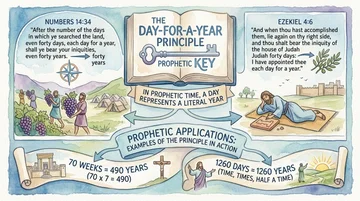
And when thou hast accomplished them, lie again on thy right side, and thou shalt bear the iniquity of the house of Judah forty days: I have appointed thee each day for a year.
Gives the day-for-a-year rule used to count the weeks as years.
- Colossians 2:14
Blotting out the handwriting of ordinances that was against us, which was contrary to us, and took it out of the way, nailing it to his cross;
Christ’s death nails the ordinances to the cross, ending sacrificial rites.
- Mark 13:14
But when ye shall see the abomination of desolation, spoken of by Daniel the prophet, standing where it ought not, ( let him that readeth understand,) then let them that be in Judæa flee to the mountains:
Jesus identifies Daniel’s sign and tells those in Judea to flee.
- Ezra 7:7
And there went up some of the children of Israel, and of the priests, and the Levites, and the singers, and the porters, and the Nethinims, unto Jerusalem, in the seventh year of Artaxerxes the king.
Artaxerxes’ decree to restore Jerusalem marks the starting point of the seventy weeks.
- Daniel 9:2
In the first year of his reign I Daniel understood by books the number of the years, whereof the word of the LORD came to Jeremiah the prophet, that he would accomplish seventy years in the desolations of Jerusalem.
Jeremiah’s seventy years of Jerusalem’s desolation set the context for Daniel’s prophecy.
- Matthew 26:28
For this is my blood of the new testament, which is shed for many for the remission of sins.
Jesus identifies his blood, shed for many, as the blood of the new covenant.
- Daniel 12:7
And I heard the man clothed in linen, which was upon the waters of the river, when he held up his right hand and his left hand unto heaven, and sware by him that liveth for ever that it shall be for a time, times, and an half; and when he shall have accomplished to scatter the power of the holy people, all these things shall be finished.
Its parallel time expression is explained as prophetic years.
- Daniel 8:11
Yea, he magnified himself even to the prince of the host, and by him the daily sacrifice was taken away, and the place of his sanctuary was cast down.
Both describe the sacrifice being stopped and the sanctuary cast down.
- Matthew 23:38
Behold, your house is left unto you desolate.
Jesus declares the temple desolate, linked to the events at the middle of the week.
- Numbers 14:34
After the number of the days in which ye searched the land, even forty days, each day for a year, shall ye bear your iniquities, even forty years, and ye shall know my breach of promise.
A day is counted as a year, establishing the day-year principle for prophetic periods.
Commentary part 1 of 3
Each commentary is drawn from primary sources: the writings of Ellen G. White and Adventist pioneers and periodicals. Each commentary is separate. Its own words are not a quotation; follow the references to read the source passages.
Ellen G. White
43 sources
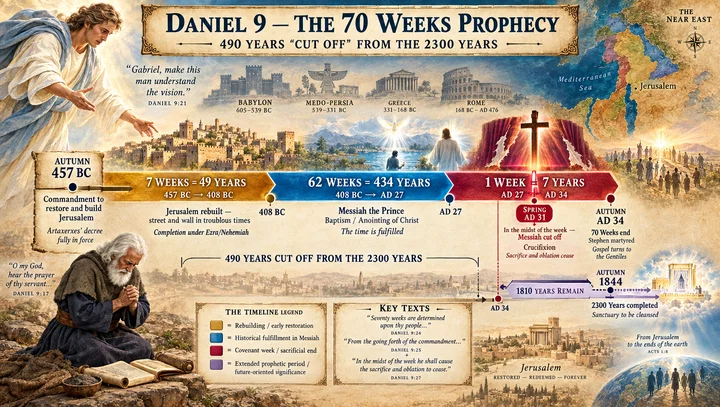
The final seven years of the seventy weeks are the time when the gospel invitation is given especially to the Jews, first by Christ Himself for three and a half years and then through His disciples.PK 699.1–2PK 698.1DA 232.5–233.2 In the middle of that week, in the spring of A.D. 31, three and a half years after His baptism in A.D. 27, Messiah is cut off on Calvary as the true Sacrifice, where type meets antitype and the animal offerings lose their value so that sacrifice and oblation cease.PK 699.1–2PK 698.1DA 232.5–233.2 The rending of the temple veil shows that sacredness and significance have departed from the earthly sacrificial service.PK 699.1–2PK 698.1DA 232.5–233.2 The week ends in A.D. 34 with the stoning of Stephen and persecution sealing Jewish rejection, when the disciples are scattered to preach everywhere, Saul is converted as apostle to the Gentiles, and the gospel turns from the Jews as a nation to the Gentiles.PK 699.1–2PK 698.1DA 232.5–233.2 These seventy weeks are 490 years cut off from the 2,300 years and allotted to the Jews, both beginning with the command to restore Jerusalem in the autumn of 457 B.C., with sixty-nine weeks reaching to Messiah's anointing in A.D. 27 and the remaining 1,810 years extending from A.D. 34 to 1844 for the cleansing of the sanctuary.GC 325.2–326.3GC88 325.1–2GC 410.1–2GC88 409.1–410.1GC88 328.3
Wording and Historical Setting
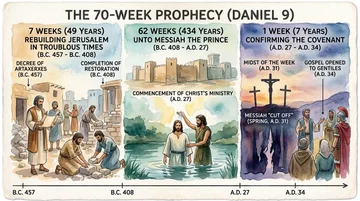
The one week is seven years, the last seven years of the seventy weeks, extending from A.D. 27 to A.D. 34.PK 699.1–2PK 698.1DA 232.5–233.2GC 327.1–328.2GC88 327.2 The seventy weeks are 490 years counted from 457 B.C. and ending in A.D. 34, divided in the chart into 49 years, 434 years, and a final seven years, with a prophetic day representing a year.GC88 328.3
It was given while Israel was in captivity with the temple destroyed and its service suspended.4MR 122.1–123.1 Israel's religion had centered in the ceremonies of the sacrificial system, making outward forms all-important while losing the spirit of true worship.4MR 122.1–123.1 The services had been corrupted with the traditions and practices of heathenism, the rites performed without looking beyond shadow to substance, and Christ not discerned as the true offering for the sins of men.4MR 122.1–123.1 God brought the captivity and suspension of the temple services so that outward ceremony would not become the sum of religion, so that principles and practice would be purged from heathenism, so that ceasing of ritual would revive heart service, and so that removal of outward glory would reveal the spiritual.4MR 122.1–123.1
In the land of captivity, as the people turned to the Lord in repentance with humiliation and distress without outward representation of His presence, He manifested Himself to them with bright beams shining into minds and hearts.4MR 122.1–123.1 He gave visions to His prophets unfolding the overthrow of the oppressors of God's people, the coming of the Redeemer, and the establishment of the everlasting kingdom.4MR 122.1–123.1
It was communicated to Daniel in vision by ministering angels in answer to earnest prayer with fasting and affliction of soul and tears and confession and humiliation, showing his seeking was not in vain and his prayer was heard.Ms 93, 1900, par. 2711MR 101.2–3 It belongs to Daniel's prophecies about future ages which Daniel did not fully understand and which were sealed until the time of the end.PK 547.1 Those prophecies are to receive special attention in the closing period of world history, when the wise will understand them.PK 547.1
Confirming the Covenant
To confirm the covenant with many for one week is to extend the gospel invitation especially to the Jews through those final seven years of the seventy weeks.PK 699.1–2PK 698.1DA 232.5–233.2GC 327.1–328.2GC88 327.2 The week runs from A.D. 27 to A.D. 34, beginning when Jesus entered His ministry.PK 699.1–2PK 698.1DA 232.5–233.2GC 327.1–328.2GC88 327.2 For the first three and a half years the invitation is given in person by Christ Himself, and for the remainder it is carried forward through His disciples and apostles.PK 699.1–2PK 698.1DA 232.5–233.2GC 327.1–328.2GC88 327.2
The full seventy weeks, or 490 years, mark the complete confirmation of the covenant with Daniel's people.4SP 493.14SP 493.2–494.14SP 494.2–3 That period begins in 457 B.C. with the going forth of the commandment to restore and build Jerusalem and is cut off from the longer prophetic period of twenty-three hundred years.4SP 494.2–3CET 48.1 Its completion brings the special allotment to the Jews to its close.4SP 493.14SP 493.2–494.14SP 494.2–3
The week ends in A.D. 34, when the stoning of Stephen and the persecution of the disciples finally seal Jewish rejection of the gospel.PK 699.1–2PK 698.1DA 232.5–233.2GC 410.1–2 The scattered disciples then go everywhere preaching the word, and shortly after Saul is converted to become Paul the apostle to the Gentiles.PK 699.1–2PK 698.1DA 232.5–233.2 When that period ends the Jews cease to be God's chosen people as a nation, and the gospel, rejected by the Jews, is carried to and preached to the Gentiles as the apostles turn to them.4SP 493.14SP 493.2–494.1GC 410.1–2CET 48.1
Sacrifice Ceasing at Cross
In the midst of the week, in the spring of A.D. 31, three and a half years after His baptism and anointing in A.D. 27, Messiah is cut off when Christ is offered on Calvary as the true Sacrifice and Lamb of God.PK 699.1–2PK 698.1DA 232.5–233.2GC 410.1–2GC88 409.1–410.1 That middle of the seventieth week fulfills the cutting off of Messiah three and a half years after the close of the sixty-nine weeks.GC 410.1–2GC88 409.1–410.1GC 327.1–328.2 His death there is the offering of the true Sacrifice on Calvary.PK 699.1–2PK 698.1DA 232.5–233.2
His death causes the sacrifice and the oblation to cease because the animal offerings had foreshadowed His one great offering of His own life.GC 327.1–328.2GC88 327.3ST Apr 8, 1875 At Calvary symbol met fulfillment and type reached antitype.GC88 327.3Ms 78, 1897, par. 31–33 So the ceremonial sacrificial system ceased in significance and lost its value, its sacrifices and offerings brought to an end.PK 699.1–2PK 698.1GC 327.1–328.2GC88 327.3ST Apr 8, 1875
The tearing of the temple veil in twain at the offering of that antitypical sacrifice shows that sacredness and significance had departed from the earthly sacrificial service.PK 699.1–2PK 698.1DA 232.5–233.2Ms 78, 1897, par. 31–33 It shows that the time had come for earthly sacrifice and oblation to cease and that the sacrificial system had ceased.PK 699.1–2DA 232.5–233.2Ms 78, 1897, par. 31–33
Through His sacrifice Messiah brings in reconciliation for iniquity and everlasting righteousness, and the cross of Calvary is the great center.11MR 101.2–3 That truth becomes effectual when acted upon.11MR 101.2–3 By the humiliation of the cross He brings everlasting deliverance to all who walk after Him and give positive evidence that they are separated from the world.11MR 101.2–3
Causing sacrifice to cease in the midst of the week does not abolish the Sabbath or nail it to the cross.ST Feb 20, 1901 The fourth commandment was not rendered null and void but was to be held sacred forty years after His death.ST Feb 20, 1901 It holds its claim upon humanity as long as heaven and earth remain.ST Feb 20, 1901
Abomination and Desolation
The overspreading of abominations and making desolate is fulfilled when idolatrous Roman standards are set up on holy ground outside Jerusalem, standing in the holy place.GC 25.44SP 25.3–26.2 Their appearance is the sign that judgment on the city will swiftly follow.GC 25.44SP 25.3–26.2 It warns those in Judea to flee at once into the mountains without presumptuous delay.GC 25.44SP 25.3–26.2ST Feb 20, 1901Ms 78, 1897, par. 46
Those warned are not to go down from the housetop to take anything out of the house, and not to return from the field to take clothes, nor to go back for goods or clothing.ST Feb 20, 1901Ms 78, 1897, par. 46 It pronounces woe upon those with child and upon those giving suck in those days.Ms 78, 1897, par. 46 It directs prayer that flight be not in winter nor on the Sabbath day.Ms 78, 1897, par. 46
Heeding the warning preserves life, so that not one Christian perished in the city, while delay and returning for possessions exposes to destruction.GC 25.4ST Feb 20, 1901Ms 78, 1897, par. 46 The foretold destruction of Jerusalem and the temple was fulfilled to the letter about forty years after Christ spoke.ST Feb 20, 1901Ms 78, 1897, par. 46Ms 78, 1897, par. 31–33 In the siege more than a million perished and many were led into captivity.Ms 78, 1897, par. 31–33 The prophecy of Jerusalem's destruction also foreshadows the terrors of the last great day.4SP 25.3–26.2
Place in Prophetic Periods
Daniel 9:27 belongs to the angel's explanation of the time left unexplained in Daniel 8, for the seventy weeks are 490 years cut off from the 2,300-year period and specially allotted to the Jews.GC 325.2–326.3GC88 325.1–2GC 410.1–2GC88 409.1–410.1 The two periods begin together with the command of Artaxerxes to restore and rebuild Jerusalem, completed and dated to the autumn of 457 B.C., and the time prophecy of this verse is among the specifications fulfilled from that starting point.GC 325.2–326.3GC 410.1–2GC88 409.1–410.1 Events limited by this period of seven weeks, sixty-two weeks, and one week were once prophecies and were fulfilled in accordance with their predictions.GC 323.2–324.2GC88 323.2
The sixty-nine weeks are the first 483 years reaching to Messiah, fulfilled by Christ's baptism and anointing by the Holy Spirit in A.D. 27.GC 410.1–2GC88 409.1–410.1 In the midst of the seventieth week Messiah is cut off, fulfilled by Christ's crucifixion three and a half years after His baptism in the spring of A.D. 31, when He confirms the covenant with many for one week and halfway through brings sacrifice and offering to an end.GC88 325.1–2GC 410.1–2GC88 409.1–410.1 The seventy weeks, or 490 years, end in A.D. 34, when Jewish rejection is sealed by persecution of the disciples and the apostles turn to the Gentiles.GC 410.1–2GC88 409.1–410.1 With the first 490 years ended, 1,810 years remain, extending from A.D. 34 to 1844, when the sanctuary is to be cleansed, supporting that calculation of the 2,300 years.GC 410.1–2GC88 409.1–410.1
The period is shown in a chart dividing the 490 years into 49 years, 434 years, and a final seven years, marking Christ's baptism and crucifixion and the gospel reaching the Gentiles, with a prophetic day representing a year.GC88 328.3 Using 457 B.C. as the shared starting point of the seventy weeks and the 2,300-day period, subtracting 457 from 2300 gives A.D. 1843, presented as verifying Miller's reckoning.GC88 328.34SP 495.1 The earlier expectation of spring rather than autumn 1844 does not change that endpoint in 1844.GC88 328.3
The seventy-weeks prophecy formed the basis for the first disciples' preaching that the appointed time was fulfilled and the kingdom of God was at hand.GC 351.1GC88 351.1–352.3 Their message concerned fulfillment of one portion of the 2,300-day period, while Miller and his associates proclaimed the approaching end of the larger period.GC 351.1GC88 351.1–352.3 The disciples proclaimed the time but did not recognize that the same prophecy foretold Messiah's death.GC88 351.1–352.3 The verse foretells that death in the midst of the final week, when sacrifice and oblation would cease, yet expectation of an earthly kingdom at the end of the seventy weeks came from adherence to popular errors that blinded minds to that truth.GC 352.3 Proclaiming the time was still giving the right message at the right time in fulfillment of God's will, even though misapprehension of the predicted event brought disappointment, paralleling the Adventist mistake over the 2,300 days.GC 352.3
Understanding and Warning
The prophecy gives a period reaching to the coming of Christ, His anointing by the Holy Spirit, His death, and the giving of the gospel to the Gentiles.DA 98.4DA 133.2–3DA 233.3–234.2 It could be understood and recognized as fulfilled in Jesus, and Christ urged His disciples to study these prophecies.DA 233.3–234.2 Gabriel made this period known to Daniel five hundred years before coming to Zacharias, and knowing that its end was near Zacharias prayed for the Messiah's advent.DA 98.4 It is sure prophecy concerning the coming One, whose real coming and testing in the wilderness stand at the center.Ms 13, 1873, par. 5–6
It points unmistakably to the time of Messiah's coming and directly foretells His death.GC88 377.3–378.2GC 377.3–378.2 So clear was its testimony that Jewish leaders discouraged its study, and the rabbis pronounced a curse on all who should attempt a computation of the time.GC88 377.3–378.2GC 377.3–378.2 It makes known the exact time of Christ's first coming, the hour determined in heaven's council for God to send forth His Son to redeem those under the law.PK 699.3–700.2 It belongs with the promises repeated from Enoch through patriarchs and prophets that kept alive the hope of His appearing.PK 699.3–700.2 Those promises led the Hebrews to live in constant expectancy as strangers and pilgrims, and were believed even by many who died without receiving them.PK 699.3–700.2
Its light concerning Messiah's coming is given to the pure and simple who are willing to receive it and who wait to catch its first gleams.Ms 27, 1898, par. 1 Earnest humble study would have helped the Jews recognize the time of visitation and would have kept them from assigning to His first advent the glories belonging to His second appearing.DA 31.2–3Ms 41a, 1896, par. 3320MR 241.5–242.2 Though Christ was among them, they misread the Scriptures and fulfilled what had been prophesied.Ms 41a, 1896, par. 33 The scribes knew from prophetic history that the time for looking and waiting had expired, and Jesus directed them to prophecies foretelling the events then taking place.ST Apr 11, 1878 Yet devotion to the world and forgetfulness of God, with pride and being lofty in their own estimation, left priests and rulers ignorant, rejecting the Redeemer and unprepared to understand.GC 377.3–378.2Ms 27, 1898, par. 120MR 241.5–242.2
Events limited by this period were once prophecies and were fulfilled in accordance with their predictions.GC 323.2–324.2GC88 323.2 The eighteen hundred years of blindness and indifference that followed rejection of this light stand as a solemn warning of the danger of rejecting light from heaven through devotion to the world and forgetfulness of God.GC 377.3–378.2
Sources
Pioneers and periodicals
527 sources
He is Messiah the Prince, who confirms the new everlasting covenant with many for one final prophetic week of seven years, and in the middle of that week is cut off in death and thereby causes the typical sacrifices and offerings to cease in force and meaning.RH Jan 7, 1858RH Apr 8, 1873ST Aug 31, 1915ST Mar 14, 1878RH Nov 12, 1901 The seventy weeks are 490 years by a day for a year, cut off from the 2,300 day-years of Daniel 8 as its first part, both beginning together from the command to restore Jerusalem going forth in Artaxerxes' seventh year in 457 B.C.RH Feb 17, 1853ST Dec 19, 1892RH Apr 30, 1901RH Jan 21, 1873LDT 42.1 Sixty-nine weeks of 483 years reach to Messiah's anointing at baptism in autumn A.D. 27, the seventieth week runs to autumn A.D. 34, with the crucifixion in its midst in spring A.D. 31 after three and a half years, and its close in the rejection by the Sanhedrin, Stephen's martyrdom and the turning of the gospel to the Gentiles.ST Jan 25, 1910RH Jan 7, 1858RH Mar 21, 1854ST Mar 3, 1909ST Mar 31, 1909 For the overspreading of abominations the rebuilt city and sanctuary are made desolate by the Romans as His instrument, the idolatrous Roman army surrounding Jerusalem and destroying it in A.D. 70.ST Aug 31, 1915ST Nov 23, 1904RH Dec 3, 1908ST Jan 27, 1890 After the seventy weeks cut off upon the Jews, 1,810 years remain to autumn 1844, when the sanctuary to be cleansed is the heavenly sanctuary where Christ ministers, beginning the investigative judgment and closing atonement.RH Aug 24, 1916ST Jan 24, 1906RH Feb 22, 1870ST May 27, 1880
Wording and Vision Setting
The word determined means literally cut off, divided, decreed.ST Jan 24, 1878RH May 26, 1853 A week denotes a group of seven, the Hebrew Shabua and the Greek Hebdomos, and this verse means a week of years, not literal days, and does not predict death in the middle of a literal week.ST Mar 3, 1890RH Jul 3, 1879RH Jun 4, 1908RH Feb 18, 1873 Where the literal offering is intended the Hebrew zebach and minchah are present, and the plural abominations does not by itself identify the particular abomination of desolation named by Jesus.RH Dec 9, 1852ST Mar 12, 1912
Daniel 9, including this verse, was given to supply skill and understanding about the vision of Daniel 8 after Daniel fainted and bore only part.ST Dec 24, 1894ST Jan 24, 1878RH May 26, 1853 The same Gabriel charged to make him understand returned to finish it, telling him to consider that vision and taking up the one point omitted there, namely time, without repeating ram, goat or little horn.ST Jan 24, 1878RH Dec 6, 1853RH May 26, 1853RH Dec 31, 1857 Gabriel's further explanation was given on a special visit in answer to prayer and fasting while Daniel prayed for people and sanctuary, directing him back to chapter 8.RH Dec 20, 1870RH Mar 10, 1874 After some points remained unexplained Daniel again sought understanding with three weeks of mourning without pleasant bread, flesh, wine or anointing, followed by Daniel 10-12 with more minute information.RH Dec 20, 1870RH Jul 18, 1871RH Dec 20, 1870
The verse corrects Daniel's mistaken connection of the sanctuary's cleansing with the end of the seventy years of captivity and Jerusalem's ruined sanctuary.RH Aug 23, 1870 Daniel 9 is the key to when the 2,300 years begin.RH Jun 12, 1856RH Oct 4, 1870 Daniel 9 does not complete the explanation of Daniel 7 about how long the host would be trodden underfoot, and Daniel had not yet learned what would befall his people at the last end of the indignation.RH Jan 10, 1856 Discouraged by the holy city destroyed and Prince cut off while pleading under Jeremiah's prediction, he was comforted by Daniel 10-12.ST Apr 9, 1912
The vision was given in Daniel's first year under Darius, dated to 538 B.C., with Daniel 8 given around that time not fifteen years earlier.ST Dec 24, 1894ST Mar 11, 1889 That instruction respecting the seventy weeks was four years before the last vision in Daniel 10-12 in the third year of Cyrus in B.C. 534.RH Dec 20, 1870 Chapters 10-12 supplement chapters 8 and 9 with more detail about events and powers, together covering the same ground and reaching the same end.ST Apr 9, 1912RH Jul 2, 1867RH Feb 27, 1866 Chapter 9 leaves the history of Daniel's own people when worship had sunk very low and worst persecution chastised them for Daniel 10 to show.ST Apr 23, 1912 The chapter gives the explanation of Daniel 8, including the transition from the earthly sanctuary as figure to the true sanctuary in heaven and what it reveals about the 2,300 days.RH Nov 10, 1863ST Dec 1, 1881
After marking the end of the seventy weeks the account returns to the Roman league with the Jews in 161 B.C. toward final triumph.ST Apr 27, 1882 The verse belongs to the seventy-week prophecy divided into seven weeks, sixty-two weeks and one week, concerning the future destiny of Daniel's people and city far beyond the immediate end of captivity.RH Dec 19, 1871RH Jan 16, 1872RH Feb 14, 1871RH Dec 20, 1870 That destiny is connected with restoration under Ezra where conditional prophecy and prayer warned renewed disobedience and alliance with abominations could leave no remnant.ST Apr 15, 1880 The verse is the final part concerning the covenant week and cessation of sacrifice, whose date is established and linked to the command to restore Jerusalem.RH Dec 19, 1871RH Jan 16, 1872RH Feb 14, 1871RH Dec 20, 1870RH Oct 27, 1874 It belongs with the seventy-week and 2,300-day chronology.RH Dec 1850ST May 20, 1880
Daniel is partly Hebrew and partly Aramaic as narrative with prophecy, showing the world's career to God's everlasting kingdom, and Daniel means judge of God.ST Dec 1, 1909 The verse belongs to genuine future prophecy, not past events in prophetic style, with Babylonian, Medo-Persian, Grecian and Roman kingdoms held by Jewish interpreters before Christ, by Christ, and by most expositors for nearly two millennia.ST Unlike literal Daniel 11 it belongs to symbolic prophecy.RH Dec 28, 1911 The verse belongs to revelation of world history and the coming Messiah.RH Nov 22, 1906
Seventy Weeks Joined to 2300 Days
The seventy weeks are four hundred and ninety years by the day-year principle, a day for a year in symbolic prophecy, cut off from the two thousand three hundred day-years of Daniel 8 as its first part, the two periods beginning together with Daniel 9 supplying the starting point and explanation of the time left unexplained.RH Feb 17, 1853ST Dec 19, 1892RH Apr 30, 1901RH Nov 15, 1853RH Nov 8, 1853 The sixty-nine weeks are four hundred eighty-three years reaching to Messiah, beginning with the decree to rebuild Jerusalem dated to 457 B.C., and the final covenant-confirming week with sacrifice ceasing in its midst belongs within that seventy-week division whose periods mark separate events.ST Dec 19, 1892RH Apr 30, 1901RH Nov 15, 1853RH Feb 27, 1908 The seventy weeks are therefore the first four hundred ninety days of the longer period, and on that connection the two thousand three hundred days have expired.RH Nov 8, 1853RH Feb 27, 1908
The Hebrew rendered determined means cut off, and the seventy weeks are cut off from the two thousand three hundred days as its first four hundred ninety years, commencing at the same time and supplying the key to when the longer period ends.LDT 42.1ST Dec 21, 1882RH May 26, 1853RH Apr 18, 1854RH Jul 28, 1863 The periods are mutually dependent and inseparable, so separating them removes the chronological basis, and the vision Daniel is told to consider is the Daniel 8 vision whose time Gabriel was commanded to make him understand.RH May 26, 1853RH Apr 18, 1854 The seventy weeks and the two thousand three hundred days therefore begin from the same starting point in B.C. 457, with the longer period extending one thousand eight hundred ten years beyond the seventy weeks to end in 1844.RH May 26, 1853RH Apr 18, 1854RH Jul 28, 1863 The crucifixion stands in the middle of the last week in A.D. 31, the seventy weeks ending in autumn A.D. 34, reckoned from the actual beginning of restoration work in autumn 457 B.C. rather than Ezra's departure.RH Jul 28, 1863
The seventy weeks are cut off as an appendix explaining the chronological part of Daniel 8:14, joined not separated, comprising the first four hundred ninety days in direct relation.RH Dec 20, 1853ST Mar 13, 1884 They are not to be shifted forward thirteen years, and their chronology fixes the dates of Christ's ministry and crucifixion and the beginning of the gospel to the Gentiles.RH Dec 15, 1868RH Oct 30, 1855 They belong to the explanation in Daniel 9 of Daniel's second vision of the ram and he-goat in Daniel 8.
The seventy weeks are four hundred ninety years by year-day reckoning, with the twelve hundred sixty and two thousand three hundred days likewise reckoned as so many years, consecutive years counted from the command to restore Jerusalem rather than from the vision or Jeremiah's prophecy.RH Jan 21, 1873RH Jan 21, 1858RH May 26, 1853RH Oct 13, 1863RH Feb 27, 1908 Reckoned from the decree in autumn B.C. 457, the sixty-nine weeks extend to autumn A.D. 27 when Jesus was baptized and went forth as Messiah the Prince preaching the time fulfilled, three and a half years later in spring A.D. 31 the crucifixion took place in the midst of the seventieth week, and three and a half years more terminate the seventy weeks in autumn A.D. 34.RH Jan 21, 1858 The whole period concerns the future destiny of Daniel's people and city far beyond the immediate captivity, divided into seven weeks, sixty-two weeks and one week, the seventieth week as seven years divided into two halves of three and a half years each.RH Jan 21, 1858RH Feb 27, 1908
Prophetic days mean years by Gabriel's rule, the same rule given to Ezekiel, proving the days in Daniel's prophecy are so many years.RH Oct 27, 1859ST Aug 8, 1878ST May 11, 1876ST Jan 11, 1883 The seventy weeks and the two thousand three hundred-year period in Daniel 8 are historical prophecies extending to the end of time, and the four hundred ninety days reckoned as years ending at Christ's death applies the same reckoning to the two thousand three hundred days, among year-day periods used in Revelation, allowing the prophecy to reach the age of Josephus.RH Oct 27, 1859LDT 151.1 The seventy weeks marked out for Israel ended in A.D. 34 with Messiah cut off in the midst, ending special national privilege while the apostles continued special preaching to Jews about three and a half years to complete the weeks.ST Dec 25, 1901
The seventy weeks are the first part and division of the two thousand three hundred years, giving the explanation of Daniel 8 and one link in a connected prophetic chain marked by subdivisions tied to definite world-history events.RH May 26, 1853RH Aug 2, 1864ST Sep 7, 1915ST Jul 30, 1902RH Jan 17, 1856 Beginning in B.C. 457 at the same time as the two thousand three hundred years, they terminate the longer period in 1843-1844, with the confirmation of the covenant for one week and causing sacrifice to cease in the middle fulfilled in Christ's first advent and crucifixion at the close of sixty-nine weeks and in the seventieth week.RH May 26, 1853RH Aug 2, 1864 The later message announcing the end of the two thousand three hundred days identifies the cleansing of the sanctuary, when the final stage of salvation was about to begin in heaven and on earth, and some students saw the period ending near 1844 with no further explanation of Daniel 9:27 itself.ST Sep 7, 1915ST Jul 30, 1902RH Jan 27, 1916
The verse is included in the seventy-weeks prophecy presented together with the twenty-three-hundred-days prophecy as part of Daniel 8 and 9.ST Nov 18, 1903 The seventy weeks and the two thousand three hundred days were preached together in 1843, connected rather than separate.RH Dec 6, 1853 The seventy weeks are one link in a connected chain of prophetic periods whose dates stand or fall together harmoniously, so none can be moved without invalidating the evidence for all.RH Jan 17, 1856 That connection is proved independently of the starting point by fixing the end of the twelve hundred ninety days in 1798 as the end of the indignation, then adding the final forty-five years as the time of the end of the vision to reach its termination, then counting back two thousand three hundred years to arrive at the date of the seventy weeks.RH Jan 17, 1856
The connection between Daniel 8 and Daniel 9 was retained as a sound principle in interpreting prophecy, while the claim that the earth is the sanctuary was rejected.RH Aug 4, 1868 Light on the seventy weeks had been present since Christ preached the time fulfilled, but light that they explain the two thousand three hundred days came after 1798 as the time of the end.GSAM 84.3LDT 42.2RH Jul 16, 1914 Before then students understood the seventy weeks but had not connected them to the two thousand three hundred days, the connection remaining sealed until 1798.GSAM 84.3LDT 42.2 It was then discovered independently in at least twenty different countries with agreement the period would terminate in 1844, accepted as proof Christ would come in 1844 to cleanse the sanctuary understood as the world by fire.RH Jul 16, 1914 Christ's ministry and death fulfilled the prophecy in harmony with the 457 B.C. beginning, confirming Him as Messiah and fixing the date, with the seventy weeks terminating in A.D. 34 so the two thousand three hundred days terminate one thousand eight hundred ten years later in 1844.LDT 42.2RH Jul 16, 1914
Views of exact time from the prophecy depend entirely upon accuracy of chronology, prophetic periods are as much subject to investigation as any other Scripture, and it is duty to present the evidence and preach definite time and warn men.RH Jan 21, 1873 The seventy-week prophecy is linked with the two thousand three hundred-day prophecy, that connection being necessary to reckon the two thousand three hundred days from starting point to termination in 1844.RH Dec 6, 1853RH Feb 11, 1858 Daniel 9:24-27 makes clear when the two thousand three hundred-day period understood as years begins, so its ending can be known.ST Mar 4, 1889 It places cessation of sacrifice and offering in the middle of the final week at the crucifixion in A.D. 31, the seventy weeks providing the clue to when the longer period begins.RH Jan 21, 1858
That connection was used to place the longer period's end in 1843-44 by a common starting point, though failure of the expected event at that time was cited as evidence against the connection.RH Jan 10, 1854 The passing of time does not disprove that connection, and the seeming objection raised by passing of time since 1844 has been thoroughly removed, the seventy weeks and two thousand three hundred days forming one prophetic period under just rules of interpretation.ST May 13, 1880RH Jan 21, 1858 The beginning and ending remain in the position traditionally assigned, with connected simultaneous beginning, and the fact Christ did not come in 1844 to burn the earth does not undo it.RH Dec 23, 1852RH May 26, 1853 Nor should it be rejected on grounds the sanctuary is earth or Canaan and cleansing means earth's burning or Palestine's purification at Christ's coming.RH Dec 23, 1852
Decree and Chronological Reckoning
The seventy weeks and the 2,300 days share the same starting point from the going forth of the commandment to restore and build Jerusalem in the seventh year of Artaxerxes as in Ezra 7, dated to 457 B.C. in autumn when effective through Ezra, with Messiah revealed at the beginning of his ministry.RH Feb 17, 1853ST Dec 19, 1892RH Apr 30, 1901RH Nov 15, 1853 The seventy weeks are divided into periods marking separate events so the application can be identified, the seven weeks and threescore and two weeks together being sixty-nine prophetic weeks or 483 years reaching unto Messiah the Prince.ST Dec 19, 1892RH Apr 30, 1901ST Jan 24, 1906 Starting from the return from captivity and the rebuilding of Jerusalem with 457 B.C. as basis, the prophecy foretells the year of baptism and crucifixion, the final rejection of the gospel by the Jewish nation, the beginning of work for the Gentiles, and extends to A.D. 1844 pointing to a solemn work connected with salvation then begun.ST Jan 24, 1906 A chronology putting the crucifixion as late as A.D. 43 or later does not fit.RH Feb 17, 1853
That commandment was originated by Cyrus, reaffirmed by Darius, and completed by Artaxerxes, reaching its completest form in the decree of Ezra 7 issued in B.C. 457, which marks the beginning of the 2,300 years.RH Jun 29, 1911RH Sep 20, 1870RH May 6, 1852ST Mar 2, 1882 It was God's commandment through the Persian king, authorizing civil and religious restoration.RH Jun 29, 1911 The seventy weeks beginning then expire in A.D. 34, leaving 1,810 years extending to 1844 when the sanctuary shall be cleansed.RH Jun 29, 1911RH May 6, 1852 Of four Persian edicts the first two are excluded because counting from either does not reach Christ's birth, and counting 483 years from late 458 or early 457 B.C. leads to baptism and public appearance around the close of A.D. 26 or beginning of A.D. 27.
Cyrus and Darius are ruled out because they concerned chiefly the temple and its worship, not the restoration of Jerusalem's civil state and polity.RH Jul 15, 1873RH Sep 13, 1870RH Feb 14, 1854 The decree of Artaxerxes in his seventh year alone fits the conditions of Messiah the Prince coming, crucifixion causing sacrifice to cease, and confirmation of the covenant for one week, and these events fix the beginning and rule out moving the date to make the 2,300 days end in the future.RH Feb 14, 1854 The seventh-year decree sending Ezra to Jerusalem with treasure and authority to govern implied license to rebuild the walls later executed by Nehemiah in the twentieth year as a confirmation rather than a new decree.RH Jul 15, 1873
Of four Persian edicts only the third grant to Ezra harmonizes in every particular with restoring civil and religious order with magistrates and judges under the law of God, begun by Ezra and perfected by Nehemiah while the temple was already built.RH Dec 24, 1861RH Nov 7, 1907RH Jan 21, 1858 The earlier decrees of Cyrus and Darius were ineffective or limited to the temple, and the later decree in the twentieth year only confirmed the earlier one.RH Dec 24, 1861RH Nov 7, 1907 Nehemiah's letters to officials were not a single decree, and the walls and gates had already been built before he arrived, so Ezra's written commission not Nehemiah's verbal permission for travel and timber is the start.RH Jul 21, 1863RH Jul 28, 1863 Dating from Nehemiah disrupts the stated periods: the seven weeks do not fit the rebuilding, the sixty-nine weeks miss the Messiah, and the seventieth week misses the crucifixion and the end.RH Jul 28, 1863
The starting decree is Ezra's commission in Artaxerxes Longimanus's seventh year in 457 B.C. when Ezra arrived at Jerusalem with enlarged powers, countrymen, gold, silver and rich presents, rather than Cyrus, Darius, Nehemiah's later commission, or twentieth-year marginal readings which are only man's work.RH Mar 14, 1871ST Jul 25, 1878RH Nov 18, 1909RH Apr 25, 1854ST Apr 22, 1880 The commission given to Ezra rather than Nehemiah matters to the chronology including dates associated with 1844.ST Apr 22, 1880ST Jan 22, 1880 The seventy weeks must begin from Artaxerxes' seventh or twentieth year, and since his reign began in 464-463 B.C. these place the seventieth week's end no later than A.D. 34 if from the seventh or no earlier than A.D. 46-47 if from the twentieth.RH Dec 23, 1852RH Jul 23, 1857 They begin when issued not when rebuilding finished, so work begun under Ezra and finished under Nehemiah does not change the ending.RH Jul 23, 1857
Counting from Nehemiah's twentieth-year commission dated B.C. 444 or 445-444 does not fit building, appearance and crucifixion, placing 483 years in A.D. 39-40 after Jesus was already revealed at baptism in A.D. 27, finished work, died in A.D. 31, risen and ascended, with midst in A.D. 44 and end in A.D. 47 with nothing to mark it.ST Apr 22, 1880RH Sep 13, 1870RH Mar 21, 1854RH Jul 28, 1863RH Jan 14, 1858 The first seven weeks or forty-nine years are allotted to building street and wall in troublous times, not to a work finished in fifty-two days.RH Jan 14, 1858 Even dated correctly at 444 B.C. that start would carry the 2,300 days only to 1857 or 1854, now past, showing the utmost limit for extending the days has passed and the original reckoning stands with mistake not in time but in event.RH Jan 21, 1858 Counting 490 consecutive years from any of the four edicts does not bring the end near Jerusalem's destruction in A.D. 70, with Cyrus's edict more than 490 years before the Christian era.RH Apr 9, 1908RH Apr 9, 1908RH Apr 9, 1908ST Mar 18, 1889 The 490 years from seventh or twentieth year does not extend to A.D. 70, and destruction and later desolation following the cutting off are distinct events closely connected to the 490 years but not within that period, with precise timing of the decreed desolation not specified.RH Apr 9, 1908RH Apr 9, 1908ST Mar 26, 1912
The decree must be dated so 490 years reach Jesus' life, the first two edicts being too early and leaving Artaxerxes' seventh- or twentieth-year edict for examination, with Messiah establishing covenant with many Jews during the seventieth week and in its middle cut off bringing sacrifices to an end in God's sight.RH Apr 9, 1908 The effective decree to Ezra in 457 B.C., late 458 to early 457, is reckoned from autumn 457 at actual restoration work rather than spring departure or calendar year.RH Sep 20, 1870RH May 6, 1852ST Mar 2, 1882RH Jan 21, 1858 Reckoned from the decree in autumn B.C. 457, the sixty-nine weeks extend to autumn A.D. 27 when Jesus was baptized and went forth as Messiah preaching time fulfilled, three and a half years later in spring A.D. 31 the crucifixion took place, and three and a half years more terminate the seventy weeks in autumn A.D. 34.RH Jan 21, 1858 Reckoned from beginning of B.C. 457 the 483 years end at beginning of A.D. 27 with rebuilding and crucifixion agreeing with history.RH Nov 7, 1907
The start fulfilled by Artaxerxes Longimanus in his seventh year in 457 B.C. when Ezra received commission begins by day-for-a-year the 2,300-year longest period in Daniel 8 and 9 reaching A.D. 1844, ending autumn 1844 because nearly six months of 457 B.C. had passed.ST Feb 25, 1886ST Mar 25, 1897RH Jan 8, 1901 Dating seventy weeks 458 B.C. to A.D. 39 is error.RH Nov 26, 1857 The 457 B.C. date is fixed and undisputed by astronomy: a lunar eclipse in Cambyses' seventh year the night after July 16 in year 4191 of the Julian period, B.C. 523, plus one more year of Cambyses, thirty-six of Darius and twenty-one of Xerxes to Artaxerxes' first year B.C. 464, making his seventh B.C. 457, confirmed by more than twenty concurrent eclipses.RH Jan 14, 1858RH Jan 21, 1858ST Apr 15, 1880RH Jan 17, 1856 The 483 years extend to Christ's thirtieth year after birth in B.C. 4-5, placing the cross 3 1/2 years later, and moving the start from B.C. 464 or 464-463 would overturn that evidence.RH Jan 21, 1858RH Jan 17, 1856RH Mar 2, 1869
Chronology cannot be moved later without disproving Artaxerxes' established date and providing a better start, with more than twenty eclipses confirming reign beginning 464-463 B.C.ST Oct 25, 1883 The autumn endpoint in the seventh month A.D. 34 with remaining three and a half years ending autumn A.D. 34 after crucifixion spring A.D. 31 supports beginning from autumn restoration work rather than spring departure, fixing autumn 457 B.C. for seventy weeks and 2,300 years.RH Dec 23, 1852RH May 1, 1866 The true date is of highest interest to the Advent movement because it furnishes the key to the 2,300 days, with beginning tied to Artaxerxes Longimanus authorizing Ezra giving harmonious fit for beginning, intermediate dates and ending.ST Apr 22, 1880RH Jul 15, 1873 The verse fixes the 2,300 days' start at B.C. 457, settled by seven years examining dates to prove fall 1844 ending, and does not teach crucifixion at end of sixtieth week, a perversion to stretch time to spring 1850.RH Dec 1850
Proposals moving dates are rejected: that Acts 13 marks end in A.D. 45 with apostles confirming covenant and death in A.D. 38; that beginning as late as B.C. 446 leaves last week beginning after crucifixion; and twentieth year no later than B.C. 454 placing crucifixion A.D. 33 and end A.D. 37, which must still harmonize beginning with crucifixion in last week.RH Jan 10, 1854RH Oct 10, 1854 The seventy weeks begin in middle of 457 B.C. and end autumn A.D. 34, leaving 1,810 years to autumn A.D. 1844.RH May 14, 1867RH Dec 1850RH Jun 9, 1851 Because part of the starting year had passed, the periods extend into 1844 rather than ending 1843, the fractional year being counted to reach full length, though by one reckoning beginning B.C. 457 terminates in 1843.RH Dec 1850RH Jun 9, 1851RH May 26, 1853
The seventy weeks are the first 490 years of the 2,300 beginning 457 B.C.; after A.D. 34, 1,810 years remained to autumn A.D. 1844 calculated from autumn 457 B.C. with seventy weeks ending autumn A.D. 34, ending with Christ entering the Most Holy to complete atonement.RH May 6, 1852RH May 26, 1853RH Apr 18, 1854RH Jul 28, 1863 Fulfillment of sixty-nine and seventieth weeks means remainder expired by 1844 behind definite-time proclamation, and cleansing is not earth by fire at coming, for which there is not particle of evidence.RH Apr 18, 1854RH Apr 18, 1854 By a differing reckoning the seventy weeks run from seventh year 457 B.C. to death in A.D. 33, leaving 1,810 years to A.D. 1843 for cleansing; 490 years terminating at Christ's death linked to 2,300 days as years brings 2,300 years to 1843.SMV 25.1RH Jan 31, 1856GSAM 110.3–111.1 On one calculation the 70 weeks were understood to end with crucifixion in A.D. 33, so the larger period ended on its anniversary in 1843.RH May 8, 1856
Other datings place beginning at B.C. 446, at 456 1/2 B.C. in Artaxerxes' seventh year with seven years from baptism reaching A.D. 34, at 457-458 B.C. ending at crucifixion in A.D. 31 in the middle of the final week, and at 456 1/2 years with death after 486 1/2 years; and one teaching holds the whole period commences with the decree in 467 B.C. and ends A.D. 1844 to complete 2,300 full years.RH Jun 17, 1915ST Jul 1, 1897RH Aug 24, 1869RH Mar 30, 1876RH Oct 10, 1854 The seventy weeks begin B.C. 457 at the same time as 2,300 years when the command went forth in 457 B.C.RH Mar 14, 1871ST Jul 25, 1878RH Nov 18, 1909RH Apr 25, 1854 The first seven weeks allot forty-nine years to restoring Jerusalem, from Ezra's decree in 457 B.C. until restoration of Jewish church and state was completed, marked by Nehemiah's final reforms in Darius Nothus's fifteenth year; forty-nine years reach restoration in B.C. 408.ST Jul 1, 1897RH Sep 13, 1870
The sixty-nine weeks are 483 years from the decree finally confirmed by Artaxerxes to Messiah the Prince's public ministry preaching the kingdom and time fulfilled; ministry began at end of 69 weeks in A.D. 27, John beginning spring A.D. 27 and Christ autumn, and moving that start would disrupt chronology with the 2,300 days.RH Mar 27, 1900RH Apr 17, 1855ST Jul 16, 1902RH May 14, 1901 Messiah's appearance comes at end of 483 years counted as years of at least 365 days, not defective 360-day years, probably solar year.RH Apr 9, 1908 The type of cleansing fell on the tenth day of the seventh month, so 2,300 years closed that day in autumn 1844 and began that day in autumn 457 B.C. when the decree went into effect through Ezra and was delivered and published.ST Sep 18, 1901 The prophecy concerning Christ verifies the date of ascension as May 31.ST Dec 17, 1896 Its chronology involves dispute about crucifixion's calendar year, distinguishing age at death from year, with Dr. Jarvis dating crucifixion A.D. 28 not A.D. 37 and birth B.C. 6 to count crucifixion in His thirty-fourth year.RH Oct 10, 1854 The seventy weeks are weeks of years ending at death with anointing and sufferings, while punishment for murdering Messiah in loss of principality and priesthood, perpetual exile and irreparable desolation is not counted inside the 490 years, with half a week assigned for those plagues upon murderers.RH Jul 15, 1873
Sources