Matthew 25:6
And at mid night there was a cry made, Behold, the bridegroom cometh; go ye out to meet him.
Translations
And at midnight there was a cry made, Behold, the bridegroom comes; go you out to meet him.
And at mid night there was a cry made, Behold, the bridegroom cometh; go ye out to meet him.
KJV Cambridge Paragraph Bible, Webster Bible
And at midnight there was a cry made, Behold, the bridegroom cometh; go ye out to meet him.
Revised Version, American Standard Version
But at midnight there is a cry, Behold, the bridegroom! Come ye forth to meet him.
and in the middle of the night a cry was made, Lo, the bridegroom doth come; go ye forth to meet him.
But in [ the] middle of [ the] night there was a cry, Behold, the bridegroom; go forth to meet him.
And, at midnight, an outcry hath been made—Lo! the bridegroom! Be going forth to meet him!
At midnight the cry rang out: ‘ Here is the bridegroom! Come out to meet him!’
At midnight the cry rang out: ‘ Behold, the bridegroom is coming! Come out to meet him!’
But at midnight there was a cry, ‘ Behold! The bridegroom is coming! Come out to meet him!’
But in the middle of the night there is a cry, The husband comes! Go out to him.
And at midnight there was a crie made, Behold, the bridegrome commeth: goe out to meete him.
Douay-Rheims (Challoner revision)
And at midnight there was a cry made: Behold the bridegroom cometh, go ye forth to meet him.
Pictures
Cross-references 20 of 78
- Luke 12:35-36
Let your loins be girded about, and your lights burning;
Servants are to keep watch while waiting for their Lord.
- Revelation 19:9
And he saith unto me, Write, Blessed are they which are called unto the marriage supper of the Lamb. And he saith unto me, These are the true sayings of God.
The marriage feast is waiting for the bridegroom’s guests.
- Matthew 25:10
And while they went to buy, the bridegroom came; and they that were ready went in with him to the marriage: and the door was shut.
The midnight cry is followed by the Bridegroom’s arrival and the prepared entering the wedding.
- 1 Thessalonians 4:16-17
For the Lord himself shall descend from heaven with a shout, with the voice of the archangel, and with the trump of God: and the dead in Christ shall rise first:
The Lord returns, the dead rise, and the living meet him.
- Matthew 24:44
Therefore be ye also ready: for in such an hour as ye think not the Son of man cometh.
Both warn that Christ comes unexpectedly and call people to be ready.
- 1 Thessalonians 5:2-6
For yourselves know perfectly that the day of the Lord so cometh as a thief in the night.
The unexpected coming calls believers to stay awake and alert.
- Matthew 25:13
Watch therefore, for ye know neither the day nor the hour wherein the Son of man cometh.
Concludes the parable with a call to watch because the day and hour of the Son of Man’s coming are unknown.
- Revelation 22:20
He which testifieth these things saith, Surely I come quickly. Amen. Even so, come, Lord Jesus.
The midnight cry for the Bridegroom echoes Christ’s promise to come quickly.
- John 14:3
And if I go and prepare a place for you, I will come again, and receive you unto myself; that where I am, there ye may be also.
Jesus promises to return and receive his people to himself.
- Mark 13:35-37
Watch ye therefore: for ye know not when the master of the house cometh, at even, or at midnight, or at the cockcrowing, or in the morning:
Both call for watchfulness because the Lord may come unexpectedly, even at midnight.
- Hebrews 10:37
For yet a little while, and he that shall come will come, and will not tarry.
The coming Lord will arrive soon, encouraging patient confidence while waiting.
- Titus 2:13
Looking for that blessed hope, and the glorious appearing of the great God and our Saviour Jesus Christ;
Christ’s appearing is the blessed hope believers await.
- Luke 12:37
Blessed are those servants, whom the lord when he cometh shall find watching: verily I say unto you, that he shall gird himself, and make them to sit down to meat, and will come forth and serve them.
Both bless servants found watching when their Lord comes.
- Matthew 24:48-50
But and if that evil servant shall say in his heart, My lord delayeth his coming;
The evil servant assumes his lord delays, then is caught unprepared when he comes.
- Revelation 21:9-10
And there came unto me one of the seven angels which had the seven vials full of the seven last plagues, and talked with me, saying, Come hither, I will shew thee the bride, the Lamb’s wife.
Identifies the holy city as the Lamb’s bride.
- Revelation 21:2
And I John saw the holy city, new Jerusalem, coming down from God out of heaven, prepared as a bride adorned for her husband.
The holy city is pictured as a bride prepared for her husband.
- Matthew 22:1-14
And Jesus answered and spake unto them again by parables, and said,
The wedding-feast parable depicts the marriage invitation, guest examination, and required garment.
- Luke 21:36
Watch ye therefore, and pray always, that ye may be accounted worthy to escape all these things that shall come to pass, and to stand before the Son of man.
Both urge watchfulness and prayer to be ready for the Lord’s coming.
- Revelation 16:15
Behold, I come as a thief. Blessed is he that watcheth, and keepeth his garments, lest he walk naked, and they see his shame.
Both call for watchfulness and readiness for the bridegroom’s unexpected coming.
- 1 Thessalonians 5:6
Therefore let us not sleep, as do others; but let us watch and be sober.
Both urge believers to stay awake and watch for the Lord’s coming.
Commentary part 1 of 3
Each commentary is drawn from primary sources: the writings of Ellen G. White and Adventist pioneers and periodicals. Each commentary is separate. Its own words are not a quotation; follow the references to read the source passages.
Ellen G. White
310 sources
At midnight the bridegroom comes to bring the bride by torchlight and music to the house where the supper is prepared, and the waiting company is called to go out with trimmed lamps and join his procession.Ms 126, 1903, par. 1–4ST Aug 6, 189410MR 204.1–206.2 In Jesus' parable of the ten virgins this portrays the professed church watching in the evening of earth's history at and before His second coming, when after long delay His arrival is suddenly announced with the call to awake and go out to meet Him.COL 405.1Ms 79, 1897, par. 3–4Ms 144, 1898, par. 2–4ST Nov 20, 1884Ms 47a, 1898, par. 6 Midnight is the darkest hour when lamps are most needed, meaning He comes in the darkest period of earth's history, with deep spiritual darkness, error and deception as in the days of Noah and Lot.Ms 92a, 1898, par. 4–6COL 414.3–415.2ST Jul 20, 1915 The lamps are the Word of God and outward profession, and the oil in the vessels is the Holy Spirit with the grace and righteousness of Christ, which keeps the light burning in moral darkness and cannot be borrowed or obtained at the last moment but must be secured beforehand during probation.Ms 4, 1898, par. 5Lt 25, 1895, par. 4CH 128.3Lt 84, 1895, par. 17–18Ms 77, 1908, par. 8–10 That cry was proclaimed in the summer of 1844 to awaken those waiting to prepare through repentance and consecration, and it sounds now as the last warning to have the lamp trimmed and burning with sins confessed and character formed for entrance to the supper before the door is shut.Lt 38, 1893, par. 11–14GC 400.1–401.2GC88 398.4–400.121MR 30.3Lt 58, 1906, par. 1–3
Wedding Custom and Story
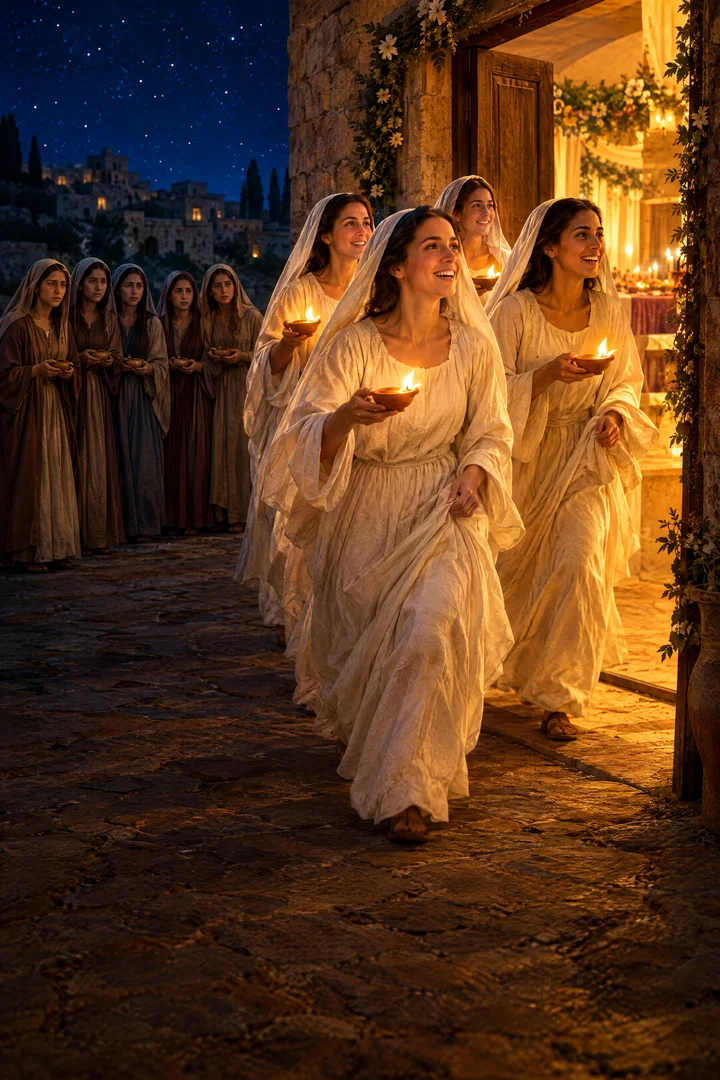
The verse pictures the evening part of a Jewish wedding, when the bridegroom went to the bride's father's house to meet her and bring her to his own house where a supper was prepared.Ms 126, 1903, par. 1–4ST Aug 6, 1894 A company of invited guests waited at the bride's house for his appearance, and as he neared they were called to go out to meet him and join the procession.Ms 126, 1903, par. 1–410MR 204.1–206.2 The bride, clothed in pure white with her head encircled with flowers, received him, and then all went by torchlight with singing and instruments of music from her father's house to his house for the feast.Ms 126, 1903, par. 1–4ST Aug 6, 1894
It belongs to Jesus' discourse in Matthew 24 and 25 and to the parable of the ten virgins told to His disciples, presenting the duty of being ready, waiting and watching for His second coming.Ms 79, 1897, par. 3–4ST Nov 20, 1884COL 406.2 The parable portrays the spiritual condition of the church in the evening of earth's history at and before His coming, calling each one to consider whether he is among the wise or the foolish as shown by conduct and conversation.Ms 79, 1897, par. 3–4ST Sep 17, 1912COL 406.2 The ten virgins represent the church watching for the Lord's appearing and earnestly seeking to be acknowledged as the Lamb's wife, and its lesson is to be prepared with oil and lamps rather than saying the coming is delayed.Ms 47a, 1898, par. 6Ms 144, 1898, par. 1Ms 168, 1898, par. 1–3 The experience in the story illustrates the experience of the church that shall live just before His second coming.COL 406.2
After a long delay and tarrying during which all sleep, His arrival is suddenly and unexpectedly announced at midnight with the cry to awake, trim lamps, and go out to meet Him as the procession with torches and music approaches.COL 405.1Ms 144, 1898, par. 2–4ST Jul 20, 1915COL 405.2–406.1ST Aug 6, 1894 The cry wakes the waiting maidens and brings them to immediate activity to prepare to join the procession, but the opportunity does not remain open indefinitely.COL 405.1ST Aug 6, 1894ST Sep 17, 1912 The long wait exposes the difference between those prepared with oil who join the procession and enter the wedding and those unprepared who are away when He comes.Ms 92a, 1898, par. 4–6ST Aug 6, 1894ST Sep 17, 1912 The verse thus portrays the unexpected announcement of Christ's coming and the need to be ready when it is made.ST Jul 20, 1915
Midnight is the darkest hour, when lamps are most needed, meaning Christ will come in the darkest period of earth's history.Ms 92a, 1898, par. 4–6COL 414.3–415.2ST Jul 20, 1915 That darkness is the rapidly increasing multitudinous errors, heresies, delusions and apostasy of the last days, when Satan works with all power and all deceivableness of unrighteousness, leading the world captive and leavening the professed churches until the great apostasy becomes darkness deep as midnight, impenetrable as sackcloth of hair.COL 414.3–415.2ST Jul 20, 1915 The condition of the world is pictured by the days of Noah and Lot just before the coming of the Son of man.COL 414.3–415.2ST Jul 20, 1915 To God's people it will be a night of trial, weeping and persecution for the truth's sake, but out of that night God's light will shine as His word goes forth, Let there be light, and His glory is seen upon His people.COL 414.3–415.2ST Jul 20, 1915
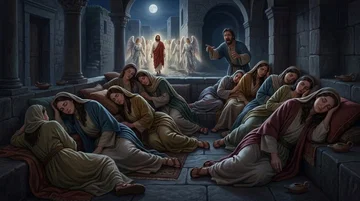
In vision the midnight announcement was seen with angels marching through the air singing of the great day of wrath, while professed believers who had heard that Jesus' coming and the day of wrath were very soon to come lost interest because time went on a little longer than expected, stupidity crept over them, and they slumbered never to awake again.Lt 14, 1850, par. 6–9 They missed the angels and the changing of the saints' garments to meet in the air, so watching with doubled diligence to make calling and election sure is needed to be able to stand and meet Him.Lt 14, 1850, par. 6–9 No finite man can learn the very period of the coming by any device or reckoning of figures, symbols or types, but the signs showing He is at the door are to be studied.Ms 9, 1891, par. 21–2210MR 272.1–2 The long waiting before the midnight cry tempts to think the Master is not coming, as the foolish began to think, and God takes time to test and prove who has real genuine righteousness of Christ and whether waiting and watching can be borne with patience and with working.Ms 9, 1891, par. 21–2210MR 272.1–2 Waiting is not idle expectancy that refuses to plant a tree or build a meetinghouse because the Lord is coming, but calls for more diligent work to uphold and gather His sheep into the fold, not living as though His coming were delayed.Ms 9, 1891, par. 21–22Ms 168, 1898, par. 1–3
The Bridegroom's coming is delayed by longsuffering and patience toward humanity, not willing that any should perish but that all should come to repentance and have eternal life.10MR 266.2Lt 21, 1886, par. 28–295T 485.1 Those who wait must therefore remain watchful with bridal lamps kept trimmed and burning, taxing every power to perfect Christian character, to gather with Christ and not scatter, and to watch and pray to avoid entering temptation.10MR 266.2Lt 21, 1886, par. 28–29 Blessed are those servants who when the Lord comes shall be found watching.Lt 21, 1886, par. 28–29 The waiting period of probation will appear very short when the redeemed stand upon the sea of glass with harps of God and crowns of glory before unmeasured eternity.10MR 266.2Lt 21, 1886, par. 28–295T 485.1
Fulfillment in Eighteen Forty-Four
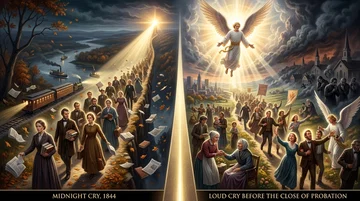
The midnight cry was proclaimed in the summer of 1844, midway between the spring date first expected for the end of the 2,300 days and the autumn date later calculated as correct.GC 398.3–4GC88 398.2–34SP 248.14SP 248.2 The correction followed discovery that Artaxerxes' decree to restore Jerusalem took effect in autumn 457 B.C., so that counting 2,300 years from then brings the period to autumn 1844.GC 398.3–4GC88 398.2–3 In its application the cry announced, Behold the Bridegroom cometh, and called the virgins to go out to meet him as another step in fulfillment of the marriage parable.GC88 398.2–34SP 248.14SP 248.2
In accord with prophetic and sanctuary arguments pointing to autumn 1844 as the cleansing of the sanctuary, the message announcing Christ's coming was heralded by thousands.GC 400.1–401.2GC88 398.4–400.1 The waiting people were stirred to prepare to meet the Lord through prayer, confession, repentance and consecration after a time of waiting and sleep.GC 400.1–401.2GC88 398.4–400.1 The bridegroom's coming represents Christ's coming as proclaimed in the first angel's message, the cry corresponds to proclaiming He would soon come in the clouds, and the going out represents the widespread Advent reformation stirred by that proclamation.GC88 393.1–394.1GC 393.2–394.1Ms 92a, 1898, par. 1–316MR 267.1–2 Under the first and second angels' messages believers preached His second coming in the clouds of heaven, were compelled to leave the churches because of that preaching, separated from those who rejected His coming, and the message was to be heard throughout the world.Ms 92a, 1898, par. 1–316MR 267.1–2SG1 155.2 Those who cherished the light were strengthened and united as they waited for their Deliverer, while those who rejected it lost its light and power, and angels repeated the cry after the announcement that Babylon had fallen amid ridicule and persecution.SG1 155.2SG1 144.2–146.2
Its power did not depend on learned reasons or proof but on God's Spirit attending simple repetition.Ms 12, 1893, par. 19–219MR 5.1–24SP 250.3 Even when given by poor, foolish or unlearned messengers unable to give any reason, it convicted the learned, humbled pomp and pride to confession on the knees, moved even curious unbelievers and scoffers who came to ridicule, and showed character is transformed by God alone and not by human wisdom.Ms 12, 1893, par. 19–219MR 5.1–24SP 250.3 In 1844 the message went with light into cities, villages, remote regions and all classes among both learned and humble, arousing thousands to joyful expectation.LSEGW 59.1–2CET 50.41T 53.3–54.3ST Mar 30, 1876ST May 2, 1878 It produced earnest prayer for true inward experience and clear evidence of acceptance with God, self-examination, Scripture study, casting off error, keeping the commandments and giving up worldly interests, with pity for the hopeless and patient endurance amid opposition, scorn, sarcasm about former disappointment, and formal churches shutting out hope of Christ's soon coming.CET 51.1ST Mar 30, 1876ST May 2, 1878
Given near the close of the second angel's message to strengthen it and awaken discouraged believers, it gave power as a great light with angels moving humble devoted people by the Holy Spirit rather than by human learning or status.EW 200.3–201.1EW 210.1–24SP 250.2SG1 140.2 It was received first by the most spiritual while some former leaders were last to join, led to intense Bible study and warning others, stirred departure from fallen churches, revived faith amid spiritual darkness, and prepared people to understand an important move in heaven.EW 200.3–201.1EW 210.1–24SP 250.2EW 204.2GC88 401.2–403.1 Proclaimed together with the first angel's message and with the message that Babylon had fallen, it directly restrained fanaticism and division and united those who joined in faith, mutual love and hope of soon seeing Jesus, shielding them from human influence and Satan's attacks.GC 397.1–398.2GC88 397.1–398.14SP 247.2
The coming announced was not to earth but Christ as High Priest coming to the Ancient of Days in the most holy place in heaven to cleanse the sanctuary, receive His kingdom and come to His temple, distinct from His second advent to execute judgment.GC 425.3–426.1GC 426.2–427.2GC88 426.2–427.2 Going in is following Him by faith in that ministry, the bride is the New Jerusalem while God's people are guests at the supper, and this settles the shut door.GC 426.2–427.2GC88 426.2–427.25MR 97.3 Jesus leaves the throne, goes to the Father to receive the kingdom, bids those waiting keep garments spotless because He will return from the wedding to receive them, and ministers before the Father as great High Priest; those rejecting earlier messages were not benefited by this cry.EW 46.15MR 97.3EW 221.1 The movement under the first message corresponds to going out to meet the bridegroom, and the passing of the expected time, disappointment and delay correspond to His tarrying.4SP 242.3SG1 141.2 After disappointment believers were to hold fast to the light showing His coming near and wait patiently by faith, and the cry finished in the seventh month of 1844 when Jesus completed mediation in the holy place and passed within the second veil.GC 407.1–408.1ExVEGW 25.2EW 35.1
The midnight cry is a bright light set behind the Advent people at the beginning of their path to the City after 1844, shining along the way so they do not stumble while eyes are kept on Jesus who leads them.WLF 14.2CET 57.2–3LSEGW 64.1–3SG2 30.2ExVEGW 10.1–13.1 Denying God's leading in it leaves them in darkness to lose sight of Him, lose the way and fall from the path.WLF 14.2LSEGW 64.1–3ExVEGW 10.1–13.11T 58.4 Some who went forth in 1844 were afterward deceived by false shepherds until they did not know where they were or what they believed, and are now coming out upon truth with others who never heard the Advent doctrine.Lt 4, 1850, par. 45MR 91.4 Christians who died before that change without keeping the true Sabbath had not received its light or faced its test but rest in hope, which does not show the Sabbath is not a test now.ExVEGW 25.2EW 35.1 The cry came suddenly, and the latter rain will come as suddenly with ten times its power, showing the Lord's coming is not far off.Ms 4, 1852, par. 1
The 1844 cry joining the second angel's message is the pattern for the later call to come out of Babylon joining the third angel's message, to be given with far greater power and strength to call sincere people out of fallen bodies to join those looking for the Lord and keeping His commandments before Babylon's judgment and the completion of sealing and mediation.SG1 195.1EW 237.25MR 200.2–201.1EW 237.1 The cry stirred people in 1842 to 1844 and is to be sounded again with great power, especially in large cities small and great with a loud voice as part of the first, second and third angels' messages, as an urgent invitation to the marriage supper since all things are ready and the King is coming.STE 147.1–149.1CWP 4.3–4Lt 88, 1910, par. 4Lt 88, 1910, par. 65MR 128.1 The delay gives the world time to hear the final message of mercy, and readiness required receiving the further light of the third angel's message as the last testing message.16MR 269.3Ms 92a, 1898, par. 7–10 Many who went out under the earlier messages refused it like the foolish, theory of it alone without Christ's grace sustaining the lamp is not enough, and faith in it may be lost if lamps go out.16MR 269.3Ms 81, 1908, par. 9–10Ms 92a, 1898, par. 7–10Ms 80, 1905, par. 1–2
Meaning of Key Symbols
The ten virgins are all professed believers, the professed Christian church in its present state watching for the Lord's appearing, all with a call, a name, a lamp and a claim of doing God service and professing pure faith. Ms 72, 1895, par. 1–2Ms 92a, 1898, par. 33–35Ms 49, 1898, par. 44–46Lt 24, 1892, par. 5–7Ms 84b, 1897, par. 23 They are divided into five wise true Christians who have life in themselves and five foolish false professors who are wanting, surprised and dismayed without oil and left outside with the door shut. Ms 72, 1895, par. 1–2Ms 92a, 1898, par. 33–35Ms 49, 1898, par. 44–46Ms 60, 1890, par. 16 The foolish knew God but did not worship Him as God, with self hardening the heart and closing the door against Christ so He cannot enter and abide, leaving them unconverted with hard hearts, unappreciative minds and eyes blinded by self-indulgence, to die greater sinners than before they professed truth. Ms 49, 1898, par. 44–46Ms 60, 1890, par. 16Lt 24, 1892, par. 5–7 Mere profession, association, birth, descent, or church membership saves no soul, but there must be visible connection with God through faith working by love, entire willing obedience and consecration securing oneness of life, feelings, desires and interests with Christ, eating His flesh and drinking His blood, denying self daily, doing and teaching even the least commandments, in the lifetime work of sanctification. Ms 72, 1895, par. 1–2Ms 92a, 1898, par. 33–35
About half of those waiting will be ready and half unready, five wise and five foolish, for a time outwardly alike with lamps, knowledge of the Scriptures and confident expectation of His appearing so no difference is seen. 16MR 270.3–271.2Ms 140, 1901, par. 4–13Lt 86, 1895, par. 2Ms 47, 1895, par. 1–3 People cannot reliably tell which are wise by outward appearance, for fruits reveal character and angels distinguish them without error. 16MR 270.3–271.2 When the waiting tries faith and the announcement comes, many are unready because destitute of the Holy Spirit, and when the foolish see defects and try to buy or borrow, the Bridegroom comes before they obtain it and their chance to trim lamps and enter the marriage supper is gone. Ms 174, 1905, par. 12 Readiness is more than theoretical knowledge, for only a small number with great light, opportunities and privileges have more than theory, while many think it enough and are not doers of the Word; in the last days this warns against false theories, trampling the Sabbath, exalting Sunday and making void the law. Lt 86, 1895, par. 2Ms 47, 1895, par. 1–3
Lamps are the Word of God as a lamp to the feet and light to the path, Bible knowledge, the lamp of faith and outward profession and preparation, and vessels are the inward store of the soul with inward piety. Ms 174, 1905, par. 12Lt 6a, 1893, par. 12–13COL 406.3–408.1 The foolish virgins' lamps represent outward profession without the oil of grace which makes the lamp burn and give light, and without this inward work all outward preparation is worthless. STBk 9.1Lt 6a, 1893, par. 12–13 Having lamps, baptism, profession, office, ordination, appointment as minister or Sabbath school superintendent or teacher, or theory alone is not readiness, for to have just enough religion to deaden conscience, deceive the senses and ruin the soul is to have a name to live while dead. Lt 6a, 1893, par. 12–135T 104.4 Those awaiting Christ must have living faith and love, not merely lamps, for faith works through love and purifies the soul, requiring giving up wrong ideas and faults and receiving Christ's righteousness. STBk 9.1
Oil in vessels with lamps is the Holy Spirit and the grace of God and of Christ from heaven, including His righteousness and life-giving truth, the new life and power from above that nourishes faith, love and patience daily, purifies the soul, appears in good works and keeps light burning in moral darkness to endure the final conflict. Lt 25, 1895, par. 4CH 128.3Ms 77, 1908, par. 8–109T 155.1ST Aug 6, 1894 Knowing theory of truth, even theory of the third angel's message, is not enough, for faith must not stop with assent but must have the oil of grace feeding the lamp so the light of life shines to those in darkness, shown by a sanctified life and works agreeing with truth. CH 128.39T 155.1Ms 91, 1910, par. 10 The call comes after waiting when the unprepared cannot obtain it then, marking when it is too late to form character fit to join the procession because probation has ended and the door is closed, bringing surprise and disappointment to many deprived by pride and weakness of faith because they humbled not their hearts. Lt 25, 1895, par. 49T 155.1
The oil is the holy golden oil shown to Zechariah emptied out of the olive trees and branches through two golden pipes from the two olive trees, the two anointed ones standing by the Lord of the whole earth, into vessels prepared for it, clean vessels ready to receive it. Lt 94, 1898, par. 10–15Ms 186, 1905, par. 3Ms 140, 1901, par. 4–13COL 406.3–408.1 From the holy ones in God's presence the Spirit is imparted to consecrated human workers through the two anointed ones to communicate heavenly grace, and only so does the Word become lamp and light, for it is not by might nor by power but by God's Spirit. COL 406.3–408.1Lt 98a, 1897, par. 58–59 The oil is communicated to the churches by the two anointed ones, and when lamps go out it shows faith, love and knowledge have left, for character cannot be transferred and those following natural impulses will be without it. Lt 98a, 1897, par. 58–59Lt 56, 1896, par. 8–9 If truth is not practiced it is not received and the Spirit's work remains strange, and those professing truth yet keeping Christ out of the heart, keeping truth in the outer court, not doing the Word, cherishing misrepresenting traits and not putting on the robe of righteousness are as the man without the wedding garment and will lose bearings unless they cleave to God. Lt 94, 1898, par. 10–15
Having lamp without oil is having theory, light and profession without living connection with God, without being vitalized by the Spirit or surrendered and transformed in heart, leaving profession ineffective and lamps dim and going out. RH Nov 18, 19095T 219.4–220.1AAP 3.4Ms 19, 1890, par. 8 It is outward profession without grace which alone makes the lamp burn and give light, leaving one destitute of faith and love, still under sin's control, a warning applying directly to those preaching in conferences. 5T 219.4–220.1Ms 19, 1890, par. 8 Having no oil is deeming the ordinances of grace and Christ's mediatorial work not of vital importance and unnecessary, feeling no need of the illumination and warmth they give, seeing as unnecessary the instrumentalities God employs to keep lamps burning. 3MR 336.2Lt 18, 1892, par. 7–11 It is making science everything and much of powers inherent in man and nature instead of exalting God's power and glory, wandering in mazes of skepticism and walking in self-kindled sparks while Satan weaves his net about the feet. 3MR 336.2Lt 18, 1892, par. 7–11
A coming night will expose costly new lamps preferred to the old-fashioned lamp as destitute of oil, revealing those weary of the old Book, the living oracles, who trusted human power and devising rather than the living God, mingling human with sacred and kindling common fire instead of sacred light. Lt 173, 1898, par. 5–10 The honest will then discern between pure golden oil from the olive branches and the spurious article used, and cry eagerly to return to the old Lamp exchanged for human inventions. Lt 173, 1898, par. 5–10 The Bible and the Bible alone is the lamp and light, pure unadulterated truth standing forever, outshining every modern invention and throwing rays into the future to show things to come, and only those walking humbly with God in obedience make safe paths. Lt 173, 1898, par. 5–10 While hidden, Luther was filling his lamp with truth so he could shine more brightly at the proper time. 4SP 142.1
The oil of grace held in conscious and unconscious influence is obtained and shown by words revealing the light of life to shine to others in direct positive testimony upon subjects where all can agree. Ms 74, 1898, par. 6 Such testimony leaves a telling influence drawing precious souls under the standard and to examination of truth, even without dwelling publicly and too definitely upon distinctive features of faith. Ms 74, 1898, par. 6 The oil of grace in the vessel enables discovery of wondrous things out of God's Word, requiring a humble contrite spirit revived by the lofty One inhabiting eternity and sight like Moses enduring seeing the Invisible. Ms 8, 1898, par. 11 It requires overcoming defects of character darkening understanding and hiding truth in its loveliness, breadth, harmony and bearing on other truths, and vigorous searching with that oil rewards the student by making him after the similitude of God. Ms 8, 1898, par. 11 The oil as grace of God in the heart is necessary to prevent friction and keep unity between believers. Ms 135, 1901, par. 58
Wise and Foolish Contrast
The wise have unseen principle and open communion with God, and their genuine Christianity appears in conduct and conversation as doing the Word, keeping the commandments, and living consecrated after Christ's example in the wedding garment with faith working by love, faults given up and Christ's righteousness received, which alone gives entrance as those the Lord knows.Ms 92a, 1898, par. 19ASCOP 23.1ST Aug 6, 1894STBk 9.1Ms 74, 1899, par. 7 Readiness requires more than baptism, profession, hearing Bible truth, or outward lamps, for the oil is holy grace from heaven that must inwardly adorn the believer and be evident in a life changed from worldly habits, making people wise unto salvation and pure.Ms 92a, 1898, par. 19Lt 60, 1898, par. 34ASCOP 23.1STBk 9.1 Those who prayerfully study and obey keep grace in vessels and lamps burning so they are ready to respond to the cry, distinguished as watchful and careful in conduct.Lt 60, 1898, par. 34Ms 74, 1899, par. 7
The foolish are careless self-satisfied professors who have become spiritually cold and backslidden, with no vital connection with God, neglecting Scripture, cherishing hidden sins, and trusting theory or feeling without a purified life tested by God's standard of righteousness.ST Sep 24, 1912ST2 22.5ST Aug 13, 1894 Their slumber is carelessness, indifference, waning piety and failure to grow in spiritual understanding and power after being made depositaries of truth, feeling no burden to keep the soul in God's love by earnest daily use of entrusted talents and by self-denial and cross-bearing, so vessels are not kept filled and lamps burn dim and flicker out.ST Sep 24, 1912ST2 22.5Ms 82, 1896, par. 6 Failing to cultivate and tend faith until it weakens and loses its place leaves light extinguished like a lamp without supply.Ms 82, 1896, par. 64MR 158.6–159.3
The coming exposes outward profession versus genuine readiness, for the foolish had lamps and appeared like the wise with real interest in the gospel and knowledge of righteousness as the perfect standard, yet lacked the oil of grace as essential life-giving truth and conversion, living to please and glorify self on uncertain principles with weak fluctuating experience.ST Feb 17, 1890ST Aug 13, 1894ST Sep 24, 1912COL 412.2–413.1 The parable concerns not open sinners making no profession but church members claiming to be children of God while not practicing it, with no burden for souls, no self-denial, no lifting of the cross, seeking enjoyment with the world, wearing a mask, refusing authority, harming others by worldly principles and seducing many, against whom stand Christians in deed and truth laboring to restore God's moral image and convince every class that consecrated life is power for good while sin ends only in weakness and eternal ruin.Ms 144, 1898, par. 7COL 412.2–413.1 At the final day they claim admission by eating and drinking in His presence, prophesying, casting out devils and doing wonderful works in His name, but are answered I know you not, for in this life they did not enter fellowship with Christ, do not know heaven's language, are strangers to its joy, and are shut out by unfitness for its companionship; the foolish also lack sense of their own unworthiness.COL 412.2–413.1
The earnest cry awakens both classes but gives no time to become ready, for oil representing grace and character is not transferable nor obtainable by borrowing another's experience and must be secured beforehand during probation by seeking the Lord, confessing sins, exercising faith for pardon, and opening the chambers of mind and soul temple to let Jesus in as honored guest rather than letting faculties become overcharged with surfeiting, drunkenness and cares of this life.Ms 4, 1898, par. 5Lt 84, 1895, par. 17–18Ms 61b, 1895, par. 8–15Lt 16, 1895, par. 26COL 412.1 Mingling with the world lets light go out for failure to continue providing oil, and the peace and safety cry hushes to slumber and carelessness, so ease-loving world-loving professors summoned by this last call cannot go in with the wise to the feast but solicit entrance and are rejected as unknown.Ms 4, 1898, par. 5Lt 84, 1895, par. 17–18Ms 27, 1895, par. 5–7 Crisis reveals character, as a sudden unlooked-for calamity bringing the soul face to face with death shows whether there is real faith and sustaining grace, pointing in final sense to the great test at the close of probation when it will be too late for the soul's need to be supplied.Lt 16, 1895, par. 26COL 412.1
Preparation cannot be postponed until the time of final trouble or judgment, when oil and formed character cannot then be transferred or acquired; those meeting that crisis unprepared will confess sins in despair too late.4SP 437.3Lt 64a, 1895, par. 12–16Lt 7, 1869, par. 6–7 At His coming in power and glory Christ makes final separation of righteous and wicked with each permanent place fixed, the wise identified by obedience to God's commandments while those hearing warning but refusing obedience are excluded from His kingdom, and excuses and halfhearted effort leave the door shut with admission sought too late.Lt 64a, 1895, par. 12–16Lt 7, 1869, par. 6–718MR 232.1 Some who have not resisted heaven's light will accept truth even at the eleventh hour, while those given great light and opportunity who fail to live by it will lose their light with lamps going out for lack of grace.RCOC 123.3Lt 36a, 1890, par. 7
People cannot reliably tell who are wise by outward appearance, for it can hide an unrighteous heart, but the wise are known by the light of good works and readiness, and each member holding truth as light must send forth clear steady unfailing rays with works corresponding to privilege and opportunity, possible only by sanctification through truth and setting apart for special service.Lt 11b, 1892, par. 16Ms 92a, 1898, par. 14–18 The foolish are many because they know truth without being sanctified by it and forget accountability in the day of trust and reckoning; knowing Bible truth or holding a teaching position does not make ready without transformed character, and everyone entrusted with talents has sacred responsibility to bless others by opening precious truth to those in error.Lt 86, 1895, par. 12Ms 45, 1899, par. 4
Becoming too engaged in business leaves one among the foolish without oil at the midnight cry, the same class as the man who came to the festal supper without the wedding garment, and those lightly regarding warnings and going far into worldliness in dress and practices will at last find the door shut and themselves outside.15MR 82.1Lt 7, 1894, par. 45 Like the foolish with no oil, one who relies on being carried by others instead of following Christ from the heart is unprepared, and church membership, prayers, exhortation and good advice cannot supply lack of personal commitment.Lt 66, 1899, par. 3–4 Those relying on their own wisdom and neglecting heavenly grace may find lamps going out and be unprepared for the bridegroom's coming, without entrance to the marriage supper of the Lamb.20MR 179.3–180.1
Having no oil is robbing God of time that is wholly His, stealing time for God's service to gain spiritual strength and using it to gain extra time for temporal business, while readiness is awaking, opening the heart's doors to let Jesus in, and taking time to pray.Lt 31, 1888, par. 20–22 Lamps without oil go out when dissatisfaction, despondency, mourning, sighing and complaining take over, misrepresenting Jesus, losing His love from the soul and spreading gloom like a funeral pall, while readiness requires taking Christ as strength, stopping complaint, rejoicing in a Saviour's love, speaking good cheer and His mercy and power, so the lamp burns in clear steady rays lightening others weak in faith and hope.Lt 110, 1893, par. 15–17 The lamp in hand without oil to feed it means shallowness in practical life and a heart without moral restoration, for genuine restoration reaches roots producing evil and depths of hidden springs, while only nipping sprouts leaves bitterness to spring up and defile many, as daily life testifies.Ms 109, 1898, par. 14–16
Coming emergencies that try the soul cannot supply oil in the moment but require it gathered beforehand by faithfulness in little things, restraining thoughts into obedience to Christ, regulating words and actions by God's holy law, and training affections to act on principle, since little things enter habitual thought and shape character and little foxes spoil vines.Lt 18, 1894, par. 9–11 An untrained undisciplined nature allowed its own will in small matters will be unable to submit in larger matters when consistency crosses inclination and habit, leaving a scarred warped life, want of grace in trial, no delight in heart service, and danger of the name blotted from the book of life.Lt 18, 1894, par. 9–11 Those without oil miss the marriage supper, for while they go to buy the bridegroom enters with the wise and the door is shut, and arriving too late they are denied as unknown and left outside in darkness in the empty street in blackness of night while signs fulfill and churches generally slumber.Ms 136, 1903, par. 5Lt 161, 1903, par. 7–8ST Sep 17, 191215MR 229.1
The same warning applies to death and to a self-pleasing life, which may find one too late to become ready and unfit at the decisive moment to meet the King or share the expected supper, while those confessing and pardoned wait in joyful expectation.14MR 122.2–123.1MYP 387.3Ms 10a, 1898, par. 8–10Lt 57, 1895, par. 28Ms 15, 1910, par. 19 Worldly pleasures distracting from the invitation, self-indulgent habits darkening understanding and blurring vision to make warnings ineffective, and blindness to danger while expecting to share the Lamb's supper unprepared, call for vigilance; readiness is inward Christianity inwrought with Jesus' life and clothed with His righteousness, shown in neat unobtrusive dress, refusing politics and worldly amusement, living as strangers and pilgrims looking for a city with foundations whose builder is God.14MR 122.2–123.1Ms 10a, 1898, par. 8–10Lt 57, 1895, par. 28Ms 7, 1898, par. 33–34 After long delay the foolish slumbered until lamps went out with no provision, then sought too late when the door was shut unto outer darkness and despair, and oil is now almost consumed unreplenished, yet that desperate shut-door position has not yet been reached and there is still opportunity to obtain gold and white raiment.Ms 143, 1901, par. 5–10
Call to Watchful Readiness
The midnight announcement is an urgent call to rise at once, trim the lamps, and go out to meet the coming Bridegroom without delay, and to seek perfect unity with one another without one mind surrendering its identity to be directed and balanced by another. 8T 212.3Lt 255, 1903, par. 28Ms 83, 1903, par. 36 Going out requires the oil of grace in an open heart, received by sanctification through the truth, adorning doctrine by a changed life, being doers of the Word and not hearers only, hiding self with Christ in God, refusing unbelief that magnifies molehills into mountains, and moving forward together with the mind of Christ, so that every power of darkness melts away and the work goes forward. Lt 108, 1898, par. 6–8 The lamps are to be kept trimmed, supplied, and burning with holy oil, and the light must not be allowed to flicker and go out, for this is what it means to stay prepared for the Bridegroom and to let light shine to others. Lt 178, 1899, par. 32–34RH Apr 2, 1908Lt 52, 1892, par. 34–35
Trimming the lamps and seeking fresh oil means kindling the taper from the divine altar, receiving Christ's righteousness, being emptied of self and prepared for God, putting away unbelief and gloom before worship, giving the whole self to the Lord, and beginning in the home church and in daily toil. 6T 116.1SSP 9.1 It means bearing light and taking action like men who look for their Lord to come, moving into line in response to God's call for revival, with Christian teachers keeping their own lamps burning to become lights to students and carrying that light into homes, neighborhoods, and the world. RH May 29, 1913STE 55.4–56.1 Readiness is shown in the worker who serves unselfishly with steady vigilance, for lamps filled with holy oil describe true followers who go out to give light to people in darkness, and personal consecration and service bring more lasting results than showy public display. RH Jan 4, 19066T 116.1
Waiting is not idle expectancy, nor mere excitement or bustle to the neglect of personal piety, nor quiet prayerful meditation alone, but genuine Christianity that blends working, waiting, watching, and praying, with the soul constantly supplied with the oil of grace and increasing in spiritual power. ST Nov 20, 1884 The long waiting tries faith and tempts to think the Master is not coming, and God takes time to test who has real righteousness, whether waiting and watching can be borne with patience and with working to uphold and gather sheep into the fold, even planting a tree or building a meetinghouse. Ms 9, 1891, par. 21–22 The lamp of the soul must be kept trimmed and supplied while spiritual decline is guarded against, for the day may overtake the unready unexpectedly, and to act as though the coming is delayed risks the fate of hypocrites and unbelievers. 5T 276.2Ms 28, 1888, par. 1420MR 67.4
The wise virgins' lamps keep burning through the night, honoring the Bridegroom and helping illuminate the way to his home and the marriage feast. COL 414.1–2ST Jul 20, 1915 So followers are to shine into the world's darkness: God's word, working through the Holy Spirit, transforms those who receive it, forming God's attributes in them so His character shines through them, their lives glorify God, and they light the way to the Bridegroom's home, the city of God, and the marriage supper of the Lamb. COL 414.1–2ST Jul 20, 1915 That vital connection with God is the source of spiritual growth, producing genuine experience that unfolds with continual advancement in knowledge and power until holy love grows brighter unto the perfect day, and as they receive new truths they pass them on so souls turn to the Lord. AA 55.25T 413.1Ms 59, 1902, par. 71 Without the oil the light grows dim and will go out in darkness where no warnings reach, and without living connection believers will not be ready for the harvest nor receive added grace in special need. AA 55.2STE 147.1–149.15T 413.1
After delay and sleep, the message announcing the approach awakens all who wait, and the wise respond with discernment still alive by receiving Christ's grace and the Holy Spirit, becoming vigorous in religious experience with affections set on heavenly things. ST Aug 13, 1894ST Sep 24, 1912 Their spiritual life is renewed, they recognize God as the source of supply, His love fills their hearts, their lamps burn steadily in moral darkness, and they glorify God by going out to seek and save the lost as their Master did. ST Aug 13, 1894ST Sep 24, 1912 As proclaimed by watchmen, the nearness calls people to go out joyfully to meet Him, for the marriage feast is ready and its gates stand open. ST Aug 6, 1894ST Sep 17, 1912
Going out is meeting Him at His second coming with power and great glory, with His own glory and the Father's glory and all the holy angels, when to those who go out comes the call to arise and shine because their light is come. COL 420.3 While the world is plunged in darkness there will be light in every dwelling of the saints, they will catch the first light of His appearing, rejoice that redemption is near, and welcome Him as the God for whom they waited, while the wicked flee and Christ is admired by all who served Him. COL 421.1COL 420.3 Such followers have had Him as daily companion and familiar friend in close contact and constant communion, with the glory of the Lord risen upon them and the knowledge of God's glory in the face of Jesus reflected in them, prepared for heaven's communion because they have heaven in their hearts. COL 420.3
The warning, Behold the Bridegroom cometh, concerns His coming to judgment and must be proclaimed as prophecy is fulfilled, even though many reject it and faithful messengers may be called enthusiasts as Noah was. Lt 64a, 1895, par. 8–11 Meeting Him means preparing without delay by obtaining Christ's righteousness represented by the oil and forming a purified character that cannot be transferred to another, and it presses followers to warn the lost rather than spend effort only on those who already know truth. Lt 64a, 1895, par. 8–11 Readiness therefore demands constant watching, praying, and working, avoiding being surfeited with this life's cares lest the day come as a thief, having grace today and a living complete connection with God every day by putting talents out to the exchangers to bring souls to the Master. Ms 9, 1891, par. 45–46
Each person must attend to his own soul and do the work of preparation, examining his own standing and remaining watchful rather than careless, for the Lord at the door will reveal who are wise and who are foolish by whether there is oil of grace in vessels with lamps. Lt 23, 1880, par. 9–10Lt 11b, 1892, par. 16Lt 178, 1899, par. 11 The cry awakens the slumbering so each has his lamp trimmed and burning with no time to lose, employing every entrusted talent in active service while day lasts because night comes when no one can work, and the time for work is diminishing so none must count on a long tomorrow or wait idly. CT 418.3Lt 59, 1893, par. 4–5 The light from God's throne will shine upon the prepared, lighting and cheering their countenances until they reflect the image of Jesus, and each member sanctified through truth must send forth clear steady rays with works corresponding to privilege and opportunity. Lt 23, 1880, par. 9–10Lt 11b, 1892, par. 16
The cry comes to all who profess to be Christians, even while asleep, finding many with outward garment and lamp yet destitute of vital truth, with lamps burning dimly and unprepared to go out. Lt 38, 1893, par. 11–14Lt 160, 1903, par. 19–21 The lesson is not to delay necessary preparation but to have the lamp trimmed and burning now, living prepared at every hour with sins confessed, in order to go in with the Bridegroom to the marriage supper before the door is shut. Lt 38, 1893, par. 11–14Lt 160, 1903, par. 19–21 Going out now while the end is near means filling vessels with holy oil by being cleansed from every selfish purpose, confessing sins, cleansing hands and purifying double-minded thoughts, being converted, becoming laborers together with God, trimming lamps, seeking pardon, holding to hope in Christ, and obtaining fitness to unite with the redeemed. Ms 25, 1908, par. 13Lt 52, 1906, par. 11–19Lt 1, 1898, par. 4
Readiness begins in the home circle, where the trimmed and burning lamp sends clear distinct rays that reach beyond the home to neighbors. ST Sep 10, 1894 The father represents the divine Lawgiver by establishing upright principles, forming pure characters, preoccupying the soul with what enables obedience to earthly parent and heavenly Father, and like Abraham commanding his household to keep the way of the Lord, so that doers of Christ's commands find the Sun of Righteousness brightening darkness and smoothing rough paths. ST Sep 10, 1894 Everyone in the home must keep his lamp constantly replenished from the divine source through habitual communion until the whole heart becomes a reservoir of divine love, strengthening and purifying affection, bringing thoughts into captivity to Christ, and flowing forth in words and actions in family life. Ms 38, 1893, par. 13–15 Parents are not ready unless they humble themselves, reform character, overcome defects, pray more, and receive faith that works by love and purifies the soul, shining through faithful earnest consecrated work. Ms 80, 1901, par. 4
Keeping lamps trimmed and burning means remaining active workers assembling in worship, prayer, and praise to draw near to God, while those who plead no time, absent themselves, and lay off devotion reflect God's light only feebly and sink into form, low spiritual life, and lukewarmness. 19MR 254.4–255.1Ms 24, 1891, par. 74 It means working diligently without delay to bring truth and save souls with earnest appeals and fervent prayer, doing faithful stewardship in the allotted task with time taken to pray and search Scripture, for idleness leaves unused the power given to bless and to be a blessing. Lt 62, 1894, par. 22–23Ms 6, 1902, par. 4 The light must shine steadily undimmed by selfishness, unrighteous actions, harsh words, or half-hearted negligent service, but with supreme love to the Lord, using every opportunity while there is time to work. Lt 53, 1904, par. 27–29Lt 23, 1890, par. 26Lt 26, 1894, par. 20
Readiness requires constant trimming of the inner lamp, habitual obedience to God's law, diligence as useful workers, and consecration of soul, body, and spirit, with each responsibility measured exactly by talents bestowed and heaviest upon greatest opportunity, for now is the day of trust. Ms 14, 1895, par. 13 The lamp must be kept supplied with the oil of grace so its light does not go out in family life as well as individually, and keeping it supplied, trimmed, and burning means working for God and souls today with wisdom instead of idleness. Lt 145, 1893, par. 10–11Lt 47, 1895, par. 92–94 Counting on a long tomorrow leaves the lamp unready while souls decide for evil or good, warfare increases, work accumulates, and time diminishes. Lt 47, 1895, par. 92–94 Through lamp-and-oil imagery the cry points to keeping the soul spiritually prepared and replenished by the Spirit, with inner lamp trimmed and burning by a consecrated surrendered heart, trimming lamps with grace to shine in a dark world and prepare people to stand in the day of the Lord. 20MR 123.6–124.1Lt 119, 1899, par. 920MR 317.6–318.1Ms 6, 1902, par. 6–9
Keeping the lamp trimmed and burning means maintaining a living light and responding faithfully to light given, where greater light brings greater responsibility and rejecting God's means of drawing to salvation deepens guilt, and losing the oil of grace is losing readiness for His coming. Lt 14, 1885, par. 12–13Ms 12, 1897, par. 18–20 Readiness is more than assenting that the Bible is true or holding name, call, lamp, and claim of service, for without grace and holy character one is unprepared and surprised without oil outside the shut door. Ms 92a, 1898, par. 33–35Lt 8b, 1891, par. 17–18 It is receiving Christ's words as life, eating His flesh and drinking His blood, denying self daily, doing and teaching even the least commandments, digging deeper instead of burying talents, and overcoming to walk in white with the name kept in the book of life. Ms 92a, 1898, par. 33–35Ms 92a, 1898, par. 28
Meeting Him requires lamps burning with Christ's grace essential every hour and continually, for unless His grace is present the inconsistencies of the natural heart appear in divided service, but where grace works character becomes full of grace and truth, brightening life with more than earthly joy, and the call to awake is sustained by God's Spirit. Lt 2a, 1892, par. 7Lt 20, 1893, par. 13 The lamp is the precious light God gives, kept burning by cherishing that light, maintaining consecration, self-denial, and daily beholding Christ until perfected in His likeness, doing works corresponding to light and flashing heaven's light on others' pathways to receive more. Lt 47, 1893, par. 3–5 Where consecration is lacking and the Spirit's manifestation is misapplied, light is eclipsed into doubt and unbelief. Lt 47, 1893, par. 3–5
Lack of oil is failure to live the truth and to obtain wisdom and grace to be complete in Christ, failure to seek faith that works by love and purifies the soul while hearing and assenting without daily practice. Lt 60, 1898, par. 34Ms 144, 1898, par. 5 It is self-love without life-giving truth, outward semblance without inward piety, walking in self-kindled sparks instead of sacred fire, living for self instead of saving the perishing, so lamps go out, the door is shut, and the word is, I know you not. Ms 144, 1898, par. 9Lt 6a, 1893, par. 12–13 The foolish had lamps but no inward work of the Spirit linking the soul with Jesus, no humble Christlike character, no growth in grace through doing Christ's words, and no profession or appointment can supply it. Lt 6a, 1893, par. 12–13ST Sep 24, 1912Lt 12, 1893, par. 4–7 Their light went out because faith was not cultivated and tended until it weakened and lost its place like an extinguished lamp, and when love for the world cools love for Jesus the lamp flickers into darkness. Lt 97, 1895, par. 32–33
Sources