Translations
American King James Version, King James Version, KJV Cambridge Paragraph Bible, Webster Bible, Revised Version, American Standard Version, World English Bible
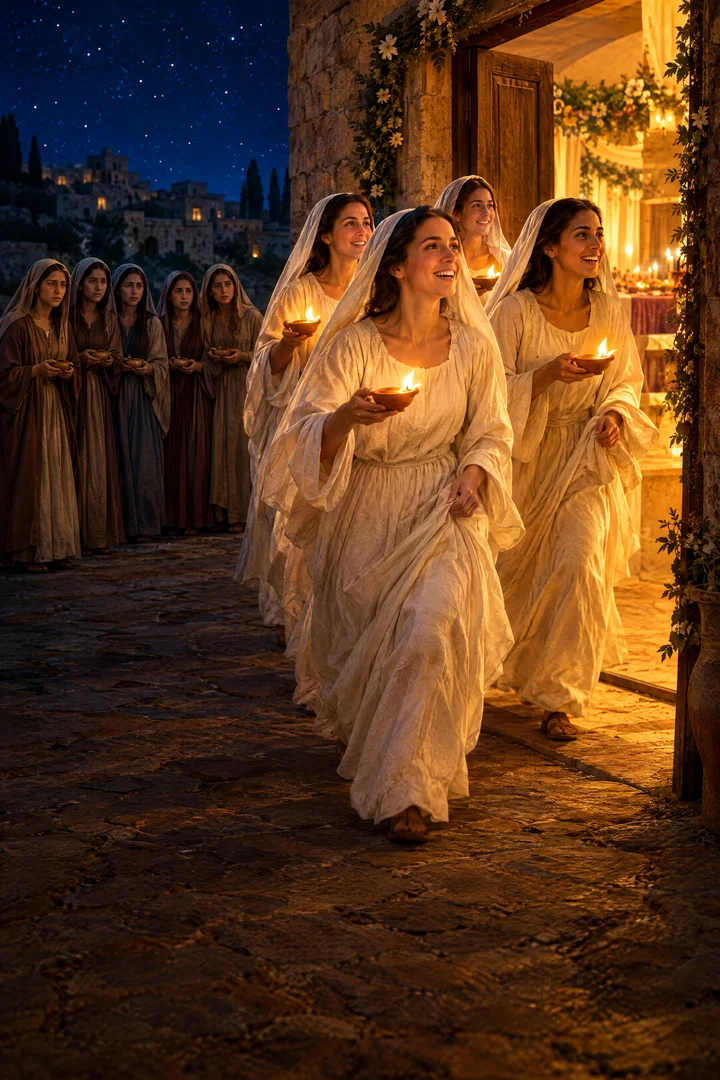
Then all those virgins arose, and trimmed their lamps.
'Then rose all those virgins, and trimmed their lamps,
Then all those virgins arose and trimmed their torches.
Then, arose all those virgins, and trimmed their torches.
Berean Standard Bible, Majority Standard Bible
Then all the virgins woke up and trimmed their lamps.
Then all those virgins got up, and made ready their lights.
Then all those virgins arose, and trimmed their lampes.
Douay-Rheims (Challoner revision)
Then all those virgins arose and trimmed their lamps.
Pictures
Cross-references 20 of 22
- Luke 12:35-36
Let your loins be girded about, and your lights burning;
shares burning lamps and waiting for Lord from wedding
- Revelation 19:9
And he saith unto me, Write, Blessed are they which are called unto the marriage supper of the Lamb. And he saith unto me, These are the true sayings of God.
The prepared are welcomed to the Lamb’s marriage supper.
- Matthew 25:13
Watch therefore, for ye know neither the day nor the hour wherein the Son of man cometh.
The parable commands watchfulness because the time of the Son of man’s coming is unknown.
- Psalms 119:105
Thy word is a lamp unto my feet, and a light unto my path.
God’s word is compared to the virgins’ lamps and guides the way.
- Zechariah 4:2-6
And said unto me, What seest thou? And I said, I have looked, and behold a candlestick all of gold, with a bowl upon the top of it, and his seven lamps thereon, and seven pipes to the seven lamps, which are upon the top thereof:
The golden oil supplies the lamps, illustrating the Spirit’s power to keep them burning.
- Matthew 25:12
But he answered and said, Verily I say unto you, I know you not.
The unready arrive too late, and the bridegroom refuses them entry.
- Luke 12:36
And ye yourselves like unto men that wait for their lord, when he will return from the wedding; that when he cometh and knocketh, they may open unto him immediately.
Both portray servants prepared for their Lord’s return from the wedding.
- Luke 12:37
Blessed are those servants, whom the lord when he cometh shall find watching: verily I say unto you, that he shall gird himself, and make them to sit down to meat, and will come forth and serve them.
Blesses servants whom the Lord finds watching when he comes.
- Mark 13:35-37
Watch ye therefore: for ye know not when the master of the house cometh, at even, or at midnight, or at the cockcrowing, or in the morning:
Commands watchfulness because the Lord may come unexpectedly.
- John 8:12
Then spake Jesus again unto them, saying, I am the light of the world: he that followeth me shall not walk in darkness, but shall have the light of life.
Christ is the Light whose followers receive life and shine.
- Revelation 19:7-8
Let us be glad and rejoice, and give honour to him: for the marriage of the Lamb is come, and his wife hath made herself ready.
Connects readiness for Christ’s coming with pure garments.
- Matthew 5:16
Let your light so shine before men, that they may see your good works, and glorify your Father which is in heaven.
The lamp is to shine so its light can be seen.
- Matthew 25:1
Then shall the kingdom of heaven be likened unto ten virgins, which took their lamps, and went forth to meet the bridegroom.
The ten virgins who went out to meet the bridegroom are those who later arise.
- Zechariah 4:11-14
Then answered I, and said unto him, What are these two olive trees upon the right side of the candlestick and upon the left side thereof?
The olive branches supply the golden oil associated with the lamp imagery.
- Luke 13:25-27
When once the master of the house is risen up, and hath shut to the door, and ye begin to stand without, and to knock at the door, saying, Lord, Lord, open unto us; and he shall answer and say unto you, I know you not whence ye are:
The shut door and rejected claimants echo the warning about being shut out and unknown to the master.
- Matthew 24:44
Therefore be ye also ready: for in such an hour as ye think not the Son of man cometh.
Both call for readiness because Christ’s coming may be unexpected.
- Matthew 25:3
They that were foolish took their lamps, and took no oil with them:
foolish virgins took no oil
- Matthew 25:11
Afterward came also the other virgins, saying, Lord, Lord, open to us.
The virgins arrive after the door is shut and plead to be let in.
- Mark 4:21
And he said unto them, Is a candle brought to be put under a bushel, or under a bed? and not to be set on a candlestick?
light given to be set high, not hidden
- John 14:3
And if I go and prepare a place for you, I will come again, and receive you unto myself; that where I am, there ye may be also.
The Bridegroom comes to receive the redeemed into their home.
Commentary part 1 of 4
Each commentary is drawn from primary sources: the writings of Ellen G. White and Adventist pioneers and periodicals. Each commentary is separate. Its own words are not a quotation; follow the references to read the source passages.
Ellen G. White
375 sources
Then all the waiting virgins rose together at the midnight announcement that the bridegroom was coming and tended their lamps to make them ready to burn and give light in the night procession.COL 405.1COL 405.2–406.1ST Aug 6, 1894ST Aug 6, 1894ST Sep 17, 1912 The lamps are the outward profession of religion, a knowledge of the truth and the Word of God, while the oil in vessels with the lamps is the Holy Spirit and the grace of Christ in the heart that alone keeps the light alive.ST Aug 6, 1894RH Feb 3, 1903Ms 35, 1891, par. 32–33Lt 6a, 1893, par. 12–13Ms 74, 1899, par. 7 For a time all ten look and act alike, but five are wise with a living connection that feeds the lamp and five are foolish with lamp without oil, outwardly ready yet inwardly unprepared.Ms 79, 1897, par. 3–4ST Aug 6, 1894ST Sep 17, 1912Ms 72, 1895, par. 1–2ST Apr 21, 1898 That readiness must be formed beforehand in probationary time and cannot be borrowed or supplied at the last moment, so those without oil awake too late and are shut out from the marriage supper.Ms 136, 1903, par. 5Lt 161, 1903, par. 7–8Ms 47a, 1898, par. 6ST Aug 6, 189415MR 229.1 This arising and trimming was fulfilled in the summer of 1844 when thousands were awakened to study the Word and go out to meet Him, and it now calls all to arise, be converted, receive the Spirit daily, and keep the lamp burning in watchful working for others.GC 398.3–44SP 248.1GC88 398.2–3GC 400.1–401.2
Wedding Setting and Context
The parable is set at an evening wedding where a waiting company intends to join the bridal procession that moves at night by torchlight from the bride's father's house to the bridegroom's home, and the lamps are torches used to light the way.COL 405.1ST Aug 6, 1894 When the bridegroom's arrival is announced the ten bridal attendants rise and prepare their lamps to go out to meet him.ST Aug 6, 1894
The story was told to the disciples while looking upon a party waiting for the bridegroom.COL 406.2 It belongs to teaching about the second coming, presenting events connected with it and the duty of readiness, waiting and watching for that event.ST Nov 20, 1884ST Aug 6, 1894ST Nov 20, 1884 The arising and trimming of the lamps illustrates the experience of the church that shall live just before Christ's second coming.COL 406.2
The ten virgins represent the church watching for the Lord's appearing in the closing period and evening of earth's history, earnestly seeking to be acknowledged as the Lamb's wife.Ms 144, 1898, par. 1Ms 92a, 1898, par. 2016MR 271.4 They represent the professed Christian church watching in that closing time, calling for serious personal attention to Scripture and earnest prayer for God to lead into truth.16MR 271.4
The bridegroom's coming represents Christ's coming to the Ancient of Days in heaven to receive His kingdom and begin the sanctuary work associated with the cleansing of the sanctuary, distinct from His later return to earth.GC 425.3–426.1GC 426.2–427.2Lt 3, 1847, par. 6–7 In 1844 that coming was understood as Christ's coming in heaven to receive His kingdom, not His return to earth, with those ready going in by faith to follow His sanctuary ministry while waiting on earth.GC 426.2–427.2 It is connected with Jesus going into the Most Holy Place as Bridegroom to receive His kingdom and with the teaching about the shut door.5MR 97.3Lt 3, 1847, par. 6–7 While He goes to the Father to receive the kingdom, His followers are to wait ready with spotless garments to await His return to receive them to Himself.EW 46.1 The rising and trimming occurs within this picture of waiting for the Bridegroom, distinguishing the wise who were ready with God's grace from the foolish who had only a theory of truth, and the midnight cry aroused the waiting believers to seek a living experience for themselves rather than lean on one another.GC 425.3–426.1GC 426.2–427.2SG1 141.1
The verse belongs to Christ's warning about dangers facing the church, underscoring the need to remain prepared and guard against teachings that undermine faith in Scripture.AA 474.1 It belongs to preparation for the marriage before the door shuts, teaching thorough preparation rather than delay or excuses, with readiness also meaning having the wedding garment and discerning the danger of being unprepared.Lt 188, 1908, par. 1–5Lt 7, 1869, par. 6–7 Where a hymn evokes its expectation of the Bridegroom's arrival and the waiting marriage feast urging the heirs of glory to go meet him, it is not separately explained.ST Aug 6, 1894
Lamps Oil and Trimming
When the announcement that the bridegroom is coming sounds, all ten arise together and make the same outward response of preparing to give light in order to join the procession, and to trim the lamps is to get them ready to burn as he approaches and to tend them so they can give light.COL 405.2–406.1ST Aug 6, 1894ST Sep 17, 1912EDFCP 27.3Ms 35, 1891, par. 32–33 The five who brought no extra oil are then shown unprepared for delay, while the five with oil in their flasks have freshly trimmed lamps ready to join the procession and cannot replenish the others' lack.COL 405.2–406.1ST Aug 6, 1894ST Sep 17, 1912Ms 77, 1908, par. 8–10 Outward preparation alone is not enough, for the foolish have lamps yet lack oil, which must be supplied for a living experience and faithful readiness.Ms 35, 1891, par. 32–33Ms 77, 1908, par. 8–10 The response therefore reveals the difference between the prepared and the unprepared when the midnight cry comes.ST Aug 6, 1894ST Sep 17, 1912
The lamps are the outward semblance of religion and profession, including a knowledge of the truth and the form of truth.RH Sep 17, 1908Ms 35, 1891, par. 32–33Lt 6a, 1893, par. 12–13 They are also the Word of God as a lamp to the feet, the light of truth, faith whose light must be sustained, readiness for Christ's coming, and each believer's light and soul that must be kept burning.Ms 35, 1891, par. 32–33Ms 74, 1899, par. 75T 104.49T 155.1COL 406.3–408.1 Having lamps is not enough, for outward readiness without the needed spiritual life leaves people unprepared, and outward profession must be joined to inward grace, faith and love.5T 104.4STOM 7.39T 155.1 Without that inward supply all taking and trimming is worthless and cannot feed the lamp to send forth clear rays, even when joined to highest profession, ordination, or appointment to high responsibility, and to have only enough religion to deaden conscience is to have the name to live while dead.Lt 6a, 1893, par. 12–13
The old-fashioned lamp is the Bible and the Bible alone, the living oracles of God, which alone is solid healthful light shining amid moral darkness and showing things to come.Lt 173, 1898, par. 5–10 The new costly lamps many prefer are human power, human devising and human inventions giving an uncertain sickly light.Lt 173, 1898, par. 5–10 When night comes and the cry sounds, all professed believers arise to attend to their lamps, and it is then revealed that those new lamps are destitute of oil.Lt 173, 1898, par. 5–10 Honest men and women then discern between the pure golden oil from the olive branches and the spurious article they have used, and cry eagerly for the old lamp they exchanged for human inventions.Lt 173, 1898, par. 5–10
The oil in vessels with the lamps is the Holy Spirit and the grace of Christ or God in the heart.ST Aug 6, 1894RH Feb 3, 1903ST Sep 17, 1912ST Feb 17, 1890Lt 25, 1895, par. 4 It is inward piety, living connection with God, and unseen principles and open communion that feed the lamp and cause the light of life to shine in good works.ST Aug 6, 1894RH Feb 3, 1903Lt 25, 1895, par. 4RH Sep 17, 1908 The wise keep their lamps supplied through vital connection with Christ and daily preparation nourished by the Spirit, showing faith, love and patience and following Jesus, while the foolish neglect the grace their characters need and find their lamps dim or going out.ST Aug 6, 1894RH Feb 3, 1903ST Sep 17, 1912 The lamp is the form of truth, and trimming without oil leaves lamps going out and presentation of truth superficial, weak and ineffective, with the Holy Spirit not represented in the labors and no living experience, pure influence or power of godly example.RH Sep 17, 1908
The oil is grace, the righteousness of Jesus Christ.Ms 9, 1891, par. 38–39Lt 2a, 1892, par. 7 It is received by depending on God every hour as a branch grafted into the living Vine draws sap and nourishment every day, and by living in hourly contact and conscious communion with the principles of truth, righteousness and mercy that reveal God's attributes within the soul.Ms 9, 1891, par. 38–39Lt 75, 1896, par. 10 Beholding the cross of Calvary is the guarantee of spiritual efficiency and skill and understanding in the Scriptures to represent truth by precept and example, and God as the deep Source of all moral and intellectual power gives safety in binding up with Him and cooperating with Him.Lt 75, 1896, par. 10 Unless His grace is continually present every day and every hour the inconsistencies of the natural heart appear in divided service, while acting according to light brings advance in spiritual understanding and real heart worship, with character full of grace and truth brightening and sweetening every detail of life; without that daily supply the lamps go out.Ms 9, 1891, par. 38–39Lt 2a, 1892, par. 7 Those with oil in vessels are taken to enter the marriage supper, while those belated without oil are left outside in darkness, gloom and despair of midnight without hope.Ms 9, 1891, par. 38–39
The oil is the holy golden oil emptied from the olive trees through the two golden pipes shown in Zechariah, received into vessels prepared for it.RH Sep 17, 1908Ms 186, 1905, par. 3Ms 140, 1901, par. 4–13 Provision is made that every soul may be abundantly supplied through the two anointed ones who stand by the Lord of the whole earth through connection with heavenly agencies.RH Sep 17, 1908Lt 67, 1899, par. 17–18 The word of the Lord is not by might nor by power but by His Spirit, and that Spirit is the strength of every child of God and the only power that can heal him, so he must place himself in right relation to God and it is the church's privilege in every age to advance by trusting God.Lt 108, 1898, par. 3–5 The oil is the Holy Spirit in the heart working by love and purifying the soul, and trimming is applied to preparing for the soon coming by receiving that holy oil from the two olive branches.Ms 140, 1901, par. 4–137MR 168.3–169.1 Trimming the lamps means being prepared to shine through united faithful work for souls by arousing and receiving that holy oil which gives light.Lt 67, 1899, par. 17–18
To trim the lamp is to obtain the oil of grace, which is the Holy Spirit, to refresh the lamp and reflect its light with rejoicing.Ms 174, 1905, par. 12 It is to send forth clear steady rays to the world that never grow dim or burn low, to kindle the taper from the divine altar, and to keep it ready and burning by a heart sanctified by truth so that wisdom and light appear in speech and action wherever one goes.RH Sep 17, 1908Lt 11b, 1892, par. 16Lt 50, 1911, par. 7–8 To have a lamp is to have truth imparted as a member of the church that is the depository of truth, but the foolish are at last revealed as having lamp without oil of grace in vessels and cannot correctly represent truth unless sanctified through truth with works corresponding to privileges and opportunities.Lt 11b, 1892, par. 16 When the foolish see defects and try to buy or borrow oil, before they can obtain it the bridegroom comes and their chance to trim and enter into the joy of the marriage supper is gone, so all who have lamps are now called to trim them.Ms 174, 1905, par. 12
Trimming depends on having the oil of grace in the heart.Ms 144, 1898, par. 6 That oil is truth enthroned in the heart, and where present it awakens a train of thought, arouses conscience to decided action, adorns character and renews the whole nature.Ms 144, 1898, par. 6 Only heavenly grace communicated by the Spirit, imparted from the holy ones that stand in God's presence to consecrated workers, can make the word, a lamp to the feet and light to the path, give light.COL 406.3–408.1 The oil of grace in vessel with lamp enables discovery of wondrous things in God's Word.Ms 8, 1898, par. 11
The lamp must keep burning by being fed with holy oil.ST Mar 17, 1898Lt 153a, 1897, par. 19–20 The oil is effective as its light is shared with others, so readiness joins devotion with active service.ST Mar 17, 1898Lt 153a, 1897, par. 19–20 Lamps filled with holy oil represent spiritual light carried by followers who receive divine truth and grace then share them, bringing light to those in darkness.Ms 59, 1902, par. 71 The lamp kept burning is a consecrated Christlike life that receives grace in order to impart it, each vessel filled that it may be emptied into other vessels, the vessel emptied of self and prepared to receive it, and as light is shed upon souls in darkness new light is imparted and sinners and wanderers are guided along the right path.Lt 54, 1899, par. 10Lt 228, 1908, par. 12
The oil of grace can be lost from the heart, and conduct shows the loss, including selfish and dishonest dealings, for vital connection sustained by the Spirit and Christ's words is necessary for spiritual life.Ms 12, 1897, par. 18–20 Lamps filled with holy oil must be replenished or they flicker and go out.Lt 53, 1887, par. 15 This happens when love for God and prayer grows cold and spiritual life fades, when love for the world or cherished sin draws the heart from love for God, prayer and meditation and leaves observance formal and devotion cold, and when despondency, dissatisfaction, complaining, mourning and sighing drive Christ's love from the soul and spread gloom like a funeral pall.5T 538.2Lt 110, 1893, par. 15–17Lt 53, 1887, par. 15 When light and deep movings of the Spirit are not cherished through consecration, self-denial, humiliation and works corresponding to light, the enemy allures from allegiance and rays are eclipsed by doubt, unbelief and Satan's shadow.Lt 47, 1893, par. 3–5 To trim again is to stop complaint, pour in oil, take Christ as strength, rejoice in a Saviour's love and speak good cheer of His mercy and power, so the lamp burns again in clear steady rays to lighten others weak in faith and hope.Lt 110, 1893, par. 15–17
Wise and Foolish Virgins
All ten stand for all professed believers watching for the Lord's appearing, having lamps and vessels for oil, a knowledge of the Scriptures, having heard the message of Christ's near approach and confidently expecting His appearing, so that for a time no difference is seen between them.Ms 79, 1897, par. 3–4Ms 72, 1895, par. 1–2ST Apr 21, 1898ST Sep 17, 1912COL 408.2–3 When the midnight cry announces the bridegroom's coming all rise together and prepare their lamps with the same outward response, yet trimming does not itself make the unprepared ready, and the different readiness is exposed by whether they have oil.Ms 79, 1897, par. 3–4ST Apr 21, 1898ST Sep 17, 1912Lt 60, 1898, par. 34 The arising exposes a foolish company who had lamps but took no oil with them, so their lamps went out, and when they would have entered in the door was shut and they could not partake of the marriage supper of the Lamb because they did not live the truth and failed to obtain wisdom and grace to make them complete in Christ.Lt 60, 1898, par. 34
For now all represented as wise or foolish look alike, with those holding truth in unrighteousness appearing outwardly like the wise.16MR 270.3–271.2 No human can now distinguish who is wise and who is foolish or has authority to say, because men cannot read the heart, just as tares so closely resemble wheat and it is not given to human beings to try to separate them.16MR 270.3–271.2 The difference is known by fruits which declare character, and the angels of God know them and never make a mistake in gathering the wheat from among the tares and counterworking those who fight against the truth, before the time comes when the door will be shut.16MR 270.3–271.2
The ten, five wise and five foolish, mark the proportion of the ready and the unready among professed believers facing great events soon to open.Ms 47, 1895, par. 1–3Lt 86, 1895, par. 221MR 37.4–5Ms 2, 1883, par. 11 Only a small number of those with great light and privilege, with abundant opportunities and continuous privileges, have more than a theoretical knowledge of the truth, while many think theory is enough and are not doers of the Word.Ms 47, 1895, par. 1–3Lt 86, 1895, par. 2 The picture of all ten rising together yet divided into five with oil and five whose lamps go out should cause trembling as a solemn warning to every church of the danger when works do not correspond to profession of faith.Ms 2, 1883, par. 11
The wise are those worked by the Holy Spirit who bear living testimony, walk in the light received, search the Scriptures, communicate precious truth to others, and receive more light as they impart what they have while cooperating with heavenly agencies.Ms 47, 1895, par. 1–3 They have faith, love, and patience, follow Jesus, and keep their lamps burning through vital connection, with an experience nourished daily by the Spirit that last-minute attention cannot replace.ST Aug 6, 1894ST Sep 17, 1912 Their trimmed, burning lamps picture a living faith nourished daily by the Spirit.ST Sep 17, 1912
The wise had stored oil so their lamps could keep burning through delay, and at the midnight announcement they replenished theirs to burn brightly, having freshly trimmed lamps ready to join the procession to meet the bridegroom.COL 405.2–406.1ST Aug 6, 1894ST Sep 17, 191216MR 267.3Ms 92a, 1898, par. 4–6 Trimming the lamps means getting them ready to burn as the bridegroom approaches.ST Aug 6, 1894 The five without extra oil made no provision for the long delay, find their lamps going out, and cannot replenish theirs.COL 405.2–406.1ST Aug 6, 1894ST Sep 17, 191216MR 267.3Ms 92a, 1898, par. 4–6
The wise show those who have perfected Christian character, who have washed their robes and made them white in the blood of the Lamb.Ms 92a, 1898, par. 28 They are people whose hearts are filled with Christ's grace and who have an increasing desire for peace and joy.Lt 117, 1901, par. 4 Their spiritual discernment remained and their religious experience became vigorous, receiving Christ's grace and the Holy Spirit so their lights burned steadily through moral darkness, with God's love filling hearts, affections set on heavenly things, and service in seeking and saving the lost.ST Aug 13, 1894ST Sep 24, 1912
The foolish had a real interest in the gospel and knew the standard of righteousness, yet self-love weakened their spiritual life and they treated life-giving truth as unessential, leaving them spiritually dark, unstable, and vulnerable to false light.ST Aug 13, 1894ST Sep 24, 1912 They lack the humility and sense of unworthiness that come from seeing Christ's holiness and have no sense of their own unworthiness.ST Sep 24, 1912 Outward readiness and knowledge of the standard were not enough without the oil of grace.ST Aug 13, 1894
The five sleeping virgins without oil represent people who have received great light and knowledge but are spiritually cold, senseless, lifeless, and weak or waning in piety.ST2 22.5STBk 68.1STA 68.1STA 77.3–4STOM 54.1 Their outward readiness does not supply the inner life needed for the coming crisis, in contrast to God's people who receive new life and power from above, recognize and receive the Holy Spirit, and are prepared for the final conflict.STBk 68.1STOM 54.1STM2 6.5 They picture people with great light whose piety is cold and fading.STM2 6.5Ms 27, 1892, par. 6
Having a lamp is not enough because the foolish lacked the oil of grace needed to keep it burning and give light, which is faith and love.STBk 9.1Ms 19, 1890, par. 8 This applies to ministers, who need faith that works by love and purifies the soul and must not remain in that condition of being destitute of oil while preaching.STBk 9.1Ms 19, 1890, par. 8 The foolish are professed disciples who follow their own ways and indulge sinful desires without ever submitting their hearts to God, neglecting to obtain the oil of grace, meaning they lack genuine faith followed by love and love followed by obedience, with all powers and passions brought under Christ's control by His renewing Spirit transforming to the divine image.RH Nov 18, 1909AAP 3.4 A large number who profess to believe and even to teach the truth remain under bondage of sin, with base passions defiling the mind and corrupting the soul, and some in vilest iniquity borrow heaven's livery to serve Satan more effectively, becoming worse after professing truth because knowing God without honoring Him leaves self-indulgence to harden the heart and shut Jesus out.Ms 49, 1898, par. 44–46RH Nov 18, 1909
Their false religion is shown by not practicing Christ's lessons in daily life or displaying His meekness, gentleness, tenderness, sympathy, and love, whether active in God's work or not.Ms 168, 1898, par. 16–18Lt 71, 1895, par. 30 The passage does not describe open sinners who make no profession of loving God and keeping His commandments, but those who claim to be children of God, church members who claim to be Christians, yet do not practice the truth.Ms 144, 1898, par. 7 They have no burden for souls, do not deny self, do not lift Christ's cross, seek an enjoyable time with the world, wear a mask, refuse to yield to any authority, do great harm to others, and by worldly principles seduce many, in contrast to Christians in deed and truth who live and work to restore God's moral image in man and labor to convince men of every class that a consecrated life is power for good.Ms 144, 1898, par. 7
The foolish are unconverted members of the church who claim to believe the truth yet remain in character the same as before, live for self instead of seeking to save souls ready to perish, and carry empty vessels so they cannot keep lamps replenished.Ms 144, 1898, par. 9 Their light is darkness because they have not taken Christ as Counsellor, have not walked in the light of His Word, have not come under His yoke, and have worked their own way in the light of sparks of their own kindling without the sacred fire from God.Ms 144, 1898, par. 9 Outward service and formal connection without heart-union with Christ and daily genuine conversion leave a person unprepared, with envy, evil thoughts and speech, vanity, and love of exaltation unput away, and prayers and advice cannot make up for that lack.Lt 37a, 1903, par. 8–9Lt 24, 1892, par. 5–7Lt 66, 1899, par. 3–4
They reveal false religion because God's law is not written on their hearts, having no oil of grace and not obeying Christ's words, with truth received by the understanding only and assented to without firm principles in the soul.Lt 8b, 1891, par. 17–18 True Bible religion is believing with the heart unto righteousness and loving God with whole soul, heart, mind, and strength in obedience to the first four commandments.Lt 8b, 1891, par. 17–18 The foolish are those who hide their light, and their trimming reveals that while mingling with the world their light has gone out and they have lost all power to shine.Ms 4, 1898, par. 5
Their lamps fail because they did not continue to provide themselves with oil of grace, and because the peace and safety cry hushed them to slumber and made them careless about their light, leaving ease-loving, world-loving professed Christians unready to go in to the marriage feast, since character is not transferable.Ms 4, 1898, par. 5 They are a class of religionists who suit men of the world who do not want the light of truth, being one in spirit with those who never let light shine in words of truth and deeds of holiness, while those truly serving God reveal progression heavenward, help others serve Him with whole mind, heart, soul, and strength, and have vessels well filled with oil.Ms 144, 1898, par. 8 They are half with Christ and half with the world, whose great truth has lost its force through indolence, carelessness, frivolity, and careless indifference, separated from Christ and led away from their Leader by Satan with his specious temptations.Ms 7, 1898, par. 32
To avoid that classing every soul must make a reality of truth, be wholly with Christ and not lukewarm, and as one connected with Christ do thorough work, bear fruit to His glory, and work earnestly with Christ to bring other souls as sheaves to the Master.Ms 7, 1898, par. 32 Those with lamps but no oil are spiritually cold with weak fading piety, and people who have received much light but fail to live by it will lose that light so lamps gradually grow dim and go out, while people who have lived up to the light they had may accept truth even at the eleventh hour.RCOC 123.3STM2 6.5Ms 27, 1892, par. 6Lt 36a, 1890, par. 7 The foolish include those too engaged in business and robbing God of time that should be given to prayer and God's service to gain extra time for temporal business, leaving no oil in the vessel with the lamp, the same as the man who came to the festal supper not having on the wedding garment.15MR 82.1Lt 31, 1888, par. 20–22
Many claiming belief have no true faith and failed to provide oil because they thought they had no need, thinking themselves rich and increased in goods with need of nothing, trusting a wisdom that is foolishness with God, and feeling well supplied by human understanding with no room in vessels for heavenly grace because they do not hunger and thirst after righteousness.Ms 8, 1898, par. 9Ms 95, 1898, par. 36–38 They look with pity and disgust on those earnestly seeking to know the Lord's way more perfectly, and awake from slumber to find lamps going out, having neglected the one thing needed for entrance to the marriage supper.Ms 8, 1898, par. 920MR 179.3–180.1 They handle strange and common fire instead of fire of God's own kindling, bear strange fruit of dissension and a root of bitterness that defiles instead of genuine faith leading to unity and oneness with Christ, having not learned to be emptied of self, to center the whole being in Christ, to receive true wisdom and deep conviction of the Word, and to come into full assurance by eating the flesh and drinking the blood of the Son of God.Ms 95, 1898, par. 36–38 The presence of such foolish virgins without oil among the wise shows the church includes unprepared people alongside faithful members, and their presence does not mean God has no church.ST Oct 23, 1879
Fulfillment in 1844 Movement
The arising and trimming of the lamps was fulfilled in the summer of 1844 when the announcement that the bridegroom was coming was proclaimed in the very words of Scripture.GC 398.3–44SP 248.1GC88 398.2–3 That waking and preparing took place midway between the time when the 2300 days were first thought to end in the spring and the autumn date of the same year to which they were afterward found to extend.GC 398.3–44SP 248.1GC88 398.2–3 The reckoning behind it was that the decree of Artaxerxes for the restoration of Jerusalem went into effect in the autumn of 457 B.C. and not at the beginning of the year, so that 2300 years reckoned from autumn 457 terminate in autumn 1844.GC 398.3–4GC88 398.2–3
The midnight cry came under the proclamation of the first and second angels' messages, when believers were compelled to go out from the churches because they preached Christ's second appearing in the clouds of heaven.Ms 92a, 1898, par. 1–316MR 267.1–2 The whole world was to hear the call to go out to meet Him, Behold, the Bridegroom cometh.16MR 267.1–2 The going forth represents the widespread movement under the first message.4SP 242.3 The waiting and sleep followed by the coming was applied to that 1844 movement in which the announcement was proclaimed by thousands and awakened people across the land to go out to meet Him, and the verse shows the virgins responding by getting up and preparing their lamps.GC88 398.4–400.11T 53.3–54.3LSEGW 59.1–2CET 50.4
In that movement preparation meant studying God's word with an intensity of interest not known before, so they could give warning that the Bridegroom was coming.4SP 250.2GC 402.1–403.1GC88 401.2–403.1 The cry stirred them through prayer, confession and consecration to prepare to meet the Lord.GC 400.1–401.2 The humble and devoted were the first to hear and obey, leaving ordinary work to join the movement, while many former leaders joined late and the churches generally rejected it.4SP 250.2GC 402.1–403.1GC88 401.2–403.1 Their proclamation united with the second angel's message and gave power to that work.GC88 401.2–403.1
All ten virgins arose expecting to live to see Christ coming in the clouds when the first and second messages were heard, and all should have proclaimed the truth so that had all acted as wise virgins the message would already have gone to every nation, kindred, tongue and people.16MR 269.3 Instead five were wise and five were foolish, because only five had made the provision essential to join the company walking in the light that had come to them.16MR 269.3 Many who thus arose under the first and second messages then refused the third angel's message, the last testing message to be given to the world, making that third message necessary.16MR 269.3 The sleep during the bridegroom's delay represents waning zeal and devotion after the expected time passed.4SP 242.3 There was a long delay in which the foolish grew weary in waiting and began to think He is not coming, having no supply of grace to enable them to stand the test and trial of waiting.Ms 9, 1891, par. 21–2210MR 272.1–2
In the 1844 application the two classes revealed were those prepared with God's Spirit and grace and those who had only a theory of truth without that grace.GC 426.2–427.2GC88 426.2–427.2 The wise had patiently searched Scripture and followed Christ by faith in His heavenly sanctuary ministry while waiting on earth, and those ready went in by faith, for the Bridegroom's coming in 1844 was His coming in heaven to receive His kingdom and not His return to earth.GC 426.2–427.2GC88 426.2–427.2 The going forth to meet the Bridegroom took place in 1844, and some who shared in that rising were afterward deceived by false shepherds until they did not know where they were or what they believed, while others now coming to the truth had never heard the Advent doctrine, so no one should rest without the abiding witness that his ways please God.Lt 4, 1850, par. 4 The virgins waking and preparing lamps at the midnight cry shows that those professing to wait were not all truly converted or ready, and earnest prayer and expectation did not prevent disappointment when the expected time passed.SG1 141.2
One position held by those who held it is that the arising and trimming in the midnight cry was still future after the disappointment, shown in December 1844 as light from God to be delivered to the Advent band.Lt 3, 1847, par. 3–5 In that position the midnight cry is distinct from the coming of the Bridegroom, which was not shown until February following, and the message was confirmed when J. Turner told out the same thing the evening before it was delivered and the band received it as from God.Lt 3, 1847, par. 3–5 The opposite position held by those who held it is that the arising of the virgins in the Midnight Cry had already happened in the past and was not still future.5MR 95.3–97.2 In that position likewise the Midnight Cry was shown in December, separate from the coming of the Bridegroom not shown until the following February, with the same Midnight Cry message being given out by others on the very same evening it was to be delivered to the band.5MR 95.3–97.2
Readiness Before Probation Closes
Readiness to meet the Bridegroom must be formed beforehand during probationary time and cannot be supplied at the last moment, for last-minute attention cannot replace oil already used.Lt 161, 1903, par. 7–8Ms 47a, 1898, par. 6ST Aug 6, 1894ST Sep 17, 1912Lt 25, 1895, par. 4 The oil is the Holy Spirit and the grace of Christ and of God in the heart, which keeps the light shining in good works, and the wise keep oil in vessels with lamps ready through daily preparation and an experience nourished by the Spirit with faith, love and patience, following Jesus and keeping lamps burning.Ms 47a, 1898, par. 6ST Aug 6, 1894ST Sep 17, 1912Lt 25, 1895, par. 4 Those who neglect this daily receiving of grace and fail to form character after the divine likeness will find it too late to become fit to join the procession when the call comes, because probation has ended and the door is shut, and there is no evidence the foolish ever obtained oil.ST Sep 17, 1912ST Sep 17, 1912Lt 25, 1895, par. 4
The trimming exposes that the foolish have no oil, and while those with oil are taken to enter the marriage supper, those belated without oil are left outside in darkness, gloom, despair and the blackness of midnight without hope.Ms 136, 1903, par. 515MR 229.1Ms 9, 1891, par. 38–39 The churches, though generally slumbering while the signs of the times are fulfilling, will be roused to act when the call goes out to meet Him, and then the unprepared will discover their lack.Ms 136, 1903, par. 515MR 229.1 Their going to buy oil leaves them absent when the Bridegroom enters with the wise and the door is shut, so when they reach the banqueting hall they are denied with I know you not and left standing without in the empty street in the blackness of the night, a warning to take heed now so as not to be sent out too late.Ms 136, 1903, par. 515MR 229.1 That oil is grace, the righteousness of Jesus Christ, received by depending on God every hour as a branch grafted into the living Vine draws sap and nourishment every day and bears fruit to the glory of God, and without that daily supply lamps go out.Ms 9, 1891, par. 38–39
When the cry, Behold the Bridegroom cometh, sounds, all arise, but many will be surprised and disappointed because pride and weakness of faith have deprived them of blessing.RH Feb 24, 19109MR 205.2–206.2Lt 234, 1906, par. 13–16Ms 37, 1909, par. 9 Though they hold the theory of truth and give assent even to the third angel's message, they have no oil of the grace of Christ in the vessel with the lamp to feed it and cause the light of life to shine to those in darkness, and in ignorance they consider themselves wise and do not realize their lamps are going out.RH Feb 24, 1910ASCOP 28.19MR 205.2–206.2Lt 234, 1906, par. 13–16Ms 37, 1909, par. 9 When they awake to their true failing condition it will be too late to obtain a fresh supply and be ready to meet the Bridegroom, for delay risks finding no oil for lamps that are going out.ASCOP 28.19MR 205.2–206.2Lt 234, 1906, par. 13–16Lt 22, 1892, par. 21 Having no oil leaves people unprepared when the decisive moment comes, and this is linked to receiving the Holy Spirit through fully believing in Christ; those who live merely to please themselves may reach sickness and death without inward preparation and be wholly unready to meet the close of life.14MR 122.2–123.1MYP 387.3Lt 57, 1895, par. 28Ms 90, 1903, par. 3
The scene is the evening of this earth's history, when all who claim to be Christians rise with a call, a name and a lamp, professing to do God's service and to wait for Christ's appearing, but five are unready and will be found surprised and dismayed outside the banquet hall.COL 412.2–413.1 At the final day they claim admission by outward works and privileges, yet the answer is I know you not, depart from Me, the saddest words that ever fell on mortal ear.COL 412.2–413.1 In this life they have not entered into fellowship with Christ, so they know not the language of heaven and are strangers to its joy, for only the Spirit of God knows the things of God; the fellowship of the Spirit which they slighted could alone make them one with the joyous throng, and without it its light falls on blinded eyes, its melody on deaf ears, and its love and joy awaken no gladness in the world-benumbed heart, so they are shut out from heaven by their own unfitness for its companionship.COL 412.2–413.1
The foolish have rejected the messages God sent and the offers of pardon and forgiveness, and when hidden sins are proclaimed and startling declarations are invested by the Holy Spirit with sanctity and solemnity, they feel the woes pronounced upon those who had light and did not heed it but have no power to act.Lt 56, 1896, par. 8–9 They have no oil of grace to discern the clear light or to accept it, so they cannot obtain character from the wise nor join the procession going into the marriage supper of the Lamb.Lt 56, 1896, par. 8–9 When Christ comes those without oil cannot borrow it from others or obtain it in time, for character cannot then be made or changed; the separation of righteous and wicked reveals the character each has chosen, the obedient entering God's kingdom while the disobedient are finally separated.Lt 64a, 1895, par. 12–16
There is danger in delaying preparation, for those who come to the final conflict unprepared cannot become ready during the time of trouble, and their late confession brings despair rather than deliverance.4SP 437.3 The end will come unexpectedly like a thief in the night, and lamps going out picture those who fail to watch and are unready to meet the Bridegroom, who is Christ met at the near end.Lt 208, 1906, par. 1020MR 67.4Ms 20, 1906, par. 18–19 Watching is therefore required lest lamps go out and leave souls found unready and unprepared.Lt 208, 1906, par. 1020MR 67.4
The verse shows the arousing of all professed believers by the call that the end is near and He that is to come will come and will not tarry.Ms 25, 1908, par. 13 Arising means getting ready, getting ready, getting ready now, and trimming means filling the vessels with holy oil in this life by being cleansed from every selfish purpose, confessing sins before God, cleansing the hands as sinners and purifying the minds as double-minded, being converted, becoming laborers together with God, staying spiritually awake, and thus preparing to recognize Christ, understand His will and unite with the redeemed.Ms 111, 1909, par. 6–9Ms 25, 1908, par. 13 The present time is before the Lord's near coming when all must arise and prepare lamps, make His paths straight, and use time to prepare and work now because opportunity will end; all must now arise and build for time and eternity by giving the heart wholly to Christ that He may mold and fashion character, refusing amusement, stubborn self-will, defiling associations and whatever eclipses heaven's light, and instead following on to know the Lord, being refined, sanctified and rightly employed as a channel of light for saving souls.Ms 7, 1898, par. 33–34Lt 67, 1897, par. 118MR 266.2–4
Trimmed and burning lamps picture being ready to meet Christ at any time, even if the call comes while asleep, with the 1844 expectation serving as example of preparing to meet the Lord.9T 48.2 The bridal lamps must be kept trimmed and burning in continual readiness and watchfulness while waiting, and the delay is Christ's long-suffering giving time to repent and receive eternal life, which in eternity will seem short.Lt 21, 1886, par. 28–2910MR 266.214MR 138.25T 485.1RH Apr 2, 1908 The verse is therefore a call to prepare spiritually without delay by confessing sins, seeking Christ's pardon, laying hold of hope in Him, seeking forgiveness for sin and lack of faith, keeping the lamp of the soul trimmed and supplied with oil of grace so as to arise and respond at a moment's warning, for the day of God may come suddenly, the time for preparation and service is short, and the Lord will not wait.Lt 66, 1895, par. 4–5Lt 19, 1904, par. 7–8Lt 52, 1906, par. 11–19 It warns of sleeping while waiting, where sleepers profess to be with God's people and heard Jesus is coming and His wrath is soon to come, but because time continued longer than expected they lost interest, stupidity crept over them, and they slumber; to watch is to stay awake and diligent, doubling diligence to make calling and election sure, so as to be ready when saints receive changed garments and lighted faces to meet angels in the air.Lt 14, 1850, par. 6–9
Spirit-Filled Life and Character
Readiness for the Lord's coming requires seeking grace and maintaining a complete living connection with God every day, and keeping the lamps trimmed and burning means maintaining that connection with God as the source of spiritual growth, without which believers will not receive the added grace needed in times of special need.Ms 9, 1891, par. 45–46AA 55.2 The oil is unseen principles, open communion with God, and that character which gives entrance into the marriage supper of the Lamb and marks those whom the Lord knows, so that mere profession without possession of that character will not save, and neither human birth nor descent from Abraham nor membership in any church will save.Ms 72, 1895, par. 1–2 Trimming the lamp requires a personal visible connection with God through personal faith in the living Word, a faith working by love in true preference for Christ, firm reliance, entire willing obedience and consecration, binding life with Christ in complete identification and oneness with Him.Ms 72, 1895, par. 1–2
The illustration of the ten belongs to the present time and distinguishes the wise from the foolish, for the Bible's life-giving truth when practiced makes people wise unto salvation, and receiving the Holy Spirit is a positive necessity.ASCOP 23.1Lt 22, 1892, par. 1 Without the Spirit knowledge of the word is of no avail, the theory of truth cannot quicken the soul or sanctify the heart, familiarity with the commands and promises will not transform character unless the Spirit sets truth home, and without enlightenment men cannot distinguish truth from error and will fall under Satan's masterful temptations.COL 408.2–3 All who know the truth are pictured as sleeping virgins, half wise and half foolish, where the wise shake off sleep, arise and trim, while the foolish profess godliness and have lamps which are their Bibles but lack the oil of grace to use them to decide to obey the truth.Ms 174, 1905, par. 12 To trim means to obtain the oil of grace which is the Holy Spirit to refresh the lamp and reflect its light with rejoicing, yet when the foolish see their defects and try to buy or borrow oil, the bridegroom comes before they obtain it and their chance to trim and enter the joy of the marriage supper is gone, so all who have lamps are now called to trim them.Ms 174, 1905, par. 12
Without that oil of grace, which is the Spirit of life abiding in the heart and linking the soul with Christ, all taking and trimming is worthless and cannot feed the lamp to send forth clear rays of heavenly light, even when joined to the highest profession, ordination to the ministry, or appointment as Sabbath School superintendent or teacher with high responsibilities.Lt 6a, 1893, par. 12–13 To have only enough religion to deaden conscience and deceive the senses is to have the name to live while dead and ruins the soul.Lt 6a, 1893, par. 12–13 Outward readiness and the Christian name do not prove genuine preparation, for all respond and tend their lamps yet five are still wanting, unprepared and surprised and shut out, because profession alone is nothing and taking promises for granted while failing to live as commanded leaves one unready, and waking then to replenish empty lamps cannot make ready those in whom Christ is not part of life now.16MR 274.2ST Jul 20, 1915COL 413.2ST Aug 6, 1894 The foolish cannot gain the wise one's character nor discern and accept light, and without oil cannot light lamps or join the procession to the marriage supper, while many expect to share that supper while unprepared and unaware of danger.STMW7 54.1–2
Readiness requires more than knowing or professing truth, with lamps supplied with the oil of grace and faith continuing through earth's final period and producing corresponding works and a sanctified life, while indulgence of appetite is a snare.Ms 91, 1910, par. 10 A lamp can be in hand without oil to feed it, seen in much shallowness of practical life, whereas genuine work reaches the roots producing evil and the depths of hidden springs, with moral senses judged in the light of the divine presence, so the heart receives moral restoration and daily life testifies the work is genuine.Ms 109, 1898, par. 14–16 Having theory without godliness is like a lamp without enough oil that goes out when it should give strong bright light, and such faith fails when temptations press, for the lamp is a faith that must be kept burning and assent to the theory of the third angel's message is not enough without the grace of Christ feeding the lamp to cause the light of life to shine and show the way to those in darkness.RH Feb 3, 1916CH 128.3Ms 81, 1908, par. 9–10Lt 12b, 1893, par. 3–4
Being wise means not resting on mere theory but having the oil of grace so lamps truly shine and the world knows believers have been with Jesus and learned of Him, while those without oil leave the mind unguarded for Satan to seize, and staying awake requires a mind strengthened to discern the reasons of faith and a soul-temple purified by truth.Ms 11, 1893, par. 9 The test divides the wise from the foolish, for the wise let light burn in good works by remaining with Jesus and learning His ways, and the oil in vessels with lamps is holy grace sent from heaven adorning the heart within and conforming to Christ's image with evidence in changed habits and godly influence.16MR 271.3 Baptism does not make ready without that oil, and those clinging to old habits and weaving worldly ideas and customs into life have no oil and are not ready and cannot stand when He appears.16MR 271.3 The warning is directed to professing believers grown cold and backslidden, to careless self-satisfied people who know theory but lack living connection and the oil of grace, who neglect Scripture and cherish hidden sins, so that outward profession, baptism, knowledge or expectation of heaven while clinging to old habits does not suffice.ST Sep 24, 1912ST Aug 13, 1894Ms 92a, 1898, par. 19 The call is to diligent self-examination, testing character by God's standard, searching Scripture, obeying truth, seeking cleansing and holiness, with the wise letting light burn in good works through inward transformation.ST Sep 24, 1912ST Aug 13, 1894Ms 92a, 1898, par. 19
The rising and preparing in response to the bridegroom's coming shows the wise represent hearts transformed by God, and mere profession or agreement is not enough, calling for serious self-examination and readiness.Ms 92a, 1898, par. 21–2216MR 272.1 The parable represents the condition of the church before Christ's coming and calls each to consider whether among wise or foolish, with true condition made manifest by conduct and conversation, warning to watch since the time of the Son of Man's coming is unknown.ST Sep 17, 1912ST Aug 6, 1894 Christ gave His life to make it possible for all to be wise virgins, meaning partaking of the divine nature, complete in Christ, perfect without spot and blameless, one with Christ in God, attaining His righteousness, with human nature through Christ placed on vantage ground before heaven and the fallen world, since no untruthful impure unrighteous evil nature can inherit the kingdom and sin if not destroyed will destroy the sinner.Ms 92a, 1898, par. 29–32 Becoming wise still leaves full responsibility to choose good, make Christ personal Saviour, work out salvation with fear and trembling in cooperation with God who works to will and to do, count life more than meat and soul more than the world, resist wrong, subdue temper selfishness and pride, exercise self-control, and take hold of Christ's strength and make peace with God in whom is all sufficiency for a pure holy self-directed life.Ms 92a, 1898, par. 29–32
Each must obtain oil without delay before Christ's coming and the final separation, for the oil is Christ's righteousness and purified character which cannot be transferred, and trimming oil cannot be imparted by one to another nor character and experience bought or borrowed.Lt 64a, 1895, par. 8–11Ms 174, 1905, par. 13 The oil is the Holy Spirit in vessels with lamps, pictured as golden oil taken by the two olive trees and emptied into clean pure sanctified souls prepared to receive it, and each must prepare through humbleness by wearing Christ's yoke and learning of Him, forming character beforehand through faith, earnest prayer and nourishment by faith in Christ, because faith and grace will be most needed in testing.Lt 98a, 1897, par. 58–59Lt 114, 1895, par. 5–6Lt 79, 1897, par. 3Lt 108, 1898, par. 10–11Ms 80, 1905, par. 6 When lamps go out it shows faith, love, knowledge of God and of truth have left, and merely nominal religion and knowing truth without living in it leaves unprepared, while those with genuine experience whose lives have not contradicted truth must not remain asleep but wake to the importance and dangers of the present time.Lt 98a, 1897, par. 58–59Lt 79, 1897, par. 3Ms 80, 1905, par. 6 Genuine experience unfolds and intensifies through vital connection with continual advancement in knowledge and power in the word and holy love growing brighter unto the perfect day, but without oil light grows dim and unless decidedly changed soon will go out in darkness where no warnings reach, leaving despair.5T 413.1 The rising shows the great emergency that tries the soul when all are aroused to trim, where readiness depends on faithfulness in little things by restraining thoughts into obedience to Christ, regulating words and actions by God's law and guarding little duties, since undisciplined trifles and little foxes spoiling the vines shape character and leave oil wanting when the great test comes, and no one can act in crisis on principles never practiced.Lt 18, 1894, par. 9–11
Sources