1 Kings 19:19
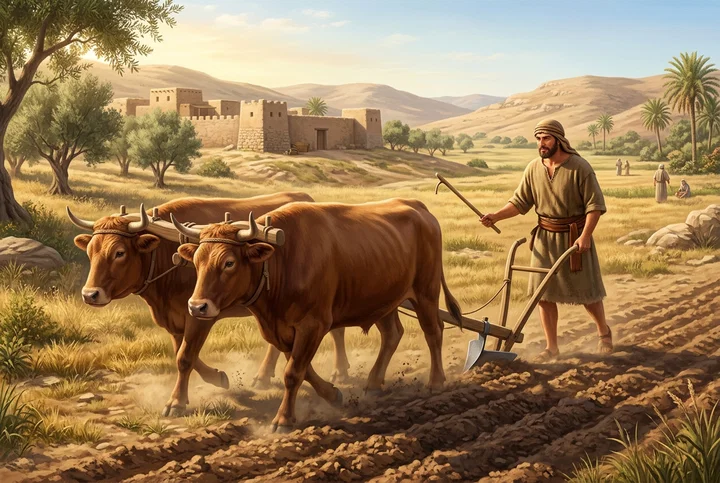
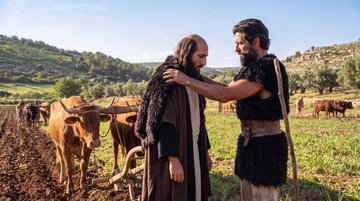
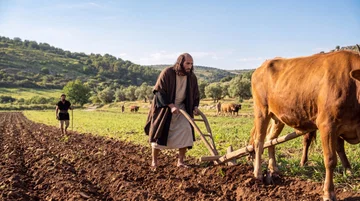
So he departed thence, and found Elisha the son of Shaphat, who was plowing with twelve yoke of oxen before him, and he with the twelfth: and Elijah passed by him, and cast his mantle upon him.
Translations
So he departed there, and found Elisha the son of Shaphat, who was plowing with twelve yoke of oxen before him, and he with the twelfth: and Elijah passed by him, and cast his mantle on him.
King James Version, KJV Cambridge Paragraph Bible, Webster Bible
So he departed thence, and found Elisha the son of Shaphat, who was plowing with twelve yoke of oxen before him, and he with the twelfth: and Elijah passed by him, and cast his mantle upon him.
So he departed thence, and found Elisha, the son of Shaphat, who was plowing, with twelve yoke of oxen before him, and he with the twelfth: and Elijah passed over unto him, and cast his mantle upon him.
So he departed thence, and found Elisha the son of Shaphat, who was plowing, with twelve yoke of oxen before him, and he with the twelfth: and Elijah passed over unto him, and cast his mantle upon him.
And he goeth thence, and findeth Elisha son of Shaphat, and he is plowing; twelve yoke [are] before him, and he [is] with the twelfth; and Elijah passeth over unto him, and casteth his robe upon him,
And he departed thence, and found Elisha the son of Shaphat, who was ploughing [ with] twelve yokes before him, and he with the twelfth; and Elijah went over to him, and cast his mantle on him.
So he departed from thence, and found Elisha son of Shaphat, as he was plowing, with twelve yoke of oxen before him, he being with the twelfth,—so Elijah crossed over unto him, and cast his mantle towards him;
Berean Standard Bible, Majority Standard Bible
So Elijah departed and found Elisha son of Shaphat. He was plowing with twelve teams of oxen, and he was with the twelfth team. Elijah passed by him and threw his cloak around him.
So he departed from there and found Elisha the son of Shaphat, who was plowing with twelve yoke of oxen before him, and he with the twelfth. Elijah went over to him and put his mantle on him.
So he went away from there and came across Elisha, the son of Shaphat, ploughing with twelve yoke of oxen, he himself walking with the twelfth; and Elijah went up to him and put his robe on him.
So he departed thence, and found Elisha the sonne of Shaphat who was plowing with twelue yoke of oxen before him, and was with the twelft: and Eliiah went towards him, and cast his mantel vpon him.
Douay-Rheims (Challoner revision)
And Elias departing from thence, found Eliseus the son of Saphat, ploughing with twelve yoke of oxen: and he was one of them that were ploughing with twelve yoke of oxen: and when Elias came up to him, he cast his mantle upon him.
Pictures
Cross-references 20 of 22
- Matthew 4:21-22
And going on from thence, he saw other two brethren, James the son of Zebedee, and John his brother, in a ship with Zebedee their father, mending their nets; and he called them.
Both show God calling busy workers from their labor into service.
- 2 Kings 2:9
And it came to pass, when they were gone over, that Elijah said unto Elisha, Ask what I shall do for thee, before I be taken away from thee. And Elisha said, I pray thee, let a double portion of thy spirit be upon me.
Elisha asks for and receives a double portion as Elijah’s successor.
- Matthew 9:9
And as Jesus passed forth from thence, he saw a man, named Matthew, sitting at the receipt of custom: and he saith unto him, Follow me. And he arose, and followed him.
Both were called while occupied in their daily work.
- Judges 6:11-14
And there came an angel of the LORD, and sat under an oak which was in Ophrah, that pertained unto Joash the Abi-ezrite: and his son Gideon threshed wheat by the winepress, to hide it from the Midianites.
Both men were called to serve while doing farm work.
- 1 Kings 18:40
And Elijah said unto them, Take the prophets of Baal; let not one of them escape. And they took them: and Elijah brought them down to the brook Kishon, and slew them there.
Elijah’s return follows his triumph at Carmel and the slaying of Baal’s prophets.
- 2 Kings 2:11
And it came to pass, as they still went on, and talked, that, behold, there appeared a chariot of fire, and horses of fire, and parted them both asunder; and Elijah went up by a whirlwind into heaven.
Elijah is taken up after calling Elisha to follow him.
- 2 Kings 3:11
But Jehoshaphat said, Is there not here a prophet of the LORD, that we may enquire of the LORD by him? And one of the king of Israel’s servants answered and said, Here is Elisha the son of Shaphat, which poured water on the hands of Elijah.
Elisha’s service to Elijah follows his call to prophetic ministry.
- 1 Kings 19:15
And the LORD said unto him, Go, return on thy way to the wilderness of Damascus: and when thou comest, anoint Hazael to be king over Syria:
Elijah departs in obedience to God’s command to return.
- Matthew 4:18
And Jesus, walking by the sea of Galilee, saw two brethren, Simon called Peter, and Andrew his brother, casting a net into the sea: for they were fishers.
Both show God calling people who are busy at their work.
- Matthew 19:21
Jesus said unto him, If thou wilt be perfect, go and sell that thou hast, and give to the poor, and thou shalt have treasure in heaven: and come and follow me.
Jesus calls the ruler to surrender his possessions and follow him, as Elisha accepted his call.
- Luke 5:10-11
And so was also James, and John, the sons of Zebedee, which were partners with Simon. And Jesus said unto Simon, Fear not; from henceforth thou shalt catch men.
Jesus calls working fishermen from their occupation to follow and serve him.
- 2 Kings 6:17
And Elisha prayed, and said, LORD, I pray thee, open his eyes, that he may see. And the LORD opened the eyes of the young man; and he saw: and, behold, the mountain was full of horses and chariots of fire round about Elisha.
Both describe divine deliverance through angelic forces.
- 2 Kings 2:2
And Elijah said unto Elisha, Tarry here, I pray thee; for the LORD hath sent me to Beth-el. And Elisha said unto him, As the LORD liveth, and as thy soul liveth, I will not leave thee. So they went down to Beth-el.
Elisha’s refusal to leave Elijah shows his faithfulness and perseverance.
- 2 Kings 2:10
And he said, Thou hast asked a hard thing: nevertheless, if thou see me when I am taken from thee, it shall be so unto thee; but if not, it shall not be so.
Elisha’s request is granted on the condition that he remains with Elijah until his departure.
- Luke 9:62
And Jesus said unto him, No man, having put his hand to the plough, and looking back, is fit for the kingdom of God.
Both texts portray the call to follow as demanding undivided commitment.
- 1 Kings 19:12-13
And after the earthquake a fire; but the LORD was not in the fire: and after the fire a still small voice.
The still small voice gives Elijah the command he obeys.
- 1 Kings 19:2-3
Then Jezebel sent a messenger unto Elijah, saying, So let the gods do to me, and more also, if I make not thy life as the life of one of them by to morrow about this time.
Jezebel’s threat leads Elijah to flee.
- 1 Kings 19:4-7
But he himself went a day’s journey into the wilderness, and came and sat down under a juniper tree: and he requested for himself that he might die; and said, It is enough; now, O LORD, take away my life; for I am not better than my fathers.
Elijah’s despair and God’s care continue the account.
- Mark 1:16-20
Now as he walked by the sea of Galilee, he saw Simon and Andrew his brother casting a net into the sea: for they were fishers.
Jesus calls people from their work to follow and serve him.
- Malachi 4:5
Behold, I will send you Elijah the prophet before the coming of the great and dreadful day of the LORD:
Foretells Elijah’s work before the day of the Lord.
Commentary
Each commentary is drawn from primary sources: the writings of Ellen G. White and Adventist pioneers and periodicals. Each commentary is separate. Its own words are not a quotation; follow the references to read the source passages.
Ellen G. White
51 sources
Directed by God to find a successor, Elijah left where he was and found Elisha at work plowing in the field with his father's servants, and passing by him cast his mantle upon him as the sign of consecration to solemn service and to succeed him in the prophetic office.TBC1882 64.3–65.25T 82.2–4ED 58.4–5Lt 12, 1897, par. 14–16PK 218.1
The Spirit impressed its meaning on Elisha so he recognized the summons, yet he was left to decide for himself, and he valued serving as God's messenger and being with Elijah above every worldly advantage and comfort left behind.ED 59.1ED 58.4–5PK 221.1–2Lt 12, 1897, par. 14–16Lt 12, 1897, par. 19–20
The Lord thus calls men from the plow and humble ordinary labor into His service, showing such occupation does not prevent being chosen, and faithfulness in everyday toil teaches cooperation with God and fits a person for greater responsibility.CH 425.3GW 332.3–333.1GW92 316.1Lt 48, 1909, par. 10Lt 12, 1897, par. 10
He chooses servants from every rank and kind of life by His Spirit rather than relying on outward education, learning, or social position, and the call demands a willing personal response from one who knows God is behind it and stands ready whatever the sacrifice.TBC1882 64.3–65.25T 82.2–4Lt 12, 1897, par. 19–20Lt 123, 1905, par. 3Lt 60, 1897, par. 1–2
Elisha left his work to follow and serve Elijah and learned through small responsibilities and humble duties the meekness, steadfastness, integrity, and reverence that fitted him to guide Israel, which is the model for experienced workers to teach younger workers and entrust responsibility to them.Ms 81a, 1901, par. 6–7PK 218.1CH 584.1–2STB 328.1Lt 164, 1901, par. 11–12
As Elisha was taken from farm work to follow Elijah, so William Miller was called to leave his farm and plow to proclaim Christ's appearing, and with a great work to be done in a short time the Lord will again take men from the plow and ordinary work to carry the final warning message to the world.SG1 128.1–129.1EW 192.2–193.1GC88 330.2–331.120MR 350.4Lt 96, 1902, par. 17
Words and Setting
Even after a powerful victory God's servants can lose courage when they stop trusting Him and look only at threatening circumstances.Lt 62, 1900, par. 3–6 Elijah fled from Jezebel without being sent, though God had strengthened him for his work, when he should have continued to trust God as his refuge and strength.Lt 62, 1900, par. 3–6 The lesson is to maintain confidence in God through trials and to remain steadfast in the work He has given.Lt 62, 1900, par. 3–6 Directed by God to seek a successor, Elijah departed and found Elisha at work plowing in the field.ED 58.4–5Lt 12, 1897, par. 14–16PK 218.1Lt 12, 1897, par. 10Lt 60, 1897, par. 1–2 He was plowing with his father's servants, doing the work nearest to him.ED 58.4–5PK 218.1Lt 12, 1897, par. 10
Elijah passed by Elisha and cast his mantle upon him.TBC1882 64.3–65.25T 82.2–4Lt 12, 1897, par. 14–16GC88 330.2–331.1GC 331.1–332.2 The placing of the mantle was the sign of consecration to solemn service for God.TBC1882 64.3–65.25T 82.2–4Lt 12, 1897, par. 14–16 It marked his call to succeed Elijah in the prophetic service and office.Lt 12, 1897, par. 14–16GC88 330.2–331.1GC 331.1–332.2Lt 96, 1901, par. 6–7 The Spirit of God impressed the meaning of the act on Elisha so that he recognized the summons and obeyed it.ED 58.4–5Lt 12, 1897, par. 14–16
Yet Elijah left him to decide whether to accept the call.ED 59.1Lt 12, 1897, par. 14–16 He was given the choice to return home and consider it.ED 59.1Lt 12, 1897, par. 14–16 Elisha valued the chance to serve as God's messenger and to be with Elijah more than any worldly advantage, and so he chose to follow.ED 59.1 He accepted without looking back at the pleasures and comforts he was leaving.PK 221.1–2 Those who answer such a call must know for themselves that God is behind it and not follow merely because a person invited them, being ready to count every earthly gain as loss for the favor of God.Lt 12, 1897, par. 19–20
Call to Service
The verse shows the Lord calling Elisha from the plow into His service, from humble ordinary labor and ordinary business to the Master's work.CH 425.3GW92 316.1Lt 48, 1909, par. 10Lt 100, 1902, par. 2Lt 116, 1905, par. 26 His work as a plowman and his humble occupation did not prevent him from being chosen, and God may still call men from plowing and humble positions to teach Bible truth, serve in gospel work, and carry His message to the world.GW92 316.1Lt 48, 1909, par. 10Lt 330, 1906, par. 13–14Lt 100, 1902, par. 2Lt 116, 1905, par. 26
Plowing and other humble, ordinary duties are compatible with active service to God, and Elisha's ordinary work at the plow was part of his preparation for carrying out God's bidding.GW 332.3–333.1Lt 12, 1897, par. 1013MR 262.4 Faithfulness and care in everyday toil prepare a person for service by teaching cooperation with God and practical lessons in living by holy principles, fitting for greater responsibility, while carelessness in small duties leaves one unfit for greater responsibilities.Lt 12, 1897, par. 1013MR 262.4 His manual work as a plowman illustrates that Israel's greatest men were trained in useful occupations, where altar and plough alike give experience to those who seek eternal life.13MR 262.4MH 184.2–185.2
The call from the plow to important service shows that God can raise up workers taught by His Spirit and by inspiration rather than relying on outward education, learning, or social position.TBC1882 64.3–65.25T 82.2–4 He chooses servants from every rank and kind of life and did not work exclusively through one class, raising as representatives prophets and princes, the noble and the lowly, humble as well as noble, including tillers of the soil.Lt 57, 1896, par. 10–11Lt 96, 1901, par. 6–7 Those regarded as uneducated and those without formal schooling, even without education at Battle Creek, may be called from ordinary labor in the fields to preach the truth, to take up the service God appoints, and to begin simply and quietly by reading and explaining Scripture to others with successful results.Lt 123, 1905, par. 3Ms 33, 1906, par. 13–14
The call may require leaving ordinary work, and it demands a willing, personal response in which one knows for oneself that God is behind it and not merely following because a person invited him.Lt 12, 1897, par. 19–20Lt 60, 1897, par. 1–2 The one called must be ready to recognize and answer it, to count every earthly gain as loss for God's favor, and to stand ready to answer whatever the sacrifice.Lt 12, 1897, par. 19–20Lt 60, 1897, par. 1–2Ms 126, 1902, par. 59–60 The call of workers to distant fields to proclaim His message follows this same pattern of responding to God's call directly from ordinary work, including the plow.RH Nov 11, 1902Ms 126, 1902, par. 59–60
Those thus called from the plow and ordinary occupations are called to serve and deliver His warning to others, to warn others and give them instruction for their work, even to give warning to perishing souls.STB 434.49T 170.3PMMEP 27.4 The call to service comes from God, who gives workers instruction about their work, directing their field of labor and the methods they should follow.PMMEP 27.4Lt 210, 1903, par. 6–7
Training and Character
1 Kings 19:19 stands at the beginning of the training under God's direction that prepared Elisha to succeed Elijah.ED 60.3 That early preparation fitted him to guide Israel in safe paths through careful, patient instruction.ED 60.3 When called, Elisha left his work to follow Elijah, began by serving him, and learned the work in which he later took a leading part.Ms 81a, 1901, par. 6–7 His work was different from Elijah's, while both served the Lord.Ms 81a, 1901, par. 6–7
The call began a process of training in which young workers are given small responsibilities first and then larger ones as they gain strength and experience, learning ministry alongside experienced servants of God.Lt 164, 1901, par. 11–12 Elisha's service under Elijah included humble duties and submission, through which he learned to serve and developed character fit for responsibility.Lt 64, 1897, par. 14–15 His ordinary duties were a setting in which he was learning to cooperate with God, and his leadership ability, meekness, quiet spirit, energy, steadfastness, integrity, fidelity, and reverence for God were strengthened through daily toil.PK 218.1
Elijah's giving Elisha opportunity to learn from him is the pattern for experienced gospel workers and ministers to teach younger workers how to teach the truth to others.CH 584.1–2STB 328.1Ms 125, 1903, par. 20 Experienced ministers are by it to give younger workers the opportunity to learn how to teach the truth and to begin training them for service.Ms 125, 1903, par. 20RH Nov 19, 1903YGBCOEP 49.1 It illustrates experienced workers preparing younger people to carry the work forward and entrusting them with work and responsibility rather than carrying every burden themselves.RH Mar 20, 1900
The verse points to the spirituality seen in the schools of the prophets that schools educating youth are to recover and bring in.Ms 73, 1912, par. 16–19 That spirituality means teachers educate themselves by the high and holy principles Christ has given in His Word, have an intimate acquaintance with the Word of God, take the Bible and the Bible alone as counselor, take His Word as it reads, follow the Lord's way closely instead of devising and planning by their own judgment, and discharge their duties faithfully in His name and strength by believing His Word and acting on its teachings.Ms 73, 1912, par. 16–19 It means students, even those unconverted though baptized, are taught to search and understand the Bible, receive its truths into the heart and carry them out in daily life, be sanctified through belief of the truth, and become strong in the Lord with spiritual sinew and muscle nourished by the bread of life.Ms 73, 1912, par. 16–19 In such schools the truths of the Bible are earnestly studied and thoughtfully dwelt upon, giving desire for what is infinitely higher than worldly amusement, and as learners draw near to God and become partakers of the divine nature earth-born amusements sink into nothingness, minds take a higher turn, and beholding the character of Jesus they strive to be like Him.Ms 73, 1912, par. 16–19
Elisha's call shows that young people can study while doing practical labor, rather than needing the worldly education required by other schools.Ms 195, 1903, par. 20–21 The Lord can call young men from ordinary occupations, including work at the plow, to missionary work and provide the education He wants them to have.Lt 169, 1903, par. 3–5 Those so called, including those regarded as uneducated, can begin simply and quietly by reading and explaining Scripture to others, with successful results.Lt 123, 1905, par. 3
History and Final Warning
Elisha was at his farm work plowing with oxen when Elijah passed by and cast his mantle upon him to call him to follow and enter prophetic service.SG1 128.1–129.1EW 192.2–193.1GC88 330.2–331.14SP 206.1–207.3GC 331.1–332.2 As Elisha was thus called to leave his farm and his oxen and plow to follow Elijah, so William Miller was called to leave his farm and his plow to proclaim the prophecies and mysteries of the kingdom of God concerning the second advent and appearing of Christ.SG1 128.1–129.1EW 192.2–193.1GC88 330.2–331.14SP 206.1–207.3GC 331.1–332.2
As the Lord took Elisha from the plow into His service, so with a great work to be done in a short time He will again take men from the plow and from ordinary work and give them a part in the closing work.20MR 350.4Lt 96, 1902, par. 17Ms 126, 1902, par. 59–60Ms 107, 1902, par. 1 He will take them directly from their ordinary occupations to proclaim His truth and will send them to carry His message and give the final warning message to the world.20MR 350.4Lt 96, 1902, par. 17Ms 126, 1902, par. 59–60Ms 107, 1902, par. 1 All should stand ready to answer that call whatever the sacrifice.Lt 96, 1902, par. 17Ms 126, 1902, par. 59–60Ms 107, 1902, par. 1
Sources
Pioneers and periodicals
44 sources
Elijah left Horeb at once in complete obedience and found Elisha the son of Shaphat plowing with twelve yoke of oxen, and by passing by him and casting his mantle upon him he appointed him to leave his former work, follow and serve him, and succeed him as prophet.ST Jul 7, 1898STST Jan 15, 1880RH Jun 3, 1873 No further outward or formal consecration is recorded, for the call rested on the inward movement of God's Spirit. God calls to His service men already faithfully busy at honest lawful labor, and not the lazy or idle.RH Jun 18, 1872RH Sep 2, 1873 Elisha promptly left his oxen and worldly interests without objection to follow and minister to Elijah, giving up everything that could draw him back.RH Apr 4, 1871RH Oct 23, 1860RH Jul 20, 1916 So those called as reapers today are to rise at once when the Master calls, leaving plow, possessions and hindrances to toil while it is still day, even to distant fields.RH Nov 11, 1902RH Mar 5, 1908ST May 17, 1905
Historical Setting and Background
The verse comes after the victory over the false prophets and the prayer for rain upon the drought-smitten land, followed by the twenty-five mile run before Ahab's chariot from Carmel to Jezreel and discouragement at Israel's spiritual apathy. It comes after Jezebel's message threatening Elijah's life by the next day, his fearful flight to the southern border of Judah and into the wilderness, and his prayer under the broom tree to die because he was no better than his fathers. It comes after God's pity in twice feeding him by an angel, his journey of forty days and nights in that strength to Horeb the Mount of God, and his lodging in a cave with the complaint that Israel had forsaken the covenant, thrown down the altars and slain the prophets, leaving him alone and hunted. It comes after God's passing by in the great wind rending mountains and breaking rocks, the earthquake, and the fire, in none of which Jehovah was, and after the still small voice before which Elijah wrapped his face in his mantle, his repeated complaint, and Jehovah's command to go return on his way.
The verse belongs to 1 Kings 12 to 22, which records the history of the separate kingdoms of Judah and Israel for about eighty years from the revolt of the ten tribes to the death of Jehoshaphat.RH May 25, 1916 That history comprises the reigns of several kings of both Judah and Israel, and within it the verse is part of the extraordinary ministry of the prophet Elijah.RH May 25, 1916 Elijah the Tishbite, the greatest of the Hebrew prophets, was at work during the reign of Ahab, the seventh king of Israel and second ruler of the third Israelitish dynasty.RH Nov 7, 1912 Ahab reigned twenty-two years early in the ninth century before Christ as the contemporary of Jehoshaphat of Judah, and the extended record of Ahab in 1 Kings 16 to 22 is written for the learning and profit of men and kings of later generations.RH Nov 7, 1912
Elijah appeared to stand alone in human support before Ahab on Mount Carmel, devoted and earnest in God's work.ST Jul 1, 1880ST May 20, 1913 Under God he slew the prophets of Baal, work Israel itself ought to have done, and prayed for God to send rain and God answered his prayer.ST May 20, 1913 Even though great, he was overcome by weariness and became discouraged, yet God translated him.ST May 20, 1913 The verse is part of the Old Testament history associated with Jezebel, Ahab's wife, who promoted idolatry and persecuted the Lord's prophets.RH Aug 7, 1860RH Oct 16, 1856 Her story supplies the background for the figurative Jezebel in Thyatira, as a figure for Papal abominations and for false teaching allowed among the church of Christ.RH Jun 17, 1862RH Oct 16, 1856
In Elijah's day Israel had widely abandoned the worship of the true God for Baal, and Elijah thought he alone remained faithful.RH Feb 21, 1865 Apostasy had not destroyed the true church, for God preserved a faithful remnant of seven thousand in Israel who had not bowed to Baal, though they were hidden from Elijah's view.RH Feb 21, 1865 That remnant responded to the prophet's call. The chapter is part of a historical parallel to a future time when people who have turned from God's commandments will blame God's faithful people for the troubles caused by their own disobedience.RH Dec 3, 1901 The parallel warns that commandment-keepers may be treated as the cause of public distress and targeted for removal.RH Dec 3, 1901
The account shows that God maintains the forces of the body and promotes endurance by means beyond physical food.RH Sep 25, 1913 Elijah went on foot through rugged country for forty days and forty nights in the strength of two meals prepared by an angel.RH Sep 25, 1913 This proves man shall not live by bread alone but can receive bodily energy from God.RH Sep 25, 1913
Meaning of the Mantle
Elijah departed at once in immediate and complete obedience when God said Go at Horeb, with no hesitancy, no doubts, and no lingering delay, trusting the mighty God of Israel to sustain him though Jezebel sought his life, with the same faith as one who cried to the Lord, lay down and slept, and awoke because the Lord sustained him.RH Jun 3, 1873
He found Elisha the son of Shaphat plowing with twelve yoke of oxen before him while he himself worked with the twelfth, then passed by him and cast his mantle upon him.ST Jul 7, 1898ST Jan 15, 1880ST Aug 27, 1885RH Nov 9, 1916
That act appointed and called Elisha to leave his former work, follow Elijah, serve him and minister to him as attendant, and take up prophetic service as God's messenger and prophet in Elijah's place and as his successor.ST Jul 7, 1898ST Jan 15, 1880ST Aug 27, 1885RH Nov 9, 1916
The mantle was to fall to Elisha to mark him as Elijah's successor, and though he was a humble plowman chosen from ordinary working life, this revealing of the successor beforehand was exceptional.STRH Aug 19, 1915
Elijah was returning to God's work after his experience at Horeb and connecting Elisha with him as successor, for God sent him back to his duty and provided him special help and companionship through Elisha.ST May 24, 1905ST May 13, 1908
No further outward or formal consecration is recorded beyond passing by while Elisha plowed and casting the mantle on him, for the prophetic call depended on the inward movement of God's Spirit and the prophet's personal relation to his divine Instructor.
The verse is an example of God giving a servant an extraordinary sign to support human weakness, here associated with Elijah's call of Elisha.ST Aug 7, 1901
The account of Elijah to which it belongs serves as a pattern for a reforming, converting work, like the work associated with Elijah and John the Baptist.RH Jul 9, 1901
Elisha received his commission while plowing in the field, illustrating that God called people to the prophetic office under varied circumstances and occupations.
Elisha's plowing with a yoke of oxen exemplifies the tools of labor and systems of husbandry of the Holy Land still seen there, showing farming practice has remained substantially unchanged and bears testimony to the Bible, and that whenever war ceases the ground still yields with its ancient abundance.RH Aug 29, 1871
He was engaged in peaceful farm toil plowing when the divine call came, in the same way Amos was engaged in tending cattle and gathering sycamore fruit in Tekoa when inspiration came to him.ST
God Chooses Working People
Elisha was busy plowing with twelve yoke of oxen in the field when Elijah passed by and cast his mantle upon him to call him to God's service.RH Jun 18, 1872RH Sep 2, 1873RH Jan 28, 1902RH Sep 5, 1912 God never goes to the lazy or idle when He needs men for His service, for when He wants a worker He calls a worker, when He has work to be done He goes to those already at work, and when He wants a great servant He calls a busy man.RH Sep 2, 1873RH Sep 5, 1912 His great appearances and calls come to eminent saints while they are busy at lawful work, because He does not manifest Himself to idle persons, and the diligent may expect the sweet company of the Saviour while the slothful and inactive cannot.RH Jun 18, 1872RH Sep 2, 1873RH Jan 28, 1902 Heaven is nearest to one busy at honest labor with a right heart, and God calls working men to His service and brings no idleness into His work.RH Sep 2, 1873RH Jan 28, 1902 He chooses, honors, and blesses diligent, willing-hearted, busy, active workers, and in most instances calls men to deliver nations, lead armies, utter prophecies, and save men from the midst of secular pursuits, so that Providence comes first to those who labor faithfully rather than to those who wait idly.RH Jan 28, 1902
Elisha was faithfully working as a husbandman when Elijah found him, showing the Lord knows where to find those faithful in their work. Elijah's call led Elisha to follow and minister to him, and Elisha received Elijah's mantle and a double portion of the Spirit of God. His ordinary work plowing in a field did not prevent him from being chosen to prophetic service.RH Sep 3, 1914 That work as a farmer prepared him to serve Elijah and, when called, to take up Elijah's unfinished duties.RH Jan 12, 1905 Keeping his eye on a mark and plowing a straight furrow prepared him in principle for guiding Israel's wandering people along straight paths, showing practical work can prepare a person for later service.RH Jun 14, 1906
His prompt departure from the plow and training for God's work show that God can call workers from workshops and fields and that a short course of preparation can equip them to begin their life-work.RH Apr 5, 1906 His experience following the plow also teaches perseverance and the opposite of discouragement: not to give up.RH Apr 5, 1906 Taking him from the plow to be a prophet to Israel proves God accomplishes His benevolent designs by His own selected agencies whose thoughts and ways are not as human thoughts and ways.ST Mar 17, 1887 God chooses the weak and unlikely things of the world to confound the mighty instead of what human wisdom would approve, so that the excellency of the power may appear of God and not of men, the pride of human wisdom and power is stained, and the world is taught it is saved not by men's wisdom but by God's power.ST Mar 17, 1887
God calls men from common work at the plow to take up the work He appoints, making Elisha the pattern for calling unexpected talent from the common walks of life, men regarded as uneducated, to the Master's service.RH Jun 27, 1912RH Mar 12, 1908 Those so called begin to labor in simplicity and quietness, reading and explaining the Scriptures to others in house-to-house work, and their simple efforts are made successful by the Spirit of God upon them, the grace and presence of Christ with them, and angels moving upon hearts.RH Jun 27, 1912 God called Elisha from plowing to His work in a time of crisis, as His practice in all ages of calling men from the plow, the bench, and other ordinary walks when crisis demands it.RH Mar 12, 1908 The call from common labor does not lower the standard, for God's work demands the best talent and those called must qualify themselves to the best of their ability, measuring as nearly as possible to the high ideal of perfection.RH Mar 12, 1908
Elisha hitched his oxen for his ordinary day's work without knowing that before evening the prophet's mantle would be on his shoulders.RH Apr 8, 1909 This means God leads by a secular incentive to a blessing of an entirely different nature and meets people in life's commonplaces, so honest faithful performance of everyday vocations brings the richest spiritual blessings.RH Apr 8, 1909 God calls men to greater honors and more extensive labor, even to be successor and receive a double portion of the spirit, while simply employed in everyday concerns.ST Oct 18, 1877 Doing everyday duties, however trivial and simple, as God would have them done from desire for His glory is doing His will and is as pleasing to God as great things, and faithful employment of talents in daily work leads to being entrusted with more.ST Oct 18, 1877 Elijah who called him was Israel's great prophet who had stood fearless and alone on God's side among the multitudes of Baal's prophets and the prophets of the groves.ST Oct 18, 1877
Following and Passing On
Elisha left his twelve yoke of oxen and his worldly interests to follow Elijah and minister to him, for he was a helper raised up by God for a special work.RH Apr 4, 1871 He left his work with the oxen and promptly followed the man of God without raising objections, showing readiness to obey a call from God even when it requires leaving familiar work behind.RH Oct 23, 1860 The call of God must be answered at once no matter how busy a person is, and everything from the former occupation that could draw a person back to it must be given up to God.RH Jul 20, 1916
Answering God's last call for reapers today means rising up at once like Elisha when the Master calls.RH Mar 5, 1908 The one called must leave the plow and all world-bound business, possessions, chains, hindrances, frowns, scoffs, and even mother, father, and loved ones that would hold him back, counting the Master's call enough reason to go.RH Mar 5, 1908 He must hasten away free to toil in the harvest while the great fields are white and it is still day before night comes, including going to far foreign shores where the heathen wait with open doors.RH Mar 5, 1908
Elisha began to follow Elijah and serve him faithfully, learning from the words and example of the man of God. Choosing that companionship rather than pursuing worldly pleasure and riches prepared him for a higher position. Elijah's beginning of Elisha's call by taking him from work in the fields teaches that experienced ministers should give younger workers opportunity to learn how to teach the truth.RH Nov 19, 1903 It illustrates experienced workers preparing younger people to carry the work forward and entrusting them with responsibility.RH Mar 20, 1900
The call illustrates the need to enter Christian work with wholehearted, unreserved devotion when the mantle is placed upon one.ST May 17, 1905 God called Elisha from his work at the plow to proclaim His message, and the call of workers to distant fields follows the same pattern of responding to God's call whatever the sacrifice.RH Nov 11, 1902
Sources