Translations
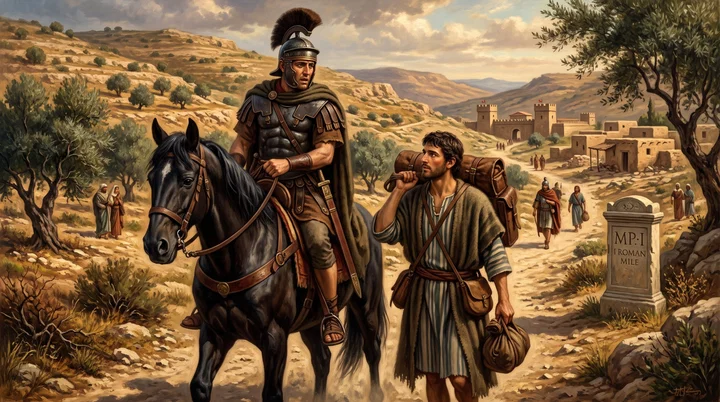
And whoever shall compel you to go a mile, go with him two.
King James Version, KJV Cambridge Paragraph Bible
And whosoever shall compel thee to go a mile, go with him twain.
And whoever shall constrain thee to go one mile, go with him two.
And whosoever shall compel thee to go one mile, go with him twain.
And whosoever shall compel thee to go one mile, go with him two.
'And whoever shall impress thee one mile, go with him two,
And whoever will compel thee to go one mile, go with him two.
And, whoever shall impress thee one mile, go with him two:
Berean Standard Bible, Majority Standard Bible
and if someone forces you to go one mile, go with him two miles.
Whoever compels you to go one mile, go with him two.
And whoever makes you go one mile, go with him two.
And whosoeuer will compell thee to goe a mile, goe with him twaine.
Douay-Rheims (Challoner revision)
And whosoever will force thee one mile, go with him other two,
Pictures
Cross-references
- Romans 12:17-21
Recompense to no man evil for evil. Provide things honest in the sight of all men.
Both teach answering evil with good rather than retaliating.
- Exodus 21:24
Eye for eye, tooth for tooth, hand for hand, foot for foot,
Jesus contrasts eye-for-eye retaliation with willingly going the second mile.
- Luke 6:27-28
But I say unto you which hear, Love your enemies, do good to them which hate you,
Jesus teaches blessing and loving those who do harm.
- Luke 6:29-30
And unto him that smiteth thee on the one cheek offer also the other; and him that taketh away thy cloke forbid not to take thy coat also.
Both teach generous, nonretaliatory responses to mistreatment and loss.
Commentary
Each commentary is drawn from primary sources: the writings of Ellen G. White and Adventist pioneers and periodicals. Each commentary is separate. Its own words are not a quotation; follow the references to read the source passages.
Ellen G. White
17 sources
Under Roman rule a person in authority could force another to carry a burden for a mile, and going with him twain means willingly carrying it even farther in a second mile of service.4RED 74.2ST Apr 26, 18772SP 222.2–223.2 It forbids meeting coercion and oppression with defiance, hatred, revenge, or bitterness, and requires answering a forced demand with willing service beyond what is demanded and with a heart free of personal resentment.Lt 35, 1895, par. 1–34RED 74.2ST Apr 26, 1877DA 310.3–44RED 75.1–76.1 Jesus Himself lived this out by never retaliating for insult and persecution, copying a holy God who gives sunshine and rain to the just and the unjust alike, and this spirit marks the children of the Father in heaven and moves toward being perfect as the Father in heaven is perfect.2SP 222.2–223.24RED 75.1–76.1 In the Sermon on the Mount Christ set it forth as part of the far-reaching claims and spirit of God's law, laying out the principles of His kingdom of divine grace rather than earthly power and demanding wholehearted love for God and neighbor from the heart.FE 237.12SP 204.1FE 309.1Lt 7, 1886, par. 34ST Jan 9, 1912 It is to be studied, believed, and acted upon in daily life, so that its divine principles are embedded in the heart and develop Christlike character in words, attitude, and deeds of mercy.ST May 10, 1910Ms 201, 1898, par. 11Ms 151, 1902, par. 8–96T 472.1Lt 7, 1886, par. 34
Setting and Wording
The mile is the distance a person could be compelled to go under Roman rule, when a soldier could force another to carry his load or burden for a mile.4RED 74.2ST Apr 26, 18772SP 222.2–223.2 It was especially Jewish peasants who were thus compelled to carry the burdens of Roman soldiers.4RED 74.22SP 222.2–223.2 Jesus spoke these words while Roman soldiers were forcing Jewish peasants to carry their burdens, at one time up a steep ascent from the shore.4RED 74.22SP 222.2–223.2 The demand was an act of oppression that illustrated a humiliating power imposed upon the Jews and stood as a reminder of their national subjection.4RED 74.2ST Apr 26, 18772SP 222.2–223.2 It stirred indignation in the crowd who witnessed it.4RED 74.2 He looked with sadness on the shameful scene because their sins had brought them into such Roman bondage, and He saw hatred on their faces and the desire to crush their oppressors.4RED 74.2
The mile is an obligation imposed by people in authority, including Roman soldiers or other authorities who force someone to carry a burden or perform a service.ST Apr 26, 18772SP 222.2–223.2 Going with him twain means not stopping at the mile forced upon him but willingly going twice as far.4RED 74.22SP 222.2–223.2 It means willingly carrying the load farther than required and performing a second mile of service.ST Apr 26, 18772SP 222.2–223.2 The forced demand is thus to be met with willing service beyond what is demanded rather than with resistance.ST Apr 26, 18772SP 222.2–223.2
Nonresistance and Willing Service
Compulsion and oppression are not to be met with defiance, resistance, hatred or revenge, but with willing service that goes beyond what is forced.Lt 35, 1895, par. 1–34RED 74.2ST Apr 26, 18772SP 222.2–223.2 When made to go a mile, the requirement is to go willingly twice as far rather than resist evil.4RED 74.2ST Apr 26, 18772SP 222.2–223.2 When an oppressor compels performance of a task, or persons in authority require a service, the disciple willingly does more than is required and carries the imposed obligation into a second mile of service.ST Apr 26, 18772SP 222.2–223.2 Being compelled or wronged gives no excuse for cherishing retaliation, desire for revenge, bitterness or personal resentment, and the heart must be kept free of them.DA 310.3–44RED 75.1–76.1 Anger indulged over personal provocation is altogether distinct from righteous indignation at dishonor done to God or at oppression of the innocent.DA 310.3–4
Even in persecution for the truth, resistance is not to be encouraged though believers face severe punishment, and the call instead is to the meekness of Christ and to prayer for those who do the mistreating.Lt 35, 1895, par. 1–3 The requirement is Christian courtesy toward all, unfailing deeds of mercy, and a benevolence in answering requests for favors that is superior to the narrow, selfish spirit of the world.4RED 75.1–76.1 Hatred never breaks down malice, while such love and kindness beget love in return and seek by kindness to win injurers away from evil ways.4RED 75.1–76.1 Jesus Himself exemplified this by never retaliating for insult, contumely and persecution, modeling patient and unrevengeful conduct under persecution.2SP 222.2–223.24RED 75.1–76.1
Such forbearance copies a holy God who rewards virtue and punishes guilt yet bestows sunshine and rain and worldly prosperity upon the just and the unjust, the good and the evil, the rebellious and the idolatrous alike.4RED 75.1–76.1 This spirit marks the children of the Father in heaven.4RED 75.1–76.1 It moves toward being perfect as the Father in heaven is perfect, which alone fits for companionship with sinless beings in the kingdom of heaven.4RED 75.1–76.1
Law, Kingdom, and Practice
Matthew 5:41 belongs to the Sermon on the Mount, in which Christ explains the far-reaching claims and spirit of God's law and restores its true meaning from the distorted, rigid presentation of the rabbis.FE 237.1Lt 7, 1886, par. 34 That sermon opposed the doctrines and practices of the self-righteous scribes and Pharisees and corrected their misrepresentation of God.FE 309.1 It teaches the far-reaching principles of the law and shows that the state of the heart regulates life and character, so that the spirit of the law must be in the heart.Lt 7, 1886, par. 34
In that sermon He sets out the principles governing His kingdom of divine grace rather than promising earthly power or the restoration of Israel's former glory.2SP 204.1 The law explained there reaches beyond outward acts and demands perfect obedience, which Christ exemplified in His sinless life.ST Jan 9, 1912 That pure gospel given on the mount requires wholehearted love for God and love for neighbor, and rules out gaining wealth unjustly at another's expense.Ms 26, 1899, par. 29–30 Its application includes the way people respond to demands made of them, and true followers seek to obey as He did.ST Jan 9, 1912
The whole fifth chapter in which the verse stands is full of precious instruction laid out in figures, giving a clear, definite expression of God's will.ST May 10, 1910Lt 181, 1901, par. 6 It is to be studied and acted upon, believed and practiced, learned and obeyed, dwelt upon often, and read and written upon the tablets of the soul.ST May 10, 1910Ms 201, 1898, par. 11Ms 151, 1902, par. 8–9Lt 181, 1901, par. 6 Doing the will of God thus made known reveals that the doctrine is of God.Lt 181, 1901, par. 6
Living by it helps develop Christlike character and embed divine principles in the heart, bringing divine virtues constantly into life.Ms 201, 1898, par. 11Lt 181, 1901, par. 6 It holds the standard high without spot or wrinkle, and shapes words, attitude, and actions to represent Christ and to break up words that separate friends.Lt 181, 1901, par. 6 It calls to unity, love, and Christian fellowship rather than accusation and faultfinding.Ms 151, 1902, par. 8–9 Studied and acted upon in cooperation with Christ and union with Him, it shows what can be accomplished and reveals the divine likeness in a life of suffering with those who suffer and helping those in need.ST May 10, 1910
Its lesson is to be exemplified in daily life, since living out Christ's lessons makes a deeper, more lasting impression than preaching alone.6T 472.1 Those who instruct new converts in the claims of the law must impress them with these principles, or their labors will be lost.Lt 7, 1886, par. 34
Sources
Pioneers and periodicals
70 sources
Under Roman rule a soldier or official could force a demeaning service such as carrying a load for a mile, so the first mile is required duty under compulsion while the second mile is freely chosen service beyond demand.ST Apr 26, 1877ST Mar 28, 1911ST Dec 23, 1913RH Jan 12, 1869
It belongs to the Sermon on the Mount in Matthew 5-7, Christ's fullest declaration of the spiritual character and principles of His kingdom, given when His hearers expected an earthly reign to break the Roman yoke.ST Jan 15, 1880ST Aug 6, 1912ST Aug 30, 1877
It replaces eye for eye with non-retaliation, calling for meekness without violence, defiance or revenge, meeting petty compulsion and loss with willing service, good for evil, love for enemies and prayer for persecutors.ST Mar 28, 1911RH Aug 8, 1871ST Nov 5, 1894RH Jan 12, 1869
It vindicates and expounds the Father's law rather than establishing a new code to replace the Ten Commandments, while those who held the differing position teach it as a new code superior to the old schoolmaster and superseding the Ten Commandments.RH May 17, 1864RH May 17, 1864RH May 17, 1864RH Jul 26, 1870
As part of that teaching against retaliation it rules out deliberately going to war to kill, and in daily life it calls for generous service beyond strict duty without keeping account of time.RH Oct 1, 1914RH May 15, 1913ST Jun 6, 1900ST Aug 10, 1904
Words and Historical Setting
The command reflects life under Roman rule, when soldiers or other authorities could force Jews to perform humiliating services, and when even Jews acting for Romans could impose such demands.ST Apr 26, 1877ST Mar 28, 1911 The compulsion could be petty, cruel or unjust, such as being made to carry a burden or to carry mail for a mile.ST Apr 26, 1877ST Mar 28, 1911 The required response is patience rather than resistance, accepting the loss or injury instead of answering oppression with hatred, resistance, revenge, or going to law over something of small value.ST Apr 26, 1877ST Mar 28, 1911 Willing service beyond the demand takes the place of retaliation.ST Apr 26, 1877
The first mile is compelled and required duty, while going the second mile is freely chosen service beyond what is demanded.ST Dec 23, 1913RH Jan 12, 1869 What necessity compels is not freely chosen, but the extra that is added is a free gift.RH Jan 12, 1869 That added service brings personal growth and freedom, makes even the required service appear willing, and refreshes the one who serves.ST Dec 23, 1913 It applies to acts of service for others that are unexpected or perhaps undeserved, and especially when an unjust demand comes for Christ's sake the yield is to be more than was demanded.ST Dec 23, 1913RH Jan 12, 1869 Returning good for suffered evil may bring conviction to the persecutor as coals of fire on his head.RH Jan 12, 1869
The instruction means exactly what it says and is to be taken for just what it says rather than quibbled over or explained away.ST Sep 8, 1898 It is plain and direct instruction to be carried out just as given and obeyed because obedience is best.ST Sep 8, 1898 The life of Christ is in full harmony with it, and divine life and power are in the Word that contains it, which is therefore to be studied.ST Sep 8, 1898
It lays down an unchanging principle of non-retaliation to replace eye for eye and tooth for tooth, meaning to go two miles when compelled to go one rather than prolonging strife or paying back wrong for wrong.RH Aug 8, 1871 It is to be taken as it reads and acted upon always under sober and sanctified judgment, so different circumstances lead to different actions while the underlying principle stays exactly the same.RH Aug 8, 1871 Applied with reasonableness it teaches generous response rather than grudging minimum, rendering assistance to those in need on the principle of loving neighbors as self and not on the principle of receiving as much in return.RH Aug 8, 1871 That includes giving money when the requester truly needs it, while an unjust demand is treated as taking what belongs to God and as something for which the requester must answer at judgment.
Sermon Setting and Purpose
Matthew 5:41 belongs to the Sermon on the Mount in Matthew 5, 6, and 7, which is the fullest verbal declaration of the underlying principles of the law and the inaugural address laying out work for the church, teaching that following Christ means doing what He commands and not merely professing belief while neglecting obedience.ST Aug 6, 1912ST Aug 30, 1877 The same teaching is also presented in condensed form in Luke 6, with some additional thoughts.ST Mar 24, 1909 The law set forth there is the written expression of righteous principles of truth and righteousness, justice and mercy inherent in Divinity and constituting the transcript of God's character, while Christ dwelling in human flesh was the living expression of those same principles, revealing God's character with the law within His heart.ST Aug 6, 1912 He came to explain the relation of the law to man and to illustrate its precepts by His own life of obedience, and keeping the law consists in living the opposite of what the law condemns, negative to sin but positive to righteousness.ST Aug 6, 1912 The beatitudes that introduce the sermon set forth the blessings bestowed of heaven upon those who seek and develop righteousness, God-likeness of character.ST Aug 6, 1912
It was given when the disciples expected Christ to commence His reign as Prince upon the throne of David, break the Roman yoke from their necks, and share great honor and glory with Him.ST Jan 15, 1880 It disappointed their expectations of earthly glory and more clearly revealed the character of Christ's kingdom and the principles that govern it in the beatitudes.ST Jan 15, 1880 It embodies the principles of the moral law, laying down at once the whole sum and substance of true religion by specifying the kind of character essential for the subjects of His kingdom.ST Jan 15, 1880
The whole fifth chapter is full of precious instruction laid out in figures to be studied and acted upon, to be read and written upon the tablets of the soul, showing what can be accomplished through cooperation with Christ and union with Him.ST May 10, 1910 It reveals the likeness of the divine Lord in a life of suffering with those who suffer and helping those in need.ST May 10, 1910 It is presented as a guide to the full demands of the moral law in both its letter and its spirit, helping people examine whether they have kept the law perfectly, so that its requirements expose sin and show the sinner's need of a Saviour.RH Dec 10, 1872 It gives a full portrait of the Bible Christian and sets a high standard for Christian conduct.RH Jan 21, 1875 It teaches the faith of Jesus, which those who gain victory over the beast, its image, and its mark possess.RH Feb 7, 1854
It was spoken by the same divine voice that gave the law at Sinai, and its teaching did not retract or nullify any part of God's law.ST Sep 22, 1909 Although given before Pentecost, its teaching about the law's continuance shows that pre-Pentecost teachings remain applicable and must not be set aside as irrelevant to the Christian age.ST Jun 4, 1885 Its teachings are presented as wisdom with practical spiritual lessons on the spirituality of the law.ST Jun 23, 1914
Law and Commandments
The command to go the second mile does not set up a new code to take the place of the Ten Commandments, but teaches the Father's law and expounds its principles, especially the duty of love to neighbor, while the gospel establishes the law rather than replacing it.RH May 17, 1864RH May 17, 1864RH Nov 26, 1857RH Apr 16, 1861RH Jan 10, 1865 The teaching in Matthew 5 is not a revised law displacing what existed from the beginning, for Christ speaks as one delivering what the Father gave Him, and His words vindicate the commandments rather than contrasting with them or with the principles growing out of them.RH May 17, 1864RH Jul 26, 1870RH Apr 16, 1861RH Jan 10, 1865 In a differing position held by some, the same command in Matthew 5:27-48 concerning non-resistance to evil, giving to the asker, loving enemies, blessing and doing good and praying for persecutors, and being perfect as the Father in heaven is perfect, was presented as a new code superior to the old schoolmaster and superseding the Ten Commandments, with special reference to the sixth and seventh commandments.RH May 17, 1864
It declares the underlying righteous principles of truth, justice and mercy inherent in Divinity and constituting the transcript of God's character, which Christ in human flesh lived out as the living expression with the law in His heart.ST Aug 6, 1912 The commandments so declared are comprehensive, reaching beyond outward acts to thoughts, desires, affections, motives, heart, words and everything offensive to God, and keeping them consists in living the opposite of what they condemn, negative to sin but positive to righteousness.ST Aug 6, 1912RH Jul 11, 1865RH Jan 5, 1864ST Oct 2, 1884RH May 17, 1864 Christ came to explain the relation of the law to man and to illustrate its precepts by His own life of obedience, and the full requirements are to be taught by the Spirit, with blessing upon those who seek and develop righteousness and God-likeness of character.ST Aug 6, 1912RH Jan 5, 1864 It belongs to the duty of loving one's neighbor and requires love even in dealings with enemies, so that going beyond compulsion is part of the practice of love.RH May 17, 1864ST Feb 14, 1906RH May 17, 1864 As a principle of the sixth commandment against murder it teaches yielding rather than retaliation even when compelled beyond what is rightfully required, expressing the law's underlying love and mercy toward others.ST Aug 6, 1912
The contrast is not with the Ten Commandments, which Christ confirmed, strengthened, extended and more fully explained without abolishing, but with sayings of people of old and with temporary ceremonial and civil laws, special precepts and rules of application granted to Israel for hardness, corrupted customs and particular circumstances.RH Jul 26, 1870ST May 20, 1875ST Mar 24, 1887RH May 10, 1864ST Nov 11, 1880 Christ set aside that class of regulations, including the law of retaliation, and reversed those earlier regulations, bringing conduct to the test of the moral law and making its requirements clearer without enlarging, replacing or weakening what remains unchanged.ST May 20, 1875ST Mar 24, 1887ST Nov 11, 1880RH Aug 13, 1861 The command to go the second mile is itself an example of such practical application fitting the commandments to varied circumstances of life.RH Feb 21, 1854RH Apr 21, 1859 It therefore does not remove Sabbath obligation as if every day were equally holy, since the Sermon on the Mount shows the spiritual reach of God's law while leaving its requirements unchanged.RH Aug 13, 1861
The law so expounded reaches beyond outward acts and demands perfect obedience, as exemplified in Christ's sinless life, and true followers seek to obey as He did in responding to demands made of them.ST Jan 9, 1912 It exposes sin but cannot justify or empower obedience, while Christ through the Spirit enables its righteousness to be fulfilled in those who walk by the Spirit.ST Sep 17, 1912 It is part of Christ's expanded, far-reaching exposition and spiritual reproduction of the continuing moral law, with willing going beyond compulsion as part of that instruction.ST Jan 9, 1912ST May 3, 1899ST Nov 25, 1889ST Mar 8, 1910 That practical application to the varied circumstances of human life is what He both taught and demonstrated through His perfect human example.RH Apr 21, 1859
Nonresistance and Love
The verse replaces retaliation with patience rather than resistance when officers compel petty, cruel or unjust services such as carrying mail.ST Mar 28, 1911RH Aug 8, 1871RH Sep 11, 1900 Under Roman rule Jews could face such demands from Romans or from Jews acting for them, and the call is to accept the loss or injury rather than resist or go to law over something of small value.ST Mar 28, 1911 Going two miles when compelled to go one means not prolonging strife or paying back wrong for wrong, laying down non-retaliation in place of eye for eye and tooth for tooth.RH Aug 8, 1871RH Sep 11, 1900 It is to be taken as it reads and acted upon, always under sober and sanctified judgment, so that different circumstances lead to different actions while the underlying principle stays exactly the same.RH Aug 8, 1871 Applied with reasonableness, it teaches rendering assistance to those in need on the principle of loving neighbors as self and not on the principle of receiving as much in return, meeting mistreatment with willing service and returning good for evil.RH Aug 8, 1871RH Sep 11, 1900
When unjustly compelled, especially for Christ's sake, the follower yields more than is demanded without retaliation, willingly going beyond what is demanded.RH Jan 12, 1869 What necessity compels is not freely chosen, but the extra given is a free gift, and this belongs to teaching against violence and in favor of love toward enemies.RH Jan 12, 1869 The Sermon on the Mount to which it belongs is consistent with meekness rather than anger and retaliation, for meekness is an essential fruit of the Spirit and a mark of Christian character.ST Apr 6, 1882 Returning good for the evil suffered may bring conviction to the persecutor like coals of fire on his head.RH Jan 12, 1869
That returning of good includes loving enemies, blessing, doing good, praying for persecutors and being perfect as the Father, treating others as one would wish to be treated.ST Nov 5, 1894RH Jan 12, 1869RH Sep 18, 1855 Rather than retaliating when goods are taken, the disciple gives freely.ST Nov 5, 1894 Doing to others as one would have them do extends to buying and selling, giving and receiving, injuries and faults, forgiving as one would be forgiven, loving to oblige from pure love and principle rather than selfishness to get kindness in return.RH Sep 18, 1855 It means being kind to the evil and unthankful, showing the love and mercy desired when overtaken in fault, and thereby overcoming evil with good and greatly diminishing trials.RH Sep 18, 1855
A Christian does not assert personal rights when pressed to give time or service, but willingly gives more than demanded, with willing service rather than retaliation or coercion.ST Sep 5, 1900RH Dec 8, 1910 Going the second mile is an example of Christian nonresistance and generosity, and stands against demanding from others an excessive return for what they have required.ST Sep 5, 1900RH Dec 8, 1910 To refuse the farther distance is disobedience to Christ as Master and Lord.RH Sep 18, 1855
War and Civil Duty
As part of the Sermon on the Mount's teaching against retaliation, going the second mile when compelled rules out deliberately going to war to kill other people.ST Jun 6, 1900ST Aug 10, 1904RH May 28, 1867ST Sep 22, 1909 Practicing and endorsing war is incompatible with the Redeemer's teaching, so Christians must either give up war or admit they do not put His teaching into practice, and they are forbidden to kill people in war or to enlist in armies that require them to do so.ST Jun 6, 1900ST Aug 10, 1904ST Sep 22, 1909 Bearing arms and engaging in war is a direct violation of Christ's teaching and of the spirit and letter of God's law.RH May 28, 1867 The Christian standard against human retribution set for individuals does not change when individuals act together as a nation, and followers must not take vengeance into their own hands or use Christ's name to endorse war and earthly conflicts.ST May 5, 1898ST Aug 12, 1897
Its instruction belongs to Christ's spiritual kingdom and its spiritual principles lived out by those who have the Spirit of Christ while civil governments still exist, not to civil government as public policy, since civil systems restrain sinful conduct.ST Apr 9, 1896 Yet respect is to be yielded to rulers and all civil laws obeyed that do not conflict with God's word, rendering tribute, custom, reverence and other such dues.RH May 28, 1867 Quoting the command to go willingly and if possible farther than required as proof that one compelled by government to go to war should do so is questioned as use without regard to its context.RH Sep 9, 1862
Applied to the defeated Boers, willingly going beyond what is demanded means accepting the conqueror's promised freedom and equal rights rather than continuing a hopeless war, since such cooperation is more profitable than fighting for nothing.ST Jul 18, 1900 In settings of religious prejudice, followers must not answer opposition with defiance or retaliation but respond with meekness, even accepting an imposed burden beyond demand, lest resistance hinder the work and close hearts to truth.RH Apr 13, 1911 Abandonment of the Sermon on the Mount's moral standards by teachers of religion turning from God's Word helps produce oppression and inequality, and disregard for law among the masses.ST Nov 8, 1910
Generous Service in Life
The verse calls for willing, generous service beyond strict duty, patiently accepting hardship and extra effort without watching the clock or keeping account of time and duty, with going two miles instead of one representing this spirit.RH Oct 1, 1914RH May 15, 1913 The first mile is required duty and the second is freely chosen service beyond demand, applied to unexpected or even undeserved acts of service for others.ST Dec 23, 1913ST Jul 5, 1910 Such going beyond the minimum brings personal growth and freedom, makes the required service appear willing, and refreshes the one who serves.ST Dec 23, 1913ST Jul 5, 1910 It brings joy and victory, living fellowship with the Lord, and witness of the Gospel to others, while character grows beyond obedience to fixed rules to respond to finer promptings and do more than once seemed required.ST Jul 5, 1910ST Feb 27, 1896
It applies to kindness toward others, concern for their welfare, and readiness to share food or clothing rather than suppressing these qualities for worldly success.RH Dec 1, 1868 It teaches a generous rather than grudging response to demands, giving money when the requester truly needs it, while an unjust demand takes what belongs to God and must be answered for at judgment.RH Dec 1, 1868 In labor disputes it forbids striking for higher pay even when the pay is owed, since insisting on one's own rights and seeking one's own interests violates the law of nonresistance, calling instead to accept an imposed burden and willingly do more than required.RH Dec 18, 1900 Its principles must be applied to every move in Christian duty by those who appreciate the plan of salvation and the infinite price paid for redemption.ST Jul 8, 1886RH Feb 28, 1907 They are to move forward as co-laborers with the Redeemer with firm hold on God for strength and grace, spreading the light of truth and advancing moral reform to elevate, ennoble, and bless humanity with the world as the field of labor, trusting consequences with God in earnest labor to save, so Christ did not die in vain, in contrast to interpreting law to suit personal wishes or placing one's own actions above God's law.ST Jul 8, 1886RH Feb 28, 1907
As warning, yielding to go even a little way with Satan draws one farther step by step down winding stairs without seeing the bottom or the way out, even to two miles never intended.ST Dec 3, 1885RH Aug 5, 1902 The mile and twain express the contrast between the church going partway into worldliness and the greater commitment it should teach youth, rather than teaching them to go further in that worldly course.ST Dec 3, 1885ST Aug 13, 1885RH Aug 5, 1902 The Sermon on the Mount teaches a spirit opposite to David's fierce denunciations and prayers for the destruction of others, reconcilable only by attributing those psalms to the human side and human imperfection coming to the surface.
Sources