Nahum 2:6
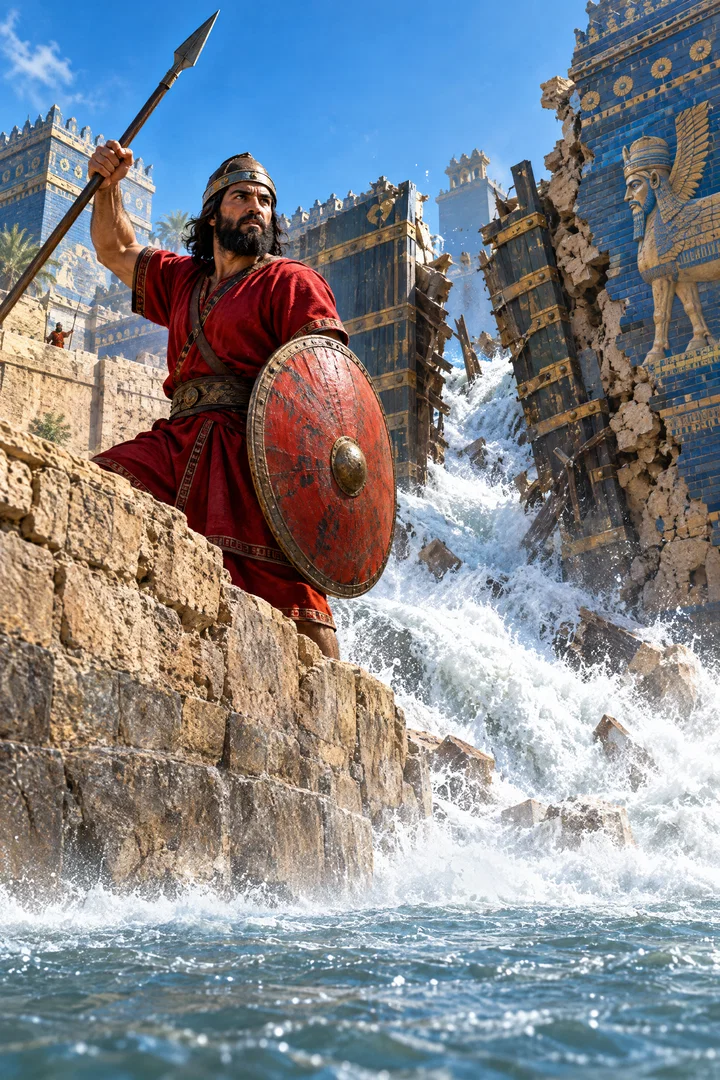
The gates of the rivers shall be opened, and the palace shall be dissolved.
Translations
American King James Version, King James Version, Webster Bible
The gates of the rivers shall be opened, and the palace shall be dissolved.
The gates of the rivers shall be opened,
And the palace shall be dissolved.Revised Version, American Standard Version, World English Bible
The gates of the rivers are opened, and the palace is dissolved.
Gates of the rivers have been opened, And the palace is dissolved.
The gates of the rivers are opened, and the palace melteth away.
The gates of the rivers, have been opened,—and, the palace, doth quake.
Berean Standard Bible, Majority Standard Bible
The river gates are thrown open
and the palace collapses.The river doorways are forced open, and the king's house is flowing away.
The gates of the riuers shalbe opened, and the palace shall melt.
Douay-Rheims (Challoner revision)
The gates of the rivers are opened, and the temple is thrown down to the ground.
Pictures
Cross-references
- Nahum 1:8
But with an overrunning flood he will make an utter end of the place thereof, and darkness shall pursue his enemies.
Both foretell Nineveh’s utter destruction.
- Jonah 3:4
And Jonah began to enter into the city a day’s journey, and he cried, and said, Yet forty days, and Nineveh shall be overthrown.
Jonah foretold Nineveh’s overthrow.
- Nahum 1:1
The burden of Nineveh. The book of the vision of Nahum the Elkoshite.
Both texts concern the prophecy against Nineveh.
- Jonah 1:2
Arise, go to Nineveh, that great city, and cry against it; for their wickedness is come up before me.
God sent Jonah to warn Nineveh of its wickedness.
- Nahum 3
Woe to the bloody city! it is all full of lies and robbery; the prey departeth not;
Both texts predict Nineveh’s fall.
Commentary
Each commentary is drawn from primary sources: the writings of Ellen G. White and Adventist pioneers and periodicals. Each commentary is separate. Its own words are not a quotation; follow the references to read the source passages.
Pioneers and periodicals
12 sources
The verse foretells the final destruction of Nineveh, the wicked capital of Assyria, when its river gates would be opened and its palace dissolved and swept away despite its pride, power, magnificence and strong fortifications after its people grew corrupt again without repentance.ST Aug 31, 1888ST Mar 27, 1884 Its people felt secure behind formidable walls because the city could not be taken until the river became its enemy, yet the river became the means of its downfall when the Medes and Babylonians overthrew it and its king perished in his burning palace, leaving its ruins as a visible object-lesson of fulfilled prophecy.ST Oct 11, 1905ST Oct 11, 1905ST Mar 27, 1884 Nineveh is a type of many later cities, and its fall to the combined superior power of Media, Egypt and Babylonia lifted Babylon under Nabopolassar from vassalage to ascendancy as the ruling power.ST Nov 28, 1911 The surrounding description of chariots raging in the streets, jostling in the broad ways, seeming like torches and running like lightnings is fulfilled in mighty railway engines rolling on tracks with great and lesser lights, shaking the earth and uniting lands, marking this age as the day of God's preparation with rapid locomotion calling for a people to be prepared for the coming of the Lord.RH Dec 3, 1861ST Jul 19, 1905ST Nov 12, 1894ST Oct 6, 1898 The opening of obstructions pictures barriers dissolved so modern transportation can move faster, even as those who hold the other view teach that the prophecy belongs to Nineveh's destruction and its details need not be read as railways.ST Aug 7, 1893
Nineveh's Destruction Foretold
The prophecy belongs to the latter days of Isaiah and is chiefly concerned with Nineveh, the wicked capital city of Assyria, which stands as a type of many later cities. It foretells Nineveh's final destruction, that the river gates would be opened and the palace would be dissolved and swept away.ST Aug 31, 1888ST Mar 27, 1884 Despite the city's pride, power, magnificence, and strong fortifications, it was overthrown after its people failed to repent following Nahum's warning, having again become corrupt with no recorded repentance.ST Aug 31, 1888ST Mar 27, 1884
Nineveh could not be captured until the river became its enemy.ST Mar 27, 1884 Its people therefore felt secure behind its formidable walls.ST Mar 27, 1884 But the river itself would become the means of its downfall.ST Mar 27, 1884 The dissolving of the palace was fulfilled when the Medes and Babylonians overthrew the city and its king immolated himself in the burning palace.
The fall came when Assyria was overcome by the combined and superior power of Media, Egypt, and Babylonia.ST Nov 28, 1911 Assyria yielded to those united powers as its former dependencies. Nineveh fell, leaving Babylon under Nabopolassar to rise from vassalage to ascendancy as the ruling power. The destruction stands fulfilled in the ruins of Nineveh, which remain as a visible object-lesson of fulfilled prophecy.ST Oct 11, 1905ST Oct 11, 1905
Modern Transportation Sign
Nahum 2:6 belongs to the description of chariots in Nahum 2:3-6, which is fulfilled in modern railway trains and stands as a sign that this age is the day of God's preparation.RH Dec 3, 1861ST Jul 19, 1905ST Nov 12, 1894ST Oct 6, 1898 The description concerns the war chariots in use in ancient times and at the same time pictures the construction and operation of the present railway train and the modern railway cars now seen in operation.ST Jul 19, 1905 The chariots with flashing lights and flaming torches that rage in the streets, race, jostle one against another in the broad ways, collide in the roads, seem like torches, and run like the lightnings are mighty engines rolling along tracks, with one great light and many lesser lights driving darkness from the track, shaking the earth beneath them, and uniting all lands.RH Dec 3, 1861ST Nov 12, 1894ST Oct 6, 1898 Their speed and appearance show that there will be means of rapid locomotion from place to place, marking this age as different from all ages before, raising the question of the end and destiny of all that is seen, and calling for a people to be prepared for the coming of the Lord as Noah and his family were prepared for the Flood when the ark was in preparation.RH Dec 3, 1861ST Jul 19, 1905ST Nov 12, 1894ST Oct 6, 1898
The verse supplies the image of obstructions being dissolved, applied to the removal of barriers so that modern transportation can move faster. It is an example of lightning, called the fire of God, being brought down from heaven, applied literally to the human ability to harness lightning and send it as a messenger across the land.RH May 19, 1851 In disagreement, those who held otherwise taught that the prophecy can be applied to the destruction of Nineveh, and that its details do not need to be interpreted as a prediction about railways or railroad cars.ST Aug 7, 1893
Sources