Leviticus 23:24
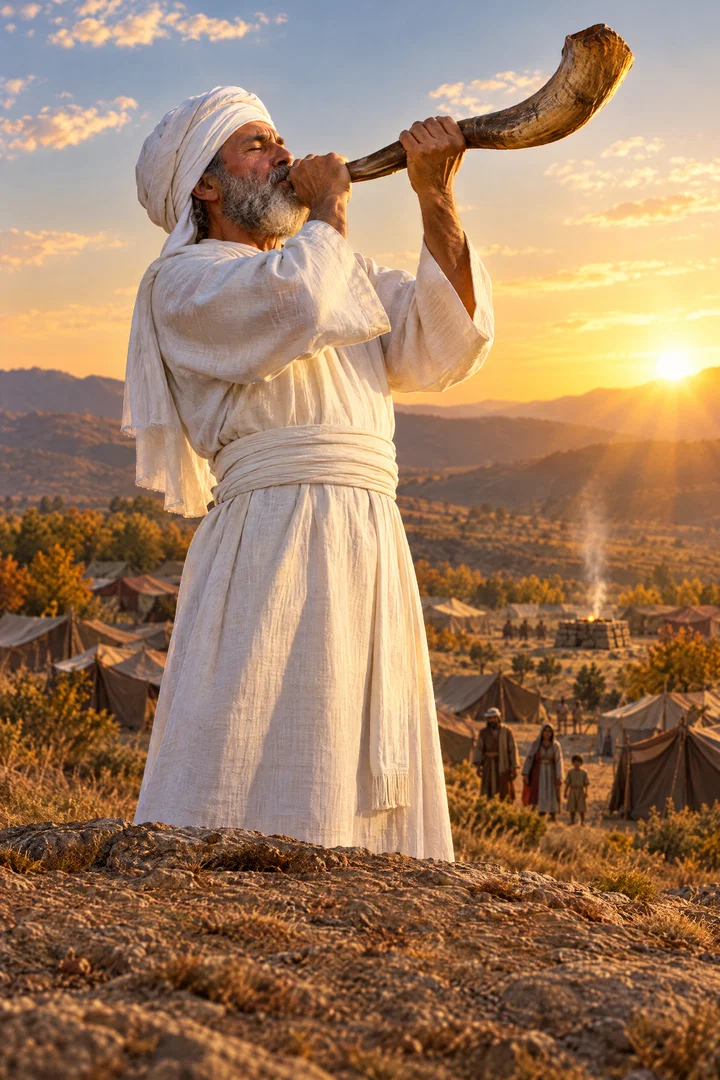
Speak unto the children of Israel, saying, In the seventh month, in the first day of the month, shall ye have a sabbath, a memorial of blowing of trumpets, an holy convocation.
Translations
Speak to the children of Israel, saying, In the seventh month, in the first day of the month, shall you have a sabbath, a memorial of blowing of trumpets, an holy convocation.
Speak unto the children of Israel, saying, In the seventh month, in the first day of the month, shall ye have a sabbath, a memorial of blowing of trumpets, an holy convocation.
Speak unto the children of Israel, saying, In the seventh month, in the first day of the month, shall ye have a sabbath, a memorial of blowing of trumpets, a holy convocation.
Speak to the children of Israel, saying, In the seventh month, in the first day of the month, shall ye have a sabbath, a memorial of blowing of trumpets, a holy convocation.
Speak unto the children of Israel, saying, In the seventh month, in the first day of the month, shall be a solemn rest unto you, a memorial of blowing of trumpets, an holy convocation.
Speak unto the children of Israel, saying, In the seventh month, on the first day of the month, shall be a solemn rest unto you, a memorial of blowing of trumpets, a holy convocation.
'Speak unto the sons of Israel, saying, In the seventh month, on the first of the month, ye have a sabbath, a memorial of shouting, a holy convocation;
Speak unto the children of Israel, saying, In the seventh month, on the first of the month, shall ye have a rest, a memorial of blowing of trumpets, a holy convocation.
Speak unto the sons of Israel, saying:—In the seventh month on the first of the month, shall there be unto you a sacred rest, a trumpet-blowing commemoration a holy convocation:
Berean Standard Bible, Majority Standard Bible
“ Speak to the Israelites and say, ‘ On the first day of the seventh month you are to have a day of rest, a sacred assembly announced by trumpet blasts.
“ Speak to the children of Israel, saying, ‘ In the seventh month, on the first day of the month, there shall be a solemn rest for you, a memorial of blowing of trumpets, a holy convocation.
Say to the children of Israel, In the seventh month, on the first day of the month, let there be a special day of rest for you, a day of memory, marked by the blowing of horns, a meeting for worship.
Speake vnto the children of Israel, and say, In the seuenth moneth, and in the first day of the moneth shall ye haue a Sabbath, for the remembrance of blowing the trumpets, an holy conuocation.
Douay-Rheims (Challoner revision)
Say to the children of Israel: The seventh month, on the first day of the month, you shall keep a sabbath, a memorial, with she sound of trumpets, and it shall be called holy.
Pictures
Cross-references 20 of 29
- Colossians 2:16-17
Let no man therefore judge you in meat, or in drink, or in respect of an holyday, or of the new moon, or of the sabbath days:
Calls the ceremonies shadows whose substance is connected with Christ.
- Leviticus 23:38
Beside the sabbaths of the LORD, and beside your gifts, and beside all your vows, and beside all your freewill offerings, which ye give unto the LORD.
Distinguishes the appointed feast observances from the Lord’s Sabbaths.
- Leviticus 23:39
Also in the fifteenth day of the seventh month, when ye have gathered in the fruit of the land, ye shall keep a feast unto the LORD seven days: on the first day shall be a sabbath, and on the eighth day shall be a sabbath.
The feast’s first and eighth days are listed as sabbaths.
- Leviticus 23:32
It shall be unto you a sabbath of rest, and ye shall afflict your souls: in the ninth day of the month at even, from even unto even, shall ye celebrate your sabbath.
Both identify an annual feast day as a Sabbath.
- Exodus 20:10
But the seventh day is the sabbath of the LORD thy God: in it thou shalt not do any work, thou, nor thy son, nor thy daughter, thy manservant, nor thy maidservant, nor thy cattle, nor thy stranger that is within thy gates:
Distinguishes the weekly Sabbath from the annual festival sabbaths.
- Hosea 2:11
I will also cause all her mirth to cease, her feast days, her new moons, and her sabbaths, and all her solemn feasts.
It foretells the cessation of Israel’s appointed feasts and ceremonial sabbaths.
- Leviticus 23:3
Six days shall work be done: but the seventh day is the sabbath of rest, an holy convocation; ye shall do no work therein: it is the sabbath of the LORD in all your dwellings.
Contrasts the weekly Sabbath with the appointed annual sabbaths.
- Numbers 29:1-6
And in the seventh month, on the first day of the month, ye shall have an holy convocation; ye shall do no servile work: it is a day of blowing the trumpets unto you.
Both identify the first day of the seventh month as a holy convocation and prescribe its offerings.
- Colossians 2:17
Which are a shadow of things to come; but the body is of Christ.
The yearly feast observance is a shadow of things to come, whose body is Christ.
- Nehemiah 8:2
And Ezra the priest brought the law before the congregation both of men and women, and all that could hear with understanding, upon the first day of the seventh month.
Describes observances in the seventh month.
- Leviticus 16:29-30
And this shall be a statute for ever unto you: that in the seventh month, on the tenth day of the month, ye shall afflict your souls, and do no work at all, whether it be one of your own country, or a stranger that sojourneth among you:
The trumpet day warned Israel that the Day of Atonement was near.
- Ezra 3:1-6
And when the seventh month was come, and the children of Israel were in the cities, the people gathered themselves together as one man to Jerusalem.
Records Israel observing the appointed festivals in the seventh month.
- Isaiah 66:23
And it shall come to pass, that from one new moon to another, and from one sabbath to another, shall all flesh come to worship before me, saith the LORD.
Sabbath observance continues in the future state.
- Leviticus 23:4
These are the feasts of the LORD, even holy convocations, which ye shall proclaim in their seasons.
Introduces the Lord’s appointed feasts and holy convocations listed in the chapter.
- Leviticus 25:9
Then shalt thou cause the trumpet of the jubile to sound on the tenth day of the seventh month, in the day of atonement shall ye make the trumpet sound throughout all your land.
The Jubilee trumpet sounds on the tenth day of the seventh month, linking it to the month’s feasts.
- Nehemiah 8:9-12
And Nehemiah, which is the Tirshatha, and Ezra the priest the scribe, and the Levites that taught the people, said unto all the people, This day is holy unto the LORD your God; mourn not, nor weep. For all the people wept, when they heard the words of the law.
Describes a recorded seventh-month observance.
- Leviticus 23:35-36
On the first day shall be an holy convocation: ye shall do no servile work therein.
Describes sacred feast days and their convocations.
- Psalms 81:3
Blow up the trumpet in the new moon, in the time appointed, on our solemn feast day.
Both associate trumpet blowing with the new moon and appointed feast.
- Leviticus 23:31
Ye shall do no manner of work: it shall be a statute for ever throughout your generations in all your dwellings.
The feast-day instructions forbid ordinary work.
- Leviticus 23:37
These are the feasts of the LORD, which ye shall proclaim to be holy convocations, to offer an offering made by fire unto the LORD, a burnt offering, and a meat offering, a sacrifice, and drink offerings, every thing upon his day:
Lists the Lord’s feasts and their prescribed offerings, including drink offerings.
Commentary
Each commentary is drawn from primary sources: the writings of Ellen G. White and Adventist pioneers and periodicals. Each commentary is separate. Its own words are not a quotation; follow the references to read the source passages.
Ellen G. White
1 source
The appointed time for the Feast of Trumpets is the first day of the seventh month.PK 661.1–2 For that day are prescribed a Sabbath rest, a memorial marked by the blowing of trumpets, and a holy gathering.PK 661.1–2 The gathering of the people at Jerusalem in Ezra's time was held at this feast.PK 661.1–2
Sources
Pioneers and periodicals
98 sources
The verse appoints the first day of the seventh month as a sabbath rest, a memorial marked by blowing trumpets, and a holy convocation for worship and offerings on which servile work was forbidden.ST Jun 4, 1902RH Jan 22, 1914ST Apr 1, 1875RH Jan 14, 1862ST Dec 26, 1892 It is an annual feast-day sabbath beside and distinct from the weekly seventh-day Sabbath of the Lord, using the same word for sabbath yet belonging to the appointed feasts and new moons rather than to the fourth commandment.ST Oct 2, 1884RH Aug 24, 1905RH Nov 17, 1868ST Jul 17, 1879RH Dec 29, 1859 Unlike the weekly Sabbath instituted at creation as universal moral law, it was a ceremonial institution for Israel arising because of sin, pointing forward to Christ and his sacrificial work.ST Oct 2, 1884ST Sep 21, 1876STRH Jul 8, 1852RH Nov 7, 1854 As a type and shadow it was fulfilled in Christ and ceased, nailed to the cross with the handwriting of ordinances, so it is among the plural sabbaths and holy days of Colossians 2:16-17 in which no one is to judge.ST Oct 2, 1884ST Sep 21, 1876ST Jun 17, 1903RH Dec 29, 1859 Its trumpet blast warns that the Day of Atonement and judgment is near, typifying the worldwide proclamation of the judgment hour before 1844 that prepared the way for Christ's cleansing of the heavenly sanctuary.RH Nov 7, 1912ST Jan 24, 1900RH Aug 10, 1916RH Jan 27, 1916
Words and Calendar Setting
The first day of the seventh month is appointed as a sabbath, a memorial of blowing of trumpets, and a holy convocation.ST Jun 4, 1902RH Jan 22, 1914RH Jan 14, 1862ST Aug 17, 1915RH Jan 22, 1914 It was a yearly feast Sabbath, the first day of the feast concerned and not the first day of the week, set apart from common days and kept beside the weekly Sabbaths of the Lord.ST Jun 4, 1902ST Aug 17, 1915RH Jan 22, 1914ST Sep 9, 1913 Servile work was forbidden on it, the people assembled together, and offerings by fire were brought to the Lord as special offerings of the day.RH Jan 22, 1914RH Jan 14, 1862ST Aug 17, 1915RH Jan 22, 1914ST Sep 9, 1913 Trumpets and horns were blown in Jerusalem from morning to evening to mark the memorial.ST Jun 4, 1902RH Jan 22, 1914RH Jan 14, 1862 It belongs not to the moral law but to the ceremonial law of Moses governing feast days and offerings, and like the other feast sabbaths it shadowed forth Christ and ceased with the sacrificial system.ST Aug 17, 1915RH Jan 22, 1914ST Sep 9, 1913
The day coincided with the new moon of that month.RH Jan 14, 1862 It began the old civil year as New Year, Rosh Hashanah kept on Tisri 1 with a second day on Tisri 2.RH Feb 19, 1914RH Jan 22, 1914ST Sep 9, 1880RH Dec 5, 1871ST Feb 10, 1914 It is described as the anniversary of creation, and the seventh month was the civil New Year because Nisan, the first month, marked independence from Egyptian slavery and the Passover.ST Sep 9, 1880 It began ten penitential days continuing until after the Day of Atonement on Tisri 10, the Sabbath between that day and the tenth being known as the Sabbath between.ST Sep 9, 1880ST Oct 2, 1879RH Dec 5, 1871ST Feb 10, 1914 On that New Year day the fate of the world is written but is not sealed until the Day of Atonement ten days after, to afford that time for repentance.ST Oct 2, 1879 That sealing on the Day of Atonement is fitting because the High Priest's work on that day was for judgment, when the sins of God's people were blotted out from before God and transferred to the scapegoat by which they were borne to a land not inhabited.ST Oct 2, 1879
A holy convocation means the people were called together for worship, prayer, hearing the law read and explained, and bringing offerings, and the day is sanctified by resting from ordinary labor.ST Apr 1, 1875RH Oct 2, 1913 The blowing of trumpets on the first day called all the people together.ST Dec 26, 1892 That calling together prepared the people for building the altar, as in the seventh month of the first year of Cyrus when the Jews left Babylon for Jerusalem, and the gathering on the first day of the seventh month in Nehemiah 8 took place at that appointed feast time when Israel assembled in Jerusalem to hear the law read and explained.ST Dec 26, 1892ST Feb 13, 1893 The day commences at evening, at the setting of the sun.ST Mar 8, 1883 At each of the three yearly gatherings, including the Feast of Tabernacles held around the middle of the month, the people offered products of the land and their labor, along with pledges or vows and freewill offerings.RH Oct 2, 1913
Its date is fixed by month and day rather than by weekday, so it naturally falls on different weekdays in different years and sometimes coincides with the weekly Sabbath without changing which day is the seventh day of the week.ST Jul 3, 1879ST Jul 17, 1879ST Jul 17, 1879 The chapter counts the day of the feast and not the day of the week, reckoning by dates in the month with nothing about reckoning the days of the week in the account.ST Jul 17, 1879RH Apr 19, 1870 The eighth day of the feasts is counted the same way, from fixed month dates, and to make that eighth day mean Sunday assumes that a feast day is a week day, which is unwarrantable, so any argument for Sunday-keeping built on that point falls to the ground.RH Apr 19, 1870 The stated date of the first day of the seventh month is also used to challenge a calendar reckoning that would place it on the third day of the month.ST Jul 17, 1879
It is the fourth annual sabbath and one of four to seven annual sabbaths in the chapter, with the count given as at least four, as four, and as seven.ST Jul 3, 1879RH Jan 14, 1862ST Dec 18, 1893RH Oct 21, 1851 It stands among three seventh-month gatherings, the Feast of Trumpets, the Day of Atonement on the tenth day, and the Feast of Tabernacles beginning on the fifteenth, with the others named on the tenth, the fifteenth, and the twenty-second day, so that certain days in the seventh month were holy though the whole month was not a sabbath, and that month is thereby especially sabbatical.ST Aug 10, 1882ST Dec 18, 1893ST Dec 26, 1892RH Oct 21, 1851ST Feb 10, 1914 These sabbaths were to be kept at their appointed times besides the Sabbaths of the Lord, falling at irregular intervals with only four days or as many as nine days between them rather than every seventh day.RH Oct 21, 1851 They belong in the midst of the ordinances of Moses with burnt-offerings, meat-offerings, sacrifices, and drink-offerings, given at Mount Sinai twenty-five hundred years after creation, and are called her sabbaths and your sabbaths to distinguish them from the Sabbaths of the Lord.RH Oct 21, 1851
It belongs to the yearly round of sanctuary service and its appointed times for beginning and ending feasts, which Deuteronomy 16 parallels somewhat.ST Jun 19, 1907ST Mar 18, 1913 That yearly round closes with the tenth day of the seventh month, the Day of Atonement, when the sanctuary was cleansed of the sins of God's people that had been transferred there by the daily ministration through the year, giving a final yearly riddance of sin from the people and the sanctuary.ST Jun 19, 1907 The annual sabbaths, new moons, and feasts required special priestly work in the holy place as part of the continual daily service in the first apartment.RH Feb 3, 1853RH Mar 8, 1870 That continual work in the holy place, the first great division of the earthly sanctuary ministration and the example and shadow of Christ's ministry in the true tabernacle, included the regular morning and evening burnt offering, the burning of sweet incense when the lamps were lighted morning and evening, and the offerings for individuals, distinct from the special and from-time-to-time services and from the once-a-year work of the high priest alone in the most holy place for the sins of the people and the cleansing of the sanctuary.RH Feb 3, 1853RH Mar 8, 1870 The verse belongs to the Leviticus 23 system of feast laws, including the law of the firstfruits of the barley harvest, which is used in an attempt to shape the months so that the weekly Sabbath fills them in turn and comes again on Abib 15 in the next sacred year, while the passage itself does not explain the trumpet memorial but places it within the yearly cycle of priestly service culminating in the Day of Atonement.ST Jul 3, 1879
Weekly Sabbath Distinguished
The day is an annual feast-day sabbath, separate from, beside and in addition to the weekly seventh-day Sabbath of the Lord.ST Oct 2, 1884RH Aug 24, 1905ST Sep 21, 1876ST Jul 29, 1875ST Dec 13, 1905 It belongs to the appointed feasts and new moons rather than to the fourth commandment, and it occurred once a year as a special appointed sabbath marked by a memorial of blowing of trumpets and a holy convocation.ST Oct 2, 1884RH Aug 24, 1905ST Sep 21, 1876ST Jul 29, 1875ST Dec 13, 1905 Scripture thereby recognizes more than one kind of sabbath, with the usual weekly Sabbaths also called the Sabbaths of the Lord.ST Oct 2, 1884RH Aug 24, 1905ST Jul 17, 1879 These appointed sabbaths in the seventh month were annual days fixed to dates in the month, distinct in nature from the Lord's weekly Sabbath, and they did not regularly fall on the weekly Sabbath though they sometimes coincided with it.ST Jul 17, 1879ST Sep 21, 1876ST Jul 29, 1875 As one of the plural ceremonial sabbath days in Leviticus 23, it was a type and shadow of things to come that corresponds to Paul's reference to sabbaths that were shadows and were taken out of the way at Christ's death when the body was reached.ST Oct 2, 1884ST Sep 21, 1876ST Dec 13, 1905
The same Hebrew word for sabbath is used here as in Exodus 20:8, a word that in nearly every other occurrence refers to the weekly Sabbath, showing the term can denote a yearly feast day and not only the seventh day.RH Nov 17, 1868RH Oct 21, 1851ST Dec 23, 1903 The yearly sabbaths connected with the Jewish feasts differed from the weekly Sabbath of the Lord in being local and ceremonial, plural sabbaths distinct from the singular Sabbath of the Lord of the fourth commandment.RH Dec 29, 1859RH Oct 21, 1851RH Feb 21, 1854 They are called your sabbaths and her sabbaths, bearing a human name, while the weekly Sabbath bears God's name as my holy day, thy holy Sabbath, and the Sabbath of the Lord.RH Dec 29, 1859RH Oct 21, 1851RH Oct 21, 1851 The first day of the seventh month is called a sabbath, not the Sabbath or the Sabbath of the Lord thy God, and together with the tenth day being called your sabbath this marks the festival sabbaths as man's, in contrast to God's.RH Dec 29, 1859RH Oct 21, 1851RH Oct 21, 1851 Their cessation was predicted in Hosea 2:11 and fulfilled in Colossians 2:14-16, so Paul's teaching about letting no one judge in meat or drink and sabbath-days has no reference to the fourth-commandment Sabbath.RH Dec 29, 1859RH Oct 21, 1851RH Feb 21, 1854
Unlike the weekly Sabbath instituted at creation before sin entered as God's own rest, memorial of creation, universal and perpetual, the trumpet memorial is a type and shadow of better things centering in Christ Jesus, one of the feast days and new moons and sabbath days whose body is Christ's.STRH Jul 8, 1852RH Nov 7, 1854RH Oct 21, 1851 It originated this side of the fall because of sin as a ceremonial, temporal institution for one nation, growing out of man's actions as a sinner and never existing but for sin after types and shadows were introduced, which marks it as shadowy and typical.STRH Jul 8, 1852ST Feb 25, 1875 It has no basis in God's act of creation, was never sanctified and hallowed as God's Sabbath was, was not God's own rest day, was not commanded by God's voice from heaven, and stands not in the midst of the nine moral precepts of the moral law but with the feasts and new moons of the handwriting of ordinances.ST Feb 25, 1875RH Oct 21, 1851RH Jul 22, 1852 It was not twice written by God's finger nor engraven on stone to show an enduring unchangeable nature, but was written by men on parchment to show it would soon pass away, belonging to the law written in a book and placed beside the ark rather than to the ten commandments written by God on stone, placed in the moral law and placed in the ark in the most holy place as the constitution of God's government.RH Jul 8, 1852RH Nov 7, 1854ST Feb 25, 1875 It was instituted for the Jews in the wilderness at Mount Sinai twenty-five hundred years after creation, in the midst of the ordinances of Moses with burnt-offerings, meat-offerings, sacrifices and drink-offerings, among at least four sabbaths beside the Sabbaths of the Lord, and Gentiles had to be circumcised to keep it while they can keep the Sabbath without circumcision, and it had to be kept by going up to Jerusalem while the Sabbath is kept wherever people are.RH Jul 8, 1852ST Feb 25, 1875RH Oct 21, 1851RH Jul 22, 1852
The chapter shows four annual Jewish sabbaths kept on the first day of the seventh month with the others on the tenth, the fifteenth and the twenty-second day, kept at their appointed times besides the Sabbaths of the Lord.RH Oct 21, 1851ST Jul 17, 1879ST Oct 7, 1930 They came once a year at irregular intervals with only four days or as many as nine days between them rather than every seventh day.RH Oct 21, 1851ST Jul 17, 1879 The annual days prohibited servile work while the weekly Sabbath prohibited all work, though like the other feast days it was not a day for ordinary secular work, and the tenth day of the seventh month was more sacred than the other annual Sabbaths.RH Oct 21, 1851ST Jul 17, 1879ST Oct 7, 1930 The Sabbath was the only weekly feast among the Jews, standing first and alone.RH Oct 21, 1851RH Feb 20, 1872
In opposing readings, the seventh-day Sabbath is classed with the feast days and holy convocations with the seventh-day Sabbath standing first among them, so that all those feasts together were abolished.RH Mar 8, 1864 In that reckoning the Sabbath days spoken of with the yearly sabbaths include the weekly Sabbaths as well as the yearly sabbaths, and being a type places the Sabbath in the category of positive rather than moral institutions, for moral institutions are not typical nor typical institutions moral, while pointing back to a past event does not prevent a memorial from also pointing forward as a type.RH Oct 29, 1872 By another opposing reckoning the Sabbath of the fourth commandment, written with the finger of God on stone and recorded in Deuteronomy 5, is explained as requiring observance to fall on fixed dates, which would change the weekday upon which it fell as many times as there were years in the period it was kept, so that while Christ kept the true Sabbath of the law no one now keeps it as Christ kept it.ST Apr 15, 1897 By yet another, God's appointment of annual sabbaths in addition to the weekly Sabbath proves that any day of the week might be a Sabbath if God chose to make it one.RH Apr 24, 1879
The annual sabbath's observance was attached to a temporary yearly festival rather than to an inherently holy weekday.ST Jan 9, 1879 Because the festival recurred yearly, it could fall on different days of the week, and those weekdays were not made holy by any blessing or sanctification.ST Jan 9, 1879 This annual rest was not based on God's original claim to the seventh day through creation, unlike the seventh-day Sabbath.ST Jan 9, 1879
Ceremonial Shadow Ended at Cross
The first day of the seventh month belongs to the ceremonial law of Moses and not to the moral law.ST Sep 21, 1876ST Dec 13, 1905RH Aug 31, 1905RH May 3, 1860 It is one of the annual sabbaths and set feasts kept with Passover, Pentecost and the other feasts of the year, a holy convocation marked by trumpet blowing on which no servile work was done.ST Dec 13, 1905ST It governs temple services, feast days, holy days, offerings, drink offerings and atonement, and stands among at least four annual sabbaths in the seventh month, distinct from the Sabbath of Jehovah, the regular weekly seventh-day Sabbath of Exodus 20:10.STRH May 3, 1860 It was written in the book of the law of Moses rather than in the law written on stone, and corresponds to Paul's reference to appointed feast days and new-moon observances.ST Oct 2, 1884ST Sep 21, 1876RH May 3, 1860
It came in consequence of sin and is of the nature of a type, shadow and prophecy pointing forward to Christ and to better things to come centering in Christ Jesus.ST Dec 13, 1905ST Jun 17, 1903STST Feb 7, 1911 Unlike the weekly Sabbath instituted at creation before sin entered, which points back as a memorial in constant succession and has nothing shadowy in it, this yearly sabbath could fall on any day of the week and pointed forward to His mediatorial and sacrificial work.ST Oct 2, 1884ST Jun 17, 1903ST Its accompanying offerings typified Christ's offering for sin, and like each and all of the feasts in the chapter it is typical and distinguished from the Sabbath of Jehovah.STST Feb 7, 1911 The Lord separates the two by the expression besides the Sabbaths of Jehovah.ST Jun 17, 1903
As a shadow it expired by limitation when the substance, Christ the body, was reached, met its fulfillment in Christ Jesus, and ceased when that law was abolished.ST Oct 2, 1884ST Jun 17, 1903RH Aug 31, 1905 It was taken out of the way at Christ's death, blotted out and nailed to the cross with the handwriting of ordinances, and as part of the Levitical typical service and sacrificial system it passed away when Christ died.ST Sep 21, 1876RH Aug 31, 1905ST Oct 31, 1900 These yearly sabbaths were local and ceremonial, called your sabbaths or her sabbaths and not the Sabbaths of the Lord, and their cessation was predicted in Hosea 2:11 and fulfilled in Colossians 2:14-16.RH Dec 29, 1859 It could also be judicially taken away like exclusion from the Lord's Supper.ST Oct 2, 1884ST Sep 21, 1876ST Jun 17, 1903RH Dec 29, 1859RH Aug 31, 1905
It is one of the plural sabbath-days, holy days, new moons, and meats and drinks of Colossians 2:16-17 and Romans 14, distinct from the Sabbath of the fourth commandment.ST Sep 21, 1876RH Nov 7, 1854ST Jun 5, 1884RH Feb 3, 1852RH May 6, 1852 The sabbath-days of Colossians 2:16 mean these ceremonial sabbaths connected with feasts, meats, drinks and new moons, and the holy day of that verse does not mean the weekly Sabbath either.RH Nov 7, 1854RH Feb 3, 1852RH May 6, 1852 Together with Leviticus 23:32 and Leviticus 23:39 these sabbaths are beside the Sabbath of the Lord named in Leviticus 23:38, belonging to the handwriting of ordinances that was against and contrary to men, while the Sabbath of the Lord belongs to the royal law that remains in force.RH Feb 3, 1852RH May 6, 1852 So no one is to judge in it, and its observance for justification or as a means of salvation is indifferent or a yoke of bondage, the days of Romans 14 being these typical shadows pointing forward that ceased at the cross while the weekly memorial pointing back remains part of the law.ST Sep 21, 1876RH Dec 29, 1859ST Jun 5, 1884
Prophetic Warning and Fulfillment
The appointed feasts together foreshadow the work of Christ as High Priest in the most holy place of the heavenly sanctuary, beginning on the tenth day of the seventh month in 1844 and continuing until the consummation.RH May 13, 1862ST Apr 23, 1912 The Passover lamb points to His death, firstfruits to His resurrection, Pentecost to the outpouring of the Spirit, the Day of Atonement to the heavenly cleansing and judgment, and Ingathering or Tabernacles, kept at the end of the year after harvest and following the Day of Atonement and sanctuary cleansing, to the final gathering of the righteous as the harvest in the home-coming in the New Jerusalem.ST May 27, 1908ST May 7, 1912ST Apr 23, 1912 No separate fulfillment is assigned to the trumpet blowing itself, which stands within the yearly cycle of priestly service culminating in the Day of Atonement.ST May 27, 1908 As pattern, shadow, type, and impressive object-lesson of the temple of God in heaven and Christ's priestly service therein, the earthly sanctuary and its service reveal God's way, power, glory, and dealings with men and give clearer views of the Saviour and His work in behalf of men.ST Jun 19, 1907 These feasts were celebrated annually when Israel lived faithfully before God, but they are not to be kept year by year until their complete antitypical fulfillment, since all the ceremonies of the Levitical law are fulfilled in Christ and His priestly work and their meaning is met in His ministry and in walking in newness of life.ST May 27, 1908
The spring types were fulfilled exactly as to time, the Passover lamb slain on the fourteenth day of the first month in Christ sacrificed as Passover, the sheaf of firstfruits waved on the sixteenth in Christ risen as firstfruits of them that slept, and the Feast of Weeks fifty days from firstfruits in the outpouring of the Holy Spirit on the very day of Pentecost.RH Oct 30, 1855RH Dec 15, 1868RH Mar 31, 1874 The honor God gave on that Pentecost day marked the antitype of that feast, not the weekday on which it fell, and the fifty days were counted from the annual Passover Sabbath rather than the weekly Sabbath so that Pentecost could fall on different weekdays.RH Nov 1850RH Mar 31, 1874 Mere preliminary and circumstantial burnt offerings on those days did not prevent the grand central event from meeting its antitype at the time pointed out in the type.RH Oct 30, 1855RH Dec 15, 1868 By the same principle the antitype of the tenth day of the seventh month must commence on that day in its appointed year, though it may then extend forward a great distance corresponding to its magnitude and importance, as believers still feed on Christ the Passover, still keep the feast of unleavened bread, and the Spirit that came on Pentecost still abides.RH Mar 31, 1868RH Oct 30, 1855RH Dec 15, 1868
The trumpet blast on the first day of the seventh month, a holy convocation and memorial marked by blowing trumpets long and loud, warned Israel that the Day of Atonement on the tenth day was near and gave opportunity to prepare hearts during solemn scrutiny.RH Nov 7, 1912RH Jan 27, 1916ST Jul 24, 1901ST Jul 24, 1901 That approaching day was the year's most solemn day, a typical hour of judgment and sanctuary cleansing when every case came in review before the mercy seat through the high priest's ministry in the most holy place, when the people confessed sins and made wrongs right, and when confessed sins would either be blotted from the sanctuary record or returned upon the guilty.RH Aug 10, 1916RH Jan 27, 1916RH Feb 2, 1911 The seventh-month calendar is therefore a solemn preparation for atonement, explaining the people's solemn regard and close scrutiny of their lives beforehand and warning anyone who had neglected necessary purification that only a short time remained.RH Aug 10, 1916ST Jul 24, 1901 Ten days before the cleansing there was to be this blowing, announcing the day of judgment as at hand so the people might prepare to meet its demands and be made free from sin.ST Jul 24, 1901ST Jul 24, 1901RH Feb 2, 1911
In fulfillment, about ten years before Christ began to cleanse the heavenly sanctuary in 1844, beginning in 1833 with Miller's preaching of the Advent doctrine and the falling of the stars, the judgment message of the first angel began to be made to the world with increasing power until 1844.RH Nov 7, 1912RH Jan 27, 1916ST Jul 24, 1901 That trumpet warning is the type of the worldwide announcement of the coming judgment-hour before 1844, when the opening of the antitypical Day of Atonement was proclaimed and the approaching judgment hour was prefigured as it drew near.RH Nov 7, 1912RH Jan 27, 1916ST Jun 22, 1915 The blowing ten days before atonement means the heavenly cleansing must have a like warning ten prophetic days, or ten literal years by the day-for-a-year principle, before it begins, which came on schedule with the falling of the stars over the Western Hemisphere on the night of November 13, 1833, ten years before the cleansing judgment begins.ST Jul 24, 1901ST Apr 28, 1914 The Advent movement of 1840-44 was the antitype of this trumpet day, announcing that in 1844 Christ would begin cleansing the heavenly sanctuary through judgment and atonement, and the memorial of blowing trumpets represents the worldwide proclamation of Christ's second coming symbolized in Revelation 14 by three angels proclaiming the everlasting gospel, fulfilled in its proper order without repeating the old ceremonial observance, a call due even though its heralds did not fully understand what would follow.RH Nov 7, 1912ST Jan 24, 1900ST Jun 22, 1915
The autumn festivals are types pointing to events connected with the second advent, when the High Priest comes out of the sanctuary to bless His waiting people with immortality and gather the harvest.ST May 7, 1912RH Mar 31, 1868RH Aug 27, 1857 Their antitypical fulfillment was thought possibly to have chronological significance, so the seventh-month observances with their several religious festivals made the seventh month a subject for prayerful consideration, but they were not conclusive evidence that the Advent would occur at that time of year.RH Aug 27, 1857 The seventh-month Sabbath contributes with the seventh day, the fiftieth day, the seventh week, the seventh year, the Jubilee, and the great Jubilee to a calculation of the Jubilee of Jubilees.RH Mar 31, 1868RH Aug 27, 1857
Other Scriptures and Sunday Claims
The gathering on the first day of the seventh month to hear the law read and explained in Nehemiah 8 took place at this appointed feast time.ST Feb 13, 1893 Its trumpet blowing called all the people together, and that calling together prepared them for building the altar in the seventh month of the first year of Cyrus when the Jews left Babylon for Jerusalem.ST Dec 26, 1892 This festival is one of the seventh-month festivals whose observance is recorded, coming ten days before the Day of Atonement and closely connected with it.RH Oct 31, 1854 The observance of these festivals is recorded repeatedly and particularly, in contrast to silence about observances of the Day of Atonement and the Jubilee, and that silence does not prove those appointed days were not observed.RH Oct 31, 1854RH Dec 10, 1861
The chapter counts the day of the feast by month and day and not by day of the week, with nothing about reckoning days of the week in the account.RH Apr 19, 1870ST Jul 17, 1879 To make the eighth day spoken of in the same chapter mean Sunday assumes a feast day is a week day, which is unwarrantable, and any argument for Sunday-keeping built on that central point falls to the ground.RH Apr 19, 1870 The fifty days to Pentecost were counted from the annual Passover Sabbath, not from the weekly Sabbath, so Pentecost could fall on different days of the week.RH Nov 1850 The descent of the Spirit then fulfilled the promise of baptism with the Holy Ghost and does not connect that event to a special weekly honor for any day.RH Nov 1850 Israel had seven annual sabbaths besides the Lord's seventh-day Sabbaths, so one of these annual sabbaths could have fallen between the Sabbath of the Antioch meeting and the next seventh-day Sabbath, and the first day of the seventh month as an annual sabbath could fall on a different weekday from the weekly Sabbath.ST Jul 17, 1879RH Dec 5, 1871 Israel held holy convocations on days other than the weekly Sabbath, abstaining from servile work, as on the first day of the seventh month marked by blowing of trumpets, so an all-day religious gathering on a weekday did not cancel the command to work six days and rest on the seventh.RH Mar 18, 1862RH Dec 17, 1857
Positive institutions as a rule are commemorative and fall most appropriately on memorable days when they can be permanently located.RH Jun 24, 1873 The time of instituting an institution has nothing to do with the time of observing it, for otherwise all the commemorative institutions would have fallen on different days than appointed and nearly all on the same day.RH Jun 17, 1873 The Jewish feasts were given a specific statement of the time of their instituting and of their observance, with the memorial of blowing of trumpets fixed to the first day of the seventh month, unlike the Lord's supper for which no such stated time exists.RH Jun 17, 1873 When sacred occasions are listed, the Hebrew may use or omit the definite article by the writer's option, so absence of the does not prove an institution such as the Sabbath is indefinite.RH Nov 12, 1872 The ceremonial instructions show God required careful obedience even in small details, as in the requirement for an unblemished offering in the context of Leviticus 23:18-24.RH Oct 11, 1864
The chapter lists both the seventh-day Sabbath and feast days, and Leviticus 23:37-38 distinguishes the feasts from the Lord's Sabbaths.RH Mar 8, 1864 It gives the times when the feasts begin and end throughout the sacred year, distinguishing these annual sabbaths from the Sabbath of Jehovah. It describes the appointed Jewish feast days, showing the word Sabbaths in Colossians 2:16 could include Jewish feast days.RH Nov 8, 1853 Its instruction regarding the yearly feasts is paralleled somewhat by Deuteronomy 16.ST Mar 18, 1913
Study Value and Practice
Study of the yearly round of sanctuary service closing with the tenth day of the seventh month gives a final yearly riddance of sin from the people and the sanctuary, when it was cleansed of sins transferred there by daily ministration through the year.ST Jun 19, 1907 The trumpet day belongs to the main features of that service and to the special priestly work in the holy place as part of the continual daily service in the first apartment, distinct from the once-a-year work in the most holy place for the sins of the people and the cleansing of the sanctuary.ST Jun 19, 1907RH Feb 3, 1853RH Mar 8, 1870 That continual work included the regular morning and evening burnt offering, the burning of sweet incense when the lamps were lighted morning and evening, and the offerings for individuals, while the trumpet service is distinguished as one performed from time to time rather than as the daily morning and evening offering upon the altar.RH Mar 8, 1870ST Jan 21, 1886 As part of the earthly sanctuary and its service it is a pattern, shadow and type and impressive object-lesson concerning the temple of God in heaven and Christ's priestly service therein as High Priest and Minister of the true tabernacle, and is given for doctrine, reproof, correction, instruction in righteousness, and for learning, patience, comfort and hope, so that studying it reveals God's way, power and glory and His dealings with men and gives clearer views of the Saviour and His work in behalf of men.ST Jun 19, 1907RH Mar 8, 1870
At each of the three yearly gatherings the people offered products of the land and their labor, along with pledges or vows and freewill offerings, and the seventh-month gathering is connected with the Feast of Tabernacles held around the middle of the month.RH Oct 2, 1913 These special laws governing sabbaths and worship gatherings were binding on Israel as a nation and church, not on later people as laws, though their underlying principles of support and worship remain binding.RH Oct 2, 1913RH Nov 12, 1908
The yearly system of religious services marked by prescribed forms and order was instituted to draw Israel nearer to God and help make them a great people and a praise throughout the earth, and departure from even a small particular in that system was blameworthy.ST Mar 24, 1887 The ceremonial instructions require careful obedience even in small details, such as the requirement for an unblemished offering.RH Oct 11, 1864 During the several feasts appointed for Israel the people were not allowed to labor, and these appointed rests show that God did not intend people to labor so much that they injure their health.RH Aug 21, 1860
The trumpet memorial on the first day of the seventh month is one of the ceremonial sabbaths associated with feast-days, new moons and solemn feasts, drawing its only force from the law of ceremonies regulating sacrifices and offerings, a shadow of things to come, so that when that sacrificial law was nailed to the cross it was abolished and shall cease.ST Dec 2, 1913 These annual observances, unlike the Lord's weekly rest day, were not pleasing to God when observed amid the people's sins.RH Apr 28, 1874 The seventh-day Sabbath made for man before sin and embodied in the fourth commandment remains in full force and continues in the new earth.ST Dec 2, 1913
Sources