Numbers 15:40
That ye may remember, and do all my commandments, and be holy unto your God.
Translations
That you may remember, and do all my commandments, and be holy to your God.
That ye may remember, and do all my commandments, and be holy unto your God.
that ye may remember, and do all my commandments, and be holy unto your God.
That ye may remember, and do all my commandments, and be holy to your God.
Revised Version, American Standard Version, Darby Translation
that ye may remember and do all my commandments, and be holy unto your God.
so that ye remember and have done all My commands, and ye have been holy to your God;
to the intent ye may call to mind, and do all my commandments, and be holy unto your God.
Berean Standard Bible, Majority Standard Bible
Then you will remember and obey all My commandments, and you will be holy to your God.
so that you may remember and do all my commandments, and be holy to your God.
And that you may keep in mind all my orders and do them and be holy to your God.
That yee may remember and doe all my commandements, and bee holy vnto your God.
Douay-Rheims (Challoner revision)
But rather being mindful of the precepts of the Lord, may do them and be holy to their God.
Pictures
Cross-references
- Deuteronomy 22:12
Thou shalt make thee fringes upon the four quarters of thy vesture, wherewith thou coverest thyself.
Commands fringes on the garment’s four corners.
- Romans 12:1
I beseech you therefore, brethren, by the mercies of God, that ye present your bodies a living sacrifice, holy, acceptable unto God, which is your reasonable service.
Holy conduct includes offering oneself to God and following his will.
- Exodus 19:5-6
Now therefore, if ye will obey my voice indeed, and keep my covenant, then ye shall be a peculiar treasure unto me above all people: for all the earth is mine:
Obeying God’s covenant commands makes his people a holy nation.
- 2 Corinthians 7:1
Having therefore these promises, dearly beloved, let us cleanse ourselves from all filthiness of the flesh and spirit, perfecting holiness in the fear of God.
Calls believers to cleanse themselves and perfect holiness.
- Isaiah 52:11
Depart ye, depart ye, go ye out from thence, touch no unclean thing; go ye out of the midst of her; be ye clean, that bear the vessels of the LORD.
Both command God’s people to be clean.
- Romans 7:7
What shall we say then? Is the law sin? God forbid. Nay, I had not known sin, but by the law: for I had not known lust, except the law had said, Thou shalt not covet.
Both affirm God’s law as a continuing standard.
- Deuteronomy 6:4-5
Hear, O Israel: The LORD our God is one LORD:
Both call Israel to keep God’s commandments and remain devoted to him.
- Numbers 15:24-28
Then it shall be, if ought be committed by ignorance without the knowledge of the congregation, that all the congregation shall offer one young bullock for a burnt offering, for a sweet savour unto the LORD, with his meat offering, and his drink offering, according to the manner, and one kid of the goats for a sin offering.
Prescribes offerings and atonement for unintentional sin, followed by forgiveness.
- 1 John 2:15-16
Love not the world, neither the things that are in the world. If any man love the world, the love of the Father is not in him.
Holy conduct rejects love of the world and its desires.
Commentary
Each commentary is drawn from primary sources: the writings of Ellen G. White and Adventist pioneers and periodicals. Each commentary is separate. Its own words are not a quotation; follow the references to read the source passages.
Ellen G. White
5 sources
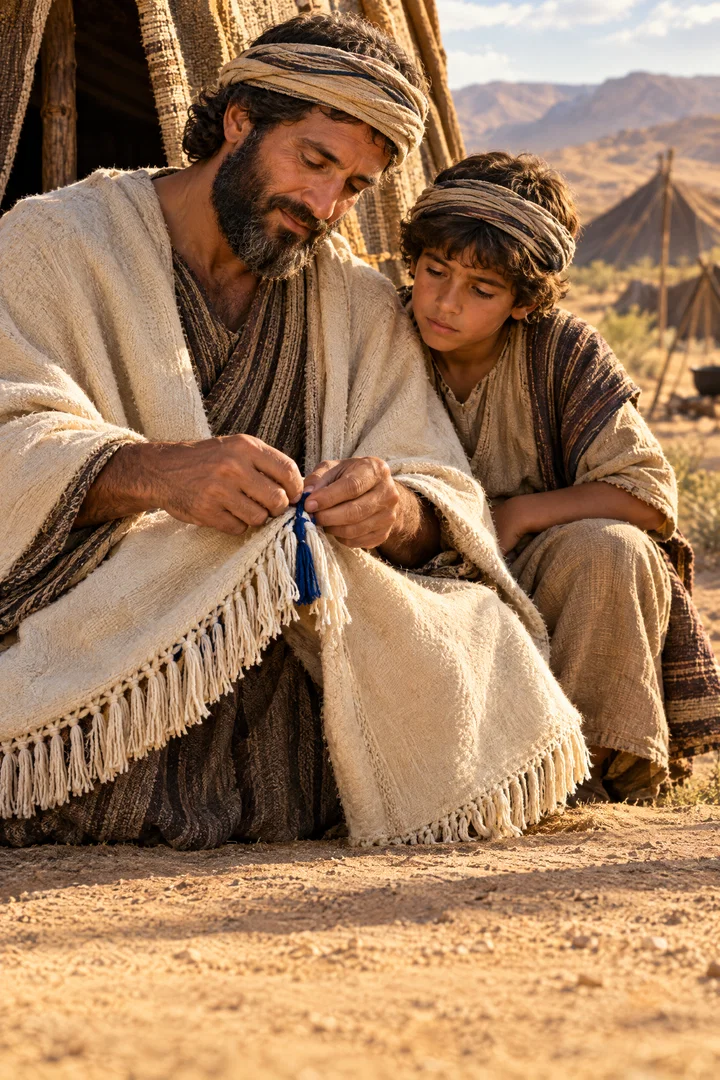
The verse commands a simple, distinctive dress for Israel, a fringe in the borders of the garments with a ribbon of blue upon it, given as a definite requirement to be worn in obedience unto holiness.1T 524.1–2TBC1872 60.1TBC1872 64.2–65.2 By looking upon that mark they were to remember and do all His commandments and be holy unto Him.1T 524.1–2TBC1872 60.1RH Jan 23, 19003T 170.3–171.1 The fringe was to remind them that they were His commandment-keeping people, keepers of the law of ten commandments.1T 524.1–2
It signified that they were God's peculiar people and treasure, whom He had brought by miracle out of Egyptian bondage to serve Him as a holy people.1T 524.1–2RH Jan 23, 1900 It distinguished them as a people who acknowledged the Creator as their God and obeyed His ordinances and commandments, brought out of Egypt to keep His law.1T 524.1–2TBC1872 60.1RH Jan 23, 1900 All who saw them were to recognize them as brought out to keep God's law and to serve Him as a holy people.1T 524.1–2
It meant they were not to seek after their own hearts and eyes or serve their own unsanctified desires.1T 524.1–2TBC1872 60.1 They were not to imitate or mingle with the idolatrous nations around them in idolatry, drunken feasts, and eating swine's flesh and luxurious food hurtful to health, but to remain a distinct, separate people.1T 524.1–2 Though He is the Maker of heaven and earth, God condescended to the particulars of dress, specifying the style Israel should wear to preserve their peculiarity from other nations.TBC1872 60.1
The ribbon itself had no direct power over health except as God blessed obedience, but by keeping His high claims in memory it kept them separate.1T 524.1–2 The literal special mark on garments is not now required, but the same command and principle still applies, with ancient Israel standing as an example.1T 524.1–2RH Jan 23, 1900 God still takes notice of the dress of His people in this age.RH Jan 23, 1900
His people now are to come out from the world, forsake idolatrous practices and conformity to the world, and refuse to follow their own hearts and eyes.1T 524.1–2 They are to adopt a simple, modest, convenient, healthful reform dress that serves the same purpose as the ribbon of blue did then, as a visible mark of obedience and separation from the world.1T 524.1–2TBC1872 60.13T 170.3–171.1 That dress distinguishes them as His peculiar people and treasure, distinct from the world.1T 524.1–2TBC1872 60.1RH Jan 23, 19003T 170.3–171.1
Even in dress they are to seek to glorify God, and by simple style be examples that rebuke the pride, vanity, and extravagance of worldly pleasure-loving professors, which God requires and rebukes in His word.RH Jan 23, 1900 Reform in dress is essential to physical and mental health, which is an added reason for it now.1T 524.1–2 That reform dress brings a cross that tests pride and love for sacred truth that separates from the world.3T 170.3–171.1
Those who are proud and have no love for that separating truth show it by indifference or contempt toward it, while faithful practice shows remembrance and doing of the commandments.3T 170.3–171.1 No excuse of want of time, extra work, easy soiling, inconvenience, mortified pride, fashion, or convenience justified refusing the ancient requirement, when Israel could have pleaded more valid excuses yet remained bound to obey.TBC1872 64.2–65.2 Trivial objections likewise vanish before duty now, requiring the reform dress and a right influence for young girls.TBC1872 64.2–65.2
Sources
Pioneers and periodicals
11 sources
The fringes with a ribbon of blue in the border of the garment were commanded to remind Israel to remember and do all of God's commandments and be holy to Him, and the garment was treated as a sacred reminder of that duty.ST Jul 1, 1897ST Jul 1, 1897ST Jul 1, 1897 The command was given after God brought Israel out of Egypt to distinguish them from the nations around them and to signify that they were God's peculiar people.RH Jan 23, 1900 The ribbon of blue was their present truth, a light to keep and guide them in the way to Heaven and to keep them a distinct people who remember and do all His commandments and are holy to Him.RH Jan 14, 1873
Remembering God's commandments is meant to lead to obeying all of them and being holy to God, so that holiness includes remembering and obeying all His commandments.ST Jul 1, 1897RH Aug 19, 1852 The garment itself could not give holiness or righteousness; these come only through the Messiah, whose righteousness enables holiness and obedience.ST Jul 1, 1897 Wearing the fringed garment establishes the Creator's command and expresses hope that the soul will be clothed with beauty in the world to come, in the Garden of Eden, and that deliverance will come to body, soul, and spirit.ST Jul 1, 1897
The verse stands in a chapter giving various laws and recounting a man's deliberate, open, defiant violation of the fourth commandment by gathering sticks on the Sabbath in defiance, a special and flagrant case of presumptuous sin punished by stoning.ST Feb 1, 1905 That Sabbath law in Numbers 15 was a temporary police or sanitary regulation adapted to that people, that time, and their wilderness environment, easily distinguishable from the Decalogue, the eternal constitution of God's government epitomized in the Ten Commandments, yet the chapter shows that keeping a definite Sabbath was possible during Israel's forty years in the wilderness.ST Nov 3, 1881ST Feb 1, 1905 Alongside the verse's call to remember, obey, and be holy, Numbers 15 teaches that a person could sin without knowing it, but once the sin became known the person was still guilty and had to make the required offering to be forgiven, so ignorance does not remove sin or the need for atonement.ST Apr 26, 1883
Together with offerings and sacrifices to keep Israel near to God and a healthful diet that made them strong to endure hardship without complaint, heeding this light brought prosperity, while disobeying the precepts of Jehovah brought disaster and defeat.RH Jan 14, 1873 The verse belongs to the cleansing work given to ancient Israel — remembering God's commandments, obeying them, and being holy to God — cited as an example of cleansing truth; Christians are warned not to fall away from such truths but to walk in the light of health reform and other cleansing teachings as preparation to receive the latter rain.RH Nov 3, 1868 Holiness under the verse includes outward acts conforming to God's commands and the testimony of Jesus Christ.RH Aug 19, 1852
The special mark on garments is not now required, but the same principle still applies because ancient Israel stands as an example.RH Jan 23, 1900 God still takes notice of the dress of His people in this age, and as His peculiar treasure they must be distinct from the world and seek even in dress to glorify God.RH Jan 23, 1900 By simple style they are to be examples that rebuke the pride, vanity, and extravagance of worldly pleasure-loving professors, for God requires this and rebukes pride in His word.RH Jan 23, 1900
Sources