Philemon 1:14
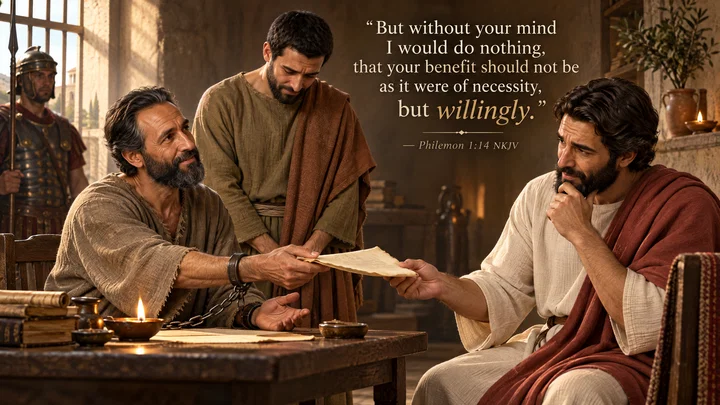
But without thy mind would I do nothing; that thy benefit should not be as it were of necessity, but willingly.
Translations
But without your mind would I do nothing; that your benefit should not be as it were of necessity, but willingly.
But without thy mind would I do nothing; that thy benefit should not be as it were of necessity, but willingly.
but without thy mind would I do nothing; that thy benefit should not be as it were of necessity, but willingly.
But without thy mind I would do nothing; that thy benefit should not be as it were of necessity, but willingly.
Revised Version, American Standard Version
but without thy mind I would do nothing; that thy goodness should not be as of necessity, but of free will.
and apart from thy mind I willed to do nothing, that as of necessity thy good deed may not be, but of willingness,
but I have wished to do nothing without thy mind, that thy good might not be as of necessity but of willingness:
But, apart from thy mind, I wished to do, nothing, that, not as by necessity, thy goodness should be, but, by choice.
Berean Standard Bible, Majority Standard Bible
But I did not want to do anything without your consent, so that your goodness will not be out of compulsion, but by your own free will.
But I was willing to do nothing without your consent, that your goodness would not be as of necessity, but of free will.
But without your approval I would do nothing; so that your good works might not be forced, but done freely from your heart.
But without thy minde woulde I doe nothing, that thy benefite should not be as it were of necessitie, but willingly.
Douay-Rheims (Challoner revision)
But without thy counsel I would do nothing: that thy good deed might not be as it were of necessity, but voluntary.
Pictures
Cross-references
- Colossians 4:9
With Onesimus, a faithful and beloved brother, who is one of you. They shall make known unto you all things which are done here.
Onesimus is identified as Paul’s messenger to the Colossians.
Commentary
Each commentary is drawn from primary sources: the writings of Ellen G. White and Adventist pioneers and periodicals. Each commentary is separate. Its own words are not a quotation; follow the references to read the source passages.
Ellen G. White
6 sources
The verse belongs to Paul's time as a prisoner on the way to Rome, after voyaging on the Castor and Pollux, landing at Puteoli, remaining seven days with the Christians there, and being met on the road to Rome by Italian believers who had received his letter to the Romans and loved him more because of his sufferings and chains.AA 447.2 It stands in a letter that addresses the relationship of master and servant under the gospel within the Roman slave system, in which slaves were often subjected to severe and arbitrary cruelty.RH Dec 14, 1911 By this time Onesimus had become pious, sincere, tender in caring for Paul's comfort, and zealous for the gospel, and was fitted to be useful in missionary labor.AA 456.1–2
Paul desired to keep Onesimus with him in Rome to minister to him in his imprisonment in Philemon's place and as a helper in missionary work, but he would not do so without Philemon's mind and consent.AA 457.2–3AA 456.1–2SLP 286.1–2RH Dec 14, 1911 He left the matter to Philemon to set him free of his own accord, so that Philemon's benefit and good deed and any service by Onesimus would be willing and freely granted rather than of necessity, forced, or under compulsion.AA 457.2–3SLP 286.1–2RH Dec 14, 1911 He therefore counseled Onesimus to return without delay to Philemon at Colosse, ask forgiveness, and plan for the future, promising to hold himself responsible for the sum taken from Philemon, and sent him with Tychicus, who was carrying letters to the churches in Asia Minor.AA 456.1–2
In returning and giving himself up to the master he had wronged instead of turning aside from duty, Onesimus met a severe test that proved his conversion was genuine.AA 456.1–2
Sources
Pioneers and periodicals
9 sources
The letter belongs to the Roman slave system, and shows the gospel shaping the relationship between master and servant at a time when slavery under Roman despotism had reached severe and arbitrary cruelty and the very depths of degradation.RH Dec 14, 1911ST Mar 4, 1913 Paul would not keep Onesimus with him to serve him, decide for Philemon, accept his benefit, or otherwise act in a matter personally affecting him without Philemon's consent.RH Dec 14, 1911ST Jan 9, 1907RH Apr 28, 1863ST Oct 27, 1909 He wanted any kindness, service, benefit, and help to Onesimus to be given freely and willingly and voluntarily, not as if by necessity or under compulsion or as an imposed obligation.ST Nov 28, 1911RH Apr 28, 1863ST Oct 27, 1909ST Feb 2, 1915
He respected Philemon's choice to set Onesimus free of his own accord rather than compelling it.RH Dec 14, 1911 The appeal on behalf of Onesimus reflects the delicacy, generosity, and justice of the letter. Onesimus's return to his master did not mean that becoming Christians erased their worldly social relationship, for both master and servant were Christians and equally precious in God's sight.ST Feb 2, 1915 His service to Paul shows that a captive could be brought to know the true God and become spiritually free even while remaining physically enslaved.RH Jul 9, 1914
Paul's advising a runaway slave to return to his master proves that Jesus was not a reformer in the usual and ordinary sense, and that His followers were not engaged in repealing bad laws or in providing criminal punishments for violators of good ones.ST Mar 4, 1913 Even Paul's refusal to act without consent is a rule for business dealings and for relations among fellow believers, helping prevent trouble and misunderstanding.ST Jan 9, 1907
Sources