Philemon 1:13
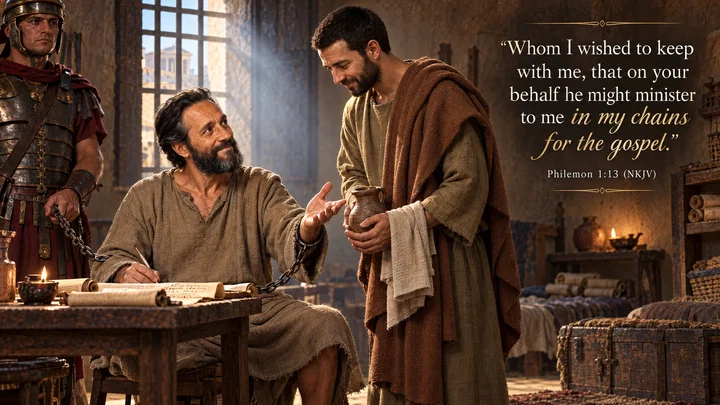
Whom I would have retained with me, that in thy stead he might have ministered unto me in the bonds of the gospel:
Translations
Whom I would have retained with me, that in your stead he might have ministered to me in the bonds of the gospel:
Whom I would have retained with me, that in thy stead he might have ministered unto me in the bonds of the gospel:
whom I would have retained with me, that in thy stead he might have ministered unto me in the bonds of the gospel:
Whom I would have retained with me, that in thy stead he might have ministered to me in the bonds of the gospel:
Revised Version, American Standard Version
whom I would fain have kept with me, that in thy behalf he might minister unto me in the bonds of the gospel:
whom I did wish to retain to myself, that in thy behalf he might minister to me in the bonds of the good news,
whom I was desirous of keeping with myself, that for thee he might minister to me in the bonds of the glad tidings;
Whom, I, was minded, with myself, to detain, that, in thy behalf, unto me, he might be ministering in the bonds of the joyful message;
Berean Standard Bible, Majority Standard Bible
I would have liked to keep him with me, so that on your behalf he could minister to me in my chains for the gospel.
whom I desired to keep with me, that on your behalf he might serve me in my chains for the Good News.
Though my desire was to keep him with me, to be my servant in the chains of the good news, in your place:
Whom I woulde haue reteined with mee, that in thy steade he might haue ministred vnto me in the bondes of the Gospel.
Douay-Rheims (Challoner revision)
Whom I would have retained with me, that in thy stead he might have ministered to me in the bands of the gospel:
Pictures

Cross-references
- Colossians 4:7-9
All my state shall Tychicus declare unto you, who is a beloved brother, and a faithful minister and fellowservant in the Lord:
Onesimus sent back with Tychicus to Asia Minor.
- Philemon 1:18-19
If he hath wronged thee, or oweth thee ought, put that on mine account;
Paul offers to answer for Onesimus’s debt and promises to repay it.
- Galatians 3:28
There is neither Jew nor Greek, there is neither bond nor free, there is neither male nor female: for ye are all one in Christ Jesus.
Believers of different social conditions are one in Christ.
- Leviticus 25:39-46
And if thy brother that dwelleth by thee be waxen poor, and be sold unto thee; thou shalt not compel him to serve as a bondservant:
Israel’s laws distinguish treatment of servants and bondmen.
Commentary
Each commentary is drawn from primary sources: the writings of Ellen G. White and Adventist pioneers and periodicals. Each commentary is separate. Its own words are not a quotation; follow the references to read the source passages.
Ellen G. White
6 sources
The bonds of the gospel are Paul's imprisonment as a prisoner brought to Italy, bound by a chain to his soldier guard, whose sufferings endeared him to the Italian Christians who had eagerly expected his promised visit since his letter to Rome and welcomed him on his way from Puteoli to Rome.AA 447.2 The verse belongs to a letter dealing with the effect of the gospel on the relationship between master and servant in Roman society, where slavery was widespread and often enforced by severe laws and cruelty that degraded enslaved people and left them vulnerable to their owners' power.RH Dec 14, 1911 The one Paul would have retained is Onesimus, a pagan slave of Philemon in Colosse who had wronged his master and escaped to Rome.AA 456.1–2 In Rome Paul relieved Onesimus in his poverty and distress, shed light into his darkened mind, and led him to listen, confess his sins, and be converted to Christ as a repentant believer.AA 457.2–3AA 456.1–2
Onesimus endeared himself to Paul by piety and sincerity, by tender care for Paul's comfort, and by zeal in promoting the gospel, showing traits of character that would make him a useful helper in missionary labor.AA 456.1–2 Paul desired to keep Onesimus with him in Rome during his imprisonment for the gospel, that Onesimus might minister to him in Philemon's place by doing what Philemon himself would have done.AA 457.2–3AA 456.1–2SLP 286.1–2RH Dec 14, 1911
Paul would not keep Onesimus for this service unless Philemon of his own accord freely agreed to set him free.AA 457.2–3SLP 286.1–2RH Dec 14, 1911 Even while wanting his services, Paul counseled Onesimus to return without delay to Philemon to beg forgiveness and plan for the future.AA 456.1–2 Philemon was to receive Onesimus as his own child, not now as a servant but as a beloved brother, and to show him such affection that he would choose to dwell with his former master.AA 457.2–3
Sources
Pioneers and periodicals
14 sources
Paul, a prisoner for the gospel at Rome, wished to keep Onesimus with him so that Onesimus might serve him in Philemon's place.RH Dec 14, 1911RH Apr 28, 1863ST Nov 29, 1910ST Nov 28, 1911RH Apr 28, 1863 Onesimus was Philemon's runaway enslaved servant who had been converted to Christ, changed from unprofitable to profitable to both Paul and Philemon, and was sent back to be received no longer merely as a slave but as a brother.ST Jan 9, 1907ST Oct 27, 1909 His return was voluntary by Paul's persuasion, and Paul would retain him only with Philemon's free consent, though his service for Paul could also have been voluntary or by employment rather than by bondage.RH Dec 14, 1911RH Apr 28, 1863RH Apr 28, 1863 Though still a bondman in outward condition in a Roman world where slavery was widespread and enforced by severe laws and cruelty, he could minister to Paul as a fellow Christian without a change in social status.RH Dec 14, 1911ST Feb 2, 1915 His physical bondage shows that bodily captivity cannot confine the soul, for those so held can come to saving knowledge and become spiritually free, bound together with fellow laborers in the fellowship of the gospel.RH Jul 9, 1914RH Jan 8, 1861
Meaning and Background
Paul desired to keep Onesimus alongside himself so that Onesimus could attend to him on Philemon's behalf during his confinement for the sake of the gospel.RH Apr 28, 1863ST Nov 29, 1910ST Nov 28, 1911RH Apr 28, 1863ST Jan 9, 1907 That desire was for service in Philemon's place, with Onesimus standing in for his master in ministering to Paul's need.ST Nov 29, 1910ST Nov 28, 1911RH Apr 28, 1863ST Jan 9, 1907 Onesimus was able to do more than merely sustain himself, for he was also able to be of service to Paul.RH Apr 28, 1863 His return to Philemon was therefore voluntary rather than compelled.RH Apr 28, 1863
The imprisonment in which Paul formed this wish was at Rome, where he was held as a prisoner for the gospel.RH Dec 14, 1911RH Apr 28, 1863 The letter belongs to a setting in which the gospel bears upon the relation of master and servant in Roman society, where enslavement was widespread and commonly upheld by harsh laws and cruelty.RH Dec 14, 1911 That was a system that debased those held in bondage and left them exposed to the power of their owners.RH Dec 14, 1911
Onesimus was Philemon's enslaved servant who had run away and who had been converted in Christ.ST Jan 9, 1907ST Oct 27, 1909ST Mar 4, 1913RH Jul 9, 1914 He had once been unprofitable, but after conversion he had become profitable both to Paul and to Philemon.ST Oct 27, 1909 Paul persuaded and counseled him to go back to his master and to face whatever punishment might follow, rather than keeping him for service in the work of the gospel.ST Mar 4, 1913 He was sent back to be received not only as a slave but as a brother in Christ.ST Oct 27, 1909 In his bodily bondage he illustrates how those held captive may still come to a saving knowledge of God.RH Jul 9, 1914
Philemon himself stands among the many faithful and useful Christians who were not of the small number of prominent leaders such as David and Paul.RH Aug 19, 1862 His example is grouped with those of Onesimus, Lydia, and Dorcas.RH Aug 19, 1862
Teaching and Application
Paul's wish to keep Onesimus with him in Rome while a prisoner for the gospel, that Onesimus might serve in Philemon's place, is a request and not proof that Onesimus was enslaved, since such service could have been voluntary or under an employment arrangement.RH Apr 28, 1863 Onesimus was capable of doing more than providing for his own needs, for he could also serve Paul, and Paul's desire to retain him shows that his return to Philemon was voluntary and not forced.RH Apr 28, 1863 Paul persuaded him to return and face whatever punishment might be given, and advised the runaway to go back to his master rather than remain.ST Mar 4, 1913 Paul would accept Onesimus's service only if Philemon freely agreed to release him.RH Dec 14, 1911
Though still a bondman in his worldly condition, Onesimus could serve Paul as a fellow Christian and minister to him while Paul was imprisoned for the gospel, and such service did not depend on a change in social status.ST Feb 2, 1915 Placed in the setting of physical bondage as Philemon's enslaved servant, Onesimus exemplifies how people held captive can come to a saving knowledge of God and become spiritually free, since physical bonds cannot confine the soul.RH Jul 9, 1914
Those who labor for the gospel are bound together in it, and the language of ministering in the bonds of the gospel serves as an expression of fellowship between believers in that shared work.RH Jan 8, 1861 The same ministering is connected with service in Christian mission, as seen in a heathen Galla slave educated in Sweden who became a great help in missionary work.RH Jun 25, 1908
Sources