Psalms 106:31
And that was counted unto him for righteousness unto all generations for evermore.
Translations
And that was counted to him for righteousness to all generations for ever more.
And that was counted unto him for righteousness unto all generations for evermore.
And that was counted unto him for righteousness
Unto all generations for evermore.And that was counted to him for righteousness to all generations for ever.
And that was counted unto him for righteousness, unto all generations for evermore.
And that was reckoned unto him for righteousness,
Unto all generations for evermore.And it is reckoned to him to righteousness, To all generations — unto the age.
And that was reckoned unto him for righteousness, from generation to generation, for evermore.
So it was counted unto him, for righteousness, To generation after generation, unto times age abiding.
Berean Standard Bible, Majority Standard Bible
It was credited to him as righteousness
for endless generations to come.That was credited to him for righteousness,
for all generations to come.And all the generations coming after him kept the memory of his righteousness for ever.
And it was imputed vnto him for righteousnes from generation to generation for euer.
Douay-Rheims (Challoner revision)
And it was reputed to him unto justice, to generation and generation for evermore.
Pictures
Cross-references
- Numbers 25:7-13
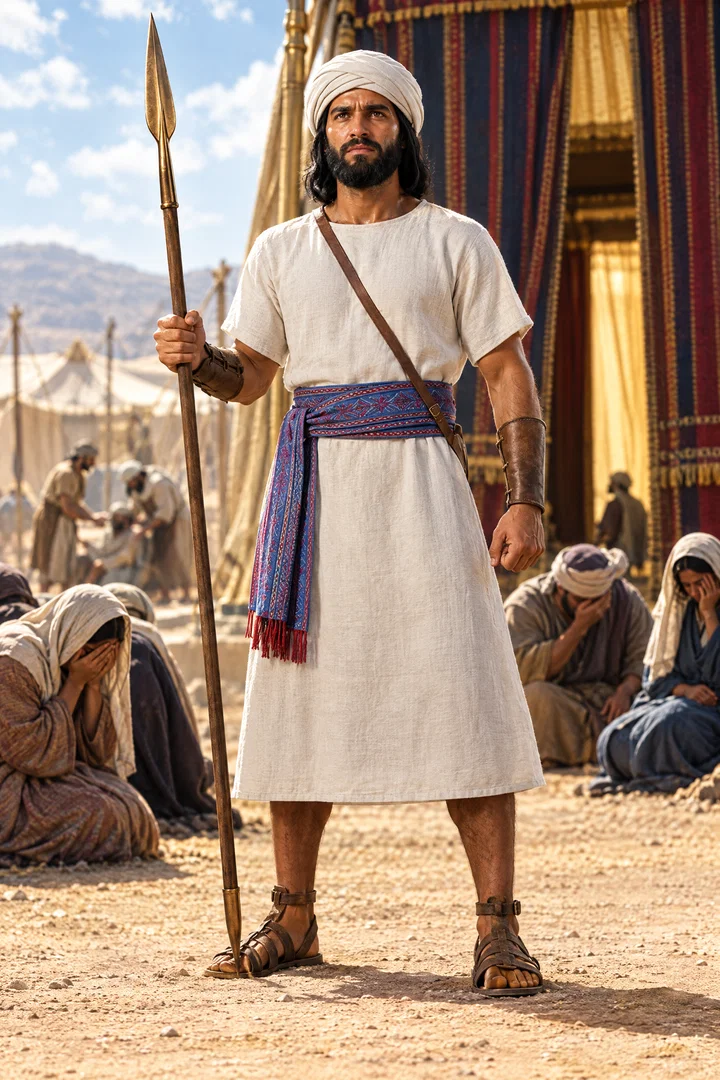
And when Phinehas, the son of Eleazar, the son of Aaron the priest, saw it, he rose up from among the congregation, and took a javelin in his hand;
Phinehas’s action stopped the plague and was counted as righteousness.
- Numbers 14:28-33
Say unto them, As truly as I live, saith the LORD, as ye have spoken in mine ears, so will I do to you:
Both describe Israel’s sentence to wander and die in the wilderness, excluded from the promised land.
- Genesis 15:6
And he believed in the LORD; and he counted it to him for righteousness.
Uses the parallel language of righteousness being reckoned to someone.
- Numbers 25:12-13
Wherefore say, Behold, I give unto him my covenant of peace:
Phinehas’s zeal is counted as righteousness, and God gives him an enduring covenant.
- Numbers 26:65
For the LORD had said of them, They shall surely die in the wilderness. And there was not left a man of them, save Caleb the son of Jephunneh, and Joshua the son of Nun.
The unbelieving generation died in the wilderness, as the psalm recalls.
- Exodus 32
And when the people saw that Moses delayed to come down out of the mount, the people gathered themselves together unto Aaron, and said unto him, Up, make us gods, which shall go before us; for as for this Moses, the man that brought us up out of the land of Egypt, we wot not what is become of him.
Israel’s rebellion and idolatry are recounted in both texts.
Commentary
Each commentary is drawn from primary sources: the writings of Ellen G. White and Adventist pioneers and periodicals. Each commentary is separate. Its own words are not a quotation; follow the references to read the source passages.
Ellen G. White
3 sources
The reckoning described was for Phinehas, whose decisive act of judgment against the sin at Baal-peor stopped the plague among the people.8T 110.3–111.1 That act was credited to him as righteousness, and the credit stands remembered through all generations forever.8T 110.3–111.1 The verse belongs together with Psalms 105, 106, and 107 as a connected group.Ms 1, 1897, par. 2 All who claim to be children of God should read those three psalms carefully, because they teach the necessity of appreciating God's goodness and mercy and love.Ms 1, 1897, par. 2
The verse forms part of the recorded experience of Israel.SPBC 155.1 That record holds warning lessons intended for God's people living in the last days.SPBC 155.1
Sources
Pioneers and periodicals
16 sources
Phinehas decisively executed judgment against the idolatry and wickedness at Baal-peor, where Israel joined themselves to false gods and ate sacrifices to the dead, and his intervention stopped the plague.ST Feb 11, 1903RH Dec 17, 1903ST Dec 3, 1902ST Feb 11, 1903 That act was credited to him for righteousness as a lasting testimony and blessing remembered unto all generations for evermore.ST Feb 11, 1903RH Dec 17, 1903ST Dec 3, 1902 God approved and commended his zeal in stopping wickedness, and confirmed the priesthood to him and his family forever.ST Dec 30, 1880RH Jun 14, 1906 The psalm sets this in the history of the Lord's wonderful deliverances and His mercy toward His backsliding and rebellious children, who were forgiven and pitied when they returned to Him with all their heart, and it stands written as learning and admonition to warn those living near the end of the world against falling after the same example of unbelief.ST Oct 25, 1910ST Aug 20, 1894ST Dec 5, 1911ST Mar 19, 1912RH Jul 2, 1857
Historical Setting and Meaning
The setting is Israel's idolatry at Moab, when the people joined themselves to Baal-peor and ate sacrifices offered to the dead.ST Dec 3, 1902 Those pagan deities were treated as dead heroes, and their worship joined idolatry with sexual sin.ST Dec 3, 1902 Against that sin and wickedness in rebellion and apostasy at Baal-peor, Phinehas decisively executed judgment.ST Dec 30, 1880ST Feb 11, 1903RH Dec 17, 1903ST Feb 11, 1903RH Jun 14, 1906 His intervention stopped the plague.ST Dec 30, 1880ST Feb 11, 1903RH Dec 17, 1903RH Jun 14, 1906
What he did was counted and credited to him for righteousness unto all generations for evermore.ST Feb 11, 1903RH Dec 17, 1903ST Dec 3, 1902ST Sep 28, 1904RH Jun 14, 1906 That reckoning endures as a lasting testimony and blessing remembered through all generations.ST Feb 11, 1903ST Sep 28, 1904ST Feb 11, 1903RH Jun 14, 1906 God approved and commended his zeal in stopping wickedness in Israel.ST Dec 30, 1880RH Jun 14, 1906 By that approval the priesthood was confirmed to Phinehas and his family forever.ST Dec 30, 1880
The verse stands in a historic psalm recounting God's wonderful deliverances to His people.ST Dec 5, 1911 Those deliverances led them from Egypt through the desert to the promised land.RH Jul 2, 1857 They were wrought through Jesus Christ as the Angel of God's presence who was with them.ST Dec 5, 1911
Mercy Warning and Instruction
Psalm 106 displays the Lord's dealing with His children in their backsliding, rebellion and departure from Him, and His wonderful mercy toward them in it despite their sinfulness.ST Oct 15, 1896ST Oct 25, 1910ST Mar 19, 1912ST Aug 11, 1909 That rebellion continued despite His law, His presence and His care, yet He continued to hear and pity them when they suffered and called to Him.ST Oct 15, 1896ST Aug 11, 1909 After apostasy some returned to God with all their heart and were forgiven through His mercy.ST Oct 15, 1896ST Oct 25, 1910ST Aug 20, 1894ST Mar 19, 1912 In this He gives wonderful assurance to all who will only return.ST Oct 25, 1910ST Mar 19, 1912
The psalm records Israel's frequent murmurings, rebellions, idolatries and provocations in the wilderness, and shows that unbelief was the root of them.RH Feb 28, 1856RH Jul 2, 1857 That history is recorded as examples written for learning and admonition to later generations, especially for God's people living near the end of the world.RH Aug 29, 1912RH Feb 28, 1856RH Jul 2, 1857 It warns those upon whom the ends of the world are come against falling after the same example of unbelief.RH Jul 2, 1857 That unbelief includes doubting God's goodness, distrusting His ability to save, speaking against God and His chosen leaders, and envying and gathering against Moses and Aaron.RH Jul 2, 1857 For such sins judgment was immediately executed to make them examples to all following generations, showing that though judgment against an evil work is not now speedily executed, those who do wickedly will finally share just as dreadful a punishment.RH Jul 2, 1857
Sources