Translations
American King James Version, King James Version, Revised Version
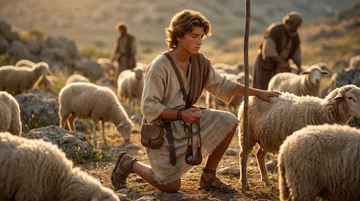
He chose David also his servant, and took him from the sheepfolds:
KJV Cambridge Paragraph Bible, American Standard Version
He chose David also his servant,
And took him from the sheepfolds:He chose David also his servant, and took him from the sheep-folds:
And He fixeth on David His servant, And taketh him from the folds of a flock,
And he chose David his servant, and took him from the sheepfolds:
And made choice of David his servant, And took him from among the folds of the sheep:
Berean Standard Bible, Majority Standard Bible
He chose David His servant
and took him from the sheepfolds;He also chose David his servant,
and took him from the sheepfolds;He took David to be his servant, taking him from the place of the flocks;
He chose Dauid also his seruant, and tooke him from the shepefolds.
Douay-Rheims (Challoner revision)
And he chose his servant David, and took him from the hocks of sheep: he brought him from following the ewes great with young,
Pictures

Cross-references
- 1 Samuel 16:11-13
And Samuel said unto Jesse, Are here all thy children? And he said, There remaineth yet the youngest, and, behold, he keepeth the sheep. And Samuel said unto Jesse, Send and fetch him: for we will not sit down till he come hither.
David is called from tending sheep and anointed for kingship.
- 1 Samuel 16:7
But the LORD said unto Samuel, Look not on his countenance, or on the height of his stature; because I have refused him: for the Lord seeth not as man seeth; for man looketh on the outward appearance, but the LORD looketh on the heart.
God chose David for his heart, not his outward appearance.
- Acts 13:22
And when he had removed him, he raised up unto them David to be their king; to whom also he gave testimony, and said, I have found David the son of Jesse, a man after mine own heart, which shall fulfil all my will.
Both describe David as chosen by God and a man after his own heart.
- Isaiah 55:3
Incline your ear, and come unto me: hear, and your soul shall live; and I will make an everlasting covenant with you, even the sure mercies of David.
It names the everlasting covenant and the sure mercies of David.
- Amos 7:14-15
Then answered Amos, and said to Amaziah, I was no prophet, neither was I a prophet’s son; but I was an herdman, and a gatherer of sycomore fruit:
shows a herdsman called to serve
- Psalms 105
O give thanks unto the LORD; call upon his name: make known his deeds among the people.
Grouped with Psalm 78 as a historical psalm recounting God’s works.
Commentary
Each commentary is drawn from primary sources: the writings of Ellen G. White and Adventist pioneers and periodicals. Each commentary is separate. Its own words are not a quotation; follow the references to read the source passages.
Ellen G. White
6 sources
Psalm 78 recounts the rich blessings God bestowed on His people and their poor return and response to those benefits.CT 457.2Ms 96, 1899, par. 21–22 It stands in the record that the children of Israel worked constantly against a good God.Ms 38, 1898, par. 22 Through disobedience they brought upon themselves the state that was the sure result of their own course of action, and under rebuke and chastisement they repented, but under temptation they fell again through self-indulgence and self-gratification.Ms 38, 1898, par. 22 Within that history God chose David as His servant, taking him from tending sheep in the sheepfolds to the throne of Israel.12MR 225.2–3Lt 96, 1901, par. 6–7
God can call and choose people from humble, ordinary work to serve Him and place them in His service.12MR 225.2–3RH Dec 15, 1904 The Lord calls men of high and low degree to do His bidding and enter His service, so the truth goes forth as a lamp that burneth through lowly men as well as royal and noble men.Lt 96, 1901, par. 6–7 He calls workers from humble occupations rather than relying on people who seek high wages, whose selfishness makes their efforts unfit for His work.RH Dec 15, 1904
Sources
Pioneers and periodicals
7 sources
Psalm 78:70 stands within a brief outline of Israel's history running from the departure from Egypt to the time of David.RH Mar 12, 1861 In that setting it belongs to a presentation of Israel's unfaithfulness set alongside God's faithfulness, giving assurance through God's dealings with His people.ST Mar 11, 1908 The deliverances recounted in that historical psalm were wrought through Jesus Christ, the Angel of God's presence who was with the people.ST Dec 5, 1911
The verse means that God chose David as His servant and took him from tending sheep in humble, lowly beginnings to become ruler and king.RH Oct 26, 1911ST Aug 19, 1889 That humble shepherd work did not prevent the choice, for God lifted him from it to take a scepter as king.RH Oct 26, 1911ST Aug 19, 1889 Beyond inward qualifications of heart, faithful and courageous discharge of tending sheep developed in him the self-reliance and patience that fitted him to rule, while his early life of solitude in communion with God and nature afterward appeared in sympathetic relations with the people and in poetic productions.ST Aug 19, 1889 Through the everlasting covenant God formed him thus taken from the sheepfold into a musician, poet, and king, making him a type of the King of kings.ST Sep 6, 1899
The same choosing still holds, for God can take people from ordinary work, even from tending sheep, and place them in His service.RH Dec 15, 1904 He calls workers from humble occupations rather than relying on those who seek high wages, whose selfishness makes their efforts unfit for His work.RH Dec 15, 1904
Sources