Revelation 13:1
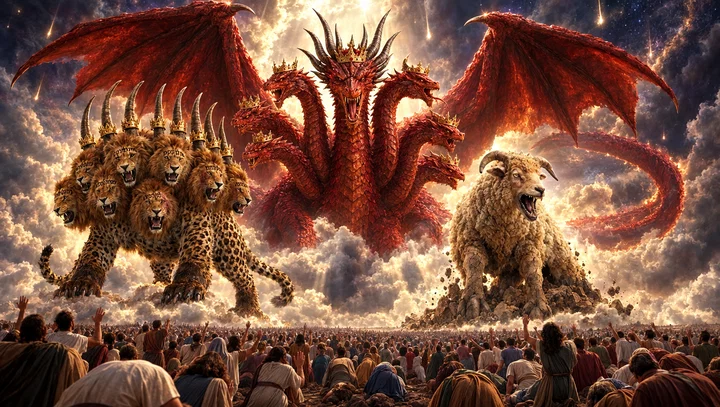
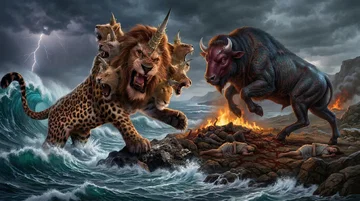
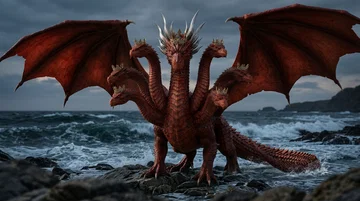
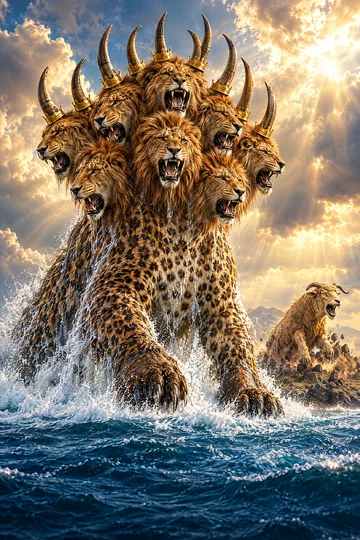
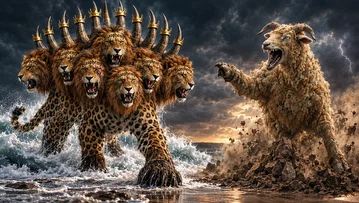
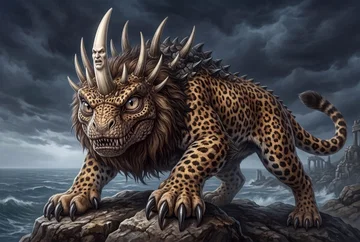
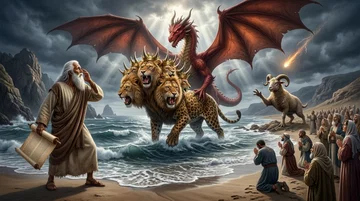
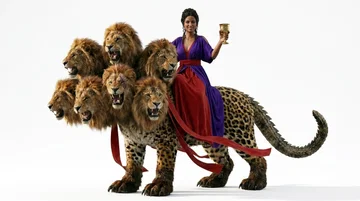
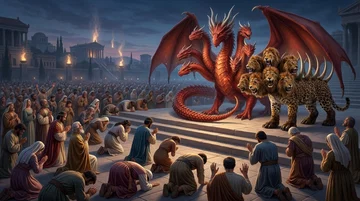
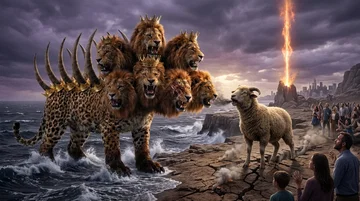
And I stood upon the sand of the sea, and saw a beast rise up out of the sea, having seven heads and ten horns, and upon his horns ten crowns, and upon his heads the name of blasphemy.
Translations
And I stood on the sand of the sea, and saw a beast rise up out of the sea, having seven heads and ten horns, and on his horns ten crowns, and on his heads the name of blasphemy.
King James Version, KJV Cambridge Paragraph Bible
And I stood upon the sand of the sea, and saw a beast rise up out of the sea, having seven heads and ten horns, and upon his horns ten crowns, and upon his heads the name of blasphemy.
And I stood upon the sand of the sea, and saw a beast rise out of the sea, having seven heads and ten horns, and upon his horns ten crowns, and upon his heads the name of blasphemy.
Revised Version, American Standard Version
and he stood upon the sand of the sea. And I saw a beast coming up out of the sea, having ten horns and seven heads, and on his horns ten diadems, and upon his heads names of blasphemy.
And I stood upon the sand of the sea, and I saw out of the sea a beast coming up, having seven heads and ten horns, and upon its horns ten diadems, and upon its heads a name of evil speaking,
And I stood upon the sand of the sea; and I saw a beast rising out of the sea, having ten horns and seven heads, and upon its horns ten diadems, and upon its heads names of blasphemy.
And I saw, out of the sea, a wild-beast coming up; having ten horns, and seven heads, and, upon his horns, ten diadems, and, upon his head, names of blasphemy.
Berean Standard Bible, Majority Standard Bible
Then I saw a beast with ten horns and seven heads rising out of the sea. There were ten royal crowns on its horns and blasphemous names on its heads.
Then I stood on the sand of the sea. I saw a beast coming up out of the sea, having ten horns and seven heads. On his horns were ten crowns, and on his heads, blasphemous names.
And he took his place on the sand of the sea. And I saw a beast coming up out of the sea, having ten horns and seven heads, and on his horns ten crowns, and on his heads unholy names.
And I saw a beast rise out of the sea, hauing seuen heads, and ten hornes, and vpon his hornes were ten crownes, and vpon his heads the name of blasphemie.
Douay-Rheims (Challoner revision)
And I saw a beast coming up out of the sea, having seven heads and ten horns, and upon his horns ten diadems, and upon his heads names of blasphemy.
Pictures
Cross-references 20 of 68
- Revelation 13:11-17
And I beheld another beast coming up out of the earth; and he had two horns like a lamb, and he spake as a dragon.
Introduces the second beast and describes its image, enforced worship, and mark.
- Daniel 7:7-8
After this I saw in the night visions, and behold a fourth beast, dreadful and terrible, and strong exceedingly; and it had great iron teeth: it devoured and brake in pieces, and stamped the residue with the feet of it: and it was diverse from all the beasts that were before it; and it had ten horns.
The ten-horned fourth beast and its blasphemous little horn parallel Revelation’s beast.
- Revelation 12:3
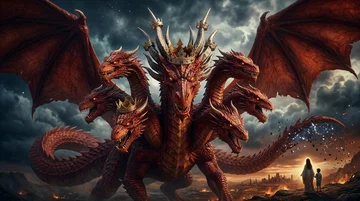
And there appeared another wonder in heaven; and behold a great red dragon, having seven heads and ten horns, and seven crowns upon his heads.
The dragon shares the beast’s seven heads and ten horns.
- Revelation 14:9-12
And the third angel followed them, saying with a loud voice, If any man worship the beast and his image, and receive his mark in his forehead, or in his hand,
Warns against worshiping the beast and its image, contrasting it with the saints’ faithfulness.
- Daniel 7:24-25
And the ten horns out of this kingdom are ten kings that shall arise: and another shall rise after them; and he shall be diverse from the first, and he shall subdue three kings.
The ten horns and blasphemous ruler parallel the beast’s horns and blasphemy.
- Revelation 17:3
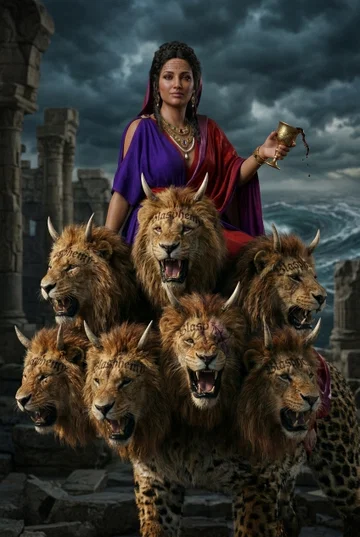
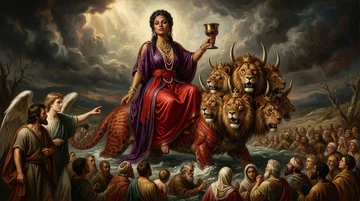
So he carried me away in the spirit into the wilderness: and I saw a woman sit upon a scarlet coloured beast, full of names of blasphemy, having seven heads and ten horns.
The beast shares seven heads and ten horns, while the woman represents religious power allied with civil authority.
- Revelation 13:5-7
And there was given unto him a mouth speaking great things and blasphemies; and power was given unto him to continue forty and two months.
The beast blasphemes, wars against the saints, and exercises allotted authority.
- Revelation 13:14-15
And deceiveth them that dwell on the earth by the means of those miracles which he had power to do in the sight of the beast; saying to them that dwell on the earth, that they should make an image to the beast, which had the wound by a sword, and did live.
image made to first beast is given life to demand worship
- Daniel 7:2-3
Daniel spake and said, I saw in my vision by night, and, behold, the four winds of the heaven strove upon the great sea.
Both visions show beasts rising from the sea amid winds and strife.
- Revelation 17:15
And he saith unto me, The waters which thou sawest, where the whore sitteth, are peoples, and multitudes, and nations, and tongues.
Interprets the waters as peoples, multitudes, nations, and tongues.
- Revelation 19:20
And the beast was taken, and with him the false prophet that wrought miracles before him, with which he deceived them that had received the mark of the beast, and them that worshipped his image. These both were cast alive into a lake of fire burning with brimstone.
The beast and false prophet are defeated and cast into the lake of fire.
- Revelation 13:16-17
And he causeth all, both small and great, rich and poor, free and bond, to receive a mark in their right hand, or in their foreheads:
mark imposed by beast power
- Revelation 12:9
And the great dragon was cast out, that old serpent, called the Devil, and Satan, which deceiveth the whole world: he was cast out into the earth, and his angels were cast out with him.
Identifies the dragon behind the beast as Satan.
- Revelation 13:14
And deceiveth them that dwell on the earth by the means of those miracles which he had power to do in the sight of the beast; saying to them that dwell on the earth, that they should make an image to the beast, which had the wound by a sword, and did live.
commands image made to first beast
- Revelation 17:9-10
And here is the mind which hath wisdom. The seven heads are seven mountains, on which the woman sitteth.
identifies the heads as mountains
- Revelation 13:7
And it was given unto him to make war with the saints, and to overcome them: and power was given him over all kindreds, and tongues, and nations.
The beast makes war on the saints, overcomes them, and receives authority over the nations.
- Daniel 7:24
And the ten horns out of this kingdom are ten kings that shall arise: and another shall rise after them; and he shall be diverse from the first, and he shall subdue three kings.
Daniel identifies the ten horns as kings arising from the fourth kingdom.
- Revelation 15:2
And I saw as it were a sea of glass mingled with fire: and them that had gotten the victory over the beast, and over his image, and over his mark, and over the number of his name, stand on the sea of glass, having the harps of God.
Those who overcame the beast, its image, and its mark stand victorious before God.
- Daniel 7:7
After this I saw in the night visions, and behold a fourth beast, dreadful and terrible, and strong exceedingly; and it had great iron teeth: it devoured and brake in pieces, and stamped the residue with the feet of it: and it was diverse from all the beasts that were before it; and it had ten horns.
Both depict a beast with ten horns, identifying the sea beast with Daniel’s fourth beast.
- Daniel 7:21
I beheld, and the same horn made war with the saints, and prevailed against them;
Both beasts wage war against the saints.
Commentary part 1 of 2
Each commentary is drawn from primary sources: the writings of Ellen G. White and Adventist pioneers and periodicals. Each commentary is separate. Its own words are not a quotation; follow the references to read the source passages.
Ellen G. White
35 sources
The beast John sees rising from the sea with seven heads and ten horns, ten crowns and blasphemy on its heads, is an earthly persecuting power from the Old World, for the sea stands for peoples, multitudes, nations and tongues, and this power inherits what Babylon, Persia, Greece and Rome held before it and receives the seat and authority pagan Rome once held.GC88 439.1DA 837.74SP 502.4–6ST Nov 1, 18994SP 502.2–3 It is the papacy, a union of church and state in which the church controls civil power to rule consciences, whose blasphemy is exalting itself above God and claiming divine authority while making war on His commandment-keeping saints like the little horn of Daniel 7.GC88 439.1DA 837.3–4GC 438.1–439.2Ms 7a, 1896, par. 10–12GC 443.2–5 Its dominant rule as a persecuting power lasted 1,260 years from 538 to 1798, when the pope was taken captive by the French army and it received its deadly wound and was forced to desist from persecution.DA 837.3–4GC 438.1–439.24SP 276.2–277.1 What matters most is the final conflict over worship, a choice between keeping the seventh-day Sabbath as the memorial of creation and sign of God's authority and keeping a man-made false sabbath of the sun, with worship of the beast linked to receiving its mark in the forehead as the mind or in the hand as action and power.4SP 505.2–314MR 90.3–91.4Ms 139, 1903, par. 22–25GC 445.2–446.2GC88 690.1–691.3 That false worship will be enforced by decree through the two-horned beast and its image, especially by Sunday laws backed by imprisonment and death, while those who refuse the mark remain as a remnant keeping all God's commandments including His day of rest.Ms 7a, 1896, par. 10–124SP 505.2–3Ms 23, 1889, par. 4–614MR 90.3–91.4GC 445.2–446.2
Symbols and Identity
The beast rising from the sea is a leopard-like symbol of an earthly, persecuting government especially engaged in trampling on God's law and persecuting His people.ST Nov 1, 18994SP 275.2–276.1Ms 51, 1899, par. 1–3 Together with the great red dragon and the beast with lamblike horns, it carries on war against the church, symbolized by a holy woman and her children, through the close of time.ST Nov 1, 1899Ms 51, 1899, par. 1–3 That war leaves God's people greatly in the minority, in the last days only as a remnant who keep the commandments of God.4SP 275.2–276.1Ms 51, 1899, par. 1–3
The sea out of which it rises means peoples and multitudes and nations and tongues, the great changing tides of nations in their rise and fall.DA 837.74SP 502.4–64SP 502.2–3 Rising from the sea therefore marks this as an Old World nation upheld by many nations, distinct from the later beast that rises from the earth.DA 837.7ST Nov 1, 1899 John is shown standing on the sand of the sea and seeing the beast rise with seven heads and ten horns, ten crowns upon its horns, and the name of blasphemy upon its heads.Lt 18, 1900, par. 8–10 Its seven heads represent its existence under different forms through the ages.DA 837.3–4
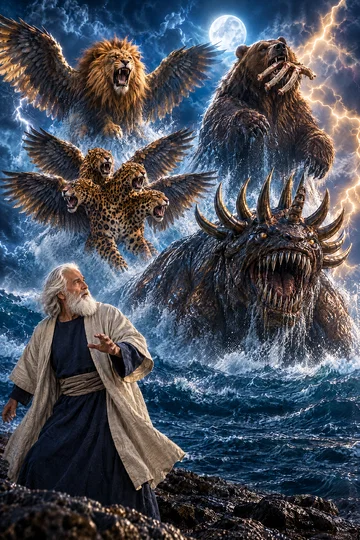
The same beast is given power to make war with the saints and to overcome them, and power over all kindreds and tongues and nations.Lt 18, 1900, par. 8–10 All that dwell on the earth whose names are not written in the book of life of the Lamb slain from the foundation of the world worship him, and the call is for everyone with ears to hear, for it is for the interest of all to hear.Lt 18, 1900, par. 8–10 The leopard-like beast carries the characteristics of the four beasts of Daniel 7 and inherits in succession the power once held by Babylon, Persia, Greece, and Rome.4SP 502.4–64SP 502.2–3
The beast is the papacy, which succeeded to the power and seat and great authority once held by pagan Rome, an identification held as the general Protestant view.GC88 439.1GC 438.1–439.24SP 501.3–502.1 The dragon that gave it that authority represents Satan and, secondarily, pagan Rome, so Satan worked through the papacy as he had formerly worked through pagan Rome.GC 438.1–439.2GC88 679.3–680.3 The change of symbol from dragon to beast marks a change in the form of opposition, from open defiance of God by pagan Rome to opposition under profession of allegiance to Him, despite the pope's claim to represent Christ.GC88 679.3–680.3 It arose when paganism in the Roman Empire gave way to a professing form of Christianity.GC88 679.3–680.3
Its blasphemous speech and war against the saints identify it with the little horn described in Daniel 7.GC88 439.1GC 438.1–439.2 Its blasphemy consists in exalting itself above God, claiming divine authority, and oppressing His commandment-keeping people.Ms 7a, 1896, par. 10–1214MR 90.3–91.4 The beast symbolizes a union of church and state that becomes destructive to both, persecuting those who oppose it.DA 837.3–4 The church gained control of civil power after the early church apostatized from the gospel, adopted heathen rites and customs, and sought state support to control consciences, and then used secular authority to advance its aims and purposes and to punish those judged heretics.GC 443.2–5GC88 443.2
The Dark Ages showed the harmful effects of that union on both church and state.DA 837.3–4 The vision was shown to John on Patmos by Christ through angels while veiling His own glory, for the instruction of God's people.Ms 139, 1903, par. 22–2518MR 33.2–34.1 The message is to reach God's people and to be received free from human wisdom and tradition, with Daniel and Revelation studied together and one scripture explaining another.Ms 139, 1903, par. 22–2518MR 33.2–34.1Ms 105, 1906, par. 5–6 Its truth is impressed by illustrations and lifelike figures representing the beast, presented so clearly from the Bible that to differ is to oppose the Word of God.Ms 105, 1906, par. 5–6
Historic Persecuting Rule
The beast arose as the papacy when paganism in the Roman Empire gave way to a professing form of Christianity.GC88 679.3–680.3 The early church had apostatized from the gospel, adopted heathen rites and customs, and sought the support of the state in order to control consciences.GC 443.2–5 The change of symbol from dragon to beast marks a change in the form of opposition, from open defiance of God by pagan Rome to opposition carried on under a profession of allegiance to Him.GC88 679.3–680.3 Satan worked through the papacy as he had formerly worked through pagan Rome, despite the pope's claim to represent Christ.GC88 679.3–680.3
Under its dominant head described in Revelation 13:1-10 this power was a persecuting power that destroyed God's faithful witnesses for many centuries.DA 837.3–44SP 276.2–277.1 Under the dominion of Rome they were tortured and slain for more than a thousand years.4SP 276.2–277.1 It was an earthly government especially engaged in trampling upon God's law and persecuting His people, carrying its war against them forward to the close of time.4SP 275.2–276.1Ms 51, 1899, par. 1–3 The Dark Ages showed the harmful effects of its union of church and state upon both church and state.DA 837.3–4 That long warfare left God's people greatly in the minority, with only a remnant in the last days.4SP 275.2–276.1Ms 51, 1899, par. 1–3
Its period of persecuting authority lasted 1,260 years and then went into captivity.DA 837.3–4 That period ran from 538 to 1798, when the pope was taken captive by the French army.GC 438.1–439.2 This fulfilled the prophecy of the beast's deadly wound and captivity, when the papacy was at last deprived of its strength and forced to desist from persecution.GC 438.1–439.24SP 276.2–277.1 The pattern of this beast defines what it means to form an image to it: religious power controls civil government so that the state is used to enforce the church's aims and purposes.GC 443.2–5GC88 443.2 The church gained control of civil power and used secular authority to control consciences and punish those judged heretics, and church-state alliances that punish dissent repeat that first beast's pattern.GC 443.2–5GC88 443.2
Last-Day Worship Crisis
Revelation 13 presents a power that will become prominent in the last days, belonging with the prophecies of Revelation 12 to 18 that are being fulfilled now as the last warning message all are to hear.Ms 75, 1906, par. 16Ms 139, 1903, par. 22–2518MR 33.2–34.115MR 321.3 It stands as part of a connected sequence of past, present, and future events continuing through to the complete redemption of the 144,000 who gain victory over the beast and its image and stand with the Lamb on Mount Zion as shown in Revelation 14:1-5.WLF 10.4 It stands in sequence before the very last call to the churches recorded in chapter 18 which is now to be given, and before the time pictured in chapter 19 when the beast and the false prophet are taken and cast into the lake of fire.Ms 75, 1906, par. 16 Then the dragon who instigated the rebellion against heaven is bound and cast into the bottomless pit for a thousand years, followed by the resurrection of the wicked and the final destruction of Satan and all the wicked and the final triumph and reign of Christ in this earth.Ms 75, 1906, par. 16
The chapter warns of perils and dangers before God's people in the last days, showing a work and a people opposed to God and working counter to Him in a prophetic setting in which people are deceived.Ms 32, 1896, par. 34–3717MR 18.2–4 It is connected with the final conflict between those who keep God's commandments and those who make void His law.Ms 55, 1895, par. 14–16 It belongs to the last-days message that joins the first and second angels' messages with the third, a proclamation to the world.Ms 55, 1895, par. 14–16 It describes the power that persecutes God's people in the last period of the earth's history, when the beast represents the churches and the world united in trampling upon God's commandments.Ms 48, 1900, par. 16–18 In that reign churches and civil authorities unite, human laws take the place of God's law, Scripture is displaced by human traditions, and the vision is connected with the time when Satan works through church and state, especially through religious laws enforced by governments.Ms 166, 1902, par. 1–2Lt 179, 1896, par. 29–30
The central issue is worship, a choice for every person between worshiping the true God by keeping the seventh-day Sabbath, the memorial of creation, and worshiping the beast through observance of a man-made false sabbath.Ms 7a, 1896, par. 10–1214MR 90.3–91.4 Changing the Sabbath to the first day of the week leads people to treat human tradition as more authoritative than God's law, and the beast's distinguishing feature is opposition to God's commandments by changing God's law, so that obedience to its altered laws is allegiance to its authority rather than to God.Ms 139, 1903, par. 22–25GC 445.2–446.2 Worship of the beast is connected with receiving its mark in the forehead or hand, where the forehead represents the mind and the hand represents power or action.4SP 505.2–3GC88 690.1–691.3 Unlike God's servants, who are sealed in the mind, the beast's worshipers may be compelled to worship, yet compulsory worship is accepted by wicked powers.4SP 505.2–3GC88 690.1–691.3 Its mark is a counterfeit Sabbath, the day of the sun, directly opposed to God's Sabbath as the sign and seal of His authority and power and the seal of His law, while keeping God's commandments distinguishes God's worshipers from the beast's worshipers.4SP 505.2–3GC 445.2–446.2GC88 690.1–691.3
That worship will be enforced by decree through the two-horned beast, and the thirteenth chapter lays out in clear lines the position of God's people for this time in regard to Sunday laws.Ms 23, 1889, par. 4–6GC 445.2–446.2Lt 183, 1902, par. 8–9 Its image represents apostate Protestantism that will seek civil power to enforce religious doctrines, especially Sunday laws enforced by governments, and the third angel warns that anyone who joins in that worship and receives the mark in forehead or hand will drink the unmixed wine of God's wrath.GC 445.2–446.2Lt 183, 1902, par. 8–9Ms 166, 1902, par. 1–2 The same beast is given power to make war with the saints and to overcome them, and power over all kindreds and tongues and nations, and all that dwell on the earth whose names are not written in the book of life of the Lamb slain from the foundation of the world worship him, so the chapter concerns every person and the call is for everyone with ears to hear.Ms 7a, 1896, par. 10–12Lt 18, 1900, par. 8–10 Its persecuting power will compel this worship by enforcing the sabbath it instituted, threatening with death all who obey God's precepts and refuse the mark, restricting liberty and sentencing to imprisonment or death those who keep God's commandments.Ms 7a, 1896, par. 10–1214MR 90.3–91.4Ms 48, 1900, par. 16–18 Those who refuse the beast's mark keep God's commandments including the Sabbath and will suffer persecution for it, remaining in the last days only as a remnant who keep the commandments of God and show loyalty to Him by keeping His day of rest.4SP 505.2–3Ms 51, 1899, par. 1–3Ms 166, 1902, par. 1–2
The papacy appears in its power in the last time, standing upon the borders of the greatest event in the world's history.Lt 54, 1906, par. 9 Satan must not have power over God's people to cause them to sleep on, so the churches must be aroused and search the Scriptures.Lt 54, 1906, par. 9 God will make known to His faithful ones what shall be in the last time, and His word is to come to His people in power.Lt 54, 1906, par. 9
Sources
Pioneers and periodicals
358 sources
The beast rising from the sea is papal Rome, a church united with civil power and clothed with its authority to persecute for conscience, receiving its seat at Rome and its power and great authority from the dragon working through pagan Rome.ST Jun 9, 1914RH Aug 19, 1851RH Jan 17, 1871RH Feb 5, 1901 The sea is peoples and nations in turmoil, and rising from it means arising among populated nations by conquest and revolution, in contrast to the lamb-like power coming up from the earth quietly by settlement in America about the time this beast goes into captivity.RH May 20, 1858ST Aug 31, 1882RH Oct 31, 1871RH May 8, 1916RH Mar 20, 1855 Its seven heads are successive ruling phases with only one ruling at a time, from Babylon through pagan Rome to papal Rome and beyond, and its ten crowned horns are ten contemporary divided kingdoms of Europe ruling together after Rome's division.ST Aug 8, 1916ST Aug 24, 1882ST Nov 26, 1896RH Oct 25, 1870RH Nov 4, 1873 Its blasphemous names are claims to be God's representative on earth with power to forgive and to change God's times and laws, fulfilled in setting Sunday in place of the seventh-day Sabbath, and it is the same power as Daniel 7's little horn and Paul's man of sin.ST Aug 8, 1916ST Jul 31, 1879RH Sep 22, 1863ST Jun 20, 1900 It was to rule forty-two months as 1260 years from 538 to 1798, receive a deadly wound by loss of civil power and captivity, and be healed in a last-days restoration when all the world wonders after it, which the third angel's warning in Revelation 14:9-12 exposes while the two-horned beast of the United States makes its image and enforces its mark.RH Aug 20, 1857RH Aug 19, 1851RH Jan 17, 1871ST Jul 31, 1879RH May 20, 1858
Sea and Manner of Rising
The sea is peoples and multitudes and nations and tongues and languages, restless and warlike peoples in turmoil who do not know God, especially the crowded civilized nations of Europe.RH Aug 19, 1851RH May 20, 1858RH Nov 11, 1862RH Mar 12, 1857 The winds striving upon that sea are wars and strife and political agitation and commotion and revolution, with secret satanic instigation driving conflict among nations.RH Nov 11, 1862ST Aug 31, 1882RH Mar 20, 1855RH Jun 25, 1857 That sea therefore pictures Papal Rome rising among peoples by war and by subduing the powers before it, a power arising through strife, war, or political revolution among peoples as an unrighteous nation.RH Aug 19, 1851RH May 20, 1858RH Nov 11, 1862RH Mar 12, 1857RH Dec 23, 1851 Its seven heads and ten horns belong to that same rising, with the dragon of Revelation 12 as pagan Rome giving it power and seat and great authority, even the city of Rome.RH Aug 19, 1851RH May 20, 1858RH Nov 11, 1862RH Mar 12, 1857
To rise up out of the sea is for a great government to arise among already populated nations and establish itself by conquest and war and aggression and revolution and upheaval on the ruins of predecessors.ST Aug 31, 1882RH Dec 23, 1851RH Oct 31, 1871RH Mar 20, 1855RH Jun 25, 1857 So rose Babylon and Medo-Persia and Grecia and Rome, each coming to power through general wars with winds as war or strife among men stirring the waters of peoples and nations.ST Aug 31, 1882RH Dec 23, 1851RH Mar 20, 1855RH Jun 25, 1857 This rising stands within the locality of Nebuchadnezzar and Cyrus and Alexander and Roman emperors and popes, inside Daniel 7 territory extending westward to the Atlantic.RH Oct 31, 1871RH May 8, 1916RH Mar 20, 1855 It belongs to the succession of kingdoms that came to power through strife and war, the first beast as the papal form of the fourth kingdom receiving power, seat, and authority from the dragon as pagan Rome.RH Dec 23, 1851RH May 8, 1916RH Mar 20, 1855
Rising from the sea through strife stands in contrast to coming up out of the earth like a plant growing quietly and peacefully by natural increase and emigration and settlement in previously unoccupied territory without overthrowing kingdoms.RH Oct 31, 1871RH Mar 20, 1855ST Nov 7, 1900ST Oct 9, 1879 The earth suggests new and previously unoccupied territory, while the sea means national strife and commotion among organized governments and world powers in crowded, contending nations.RH Oct 31, 1871RH May 8, 1916ST Nov 7, 1900ST Oct 9, 1879 That contrast identifies the lamb-like two-horned power lifting above the horizon in America around 1798, the United States of America, while the first beast went into captivity.RH Mar 20, 1855ST Nov 7, 1900 The ten-horned first beast symbolizing Rome rises from the sea, and the second beast comes up from the earth in unoccupied territory as another and distinct contemporary power acting in its sight.RH Oct 31, 1871RH May 8, 1916RH Mar 20, 1855ST Nov 7, 1900
The better Greek reading has the dragon standing on the sand of the sea rather than John standing there.ST Sep 5, 1911 In that reading the dragon stands by the sea where the beast rises from it, showing Satan's agency behind the beast and the strife among earthly powers.ST Sep 5, 1911 The sea there represents multitudes and nations and tongues and peoples and kings, and Satan stands where he can survey the masses of humanity and shape nations to his will.ST Sep 5, 1911 From that vantage he drives the conflict among nations from which kingdoms emerge, sustaining the succession and continuing persecuting and blasphemous character of world empires.ST Sep 5, 1911
The verse thus shows Satan waiting on the seashore after the fall of the Roman Empire because he had temporarily lost an effective world power through which to persecute the church and the saints.ST Oct 25, 1905 His waiting marks a change in the instrumentality of persecution rather than a change in his spirit or purpose.ST Oct 25, 1905
Dragon Giving Power and Seat
The dragon is primarily Satan and secondarily pagan Rome, the earthly power ruling at Christ's birth that sought to kill Jesus in infancy, and more generally the devil working through earthly powers to drive persecution.ST May 2, 1916RH Mar 20, 1900 The beast rising from the sea is Satan's active agent, vicegerent and counterfeit government in the human sphere, a system of church-and-state sovereignties centered on one power rather than Satan himself or legitimate government.ST May 2, 1916ST Nov 26, 1896ST Jul 4, 1911ST Jun 20, 1911 Its seven heads and ten horns show many sovereignties joined in that continuing system, bringing together the principles represented separately by Daniel's four beasts with each successive head giving the system its character.ST May 2, 1916ST Nov 26, 1896ST Jul 4, 1911 The visible peoples and institutions acting against Christ and the church are agents of evil while Satan is the hidden power directing that opposition, and the beast's persecuting and blasphemous spirit is driven by the devil amid strife among nations.ST Jun 20, 1911
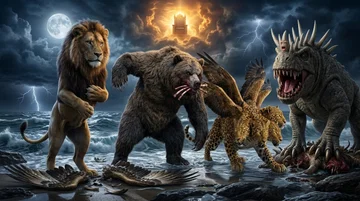
The dragon giving the beast his power and throne and seat at the city of Rome and great authority is pagan Rome as the earthly power through which Satan operated transferring Rome's city and power and authority to papal Rome.RH Aug 19, 1851RH Jan 17, 1871RH May 20, 1858RH May 10, 1870RH Nov 6, 1866 The beast with seven heads and ten horns gathers all the symbols of Daniel 7, with leopard body for Greece and bear feet for Persia and lion mouth for Babylon and the same heads and horns seen in Daniel's vision, representing the dominion of Rome in its last or papal form after the breakup shown by the ten horns and the rise of the papal little horn among them.RH Aug 19, 1851RH Jan 17, 1871 Its blasphemous character and work against God's people match the little horn, and its rise and authority and period of power and eventual captivity correspond to the little horn's rise and dominion and 1,260-year period and loss of dominion.RH May 20, 1858RH Mar 20, 1900 Power was given it to make war with the saints and overcome them and lead them into captivity and kill them with the sword for forty-two months, which are 1260 years from 538 to 1798.RH Aug 19, 1851RH Jan 17, 1871RH May 20, 1858 All that makes the beast great comes from the dragon, so he is the dragon's servant and representative, and worship of him expressed in Who is like unto the beast is really worship of the dragon that gave him power, setting Satan's supremacy against God's.RH Mar 20, 1900ST Mar 26, 1902
That transfer was fulfilled when Constantine moved the imperial seat to Constantinople in A.D. 330 and Rome became the papacy's seat, the dragon himself moving from Rome and making his seat at Constantinople.ST Jun 18, 1885ST May 31, 1877 It was completed when Justinian as emperor gave the papal church the seat of Rome and authority over his kingdom by decree issued in 533 and effective in 538, clothing the head bishop with civil authority to become pope.RH Jun 30, 1874ST May 31, 1877RH Aug 5, 1851 This came after paganism fell and the last of three opposing horns, the Ostrogoths, was plucked up in 538, giving the civil power needed to wear out the saints.RH Jun 30, 1874RH Aug 5, 1851 It culminated a mystery of iniquity already working in Paul's time, with rise after pagan Rome around 508 and civil power in 538, and with supremacy conferred by Justinian's decree carried out in 538 and captivity ending in 1798 after 1,260 years.ST May 31, 1877RH Aug 5, 1851 The ten crowned horns denote ten kingdoms with independent kingly power, and the seven heads are those explained in Revelation 17:9-10, while leopard body and bear feet and lion mouth show the character of Daniel 7's first three kingdoms whose dominion was taken away but whose lives were prolonged by merger into the succeeding kingdom.RH Feb 5, 1901
Dragon and beast share seven heads and ten horns and are essentially the same opposing power through the whole period, the dragon as the earlier pagan phase and the beast as the later papal phase, so either symbol can in a certain sense cover the whole period.RH May 10, 1870RH Jan 6, 1853RH Nov 21, 1871ST Dec 20, 1883 The change from dragon to leopard beast is religious, from paganism to Rome under papal rule in professedly Christian form, Rome with an ecclesiastical power controlling it and not merely a civil government.RH Nov 6, 1866RH Jan 6, 1853RH Apr 16, 1861 Paganism gave way to papacy under Roman power when pagan superstition grew weak as its votaries forsook him to seek the living God, with the dragon feigning conversion and carrying on ancient pagan images and doctrines and laws renamed as Christian.RH Jan 6, 1853RH Apr 16, 1861 The change altered the form of Satan's counterfeit worship but not its character, altering tactics from open attack to corrupting Christianity from within and shedding martyrs' blood for ages, yet retaining gospel names and forms.RH Jan 6, 1853ST Nov 25, 1880RH Apr 16, 1861
The sea beast is distinct from pagan Rome and kingly Rome, receiving its seat and authority as a gift from the dragon rather than by conquest, whereas pagan Rome did not give power and seat to kingly Rome which came by conquest.ST Jun 18, 1885RH Jun 25, 1857 It is distinct also from the miracle-working two-horned beast later in Revelation 13, which is the false prophet where Spiritualism arose and where an image as a union of church and state will be made.ST Jun 18, 1885 It was given power over all kindreds and tongues and nations as a system uniting church and state existing in seven forms from Babylon until Christ returns.ST Sep 8, 1914RH Jun 25, 1857
Seven Heads Successive Phases
The seven heads are successive forms of government, phases or kingdoms of one continuing persecuting church-and-state system, while the ten horns exist at the same time as contemporary powers.ST Nov 26, 1896RH May 20, 1858ST Jul 4, 1911 Only one head exists at a time and the ruling head gives character to the whole beast, proved because one head is wounded to death and healed and by the crowns on the heads in Revelation 12 contrasted with crowns on the horns here.ST Jan 23, 1907ST Jun 27, 1911 The beast has the same seven heads and ten horns as the dragon and the scarlet beast as variations of one Satanic system expressed through changing earthly governments.RH Mar 20, 1855RH Feb 2, 1864RH Jan 31, 1854 Its seven heads with blasphemous names and its crowns on horns show authority exercised through earthly powers and usurpation of God's authority over soul and conscience.ST Aug 8, 1916ST Aug 24, 1882ST Dec 20, 1883
The standard succession beginning retrospectively about 600 B.C. is Babylon first, Medo-Persia second continuing the Babylonian system, Grecia third, pagan Rome fourth, and papal Rome fifth dominant during the forty-two months and 1260 years of the Dark Ages.ST Oct 24, 1911ST Jan 23, 1907ST Jun 27, 1911 Under each head the beast takes the nationality of the ruling power, so while the first head existed the beast was a Babylonian beast and while the fifth existed it was papal.ST Nov 26, 1896ST Jul 4, 1911ST Mar 30, 1915 Satan used Grecian power against God's people through Alexander's purpose to destroy Jerusalem stopped by a dream and through Antiochus Epiphanes, yet God frustrated him and interposed as at the burning of the three Hebrews in the fiery furnace and at the captivity.ST Jun 27, 1911 The beast combines the lion's mouth for Babylon, the bear's feet for Medo-Persia, the leopard's body for Greece, and the ten-horned power for Rome, showing succession to their power, territory and persecuting character.ST Aug 24, 1882RH May 20, 1858ST Nov 14, 1906 The head that followed pagan Rome was papal Rome, receiving power, seat and authority from the dragon and exercising them for 1,260 years.ST Nov 26, 1896ST Jul 4, 1911ST Jun 17, 1903
After the five fallen heads the succession continues with a sixth head as the present mixed condition of Protestant and Catholic churches with governments, apostate Protestant church-state regime, or pagan-Christian governments of Europe in which the state dominates religion through national churches.ST Jan 18, 1916ST Oct 24, 1911 In the first four heads religion was subject to the state, while in the fifth papal head the church dominated the state.ST Nov 19, 1896 The seventh head finally is a restored papacy supported by earthly powers, also called an eighth because it combines with the seventh yet is one of the seven, still future, short-lived, preceded by socialist governments, and destroyed at the end.ST Jan 18, 1916ST Oct 24, 1911ST Jul 18, 1911 Its deadly wound was loss of civil recognition, support and authority in 1798, and its healing points to restoration of papal influence through renewed cooperation between church and state when the kingdoms reinstate that phase at the head of religious jurisdiction.ST Apr 20, 1904ST Jan 18, 1916 The beast exists only in union of church with civil power so as to form a persecuting power, since the church alone has no power to persecute and civil government alone has no desire to persecute for religion.ST Jan 18, 1916
In Roman terms the seven heads are seven successive forms of government of one Roman Empire, not contemporary branches: kings, consuls, decemvirs, dictators, triumvirs, emperors, and popes, with six belonging to pagan Rome represented by the dragon and the seventh and last as the papal government after Rome became nominally Christian.RH Jan 31, 1854ST Oct 9, 1879RH Nov 7, 1871 Temporary dictators, triumvirs exceeding power, the Exarch of Ravenna, and American executive, legislative and judicial branches are not counted as heads, since dictators were temporary emergency officers of the republic and triumvirs were officials who exceeded powers in transition to empire.ST Jun 27, 1911ST Jul 25, 1911 The heads are not Rome's seven literal hills or seven individual emperors.ST Jul 25, 1911RH Nov 7, 1871 Thus the wounded head was the papal form of government.ST Jul 25, 1911ST Oct 9, 1879
Variant reckonings place the imperial form then in power in John's time with five fallen, with the papal form still to come and the imperial government in the West giving way to the papal form in A.D. 538 when the emperor granted the pope civil power and a seat in the West.RH Feb 14, 1856RH Jan 31, 1854 Others expect a false Christian empire beginning under Constantine in 312 and ending with the fall of the Western Empire in 476, or list imperial, barbarian, papal and Napoleon forms as successive forms of universal supremacy.RH Feb 14, 1856RH Jan 31, 1854 Still others distinguish a fifth papal head in which the church dominated the state unlike earlier state-dominated heads from a sixth post-papal state-dominated head, with the papal head to return as an uncounted eighth repeating a former form and joining with the seventh to make an eighth.ST Oct 24, 1911ST Jul 18, 1911 The papacy replaced an earlier head at Nicaea in A.D. 325 with greater satanic authority when the Roman Catholic Church was established by law under Constantine, and received civil power and a western seat in A.D. 538.ST Jun 27, 1911ST Nov 19, 1896RH Jan 31, 1854 The present in this verse belongs to the 1260 years distinct from Revelation 12 under pagan Rome at the beginning of the Christian era and Revelation 17 after papal persecution in the present condition of the world.ST Oct 24, 1911ST Jul 18, 1911
Heads require both religious authority and civil power to enforce decrees to persecute, and the first four verses encompass papal spiritual domination, loss of civil power, and predicted healing when civil power is restored.ST Apr 20, 1904ST Nov 26, 1896 Mountain symbolizes strength and government on which the apostate church from Babylon to the present has rested, deceived by the wine of Babylon into believing church-state union was strength.ST Jul 18, 1911ST Jul 18, 1911 The view that the sixth imperial head was wounded and has continued ever since is rejected because it would leave only six heads with Rome still imperial.RH Nov 13, 1866
Ten Horns Crowned Kingdoms
The ten horns are ten kings or kingdoms arising out of Rome, the same power as the ten toes of Daniel 2, the ten horns of Daniel 7, and the ten horns of the dragon of Revelation 12 transferred from symbol to symbol.RH Oct 25, 1870RH Nov 4, 1873RH Mar 12, 1857 They occupied the territory Rome had originally embraced, in Europe and Western Europe, as independent contemporary governments distinct from one another, and together with the papacy they signify Rome's rule across Western Europe.RH Mar 12, 1857RH Apr 7, 1874 The leopard beast that bears them represents the papacy and is identified with the eleventh horn of Daniel 7's fourth beast, belonging to the prophetic imagery of Rome and the kingdoms into which Rome was divided.ST Sep 11, 1879RH Jan 18, 1870 Because this ten-horned power continues past the first advent through the papal period to make war against the Lamb and to face Christ at His coming, the stone has not yet smitten the image; the smiting will be at the second coming when He breaks the nations and takes an everlasting universal kingdom after the judgment.RH Oct 25, 1870 The fulfillment of that history of rise, work, duration, deadly wound, and decay of civil power proves the world has reached the last days, with only the dashing in pieces of the nations and the destruction of the papal power by Christ's brightness still unfulfilled.RH Nov 4, 1873
Rome was divided into ten kingdoms by the incursions of the northern barbarians between A.D. 351 and 476, not arising until A.D. 483 and existing A.D. 476 to 493.ST Oct 22, 1894RH Oct 25, 1870 They are no fewer and no more than ten, namely the Allemanni, Franks, Burgundians, Vandals, Suevi, Visigoths, Saxons, Ostrogoths, Lombards and Heruli, including among them the Heruli, Anglo-Saxons and Lombards.ST Nov 28, 1892 England is one horn and France is one horn and not a head.ST Nov 28, 1892 The beast combines the lion, bear, and leopard with the addition of ten horns and is the same as the dreadful and terrible fourth beast, the fourth kingdom to succeed Grecia, more cruel and oppressive than all before it especially toward the saints, applying to Rome alone throughout its pagan and Christian career and lasting in one form or another to the end. Its ten horns identify it with Daniel's fourth beast and show it follows the beasts in Daniel's prophecy as Daniel's fourth beast under the little horn, the same power as Daniel's little horn and the man of sin in 2 Thessalonians 2, arising from apostasy in the church after conquering three kingdoms.ST Jan 30, 1879ST Jul 24, 1879 It signifies papal Rome in its political character as Roman power professing Christianity, not pagan Rome, successor to pagan Rome as an idolatrous and persecuting power receiving the dragon's dominion, whose specifications of character, work, and period match the papacy and no other power.ST Nov 28, 1892 Their number and boundaries changed over time, but they continued to be known as the ten kingdoms, and the changes among them accord with the prophecy.RH Apr 7, 1874
The kingdoms displaced before the papal rise were the Heruli, Vandals, and Ostrogoths, overthrown between 493 and 538; although not destroyed, they were forced to leave their territories.RH Oct 13, 1874ST Apr 13, 1915 In one reckoning the three supplanted are listed as the Heruli, Ostrogoths, and Lombards, and the papal three-crowned tiara represents those kingdoms being subdued.ST Dec 21, 1882 Of the original ten kingdoms, three were uprooted, leaving seven that correspond to the powers of Western Europe: Britain, France, Germany, Switzerland, Spain, Portugal, and Italy, and these kingdoms together with the papacy form the beast and its power against which the third angel's message warns.RH Aug 28, 1900 The final head in Revelation 12 and 13 consists of the last two phases described in Revelation 17, distinct from a later confederacy of ten republics represented by ten horns, which are distinct from the ten kingdoms that arose as the Roman Empire broke up.ST Apr 13, 1915
Crowns on the horns signify independent kingly government with monarchical dominion by king or emperor rather than rule by the people.ST Aug 31, 1882ST Dec 13, 1883 The beast wears its ten crowns on its horns because its rule belongs to the divided phase when many kings rule together after the empire was divided, not the undivided phase when only one head ruled at a time.ST Dec 13, 1883 This is distinct from the dragon with crowns on his heads for the undivided empire through which Satan ruled at Christ's birth, distinct from the crownless lamblike republic, and distinct from Revelation 17's uncrowned horns that later give power to restore the beast.ST Dec 13, 1883 Its ten horns wore crowns during the 1,260 years, showing that political power held pre-eminence during that period, after the seven-headed ten-horned beast arose in 508 after paganism fell and in 538 received the dragon's power, seat, and great authority.RH Dec 9, 1851RH Dec 9, 1851 Seven of the ten kingdoms had already been identified under the first three trumpets, with three more divisions remaining to be described.RH May 27, 1875 During that supremacy the pope's higher crown stood over crowned kings who supported the papacy and Latin Church.ST Nov 28, 1892
For most of the 1260 years the kingdoms were kept subject to the papacy by persuasion, dealings, threats and war though never all fully united, generally continuing after 1798 and complete when the separate two-horned beast appears.RH Apr 7, 1874 They never formed a united confederacy to give the papacy their power in the Middle Ages, with fuller fulfillment yet to come when ten powers unite to give the beast their power and authority.ST Apr 13, 1915 That healing of the deadly wound inflicted in 1798 is not fulfilled merely by the pope being head of the church; it requires restoration of spiritual rule over nations and of civil power to define and punish heresy, forming together the seventh head described in Revelation 12 and 13.ST Nov 26, 1896ST Apr 13, 1915ST Feb 26, 1902 In one reckoning that restoration is a confederacy of ten republics distinct from the early ten kingdoms.ST Apr 13, 1915 Those who held the contrary view taught that its horns represent ecclesiastical power.
A horn commonly stands for kingdom, king or power, and the ten horns mean ten kings or kingdoms, while the lamb's horns show nature of power versus division of kingdom.ST Aug 2, 1910ST Feb 19, 1902 A horn can also represent a church before it is joined to civil power, as with the Roman church whose little-horn phase preceded its civil alliance, with 1290 years marking supremacy over other churches and 1260 years marking alliance with civil authority.RH Sep 30, 1873
Composite Body and Blasphemous Names
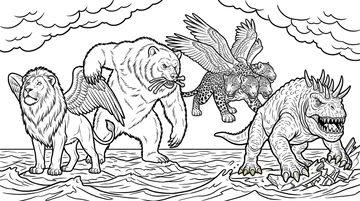
The beast gathers into one composite power all the symbols of Daniel 7, with the mouth of a lion for Babylon, the feet of a bear for Medo-Persia, the body of a leopard for Greece, and the dreadful ten-horned form for Rome and its divisions.ST Aug 24, 1882RH Jan 17, 1871RH May 20, 1858ST Jun 20, 1911 It thereby succeeds to their power, territory, dominion and persecuting character, with their lives prolonged by merger into Rome in its last or papal form after the breakup shown by the ten horns.ST Aug 24, 1882RH Jan 17, 1871ST Jul 4, 1911ST Jun 20, 1911RH Mar 12, 1857 Daniel saw these empires separately as earthly succession to God's kingdom, while John sees them as one continuous system in relation to God's people with the devil behind them and Satan giving power, throne and great authority.ST Jul 4, 1911ST Jun 20, 1911 The figure must be understood by combining Daniel's political foreview and Paul's ecclesiastical foreview to give the perfect portrait of Romanism as Antichrist in rise, character, deeds and doom.RH Sep 13, 1915RH May 24, 1864 One part of the figure presents Romanism as a temporal government and the other as an ecclesiastical system, showing the mutual relations of the Latin church and the Roman state doing Daniel's fourth beast's work on the same ground and ending at the same time to show harmony and nearness of Christ's coming.RH Sep 13, 1915RH May 24, 1864ST Oct 2, 1879 The leopard beast follows the dragon as papal Rome follows pagan Rome, distinct in religious change when paganism and Christianity coalesced yet corresponding to the little horn arising after the ten horns at the same time and place.ST Aug 7, 1879ST Oct 2, 1879
The beast is a prophetic symbol of an earthly kingdom, government or wicked persecuting empire continuing through changes, rather than a literal animal or single individual.RH Mar 30, 1876RH Jun 25, 1857ST Feb 14, 1911RH Jul 14, 1874 It is therion, the same Greek word as the wild beasts under the fourth seal, denoting Church-and-State persecuting governments whose apostasy-born union killed heretics by myriads, shown alive and active by angelic presentation without being real to show God teaches by symbolic images.RH Mar 30, 1876ST Feb 14, 1911 Its identity and location are established by the prophecy's specifications and their fulfillment rather than by guesswork, though verse 1 itself is left here without explanation of sea, heads, horns, crowns or names.ST Sep 14, 1882ST Sep 14, 1882RH Jun 25, 1857 The names of blasphemy on its heads and its blasphemous speech mean usurpation of God's authority by claiming to be God's representative and vicegerent on earth.ST Aug 8, 1916ST Aug 24, 1882RH Apr 10, 1916 That claim is expressed in infallibility, Holy Father, His Holiness and Lord God the Pope, power to forgive sins, grant indulgences, turn bread and wine into Christ's body and blood, command soul and conscience which belong to God alone, exalt men, and continue human mediation from the pagan Pontifex Maximus with the Pope as head of the Roman priesthood taking away Christ's mediation.ST Aug 8, 1916RH Apr 10, 1916 It opens its mouth against God, His name, His tabernacle and heaven-dwellers, and attempts to change God's times and laws, which identifies it as Antichrist, and worship directed to it means service and obedience.RH Apr 10, 1916RH Jun 19, 1860
Its blasphemy includes thinking to change times and laws, exalting its own decrees above God, and speaking great words against God like Daniel's little horn.ST Jun 20, 1900ST Oct 7, 1875RH Jun 26, 1856 Through apostasy it perverted law by disregarding the Sabbath of the fourth commandment and putting Sunday observance in its place without scriptural authority, teaching a changed or mutilated Sinai law and demanding worship and obedience through its own law.RH Jun 19, 1860ST Oct 7, 1875RH Jun 26, 1856 The times and laws are God's law which it cannot actually change, and obeying the altered law serves that power rather than God.RH Jun 19, 1860 The beast is the same power as Daniel's little horn and Paul's man of sin, also called horn, that wicked, mystery of iniquity, son of perdition and antitypical Baal.ST Jul 31, 1879RH Sep 22, 1863RH Nov 6, 1866ST Dec 20, 1883 This is shown by arising at the same time and place after Rome's division into ten kingdoms and the conquest of three kingdoms, with the same blasphemy, war against the saints and victory over them, speaking great things, attempted change of law, claims, forty-two months or 1260-year period, and fate ending in captivity in 1798.RH Sep 22, 1863RH Nov 6, 1866ST Dec 20, 1883
It is diverse because it rose as a church from apostasy, yet its titles show power, discernment, shrewdness, cunning and cruelty, and it is a blasphemous kingdom centered at Rome with the city as its seat ruling 1260 years, not Nero.ST Jul 31, 1879ST Dec 20, 1883 Its scarlet color is a dyed bright red symbolizing cruelty and bloodshed, distinct from the dragon's natural fire-red or sun-colored red that connects the dragon with the great apostate religion of sun-worship.ST Dec 10, 1896RH Mar 2, 1852ST Jul 18, 1911 That scarlet matches the scarlet and purple worn by popes and cardinals, and its leopard, bear and lion form gathers all the tyranny, cruelty and ravenousness of the Chaldean, Persian and Grecian monarchies into papal Rome.RH Mar 2, 1852ST Jul 18, 1911 Called a wild beast it denotes a ferocious and cruel disposition destitute of piety or sympathy, fulfilled by popes, cardinals and bishops persecuting saints accused of heresy with torture and cruel death sparing neither age nor sex, and it carries the woman who is the great city or church reigning over the kings of the earth.RH Mar 2, 1852ST Jul 18, 1911ST Dec 10, 1896
Sources