Daniel 7:24
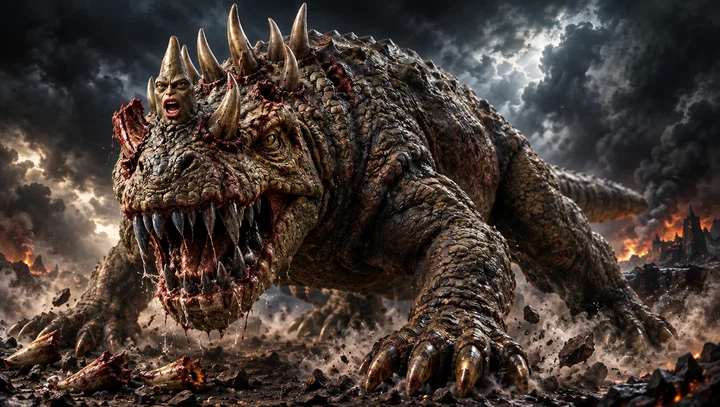
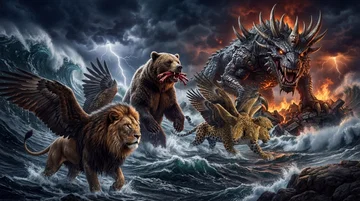
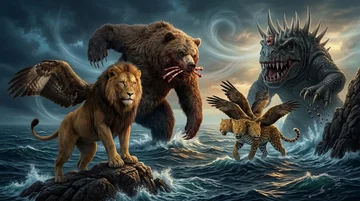
And the ten horns out of this kingdom are ten kings that shall arise: and another shall rise after them; and he shall be diverse from the first, and he shall subdue three kings.
Translations
American King James Version, King James Version, KJV Cambridge Paragraph Bible, Webster Bible
And the ten horns out of this kingdom are ten kings that shall arise: and another shall rise after them; and he shall be diverse from the first, and he shall subdue three kings.
Revised Version, American Standard Version
And as for the ten horns, out of this kingdom shall ten kings arise: and another shall arise after them; and he shall be diverse from the former, and he shall put down three kings.
And the ten horns out of the kingdom [are] ten kings, they rise, and another doth rise after them, and it is diverse from the former, and three kings it humbleth;
And as to the ten horns, out of this kingdom shall arise ten kings; and another shall arise after them; and he shall be different from the former, and he shall subdue three kings.
And, the ten horns of that kingdom, are ten kings who will arise,—and, another, will arise after them, and, he, will be diverse from the former ones, and, three kings, will he cast down;
Berean Standard Bible, Majority Standard Bible
And the ten horns are ten kings who will rise from this kingdom. After them another king, different from the earlier ones, will rise and subdue three kings.
As for the ten horns, ten kings will arise out of this kingdom. Another will arise after them; and he will be different from the former, and he will put down three kings.
And as for the ten horns, out of this kingdom ten kings will come to power; and after them another will come up: he will be different from the first ones and will put down three kings.
And the ten hornes out of this kingdome are tenne Kings that shall rise: and an other shall rise after them, and he shall be vnlike to the first, and he shall subdue three Kings,
Douay-Rheims (Challoner revision)
And the ten horns of the same kingdom, shall be ten kings: and another shall rise up after them, and he shall be mightier than the former, and he shall bring down three kings.
Pictures
Cross-references 20 of 34
- Daniel 7:8
I considered the horns, and, behold, there came up among them another little horn, before whom there were three of the first horns plucked up by the roots: and, behold, in this horn were eyes like the eyes of man, and a mouth speaking great things.
The little horn rises among the ten horns and uproots three.
- Daniel 2:41-44
And whereas thou sawest the feet and toes, part of potters’ clay, and part of iron, the kingdom shall be divided; but there shall be in it of the strength of the iron, forasmuch as thou sawest the iron mixed with miry clay.
The divided iron-and-clay kingdom parallels the ten horns and precedes God’s everlasting kingdom.
- Revelation 13:1-2
And I stood upon the sand of the sea, and saw a beast rise up out of the sea, having seven heads and ten horns, and upon his horns ten crowns, and upon his heads the name of blasphemy.
The beast’s ten horns and authority parallel Daniel’s persecuting power.
- Daniel 7:7
After this I saw in the night visions, and behold a fourth beast, dreadful and terrible, and strong exceedingly; and it had great iron teeth: it devoured and brake in pieces, and stamped the residue with the feet of it: and it was diverse from all the beasts that were before it; and it had ten horns.
The fourth beast bears the ten horns identified as ten kings.
- Daniel 7:20
And of the ten horns that were in his head, and of the other which came up, and before whom three fell; even of that horn that had eyes, and a mouth that spake very great things, whose look was more stout than his fellows.
Describes the horn that subdued three kings and grew stronger than its fellows.
- Revelation 17:12-13
And the ten horns which thou sawest are ten kings, which have received no kingdom as yet; but receive power as kings one hour with the beast.
Both identify ten horns as ten kings who unite their power with the beast.
- Daniel 2:41-43
And whereas thou sawest the feet and toes, part of potters’ clay, and part of iron, the kingdom shall be divided; but there shall be in it of the strength of the iron, forasmuch as thou sawest the iron mixed with miry clay.
The divided iron-and-clay kingdom and its ten parts parallel the fourth beast’s ten horns.
- Revelation 12:3
And there appeared another wonder in heaven; and behold a great red dragon, having seven heads and ten horns, and seven crowns upon his heads.
The dragon’s ten horns correspond to the horns of Daniel’s fourth beast.
- Daniel 7:17
These great beasts, which are four, are four kings, which shall arise out of the earth.
The beasts are identified as kings, supporting the prophecy’s use of kings for kingdoms.
- Revelation 17:3
So he carried me away in the spirit into the wilderness: and I saw a woman sit upon a scarlet coloured beast, full of names of blasphemy, having seven heads and ten horns.
The scarlet beast’s ten horns correspond to Daniel’s ten kings.
- Revelation 13:5-7
And there was given unto him a mouth speaking great things and blasphemies; and power was given unto him to continue forty and two months.
The beast’s blasphemy, war against the saints, and allotted period match the little horn’s character.
- Daniel 7:11
I beheld then because of the voice of the great words which the horn spake: I beheld even till the beast was slain, and his body destroyed, and given to the burning flame.
The boastful horn’s words are followed by the beast’s destruction.
- Daniel 8:9
And out of one of them came forth a little horn, which waxed exceeding great, toward the south, and toward the east, and toward the pleasant land.
Daniel 8 is cited as another prophecy about the little horn.
- Daniel 8:25
And through his policy also he shall cause craft to prosper in his hand; and he shall magnify himself in his heart, and by peace shall destroy many: he shall also stand up against the Prince of princes; but he shall be broken without hand.
The later little horn is the same power that opposes the Prince and is broken.
- 2 Thessalonians 2:3-4
Let no man deceive you by any means: for that day shall not come, except there come a falling away first, and that man of sin be revealed, the son of perdition;
The man of sin exalts himself against God, like Daniel’s little horn.
- Daniel 2:40
And the fourth kingdom shall be strong as iron: forasmuch as iron breaketh in pieces and subdueth all things: and as iron that breaketh all these, shall it break in pieces and bruise.
The iron kingdom is the same fourth kingdom represented by Daniel’s fourth beast.
- Revelation 17:17
For God hath put in their hearts to fulfil his will, and to agree, and give their kingdom unto the beast, until the words of God shall be fulfilled.
The ten horns are kings who unite in giving their kingdom to the beast.
- Daniel 7:19
Then I would know the truth of the fourth beast, which was diverse from all the others, exceeding dreadful, whose teeth were of iron, and his nails of brass; which devoured, brake in pieces, and stamped the residue with his feet;
The fourth beast symbolizes Rome and its kingdoms.
- Daniel 7:18
But the saints of the most High shall take the kingdom, and possess the kingdom for ever, even for ever and ever.
The saints take and possess the kingdom after the prophecy of the kings.
- Daniel 7:13-14
I saw in the night visions, and, behold, one like the Son of man came with the clouds of heaven, and came to the Ancient of days, and they brought him near before him.
The Son of man receives an everlasting kingdom after the little horn’s tyranny.
Commentary part 1 of 3
Each commentary is drawn from primary sources: the writings of Ellen G. White and Adventist pioneers and periodicals. Each commentary is separate. Its own words are not a quotation; follow the references to read the source passages.
Ellen G. White
10 sources
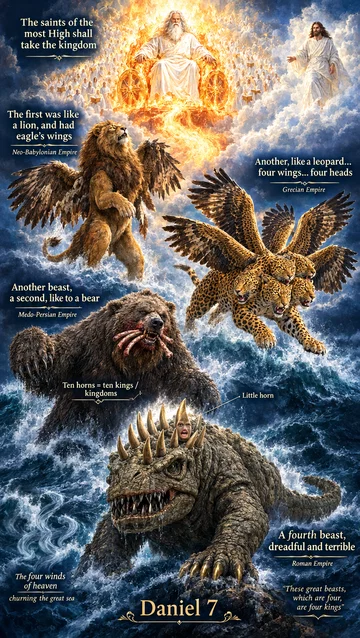
Daniel's vision presents four beasts as the successive empires of Babylon, Persia, Greece, and Rome.4SP 502.2–3 Its apocalyptic beasts arise from the union of church and state and cruelly crush those who oppose them.DA 837.3–4 The ten horns out of this kingdom are ten kings or kingdoms that arise from the Roman Empire, figured as the fourth beast.LS 41.1–42.1LS 40.1–5LS 66.1–67.2
The other king that rises after them, diverse from the first, is the little horn, the Papacy or Roman Church.LS 41.1–42.1LS 40.1–54SP 502.4–6GC88 439.1 It is represented as a horn even before it possessed civil power.4SP 502.4–6 It succeeded to the power, seat, and authority once held by the Roman Empire.GC88 439.1
It subdued three kings, the Heruli, the Vandals, and the Ostrogoths, whose removal cleared the way for papal rule.LS 41.1–42.1LS 40.1–5 It displaced the Heruli in 493, the Vandals in 534, and the Ostrogoths in 538.LS 41.1–42.1 Its rise in 538 began the 1,260-year period ending in 1798.LS 41.1–42.1
In 1798 its dominion was taken away when French forces under Berthier entered Rome and took the city, abolished the papal government, and made the Pope a prisoner, taking him into exile and confining him in the Vatican.LS 41.1–42.1LS 66.1–67.2 The papal power figured by the beast of Revelation 13 inherits the power held in succession by those empires.4SP 502.2–3 The verse belongs to prophecies about future ages that were not fully understood even by Daniel and were sealed until the time of the end.PK 547.1
It is part of the mysteries of the future taught through figures and symbols and recorded for coming generations, covering the events of this world's history till the close of time.PK 484.3 The prophecies of Daniel are to be studied carefully as figurative outlines of events in prophetic history leading to the close of earth's history, with historical events showing their fulfillment in order.Ms 31, 1896, par. 1–2 Understanding was given in visions and dreams with the spirit of prophetic power because Daniel clung to God with unwavering trust, firmness, self-denial, and purity of motive, and God blessed him with knowledge and skill in all learning and wisdom in fulfillment of the promise that those who honor God will be honored.PK 484.3
Sources
Pioneers and periodicals
569 sources
The fourth beast is Rome, and the ten horns out of it are ten contemporaneous kingdoms arising by the division of the Roman Empire, especially its western part.ST Jan 28, 1889ST Jun 27, 1878RH Jan 20, 1853ST Jun 3, 1897ST Mar 24, 1881 They are the Alemanni, Franks, Burgundians, Vandals, Suevi, Visigoths, Anglo-Saxons, Ostrogoths, Lombards, and Heruli, arising between the fourth and fifth centuries and all present together by about 476 to 493.ST Jun 30, 1914ST Oct 17, 1906RH Aug 9, 1915ST Oct 29, 1902 After and among them rises another power, diverse from the purely civil kingdoms because it is religious as well as political, which is the papacy, papal Rome.ST Jan 28, 1889ST Jun 27, 1878RH Jan 20, 1853RH Aug 9, 1915RH Oct 7, 1915 It subdues three Arian kings that obstructed its rise, the Heruli in 493, the Vandals in 533-534, and the Ostrogoths in 538, and from 538 exercises supremacy over saints, times and laws for 1260 years until 1798.RH Jan 10, 1856ST Oct 13, 1881RH Oct 30, 1856ST Oct 13, 1881RH Jun 15, 1869 That whole chain runs from Babylon, Medo-Persia, Greece and Rome to the judgment and the everlasting kingdom given to the saints, which comes after the division and the papal rule and is now near.RH Feb 3, 1853ST Aug 14, 1893RH Mar 18, 1862ST Jan 15, 1880
Fourth Beast Rome
The vision shows four successive universal kingdoms as lion, bear, leopard, and dreadful terrible beast, meaning Babylon, Medo-Persia, Greece, and Rome.ST Jun 27, 1878ST May 3, 1877RH Jun 20, 1854ST Aug 2, 1877RH Nov 2, 1905 The fourth is imperial pagan Rome, the Rome of Augustus, diverse from the others, exceedingly strong and dreadful with iron teeth and brass nails, and it is the last universal kingdom before the saints receive the kingdom permanently.ST Jun 27, 1878ST May 3, 1877RH Mar 24, 1874ST Aug 2, 1877RH Nov 2, 1905 The ten horns are the kingdoms into which Rome was divided, and the blasphemous horn rising among them is the papacy, whose actions against God and His people fulfilled the prophecy, whose allotted period has expired so that destruction by the judgment remains.ST Jun 27, 1878RH Jan 20, 1853ST Jun 24, 1897RH Jan 17, 1871RH Dec 13, 1853
The fourth kingdom is Rome, diverse because it was a republic while the others were kingdoms, and while republican it devoured and crushed other powers.ST Nov 29, 1899RH Jun 5, 1900 It is the iron monarchy, strong as iron breaking and devouring others, ruling the earth for six long centuries and then entering a second divided phase, first divided into two parts and then subdivided into ten.RH Sep 13, 1915ST Apr 13, 1904ST Nov 12, 1885 It fell through internal corruption and weakness from indulgence of appetite and passion, growing corrupt and weak until it perished, broken by hardy northern barbarians shocked at its frivolities and immoralities.RH Sep 13, 1915ST Nov 12, 1885 This overthrow and division by northern nations dismembering the empire put an end to all dreams of world monarchy and gave further opportunity for the kingdoms of this world to be won to become the kingdoms of Christ.RH Sep 13, 1915ST Jan 21, 1889
The ten horns out of this kingdom are ten kings or kingdoms arising out of Rome by division of the Roman Empire.ST Jan 28, 1889ST Jun 27, 1878ST Jun 24, 1897RH Jan 17, 1871RH Dec 13, 1853 They are the ten divisions of the Western Roman Empire, arising especially in its western division and western territory within territory peculiar to Rome proper and on territory Rome held, through northern barbarian invasions, German tribes invading its provinces, and the Gothic wars, fulfilled in the Western Roman world.RH Jan 20, 1853ST Jun 3, 1897ST Jan 27, 1898ST Nov 12, 1885ST Jan 21, 1889 Another power arises after them, different from the ten, and brings three kings down, and its specifications are fulfilled in the papacy, whose dominion ran from about 538 to 1798 and whose final return to world dominance is still expected.ST Jan 28, 1889RH Jan 20, 1853ST Jun 24, 1897RH Jan 17, 1871RH Dec 13, 1853
In prophecy kings and kingdoms are used interchangeably, because a ruler represents his dominion and a king represents the realm he rules.ST Jun 3, 1897ST Mar 24, 1881ST Jan 27, 1898ST Dec 22, 1881 Horns appearing together show ten contemporaneous kingdoms existing at the same time and coming upon the stage together, not successive individual rulers, unlike seven heads which are successive one following another.ST Jan 27, 1898ST Sep 30, 1886ST Nov 14, 1906 Are means represent, a king is a succession of rulers and a body of people under a wicked head rather than a single individual, actions of horn-kingdoms are attributed to the horns, and exactly three are removed while all exist together, so all ten must be present before any of the three are uprooted.ST Jun 3, 1897ST Mar 24, 1881ST Jan 27, 1898ST Sep 30, 1886 A horn can symbolize political power or power more broadly whatever its form, including an ecclesiastical power.ST Dec 22, 1881RH Nov 26, 1857ST Jun 19, 1884
The kingdoms come up from the sea while the four winds strive upon it, where the sea represents multitudes, peoples, nations and tongues, and the winds and their strife mean political strife, commotion, revolution, aggressive wars, and conquest producing empires.RH Jun 9, 1874RH Jan 15, 1861RH Jun 25, 1857ST Jun 19, 1884 Beasts as governments arise amid upheaval, revolution and war among peoples and through conflict among nations and overthrow of earlier governments.ST Nov 29, 1905RH Jun 9, 1874RH Jan 15, 1861RH Jun 25, 1857 This is in contrast to a power coming up quietly out of previously unoccupied territory rather than through such conflict, as with the two-horned beast.RH Jun 9, 1874RH Jan 15, 1861 The final beast passes through successive changes, its ten horns and later little horn belonging to Rome as part of the same continuous system carried forward into Revelation's composite beast dominated by Satan.ST Oct 28, 1908ST Jun 20, 1911ST Nov 29, 1905
A beast symbolizes a government or kingdom continuing through changes, a horn symbolizes a king, kingdom, component part, or power, and heads denote kingdoms, as the four heads of the leopard denote the four kingdoms into which Grecia was divided.ST Nov 29, 1905ST Apr 12, 1883RH May 8, 1916ST Dec 4, 1879RH Aug 14, 1856 Horns as agents or actors signify kings, or rather kingdoms, and the fourth beast's ten horns symbolize kingdoms or powers belonging to Rome.ST Jan 27, 1898ST Apr 12, 1883RH May 8, 1916ST Dec 4, 1879 The fourth beast has its own decade of horns and brazen nails reaching beyond the third beast and is not to be mixed with the third, with winged lion, bear with three ribs, and four-headed leopard answering to Babylon, Medo-Persia and Greece.RH Mar 24, 1874RH Nov 2, 1905 A horn in prophecy can symbolize an ecclesiastical power as well as civil authority, as the little horn diverse from the others is the Roman Catholic church, already a horn as ecclesiastical power at its establishment in 538 before first becoming a temporal monarch in 755.RH Nov 26, 1857ST Jun 19, 1884ST Dec 4, 1879
Ten Kingdoms Identified
The ten are the Alemanni, Franks, Burgundians, Vandals, Suevi, Visigoths, Saxons or Anglo-Saxons, Ostrogoths, Lombards, and Heruli, ten distinct new peoples arising within the bounds of the Western Empire as Rome fell, once subject to Rome then independent.ST Jun 30, 1914ST Oct 17, 1906ST Oct 29, 1902ST Oct 1, 1902 They arose between 351 and 476, and there were ten kingdoms from 476 to 493.ST Oct 17, 1906ST Oct 29, 1902ST Oct 1, 1902 These first ten were not united in giving power to the beast, unlike the ten powers of the end-time alliance in Revelation 17.ST Jul 23, 1912
They are also listed as the Huns, Ostrogoths, Visigoths, Franks, Vandals, Suevi, Burgundians, Heruli and Rugii or Thuringi, Anglo-Saxons, and Lombards, with Sueves and Alans together and Saxons and Angles together.ST Jan 24, 1878ST Nov 29, 1905 The number is specific as ten and no more or less at first, though the division is ultimately tenfold even when three are later uprooted well before the end.ST Oct 10, 1906ST Nov 13, 1893ST They had already developed between 356 and 476 and were not a future confederacy to emerge from a new European war.ST Nov 13, 1893
The first list is dated by place and reign as Huns in Hungary in 356, Ostrogoths in Moesia in 377, Visigoths in Pannonia in 378, Sueves and Alans in Gascoigne and Spain in 407, Vandals in Africa in 407, Franks in France in 407, Burgundians in Burgundy in 407, Heruli and Turingi in Italy in 476, Saxons and Angles in Britain in 476, Lombards first on the Danube in 526 and afterward in Italy.RH Jul 28, 1874 In later periods the list differed and was sometimes more or less in number but still known by that name.RH Jul 28, 1874 All were visible together on the beast from 483 to 493.RH May 27, 1875RH Oct 13, 1874
The division is dated in detail as Alemanni and Franks in 351, Burgundians, Vandals and Suevi in 406, Visigoths in 408, Saxons in 449, Ostrogoths and Lombards in 453, and Heruli in 475-476.ST Jul 6, 1915ST Jan 30, 1896 Rome ever after remaining divided, with ten contemporary monarchical powers all visible together from 483 to 493.ST Jul 6, 1915RH May 27, 1875RH Oct 13, 1874 This division is the leading feature of the political history of the Middle Ages and of modern times.ST Jul 6, 1915
The division into ten political kingdoms occurred between 351 and 476, with ten kingdoms existing from 476 to 493, and for seventeen years after the Heruli arose in 476 there were exactly ten kingdoms in Roman territory, fully developed with the Herulian kingdom in 475-476.RH Aug 9, 1915ST Oct 29, 1902ST Oct 1, 1902ST May 26, 1909ST Dec 17, 1896 The ten divisions existed between 476 and 493, and arose between 476 and 493 in the form in which the later power overthrew three.ST Dec 17, 1896ST Jul 25, 1911 A list of ten peoples occupying the Western Empire in 476 illustrates the division.RH Aug 9, 1915
The division is dated between 356 and 483, among peoples settling Europe between about 350 and 483, sometimes counted differently but remaining known as the ten kingdoms of the western empire.RH Feb 17, 1874RH Jun 15, 1869ST May 4, 1876RH Feb 3, 1853RH Feb 8, 1870 The same division is shown by the ten toes of the image in Daniel 2.ST Jan 24, 1878ST Feb 26, 1880 The kingdoms arising between 356 and 493 fulfill the ten horns.RH Apr 23, 1857 The division into ten parts occurred between 356 and 488, not in the days of the Roman Caesars.RH Jun 19, 1860
Western Rome was divided in 476, the tribes taking possession after its fall in 476, and the ten kingdoms appeared by about 483.ST Feb 17, 1909RH Aug 9, 1915ST Jun 5, 1884 The last of the ten was established in 483 and the division was not complete until the fifth century.ST Jun 5, 1884RH Jul 26, 1870RH Feb 3, 1863 The divided kingdom following the fall of Western Rome in 476 corresponds to the ten horns.RH Feb 3, 1863RH Oct 1, 1914 The division of the fourth empire into ten kingdoms is dated to about five hundred years after Christ, complete before the end of the fifth century.RH Jan 23, 1855RH Apr 26, 1870ST Jun 22, 1882
Rome's division was completed in 476, and the last of those kingdoms arose in 488.RH Aug 9, 1915ST Jun 20, 1900 The ten kingdoms resulted from Rome's division between 356 and 483.RH Feb 21, 1865ST Dec 20, 1883 The Western Empire broke up into ten kingdoms between 353 and 483.RH Jan 31, 1854 The empire was divided into ten kingdoms between 451 and 476.ST Jan 27, 1898 The ten primary divisions arose between 356 and 383.RH Mar 9, 1869
Rome's division into ten temporal kingdoms was completed in 476, had not occurred in the time of Christ and the apostles, and the different horn must arise afterward.ST Jan 14, 1886ST Feb 3, 1898 The divided kingdom following the fall of Western Rome in 476 corresponds to the ten horns.RH Feb 3, 1863RH Oct 1, 1914 The breakup is reported with completion in 476 and after 476 as marker, between 356 and 483, between 351 and 476, between 356 and 488, between 300 and 488 with the last arising in 488, about five hundred years after Christ, complete before the end of the fifth century, and not fully formed until 483.RH Aug 9, 1915RH Feb 21, 1865RH Apr 26, 1870ST Jun 20, 1900ST Dec 20, 1883
Variant historical lists are disputed: Mede's Britons, Saxons, Franks, Burgundians, Visigoths, Sueves and Alans, Vandals, Alemanes, Ostrogoths, and Greeks is questioned because Britons were part of the old empire displaced by Saxons.ST Oct 7, 1886 Newton's dates are reigns not establishments and his Ravenna 408-800 is too late since the exarchate was 554-752.ST Oct 7, 1886ST Jan 7, 1889 Alans in Gaul merged with Visigoths, and Britons may mean Saxons since England was also called Britain.ST Oct 7, 1886 A list drawn in the eighth century cannot correctly identify the original ten, and Bishop Newton's list includes six of the seven remaining kingdoms and omits the Suevi.ST Oct 7, 1886
The ten must be identifiable before 493 and in existence by 493.ST Oct 7, 1886 The Huns cannot be counted because their power disappeared from the Western Empire after 453, the Magyars did not enter Europe until 884 or Hungary until 889, and a people does not count merely by weakening Rome.ST Oct 21, 1886ST Oct 21, 1886 After Attila's death they were driven back across the Danube while other peoples occupied the lands they had held, and Machiavelli's account for 476 to 493 does not name them.
Kingdoms outside the Western Empire cannot complete the ten and the Eastern Empire's Greek peoples cannot be counted.ST Oct 7, 1886 Eastern lands of Chaldea, Assyria, Media, Persia, Greece, Thrace, Asia Minor, Syria and Egypt belong to the first three beasts, so the Greek empire at Constantinople, Turkey and Russia are excluded as belonging to the third beast, and Norway and Sweden are excluded because the fourth beast did not rule them.RH Apr 15, 1862ST Feb 26, 1880RH Dec 17, 1857 The Alemanni are correctly associated with Germany because they took Roman territory, with settlements including Lombards with Italy, Anglo-Saxons with England, Franks with France, Visigoths with Spain, Suevi with Portugal, and Huns with Hungary in that reckoning.RH Apr 15, 1862ST Oct 7, 1886 The ten are sought among the nations of Europe on the western side of Greece, within territory peculiar to Rome proper including Pannonia and westward, the African coastal provinces, and northwestern Illyricum.RH Dec 17, 1857ST Nov 12, 1885ST Nov 19, 1885
The Goths hold the foremost place among nations arising from ancient Germany within the Western Empire because they did most to break Rome's power.ST Dec 3, 1885 The Alemanni are counted as one of the ten arising when the Western Empire fell.ST Dec 16, 1886ST Dec 23, 1886 Christians warned that the empire would be ruined and barbarian kingdoms established as it fell.RH Jul 3, 1900
The number was not always exactly ten, but kingdoms fell and rose and boundaries, names and number changed with sometimes more or fewer through replacement, tributary status, and successors.ST Nov 9, 1882RH Apr 15, 1862RH Apr 7, 1874 They continued to be called the ten kings from their original number and remained in Europe for about twelve hundred years.ST Nov 9, 1882 Their disappearance in part does not cancel the picture of ten horns, for the divisions continue in view until God sets up His kingdom.RH Nov 19, 1901
The ten horns are fulfilled in the division of western Europe into different states living side by side for over a thousand years, represented by modern powers such as England, France, Germany, Italy, Spain, Portugal and Switzerland.ST Jul 7, 1914ST Dec 24, 1912 The Saxons are represented by the English, Franks by the French, Alemanni by the Germans, Visigoths by the Spanish, Suevi by the Portuguese, Lombards by the Italians, Burgundians by Switzerland, and Huns by Hungary, with Russia not arising from these divisions.RH Aug 28, 1900RH Oct 8, 1901RH Oct 31, 1871 England as Anglo-Saxons and France as Franks are parts of those horns and cannot themselves be the separate two-horned power coming up afterward.RH Oct 31, 1871
The divided fourth kingdom remains in that divided state until the end of time, still represented by the kingdoms of western Europe.ST Jun 30, 1914RH Sep 16, 1915 Changes in borders, names or rulers do not end the ten as a prophetic group, and no man can build another universal empire until Christ comes to take the throne of David.RH Apr 15, 1862RH Sep 16, 1915 The ten kingdoms were not fully formed until 483 and were to remain until after 1798, when beast and horns would be destroyed.RH Apr 15, 1862 France, England, Germany, and Italy are divisions of the ancient Roman Empire.ST Jul 15, 1913
The ten kings inherit Rome and are reigning when Christ returns, carrying forward universal supremacy from Babylon to Rome.ST May 8, 1907 Together with a powerful monarch on the new continent comparable to one of them they are called kings of the West, and the final condition is division into ten nations whose balance of power lies on old Roman territory to be struck down when God sets up His kingdom.ST Jun 13, 1906RH Sep 25, 1900 The great powers of Western Europe involved in the Eastern question today are the strong ones of those kingdoms.RH Sep 25, 1900 After three are uprooted seven remain alongside the Papacy until the end, continuing through lineal descendants until God's kingdom replaces them.RH Aug 14, 1900ST May 18, 1904ST Jul 3, 1893
Those seven are identified as Germany, Italy, Austria, Spain, Portugal, France and Great Britain, or as Saxons as Britain, Franks as France, Alemanni as Germany, Burgundians as Switzerland, Visigoths as Spain, Suevi as Portugal, and Lombards as Italy.RH Aug 28, 1900 Later attempts by Charlemagne, Otto the Great and Napoleon to reunite them did not restore unity, and no later power can unite the world.ST Aug 1, 1916 The division of the earth into separate kingdoms will continue until God establishes His everlasting kingdom.ST Aug 1, 1916
Those ten kingdoms all adopted the faith emanating from Rome in the sixth century, and the papacy established influence over the ten sovereignties as paganism revived under a new form.RH Sep 22, 1874 France as chief under Clovis, established 486 and converted 496, helped overthrow pagan governments and establish papal power.RH Jan 20, 1853 The Visigoths in Spain later came under Roman Catholic influence.RH Dec 17, 1908 The ten divisions are the source from which great powers of today gradually developed, shaping contemporary history and the coming conflict.RH Apr 14, 1903RH Oct 8, 1901 Belgium's rule under French kings applies the division to Western Europe, and their record shows human government failed to secure freedom.ST Oct 31, 1916
Secular history corroborates the prophecy by giving both number and names of the ten formed from Rome, and study of the seven trumpets vindicates it.RH Sep 22, 1874RH Sep 22, 1874 The first four trumpets continue and complete the breakup by describing its manner through wars in the Christian dispensation.RH Sep 29, 1874 The Papal Church refused to admit Rome had fallen and was divided, worked to bring another universal empire under the old name and to prevent Europe remaining divided.ST Apr 16, 1894 The prophecy foretells attempts by European kingdoms to dominate one another into a universal empire that never again unites, uniting and warring together until all are swallowed up in destruction when earth is rejuvenated as home of Christ's eternal empire.ST Jul 6, 1915ST Jul 20, 1915ST Jun 22, 1915
Little Horn Identified
The power rising after and among the ten, diverse from the first and subduing three kings, is the little horn, the papacy, papal Rome, ecclesiastical Rome, the Roman Church and Catholic hierarchy, the line of popes and bishop of Rome, also called modern Babylon, the Antichrist of Rome, the man of sin, whose rise is the principal subject of the vision.ST Jan 28, 1889ST Jun 27, 1878RH Jan 20, 1853RH Jun 20, 1854RH Aug 9, 1915 The ten are the division of Rome, and the later distinct power overthrows three of them, wears out the saints, receives dominion over them, and continues until judgment destroys it after its allotted period expires.ST Jan 28, 1889ST Jun 27, 1878RH Jan 20, 1853RH Jun 20, 1854RH Feb 10, 1874 Its subduing of three kings is the plucking up of three horns, linked to its rise and its historical dominion from about 538 to 1798.ST Jan 28, 1889RH Jan 20, 1853RH Jun 20, 1854RH Aug 9, 1915RH Feb 10, 1874
It is diverse because the ten were purely civil political kingdoms while it is religious as well as political, a priest-king and ecclesiastical monarchy combining temporal and spiritual dominion, putting itself in God's place and claiming dominion in both spheres as a church-and-state system with the state serving the church.RH Aug 9, 1915RH Oct 7, 1915RH Aug 21, 1900RH Aug 9, 1915ST Jun 5, 1884 It is both king and priest-king, an apostate church grown into civil supremacy, a power both political and ecclesiastical answering exactly to the eleventh horn.RH Aug 9, 1915RH Oct 7, 1915RH Aug 9, 1915ST Jun 5, 1884ST Jul 7, 1914 Endowed with almost superhuman insight and surrounded by greater pomp, whose utterances are more startling even than its deeds, it lays hands upon the saints and upon the law and exercises supremacy over Europe nearly until the coming of Christ.RH Aug 9, 1915RH Oct 7, 1915RH Aug 21, 1900ST Jun 5, 1884ST Jul 7, 1914
Its diversity is a different form of government exercising authority in spiritual matters such as defining heresy and relying on civil governments to enforce punishment, attaining prophetic effect in 538 when the state recognized it, separate from later rule over the States of the Church beginning in 755.ST Jun 3, 1897ST Jun 17, 1897RH Nov 26, 1857ST Oct 1, 1902ST Jan 30, 1896 It teaches the Church should dominate and the State define and punish heresy at its command, holding power as an ecclesiastical body within itself, spiritual domination over the nations by their consent, and temporal power in its own territory.ST Jun 3, 1897ST Jun 17, 1897ST Oct 1, 1902ST Jan 30, 1896ST Jul 6, 1915 At first purely ecclesiastical, that ecclesiastical power continues to its end, while civil power over the States of the Church given by Pepin is a separate kind of temporal power not necessary to spiritual domination.ST Jun 17, 1897RH Nov 26, 1857ST Oct 1, 1902ST Jan 30, 1896ST Jul 6, 1915
That power is diverse because as an ecclesiastical power become kingly it stepped into the imperial vacancy, inheriting the power, seat and authority of Rome through gradual development, professing distinct religion and claiming to be head of the church and vicar of Christ with universal dominion.STRH Jan 23, 1908ST Sep 30, 1880ST Jan 30, 1896ST Jun 24, 1897 Though small in temporal territory it became prominent after the ten arose and its look was more stout than its fellows, ruling as representative of God, a priest-king, with the Church dominating the State.RH Jan 23, 1908ST Sep 30, 1880ST Jan 30, 1896ST Jun 24, 1897ST Dec 20, 1883 Rome, formerly seat of imperial rule transferred to Constantinople, was given to the pope, and the conflict with Arian powers obstructing that rise belongs to the struggle between Arianism and Trinitarianism with the bishop on the Trinitarian side.STRH Jan 23, 1908ST Jan 30, 1896ST Jun 24, 1897ST Dec 20, 1883
It is an exception to the general rule that a horn means civil power, meaning ecclesiastical power; a horn can stand for a church even before receiving civil power, the church of Rome being introduced under the little horn before that union, and while rising it need not be governmental.RH Sep 30, 1873RH Apr 4, 1871RH Nov 26, 1857ST Jun 19, 1884ST Apr 12, 1883 Horns as agents signify kings or kingdoms or component parts of a kingdom, and can represent a church as well as civil authority.RH Apr 4, 1871RH Nov 26, 1857ST Jun 19, 1884ST Apr 12, 1883RH May 8, 1916 The 1290 years mark supremacy of that church over other churches, while the 1260 years mark beginning of alliance with civil authority.RH Sep 30, 1873RH Apr 4, 1871RH Nov 26, 1857ST Jun 19, 1884ST Apr 12, 1883
The little horn began small with mild appearance of a Christian church but became formidable, an eleventh kingdom arising among the ten after the tenth appeared, growing gradually and almost imperceptibly unlike the ten already formed, without a clearly identifiable year when its power began.RH Oct 30, 1856ST Dec 24, 1912ST Oct 1, 1902ST Oct 1, 1902 After the ten horns are in full view another horn rises diverse from the ten and secures territory by subduing three kings, dominating the others, speaking against God, persecuting saints, and seeking to change times and law to the end.ST Dec 24, 1912ST Oct 1, 1902ST Oct 1, 1902ST Oct 25, 1905 Its civil authority was established when Justinian conferred power, and with the last opposing kingdom subdued the saints were given into its hand.RH Oct 30, 1856ST Dec 24, 1912ST Oct 1, 1902ST Oct 25, 1905
It arose among and after the ten after division by barbarian incursions in the fourth and fifth centuries was completed before the end of the fifth century, gaining elevation as head of the church at the beginning of the sixth century, with its center at Rome within the Roman monarchy and territory of the ten Latin kingdoms.ST Nov 13, 1901RH Mar 12, 1857ST Sep 30, 1880RH Jan 10, 1871ST Oct 13, 1881 The division complete, the pope's elevation marks that rise, Rome given to the pope, the power developing after several hundred years of apostasy before taking place among the ten.ST Nov 13, 1901ST Sep 30, 1880ST Jul 15, 1913RH Jan 10, 1871ST Oct 13, 1881 France as one of those horns is a horn not a head, and the horns in Daniel and Revelation are the same kingdoms.RH Mar 12, 1857ST Sep 30, 1880ST Jul 15, 1913RH Jan 10, 1871ST Oct 13, 1881
The rise follows division of the Latin Empire into ten kingdoms, placed around the sixth or seventh century, arising from the ruins of Rome about 1200 years ago; the man of sin with his place at Rome as priest-king took place about 1300 years ago so his arising is past history, not future.RH Aug 9, 1915ST Dec 14, 1882RH Sep 26, 1854ST Dec 14, 1882ST Sep 30, 1880 The apostasy would continue for many ages and not be destroyed until the second coming, the divided state continuing until Christ comes, leaving Christ's coming next to be looked for.RH Aug 9, 1915ST Dec 14, 1882RH Sep 26, 1854ST Dec 14, 1882ST Sep 30, 1880 Its defining work of changing God's law, speaking against God and wearing out saints, cannot be attributed to Christ.RH Aug 9, 1915ST Dec 14, 1882RH Sep 26, 1854ST Dec 14, 1882ST Sep 30, 1880
The papacy rose to prominence in the fourth century as the church became political and bishops claimed preeminence, taking the form of the Roman State with power passing to the see under Leo the Great in 440-461; the pope as distinct priest-king appeared in the early sixth century after the ten, claimed rule over kings, humbled monarchs, and persecuted Bible readers refusing him as head.ST Jun 17, 1897STST Dec 20, 1883STST Jan 30, 1896 Its rise occurred during the very period when the ten existed between 351 and 476 to 493, centered around the bishop of Rome, although early teaching placed believers under Christ as one Master as brethren.ST Jun 17, 1897STST Dec 20, 1883STST Jan 30, 1896 The 1260-year period is reckoned from Justinian's decree making the pope head to overthrow of papal government in 1798.ST Jun 17, 1897STST Dec 20, 1883STST Jan 30, 1896
The horn with human eyes signifies observant, far-seeing, calculating policy, shrewdness, and strength through bulls, excommunications and anathemas, working behind the kingdoms to control them; the supremacy of the bishop answers exactly to the eleventh horn, endowed with insight and pomp, laying hands upon saints and law over Europe nearly until Christ's coming.ST Jul 7, 1914ST Nov 21, 1900ST Jan 9, 1893ST Its dominion founded on deep policy is shown by eyes of a man and mouth speaking, planning for near and distant future while earthly horns concerned only with the present are blind.ST Jul 7, 1914ST Nov 21, 1900ST Jan 9, 1893ST That shrewdness applies also to growing influence in America.ST Jul 7, 1914ST Nov 21, 1900ST Jan 9, 1893ST
Pagan Rome and papal Rome are one power with political and religious unity, so the ten barbarian kingdoms under papal domination remain inseparable parts of the fourth beast from Caesar to the end; though the horn differs the beast retains cruel, voracious, persecuting character growing more intense, marking transition from pagan imperial Rome to papal Rome.RH Jan 23, 1908ST Jan 30, 1896ST Jun 20, 1911ST Aug 3, 1915 Its rise marks that transition, a religio-political phase surpassing the other horns in influence and dominating much of the beast's career.RH Jan 23, 1908ST Jan 30, 1896ST Jun 20, 1911ST Aug 3, 1915
The little horn is not Antiochus Epiphanes, who lived centuries before Rome was divided into ten and was only the eighth of twenty-six Syrian kings of the Grecian horn, a king who could not resist Rome; shifting the prophecy to him saves the papal church from any share.RH May 27, 1873RH Dec 23, 1852RH Dec 10, 1857ST Feb 12, 1880RH Nov 21, 1854 Daniel 7 shows Roman power pagan and papal, and opposers of the Advent faith follow that shift.RH May 27, 1873RH Dec 23, 1852RH Dec 10, 1857ST Feb 12, 1880RH Nov 21, 1854 He could not at the same time be another distinct horn, and its growth corresponds to Rome first pagan then papal.RH May 27, 1873RH Dec 23, 1852RH Dec 10, 1857ST Feb 12, 1880RH Nov 21, 1854
Antichrist is the church of Rome rising after the fall of the Empire at Rome, not Caligula whose brief reign came centuries before the last of the ten, not Antiochus, and not Turkey though overthrow details might seem to fit, since other details fit the Papacy instead.RH May 27, 1873ST Dec 20, 1883ST May 27, 1875ST Jan 28, 1913RH Sep 22, 1874 The prophecy points directly to this church, held from earliest ages to appear soon after Rome's fall, with long rule marked by blasphemous claims including universal dominion as Christ's vicar and persecution through the Inquisition.RH May 27, 1873ST Dec 20, 1883ST May 27, 1875ST Jan 28, 1913RH Sep 22, 1874 By a futuristic interpretation held by some, the little horn is a future anti-Christian power to arise in connection with the beginning of Christ's everlasting kingdom.STST Dec 20, 1883ST May 27, 1875ST Jan 28, 1913RH Sep 22, 1874
The little horn of Daniel 7 rising after the ten is distinct from the little horn of Daniel 8; Daniel 7 represents the papacy exclusively while Daniel 8 represents Rome through both pagan and papal phases, with pagan Rome as type of papal Rome, and one view makes Daniel 8 a symbol of Mahometanism, which is rejected.ST May 10, 1877ST Nov 19, 1885ST Feb 10, 1898 The Daniel 7 horn covers Rome during only part of its history, while Daniel 8 covers Rome throughout pagan and papal forms and the same period as the fourth beast and all its horns.ST May 10, 1877ST Nov 19, 1885ST Feb 10, 1898 The view identifying Daniel 8 as Mahometanism is set beside the weight holding Daniel 8 as Rome pagan and papal.ST May 10, 1877ST Nov 19, 1885RH Apr 15, 1873
In Daniel 7 Rome is presented in civil and ecclesiastical phases with the little horn as the ecclesiastical phase while the wider fourth-beast power includes both, in contrast with Daniel 8 where Rome is treated as one power; the ten-horned beast corresponds to Daniel 8 and the legs and feet of Daniel 2.ST May 10, 1877ST Nov 19, 1885ST Feb 10, 1898RH Feb 17, 1853 The power is claimed to be the church with Christ as invisible head and the pope as visible head, established by God as completed organization and kingdom of God on earth, not of this world because from heaven, established upon Peter as head in place of Christ as both priest and king.ST Nov 19, 1885ST Feb 10, 1898RH Feb 17, 1853RH Jan 23, 1900 In that claim everything in Christ and the church is claimed for Peter, priesthood and kingly power intimately connected, Christ entrusted with highest priesthood and kingly power governing the religio-spiritual body.ST Nov 19, 1885ST Feb 10, 1898RH Feb 17, 1853RH Jan 23, 1900
After disintegration into ten the Roman Catholic Church rises to universal power, then declines and loses temporal power, and finally triumphs throughout the world.ST Feb 10, 1898RH Feb 17, 1853RH Jan 23, 1900ST Dec 1, 1914 Some present religious organizations strikingly resemble the little horn in spirit and action by animosity against Christ's coming, refusing peace to avowed believers in the near advent and expelling them.ST Feb 10, 1898RH Feb 17, 1853RH Jan 23, 1900RH May 28, 1901ST Dec 1, 1914 The sequence is described by some as reaching its end after four monarchies with Turkish power arising from the fourth and still remaining though near decline, without explaining the ten kings, later ruler, or three subdued.ST Feb 10, 1898RH Jan 23, 1900RH Oct 7, 1862RH May 28, 1901ST Dec 1, 1914
The little horn is a power distinct from the two-horned beast and from Revelation 13 beasts, whose place is determined by fulfillment of specifications.ST May 10, 1877ST Nov 19, 1885RH Nov 13, 1866RH Mar 21, 1854 Its difference together with specific characteristics identifies one power or system and its principles rather than every associated person; the chapter warns about an evil system not particular people, since submission to evil principles can lead even conscientious persons to evil.STRH Nov 13, 1866RH Mar 21, 1854ST Feb 13, 1912ST The warning is for people both within and outside that system.STRH Nov 13, 1866RH Mar 21, 1854ST Feb 13, 1912ST
The fourth beast with ten horns and especially the little horn is the deepest central objective of the vision, closely identified with the fourth beast yet having independent history opposing the fifth kingdom; the verse locates the territory, time and work of the antichrist kingdom.STST Sep 17, 1902ST Dec 30, 1903ST Oct 1, 1902ST Feb 13, 1912 The ten kings belong to and locate the fourth kingdom, which the first three lead up to as stepping stones, representing Babylon, Medo-Persia, Grecia, and Rome with northern tribes breaking Roman rule within the old empire.STST Sep 17, 1902ST Dec 30, 1903ST Oct 1, 1902ST Feb 13, 1912
The Papacy arose among divided kingdoms asserting a worldly kingdom, evidenced by jeweled crown and golden throne as worldly and antichristian; it develops one-man rule, dominates the world, and as apostate church power connected with decline of Roman government forges dominance bringing nations low socially, politically and educationally, yet is doomed.ST Oct 1, 1902RH Sep 15, 1910STRH Jan 23, 1908ST Jan 30, 1896 Its work upon nations is seen in Spain, Italy, Ireland and South American States, though as a system not the people trusting it, forever doomed as lost cause.ST Oct 1, 1902RH Sep 15, 1910STRH Jan 23, 1908ST Jan 30, 1896 Though small at first and distinct, it gains supremacy, brings three kings down, and with Justinian's decree culminating in 538 rises as persecuting power.ST Oct 1, 1902STRH Jan 23, 1908ST Jan 30, 1896ST Jun 24, 1897
The verse is fulfilled in the papacy as modern Babylon, revealing pride and arbitrary power marking Chaldean Babylon, where paganism from Babel takes the place of Christianity and the human is substituted for the divine; ancient Babylon's temporal sway types its attempted spiritual sway, proved by demanding subjection to the Roman Pontiff as necessary to salvation.RH Aug 21, 1900ST Jul 7, 1914ST Oct 1, 1902RH Sep 18, 1900RH Sep 13, 1915 In it paganism beginning at the tower opposes the gospel of the kingdom, ruled by the same invisible king seeking universal dominion as the beast from the sea and woman on the scarlet beast.RH Aug 21, 1900ST Jul 7, 1914ST Oct 1, 1902RH Sep 18, 1900RH Sep 13, 1915 The papacy was formed when Christianity partnered with paganism obscuring Christ's doctrines, and four hundred years before the Reformation when Christendom was lost in apostasy it held western Europe in absolute spiritual subjection, the Dark Ages being its golden age, becoming more stout than its fellows.RH Aug 21, 1900ST Jul 7, 1914RH Sep 18, 1900RH Sep 13, 1915
The verse locates the power centered at Rome in Italy with reach across the former fourth-beast territory including France, Belgium, Spain, Portugal, Savoy, Italy, Bavaria, Austria, and part of Hungary.ST Nov 13, 1901ST Sep 30, 1880ST Sep 17, 1902ST Dec 30, 1903ST Dec 14, 1882 Its center is the bishop's see at Rome within the Roman monarchy and territory of the ten Latin kingdoms, Roman in political, church, and pontifical forms.ST Nov 13, 1901ST Sep 30, 1880ST Sep 17, 1902ST Dec 30, 1903ST Dec 14, 1882
Three Kings Uprooted
The three kings subdued to make way for papal power are the Heruli, the Vandals, and the Ostrogoths, plucked up by the roots because they opposed its establishment, three kingdoms displaced to establish Roman Catholic power and to take Rome as its seat.RH Jan 10, 1856ST Oct 13, 1881ST Oct 13, 1881RH Feb 17, 1874RH Jun 15, 1869 The three plucked up are the Heruli occupying Italy, the Vandals occupying North Africa, and the Ostrogoths occupying Italy in place of the Heruli, and three taken from ten leaves seven remaining as Western European powers.RH Aug 28, 1900RH Mar 31, 1874ST Nov 5, 1894ST Apr 19, 1877ST Nov 26, 1896 Those seven of the original ten remain in that territory as the powers of Western Europe: the Saxons as Britain, the Franks as France, the Alemanni as Germany, the Burgundians as Switzerland, the Visigoths as Spain, the Suevi as Portugal, and the Lombards as Italy.RH Aug 28, 1900ST Apr 13, 1915
In one account the three wiped out are given as the Heruli, the Ostrogoths and the Lombards, the power beginning small and pushing up among the ten, and the three opposing temporal rule are also given as Heruli, Lombards and Ostrogoths.ST Dec 21, 1882RH Jul 28, 1874ST Jun 13, 1900 The three kings in that reckoning are identified as the rulers of the Heruli, Ostrogoths, and Lombards, whose territories the papal power supplanted in Italy, with its three crowns linked to the crowns of Odoacer, Theodoric, and Alboin.ST Dec 21, 1882ST Jun 13, 1900 The three kingdoms named as Ravenna in 752, the Lombards in 774, and the Senate of Rome in 800 do not fit, because three original kingdoms had already been overthrown before those dates and the Senate was not separate since counted as part of Ravenna.ST Jan 7, 1889 The three subdued kings are applied to the Senate of Rome, said to have been overthrown by Charlemagne in 800, treated as when saints, times and laws were given into the Papacy's hand and the 1260 years began, ending in 2060.ST Jan 7, 1889
The three were uprooted as the Heruli in 493, the Vandals in 534, and the Ostrogoths in 538, the last falling when Justinian sent Belisarius against them and drove them from Rome, finally in March 538.RH Oct 30, 1856RH Jun 15, 1869ST Oct 29, 1902RH Jul 23, 1872ST Jan 24, 1878 The Heruli were uprooted in 493 on March 5, the Vandals in 534, and the Ostrogoths in 538 in March, with Justinian's decree issued three years before 538 and the removal extending from 493 to 538.RH Feb 21, 1865ST Sep 30, 1886ST Nov 13, 1901ST Jun 17, 1897ST Aug 26, 1889 The Heruli fell in 493, the Vandals fell in 533, and the Ostrogoths received decisive defeat in 538, securing papal independence; the Herulian kingdom was overthrown by Ostrogoths in 493, Vandals defeated by Belisarius in 533, and Ostrogoths defeated in 538, establishing spiritual domination.ST Feb 13, 1912ST Feb 17, 1909ST Jul 3, 1893ST Oct 17, 1906
The Heruli were conquered in 493 by the Ostrogoths, the Vandals in 534 by the Greeks, and the Ostrogoths were driven from Rome in March 538 and defeated in Rome and Italy in 538, with overthrow beginning in 493 and completed in 538, marking beginning of supremacy and 1260 years.RH Apr 23, 1857RH Aug 14, 1900RH Aug 1, 1865ST Mar 23, 1888RH Jun 20, 1854 Their defeats in 498, 534, and 538 cleared the way, with Heruli conquered by Ostrogoths, Vandals by Greeks, and Ostrogoths by Justinian's army so his decree making the Bishop head of churches could be carried out.RH Aug 1, 1865 The overthrow of the Ostrogoths is also dated to 552-553, with Heruli, Vandals and Ostrogoths as Arian kingdoms overthrown in its presence in 493, 534, and 552-553; the Ostrogothic nation was forced out in 538 and completely uprooted in 554.RH Jun 20, 1912RH Aug 9, 1915 The Vandals fell in 493 and the Ostrogoths received decisive defeat in 538 in one account where the bishop supported Trinitarianism against Arianism and the ten were all in place by 476.ST Feb 13, 1912ST
The three were Arian powers whose control of Rome and Italy obstructed the bishop's rise, including control over papal elections; their overthrow cleared the way for papal dominion and Catholic supremacy.ST Oct 13, 1881ST Oct 13, 1881RH Feb 17, 1853RH Sep 27, 1853RH Apr 14, 1853 The conflict is set amid struggle between Arianism and Trinitarianism with the bishop on the Trinitarian side; three fell because they were Arian while he was Trinitarian, and in 538 the Papacy became dominating spiritual power of divided Rome.ST Oct 22, 1894ST The subduing was worked by policy as spiritual power through orthodox emperors and generals: Heruli holding Rome exterminated in 493 by Ostrogoths under Theodoric under Zeno, Vandals conquered by Belisarius with their king taken to Constantinople, and the Ostrogothic kingdom falling with Belisarius entering Rome in 536-538, so the pope could exercise power granted by Justinian and assume civil power in 538.RH May 27, 1875ST May 25, 1882ST May 9, 1878
The Ostrogoths as last of the three held Rome and Italy in Arian opposition and had to be rooted out before the pope could exercise power conferred by Justinian's decree; the Italian war begun in 534 opened Rome December 10, 536, drew Goths to besiege it from March 537 for a year and nine days, and ended March 538 when they retired in ruin, so saints, times and laws came into papal hands in fact.RH Mar 7, 1871RH Feb 17, 1853RH Aug 9, 1915RH Jun 20, 1854 The Ostrogoths' control prevented exercising power granted by Justinian; Belisarius entered Rome after cities abandoned the Gothic ruler, and the Ostrogoths had to be driven from Rome, removing an Arian obstacle and allowing enforcement of the decree establishing the bishop as head and corrector of heretics, with the Vandal nation disappearing after Belisarius drove them from Africa at Roman Catholics' request.RH Feb 17, 1853RH Aug 9, 1915RH Jun 20, 1854ST May 9, 1878 Theodoric's rule over Italy illustrates restraint an Arian king could impose before his power was removed; the three horns plucked up before the pontiff were removed to prepare supremacy, the Ostrogoths as third subdued by Justinian, enabling independent civil authority.ST Aug 12, 1875ST May 7, 1885ST Oct 27, 1881
Being plucked up by the roots means cessation of existence, falling in the presence of the coming power.RH May 27, 1875 Being subdued means they were not utterly destroyed but compelled to quit the field, withdraw from contest and seek territory elsewhere.ST Apr 19, 1877ST Sep 29, 1881RH Oct 13, 1874 The plucking up of three by the little horn shows the kingdoms were independent.ST Aug 25, 1881 The rise followed removal of three which made room for it; after three divisions were subdued the bishop became recognized as head over churches in 538, and the last Gothic horn being removed when Goths were driven from Rome left the city in papal hands ever since.RH Jan 10, 1856ST Oct 13, 1881ST Oct 13, 1881RH Jan 23, 1900RH Jul 23, 1872
The little horn appears after three horns have been uprooted, with uprooting before or in its presence, but removal of the last of the three did not mark beginning of the period of supremacy; the Papacy was already counted as a horn before uprooting three and before civil power was conferred.ST Sep 5, 1911RH Apr 28, 1910RH May 19, 1851 The subduing of three kings is linked to three horns plucked up and a peculiar horn appearing in their place; it is the last sign before the judgment and everlasting kingdom.RH Jan 20, 1853RH Feb 3, 1853ST Jul 23, 1874RH Nov 14, 1854 The passage places exaltation of the triple-crowned Pontiff within Rome's history without explaining which three kings he subdues, and one passage raises as questions for historical explanation that the ten horns are raised as nations and the little horn destroys three first horns.STRH Nov 21, 1854
Sources