Revelation 9:10
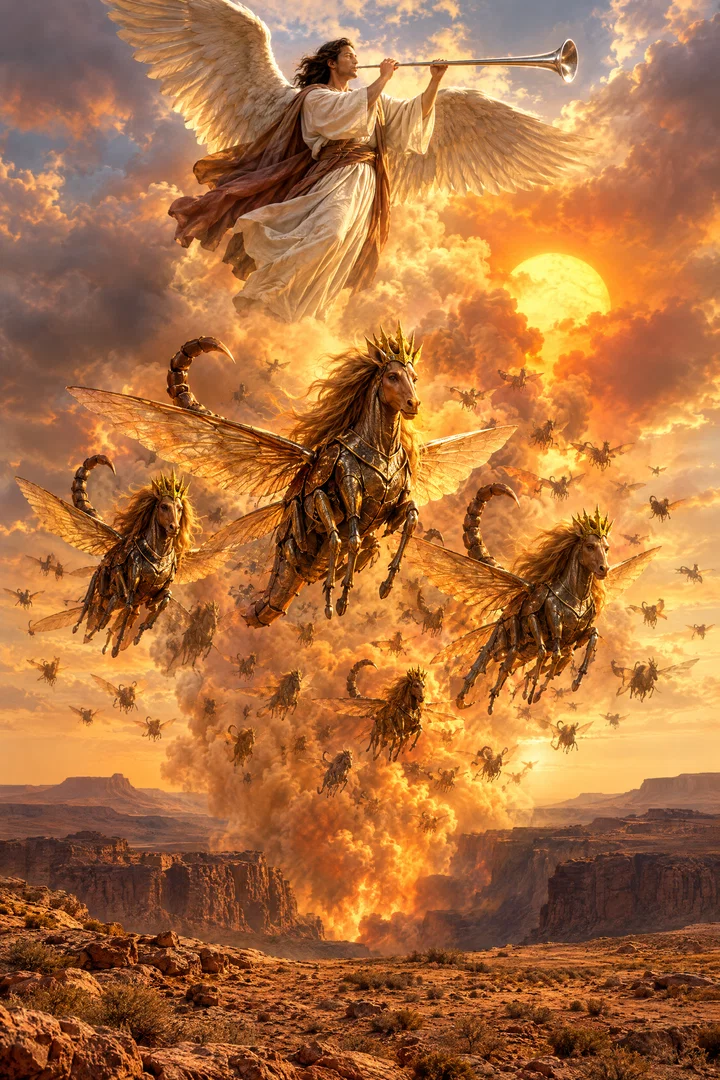
And they had tails like unto scorpions, and there were stings in their tails: and their power was to hurt men five months.
Translations
And they had tails like to scorpions, and there were stings in their tails: and their power was to hurt men five months.
King James Version, KJV Cambridge Paragraph Bible
And they had tails like unto scorpions, and there were stings in their tails: and their power was to hurt men five months.
And they had tails like scorpions, and there were stings in their tails: and their power was to hurt men five months.
Revised Version, American Standard Version
And they have tails like unto scorpions, and stings; and in their tails is their power to hurt men five months.
and they have tails like to scorpions, and stings were in their tails; and their authority [is] to injure men five months;
and they have tails like scorpions, and stings; and their power [ was] in their tails to hurt men five months.
and they have tails like unto scorpions, and stings, and, in their tails, is their licence to injure men five months.
Berean Standard Bible, Majority Standard Bible
They had tails with stingers like scorpions, which had the power to injure people for five months.
They have tails like those of scorpions, with stingers. In their tails they have power to harm men for five months.
And they have pointed tails like scorpions; and in their tails is their power to give men wounds for five months.
And they had tailes like vnto scorpions, and there were stings in their tailes, and their power was to hurt men fiue moneths.
Douay-Rheims (Challoner revision)
And they had tails like to scorpions, and there were stings in their tails; and their power was to hurt men five months. And they had over them
Pictures
Cross-references
- Revelation 8
And when he had opened the seventh seal, there was silence in heaven about the space of half an hour.
same trumpet series as chapter 9
- Revelation 9:5
And to them it was given that they should not kill them, but that they should be tormented five months: and their torment was as the torment of a scorpion, when he striketh a man.
It gives the same five-month limit on the power to hurt people.
- Revelation 9:4
And it was commanded them that they should not hurt the grass of the earth, neither any green thing, neither any tree; but only those men which have not the seal of God in their foreheads.
The sealed are distinguished from those exposed to the coming harm.
- Joel 2:3
A fire devoureth before them; and behind them a flame burneth: the land is as the garden of Eden before them, and behind them a desolate wilderness; yea, and nothing shall escape them.
Both describe locust-like devastation that leaves the land desolate.
- Revelation 8:2
And I saw the seven angels which stood before God; and to them were given seven trumpets.
The listed work treats the seven-trumpet prophecy across Revelation 8 and 9.
- Revelation 9:2
And he opened the bottomless pit; and there arose a smoke out of the pit, as the smoke of a great furnace; and the sun and the air were darkened by reason of the smoke of the pit.
The smoke and darkness introduce the prophecy of this power’s rise.
- Exodus 10:15
For they covered the face of the whole earth, so that the land was darkened; and they did eat every herb of the land, and all the fruit of the trees which the hail had left: and there remained not any green thing in the trees, or in the herbs of the field, through all the land of Egypt.
Both describe locusts bringing widespread destruction.
- Joel 1:4
That which the palmerworm hath left hath the locust eaten; and that which the locust hath left hath the cankerworm eaten; and that which the cankerworm hath left hath the caterpiller eaten.
Locusts devastate the land.
- Revelation 7:1-3
And after these things I saw four angels standing on the four corners of the earth, holding the four winds of the earth, that the wind should not blow on the earth, nor on the sea, nor on any tree.
Identifies the sealed people spared from the scourge.
- Exodus 10:4
Else, if thou refuse to let my people go, behold, to morrow will I bring the locusts into thy coast:
Both describe locusts as agents of widespread destruction.
- Luke 11:12
Or if he shall ask an egg, will he offer him a scorpion?
Both texts use scorpions as an image.
- 1 Corinthians 15:56
The sting of death is sin; and the strength of sin is the law.
The sting is linked with sin.
- Revelation 8:13
And I beheld, and heard an angel flying through the midst of heaven, saying with a loud voice, Woe, woe, woe, to the inhabiters of the earth by reason of the other voices of the trumpet of the three angels, which are yet to sound!
names the last three trumpets
Commentary
Each commentary is drawn from primary sources: the writings of Ellen G. White and Adventist pioneers and periodicals. Each commentary is separate. Its own words are not a quotation; follow the references to read the source passages.
Ellen G. White
2 sources
The verse belongs to the prophecy concerning the Ottoman Empire.GC 334.4–335.1GC88 334.4–5 Its five months are a first period of 150 years, exactly fulfilled before Deacozes ascended the throne by permission of the Turks.GC 334.4–335.1 That first period was followed by a second period of 391 years and fifteen days.GC 334.4–335.1
Together the periods ended on 11 August 1840, when Ottoman power in Constantinople was broken as Turkey, through its ambassadors, accepted the protection of the allied powers of Europe and thus placed itself under the control of Christian nations and surrendered its independence.GC 334.4–335.1GC88 334.4–5 This exact fulfillment proved the correctness of the principles of prophetic interpretation adopted by Miller and his associates.GC 334.4–335.1 It gave a powerful impetus to the Advent movement, which rapidly expanded from 1840 to 1844.GC 334.4–335.1
Sources
Pioneers and periodicals
83 sources
The verse belongs to the fifth trumpet, the first woe, which is the conquests of Mohammed and his followers, the Saracens and Turks, as a scourge upon an apostate church and upon the Roman Empire, especially the Eastern or Greek empire.ST Nov 7, 1916RH Jul 22, 1858ST Oct 31, 1916 Its locust-like figures have tails like scorpions with stings in their tails, giving them power to hurt men for five months, and their appointed work is torment rather than killing.ST Mar 21, 1911RH Dec 25, 1900 The stinging tails are the authority of the rulers who succeeded Muhammad, who combined legal and religious office and ruled conquered eastern nations through violence and severity.RH Jul 22, 1858 The five months are 150 prophetic days reckoned as 150 literal years by the day-for-a-year rule, counted from Othman's first attack on Greek territory on July 27, 1299 to July 27, 1449, when the Greek emperor took the throne only by permission of the Turkish sultan.ST Jul 13, 1915RH Sep 4, 1900RH Nov 23, 1905RH Jul 29, 1858ST May 25, 1904 For those 150 years the Turkish forces harassed and afflicted the Eastern Empire without overthrowing it, and when the period ended the power that had only hurt men was loosed to slay and destroy.ST Jul 13, 1915RH Sep 4, 1900RH Jul 29, 1858RH Mar 26, 1867ST Dec 24, 1912
Trumpet Place and Powers
Revelation 9:10 belongs to the fifth trumpet, the first woe, which symbolizes the conquests of Mohammed and his followers as their new religion swept everything before it across three continents.ST Nov 7, 1916RH Jul 22, 1858ST Oct 31, 1916 That trumpet portrays the Saracens and Turks as instruments by which a false religion scourged an apostate church, in judgment because the laws were transgressed, the ordinances changed, and the everlasting covenant broken.RH Jul 22, 1858ST Oct 24, 1911ST Jan 10, 1878 It marks the ruin of the Eastern or Greek division of the Roman Empire and the rise of the peoples who brought it about, with strife and darkening of the political heavens by those powers.RH Sep 4, 1900ST Oct 24, 1911 The Arabian horsemen came from the Arabian desert and were part of the agencies that scourged Rome as an ecclesiastical power, while the dark smoke is the doctrines spread by Mohammed and his followers.ST Jan 10, 1878 Their mission in the verse was to torment, not kill, for five prophetic months understood as 150 years, placed under Ottoman rule after Othman consolidated the separate Mohammedan tribes into a kingly government near the end of the thirteenth century.ST Jan 10, 1878
The seven trumpets of Revelation 8-9 are wars and the invasions of barbarian hordes that swept over and divided the Roman Empire. They present the history of earthly nations in conflict with one another through roughly the gospel-dispensation period, reaching to the judgment and the beginning of the day of wrath.ST May 13, 1880 The ordered series continues from chapter 8 through chapter 11, with the sounding of the fifth and sixth angels recorded in chapter 9 and reaching its seventh and final angel whose trumpet brings woe upon the inhabitants of the earth.RH May 7, 1867RH Dec 15, 1863 The last three trumpets are woes rather than blessings or peace, extending to the end of the age, a time of great peril and declining piety.ST Apr 8, 1886ST Sep 14, 1882
The five prophetic months of torment lasted 150 years, from July 27, 1299, to July 27, 1449.RH Jul 23, 1914 The later period of 391 years and 15 days ended on August 11, 1840, when the Ottoman power in Constantinople was expected to be broken and Turkey accepted European protection.RH Jul 23, 1914RH Sep 28, 1869 At that time the Turkish Sultan surrendered his supremacy and independence to the allied Christian powers of Europe, fulfilling the predicted period and showing the prophetic numbers correctly understood by the day-for-a-year rule.RH May 2, 1907RH Sep 28, 1869 The prophetic period associated with the second woe thus ended with the termination of Ottoman political power on August 11, 1840, and the downfall of the Ottoman Empire was identified with that fulfillment.RH Aug 4, 1904RH Feb 6, 1855 The exact fulfillment of these two trumpet periods in Revelation 9 is evidence that a prophetic day represents a year.RH May 2, 1907RH Sep 28, 1869
Those who place the verse within the sixth trumpet set it in a prophetic outline of political events from the breakup of the Roman Empire to Christ's return, ending with the ninth chapter and pointing to the Turkish Empire passing under control of the European allied powers on August 11, 1840.ST Feb 7, 1906ST In that reckoning its historical fulfillment was nearing its close and the seventh trumpet was to sound soon.RH Dec 13, 1853 Apart from such explanations, the verse is part of the prophecy concerning the Turkish Empire whose remarkable fulfillment drew attention to the threefold message.RH Nov 5, 1914 It is cited as one of the prophecies supporting the expectation that the Ottoman Empire would continue weakening through disintegration and ultimately come to its end, and as part of the prophecy of Turkey's downfall indicating the final crisis and events leading to Christ's second coming are near.RH Jan 2, 1913ST Dec 24, 1896RH Dec 28, 1911 In those uses the scorpion imagery, stings, and five-month period are not separately explained, and the verse stands within the seven-trumpet prophecy in discussion of the rise of Turkish power and its fulfillment.ST Dec 24, 1896ST Oct 31, 1916
Tails Stings and Torment
The figures have tails like scorpions, and stings are in their tails, giving them power to hurt men for five months.ST Mar 21, 1911RH Dec 25, 1900 Their appointed work is torment rather than killing, with the means and duration of torment defined and the power to kill withheld.ST Mar 21, 1911ST Mar 21, 1911 The harm is permitted only against those without God's seal on their foreheads, while the sealed are spared.ST Mar 21, 1911 With their mixed features they form the distinctive and devastating Saracen power in its special five-month work of torment.RH Dec 25, 1900ST Mar 21, 1911ST May 10, 1877
The locust description matches the appearance of mounted Saracenic warriors, and Arabian origin suits the scorpion image.ST Mar 21, 1911 They are winged and flying symbols of devastating armies of men rather than literal devouring insects as in Joel, and the word for them is the same Greek word used for the locusts eaten by John the Baptist.ST Feb 12, 1885ST Sep 23, 1913 Real scorpions and locusts still found in the Holy Land illustrate the terrible image, the scorpion explaining the stinging tails and the locust in its year of visitation showing power to hurt by laying the country waste.RH Aug 29, 1871 Where the land was as the garden of Eden before them, a desolate wilderness is left behind, bearing witness to the truth of the account.RH Aug 29, 1871 Their power to hurt was the harassing, annoying, worrying and tormenting of Eastern Rome by continuous warfare and raids of the Arab followers of Mahomet, directed against the priests and followers of Rome while God's true sealed people were purposely not included in the destruction.ST Mar 21, 1911ST Jan 2, 1912
The stinging tails are the authority of the rulers who succeeded Muhammad, who combined legal and religious office as supreme judges interpreting the Koran and ruled conquered eastern nations through violence and severity by oppressive rule.RH Jul 22, 1858 The tail also represents a lying prophet or false teachers, and the sting represents false teaching or sin.ST Oct 31, 1916ST Oct 31, 1916ST Oct 31, 1916 By that false religion Christians who lacked courage to hold to their own faith were hurt and forced to submit to Islam, with Christian nations tormented through 150 prophetic days reckoned as 150 literal years.ST Oct 31, 1916ST Oct 31, 1916ST Oct 31, 1916 The scorpion-like sting further portrays the Arabian horsemen's swift rush against an enemy and sudden retreat.RH Dec 25, 1900 It portrays also the Arabs' deadly vengeful power, by which an insult or contemptuous word could provoke bloodshed after months or years of patient waiting for opportunity to retaliate.RH Jul 22, 1858
The bottomless pit is the wastes and deserts of Arabia from which Mohammed's doctrines issued.RH Jul 30, 1861 The dark smoke is those doctrines spread by Mohammed and his followers, and the Arabian forces coming from the Arabian desert were among the agencies scourging Rome as an ecclesiastical power.ST Jan 10, 1878RH Jul 30, 1861 Their horsemen with scorpion-like tails had a mission to torment and not to kill for five prophetic months understood as 150 years.ST Jan 10, 1878 That period stands under Ottoman rule after Othman consolidated the separate Mohammedan tribes into a kingly government near the end of the thirteenth century, beginning a sustained terror and torment against the Eastern Roman Empire.ST Jan 10, 1878ST Mar 21, 1911
Five Months as Years
The five months are prophetic time reckoned by thirty days to the month according to ancient usage, making 150 prophetic days, and by the day-for-a-year rule 150 literal years.ST Jul 13, 1915RH Nov 23, 1905ST May 25, 1904RH Mar 26, 1867ST Mar 2, 1904 They measure the appointed work of torment rather than killing, the power to hurt men without yet ending political life.RH Sep 4, 1900ST Sep 9, 1886ST Jan 10, 1878RH Mar 26, 1867 The 150 years must be dated from the consolidation of the separate Mohammedan tribes into an organized kingly government under Othman, founder of the Ottoman Empire near the close of the thirteenth century.RH Sep 4, 1900ST Sep 9, 1886ST Jan 10, 1878ST Jan 10, 1878 He is the king called A Destroyer, named destroyer in Hebrew and Greek in Revelation 9:11, under whom the before separate and distinct tribes were united into one government with himself as king.ST Dec 17, 1896RH Mar 5, 1901ST Jan 10, 1878
The period is counted not from the founding of that government itself but from Othman's first attack on Greek territory and invasion of Nicomedia on July 27, 1299, a date accurately preserved.RH Jul 29, 1858ST May 25, 1904ST May 25, 1904 That invasion began the destructive work and the long wars of Muslim Turkish forces against the Eastern, or Greek, Roman Empire, understood as the third part of humanity and as Rome in its Eastern form and as an ecclesiastical power.RH Sep 4, 1900RH Jul 29, 1858ST Jan 10, 1878RH Mar 26, 1867 Beginning July 27, 1299, the 150 years reach to July 27, 1449.ST Jul 13, 1915RH Nov 23, 1905ST May 25, 1904ST Mar 2, 1904RH Jul 23, 1914 Then the Greek emperor, Constantine, took the throne at Constantinople only by permission of the Turkish sultan, and the emperor succeeding to the throne took office only with the sultan's consent.ST Jul 13, 1915RH Mar 26, 1867ST Mar 2, 1904ST May 25, 1904
That consent left Constantinople virtually in Turkish hands and announced Turkish supremacy and the approaching downfall of the Eastern Empire.ST Jul 13, 1915RH Jul 29, 1858ST May 25, 1904 It marked Greek submission, the end of the tormenting phase when the Turks repeatedly raided and seized Greek provinces but did not yet end Greek independence, and the end of the fifth trumpet.RH Nov 23, 1905RH Jul 29, 1858RH Mar 26, 1867RH Mar 5, 1901 The destroyer's power then extended from hurting to slaying, loosed to conquer and destroy.ST Jul 13, 1915ST May 25, 1904 Joined with the 391 years and 15 days of verse 15, the 150 years make 541 years and 15 days from July 27, 1299 to August 11, 1840.ST May 25, 1904RH Jul 23, 1914RH May 2, 1907
On that date Ottoman supremacy and independence ceased, when the Ottoman sultan surrendered his supremacy and the affairs of his empire to the allied Christian powers of Europe and Turkey thereafter acted only as a buffer among them.ST May 25, 1904RH Apr 5, 1864ST Oct 29, 1912RH May 2, 1907 This fulfillment, predicted by Josiah Litch in 1838 that the Ottoman power in Constantinople would be broken, demonstrated that the prophetic numbers had been unsealed and that a prophetic day represents a year.RH Apr 5, 1864RH Jul 23, 1914RH May 2, 1907 It gave impetus to the Advent movement of 1830 to 1840 and stands as evidence for reckoning the trumpet periods by the year-day rule.ST May 25, 1904RH Apr 5, 1864RH May 2, 1907
Torment Without Destroying
For a hundred and fifty years the Moslem Turkish forces harassed, raided, seized provinces, afflicted and destroyed in the Eastern, or Greek, Roman Empire without at first subduing it, ending its political life in Constantinople, or overthrowing it; they tormented without being able to overthrow it.RH Jul 29, 1858RH Mar 26, 1867ST May 25, 1904RH Mar 5, 1901 Their power to hurt men for five months was one hundred fifty prophetic days reckoned as one hundred fifty literal years, and their appointed work was torment rather than killing, for as destroyers their role concerned the final destruction of the Roman Empire in its Eastern form rather than the destruction of people as such.RH Sep 4, 1900RH Mar 26, 1867ST May 25, 1904RH Mar 5, 1901 The period is counted not from the founding of the government itself but from the consolidation of the separate Mohammedan tribes into an organized kingly government under Othman and from his first attack, invasion and entry upon Greek and Roman territory at Nicomedia on July 27, 1299, a date accurately preserved.RH Sep 4, 1900RH Jul 29, 1858ST May 25, 1904RH Mar 5, 1901 It reached to July 27, 1449, when the emperor succeeding to the throne at Constantinople took office only by permission of the Turkish sultan, announcing Turkish supremacy, Greek submission, and the end of the tormenting phase, with the approaching downfall of the Eastern Empire.RH Jul 29, 1858RH Mar 26, 1867ST May 25, 1904RH Mar 5, 1901 The locust description matches the appearance of mounted Saracenic warriors, Arab followers of Mahomet, whose continuous warfare and raids effected a harassing, annoying, worrying and tormenting scourge, and its figurative language of warfare was fulfilled both in its effect upon the people and in their mode of warfare.RH Mar 5, 1901
The hurt was directed against apostate Rome, its priests and followers, the apostate church, and those without God's seal, while God's true sealed people were purposely spared and not included in the destruction.ST Mar 21, 1911 The locust-like forms were permitted to torment only those who do not have God's seal on their foreheads, so the scourging did not touch the sealed faithful or nature.ST Mar 21, 1911 The people thus tormented are the same people later described as the third part of humanity, interpreted as the Greek division of the Roman Empire.RH Jul 29, 1858
When the five months ended the first woe passed and the second began, and the power that had only hurt and tormented men was loosed to slay and destroy.ST Jul 13, 1915ST Dec 24, 1912RH Jul 23, 1914ST Jan 10, 1878 Beginning with Othman's invasion of Nicomedia on July 27, 1299, the one hundred fifty years ended on July 27, 1449, when Constantine took the Greek throne only with the Turkish sultan's consent, Constantine XIII's submission to Sultan Amurath II marking the Turks' release against the Greek Empire and leaving Constantinople virtually in Turkish hands.ST Jul 13, 1915ST Dec 24, 1912RH Jul 23, 1914ST Jul 6, 1915 At the sounding of the sixth trumpet the four angels bound in the Euphrates were loosed, the destroyer's power extended from hurting to slaying, and the Ottoman conquest of Constantinople followed four years later in 1453.ST Jul 13, 1915ST Dec 24, 1912ST Dec 24, 1912ST Jan 10, 1878 That conquering power then spread across much of Asia, captured Constantinople in 1453, advanced into Italy and as far as Vienna, threatened Europe, and remained prominent in European affairs through the end of the seventeenth century, while those who place the overthrow at the close of the period itself date the overthrow of the Greek empire and the fall of Constantinople to the Turks to July 27, 1449.ST Dec 24, 1912ST Jul 6, 1915
The fifth trumpet begins with the fall of the Persian king Chosroes in 628, and its first woe attack on the Greek Empire came under Othman on July 27, 1299.RH Jun 25, 1872
Prophetic Proof and Connections
The fifth and sixth trumpets are fulfilled symbolic prophecies of political events, whose figurative language is read against the historical record while holding to the literal sense wherever no good reason requires a figure.RH Sep 29, 1874RH Aug 2, 1864RH Dec 21, 1869 Their days are prophetic years, their periods were calculable, and their exact fulfillment to August 11, 1840 proves that a prophetic day stands for a year and shows the prophetic numbers rightly understood and unsealed.RH May 2, 1907RH Sep 28, 1869RH Aug 2, 1864RH Dec 21, 1869ST Apr 18, 1878 That fulfillment came when the Turkish sultan surrendered his independence to the allied powers of Europe and lost Turkish independence and political power under European control.RH May 2, 1907RH Sep 28, 1869ST Jun 15, 1915 The fulfilled time of the fifth trumpet was proved by the events taking place at its close, and the years of the fifth and sixth angels give the precedent for reading the period of the seventh angel's sounding, when human probation is finished, as years.RH Aug 2, 1864RH Dec 21, 1869ST Apr 18, 1878
The trumpets are not literally heard by earth's inhabitants but mark the transition from one angel's sounding to the next.RH Dec 21, 1869 The last three trumpets are set apart from the first four as woes rather than blessings or peace, extending to the end of the age in great peril and declining piety.ST Apr 8, 1886ST Sep 14, 1882RH Mar 5, 1901 The fifth and sixth angels give the account of the first and second woes, which are an earlier and partial series of plagues and judgments, while the third and last woe consists of the seven last plagues, which make no exemption.RH Dec 29, 1868RH Dec 29, 1868ST Jun 23, 1898
The eighth and ninth chapters are clearly elucidated by Gibbon's history of the invasions that fell upon the Roman Empire.RH Jun 4, 1857RH Jul 8, 1858 That history includes Abubeker's command to spare the religious dwellers in monasteries and not kill them, in connection with the rise and fall of Mohammedanism.RH Jun 4, 1857 The five months is a definite prophetic time that the true application must answer, and the power to hurt men is a scourge upon men; the Saracens fulfill both the time and the scourge, whereas the crusades do not answer to the five months and, despite monstrous excesses in part of them, could scarcely be called the scourge of the prophecy.ST Feb 26, 1902
The first and second woes are judgments upon apostate Christendom and part of the history leading to the subversion of the Eastern Empire, connected with Daniel's kings of the south and north and with the details of the kingdoms from the divided fourth empire in Revelation 8-11.RH Jul 22, 1858 Their fulfillment, ending August 11, 1840 with Ottoman loss of power, supported the 1840-44 announcement that the hour of God's judgment had come.ST Jun 15, 1915 The sounding of the trumpets in Revelation 8-11 is done by angels and shows one class of angelic work, in harmony with their office as ministering spirits sent to minister for the heirs of salvation.ST Jun 9, 1914 The locusts like horses represent the Saracens and Turks as earthly governments, and like the other symbols of Babylon, Medo-Persia, Greece, Rome, and the papacy have no reference to the United States.
Warning and Present Application
The rise of the Mohammedan power was permitted by God as a chastening scourge to punish idolatrous professed Christians in Europe, with a false religion scourging an apostate church because the laws were transgressed, the ordinances changed, and the everlasting covenant broken.RH Jul 22, 1858 That invasion by the Saracen hordes, followers of the false prophet, stood like the work of Cyrus as an agent of judgment against ancient Babylon. God raised up the Turks as the scourge of a fallen church, and the calamities and suffering of the Dark Ages warn that repeating that period's religious oppression will bring calamity again.ST Jul 21, 1914
The prophetic outline foretells the rise and development of the Turkish empire, including its triumphs and the character and methods of its power, with the five months of harm belonging to that rise.RH Nov 14, 1912 It is part of the events under the blowing of the seven trumpets, one of the great prophetic outlines of world history and one of about twelve great lines of symbolic and literal prophecy that together bring history almost to the focal center.ST Nov 28, 1900 Their agreement and fulfillment show that the world is in the closing years of this age, that the closing days of earth's history have arrived, that the end of earthly rule is nearly over, and that Christ's second coming is near as the next great event.ST Dec 24, 1896ST Nov 28, 1900ST Sep 10, 1894 The downfall of Turkey through continued weakening and disintegration to its end is an indication of the final crisis and the events leading to that coming, foreshadowing severe judgments preceding the revelation of Jesus Christ with practical significance for people who will be unprepared.ST Dec 24, 1896RH Feb 11, 1873
The message of Revelation 9-12 calls out the true and separates the Christian churches into true believers loyal in heart to the King of kings and base hypocrites having the form and not the power of godliness.RH Oct 22, 1872 It separates the loyal people of God out from the Babel of confusion before the sham union of evangelical denominations independent of the word of God is consummated.RH Oct 22, 1872 When that union is effected with the salt of the earth separated, the Spirit of God is consequently totally withdrawn.RH Oct 22, 1872 Adherence to the truth and to the Bible and keeping its commandments and nonconformity to the prevailing idea of Christian union then marks the separated loyal people as objects for the gentle suasion of civil law at the control of the united bodies, resulting in crucifixion of the truth as the union of enemies resulted in the crucifixion of Christ.RH Oct 22, 1872
The torment by scorpion-like stings supplies the image by which insincere prayers and prayers contradicted by neglect, selfishness, or unbelief will return as tormenting scorpions at the day of the Lord's appearing and condemn those who uttered them.RH Jan 29, 1861 The same burning and painful sensations claimed by some mediums are compared to poisoned arrows and scorpion stings with power to hurt men for five months.RH Apr 12, 1864 The imagery is also applied to literal crop-destroying insects of the last days — locusts, lice, caterpillars, worms, potato-bugs and new forms like the pea-louse — as a great devouring army marshaled by Satan for the last great catastrophe. They already destroy yearly more than half of the products of the earth, they are increasing rapidly and appearing in new forms every year, man with all his inventions and devices is as powerless to prevent them as to turn aside a tornado or an earthquake, and they will constitute one of the terrors of the last days as the sealing of the servants of God in their foreheads is nearly accomplished and the winds of destruction are let loose more and more. In counterfeit form the threat of beasts with tails that would harm and devour people is used as a command threatening punishment for failing to keep Sunday.ST Oct 8, 1896
Sources