Revelation 9:8
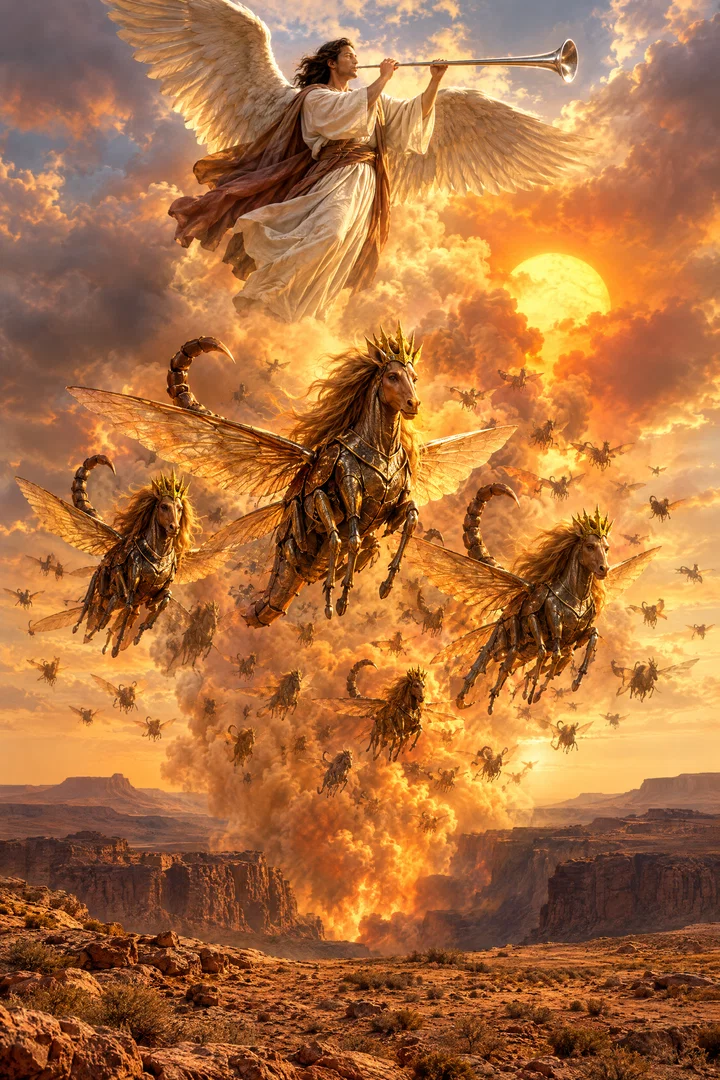
And they had hair as the hair of women, and their teeth were as the teeth of lions.
Translations
American King James Version, King James Version, KJV Cambridge Paragraph Bible, Webster Bible, Revised Version, American Standard Version
And they had hair as the hair of women, and their teeth were as the teeth of lions.
and they had hair as hair of women, and their teeth were as [those] of lions,
and they had hair as women's hair, and their teeth were as of lions,
and, they had hair, as the hair of women, and, their teeth, were, as of lions,
Berean Standard Bible, Majority Standard Bible
They had hair like that of women, and teeth like those of lions.
They had hair like women’ s hair, and their teeth were like those of lions.
And they had hair like the hair of women, and their teeth were as the teeth of lions.
And they had heare as the heare of women, and their teeth were as the teeth of lyons.
Douay-Rheims (Challoner revision)
And they had hair as the hair of women; and their teeth were as lions:
Pictures
Cross-references
- Revelation 8:6-13
And the seven angels which had the seven trumpets prepared themselves to sound.
Introduces the trumpet sequence that continues in Revelation 9.
- Joel 2:3
A fire devoureth before them; and behind them a flame burneth: the land is as the garden of Eden before them, and behind them a desolate wilderness; yea, and nothing shall escape them.
Both describe locust devastation that leaves the land desolate.
- Revelation 9:3
And there came out of the smoke locusts upon the earth: and unto them was given power, as the scorpions of the earth have power.
The locusts from the smoke represent Arabian hordes from the desert.
- Revelation 9:1
And the fifth angel sounded, and I saw a star fall from heaven unto the earth: and to him was given the key of the bottomless pit.
fallen star opens the pit
- Revelation 8:2
And I saw the seven angels which stood before God; and to them were given seven trumpets.
Introduces the seven angels whose trumpet sequence includes chapter 9.
Commentary
Each commentary is drawn from primary sources: the writings of Ellen G. White and Adventist pioneers and periodicals. Each commentary is separate. Its own words are not a quotation; follow the references to read the source passages.
Ellen G. White
2 sources
The portrayal of hair like women's hair and teeth like lions' teeth belongs to the prophecy of Revelation 9 that foretold the fall of Ottoman power.GC 334.4–335.1GC88 334.4–5 Its measured spans of 150 years and of 391 years and fifteen days were reckoned to reach their end on August 11, 1840.GC 334.4–335.1 On that day Turkey accepted the protection of the allied European powers, surrendering its independence in government.GC 334.4–335.1GC88 334.4–5
That fulfillment drew many to confidence in the system of prophetic interpretation that sustained the Advent movement.GC88 334.4–5
Sources
Pioneers and periodicals
65 sources
The long hair like women's hair means the long, uncut hair of the Arabian, Saracen and Ottoman warriors rushing to battle, not effeminacy, and the teeth like lions' teeth mean their fierce appearance, savage strength and power to devour and destroy.RH Dec 25, 1900RH Dec 25, 1900ST Oct 31, 1916RH Jul 22, 1858ST Mar 21, 1911 The locusts bearing this mark are the vast hordes of Mohammedans, first Arab and Saracen and later Turkish, rising in the fifth trumpet, the first woe trumpet, to conquer and torment Eastern Rome after the breaking up of the empire.RH Dec 25, 1900RH Sep 4, 1900RH Jul 22, 1858ST Nov 7, 1916ST Oct 31, 1916 Their five prophetic months of torment are 150 literal years, from Othman's entry into Nicomedia on July 27, 1299 to the Turkish attack on Constantinople in 1449, during which they tormented the Greek Empire without overthrowing it, before the hour, day, month and year carried supremacy to August 11, 1840, when Ottoman independence ended.STST Jan 15, 1880RH Mar 5, 1901GSAM 128.2 Their conquests were judgments permitted by God as a scourge upon an apostate, idolatrous church and professed Christians, directed chiefly against Rome's priests and followers while His sealed people were spared, yet those scourged did not repent.RH Jul 22, 1858RH Mar 26, 1867
Trumpet Context and Setting
The verse stands in Revelation 8 and 9 as part of the prophecy of the seven trumpets, which begins in chapter 8 and continues through chapter 9 before resuming in chapter 11.RH Dec 15, 1863RH Aug 15, 1871RH Jul 11, 1871RH Dec 27, 1870RH Jan 9, 1872 It belongs to the seven trumpets described in Revelation 8–11, which describe additional events and give evidence by which the approaching end of the world's history may be known.ST Nov 28, 1900 The trumpet series is a prophecy whose seventh and final angel is sounding.RH Dec 15, 1863
The seven trumpets sound in succession to reveal successive events, outlining political events from the breaking up of the Roman Empire to the coming of the Lord in glory, with seven meaning completeness to the end of the prophetic story.ST They symbolize wars and the invasions of barbarian hordes that swept over the Roman Empire and portray strife following its breakup, with the darkening of the political heavens connected with the Saracens and Turks.ST Oct 24, 1911 The trumpet visions are mostly past and portray political events interpreted through historical records, shadowing forth the instrumentalities by which the Roman Empire was overthrown and subverted and finally ruined, giving the prophetic history of the fall of the last of Daniel's four great governments in its papal form.RH Sep 29, 1874RH Jul 8, 1858 After Constantine the empire was divided into three parts, so trumpet language about a third part refers to the third part of the empire under the scourge.RH Jul 8, 1858 The trumpet subject properly begins at Revelation 8:2, with Revelation 8:1 belonging to the conclusion of the opening of the seals and Revelation 8:2-5 giving prefatory preparation for the soundings.RH Jul 8, 1858 The seven trumpets are one of the great lines of symbolic and literal prophecy, and the converging lines of these prophecies bring history almost to the focal center, showing the end of earthly rule is nearly over and the second coming of Christ is near.ST Nov 28, 1900
The verse belongs to the description of the fifth trumpet, identified as the first woe and applied to the Saracens, which with the sixth trumpet fills the whole ninth chapter in about equal portions and is described in Revelation 9:1-11.RH Jul 22, 1858ST Jan 10, 1878 It is part of the fifth trumpet, the first of the three woe trumpets announced by an angel outside the seven, which symbolizes the conquest of Mohammed and his followers as the new religion swept everything before it through three continents.ST Nov 7, 1916ST Oct 31, 1916ST Jan 10, 1878 The fifth-trumpet prophecy marks the rise and spread of Mohammedan power and is applied to the Ottoman Empire and Ottoman Turks and their attacks on Constantinople.ST Jul 13, 1915ST Dec 17, 1896 The vision turns from the agencies employed to scourge pagan Rome and break it into political divisions to the agencies employed to scourge Rome as an ecclesiastical power after its change from paganism to the papacy.ST Jan 10, 1878 The locusts symbolize the Arabian horsemen as they went forth to fight what they called the battles of the Lord, coming from the wastes of the Arabian desert symbolized by the bottomless pit, with the great smoke symbolizing the dark and delusive doctrines propagated by Mohammed and his fanatical followers.ST Jan 10, 1878 The opening of the pit was made possible by the falling star, Chosroes king of Persia overthrown by Heraclius emperor of the Eastern Empire, which utterly exhausted Rome and took out of the way Persia and Eastern Rome, the only two powers capable of meeting and crushing Mohammedanism; Chosroes was murdered in 628 after loss of empire, and 629 is marked by the conquest of Arabia and the first Mohammedan war against the Roman Empire.ST Jan 10, 1878
The first four trumpets felled the two western divisions in the downfall of Western Rome, while the fifth trumpet crushed the eastern empire and the fifth and sixth concern Eastern Rome and the East after the fall of the West.RH Jul 8, 1858ST Feb 7, 1884ST May 18, 1904 After Odoacer abolished the office and title of emperor in Western Rome in 476, and the consulship in 541 and the senate in 542 were set aside till Rome was without an emperor, a consul, or a senate, the original Roman Empire was divided and Constantinople remained the sole imperial city.ST May 18, 1904 The city of Rome was henceforth to enthrone a pope instead of a Caesar, after the overthrow of the Heruli, Vandals, and Ostrogoths, with the political supremacy of the Papacy established in 538 over seven nations in the territory of Western Rome represented by the present-day nations of Western Europe.ST May 18, 1904 The first six trumpet judgments were fulfilled through the incursions of northern European barbarian tribes and Turkish and Saracen forces into the Roman Empire over many centuries, with Revelation 9:1-21 covering the fifth and sixth trumpets concerning Eastern Rome and events connected with its history.RH May 4, 1869RH Jun 16, 1874 The sixth trumpet, which ends with the ninth chapter, discloses the passing of the Turkish Empire under the control of the European allied powers on August 11, 1840, and is said to have ceased sounding in 1840.STST Feb 7, 1884RH Jun 16, 1874 This sixth trumpet is followed by the great advent movement foretold in chapter 10 and chapter 11 to verse 14, and then the seventh trumpet or third woe commenced in 1844 at the termination of the 2300 days to announce the kingdom of Christ and His reign forever and ever, sinking great Babylon entire to rise no more.STRH Jul 8, 1858RH Jun 16, 1874
The last three trumpets are woes bringing woe rather than blessing and occur within the prophetic sequence extending to the end of the age.ST Apr 8, 1886 Revelation 9 gives a full account of the first and second woes, in contrast with the brief statement of God's wrath under the seventh angel in Revelation 11:18.RH Dec 29, 1868 The trumpet judgments are a preceding series of partial judgments upon the wicked; they come before the seven last plagues, which make no exemption and complete God's wrath.RH Dec 29, 1868 The vision foreshadows future events in human history and judgments preceding Christ's second advent, and these events have practical consequences for people.RH Feb 11, 1873
Hair and Teeth Described
The hair like women's hair describes the long, uncut hair of the Arabian, Saracen, Bedouin and Ottoman warriors as they rushed into battle.RH Dec 25, 1900RH Dec 25, 1900ST Oct 31, 1916ST Oct 31, 1916RH Jul 22, 1858 This was their custom, as reported by the ancient historians Pliny and Jerome.ST Oct 31, 1916 The figurative expressions of their warfare in this period, including the hair and the teeth, were fulfilled both in the effect upon the people and in the mode of warfare, and they were properly termed destroyers.RH Mar 5, 1901 The long hair did not signify an effeminate character.RH Jul 22, 1858
The teeth like lions' teeth represented fierce appearance in battle, ferocity and strength to devour.RH Dec 25, 1900RH Jul 22, 1858 They signified savage strength and destructive power.ST Mar 21, 1911ST Mar 21, 1911 The comparison also reflected the notably white teeth of the Bedouin warriors, whose whiteness suggested to observers such as Chateaubriand the teeth of wild beasts.ST Oct 31, 1916ST Oct 31, 1916
The hair and teeth belong to a symbolic combination of locust, scorpion, horse and man that represents a unique, devastating power.ST Mar 21, 1911 Its features join the speed and courage of battle-ready war-horses, the sound of wings, the poison of scorpions, and human wisdom and armor to make the military meaning plain.RH Sep 4, 1900ST Mar 21, 1911 The scorpion and the locust of the Holy Land still illustrate this terrible locust image and make the description plain, since the locust in his year of visitation still devastates the country as in ancient times and leaves desolation behind.RH Aug 29, 1871 An alleged heavenly command that threatened Sunday-breakers with beasts having lions' heads and women's hair echoed this imagery, but it was a falsehood and not a genuine message from God.ST Oct 8, 1896
Power Symbolized by Locusts
The locusts are the vast hordes of Mohammedans in their rise and work against Eastern Rome after the breakup of the empire, first Arab and Saracen and later Turkish, in their conquest and triumphs as a world power.RH Dec 25, 1900RH Sep 4, 1900RH Jul 22, 1858ST Nov 7, 1916RH Sep 4, 1900 The battle-ready horses and the sound of their wings make the military meaning of the symbol plain, portraying figurative armies of men rushing into battle rather than literal devouring pests.RH Sep 4, 1900ST Feb 12, 1885ST Sep 23, 1913 Through them a false religion became a scourge upon an apostate church, sweeping everything before it as the new religion spread.RH Jul 22, 1858ST Nov 7, 1916ST Oct 31, 1916 The fifth trumpet symbolizes this conquest of Mohammed and his followers, and the sixth trumpet continues the same Mohammedan work with the Saracens and Turks as the scourge of Christendom.ST Nov 7, 1916ST Oct 31, 1916ST Dec 17, 1896ST Jan 15, 1880 These are woe trumpets whose work was directed chiefly against Eastern Rome and against the priests and followers of Rome, while God's true sealed people were not purposely made the object of destruction.RH Jul 22, 1858ST Jan 10, 1878
The prophecy includes the Ottoman or Turkish power founded and organized by Othman, with its attacks on Constantinople, its loss of independence, and its weakening and disintegration.ST Jul 13, 1915RH Dec 25, 1900ST Dec 17, 1896 The sixth trumpet ends with the ninth chapter and discloses the passing of the Turkish Empire under the control of the European allied powers on August 11, 1840.STST Jan 15, 1880 This sixth trumpet is followed by the great advent movement foretold in chapter 10 and chapter 11 to verse 14, and then the seventh trumpet announces the kingdom of Christ and His reign forever and ever.ST The prophetic periods of these woe trumpets ended in 1449 and August 11, 1840, respectively.ST Jan 15, 1880
The locusts come from the wastes of the Arabian desert symbolized by the bottomless pit, issuing from the obscurity of the desert as from smoke to conquer Persia and scourge apostate Rome.ST Jan 10, 1878RH Aug 30, 1864RH Jul 7, 1874 The pit or abyss is located on the earth and confined to it, not in a separate underworld.ST Jan 10, 1878RH Aug 30, 1864RH Jul 7, 1874 The great smoke from the abyss is the false religion of Mohammed, the dark and delusive doctrines and confusion propagated by Mohammed and his fanatical followers as the Arabian horsemen went forth to fight what they called the battles of the Lord.ST Jan 10, 1878 The opening of the pit was made possible by the falling star, Chosroes king of Persia overthrown by Heraclius emperor of the Eastern Empire, which utterly exhausted Rome and took out of the way Persia and Eastern Rome, the only two powers capable of meeting and crushing Mohammedanism after they had exhausted each other in war.ST Jan 10, 1878 Chosroes was murdered in 628 after loss of empire, and 629 is marked by the conquest of Arabia and the first Mohammedan war against the Roman Empire.ST Jan 10, 1878
The locusts in this highly symbolic prophecy are used as types of armies of men, unlike the locusts in Joel, which are described as literal devouring pests.ST Sep 23, 1913 They are described as winged, flying creatures, using the same Greek word as for the locusts eaten by John the Baptist, indicating the same kind of insect.ST Feb 12, 1885 The fifth trumpet marks the conquest of Mohammed and his followers as the new religion and Eastern religious apostasy claiming Mohammed as God's prophet swept everything before it.ST Nov 7, 1916ST Oct 31, 1916RH Apr 14, 1903 Their armies spread from the Persian Gulf to the Atlantic and swept across three continents, through the eastern, southern, and southwestern parts of the Roman world.ST Oct 31, 1916
Prophetic Times and Fulfillment
The five prophetic months of torment are 150 literal years, reckoned as 150 prophetic days, from July 27, 1299, when Othman entered the Roman territory of Nicomedia with the first attack on the Greeks and the first woe began, to 1449, and to July 27, 1449, when Turkish forces attacked Constantinople with gunpowder and heavy cannon and the second woe began.RH Mar 5, 1901GSAM 128.2RH Feb 9, 1864ST Mar 2, 1904 During that 150-year period the Ottomans, founded and organized under Othman, tormented and harassed the Greek Empire and Eastern Rome without being able to overthrow it.RH Mar 5, 1901RH Feb 9, 1864ST Mar 2, 1904 The fifth trumpet itself began on July 27, 1299, with Othman's first attack on the Greeks and continued for those 150 years.GSAM 128.2RH Jun 25, 1872RH Feb 9, 1864 The fifth trumpet is a prophecy of the Saracens and the rise of Mohammedanism and the Ottoman power, belonging to the history in Revelation 9:5-12 of the Mohammedans under organized government to the close of their independence.RH Mar 5, 1901GSAM 128.2
The way for the fifth trumpet was opened by the fall of the Persian king Chosroes in 628, his murder after loss of empire following his overthrow by Heraclius emperor of the Eastern Empire as the falling star, which utterly exhausted Rome and took out of the way Persia and Eastern Rome, the only two powers capable of meeting and crushing Mohammedanism.ST Jan 10, 1878RH Jun 25, 1872 The year 629 is marked by the conquest of Arabia and the first Mohammedan war against the Roman Empire.ST Jan 10, 1878 The fifth trumpet's commencement is thus dated to the fall of Chosroes in 628, with the first attack by the Saracens on the Greek Empire under Othman on July 27, 1299, as the beginning of the first woe.ST Jan 10, 1878RH Jun 25, 1872
The hour, day, month, and year allotted to supremacy add 15 literal days, one literal year, 30 literal years, and 360 literal years to reach August 11, 1840, when Ottoman independence ended by submission to the ultimatum of England, Austria, Prussia, and Russia in the war with Egypt, disclosing the passing of the Turkish Empire under the control of the European allied powers.STST Feb 23, 1915ST Mar 2, 1904 The fifth and sixth trumpets, which symbolize the Saracens and Turks, thus have prophetic periods ending in 1449 and August 11, 1840, respectively, and the sixth trumpet ends with the ninth chapter and then closes.STST Jan 15, 1880RH Aug 4, 1904RH May 2, 1907ST Feb 23, 1915 This fulfillment was identified with the downfall of the Ottoman empire and the predicted loss of Turkish independence on August 11, 1840.RH Aug 4, 1904RH May 2, 1907ST Feb 23, 1915 The sixth trumpet then closed, followed by the great advent movement foretold in Revelation 10 and Revelation 11 to verse 14, and then the seventh trumpet or third woe commencing in 1844 at the termination of the 2300 days to announce the kingdom of Christ and His reign forever and ever, standing just before the parenthetical prophecy of Revelation 10 and part of Revelation 11 and before the seventh trumpet that began to sound in 1844.STST Feb 23, 1915
The fifth and sixth trumpet periods are presented as evidence that prophetic days represent years, for the prophetic days of the fifth and sixth angels are years, computed to end on August 11, 1840, when the predicted loss of Turkish independence was fulfilled.RH May 2, 1907RH Aug 2, 1864ST Apr 18, 1878 They involve definite periods of prophetic time that have finished, and their fulfillment is proved because the events predicted to occur at their close have occurred.RH May 2, 1907RH Aug 2, 1864 The passage is a brief prophecy of the fall of modern Persia and the rise and work of Mohammedanism, given with the most exact dates of any prophecy in the Bible.RH May 21, 1901 The same prophecy is applied to the history of Turkish power and Ottoman supremacy, its rise and development and triumphs as a world power, its weakening and disintegration and eventual end, and its expected removal of its capital from Constantinople to Jerusalem.RH Jan 2, 1913RH Nov 14, 1912ST Jan 7, 1913 It marks the downfall of the Eastern Roman Empire and the rise of a power that continued to rule the territory called the king of the North, the power ruling the territory of the king of the North, discussed alongside Daniel 11 and identified as one of three scriptural prophecies that deal with the Turkish power, alongside Daniel 11:40-45 and Revelation 16:12-14, concerning the Eastern Question and its solution.RH Dec 28, 1911ST Jan 7, 1913RH Apr 14, 1903ST Mar 2, 1904
Judgment and End-Time Relevance
The fifth trumpet is the first woe, and its locusts are the Arab hordes of Mahomet and afterward the Turks, issuing from the obscurity of the desert as from smoke to conquer Persia and to scourge apostate Rome.RH Jul 22, 1858RH Mar 26, 1867 The smoke from the abyss is the false religion of Mahomet, dark and delusive doctrine and confusion propagated by Mohammed and his followers, and through that false religion claiming Mahomet as God's prophet they became a scourge upon an apostate church.RH Jul 22, 1858RH Apr 14, 1903 They were permitted by God to fall as a scourge upon professed Christians in Europe to punish their idolatry, making inroads over the domains of the papacy with invasion, slaughter, and destruction of images and churches.RH Jun 14, 1906 Their principal work was against the priests and followers of Rome, while God's true sealed people were not purposely made the object of destruction. Though the scourge continued for six centuries, those scourged did not repent.RH Jul 22, 1858
The Euphrates in Revelation symbolizes the Turkish nation, which occupies the territory through which the river flows.ST Jul 29, 1897 The seven trumpets in Revelation 8-11 describe additional events and portray the breaking up of the Roman kingdom, the period of the Mohammedan powers, and the closing work of God's judgment, giving evidence by which people may know that the end of the world's history is approaching.ST Nov 8, 1905 The prophetic visions in Revelation 2-13, together with other prophetic lines in Daniel and Matthew 24, Mark 13, and Luke 21, declare in concurrent fulfillment that Christ's coming is near.ST Aug 14, 1893ST Sep 10, 1894 The converging lines of these great lines of symbolic and literal prophecy bring history almost to the focal center, showing the end of earthly rule is nearly over and the world is in the closing years of this age.ST Nov 28, 1900ST Sep 10, 1894 That vision foreshadows future events in human history and judgments preceding Christ's second advent, and these events have practical consequences for people.RH Feb 11, 1873
The message of Revelation 9-12 calls out the true people of God from the Christian churches, separating true believers loyal in heart to the King of kings from base hypocrites having the form without the power of godliness.RH Oct 22, 1872 It separates the true and loyal from the Babel of confusion before the proposed sham union of denominations is consummated, so that when that union is effected the salt of the earth has been removed and the Spirit of God is consequently totally withdrawn from those bodies.RH Oct 22, 1872 Those who still adhere to the Bible and keep its commandments are then left distinct and marked as objects for persecution by civil law.RH Oct 22, 1872 Revelation 9:3-10 also describes a devouring insect army that becomes one of the terrors of the last days as the sealing of the servants of God in their foreheads is nearly accomplished and the winds of destruction are let loose more and more. In that time Satan marshals his destructive forces for the last great catastrophe, while locusts, lice, caterpillars, worms, potato-bugs and similar pests yearly destroy more than half the products of the earth, increasing rapidly and appearing in new forms every year so that farmers must fight them every year, and with all his inventions and devices man is as powerless to prevent their ravages as to turn aside the tornado or the earthquake.
The locust vision has also been applied to a sequence of future events after Napoleon's rise, including five months of locusts and horses breathing brimstone, and that account stands as an example of fanciful prophetic interpretation.RH May 7, 1867
Sources