Revelation 9:7
And the shapes of the locusts were like unto horses prepared unto battle; and on their heads were as it were crowns like gold, and their faces were as the faces of men.
Translations
And the shapes of the locusts were like to horses prepared to battle; and on their heads were as it were crowns like gold, and their faces were as the faces of men.
King James Version, KJV Cambridge Paragraph Bible
And the shapes of the locusts were like unto horses prepared unto battle; and on their heads were as it were crowns like gold, and their faces were as the faces of men.
And the shapes of the locusts were like to horses prepared for battle; and on their heads were as it were crowns like gold, and their faces were as the faces of men.
Revised Version, American Standard Version
And the shapes of the locusts were like unto horses prepared for war; and upon their heads as it were crowns like unto gold, and their faces were as men’s faces.
And the likenesses of the locusts [are] like to horses made ready to battle, and upon their heads as crowns like gold, and their faces as faces of men,
And the likenesses of the locusts [ were] like to horses prepared for war; and upon their heads as crowns like gold, and their faces as faces of men;
And, the likenesses of the locusts, were like unto horses prepared for battle; and, upon their heads, as it were crowns, like unto gold, and, their faces, were as the faces of men,
And the locusts looked like horses prepared for battle, with something like crowns of gold on their heads, and faces like the faces of men.
And the locusts looked like horses prepared for battle, with something like crowns of gold on their heads; and their faces were like the faces of men.
The shapes of the locusts were like horses prepared for war. On their heads were something like golden crowns, and their faces were like people’s faces.
And the forms of the locusts were like horses made ready for war; and on their heads they had crowns like gold, and their faces were as the faces of men.
And the forme of the locustes was like vnto horses prepared vnto battel, and on their heads were as it were crownes, like vnto golde, and their faces were like the faces of men.
Douay-Rheims (Challoner revision)
And the shapes of the locusts were like unto horses prepared unto battle: and on their heads were, as it were, crowns like gold: and their faces were as the faces of men.
Pictures
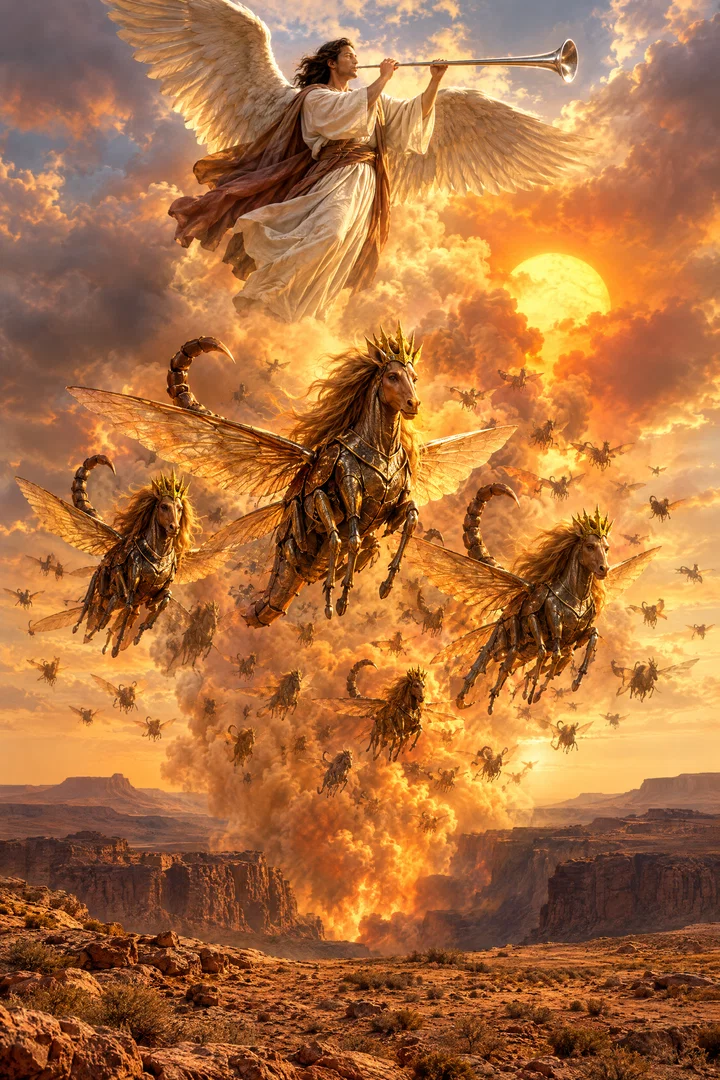
Cross-references
- Revelation 8:6-13
And the seven angels which had the seven trumpets prepared themselves to sound.
The fifth trumpet belongs to the sequence of seven trumpet judgments.
- Revelation 9:2
And he opened the bottomless pit; and there arose a smoke out of the pit, as the smoke of a great furnace; and the sun and the air were darkened by reason of the smoke of the pit.
The smoke from the pit darkens the air and is where the locusts emerge.
- Revelation 8:2
And I saw the seven angels which stood before God; and to them were given seven trumpets.
Introduces the seven angels and their trumpets, beginning the trumpet series.
- Revelation 9:1
And the fifth angel sounded, and I saw a star fall from heaven unto the earth: and to him was given the key of the bottomless pit.
fallen star opens pit locusts come from
- Revelation 9:3
And there came out of the smoke locusts upon the earth: and unto them was given power, as the scorpions of the earth have power.
introduces locusts described as horsemen
- Revelation 9:11
And they had a king over them, which is the angel of the bottomless pit, whose name in the Hebrew tongue is Abaddon, but in the Greek tongue hath his name Apollyon.
The locusts’ king is identified with the destroyer associated with the Ottoman advance.
- Revelation 8:13
And I beheld, and heard an angel flying through the midst of heaven, saying with a loud voice, Woe, woe, woe, to the inhabiters of the earth by reason of the other voices of the trumpet of the three angels, which are yet to sound!
Calls the last three trumpet blasts woes, including the trumpets explained in Revelation 9.
- Exodus 10:12-15
And the LORD said unto Moses, Stretch out thine hand over the land of Egypt for the locusts, that they may come up upon the land of Egypt, and eat every herb of the land, even all that the hail hath left.
The locusts figure devastation, covering the land and consuming its remaining plants.
- Joel 1:4
That which the palmerworm hath left hath the locust eaten; and that which the locust hath left hath the cankerworm eaten; and that which the cankerworm hath left hath the caterpiller eaten.
Both describe locusts as a destructive swarm.
- Joel 2:3
A fire devoureth before them; and behind them a flame burneth: the land is as the garden of Eden before them, and behind them a desolate wilderness; yea, and nothing shall escape them.
same Eden-to-wilderness devastation by locusts
Commentary
Each commentary is drawn from primary sources: the writings of Ellen G. White and Adventist pioneers and periodicals. Each commentary is separate. Its own words are not a quotation; follow the references to read the source passages.
Ellen G. White
2 sources
The verse stands within the prophecy of Revelation 9 understood to foretell the fall of the Ottoman power.GC 334.4–335.1GC88 334.4–5 That prediction was worked out from prophetic periods given in Scripture.GC88 334.4–5 The calculation fixed its fulfillment to August 11, 1840, when Turkey surrendered its independence by accepting the protection and control of European powers.GC 334.4–335.1GC88 334.4–5 The exact fulfillment strengthened confidence in the principles of prophetic interpretation followed by Miller and his associates.GC88 334.4–5
Sources
Pioneers and periodicals
79 sources
The verse belongs to the fifth trumpet, the first woe, whose locusts come from the smoke of the opened bottomless pit to torment for five months only those without the seal of God.RH Dec 25, 1900ST Oct 31, 1916ST Nov 7, 1916 The locusts are the Mohammedan system of error and the Arabian, Saracen and Turkish forces with it, risen in the East as a scourge on the apostate church.RH Dec 25, 1900ST Oct 31, 1916ST Nov 7, 1916 Their forms like horses made ready for war are swift, spirited Arabian horses and mounted Saracen cavalry skilled in rapid pursuit and flight.RH Jul 22, 1858RH Sep 4, 1900RH Sep 4, 1900 The crowns like gold on their heads are the Saracens' turbans, their distinctive proud head-dress and sign of becoming Muslim.ST Oct 31, 1916RH Jul 22, 1858 Their faces like the faces of men are the dignified, grave and firm appearance of the Arabs, with the beard as the venerable mark of manhood and honor.ST Oct 31, 1916RH Jul 22, 1858
Trumpet Place and Setting
Revelation 9:7 belongs to the fifth trumpet, the first woe trumpet, whose locusts come out of the smoke of the opened bottomless pit to torment for five months only those without the seal of God, after which the first woe is past.RH Dec 25, 1900ST Oct 31, 1916ST Nov 7, 1916RH Jul 22, 1858 The prophecy is of the spread of the Mohammedan system of error and the Arabian forces associated with it, with its battle imagery fitting warriors rushing toward their enemies.RH Dec 25, 1900ST Oct 31, 1916ST Nov 7, 1916RH Jul 22, 1858ST Jul 13, 1915 That fifth trumpet symbolizes the conquest of Mohammed and his followers and the spread of the new religion across three continents, applied to the Saracens and Turks as instruments by which a false religion became a scourge on an apostate church.ST Oct 31, 1916ST Nov 7, 1916RH Jul 22, 1858ST Jul 13, 1915 It is applied to the attacks of the Mohammedans on Constantinople and the destructive advance of Ottoman power, and its likeness of horses made ready for battle with gold-like crowns and human-like faces belongs to the imagery of the fifth trumpet as a symbol of warfare.ST Jul 13, 1915
A few hold that the verse is part of the sixth trumpet in a political outline reaching from the breaking up of the Roman Empire to the coming of the Lord in glory.STST Feb 7, 1906RH Oct 21, 1862ST Feb 7, 1884 In that reckoning the seven trumpets sound in succession to reveal successive events, and seven means completeness, the end of the prophetic story.STST Feb 7, 1906 The sixth trumpet ending with chapter 9 marks the passing of the Turkish Empire under the control of the European allied powers on August 11, 1840, followed by the great advent movement, after which the seventh trumpet announces the kingdom of Christ.STST Feb 7, 1906ST Feb 7, 1884 The account in chapter 9 is thus connected particularly with the sounding of the sixth trumpet, with events connected with the history of Eastern Rome and whose sounding ended in 1840.STST Feb 7, 1906RH Oct 21, 1862ST Feb 7, 1884
The verse is part of the seven trumpets in Revelation 8-11, sounded in succession to reveal successive political events from the breakup of the Roman Empire to Christ's coming, with seven meaning completeness.STRH Sep 29, 1874RH Jul 8, 1858ST May 13, 1880 The seven trumpets are mostly fulfilled in the past and denote political events to be interpreted in accordance with historical records, with language taken literally when no good reason exists to take it figuratively.STRH Sep 29, 1874ST May 13, 1880 They portray the means by which Rome was overthrown, with the fifth and sixth trumpets directed against its eastern division, giving details of the kingdoms into which the fourth universal empire was divided, describing Mohammedanism as a plague, and carrying prophecy forward to the gates of eternity.ST Oct 24, 1911RH Jul 8, 1858ST May 13, 1880 The trumpet series covers about the same period as the other series in Revelation's first eleven chapters, describing the history of earthly nations in conflict, reaching the judgment and the day of wrath, while the trumpet period is marked by strife, with God's Word bearing witness and the final phase of the gospel going forth.STST Oct 24, 1911ST May 13, 1880
The first four trumpets form one group and the last three form another group called woes.ST Apr 8, 1886ST Sep 14, 1882RH Dec 29, 1868RH May 4, 1869 The last three trumpets are woes upon the earth rather than blessings, belonging to the perilous events leading to the end of the age, not a time of blessing or peace.ST Apr 8, 1886ST Sep 14, 1882RH Dec 13, 1853 They are terrible but partial judgments of God on the wicked and plagues that precede the seven last plagues, with the first and second woes given in connection with the sounding of the fifth and sixth angels before the third and last woe.RH Dec 29, 1868RH Dec 29, 1868RH May 4, 1869 The first six trumpet judgments were fulfilled through incursions into the Roman Empire by northern European barbarian tribes and by Turkish and Saracen forces over many centuries, showing the sixth trumpet nearing its close and the seventh soon to sound.RH Dec 29, 1868RH May 4, 1869RH Dec 13, 1853
The locusts whose form the verse describes are Arabian horsemen going forth to fight what they called the battles of the Lord, coming out of the smoke from the bottomless pit.ST Jan 10, 1878RH Jul 30, 1861RH Jul 7, 1874RH Aug 30, 1864 The pit is the wastes of the Arabian desert, and the smoke is the dark and delusive doctrines propagated by Mohammed and his fanatical followers, with the bottomless pit representing the wastes and deserts of Arabia from which the doctrines of Mohammed issued.ST Jan 10, 1878RH Jul 30, 1861RH Jul 7, 1874RH Aug 30, 1864 Their coming from the abyss shows the abyss is confined to the earth, a desert waste, void, land not inhabited, and their coming out describes the action of the Mahometan power.ST Jan 10, 1878RH Jul 7, 1874RH Aug 30, 1864 The way was opened for them when the fallen star, Chosroes king of Persia overthrown by Heraclius emperor of the Eastern Empire, fell, and Rome in overthrowing Persia exhausted herself, so Persia and Eastern Rome, the only two powers able to meet and crush Mohammedanism, were taken out of the way.ST Jan 10, 1878RH Jun 25, 1872 Chosroes was murdered in 628, and 629 is marked by the conquest of Arabia and the first war of the Mohammedans against the Roman Empire, with the fall of the Persian king in 628 marking the beginning of the fifth-trumpet prophecy.ST Jan 10, 1878RH Jun 25, 1872
Locust Power Identified
The locusts are the spread of the Mohammedan system of error and the Arabian forces associated with it, with the battle imagery belonging to warriors rushing toward their enemies.RH Dec 25, 1900ST Oct 31, 1916ST Nov 7, 1916 The fifth trumpet is the conquest of Mohammed and his followers and the spread of the new religion across three continents.ST Oct 31, 1916ST Nov 7, 1916 That trumpet, together with the sixth, is applied to the Saracens and Turks as instruments by which a false religion became a scourge on an apostate church.RH Jul 22, 1858 The horse-like shapes and battle imagery portray vast Muslim forces prepared for war, referring to the Arab and later Turkish Muslim powers that rose from Arabia and helped destroy the Eastern Roman Empire.RH Sep 4, 1900 The chapter describes how a twofold power scourged the apostate church, with no separate explanation of the locusts or of the details in this verse left to stand apart from that scourging.ST Mar 21, 1911
The locusts are one of the prophetic symbols in Daniel and Revelation that represent earthly governments, and the locusts of Revelation 9 are the Saracens and Turks.ST Sep 4, 1879 The comparison to horses ready for battle points to Arabia's swift, spirited horses and to Arab and Saracen cavalry that could dart rapidly into pursuit or flight and was prepared for battle.RH Jul 22, 1858 The battle-ready appearance explains the locust symbol as vast hordes engaged in military conquest, depicted as vast Mohammedan forces like cavalry prepared for battle.RH Sep 4, 1900 Revelation 8-11 gives details of the kingdoms into which the fourth universal empire was divided, describes Mohammedanism as a plague, and carries prophecy forward to the gates of eternity. Revelation 9 uses locusts symbolically for armies of men engaged in rapacious fanatical warfare and devastation, unlike Joel's locusts understood as literal devouring insects.ST Sep 23, 1913
The twofold power is the Mohammedan power arising in the East and the Roman papacy in the West scourging the apostate church.ST Mar 21, 1911 The first woe is part of a new phase of the trumpet judgments after the western empire fell and the papacy rose to power, with the first and second woes linked with the kings of the south and north described by Daniel and with judgments on apostate Christendom that ultimately led to the eastern empire's overthrow.RH Jul 22, 1858 The followers of the false prophet, represented by the Ottoman Empire, became a chastening scourge on apostate Christianity, as Cyrus had been used as an agent of divine retribution against ancient Babylon.
The prophecy turns from the agencies that scourged pagan Rome and broke it into political divisions to the agencies that scourged Rome as an ecclesiastical power after its change from paganism to the papacy, with the locusts whose form is here described being Arabian horsemen going forth to fight what they called the battles of the Lord.ST Jan 10, 1878 They came out of smoke from the bottomless pit, where the pit is the wastes of the Arabian desert and the smoke is the dark and delusive doctrines propagated by Mohammed and his fanatical followers.ST Jan 10, 1878 The way was opened when the fallen star, Chosroes king of Persia overthrown by Heraclius emperor of the Eastern Empire, fell, so that Rome in overthrowing Persia exhausted herself and Persia and Eastern Rome, the only two powers able to meet and crush Mohammedanism, were taken out of the way.ST Jan 10, 1878 Chosroes was murdered in 628, and 629 is marked by the conquest of Arabia and the first war of the Mohammedans against the Roman Empire.ST Jan 10, 1878 The Saracens, the Arab followers of Mahomet, issued from the obscurity of the desert as locusts from smoke and conquered Persia and scourged the apostate church of Rome.
The multitude of Saracens from Arabia rapidly overran Persian and Roman provinces and spread the Mahometan creed.RH Jul 22, 1858 The Arab conquests under Mohammed and his successors spread across three continents, from the Persian Gulf to the Atlantic, as the coming of the fifth trumpet. The rise and spread of the Mohammedan power spread across much of Asia, captured the ancient city of the Caesars in 1453, and later threatened Europe.ST Dec 24, 1912 Their invasions as Saracenic Muslim forces sweeping up from Arabia and Egypt were driven by fanatical zeal against image-worshiping Christians and brought slaughter, the destruction of church images, and the conversion of churches into mosques.ST Jan 2, 1912
Horses Crowns and Faces
The shapes like horses prepared for battle portray swift, spirited Arabian horses and mounted Saracen cavalry prepared for war.RH Jul 22, 1858RH Sep 4, 1900RH Sep 4, 1900RH Jul 22, 1858 Darting rapidly into pursuit or flight, these Arab and Saracen forces made extensive use of cavalry with celebrated skill in horsemanship, and their battle-ready appearance shows vast Mohammedan hordes engaged in military conquest.RH Jul 22, 1858RH Sep 4, 1900RH Sep 4, 1900ST Oct 31, 1916 The crowns like gold on their heads are the Saracens' turbans, a distinctive ornament and source of pride resembling coronets.ST Oct 31, 1916RH Jul 22, 1858 The turban was a distinctive sign of becoming Muslim, a custom connected with Muhammad's reception as prince in Medina in 622.ST Oct 31, 1916RH Jul 22, 1858 The faces as the faces of men point to the Arabs' dignified appearance and grave, firm demeanor.ST Oct 31, 1916RH Jul 22, 1858 The beard was a venerable sign of manhood and an important mark of honor.ST Oct 31, 1916RH Jul 22, 1858
The likeness to horses prepared unto battle with crowns like gold and faces of men presents the striking appearance of the mounted Saracenic warriors who issued from desert obscurity as locusts from smoke, conquered Persia, and scourged the apostate church of Rome.ST Oct 31, 1916RH Jul 22, 1858 The combined picture of locust, horse, and man fittingly symbolizes a unique devastating power, an abnormal mixture meant to teach great moral facts rather than natural consistency.ST Mar 21, 1911ST Mar 21, 1911 In that combination locusts denote devastation, horses prepared for battle add speed and courage, and human features denote wisdom.ST Mar 21, 1911ST Mar 21, 1911 Together with scorpion poison and lion strength, these images portray the Saracenic forces that swept out of Arabia and western Asia against lands once Christian.RH Dec 25, 1900ST Mar 21, 1911
The battle-ready horse-like shapes help explain the locust symbol as vast Mohammedan forces engaged in military conquest, belonging to the fifth-trumpet prophecy of the rise and progress of Mohammedanism.RH Sep 4, 1900RH Sep 4, 1900ST Sep 9, 1886 That prophecy is applied to the attacks of the Mohammedans on Constantinople and the destructive advance of Ottoman power, identified with the Saracens and later Ottoman power that rose from Arabia and helped destroy the Eastern Roman Empire.ST Jul 13, 1915RH Sep 4, 1900ST Sep 9, 1886 Its locust imagery belongs to the same prophetic period used to calculate the Ottoman power's expected breaking at Constantinople on August 11, 1840.RH Jul 23, 1914 The chapter presents a twofold scourging of the apostate church by the Mohammedan power arising in the East and the Roman papacy in the West.ST Mar 21, 1911 The locusts emerge when the abyss is opened, and their coming out describes the action of the Mahometan power.RH Aug 30, 1864
The Greek word for these locusts is the same word used for the locusts eaten by John the Baptist and refers to the same kind of insect.ST Feb 12, 1885 The terrible image is drawn from the real insects of the Holy Land that still witness to divine truth, the locust in his year of visitation still devastating the country as in the time of Joel, so that before them the land is as the garden of Eden and behind them a desolate wilderness.RH Aug 29, 1871 Those who hold it literally describe a devouring army of insects including locusts, lice, caterpillars, worms, potato-bugs and new forms appearing every year, destroying yearly more than half the products of the earth and increasing rapidly. That army is marshaled by Satan in preparation for the last great catastrophe and will constitute one of the terrors of the last days as the sealing of the servants of God is nearly accomplished and the winds of destruction are let loose, with man as powerless to prevent these pests as to turn aside tornado or earthquake. Those who hold the weight of teaching insist instead that Revelation's locusts symbolize armies of men, unlike Joel's locusts, which are understood as literal devouring insects.ST Sep 23, 1913
Empires Dates and Fulfillment
The five-month torment was fulfilled when the Mohammedans under organized government, still unable to overthrow the Greek Empire, waged long wars against the Eastern Roman Empire without conquering it or ending its political life.RH Mar 26, 1867RH Mar 5, 1901GSAM 128.2 That period began when Othman founded the Ottoman Empire and entered the territory of Nicomedia on July 27, 1299, and continued one hundred and fifty years tormenting the Greek Empire.RH Mar 5, 1901GSAM 128.2RH Jul 23, 1914RH Feb 9, 1864 Their figurative warfare was fulfilled both in effect upon the people and in mode of warfare, as rapacious fanatical warriors arising from darkening doctrines, and they were properly termed destroyers.RH Mar 26, 1867RH Mar 5, 1901 It ended July 27, 1449, when Constantine would not ascend without Sultan Amurath's consent, followed by Mohammed II in 1451, the siege of Constantinople beginning April 6, 1453 and its capture May 16.ST Mar 2, 1904 The five months are 150 prophetic days reckoned as 150 literal years from July 27, 1299 to July 27, 1449, followed by an hour as the twenty-fourth part of a day reckoned as 15 literal days to August 11, 1449, a day reckoned as one literal year to August 11, 1450, a month reckoned as 30 literal years to August 11, 1480, and a year reckoned as 360 literal years to August 11, 1840.ST Mar 2, 1904
The hour and day and month and year of 391 years and 15 days ended August 11, 1840, when Ottoman supremacy ceased and its independence ended.ST Jan 15, 1880RH Jul 23, 1914ST Mar 2, 1904 This came through the Sultan's war with Mehemet Ali Pacha of Egypt in 1838-1840, the destruction of his army and the removal of his fleet to Egypt, and the intervention of England, Russia, Austria and Prussia to settle the difficulty.ST Mar 2, 1904 The ultimatum drawn up by England, Austria, Prussia and Russia dictating terms of settlement with the pasha of Egypt was submitted to the Turkish government and placed by the sultan's agents in the hands of the opposing ruler, so that Turkey passed under the control of the European allied powers and has since existed only on sufferance as a buffer among them.STST Feb 7, 1906ST Oct 29, 1912ST Mar 2, 1904 The sixth trumpet ending with chapter 9 marks this passing under control, as part of a political outline reaching from the breaking up of the Roman Empire to the coming of the Lord in glory, with the seven trumpets sounding in succession to reveal successive events and seven meaning completeness, followed by the great advent movement, after which the seventh trumpet announces the kingdom of Christ.STST Feb 7, 1906 The fifth and sixth trumpets as symbols of the Saracens and Turks whose invasions scourged Christendom thus ended in 1449 and on August 11, 1840 respectively, predicting the Ottoman Empire's fall in 1840.ST Jan 15, 1880ST Oct 29, 1912RH Jul 23, 1914
The seven trumpets portray the means by which Rome was overthrown, with the fifth and sixth trumpets directed against its eastern division.RH Jul 8, 1858RH May 4, 1869 The first four trumpets note events connected with the downfall of Western Rome, and the next two show their connection with Eastern Rome, applying to events in the East with Constantinople as the sole imperial city.ST May 18, 1904RH Jun 16, 1874 This new phase of the trumpet judgments came after the emperorship in Western Rome ended in A.D. 476, the consulship in 541 and the senate in 542, and after papal political supremacy was established in Rome in A.D. 538 over seven nations in the territory of Western Rome.ST May 18, 1904 The first six trumpet judgments were fulfilled through incursions into the Roman Empire by northern European barbarian tribes and by Turkish and Saracen forces over many centuries.RH May 4, 1869 The first and second woes are linked with the kings of the south and north, and with judgments on apostate Christendom that ultimately led to the eastern empire's overthrow, with the sixth trumpet ceasing to sound in 1840 and the seventh trumpet or third woe commencing in 1844 at the termination of the 2300 days.RH Jul 22, 1858RH Jun 16, 1874
The chapter foretells the rise and development of the Turkish empire, including its rise as a world power and its triumphs, its attacks on Constantinople, its expected breaking in 1840, and its continued weakening to its ultimate end.RH Jan 2, 1913RH Jul 23, 1914RH Nov 14, 1912 It supports the prediction that the Ottoman Empire would continue to weaken, move its capital from Constantinople to Jerusalem, and ultimately come to an end.RH Jan 2, 1913 The Euphrates is a symbol of the Turkish nation, which occupies the territory through which the river flows.ST Jul 29, 1897 The chapter's account of the rise and work of Mohammedanism is associated with the fall of modern Persia and is dated with exceptional exactness.RH May 21, 1901
Prophetic Periods and Interpretation
The five months of torment are 150 prophetic days reckoned as 150 literal years, running from Othman's invasion of Nicomedia and first assault on the Eastern Empire in founding the Ottoman Empire on July 27, 1299, to July 27, 1449, during which the Ottomans tormented the Greek Empire without overthrowing it.GSAM 128.2ST Mar 2, 1904ST Jan 10, 1878ST Jan 10, 1878 That close came in 1449 when on the death of John Paleologus leaving no children Constantine would not ascend the throne without consent of the Turkish Sultan Amurath, thus virtually surrendering Greek power into Turkish hands, followed by the succession of Mohammed II in 1451, the siege of Constantinople beginning April 6, 1453 and its capture May 16, making the eastern seat of the Caesars the seat of the Ottoman Empire.ST Jan 10, 1878ST Jan 10, 1878 The hour and day and month and year are then reckoned together as 391 years and 15 days, with an hour as the twenty-fourth part of a day reckoned as 15 literal days to August 11, 1449, a day reckoned as one literal year to August 11, 1450, a month reckoned as 30 literal years to August 11, 1480, and a year reckoned as 360 literal years to August 11, 1840, making with the 150 years a total of 541 years and 15 days.RH Jul 23, 1914ST Mar 2, 1904 On August 11, 1840 Ottoman supremacy ceased and its independence ended when the ultimatum drawn up by England, Austria, Prussia and Russia dictating terms of settlement with the pasha of Egypt was submitted to the Turkish government and placed by the sultan's agents in the hands of the opposing ruler, so that Turkish sovereignty was relinquished to those powers and Turkey has since existed only on sufferance.RH Jul 23, 1914ST Mar 2, 1904
The trumpet periods are calculated on the year-day principle that a symbolic day represents a literal year, and the fifth and sixth angels' prophetic days meaning years illustrate that prophetic periods can span time rather than denote literal days.RH May 2, 1907RH Sep 28, 1869ST Apr 18, 1878RH Dec 21, 1869ST Jun 22, 1915 Those prophecies of the fifth and sixth angels provide the comparison for the days of the seventh angel in Revelation 10, and link the years of the sixth angel with the beginning of the seventh angel's sounding.ST Apr 18, 1878RH Dec 21, 1869ST Jun 22, 1915 Their fulfillment in 1449 and in the predicted loss of Turkish independence on August 11, 1840, when the Turkish Sultan surrendered independence to the allied European powers, is evidence that a prophetic day is a year and that the sealed book was opened and the periods correctly understood.RH May 2, 1907RH Sep 28, 1869
The seven trumpets are mostly fulfilled in the past and denote political events to be interpreted in accordance with the historical records of such events, with all language taken in its literal sense when no good reason can be shown for taking it figuratively.RH Sep 29, 1874 They symbolize political events of the present dispensation, especially war and revolution, and describe the history of earthly nations in conflict with one another.ST May 13, 1880ST Jan 10, 1878 The seven-trumpet series covers about the same period as the other series in Revelation's first eleven chapters, and reaches to the judgment and the day of wrath.ST May 13, 1880
The prophecy of the seven trumpets spans the Christian dispensation and carries prophecy forward to the gates of eternity, giving details of the kingdoms into which the fourth universal empire was divided, describing Mohammedanism as a plague, and outlining the breaking up of the Roman kingdom, the duration of the Mohammedan powers, and the closing work of God's judgment.ST Nov 8, 1905ST Dec 16, 1908 The first four trumpets note events connected with the downfall of Western Rome, and the next two show their connection with Eastern Rome.RH Jun 16, 1874 The sixth trumpet closed in 1840 with the loss of the Turkish power's independence, and Revelation 10 and part of Revelation 11 are placed parenthetically between that trumpet and the seventh trumpet or third woe, which commenced in 1844 at the termination of the 2300 days.ST Feb 23, 1915RH Jun 16, 1874
Wider Connections and Application
The seven trumpets of Revelation 8 to 11 describe additional events in world history, forming one of the great lines of symbolic and literal prophecy alongside the other prophetic outlines that converge toward the closing days of earth's history.ST Nov 28, 1900 Together with those other lines they give evidence by which it can be known that the end of earthly rule is nearly over and approaching, bringing history almost to the focal center of the second coming.ST Nov 28, 1900ST Sep 10, 1894 Their historical fulfillment shows the sixth trumpet nearing its close with the seventh soon to sound, making Christ's second coming the next great event and the world in its closing years.RH Dec 13, 1853ST Sep 10, 1894 That fulfilled history supports that the first angel's proclamation of the everlasting gospel and the coming judgment has already gone through the world.RH Dec 9, 1851
Angels sounding the trumpets do the same class of work as the angels having charge of the seven churches in Revelation 1 to 3 and the angels pouring out the vials of the seven last plagues in Revelation 15 and 16.ST Jun 9, 1914 The seven trumpets set forth the great controversy between the church and her foes from the first advent of Christ to the glorious consummation, showing God's means of arousing mankind and the breaking up of the nations.ST Oct 20, 1909 They form one of seven great time dramas in Revelation running to the end, closing with the downfall of the false and the everlasting triumph of the true, and one of twelve great lines of prophecy from Daniel and Revelation and the Gospels whose terminals gather in the time of the end and the second coming of Jesus the Messiah.ST Oct 20, 1909
The locusts are properly termed destroyers, representing rapacious fanatical Muslim warriors arising from the darkening doctrines of Islam under organized government when still unable to overthrow the Greek Empire.RH Mar 26, 1867RH Mar 5, 1901 Their figurative warfare was fulfilled both in effect upon the people and in mode of warfare, and their five-month torment was the long wars waged for one hundred and fifty years against the Eastern or Greek Roman Empire without conquering it or ending its political life, beginning when Othman founded the Ottoman Empire and entered Nicomedia on July 27, 1299.RH Mar 26, 1867RH Mar 5, 1901 The command in Abubeker's orders to spare certain religious people belongs to the chapter's instruction not to kill.RH Jun 4, 1857 The Saracens fit the trumpet prophecy's time and scourging role, while the Crusades do not fit the five-month period and despite their excesses are not the prophesied scourge.ST Feb 26, 1902
The message of Revelation 9 to 12 calls the loyal people of God out from the Babel of confusion before a false union of denominations is completed, separating the good from the bad where Christian churches contain both believers true in heart to the King of kings and base hypocrites.RH Oct 22, 1872 Those who respond hold to Bible truth and keep its commandments, and by nonconformity become marked out for persecution through civil law controlled by the united churches, while their removal as the salt of the earth leaves the Spirit of God totally withdrawn from the united bodies.RH Oct 22, 1872 The heads, hair, and tails of the locust vision have also been used as part of a supposed heavenly threat against those who would not keep Sunday.ST Oct 8, 1896
The coming of the locusts out of the opened abyss shows the abyss is confined to the earth, a desert waste, void, land not inhabited, with the locust action describing the Mahometan power.RH Jul 7, 1874 The visions to which the chapter belongs foreshadow future events in human history leading to the revelation of Jesus Christ, as part of the severe judgments that precede Christ's return.RH Feb 11, 1873 The coming of the Son of man so foreshadowed brings both salvation and judgment, giving the prophecy practical consequence for people.RH Feb 11, 1873
Sources