Romans 9:20
Nay but, O man, who art thou that repliest against God? Shall the thing formed say to him that formed it, Why hast thou made me thus?
Translations
No but, O man, who are you that reply against God? Shall the thing formed say to him that formed it, Why have you made me thus?
King James Version, KJV Cambridge Paragraph Bible
Nay but, O man, who art thou that repliest against God? Shall the thing formed say to him that formed it, Why hast thou made me thus?
No, but, O man, who art thou that repliest against God? shall the thing formed say to him that formed it, Why hast thou made me thus?
Revised Version, American Standard Version
Nay but, O man, who art thou that repliest against God? Shall the thing formed say to him that formed it, Why didst thou make me thus?
nay, but, O man, who art thou that art answering again to God? shall the thing formed say to Him who did form [it], Why me didst thou make thus?
Aye, but thou, O man, who art thou that answerest again to God? Shall the thing formed say to him that has formed it, Why hast thou made me thus?
O man! Who, nevertheless, art, thou, that art answering again unto God? Shall the thing formed say unto him that formed it—Why didst thou make me thus?
Berean Standard Bible, Majority Standard Bible
But who are you, O man, to talk back to God? Shall what is formed say to Him who formed it, “ Why did You make me like this?”
But indeed, O man, who are you to reply against God? Will the thing formed ask him who formed it, “ Why did you make me like this?”
But, O man, who are you, to make answer against God? May the thing which is made say to him who made it, Why did you make me so?
But, O man, who art thou which pleadest against God? shall the thing formed say to him that formed it, Why hast thou made me thus?
Douay-Rheims (Challoner revision)
O man, who art thou that repliest against God? Shall the thing formed say to him that formed it: Why hast thou made me thus?
Pictures
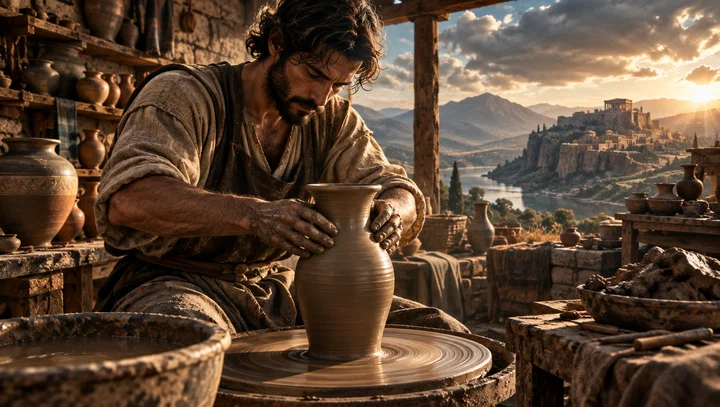
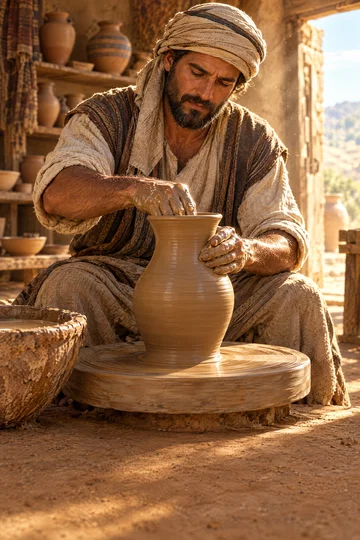
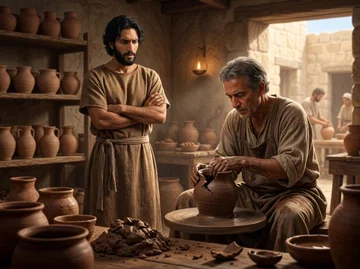
Cross-references
- Jeremiah 18:6
O house of Israel, cannot I do with you as this potter? saith the LORD. Behold, as the clay is in the potter’s hand, so are ye in mine hand, O house of Israel.
The potter and clay picture God’s authority over those he forms.
- Isaiah 64:8
But now, O LORD, thou art our father; we are the clay, and thou our potter; and we all are the work of thy hand.
God is the potter, and people are the clay and the work of his hands.
- Isaiah 45:9
Woe unto him that striveth with his Maker! Let the potsherd strive with the potsherds of the earth. Shall the clay say to him that fashioneth it, What makest thou? or thy work, He hath no hands?
Warns against the formed object questioning its Maker.
- Isaiah 43:21
This people have I formed for myself; they shall shew forth my praise.
God formed a people for himself to show his praise.
- Exodus 9:16
And in very deed for this cause have I raised thee up, for to shew in thee my power; and that my name may be declared throughout all the earth.
Pharaoh is raised up so God’s power and name are declared.
- 2 Timothy 2:20
But in a great house there are not only vessels of gold and of silver, but also of wood and of earth; and some to honour, and some to dishonour.
Both use vessel imagery to describe God’s authority over those he forms.
- Romans 9:15
For he saith to Moses, I will have mercy on whom I will have mercy, and I will have compassion on whom I will have compassion.
Introduces the question of whom God shows mercy.
- Isaiah 29:16
Surely your turning of things upside down shall be esteemed as the potter’s clay: for shall the work say of him that made it, He made me not? or shall the thing framed say of him that framed it, He had no understanding?
Challenges the creature who disputes the Creator’s authority.
- Daniel 4:35
And all the inhabitants of the earth are reputed as nothing: and he doeth according to his will in the army of heaven, and among the inhabitants of the earth: and none can stay his hand, or say unto him, What doest thou?
Nebuchadnezzar acknowledges that no one can challenge God’s sovereign will.
- Genesis 18:25
That be far from thee to do after this manner, to slay the righteous with the wicked: and that the righteous should be as the wicked, that be far from thee: Shall not the Judge of all the earth do right?
Man must not judge the Judge.
- Romans 9:6-8
Not as though the word of God hath taken none effect. For they are not all Israel, which are of Israel:
Distinguishes Israel by promise from Israel by descent.
- Genesis 25:23
And the LORD said unto her, Two nations are in thy womb, and two manner of people shall be separated from thy bowels; and the one people shall be stronger than the other people; and the elder shall serve the younger.
The oracle declares that the elder would serve the younger.
- Genesis 1:26-27
And God said, Let us make man in our image, after our likeness: and let them have dominion over the fish of the sea, and over the fowl of the air, and over the cattle, and over all the earth, and over every creeping thing that creepeth upon the earth.
Humanity is made in God’s image, while remaining distinct from God.
Commentary
Each commentary is drawn from primary sources: the writings of Ellen G. White and Adventist pioneers and periodicals. Each commentary is separate. Its own words are not a quotation; follow the references to read the source passages.
Ellen G. White
5 sources
The thing formed has no right to reply against God about how He has made it or how He shapes its life.14MR 33.2Lt 63, 1898, par. 7–8Lt 78, 1901, par. 5–8 No person has any right to challenge how He governs, uses and judges what He has made, for as Creator and Ruler He has authority and unlimited control to act as He chooses, and His character and judgments are not unjust.1SP 328.1SG4 50.1–2 Like a potter shaping clay, He molds and fashions people for His use, knowing what kind of vessel each person can become and what work and place best fit each one.14MR 33.2Lt 63, 1898, par. 7–8 Their part is to yield to His shaping work, submit to His guidance and instruction, and surrender self, rather than trying to direct themselves, resisting His will and authority, or refusing to be molded.14MR 33.2Lt 63, 1898, par. 7–8Lt 78, 1901, par. 5–8
His shaping may involve varied processes and a period of waiting before they are made fit for service.14MR 33.2 Submission allows Him to form them into shapely vessels, vessels of honor for His service, and into oneness with Christ.14MR 33.2Lt 63, 1898, par. 7–8Lt 78, 1901, par. 5–8 Resistance to His will brings difficulty, and refusing to be molded leaves crooked tendencies and defects in the character.Lt 63, 1898, par. 7–8Lt 78, 1901, par. 5–8 The verse supports that He may use His people to punish wicked nations after bearing with them until their iniquity is full, as in His command for Israel to punish the Midianites who had led Israel into idolatry and rebellion.1SP 328.1SG4 50.1–2
Sources
Pioneers and periodicals
41 sources
No human has any standing to answer back to God or demand why He made him as he is.ST Jul 1, 1908ST Aug 4, 1909ST Oct 21, 1889 The formed thing is subject to Him that formed it, so reverence and not judging God by limited human wisdom is fitting.ST Jul 16, 1896RH May 23, 1854 This sovereignty does not mean God makes men wicked, prevents them from being saved, or appoints any to destruction without regard to their actions, for He endures resistance with long-suffering, calls every soul to a savable character, and the lost choose sin and reap its result while those who yield may be used in His purpose.RH May 7, 1872ST Jul 16, 1912ST Nov 30, 1915 As Creator and Maker who sustains what He made, He has authority to direct conduct, which is the basis of moral duty and of the Sabbath as the sacred seventh day He set apart.ST Dec 3, 1874RH Dec 1, 1874ST Jan 21, 1889ST Mar 11, 1913ST Sep 23, 1886 Like clay in the potter's hands, men are therefore to accept the Father's will without murmuring, let the Master Worker shape them into vessels fit for use, and obey what He commands because He commanded it.ST Dec 8, 1914RH Sep 15, 1863ST Mar 19, 1912ST Oct 15, 1902ST May 25, 1904
Creature Before Creator
Human beings have no standing to challenge God's authority or to demand that He explain why He made them as He did, for the formed thing cannot call its maker to account over how it was formed.ST Jul 1, 1908ST Aug 4, 1909ST Oct 21, 1889 The image of a formed object questioning its maker shows that human beings are creatures and God is their Creator, and their objections give them no basis for claiming authority over Him.ST Oct 21, 1889 The potter-and-clay image that follows presents God as having authority over what He makes, yet His foreknowledge of people's characters does not keep Him from doing all He can to help even those whose characters He hates, so that if Esau had yielded as Jacob did He could have given him the same righteous character.ST Jul 1, 1908
The verse answers the objection that God cannot rightly hold people accountable because no one can resist His will: a human being has no standing to accuse God or to demand an account of why things were made as they are.ST Jul 16, 1896 The contrast between the thing formed and Him that formed it establishes the Creator's authority over His creatures, so reverence rather than indignantly judging God by limited human wisdom is fitting.ST Jul 16, 1896 Those formed by God should not challenge His purpose by demanding an explanation for how they were made, and human efforts to understand their nature and destiny apart from their Creator's revealed purpose are futile.ST May 11, 1915
It is folly for the formed world to deny that it has a Maker, for its existence points to a Creator, and to claim that it came together by chance with no one making it is unreasonable.RH May 13, 1858 God as Maker is above and superior to His own work, and the laws of nature are things He made and therefore matters of choice with Him.RH Mar 14, 1865 He could have made them different from what they are, He can now change them and form other equally harmonious combinations, and He can suspend or counteract them for a time, and this freedom of the Maker over what is formed makes miracles possible and reasonable.RH Mar 14, 1865
Replying against God is common yet foolish and wicked, for indignantly asking why God acts as He does or denying the justice of His course as if personally affronted makes understanding impossible, even of what mortals could comprehend.ST Jul 16, 1896 Blaming God because men are not equal to Him in wisdom blocks knowledge, and the only way to know the little that can be understood of God is to settle once for all that He is just and merciful and that everything He does is for the good of His creatures.ST Jul 16, 1896 What befits a creature before the infinite God is reverent stillness, not clamorous questioning.ST Jul 16, 1896 Wrestling against God is folly and ends in defeat, since the world will not adjust itself to suit personal whims and some things will go wrong through life, so the wise course is to stop replying against God and to shape oneself into God's good plan as water takes the shape of a vessel.ST Aug 13, 1896
Setting in Romans Nine
The verse belongs to Paul's explanation that God has the right, according to His will and wisdom, to choose instruments for mercy or judgment, and the potter's authority over the clay illustrates this right.RH May 23, 1854 God patiently works with people, but when they prove incorrigible He may use them for another purpose and make His judgment known, while showing mercy to those who obey His call, both Jews and Gentiles.RH May 23, 1854 God gives those who oppose His will opportunities to accept grace and become vessels of mercy and endures their resistance with long-suffering, and when they prove persistently rebellious He gives them up to their chosen ways and orders events so their rebellion displays His power and brings Him honor.RH May 7, 1872 The potter's work can be thwarted by clay that will not take the intended shape, so He may make a different, less honorable vessel from it.RH May 23, 1854 God patiently endured the Jews, but their stubborn unbelief made them fit for judgment, while believers, both Jews and Gentiles, are vessels of mercy who share His glory.RH May 23, 1854
The surrounding discussion identifies the potter's vessels with unbelieving Israel, whom God endured patiently, and distinguishes them from the believing Jews and Gentiles who become vessels of mercy.RH Mar 13, 1856 The chapter sets forth fleshly Israel as accursed from Christ, following after the law of righteousness but not attaining it because they sought it by works and not by faith, while the Gentiles gained precedence by seeking righteousness by faith.ST Jul 23, 1896 This fulfills that publicans and harlots enter the kingdom before the self-righteous and that the kingdom is taken away and given to a fruit-bearing nation, yet God did not cast off His stumbling people but endured even vessels of wrath fitted to destruction with much long-suffering.ST Jul 23, 1896 God's people are not defined by descent from the ancient tribes: those with faith in Jesus are spiritual Israel, the ancient tribes were broken off through unbelief, and people of faith are joined to God's people through Christ.ST Jul 15, 1913
The kingdom promises to Jacob's descendants were conditional and forfeited, and they can be regained through an interest in Jesus.RH Jan 19, 1860 God raised Pharaoh to the throne so His power and glory could be shown, and Pharaoh could have served that purpose by obeying God and helping His people, as Nebuchadnezzar did.ST Jul 16, 1912 Pharaoh refused and came under God's mighty hand, yet God's power and glory were shown through the outcome, and Romans 9:18-23 shows God's sovereign power, right to act, long-suffering, and kindness and does not mean Pharaoh was born for destruction.ST Jul 16, 1912 The verse is part of the teaching that humanity is sinful and utterly needs God's grace in salvation through Jesus Christ.ST Oct 21, 1908
Sovereignty and Human Freedom
The verse does not mean that God makes some people wicked or keeps them from being saved, nor that He appoints anyone to destruction without regard to what they do, nor that Pharaoh was born for destruction, nor that any person is created destined to be lost.RH May 7, 1872ST Jul 16, 1912ST Nov 30, 1915 God gives people their place, endures them with long-suffering, and calls every soul to a character that can be saved, giving those who oppose His will opportunity to accept grace and become vessels of mercy.RH May 7, 1872 When they prove persistently rebellious He gives them up to their chosen ways and so orders events that their rebellion displays His power and brings Him honor, yet His purpose is not to destroy but to save through grace and mercy, and He has foreordained the good and made it possible for everyone to receive it.RH May 7, 1872ST Nov 30, 1915 Pharaoh was raised to the throne so that God's power and glory could be shown, and he could have served that purpose by submitting, obeying God and helping His people as Nebuchadnezzar did, but he refused and was left to hardness of heart under God's mighty hand, though God's power and glory were still shown through the outcome.ST Jul 16, 1912
God's foreknowledge of people's characters, even of those whose characters He hates, does not keep Him from doing all He can to help them.ST Jul 1, 1908 If Esau had yielded as Jacob did, God could have given him the same righteous character.ST Jul 1, 1908 God's purpose and authority do not make human choices inevitable and do not force anyone to sin or be condemned.ST Nov 30, 1915 Those who are lost choose sin and death and, persisting in that choice, reap its result, while people can choose God's way and be used in His purpose.ST Nov 30, 1915 That God as Supreme Intelligence faces no conflicting solicitations does not remove the freedom human beings must exercise in choosing.ST Jun 26, 1893
The verse gives no excuse for wrongdoing by blaming the Maker, for likening a person to a faulty machine breaks down where people possess reason and will, since those powers make them responsible for their choices.ST Aug 30, 1883 As Creator and potter with authority over His vessels, God has the power and right to preserve or destroy them, and His decision whether an object or person continues accords with its fitness or unfitness for continued existence.ST Jan 17, 1906 The verse meets objections to God's sovereignty, whose great cause is that man wants to be sovereign himself.
Sin Death and Judgment
The verse forbids answering back against God when confronted with what His law establishes, that all have sinned and all stand under condemnation to death.RH May 29, 1856RH Jul 14, 1874 To deny that conclusion or to evade the universal reach of the law is itself to reply against Him.RH May 29, 1856RH Jul 14, 1874 For the same reason no one has any standing to dispute His authority or justice in condemning sinners to death and in destroying a guilty world in judgment.RH Feb 16, 1860RH Jul 14, 1874ST Oct 5, 1882 Since all are under sin and under condemnation, He would be just even if He destroyed them all, and His just judgments will ultimately fall upon the guilty world.RH Jul 14, 1874ST Oct 5, 1882
The same silencing of human objection requires accepting His testimony about death, that the dead rest unconsciously in the grave and receive no reward until the resurrection.RH Jun 3, 1858 Nor may human beings accuse Him of injustice even when His judgment against Sabbath-breaking looks severe. The guilt of willfully defying His law cannot be fully measured by men, for with Israel it was both religious duty and civil statute and a sign of the covenant relation, while deliverance from slavery and exceptional mercy and authority heightened responsibility. His judgments therefore remain righteous even when their reasons are hard to understand.
Sabbath and Moral Duty
As Creator who made and sustains people, God has authority over those He made and the right to direct their conduct, and His creative power is the basis of their moral duty to obey Him.ST Dec 3, 1874RH Dec 1, 1874 The same creation that grounds this duty also grounds the Sabbath, since God made the world in six days and rested on the seventh.RH Dec 1, 1874
The verse warns against answering back as though the creature could challenge its Maker over what He commands and has made sacred.ST Jan 21, 1889ST Mar 11, 1913ST Sep 23, 1886 It rebukes those who argue that any one-seventh portion of time can replace the specific seventh day God designated as the Sabbath.ST Jan 21, 1889ST Mar 11, 1913 God meant the definite day He named, having set apart the seventh day as sacred, a status He did not remove or give to another day.ST Mar 11, 1913ST Sep 23, 1886
Man has no right to reply against God or question His commands.ST May 25, 1904 Summoning God before a mortal tribunal to vindicate the justice of His law, judging the Judge of all the earth, and dictating by human ideas of prerogative the meaning and extent of His jurisdiction over His creatures are forbidden.ST May 25, 1904 Balancing human argument against His eternal logic, with man who is right only as God inspires him taking issue with Him who is the source of all light within him, and the stream demanding of the fountainhead reason why it flows, is arrogant, hypercritical, presumptuous liberty run mad.ST May 25, 1904 It is sufficient to obey, since He who bids alone gives power to act, and human freedom lives in the sunshine of His smile and the benignity of His love, to be rejoiced in rather than rebelled against by too nice questioning.ST May 25, 1904 Remember the Sabbath day to keep it holy is to be obeyed because it is commanded and not because it is expedient, for expediency is the makeshift of man, God recognizes no hedging, no nice construction upon the rights of man can annul the mandate of Him who made man, and what God has decreed mortal cannot improve upon.ST May 25, 1904
Yielded Life Application
Accepting the divine will without arguing back is a scriptural mark of a renewed heart.RH May 12, 1863 No one is to challenge God over how he has been made or over the circumstances of life, for as clay refusing the vessel's form illustrates, the Maker has the right to shape what He has made.RH Sep 15, 1863 The creature is not entitled to demand why God has made him thus or dealt with him as He has, and even when duty has been done men remain unprofitable servants rather than creditors of God, so toward both joy and pain the proper attitude is to accept the Father's will.ST Mar 19, 1912 The lesson is to receive God's will meekly, without murmuring, and faithfully do one's duty.RH Sep 15, 1863ST Mar 19, 1912
As clay in a potter's hands, people are to yield themselves to God the Master Worker and let Him shape them into vessels fit for use.ST Dec 8, 1914 Man is a lump of earthen clay and a rough ashlar in the hands of Jesus today, who is all-wise, almighty and all-benign, acting with organized design, wisdom, skill, gracious purpose and sovereign will.ST Oct 15, 1902 He is to subserve that will and way and let Him have His way, letting His hands with chisel, compass, square and whatever instruments He chooses fashion and use him today.ST Oct 15, 1902 Left to lie by in his rough state man can make no attainments and cannot break off his own rough edges, but as an object of God's choice he may rejoice in God's great ways.ST Oct 15, 1902
God is the skilled artisan and Maker on high, and people are yielding clay in hands that shape as willed.RH May 14, 1901 Parents hold their children as clay to mold, yet their own hands are weak and unskillful, so they must seek aid from God that His skill may teach their weak, willing hands to mold the clay rightly into true forms of beauty that unfold the Maker's highest thought.RH May 14, 1901 The image of clay questioning the potter forbids putting God on trial or accusing Him of injustice for wars, suffering and calamity while ignoring human rebellion and sin.RH Jul 8, 1875 The proper question is how people have turned from God's ways and brought these evils upon themselves.RH Jul 8, 1875 Since the Lord is judge and man is but clay, man must beware of harshness and be pitiful in all he does and says.ST Sep 12, 1895
Sources