Ruth 2:23
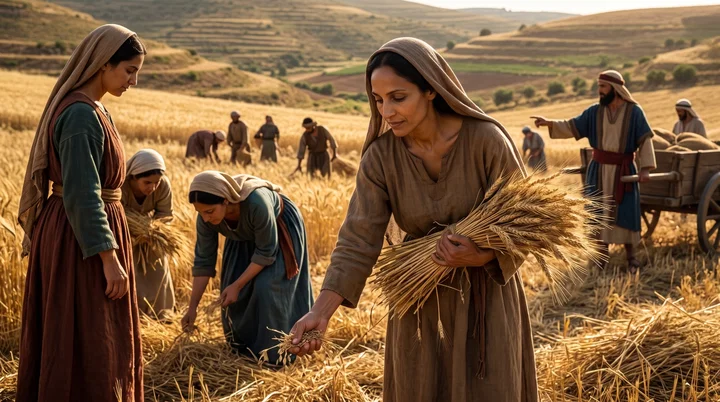
So she kept fast by the maidens of Boaz to glean unto the end of barley harvest and of wheat harvest; and dwelt with her mother in law.
Translations
So she kept fast by the maidens of Boaz to glean to the end of barley harvest and of wheat harvest; and dwelled with her mother in law.
King James Version, KJV Cambridge Paragraph Bible
So she kept fast by the maidens of Boaz to glean unto the end of barley harvest and of wheat harvest; and dwelt with her mother in law.
So she kept fast by the maidens of Boaz to glean to the end of barley-harvest and of wheat-harvest; and dwelt with her mother-in-law.
So she kept fast by the maidens of Boaz to glean unto the end of barley harvest and of wheat harvest; and she dwelt with her mother in law.
So she kept fast by the maidens of Boaz, to glean unto the end of barley harvest and of wheat harvest; and she dwelt with her mother-in-law.
And she cleaveth to the young women of Boaz to glean, till the completion of the barley-harvest, and of the wheat-harvest, and she dwelleth with her mother-in-law.
So she kept with the maidens of Boaz to glean, until the end of the barley-harvest and of the wheat-harvest. And she dwelt with her mother-in-law.
So she kept fast by the maidens of Boaz, to glean, until the end of the barley harvest, and the wheat harvest,—and dwelt with her mother-in-law.
Berean Standard Bible, Majority Standard Bible
So Ruth stayed close to the servant girls of Boaz to glean grain until the barley and wheat harvests were finished. And she lived with her mother-in-law.
So she stayed close to the maidens of Boaz, to glean to the end of barley harvest and of wheat harvest; and she lived with her mother-in-law.
So she kept near the servant-girls of Boaz to take up the grain till the cutting of the early grain and the cutting of the late grain were ended; and she went on living with her mother-in-law.
Then she kept her by the maides of Boaz, to gather vnto the end of barly haruest, and of wheate haruest, and dwelt with her mother in lawe.
Douay-Rheims (Challoner revision)
So she kept close to the maids of Booz: and continued to glean with them, till all the barley and the wheat were laid up in the barns.
Pictures
Cross-references
- Matthew 1:5
And Salmon begat Booz of Rachab; and Booz begat Obed of Ruth; and Obed begat Jesse;
Ruth is identified as one of Jesus’ ancestors.
Commentary
Each commentary is drawn from primary sources: the writings of Ellen G. White and Adventist pioneers and periodicals. Each commentary is separate. Its own words are not a quotation; follow the references to read the source passages.
Pioneers and periodicals
3 sources
Ruth 2:23 belongs to the beautiful, brief, wonderfully interesting story of Ruth, a little pastoral tale from the time of the judges.ST Mar 31, 1909 That story closes by tracing the ancestry of the Lord Jesus, and into that line a Moabite woman is brought.ST Mar 31, 1909 The verse places Ruth's gleaning fast by the maidens of Boaz through to the end of the barley harvest and the wheat harvest. Those harvests were worked by reapers cutting grain with sickles, as was done in the day of Boaz.
Its wording for the close of those harvests shows that the word rendered ended can mean that a season or period of time has run its course.RH Oct 7, 1873 In that sense it does not imply that a final part of the work itself was performed.RH Oct 7, 1873
The harvest field of Boaz from Ruth 2:1-23 teaches that it is not enough for some to cut down the grain, but others must bind it into sheaves.RH Sep 3, 1872 Binding the sheaves means gathering loose material and combining it in Sabbath-schools, prayer-meetings, missionary associations, and churches.RH Sep 3, 1872 It means bringing out followers of Christ who have never been brought out.RH Sep 3, 1872 It means organizing the people of God into active companies, regiments, battalions, sharpshooters, artillerymen, infantry, and sappers and miners, instead of leaving them idle in the reserve corps.RH Sep 3, 1872 When all the troops of God are thus in action, the castles and strongholds of sin can be taken for King Immanuel.RH Sep 3, 1872
Sources