Zechariah 3:4
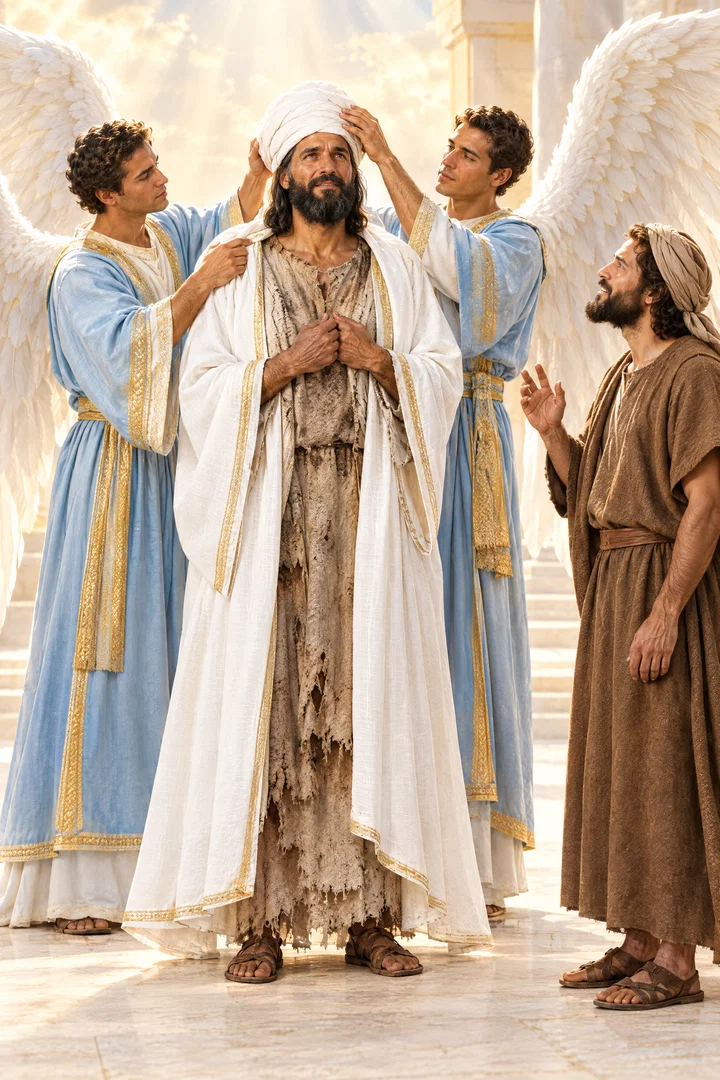
And he answered and spake unto those that stood before him, saying, Take away the filthy garments from him. And unto him he said, Behold, I have caused thine iniquity to pass from thee, and I will clothe thee with change of raiment.
Translations
And he answered and spoke to those that stood before him, saying, Take away the filthy garments from him. And to him he said, Behold, I have caused your iniquity to pass from you, and I will clothe you with change of raiment.
King James Version, KJV Cambridge Paragraph Bible
And he answered and spake unto those that stood before him, saying, Take away the filthy garments from him. And unto him he said, Behold, I have caused thine iniquity to pass from thee, and I will clothe thee with change of raiment.
And he answered and spoke to those that stood before him, saying, Take away the filthy garments from him. And to him he said, Behold, I have caused thy iniquity to pass from thee, and I will clothe thee with change of raiment.
Revised Version, American Standard Version
And he answered and spake unto those that stood before him, saying, Take the filthy garments from off him. And unto him he said, Behold, I have caused thine iniquity to pass from thee, and I will clothe thee with rich apparel.
And he answereth and speaketh unto those standing before him, saying: 'Turn aside the filthy garments from off him.' And he saith unto him, 'See, I have caused thine iniquity to pass away from off thee, so as to clothe thee with costly apparel.'
And he spoke and said unto those that stood before him, saying, Take away the filthy garments from off him. And unto him he said, See, I have caused thine iniquity to pass from thee, and I clothe thee with festival-robes.
Then responded he and spake unto those who were standing before him, saying, Take away the filthy garments from off him; and he said unto him, See! I have caused to pass from off thee, thine iniquity, And will cause thee to be clothed in robes of state.
Berean Standard Bible, Majority Standard Bible
So the angel said to those standing before him, “ Take off his filthy clothes!”Then he said to Joshua, “ See, I have removed your iniquity, and I will clothe you with splendid robes.”
He answered and spoke to those who stood before him, saying, “ Take the filthy garments off him.” To him he said, “ Behold, I have caused your iniquity to pass from you, and I will clothe you with rich clothing.”
And he made answer and said to those who were there before him, Take the unclean robes off him, and let him be clothed in clean robes;
And he answered and spake vnto those that stoode before him, saying, Take away the filthie garments from him. And vnto him hee saide, Behold, I haue caused thine iniquitie to depart from thee, and I wil clothe thee with change of raiment.
Douay-Rheims (Challoner revision)
Who answered, and said to them that stood before him, saying: Take away the filthy garments from him. And he said to him: Behold I have taken away thy iniquity, and have clothed thee with change of garments.
Pictures

Cross-references 20 of 68
- Isaiah 61:10
I will greatly rejoice in the LORD, my soul shall be joyful in my God; for he hath clothed me with the garments of salvation, he hath covered me with the robe of righteousness, as a bridegroom decketh himself with ornaments, and as a bride adorneth herself with her jewels.
Both picture God clothing the forgiven with salvation and righteousness.
- Isaiah 64:6
But we are all as an unclean thing, and all our righteousnesses are as filthy rags; and we all do fade as a leaf; and our iniquities, like the wind, have taken us away.
Human righteousness is pictured as filthy clothing.
- Revelation 7:14
And I said unto him, Sir, thou knowest. And he said to me, These are they which came out of great tribulation, and have washed their robes, and made them white in the blood of the Lamb.
The Lamb’s blood makes the redeemed clean, pictured as robes made white.
- Revelation 19:8
And to her was granted that she should be arrayed in fine linen, clean and white: for the fine linen is the righteousness of saints.
Both use clean clothing to picture the righteousness given to God’s people.
- Revelation 12:10
And I heard a loud voice saying in heaven, Now is come salvation, and strength, and the kingdom of our God, and the power of his Christ: for the accuser of our brethren is cast down, which accused them before our God day and night.
Satan accuses God’s people before God, as he accuses Joshua.
- 1 John 1:9
If we confess our sins, he is faithful and just to forgive us our sins, and to cleanse us from all unrighteousness.
God forgives confessed sin and cleanses from unrighteousness.
- Matthew 22:11-12
And when the king came in to see the guests, he saw there a man which had not on a wedding garment:
The furnished wedding garment represents the righteousness needed to stand before the King.
- 1 John 2:1
My little children, these things write I unto you, that ye sin not. And if any man sin, we have an advocate with the Father, Jesus Christ the righteous:
Christ is the righteous Advocate who pleads for sinners before God.
- Zechariah 3:9
For behold the stone that I have laid before Joshua; upon one stone shall be seven eyes: behold, I will engrave the graving thereof, saith the LORD of hosts, and I will remove the iniquity of that land in one day.
The promised removal of iniquity explains Joshua’s cleansing and change of garments.
- Revelation 3:4
Thou hast a few names even in Sardis which have not defiled their garments; and they shall walk with me in white: for they are worthy.
The faithful keep their garments undefiled and walk with Christ in white.
- 1 John 1:7
But if we walk in the light, as he is in the light, we have fellowship one with another, and the blood of Jesus Christ his Son cleanseth us from all sin.
Christ’s blood cleanses from all sin, answering the image of removed guilt.
- Romans 3:22
Even the righteousness of God which is by faith of Jesus Christ unto all and upon all them that believe: for there is no difference:
The new clothing represents righteousness received through faith in Christ.
- Revelation 3:5
He that overcometh, the same shall be clothed in white raiment; and I will not blot out his name out of the book of life, but I will confess his name before my Father, and before his angels.
The faithful are promised white garments, recalling Joshua’s change of clothing.
- Luke 15:22
But the father said to his servants, Bring forth the best robe, and put it on him; and put a ring on his hand, and shoes on his feet:
The father clothes the returning sinner in the best robe, illustrating gracious restoration.
- Philippians 3:9
And be found in him, not having mine own righteousness, which is of the law, but that which is through the faith of Christ, the righteousness which is of God by faith:
Righteousness from God comes through faith in Christ, not one’s own righteousness.
- Romans 4:6-8
Even as David also describeth the blessedness of the man, unto whom God imputeth righteousness without works,
God credits righteousness and forgives sin without works.
- Romans 8:33-34
Who shall lay any thing to the charge of God’s elect? It is God that justifieth.
Christ’s righteousness answers Satan’s accusation against those God accepts.
- Romans 3:26
To declare, I say, at this time his righteousness: that he might be just, and the justifier of him which believeth in Jesus.
God remains just while justifying the believer in Jesus.
- Revelation 3:18
I counsel thee to buy of me gold tried in the fire, that thou mayest be rich; and white raiment, that thou mayest be clothed, and that the shame of thy nakedness do not appear; and anoint thine eyes with eyesalve, that thou mayest see.
White raiment covers spiritual nakedness and signifies righteousness.
- Romans 13:14
But put ye on the Lord Jesus Christ, and make not provision for the flesh, to fulfil the lusts thereof.
Believers are told to put on Christ, like being clothed in new raiment.
Commentary
Each commentary is drawn from primary sources: the writings of Ellen G. White and Adventist pioneers and periodicals. Each commentary is separate. Its own words are not a quotation; follow the references to read the source passages.
Ellen G. White
120 sources
Christ commands the filthy garments of sin, guilt and defective character to be taken away and the repentant sinner to be clothed with His own spotless robe of righteousness for pardon, acceptance and a changed life.STB 60.4–61.1COL 169.2–3PK 591.1Lt 173, 1903, par. 8–14Ms 96, 1902, par. 38–41
This cleansing is accomplished by Christ as compassionate High Priest, Mediator and Advocate through His blood, perfect obedience and sacrifice, by which justice and mercy meet and repented iniquity is caused to pass from the sinner to Him and finally to the originator of sin.RH Jan 2, 1908FE 274.2–275.1Lt 2, 1914, par. 4–65T 470.1–2PK 586.2
When Satan stands to resist and accuse, pointing to defilement and demanding condemnation, Christ with royal authority rebukes him, refuses to abandon His afflicted people, and removes the ground of accusation so that no penitent soul trusting in Him is plucked from His hand.COL 169.2–37MR 202.2–203.3STMW6 13.2Ms 27, 1894, par. 33–36PK 587.1
The change is given to those who truly repent, confess and forsake sin, come to Christ just as they are without self-righteousness, and walk in obedience keeping His charge, for righteousness is not placed over continued transgression.PK 591.1ST Sep 16, 1889Lt 173, 1903, par. 8–14RH Aug 20, 1901Lt 68, 1900, par. 14–16
With peculiar force the promise belongs to God's remnant in the closing scenes of the great day of atonement and time of trouble, when tried to the uttermost they plead through Jesus their Advocate, are delivered, have their reproach removed, and are crowned with white robes and diadems of glory to sin no more.PK 591.119MR 244.4–245.2PK 587.2RH Jan 9, 1908RH Jan 9, 1908
Vision Context and Participants
The vision belongs to a series of symbolic visions given to sustain and encourage God's people during uncertainty about rebuilding the temple, revealing God's compassion and love toward them.RH Dec 26, 1907 It is the vision of Joshua and the Angel, coming immediately before the message regarding the work of Zerubbabel.PK 593.1–594.1
The scene is a controversy in the heavenly courts, where Joshua the high priest stands in his sacred official office before the Angel of the Lord.Ms 95, 1903, par. 6–720MR 188.5–189.1 Satan stands at his right hand in person to resist him, and the Lord rebukes Satan as the One who has chosen Jerusalem.Ms 95, 1903, par. 6–720MR 188.5–189.1Ms 195, 1903, par. 35–41 Joshua is delivered as a brand plucked out of the fire, and in that rebuke the command to take away the filthy garments with the declaration that iniquity is caused to pass and change of raiment is given is forgiveness and restoration.Ms 95, 1903, par. 6–7 What took place in the courts of heaven is repeated on earth when Satan joins himself to men who profess to believe the truth, linking himself arm in arm with sinners standing in filthy garments to accuse them even when they do not hear or understand his presence.Ms 195, 1903, par. 35–41 This is the position he now occupies toward every church and toward ministers of the gospel, standing before the angel of God to resist them in their official work of ministering the Word and to resist the Lord's working in behalf of His people, yet in answer to intercession and in pity toward His afflicted people the Lord comes to their relief.20MR 188.5–189.1
The speaker giving the order is Jesus from His throne, speaking for His people whose suffering He shares as His brethren.Ms 16, 1884, par. 7 He commands with joy that the filthy garments be taken away and change of raiment be given, at the point when Satan is about to lose his last chance to ruin these souls.Ms 16, 1884, par. 7 The order is addressed to the angel and to those standing before Him, the angels who do His bidding, who carry out the removal and the new clothing.7MR 202.2–203.3Lt 65, 1894, par. 14–15Ms 98, 1893, par. 3–6
Joshua the high priest represents the sinner for whom Christ intercedes as He brings the sinner to repentance.FE 274.2–275.1 He represents all of God's people who repent and believe and accept Christ as sin-pardoning Saviour, and God's people and Israel whose sin Satan accuses and whose guilt he demands be held against them.ST Aug 28, 1901Lt 65, 1894, par. 14–15Ms 27, 1894, par. 33–36 He represents the church, with the scene showing God relieving His afflicted people and receiving them as they repent and return to obedience through the coming Messiah, the Branch, despite Satan's accusations and resistance.Lt 68, 1900, par. 4–7 He also represents Jerusalem dishonored by yielding to temptation, and ministers with the churches also pictured as wearing filthy garments, both needing to humble themselves, fast, pray and repent so sins may be pardoned through the atoning sacrifice.Lt 208, 1906, par. 34–36
Garments Symbolize Sin Righteousness
The filthy garments are guilt and defilement, iniquity and sin, imperfection and shame, rebellion and selfishness, a defective and sin-stained character.Lt 173, 1903, par. 8–14Ms 96, 1902, par. 38–41Ms 29, 1900, par. 21–23Ms 24, 1885, par. 12Ms 87, 1906, par. 5 They picture faulty religious lives overcome by temptation, whose own righteousness cannot make them worthy of favor.Lt 173, 1903, par. 8–14Ms 24, 1885, par. 12Ms 87, 1906, par. 5 The Lord Himself takes away that guilt and gives clean clothing in its place.STB 60.4–61.1Ms 24, 1885, par. 12Ms 87, 1906, par. 5 Joshua's change shows iniquity taken away and the sinner made fit to stand before God.Ms 96, 1902, par. 38–41Ms 29, 1900, par. 21–23Ms 87, 1906, par. 5
Those defiling robes are Satan's own character, black robes woven in his hellish loom from the very sins he led souls to commit and then charges against them.7MR 202.2–203.3Ms 21, 1893, par. 10–13 He seeks to cover God's people with such defilement, though repentant, humbled and ashamed souls who feel their sin cannot remove or cancel it themselves.7MR 202.2–203.3Ms 21, 1893, par. 10–13 He clothes the church in reproach, using even reproofs and corrections to push it into false positions.Ms 21, 1893, par. 27–281MR 356.2–357.3 He likewise clothes erring workers in their mistakes set in the worst light, to discourage them and give murmurers excuse to turn against fellow workers instead of restoring honor to the cause.1MR 356.2–357.3Ms 6, 1892, par. 34–37
The change of raiment, the clean garments and new clothing, is cleansing from sin and covering with Christ's righteousness.STB 60.4–61.1COL 169.2–3ST Sep 16, 1889 It is the spotless robe of Christ's righteousness, both imputed and imparted, placed upon tried, tempted and faithful children.PK 591.1ST Sep 16, 1889Ms 125, 1901, par. 37–43Ms 96, 1902, par. 38–41 It brings pardon and acceptance, restoration and new standing, honor and glory, a changed clean character and righteous life.STB 60.4–61.1COL 169.2–3PK 591.1 The undeserving stand cleansed, acknowledged before the heavenly universe, their defects met by a change of standing.COL 169.2–3Ms 125, 1901, par. 37–43Ms 96, 1902, par. 38–41
That removal means transgressions blotted out and sin covered, repented iniquity caused to pass away.COL 169.2–3Ms 125, 1901, par. 37–437MR 202.2–203.3 Pardon is written against the name and recorded in heaven.COL 169.2–37MR 202.2–203.34MR 249.3–250.1 The iniquity is transferred to the innocent, pure and holy Son of God, and finally to the originator of sin.PK 591.1Ms 125, 1901, par. 37–43 Those who receive it have used probation to confess with contrition and put away sins, vexing their souls over corruption, sighing and crying over abominations, keeping from corruption and washing robes of character white in the Lamb's blood, while those continuing in unrepented sin are not included.7MR 202.2–203.34MR 249.3–250.1
The clean garments are not laid over garments of disobedience and sin.RH Aug 20, 1901Lt 68, 1900, par. 14–1620MR 190.3–191.1 Righteousness does not cover continued disobedience and transgression.RH Aug 20, 1901Lt 68, 1900, par. 14–16Ms 52, 1901, par. 18 Sin is first taken away, and then the person is clothed anew.RH Aug 20, 1901Lt 68, 1900, par. 14–1620MR 190.3–191.1 Unworthiness is not denied, for the people are bought with a price, and the gift is joined to obedience and faithful repentance rather than covering a wrong course continued in.RH Aug 20, 1901Lt 68, 1900, par. 14–16Ms 52, 1901, par. 18
Pardon Through Christ's Mediation
God takes away guilt pictured as filthy garments and clothes the repentant and believing with a clean change of raiment, which is cleansing from sin and covering with Christ's righteousness.STB 60.4–61.1Ms 24, 1885, par. 12Ms 74, 1904, par. 12–14Ms 32a, 1894, par. 13 This removal of sin and gift of new clothing is the Lord's own work of forgiveness, pardon and restoration to new standing.Ms 24, 1885, par. 12Ms 32a, 1894, par. 13Ms 52, 1896, par. 21–23 It is offered freely to everyone who trusts the promise and accepts salvation through God's love, with no one too sinful or corrupt to receive strength, purity and righteousness through Jesus who died for them.Ms 74, 1904, par. 12–14Ms 32a, 1894, par. 13Ms 52, 1896, par. 21–23
This cleansing comes through Christ's work as compassionate and faithful High Priest, Mediator, Advocate and Intercessor who answers Satan and defends those He is bringing to repentance.RH Jan 2, 1908FE 274.2–275.1Ms 34, 1893, par. 58–60CE 160.3–161.1 Joshua stands as the sinner for whom Christ intercedes, and the taking away of defilement and giving of clean garments is the forgiveness and restoration Christ grants in bringing the sinner to repentance and fitness to stand before God.FE 274.2–275.1Ms 29, 1900, par. 21–23 He pleads His blood, bears humanity's sins as substitute and surety, removes the guilt that separates from God, and rescues from the second death and destruction, displaying justification and victory over Satan and sin.Ms 98, 1893, par. 3–6Ms 34, 1893, par. 58–60
The pardon is accomplished through the blood of Jesus Christ which pleads for sinners and cleanses from all sin, ready to speak pardon to every repenting sinner who believes in His love.Lt 2, 1914, par. 4–65T 470.1–2 It rests on Christ's perfect obedience and death and the merits of His sacrifice at Calvary, and on His suffering and crucifixion by which humanity may be united with divinity and rescued from ruin and destruction.5T 470.1–2PK 586.2Ms 62, 1902, par. 11 Hope is not in human worthiness but in the Redeemer's merits, through whom God can justify the believer while remaining just, renewing fellowship with the fallen race.ST Mar 30, 1915GC88 415.2 In the most holy place the law stands as the rule of right covered by the mercy-seat before which Christ pleads His blood, uniting justice and mercy in the mystery of mercy that fills heaven with wonder.GC88 415.2
Christ alone can remove sin and guilt and rescue from ruin, taking the sin-stained garments from His repenting believing children and covering them with the robe of His own righteousness.4MR 245.3Ms 18, 1898, par. 8ST Dec 8, 1898 He took the sinner's place though perfectly holy and was clothed in defiled garments so they might be clothed with His glorious righteousness, with iniquity passing away in the exchange.ST Dec 8, 1898 He becomes their righteousness as they rest in His love and trust His merits, and God accepts His perfection in their behalf so the believer stands before the Father justified as one of the elect despite imperfections.Lt 31, 1890, par. 74MR 245.3
The cleansing pardons sins and imputes Christ's righteousness, lifting from corruption, regenerating and transforming so the person is ready for holy service and life with God.PK 584.2Ms 70, 1902, par. 19–22Ms 95, 1906, par. 65–77 With iniquity gone and new raiment given through repentance and conversion, the pardoned is made fit to stand before God and minister before Him in the sanctuary.Ms 29, 1900, par. 21–23Ms 70, 1902, par. 19–22Ms 95, 1906, par. 65–77 The priestly garments and miter inscribed Holiness to the Lord signify that despite former transgressions Joshua and those he represents are restored to favor and qualified to minister.PK 584.25T 469.2–4RH Jan 2, 1908
When those who belong to Him as the purchase of His blood do their best and call on God for help, their imperfect service is accepted because Christ's righteousness is imputed and His perfection is credited in their behalf.Lt 17a, 1891, par. 20–212MR 184.118MR 243.4–244.2Lt 31, 1890, par. 7 Jesus speaks over His children even when they err, makes up unavoidable deficiencies, and transforms into His character those who are faithful, true and loyal and never betray trust into the enemy's hands, as He abides in their hearts by faith.2MR 184.118MR 243.4–244.2 No one can make himself righteous, but transgressions are taken away and the sinner may rest in Christ's love clothed in pardon.Lt 31, 1890, par. 74MR 245.3
Imperfect sinful people contaminated by sin are thus accounted in heaven as justified sinners when reconverted through repentance toward God and faith in Jesus as righteousness and sanctification.17MR 240.2–241.1 Their acceptance for God's work rests on Christ's righteousness who resisted every satanic device, and though unworthy they receive mercy and cleansing with iniquity taken away and new clothing given.17MR 240.2–241.120MR 189.4–6
Repentance Faith and Obedience
The cleansing is given when the sinner truly repents and believes in Christ, confessing with sorrow and contrition, forsaking sin, humbling the self, afflicting the soul before God in pleading for purity of heart, desiring to be rid of sin and seeking separation from it in reliance on Christ's blood, and it does not belong to those who continue in sin without repentance.PK 591.1ST Sep 16, 1889Lt 173, 1903, par. 8–1421MR 384.1–385.1Lt 51, 1886, par. 19–21 In that affliction of soul God commands the filthy garments to be taken away, declares iniquity removed, and gives a change of raiment, which is the spotless robe of Christ's righteousness placed upon tried, tempted, faithful children and imparted to the repentant believer.PK 591.1ST Sep 16, 1889RH Aug 20, 1901 The filthy garments are faulty religious lives overcome by temptation, whose own righteousness cannot make them worthy of favor, and those who confess, seek pardon through Christ's merits, and keep believing and trusting are forgiven, receive power to become children of God, and experience His continuing redeeming work while Satan's accusations are refused.Lt 173, 1903, par. 8–147MR 202.2–203.3Lt 51, 1886, par. 19–21 The filthy garments are taken away before the new garments are given, for righteousness does not cover continued disobedience and transgression, and the change granted through Christ who bought His people is joined to their obedience.RH Aug 20, 1901Lt 51, 1886, par. 19–21 To the pardoned who have confessed with contrition, put sins away, and received pardon comes also the future promise that if they walk in God's ways and keep His charge they shall judge His house and have places among the angels.Ms 65, 1909, par. 2–6Lt 51, 1886, par. 19–21Lt 68, 1900, par. 11–12
The despised remnant thus clothed are arrayed in glorious apparel nevermore to be defiled by the corruptions of the world, with names retained in the Lamb's book of life among the faithful of all ages, having resisted the deceiver's wiles and refused to turn from loyalty, now eternally secure with sins transferred to the originator of sin and a fair miter set upon the head.PK 591.14MR 249.3–250.1 The sinner must come just as he is and believe in Christ as personal Saviour, instead of striving to prepare a robe to cover deformity and sin, laying aside selfishness and laboring in own strength, not relying on self-righteousness but depending wholly on a crucified and risen Saviour and trusting His love and atonement.7MR 202.2–203.3Ms 29a, 1890, par. 14–18Ms 29, 1890, par. 17–20ST Jul 4, 1911ST Dec 12, 1892 The filthy garments are sin, Satan's own character and black robes woven in his hellish loom from sins he instigated and then charges, yet they are not a true representation of souls who have repented, felt sin, and been humbled and ashamed, who cannot themselves remove or cancel sin.7MR 202.2–203.3Ms 29a, 1890, par. 14–18Ms 29, 1890, par. 17–20 As they pray Christ hears, intercedes, regenerates, and has pardon written against the name so iniquity passes away, as a forgiving Father brings forth the best robe for the returning child.7MR 202.2–203.3Lt 31, 1890, par. 7 Self-righteousness leaves no room for this grace, which is received freely by those who recognize need, humble themselves, and come to Christ, resting in His love while transgressions are taken away and His righteousness is credited.ST Jul 4, 1911ST Dec 12, 1892Lt 31, 1890, par. 7
Receiving the change calls for faithful repentance that puts away sins, turns from wrongdoing, returns to obedience, walks in God's ways and keeps His charge, striving earnestly to overcome with no sin tolerated while relying on Christ, and this repentance and faith enable obedience to the commandments and develop a pure character that will stand in the judgment.RH Aug 20, 1901Lt 51, 1886, par. 19–215T 471.1–472.1RH Jan 2, 1908Lt 225, 1906, par. 15 Cleansing and acceptance rest on Christ's merits and not on human merit, for He has resisted every satanic attack, and God's compassion is directed toward a punished, repentant people whose cleansing leads into the call to walk in His ways.Lt 68, 1900, par. 11–125T 471.1–472.1 Those awaiting cleansing afflict their souls, confess sins, and plead for pardon through Jesus their Advocate, and when guilt is removed and new clothing received they give Christ the glory for salvation.5T 471.1–472.1RH Jan 2, 1908 The renewal depends on turning from iniquity, with forgiveness, cleansing, clothing in righteousness, and the fair miter placed on the head, for those who refuse cannot develop the holy character that stands in judgment.RH Jan 2, 1908Lt 225, 1906, par. 15
Those who receive removal and change have used probation to confess with contrition and put sins away so pardon is written, vexing their souls over surrounding corruption, sighing and crying over abominations in the land, keeping from corruption, and washing robes of character white in the Lamb's blood.Lt 76, 1898, par. 6–84MR 249.3–250.1 The sinner is preserved as a brand plucked from the burning through patience and long forbearance, not because continued disobedience is excused, and to presume on that mercy by persisting in sin is a dangerous abuse of it.Lt 76, 1898, par. 6–84MR 249.3–250.1 One with a blot on the garments cannot be treated as clear or lightly assured that all is well while sin remains unrepented, for iniquity defiles like filthy clothing until God removes it and provides clean garments.4MR 249.3–250.121MR 378.1–5 In answer to reviling, Jesus changes the appearance of the accused, causes iniquity to pass away, and clothes them with clean garments, while those who have not ceased to sin nor repented and sought pardon are not included.Lt 76, 1898, par. 6–84MR 249.3–250.1
Full glorification still waits until after a time of watching for defects and a life of walking in God's ways and keeping His charge, even for those who like Joshua seek to stand justified with repented iniquity caused to pass away.Ms 65, 1909, par. 2–6Ms 67, 1910, par. 27–30 When a sinner humbles himself, confesses with broken heart, and sincerely repents, Christ as the connecting link between God and man promises personal intercession, places the whole virtue of His righteousness on the suppliant's side, and pleads in God's presence as One equal with the Father who gave His life for the world.Ms 65, 1909, par. 2–6Ms 67, 1910, par. 27–30 Angels clear away the practice of sin, because appreciation of Christ's merits is sufficient to cleanse every fully repented sin and to place Christ's righteous garments upon the soul, which is then accepted, encircled by Christ's arm, and renewed and transformed in character.7MR 202.2–203.3Ms 67, 1910, par. 27–30 This daily humble walking with God in daily conversion is the only hope of entering the kingdom.Ms 65, 1909, par. 2–6Ms 67, 1910, par. 27–30
Satan's Accusation Answered
Satan stands to resist and accuse, reviving even repented past sins to make confidence in God fail and the hold on heaven loosen.Ms 65, 1909, par. 2–6Ms 39, 1891, par. 24–25Lt 17, 1897, par. 10–14 He points to the filthy garments as defective characters, weakness and folly, sins of ingratitude, and unlikeness to Christ that has dishonored the Redeemer.PK 588.2PK 588.3GC88 618.2–3 With accurate knowledge of the sins he himself tempted people to commit, he urges that guilt be held against them rather than taken away.STMW6 13.2Ms 27, 1894, par. 33–36PK 588.3GC88 618.2–3 He claims them as his prey to destroy and demands that sentence be pronounced against them as against himself.Ms 27, 1894, par. 33–36PK 588.3GC88 618.2–3
He argues that those who have broken the law, loved self more than God, placed their own interests above His service, loved the things of the world, and shown selfishness, malice and hatred are as deserving as himself of exclusion from God's favor.PK 588.3GC88 618.2–3 By those sins, he urges, they have forfeited divine protection and have no right to take his place in heaven and the place of the angels who united with him.PK 588.3GC88 618.2–3 Justice, he contends, demands that God cannot forgive them yet banish him and his angels from His presence.PK 588.3GC88 618.2–3 To destroy faith he tries to frighten them that their case is hopeless and the stain of defilement will never be washed away, hoping they will yield to temptation and turn from allegiance to God.Lt 136, 1910, par. 5–8PK 588.2GC88 618.2–34SP 436.11MR 155.4
Christ answers the accusation with royal authority before the watching universe, looking with compassion on those who trust in Him and His righteousness.COL 169.2–3STMW6 13.2Ms 27, 1894, par. 33–36Ms 39, 1891, par. 24–25 He rebukes Satan, refuses to abandon or forsake His afflicted punished people, and will not permit their destruction.COL 169.2–3Ms 29a, 1890, par. 14–18Lt 136, 1910, par. 5–8Ms 29, 1890, par. 17–20 He removes the stated basis of accusation by commanding the defiled clothing to be taken away, causing repented iniquity to pass away rather than holding guilt against them.Ms 65, 1909, par. 2–6STMW6 13.2Ms 29a, 1890, par. 14–18Ms 29, 1890, par. 17–20 In its place He provides pardon and a justified standing, recorded in heaven and acknowledged before the heavenly universe, through an all-powerful Redeemer come from heaven in humanity to live righteousness and give power to all who accept Him.COL 169.2–3Ms 29a, 1890, par. 14–18Lt 136, 1910, par. 5–8
Satan resists this by stepping between the repenting believing soul and Christ to cast his hellish shadow, dampen faith, and eclipse love and acceptance and pardon so as to make God's words of none effect.7MR 202.2–203.3 Christ rebukes him that His light and righteousness may shine into the heart, regenerating the sinner as pardon is written against the name.7MR 202.2–203.3 Not one soul who in penitence and faith has claimed Christ's protection will He permit to pass under the enemy's power or be plucked out of the Saviour's hand.PK 587.1 Satan cannot claim final victory over one won back to God, for Christ pleads for the tempted and offers to take away sin and impute His righteousness.PK 587.1Lt 47, 1891, par. 10–13
The shame and guilt Satan points to, including adulterous conduct recorded in heaven's books, must not be excused or concealed.Lt 74, 1886, par. 6 Yet those who have sincerely repented are not to be shamed for former sins, for God causes their iniquity to pass away and clothes them in clean garments in restored standing.Lt 360, 1906, par. 2–7Lt 360, 1906, par. 8–11 When God's people accuse and condemn brethren by pointing to their faults and mistakes as polluted garments, they take their stand with Satan and grieve Christ.RCOC 100.1–2RH Mar 17, 1903 Those criticized and condemned should not become discouraged, because while brethren condemn them Christ defends them and claims them as His own by creation and redemption, and those continuing in wrongdoing who join in taunting the repentant join Satan's work of humiliation.Lt 360, 1906, par. 2–7Lt 360, 1906, par. 8–11RH Mar 17, 1903
Those forgiven should help restore people who have sinned rather than condemn them.Lt 109, 1895, par. 11–12 Those whom others point to as polluted may be justified by God and receive the sympathy of Christ and the angels, so accusing or condemning them is warned against.Ms 143, 1902, par. 21–24 Where guilt was falsely laid on God's servant, the filthy garments must be removed by exposing the false accusation, clearing away the wrong, and restoring the good name with new clothing.Lt 98a, 1897, par. 26–31 Ministers must not dress others in disgraceful accusations to build prejudice against them, parade before a hostile world the past mistakes and errors of faithful believers who died in the faith, or judge another's guilt as if it made the accuser righteous.Ms 27, 1894, par. 9–12Lt 5, 1893, par. 1–42MR 7.1–3 To be clothed in filthy garments means to be represented as a sinner under condemnation, and those who suffered for truth, overcame by the Lamb, died in Jesus with names in the book of life must instead be described as patient saints keeping the commandments and the faith of Jesus.2MR 7.1–3
God's church is dearest to Him on earth above all things in the world, and He guards those who seek Him with jealous care.Lt 136, 1910, par. 5–81MR 155.4 He has not forsaken His people, but in love and care removes their iniquity and gives clean garments, resisting Satan's power to afflict and destroy them.Lt 136, 1910, par. 5–8Ms 23, 1888, par. 10 It offends Him for Satan's servants and evil angels to strive to rob His people of their rights by holding up past unworthiness and mistakes to make them believe they have separated themselves from God and their case is hopeless.Lt 136, 1910, par. 5–81MR 155.4 His rebuke of Satan and cleansing of Joshua show His determination to discourage no striving soul seeking victory over sin.Lt 136, 1910, par. 5–81MR 155.4
Final Crisis and Vindication
The promise applies with peculiar force to God's people in the closing scenes of the great day of atonement.PK 587.2 It pictures the remnant church brought into great trial and distress as those who keep the commandments of God and the faith of Jesus.PK 587.2 They are a little company resisting Satan's supremacy while he numbers the world and even many professing Christians as his subjects, and he seeks to blot them from the earth to complete his triumph.PK 587.2 Their change of garments represents pardon and acceptance for the tried and faithful, who will no longer be defiled by the world's corruption, with sin and defilement taken away and the people clothed anew as they plead with broken hearts and earnest faith rather than surrender to despair.RH Jan 9, 1908RH Jan 9, 19085T 472.2–473.15T 475.2–476.1
As he influenced heathen nations to destroy Israel, he will in the near future stir up the wicked powers of earth to destroy God's people when men are required to render obedience to human edicts in violation of the divine law and the remnant feels the ire of the dragon and his hosts.PK 587.2 Those true to God will then be menaced, denounced, proscribed, and betrayed by parents and brethren and kinsfolk and friends even unto death.PK 588.1 Prayer will be their only defense and the mercy of God their only hope, with full consciousness of the sinfulness of their lives and of weakness and unworthiness until ready to despair.GC88 618.2–34SP 436.1PK 588.1
The Lord permits Satan to try them to the uttermost, so their confidence in God, their faith and firmness are severely tested.GC88 618.2–34SP 436.1 As they review the past their hopes sink, for in their whole lives they can see little good.GC88 618.2–34SP 436.1 Satan endeavors to terrify them with the thought that their cases are hopeless and that the stain of their defilement will never be washed away, hoping so to destroy their faith that they will yield to his temptations and turn from allegiance to God.GC88 618.2–34SP 436.1 Yet with brokenness of heart and unfaltering faith they plead for pardon and deliverance through Jesus their Advocate, with hope in God's mercy and not their own worthiness, and God removes their iniquity and answers the accuser's claim.RH Jan 9, 1908RH Jan 9, 19085T 472.2–473.1PK 588.1
In the final time of trouble those whose names are in the book of life will be delivered from Satan's power.RH Nov 19, 1908 Their cases have been decided in the sanctuary above, holy angels guard them, and Satan infers their sins have been pardoned.GC88 618.2–3 Their pardon is recorded in heaven, and God removes their filthy garments and gives them clean clothing.RH Nov 19, 1908
In final vindication after great tribulation the filthy garments are the contempt, reproach, meanness, sorrow and ridicule put upon the faithful by wicked men.Lt 6, 1884, par. 11–132MR 210.1–2 They suffered this through the fiery trial of persecution for refusing to worship the beast and his image, coming from prisons, dungeons, dens, caves, mountains, rocks, secret councils, torture chambers, hovels and garrets, through sore affliction, deep self-denial and deep disappointment.Lt 6, 1884, par. 11–132MR 210.1–2 The command to remove them means they will no longer be the sport and ridicule of the wicked, with days of suffering, reproach, want, hunger and weeping ended.Lt 6, 1884, par. 11–132MR 210.1–2
The change is the white robes of righteousness, richer robes than earthly beings ever wore.Lt 6, 1884, par. 11–132MR 210.1–2 With it a fair miter is set upon their heads and they are crowned with diadems of glory, clothed in glorious apparel as faithful obedient children in coronation robes for final honor and victory.19MR 244.4–245.2Lt 6, 1884, par. 11–132MR 210.1–2 It is the spotless robe of Christ's righteousness placed upon tried, tempted, faithful children who afflicted their souls pleading for purity of heart, who resisted the wiles of the deceiver and refused to turn from loyalty at the dragon's roar.PK 591.15T 475.2–476.1 Their names are retained in the Lamb's book of life enrolled among the faithful of all ages, now eternally secure from the tempter's devices and nevermore to be defiled by the corruptions of the world, their sins transferred to the originator of sin.PK 591.15T 475.2–476.1 Clothed, they break forth in loud, clear, musical song waving palm branches of victory crying salvation to God and the Lamb.2MR 210.1–2
What Zechariah pictures shall become a living reality in the last days when evil springs forth and the end is near.Ms 134, 1908, par. 9–10 Satan is drilling his army to develop strong parties ready for the great battle of the last great conflict, calling for wisdom.Ms 134, 1908, par. 9–10 The order to take away iniquity and clothe with righteousness is given with joy by Jesus from His throne for His brethren whose suffering He shares, when Satan is about to lose his last chance to ruin these souls.Ms 16, 1884, par. 7 It comes immediately before Satan's last great act of personating Jesus Christ, a disguise that none but those established in the Scriptures and acquainted with the word of God will discern.Ms 16, 1884, par. 7
Counsel for Daily Ministry
Understanding and receiving the vision moves to practical work for those who hunger and thirst for righteousness, with the righteousness signified by the change of raiment abundantly imputed to such seekers.Lt 5, 1897, par. 11–13STMW10 6.2–7.1 That work is to be urged forward and upward.STMW10 6.2–7.1
Joshua's cleansing shows that ministers, pictured in Joshua, and churches and church members, pictured as wearing filthy garments, need to humble themselves, fast, pray and repent so that sins may be pardoned through the atoning sacrifice.Lt 208, 1906, par. 34–36Ms 52, 1901, par. 15–17ST Nov 13, 1901 What is needed is revival, reformation and sanctification by the Holy Spirit, with forgiveness received through dependence on the merits of the crucified Saviour and trust in His atonement, so that God looks with pleasure on those who sincerely repent and continue serving Him.Ms 52, 1901, par. 15–17ST Nov 13, 1901 Even when the church falls far short, accusation against it is not heard, for Satan is rebuked.ST Nov 13, 1901
The change clothes the meek and lowly with Christ's Spirit, virtually with priestly garments, placing them on vantage ground.STB 61.3–4Ms 74, 1904, par. 15–17 A censer filled with the incense of His righteousness is put into the hand, with His distinct pledge to answer supplication in His name.Ms 74, 1904, par. 15–17 Those so clothed are commissioned to minister to others, receiving the endowment of the Spirit of God and the baptism of the Holy Ghost, which bring courage, hope, light and increased faith.4MR 302.4–304.1STB 61.3–4 The garments of Christ are sought as evidence of acceptance with God.21MR 450.4
Receiving the gift calls for looking to one's own faults and defects rather than accusing others, pleading to be baptized with the Holy Spirit.Ms 74, 1904, par. 12–14STB 61.2Ms 74, 1904, par. 15–17 Prayer and personal intercession bring victories that would otherwise be missed.STB 61.2Ms 74, 1904, par. 15–17 Occupying time in justifying self and finding fault with others forfeits the opportunity to be thus clothed, shames Christ, and encourages evil angels to war against God's people, so accusers must get on their knees in humility and contrition to confess their own sins, and then intercession prevails as the almoner of infinite grace.Ms 74, 1904, par. 15–17 The cleansing and covering are available to everyone, so that all may be cleansed, refined and ennobled.Ms 74, 1904, par. 12–14STB 61.2
The verse teaches leaving sinful lives and by faith living pure and holy lives, since reconciliation with God is made possible through Christ's merits.SW 24.1 Forgiveness and clothing in garments of righteousness lift from corruption and sin and fit for service to God.CE 96.2 As the living Lamb who takes away the sin of the world, risen and living to make intercession, Jesus takes garments of sin from those desiring a better world and clothes them with robes of His righteousness, comforting and sustaining all who come for help.5MR 252.4 Close connection with Him as living all-powerful Saviour, with unwavering faith, gives growth in grace and knowledge of the truth, with assurance of answered prayer in His name.5MR 252.4
Those forgiven are to help restore those who have sinned rather than condemn them, in contrast to Satan's accusations.Lt 109, 1895, par. 11–12 Those claiming to be laborers together with God must not help Satan by tearing down, denouncing, accusing and condemning, which clothes the church with reproach and urges believers into false positions by misusing reproofs given to show sin.1MR 356.2–357.3 Instead they are to restore the erring and win the unconverted in the church to Jesus.Lt 109, 1895, par. 11–121MR 356.2–357.3
Sources
Pioneers and periodicals
94 sources
God commands the filthy clothing to be taken from the high priest and gives him a change of clothing, meaning He causes moral defilement and guilt to pass away and clothes the sinner anew in a heavenly purity.ST Jan 9, 1893ST Apr 26, 1883ST Aug 16, 1910ST Oct 22, 1896RH Mar 17, 1910 Joshua stands there not for himself alone but as representative of Israel and of God's people, bearing their sins and shortcomings before God while interceding for them.ST Aug 28, 1901ST May 13, 1903ST Oct 8, 1902ST Aug 16, 1910 Satan stands by to accuse and declare their case hopeless because of those defiled garments, but he is rebuked, and Christ as Mediator and Advocate claims the repentant sinner as a brand plucked from the fire and bids others remove the garments.RH Jan 2, 1908RH Mar 17, 1903ST Mar 8, 1899ST Apr 9, 1902ST Aug 2, 1899 The new apparel is the spotless robe of Christ's righteousness, wrought by His perfect life and keeping of the law, counted to the sinner who has no merit of his own and put on by repentance and faith apart from works.ST Sep 16, 1889RH Jan 2, 1908ST Oct 8, 1902RH Apr 1, 1902 This cleansing therefore gives full assurance in judgment and in the final time of trouble, that God does not cast away His people for their sins but pardons, restores them to service, and keeps them clothed for His presence.RH Nov 19, 1908ST Aug 16, 1910ST Nov 5, 1885ST Oct 8, 1902ST Oct 8, 1902
Vision Setting and Symbols
The verse belongs to a series of symbolic visions given to sustain and encourage God's people amid uncertainty about rebuilding the temple, revealing God's compassion and love toward them.RH Dec 26, 1907 That change wrought for Joshua the high priest was God's rebuke of discouragement and encouragement to finish the building work, and it leads to Jesus as the great High Priest whom needy seekers may approach boldly to obtain mercy and find grace for help in time of need.ST Jan 9, 1893
The filthy garments mean iniquity and moral defilement, not material dirt, and the change of raiment has a heavenly, spiritual meaning.ST Apr 26, 1883RH Mar 17, 1910 They are taken away as iniquity passes from the person, who is then clothed in clean raiment, which warns against entering prayer with a spirit soiled by worldly distractions.RH Jun 26, 1855 The iniquity is the people's sin, which Joshua bears before God as high priest while interceding for Israel rather than his own sin alone, and the angel's command to remove the garments answers his supplication and makes way for him to receive clean raiment.ST Apr 26, 1883
Joshua the high priest stands not for himself alone but as representative of Israel and God's people, the church and the redeemed, and his filthy clothing is their sins, imperfections and shortcomings, which as high priest he bears before God while interceding for them.ST Aug 28, 1901ST May 13, 1903ST Oct 8, 1902ST Oct 22, 1896ST Jul 20, 1904 God orders the garments removed, declares iniquity forgiven and taken away, and gives clean clothing, showing that forgiveness brings acceptance and relief despite Satan's accusations that such sins cannot be forgiven.ST Aug 28, 1901ST May 13, 1903ST Oct 22, 1896 That removal of guilt and clothing in righteousness is God's cleansing and restoration, assuring those who repent and have faith that He forgives them and removes the reproach brought against them.ST Aug 28, 1901ST Oct 8, 1902 The scene is set before a holy God and angels while Satan accuses, yet God commands the garments to be removed and promises that iniquity has passed away, clothing Israel with robes of righteousness.ST Oct 8, 1902 The restoration is prompt and gracious, with iniquity removed, clean raiment given and a fair miter set on the head, and the change of raiment is Christ's righteousness given through faith to cleanse believers from sin and make them fit to stand before God.ST May 4, 1904ST Jul 20, 1904
Joshua stands before the judgment seat of Jehovah, clothed and compassed with the infirmities that beset mortal nature, with filthiness of raiment already apparent, while Satan also stands there to accuse and denounce his filthiness.ST Oct 7, 1930 The removal of the filthy garments is a sign that iniquity has been taken away, and the clothing in rich apparel is a sign of cleansing and restoration.ST Jan 9, 1893 God Himself rebukes the adversary and delivers Joshua, for He will not break a bruised reed nor quench the smoking wisp of flax.ST Oct 7, 1930
The verse stands within Zechariah 1-4.
Accuser Confronted and Rebuked
The vision shows the adversary standing even in the Lord's presence as accuser and resister of the high priest and of God's servants, seeking to hold God's people before their imperfections, to keep them in their iniquities, and to hinder the work of their high priest.RH Jan 2, 1908RH Feb 21, 1907ST Nov 5, 1896ST May 30, 1911ST Jul 6, 1915 That accusing work continued until Christ conquered him.ST Jul 6, 1915 Those who accuse sinners, as the Pharisees accused the woman taken in sin, act the same part and are his mouthpieces.ST Nov 5, 1896
Satan points to the filthy garments with only censure and fault-finding, declaring that God cannot accept such a sinful, wicked, rebellious people, that such sins cannot be forgiven, and that their case is hopeless.RH Jan 9, 1908RH Jan 9, 1908ST Mar 8, 1899ST May 13, 1903ST Oct 22, 1896 He seeks to bring further calamity and evil upon the accused.ST Mar 8, 1899 His accusation fastens on real sins and weakness, yet pardon and acceptance bring relief.RH Jan 9, 1908ST May 13, 1903
Michael, the Angel of Jehovah and Archangel, triumphs over Satan and rebukes the adversary in the Father's name.ST Apr 9, 1902ST May 30, 1911ST Jan 11, 1905 That victory over the adversary is parallel to the victory in the dispute over the body of Moses and is a sign of the power by which God raises the dead.ST Apr 9, 1902 The Lord on another such occasion rebuked Satan and overcame him, and the accuser is compelled to acknowledge the completeness of the atonement.RH Feb 19, 1867ST Jan 11, 1905
Jesus Christ as Mediator and Advocate rescues the repentant sinner who is sorry for sins and tired of them, claiming him as a brand plucked out of the fire.ST Mar 8, 1899 He commands others to take away the garments of iniquity, for Joshua does not remove them himself.ST Mar 8, 1899ST Aug 2, 1899 He declares the iniquity caused to pass away and clothes the repentant one with change of raiment, and He does this freely from love because sinners have nothing with which to hire an advocate.ST Mar 8, 1899
Christ now pleads in the heavenly sanctuary the case of every tempted and erring believer, asking the Father to look not on them and their filthy garments of sins, faults, mistakes and failures but on Him and His spotless righteousness.RH Mar 17, 1903RH Apr 14, 1910 The Father thus accepts Christ's perfection for imperfect lives, so believers are complete in Him with imputed righteousness, accepted according to a willing mind and not according to what they lack.RH Apr 14, 1910 He defends those whom brethren criticize and condemn and claims them as His own by creation and by redemption, so those who are criticized and condemned need not become discouraged.RH Mar 17, 1903 When God's people accuse and condemn one another they take their stand with Satan and grieve Christ.RH Mar 17, 1903
Iniquity Taken Away
To take away the filthy garments is to cause iniquity to pass away, to blot it out by a pardoning word.ST Jan 9, 1893ST Aug 16, 1910ST Oct 22, 1896ST Jan 9, 1893 The humbled soul is exalted, for the repentant, humbled sinner is forgiven, cleansed, accepted and relieved, made clean and innocent before God in answer to prayer for cleansing.ST Oct 22, 1896ST May 4, 1904ST Dec 17, 1902ST Jan 9, 1893 This cleansing answers the accuser's charge that such sin cannot be forgiven and the case is hopeless: God does not reject His people for their sins but removes their guilt, clothes them anew in rich apparel, and restores them to His service.ST Aug 16, 1910ST Oct 22, 1896ST May 4, 1904 The restoration is prompt and gracious, even to the setting of a fair mitre on the head, as a sign of cleansing and restoration.ST Jan 9, 1893ST May 4, 1904
The filthy garments of sin must be removed before one appears before the Lord, and before the new garments are given.RH Aug 20, 1901RH Jul 10, 1860 Righteousness does not cover continued disobedience and transgression, but the change is granted through Christ who has bought His people and is joined to their obedience.RH Aug 20, 1901 When the person is pardoned, petitions are accepted, so confession and forgiveness prepare the way for prayer.RH Jul 10, 1860 Forgiveness is gift and not debt, not earned by good works or personal righteousness; God Himself removes the iniquity and provides the change of clothing, which is righteousness received from Him.ST Sep 22, 1890RH Jul 2, 1901
The cleansing is complete: iniquity passes away and the people stand before the law as if they had never sinned, fully clothed in new garments.ST Dec 19, 1916 The shame the adversary sought to heap upon them is transferred to him, yet his punishment does not atone for their sins, which Christ has fully dealt with.ST Dec 19, 1916 This taking away of filthy garments and clothing with change of apparel is the first of two great deliverances, the mighty miracle at the start of the Christian pilgrimage that lifts souls from the mire and plants them upon the rock.ST Sep 17, 1894 It puts them in possession of the Deliverer's Spirit, character and standing, with deliverance from carnal mind, corrupt heart, evil conscience and vile raiment by being clothed with Christ's righteousness, distinct from the second deliverance at the end of the journey that gives immortal bodies.ST Sep 17, 1894
The change of garments is necessary for becoming a priest, and after unrighteousness is removed comes the anointing, which signifies the baptism of the Spirit.RH Jul 30, 1901 Willful transgression of God's law, which reveals His pure and holy will and character, spots human character with sin and makes human righteousness like filthy rags.RH Aug 12, 1875 Only the blood of Christ can remove those stains of sin from character and clothe the sinner with the robe of righteousness.RH Aug 12, 1875ST Sep 2, 1875 If His commands are disobeyed afterward the garments become soiled again and need cleansing again.RH Aug 12, 1875ST Sep 2, 1875 Hidden sin and hypocrisy beneath an outward profession of faith are such filthy garments in God's sight, and they will be disclosed in judgment, showing that a claim to be Christian is no proof of a Christlike life.ST Jul 3, 1907
Clothed with Christ's Righteousness
Being clothed with change of raiment is being clothed in clean, rich and beautiful garments of purity, picturing cleansing from sin and restoration to an honored state.ST Oct 8, 1902ST Sep 28, 1915ST Apr 9, 1902ST Feb 5, 1880ST Aug 16, 1910 The exchange gives up what is harmful and destructive for the garments of salvation, a vesture of peace, righteousness and hope valued above earthly robes of wealth and rank and offered to those willing to receive it to meet divine inspection and judgment.ST Sep 28, 1915ST Feb 5, 1880ST May 13, 1908 Guilty sinners are thereby made innocent before God, clothed with holiness and made like Christ, showing how God transforms character.ST Aug 16, 1910ST Oct 8, 1902ST Aug 16, 1910
The change of raiment is the spotless robe of Christ's righteousness, the fine linen which is the righteousness of the saints, given to believers through faith to cleanse them from sin and make them fit to stand before God.ST Sep 16, 1889ST Aug 16, 1910ST Jul 20, 1904RH Oct 23, 1856 It was prepared by Jesus' perfect life in human flesh in which He kept and fulfilled the law, and it is the righteousness required by the law, unto all and upon all who believe, in which the Judge sees a reflection of His Son.ST Dec 16, 1897 Putting it on is putting on Christ Himself, with Christ dwelling in the heart by faith, making the believer holy, spiritual and perfect in Christ, and it must be put on and not laid aside.ST Sep 16, 1889ST Dec 16, 1897 The robe is provided by heaven through Christ's merits, not by a person's own righteousness, so that even prayers, sermons, charity and service cannot be grounds for boasting but must be covered by His merit, and fallen people may stand before heaven without shame.ST Nov 1, 1899ST May 13, 1908ST Nov 8, 1905 It prepares them to meet divine inspection and judgment and to be taken to heaven, and the past sins, failures and weaknesses of those who submit to God's law are no longer counted against them, their standing being seen in the Redeemer's righteous life to which the unchangeable law bears witness while the Holy Spirit shapes their character according to God's holiness.ST Nov 1, 1899ST May 13, 1908ST Nov 8, 1905
Though perfectly holy, Christ took the sinners' place and was clothed in their defiled garments so that they might be clothed with His glorious righteousness, the removal of filthy garments signifying the passing away of iniquity and the change of raiment signifying receiving His righteousness.ST Dec 8, 1898 The filthy garments are man's own attempted self-made righteousness and supposed good deeds offered as a basis for acceptance, which are like filthy clothing with no good thing in the flesh.ST Dec 16, 1897ST Oct 8, 1902RH Mar 25, 1858 Both open sin and the supposedly good deeds people try to repair and present cannot make the wearer fit to come before God, and Christ's righteousness can be put on only after everything produced by human nature is undone and one's own garments are thrown aside and given up to receive God's pardon.ST Oct 8, 1902RH Mar 25, 1858RH Nov 14, 1865RH Oct 2, 1866RH Sep 29, 1859 Receiving the righteousness God provides brings peace and joy, and this experience of forgiveness and deliverance applies to each child of God by faith.ST Oct 8, 1902RH Nov 14, 1865
The change of raiment is heavenly apparel, spiritual raiment put on by God's remnant people sixty years ago and by individuals since, which never becomes threadbare nor loses its luster and whose divine fabric and glory are made more apparent by the friction and strain to which it has been subjected, and which every reader must wear.RH Dec 8, 1910 The robe is immaculate and constitutes and assures justification, even the righteousness of God which is by faith in Jesus Christ put on by the Lord's own hand as the spotless robe of true nobility and royalty which every son and daughter of the King must wear.ST Sep 2, 1889 Yet it is also character: a garment of humility, meekness, gentleness, patience, chastity, loyalty and faithful love, a robe of righteousness wrought in the loom of love.ST Mar 5, 1894 The new clothing represents holiness written on minds so that lives reveal God's character, with Christ's righteousness becoming the believer's character and garment which believers must make their own and retain by faith, humbly kneeling before the cross to be received and clothed and looking not at self until standing at last before the gate of the fair city.ST Mar 5, 1894ST Oct 8, 1902
Received by Repentance and Faith
When the sinner truly repents and believes, gives the heart to God, and is humbled under prophetic reproof, guilt pictured as filthy garments is taken away and the sinner is clothed with Christ's righteousness.ST Sep 16, 1889ST Jan 9, 1893 Pardon is freely offered for every sin to each repentant transgressor who trusts the promise, so no one is too sinful to receive strength, purity and righteousness through Jesus who died for them.RH Aug 12, 1902 Those troubled by the greatness or number of sins can trust they are forgiven and made clean, for God removes guilt and puts His own blessed robes of righteousness upon the repentant, humbled sinner.ST Jan 9, 1893RH Jan 14, 1902RH Aug 12, 1902
The filthy garment must first be recognized as needing to be put off.RH Dec 22, 1859 Removal comes when a person desires to be rid of sin and seeks separation from it, relying on the merits of Christ's blood, humbling self, afflicting the soul, confessing sins and pleading for purity and pardon through Jesus the Advocate.RH Jan 9, 1908RH Jan 2, 1908RH Nov 19, 1908 To wear the robe of righteousness wrought in the loom of love, a person must throw aside his own vile garments stained with sin, humbly kneel before the cross and pray to be received and clothed, and then by faith retain what is given until standing at last before the gate of the fair city.ST Mar 5, 1894
The sinner has no righteousness or merit of his own and is helpless against the accuser.ST Oct 8, 1902RH Apr 1, 1902 By grace through faith in Christ's death in his place, his sins are counted to Christ and Christ's righteousness is counted to him, so he is justified and accounted righteous apart from his own law keeping.RH Apr 1, 1902 This righteousness is imputed, not inherent, received by those who recognize their need, humble themselves, trust Christ and come to Him, while reliance on self-righteousness leaves no room for grace.RH Jan 2, 1908ST Jul 4, 1911ST Dec 12, 1892RH Apr 1, 1902
The taking away and giving is the exchange made under the new covenant at conversion, declaring God's righteousness for remission of all past sins so the sinner stands perfect and conformed to the holy law.ST Dec 16, 1897 The change of raiment is the ready-made spotless robe of Christ's righteousness, prepared by Jesus' perfect life in human flesh in which He kept and fulfilled the law, which is the righteousness required by the law, unto all and upon all who believe, has Sabbath-keeping in it, and must be put on by faith with Christ dwelling in the heart, not laid aside, making the believer holy, spiritual and able through Christ to keep the law.ST Dec 16, 1897 Repentance and faith enable obedience to God's commandments, so those who seek God's approval can stand without blame; the change is granted through Christ who bought His people and is joined to their obedience, and the forgiven person in Christ's strength is called to go and sin no more and gives Christ the glory.RH Aug 20, 1901RH Jan 2, 1908RH Jan 14, 1902 Returning to Christ after sin brings forgiveness and renewed purity from Christ, and the experience of falling and being cleansed can teach greater care and dependence on Him.ST Nov 28, 1911
Remnant in Judgment and Trouble
Joshua stands as the representative of God's people brought before the judgment, and his filthy garments are their sins and shortcomings borne before God.ST Aug 16, 1910ST Aug 16, 1910ST Aug 16, 1910 The command to take those garments away is God's pardoning word causing iniquity to pass, blotting it out and making guilty sinners innocent before Him, clothed in rich apparel which is forgiveness and the righteousness of Christ, holiness and likeness to Christ wrought in character.ST Aug 16, 1910ST Aug 16, 1910ST Aug 16, 1910 This cleansing answers the accuser: God rebukes the enemy, refuses to reject His people for their sins, removes their guilt and restores them to His service.ST Aug 16, 1910ST Mar 13, 1893 The God who thus forgives keeps His forgiven people by angelic power through those who stand before Him, giving assurance of a Great High Priest and the same divine power to keep.ST Mar 13, 1893
The scene belongs to God's people passing through the final crisis and time of trouble.RH Nov 19, 1908RH Jan 9, 1908ST Nov 5, 1885 Though Satan accuses them of real sins and points to their weakness and unworthiness, seeking to make their case seem hopeless, they plead for pardon and deliverance through Jesus their Advocate, with hope resting in God's mercy and not in their own worthiness.RH Jan 9, 1908RH Jan 9, 1908ST Mar 30, 1915 Their hope is in the Redeemer's merits, through whom God can justify all who believe, looking not on their filthy garments but on Christ's spotless righteousness.RH Jan 9, 1908ST Mar 30, 1915 Those whose names are in the book of life will be delivered from Satan's power, their pardon recorded in heaven as God removes their filthy garments and clothes them anew.RH Nov 19, 1908ST Nov 5, 1885
The promise applies with special force in the closing hours of the great antitypical day of atonement, when the remnant faces its sins, the approaching judgment, and the end of Jesus' pleading for the guilty.ST Oct 8, 1902ST Oct 8, 1902 Then Satan presses every accusation to drive them to despair, yet the word assures them that God removes iniquity, blots out sin, and clothes them with changed garments.ST Oct 8, 1902ST Oct 8, 1902 The forgiven walk carefully before God, entering the liberty of His children, for self-righteousness is itself filthy clothing and no good thing dwells in the flesh, and deliverance comes only by faith in the helpless sinner's Substitute.ST Oct 8, 1902 No audible voice announces that the cleansing has taken place; assurance rests on God's written Word grasped by faith, while unseen angels guard them and God beholds them clothed in the righteousness of His Son.ST Oct 8, 1902
Joshua's condition is that of ministers and church members who need revival, reformation, and sanctification by the Holy Spirit.ST Nov 13, 1901 Even when the church falls far short of what it should be, God rebukes Satan and refuses to hear accusations against His people.RH Apr 30, 1901ST Nov 13, 1901 When they humble themselves before Him and plead for purity, He removes guilt and reproach, pardons failures upon repentance, and clothes the tried and faithful remnant in Christ's spotless righteousness so they shall no longer be defiled by the world's corruption.RH Apr 30, 1901RH Nov 19, 1908RH Jan 9, 1908 Forgiveness is renewed even after sin following restoration, as after the return from Babylonian captivity, yet mercy is no license to continue in sin.ST Aug 16, 1910
When Joshua's intercession is accepted and iniquity is removed, all who come to Jesus in penitence and faith receive Christ's robe of righteousness.RH Nov 19, 1908RH Jan 2, 1908 Sins are pardoned and Christ's righteousness is imputed, and despite former transgressions the pardoned are qualified to serve before God in the sanctuary, as shown by the clean garments and priestly headdress.RH Apr 30, 1901RH Nov 19, 1908RH Jan 2, 1908 Satan presents their imperfections as grounds for disgrace, but God rebukes the accuser and takes away guilt and reproach.RH Apr 30, 1901
Renewed Life and Assurance
Filthy garments are unrighteousness, and sin is the deepest defilement, while God takes away iniquity and clothes the person with clean raiment that is righteousness received through faith in Christ, which is essential for receiving God's approval.RH Oct 24, 1912 Guilt pictured as filthy garments is removed and replaced with a change of raiment, for the old clothing is sin and the new clothing is Christ's righteousness and cleansing.ST Aug 13, 1902ST Jan 23, 1893 Relying on Christ's merits the believer stands justified before the Father, accepted according to a willing mind, and receiving the spotless robe expresses dependence on the Saviour to take away sin and provide righteousness.ST Aug 13, 1902ST Jan 23, 1893
The clothing image belongs to standing before Christ in His love and mercy rather than in one's own sinful condition.RH Nov 21, 1865 It is reflected in the desire to have sins washed away by Jesus' blood and to be clothed in His righteousness, since God removes iniquity and clothes the sinner in righteousness and takes away defilement to give a new covering.RH Oct 22, 1857RH Nov 21, 1865 When a poor lost sinner comes to Christ, He takes away unclean clothes and washes him in the fountain opened for sin and uncleanness that flows from Christ's own heart.ST Apr 23, 1894 He clothes him with garments pure and white as snow which are His own righteousness, feeds him with the wine and milk of grace and truth, gives him a seat better than a king's throne, and bids him hearty welcome among His people.ST Apr 23, 1894
Christ as High Priest removes the stain of sin from repentant people delivered from idolatrous Babylon rather than casting them away, and clothes them in the white robe of His righteousness.ST Feb 27, 1901 He enables the redeemed to keep garments undefiled and appoints them places in the heavenly courts to walk with Him in white.ST Feb 27, 1901 Sinners may receive and wear this robe in this life, and the saints will be clothed in white robes washed in the blood of the Lamb when they go to heaven, for the filthy garments of sin and self-righteousness are replaced by the robe of Christ's righteousness.ST By accepting His righteousness believers are complete in Him with imputed righteousness, accepted according to a willing mind and not according to what they lack, so that this work produces on earth a company walking among sin-cursed people reflecting the image of Christ fully as a sign of His second coming.RH Apr 14, 1910
The removal of filthy garments is the passing away of iniquity, and the change of raiment is being clothed in Christ's righteousness.RH Jul 8, 1902RH Sep 4, 1900 The garments to be kept are Christ's righteousness expressed in right doing, in doing God's will.RH Jul 8, 1902 The change portrays forgiveness and acceptance by God and brings joy and assurance to one who had feared being unfit to enter the marriage feast.RH Sep 4, 1900 Having iniquity removed and receiving clean garments is leaving a sinful life behind and being clothed in Christ's righteousness, seen when people turn from immoral practices to learn from Jesus who is meek and lowly in heart, and when sin is put away God clothes the sinner with the beautiful garment of righteousness and gives the help and strength needed.RH Mar 23, 1916ST Mar 24, 1909
Filthy garments of sin must be removed before appearing before the Lord, for God takes away iniquity and grants clean garments, and iniquity passes from the person who is then clothed in clean raiment.RH Jul 10, 1860RH Jun 26, 1855 This belongs to confession and forgiveness as preparation for prayer, so that when pardoned the person's petitions are accepted.RH Jul 10, 1860 It warns against entering prayer with a spirit soiled by worldly distractions.RH Jun 26, 1855 Being often alone with Jesus is a sweet and holy refuge where the soul flees from the charges of Satan, the accusations of the world, and the sorrows of life to tell its hidden tale to infinite love, tenderness, and compassion. Being often there makes Christians humble, gentle, and loving with holiness stamped on the brow, judging others less and themselves more, calm and resigned and joyfully submissive to all God's dealings, so that the passage to glory is sunshine whether through the grave or through the clouds of heaven.
Sources